Communication Theory II
Lecture 11: Viterbi Algorithm
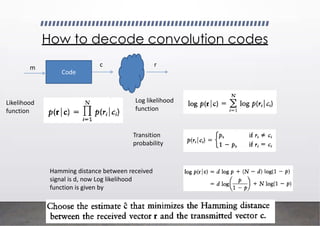
How to decode convolution codes
Code
m c r
Likelihood
function
Log likelihood
function
Transition
probability
Hamming distance between received
signal is d, now Log likelihood
function is given by
Viterbi Algorithm
➢ The Viterbi Decoder is the key to overcoming the decoding
challenges posed by Convolutional Codes. By leveraging
the Viterbi Algorithm, this decoder identifies the most
likely transmitted bit sequence, correcting errors in the
process.
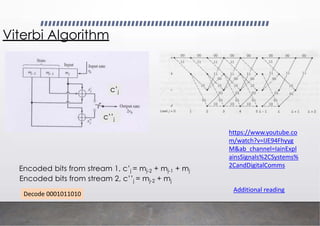
Viterbi Algorithm
• Initialization: Start with the first received symbol and initialize state
metrics for all possible states.
• Metric Calculation: Compute metrics for all possible state transitions
based on received symbols.
• Path Metric Update: Update path metrics for each state, considering
incoming transitions and previous metrics.
• Survivor Path Selection: Select the incoming transition that contributes
to the highest path metric (lowest hamming distance) for each state.
c’j
c’’j
Encoded bits from stream 1, c’j = mj-2 + mj-1 + mj
Encoded bits from stream 2, c’’j = mj-2 + mj
Viterbi Algorithm
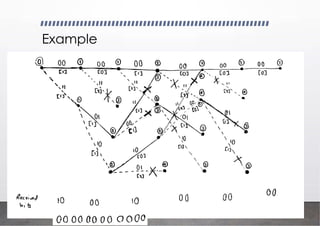
Decode 0001011010
https://www.youtube.co
m/watch?v=IJE94Fhyyg
M&ab_channel=IainExpl
ainsSignals%2CSystems%
2CandDigitalComms
Additional reading
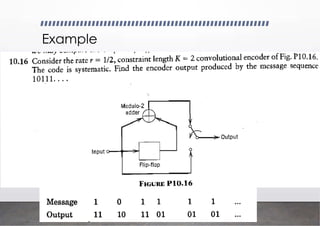
Example
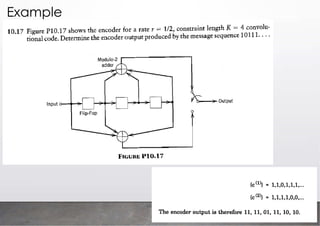
Example
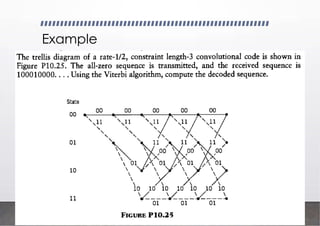
Example
Example
Turbo codes
➢ Turbo codes are advanced error correction codes used in digital
communication systems.
➢ Introduced by Claude Berrou in the early 1990s.
➢ Turbo codes consist of two or more recursive convolutional codes.
➢ Encoding involves passing data through multiple encoders and interleaving the
outputs.
➢ Decoding is an iterative process that refines the estimate of the original data.
➢ Widely used in wireless communication, satellite links, and other noisy
channels.
➢ Key element in 3G, 4G, and beyond cellular networks
Turbo codes
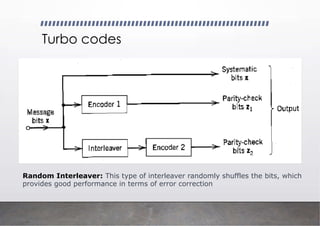
Random Interleaver: This type of interleaver randomly shuffles the bits, which
provides good performance in terms of error correction
Recursive Systematic Convolutional (RSC)
Encoder
It is a specific class of convolutional encoder
RSC (Recursive Systematic Convolutional) encoder does use feedback in its encoding
process. The feedback loop is a key feature of convolutional encoders, including RSC
encoders.
D D
C1
C2
x
g1=[1 1 1]
g2=[1 0 1]
Conventional convolutional encoder
Recursive Systematic Convolutional (RSC)
Encoder
D D
C1
C2
x
g1=[1 1 1]
g2=[1 0 1]
RSC encoder
G=[1 , g2 /g1 ]
Recursive Systematic Convolutional (RSC) encoders
are commonly used in the construction of Turbo codes
feedforward output
feedback to the input
1 denotes the systematic output
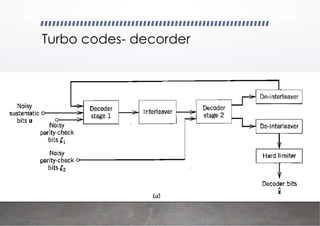
Turbo codes- decorder
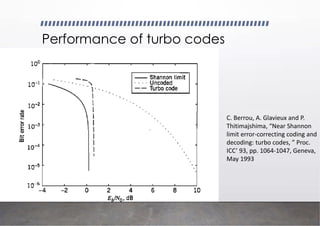
Performance of turbo codes
C. Berrou, A. Glavieux and P.
Thitimajshima, “Near Shannon
limit error-correcting coding and
decoding: turbo codes, ” Proc.
ICC’ 93, pp. 1064-1047, Geneva,
May 1993

Communication Theory II _ Lecture 11.pdf

  • 1.
    Communication Theory II Lecture11: Viterbi Algorithm
  • 2.
    How to decodeconvolution codes Code m c r Likelihood function Log likelihood function Transition probability Hamming distance between received signal is d, now Log likelihood function is given by
  • 3.
    Viterbi Algorithm ➢ TheViterbi Decoder is the key to overcoming the decoding challenges posed by Convolutional Codes. By leveraging the Viterbi Algorithm, this decoder identifies the most likely transmitted bit sequence, correcting errors in the process.
  • 4.
    Viterbi Algorithm • Initialization:Start with the first received symbol and initialize state metrics for all possible states. • Metric Calculation: Compute metrics for all possible state transitions based on received symbols. • Path Metric Update: Update path metrics for each state, considering incoming transitions and previous metrics. • Survivor Path Selection: Select the incoming transition that contributes to the highest path metric (lowest hamming distance) for each state.
  • 5.
    c’j c’’j Encoded bits fromstream 1, c’j = mj-2 + mj-1 + mj Encoded bits from stream 2, c’’j = mj-2 + mj Viterbi Algorithm Decode 0001011010 https://www.youtube.co m/watch?v=IJE94Fhyyg M&ab_channel=IainExpl ainsSignals%2CSystems% 2CandDigitalComms Additional reading
  • 6.
  • 7.
  • 8.
  • 9.
  • 10.
    Turbo codes ➢ Turbocodes are advanced error correction codes used in digital communication systems. ➢ Introduced by Claude Berrou in the early 1990s. ➢ Turbo codes consist of two or more recursive convolutional codes. ➢ Encoding involves passing data through multiple encoders and interleaving the outputs. ➢ Decoding is an iterative process that refines the estimate of the original data. ➢ Widely used in wireless communication, satellite links, and other noisy channels. ➢ Key element in 3G, 4G, and beyond cellular networks
  • 11.
    Turbo codes Random Interleaver:This type of interleaver randomly shuffles the bits, which provides good performance in terms of error correction
  • 12.
    Recursive Systematic Convolutional(RSC) Encoder It is a specific class of convolutional encoder RSC (Recursive Systematic Convolutional) encoder does use feedback in its encoding process. The feedback loop is a key feature of convolutional encoders, including RSC encoders. D D C1 C2 x g1=[1 1 1] g2=[1 0 1] Conventional convolutional encoder
  • 13.
    Recursive Systematic Convolutional(RSC) Encoder D D C1 C2 x g1=[1 1 1] g2=[1 0 1] RSC encoder G=[1 , g2 /g1 ] Recursive Systematic Convolutional (RSC) encoders are commonly used in the construction of Turbo codes feedforward output feedback to the input 1 denotes the systematic output
  • 14.
  • 15.
    Performance of turbocodes C. Berrou, A. Glavieux and P. Thitimajshima, “Near Shannon limit error-correcting coding and decoding: turbo codes, ” Proc. ICC’ 93, pp. 1064-1047, Geneva, May 1993