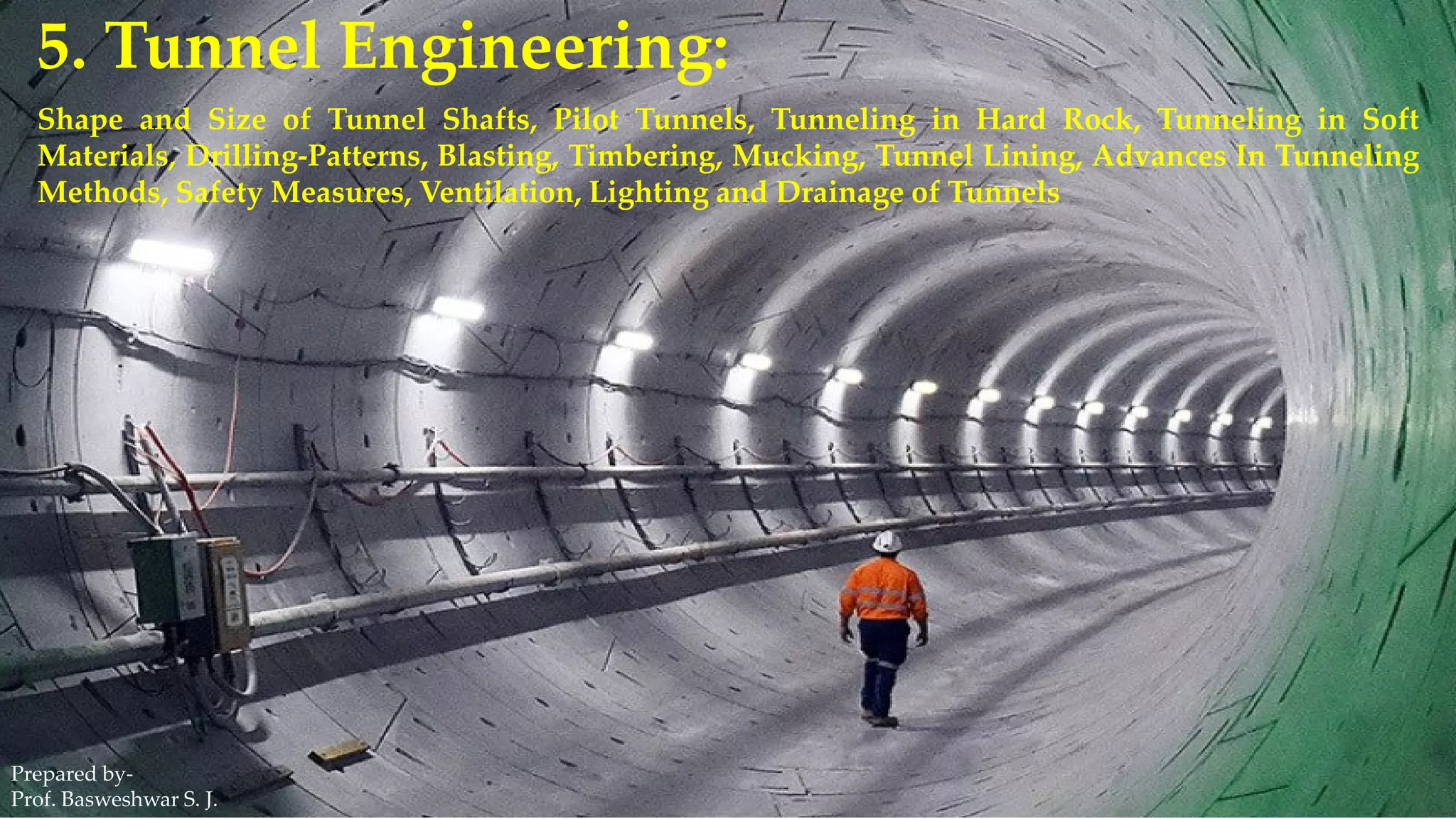
5. Tunnel Engineering:
Shape and Size of Tunnel Shafts, Pilot Tunnels, Tunneling in Hard Rock, Tunneling in Soft
Materials, Drilling-Patterns, Blasting, Timbering, Mucking, Tunnel Lining, Advances In Tunneling
Methods, Safety Measures, Ventilation, Lighting and Drainage of Tunnels
Prepared by-
Prof. Basweshwar S. J.
5. Tunnel Engineering:
• A tunnel is an underground passageway, dug through the surrounding
soil/earth/rock and enclosed except for entrance and exit, commonly at each end.
• A pipeline is not a tunnel, though some recent tunnels have used immersed tube
construction techniques rather than traditional tunnel boring methods.
• A tunnel may be for foot or vehicular road traffic, for rail traffic, or for a canal.
• The central portions of a rapid transit network are usually in the tunnel.
• Some tunnels are aqueducts to supply water for consumption or for hydroelectric
stations or are sewers.
• Utility tunnels are used for routing steam, chilled water, electrical power or
telecommunication cables, as well as connecting buildings for convenient
passage of people and equipment.
• Secret tunnels are built for military purposes, or by civilians for smuggling of
weapons, contraband, or people.
• Special tunnels, such as wildlife crossings, are built to allow wildlife to cross
human-made barriers safely.
Prepared by-
Prof. Basweshwar S. J.
5.1.1 Shape and Size of Tunnel Shafts-
1. Polycentric- This sort of tunnel shape has a
number of centers and provides a sufficient flat
base for traffic movement.
Advantages:
• It can be used for road and railway traffic.
• It can resist external and internal pressure for
their arch shape.
Disadvantages:
• The construction of these tunnels is difficult.
• The lining of this type of tunnel is difficult.
2. Circular Shaped Tunnels- Circular tunnels are
used to carry water under pressure. These are not
appropriate for traffic tunnels because more filling is
needed to make the base flat.
Advantages:
• Best to resist the external or internal force.
• It provides the greatest cross-sectional area for the
least perimeter.
Disadvantages:
• More filling is required to form a flat base for
designing a road or railway track.
• In circular tunnels, lining work is very difficult.
Continued…
Prepared by-
Prof. Basweshwar S. J.
Prepared by-
Prof. Basweshwar S. J.
5.1 Shape and Size of Tunnel Shafts-
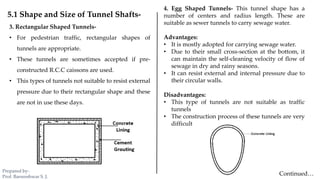
3. Rectangular Shaped Tunnels-
• For pedestrian traffic, rectangular shapes of
tunnels are appropriate.
• These tunnels are sometimes accepted if pre-
constructed R.C.C caissons are used.
• This types of tunnels not suitable to resist external
pressure due to their rectangular shape and these
are not in use these days.
4. Egg Shaped Tunnels- This tunnel shape has a
number of centers and radius length. These are
suitable as sewer tunnels to carry sewage water.
Advantages:
• It is mostly adopted for carrying sewage water.
• Due to their small cross-section at the bottom, it
can maintain the self-cleaning velocity of flow of
sewage in dry and rainy seasons.
• It can resist external and internal pressure due to
their circular walls.
Disadvantages:
• This type of tunnels are not suitable as traffic
tunnels
• The construction process of these tunnels are very
difficult
Continued…
Prepared by-
Prof. Basweshwar S. J.
5.1 Shape and Size of Tunnel Shafts-
5. Horse Shoe Type Tunnels-
• Horseshoe type tunnel shape is a combined shape
of arches and circular tunnel.
• These type of tunnels shape is quite popular.
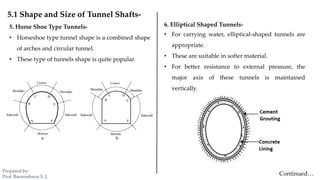
6. Elliptical Shaped Tunnels-
• For carrying water, elliptical-shaped tunnels are
appropriate.
• These are suitable in softer material.
• For better resistance to external pressure, the
major axis of these tunnels is maintained
vertically.
Continued…
Prepared by-
Prof. Basweshwar S. J.
5.1 Shape and Size of Tunnel Shafts-
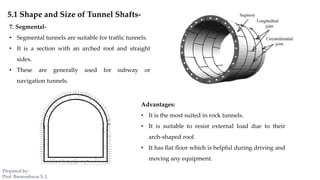
7. Segmental-
• Segmental tunnels are suitable for traffic tunnels.
• It is a section with an arched roof and straight
sides.
• These are generally used for subway or
navigation tunnels.
Advantages:
• It is the most suited in rock tunnels.
• It is suitable to resist external load due to their
arch-shaped roof.
• It has flat floor which is helpful during driving and
moving any equipment.
Prepared by-
Prof. Basweshwar S. J.
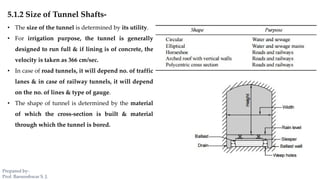
5.1.2 Size of Tunnel Shafts-
• The size of the tunnel is determined by its utility.
• For irrigation purpose, the tunnel is generally
designed to run full & if lining is of concrete, the
velocity is taken as 366 cm/sec.
• In case of road tunnels, it will depend no. of traffic
lanes & in case of railway tunnels, it will depend
on the no. of lines & type of gauge.
• The shape of tunnel is determined by the material
of which the cross-section is built & material
through which the tunnel is bored.
Prepared by-
Prof. Basweshwar S. J.
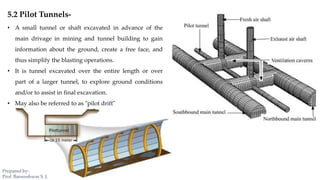
5.2 Pilot Tunnels-
• A small tunnel or shaft excavated in advance of the
main drivage in mining and tunnel building to gain
information about the ground, create a free face, and
thus simplify the blasting operations.
• It is tunnel excavated over the entire length or over
part of a larger tunnel, to explore ground conditions
and/or to assist in final excavation.
• May also be referred to as "pilot drift"
Prepared by-
Prof. Basweshwar S. J.
5.2 Pilot Tunnels-
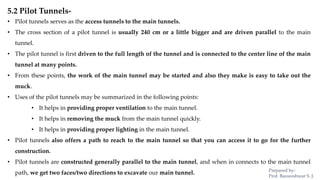
• Pilot tunnels serves as the access tunnels to the main tunnels.
• The cross section of a pilot tunnel is usually 240 cm or a little bigger and are driven parallel to the main
tunnel.
• The pilot tunnel is first driven to the full length of the tunnel and is connected to the center line of the main
tunnel at many points.
• From these points, the work of the main tunnel may be started and also they make is easy to take out the
muck.
• Uses of the pilot tunnels may be summarized in the following points:
• It helps in providing proper ventilation to the main tunnel.
• It helps in removing the muck from the main tunnel quickly.
• It helps in providing proper lighting in the main tunnel.
• Pilot tunnels also offers a path to reach to the main tunnel so that you can access it to go for the further
construction.
• Pilot tunnels are constructed generally parallel to the main tunnel, and when in connects to the main tunnel
path, we get two faces/two directions to excavate our main tunnel. Prepared by-
Prof. Basweshwar S. J.
5.3 Tunneling in Hard Rock-
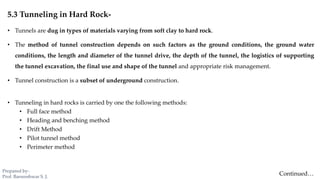
• Tunnels are dug in types of materials varying from soft clay to hard rock.
• The method of tunnel construction depends on such factors as the ground conditions, the ground water
conditions, the length and diameter of the tunnel drive, the depth of the tunnel, the logistics of supporting
the tunnel excavation, the final use and shape of the tunnel and appropriate risk management.
• Tunnel construction is a subset of underground construction.
• Tunneling in hard rocks is carried by one the following methods:
• Full face method
• Heading and benching method
• Drift Method
• Pilot tunnel method
• Perimeter method
Continued…
Prepared by-
Prof. Basweshwar S. J.
5.3 Tunneling in Hard Rock-
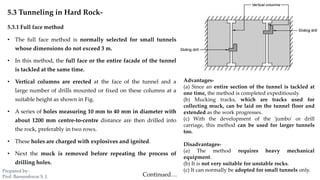
5.3.1 Full face method
• The full face method is normally selected for small tunnels
whose dimensions do not exceed 3 m.
• In this method, the full face or the entire facade of the tunnel
is tackled at the same time.
• Vertical columns are erected at the face of the tunnel and a
large number of drills mounted or fixed on these columns at a
suitable height as shown in Fig.
• A series of holes measuring 10 mm to 40 mm in diameter with
about 1200 mm centre-to-centre distance are then drilled into
the rock, preferably in two rows.
• These holes are charged with explosives and ignited.
• Next the muck is removed before repeating the process of
drilling holes.
Advantages-
(a) Since an entire section of the tunnel is tackled at
one time, the method is completed expeditiously.
(b) Mucking tracks, which are tracks used for
collecting muck, can be laid on the tunnel floor and
extended as the work progresses.
(c) With the development of the 'jumbo' or drill
carriage, this method can be used for larger tunnels
too.
Disadvantages-
(a) The method requires heavy mechanical
equipment.
(b) It is not very suitable for unstable rocks.
(c) It can normally be adopted for small tunnels only.
Continued…
Prepared by-
Prof. Basweshwar S. J.
5.3 Tunneling in Hard Rock-
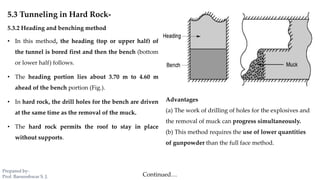
5.3.2 Heading and benching method
• In this method, the heading (top or upper half) of
the tunnel is bored first and then the bench (bottom
or lower half) follows.
• The heading portion lies about 3.70 m to 4.60 m
ahead of the bench portion (Fig.).
• In hard rock, the drill holes for the bench are driven
at the same time as the removal of the muck.
• The hard rock permits the roof to stay in place
without supports.
Advantages
(a) The work of drilling of holes for the explosives and
the removal of muck can progress simultaneously.
(b) This method requires the use of lower quantities
of gunpowder than the full face method.
Continued…
Prepared by-
Prof. Basweshwar S. J.
5.3 Tunneling in Hard Rock-
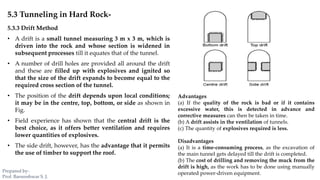
5.3.3 Drift Method
• A drift is a small tunnel measuring 3 m x 3 m, which is
driven into the rock and whose section is widened in
subsequent processes till it equates that of the tunnel.
• A number of drill holes are provided all around the drift
and these are filled up with explosives and ignited so
that the size of the drift expands to become equal to the
required cross section of the tunnel.
• The position of the drift depends upon local conditions;
it may be in the centre, top, bottom, or side as shown in
Fig.
• Field experience has shown that the central drift is the
best choice, as it offers better ventilation and requires
lower quantities of explosives.
• The side drift, however, has the advantage that it permits
the use of timber to support the roof.
Advantages
(a) If the quality of the rock is bad or if it contains
excessive water, this is detected in advance and
corrective measures can then be taken in time.
(b) A drift assists in the ventilation of tunnels.
(c) The quantity of explosives required is less.
Disadvantages
(a) It is a time-consuming process, as the excavation of
the main tunnel gets delayed till the drift is completed.
(b) The cost of drilling and removing the muck from the
drift is high, as the work has to be done using manually
operated power-driven equipment.Prepared by-
Prof. Basweshwar S. J.
5.3 Tunneling in Hard Rock-
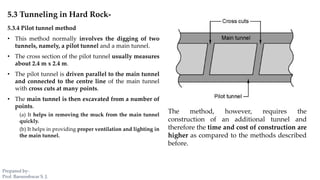
5.3.4 Pilot tunnel method
• This method normally involves the digging of two
tunnels, namely, a pilot tunnel and a main tunnel.
• The cross section of the pilot tunnel usually measures
about 2.4 m x 2.4 m.
• The pilot tunnel is driven parallel to the main tunnel
and connected to the centre line of the main tunnel
with cross cuts at many points.
• The main tunnel is then excavated from a number of
points.
(a) It helps in removing the muck from the main tunnel
quickly.
(b) It helps in providing proper ventilation and lighting in
the main tunnel.
The method, however, requires the
construction of an additional tunnel and
therefore the time and cost of construction are
higher as compared to the methods described
before.
Prepared by-
Prof. Basweshwar S. J.
5.3 Tunneling in Hard Rock-
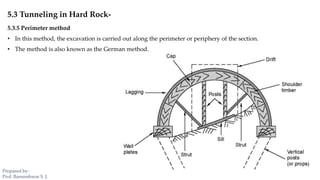
5.3.5 Perimeter method
• In this method, the excavation is carried out along the perimeter or periphery of the section.
• The method is also known as the German method.
Prepared by-
Prof. Basweshwar S. J.
5.4 Tunneling in Soft Materials-
• Tunneling in soft ground or soft rock is a specialized
job.
• It does not involve the use of explosives and the
requisite excavation work is done using hard tools
such as pickaxes and shovels.
• In recent times, compressed air has also been used for
this purpose.
• During excavation, the rail requires support at the
sidewalls and the roofs depending upon the type of
soil.
• The support could be provided in the form of timber
or steel plates or other similar material.
The various operations involved in soft rock
tunneling are as follows.
(a) Excavation or mining
(b) Removal of excavated material
(c) Scaffolding and shuttering
(d) Lining of tunnel surface
In the case of soft rock, the selection of the method
of tunneling depends upon the following
important factors.
(a) Nature of ground
(b) Size of tunnel
(c) Equipment available
(d) Sequence of operations
Prepared by-
Prof. Basweshwar S. J.
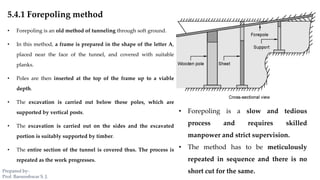
5.4.1 Forepoling method
• Forepoling is an old method of tunneling through soft ground.
• In this method, a frame is prepared in the shape of the letter A,
placed near the face of the tunnel, and covered with suitable
planks.
• Poles are then inserted at the top of the frame up to a viable
depth.
• The excavation is carried out below these poles, which are
supported by vertical posts.
• The excavation is carried out on the sides and the excavated
portion is suitably supported by timber.
• The entire section of the tunnel is covered thus. The process is
repeated as the work progresses.
• Forepoling is a slow and tedious
process and requires skilled
manpower and strict supervision.
• The method has to be meticulously
repeated in sequence and there is no
short cut for the same.Prepared by-
Prof. Basweshwar S. J.
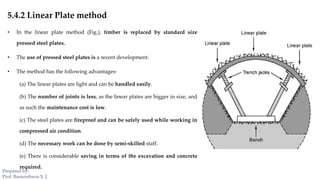
5.4.2 Linear Plate method
• In the linear plate method (Fig.), timber is replaced by standard size
pressed steel plates.
• The use of pressed steel plates is a recent development.
• The method has the following advantages-
(a) The linear plates are light and can be handled easily.
(b) The number of joints is less, as the linear plates are bigger in size, and
as such the maintenance cost is low.
(c) The steel plates are fireproof and can be safely used while working in
compressed air condition.
(d) The necessary work can be done by semi-skilled staff.
(e) There is considerable saving in terms of the excavation and concrete
required.
Prepared by-
Prof. Basweshwar S. J.
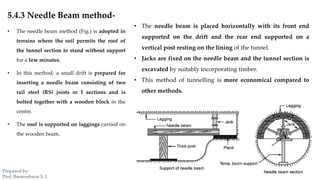
5.4.3 Needle Beam method-
• The needle beam method (Fig.) is adopted in
terrains where the soil permits the roof of
the tunnel section to stand without support
for a few minutes.
• In this method, a small drift is prepared for
inserting a needle beam consisting of two
rail steel (RS) joists or I sections and is
bolted together with a wooden block in the
centre.
• The roof is supported on laggings carried on
the wooden beam.
• The needle beam is placed horizontally with its front end
supported on the drift and the rear end supported on a
vertical post resting on the lining of the tunnel.
• Jacks are fixed on the needle beam and the tunnel section is
excavated by suitably incorporating timber.
• This method of tunnelling is more economical compared to
other methods.
Prepared by-
Prof. Basweshwar S. J.
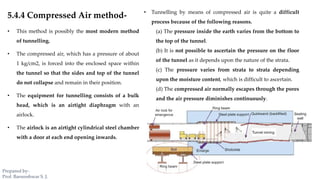
5.4.4 Compressed Air method-
• This method is possibly the most modern method
of tunnelling.
• The compressed air, which has a pressure of about
1 kg/cm2, is forced into the enclosed space within
the tunnel so that the sides and top of the tunnel
do not collapse and remain in their position.
• The equipment for tunnelling consists of a bulk
head, which is an airtight diaphragm with an
airlock.
• The airlock is an airtight cylindrical steel chamber
with a door at each end opening inwards.
• Tunnelling by means of compressed air is quite a difficult
process because of the following reasons.
(a) The pressure inside the earth varies from the bottom to
the top of the tunnel.
(b) It is not possible to ascertain the pressure on the floor
of the tunnel as it depends upon the nature of the strata.
(c) The pressure varies from strata to strata depending
upon the moisture content, which is difficult to ascertain.
(d) The compressed air normally escapes through the pores
and the air pressure diminishes continuously.
Prepared by-
Prof. Basweshwar S. J.
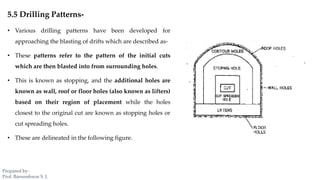
5.5 Drilling Patterns-
• Various drilling patterns have been developed for
approaching the blasting of drifts which are described as-
• These patterns refer to the pattern of the initial cuts
which are then blasted into from surrounding holes.
• This is known as stopping, and the additional holes are
known as wall, roof or floor holes (also known as lifters)
based on their region of placement while the holes
closest to the original cut are known as stopping holes or
cut spreading holes.
• These are delineated in the following figure.
Prepared by-
Prof. Basweshwar S. J.
5.5 Drilling Patterns-
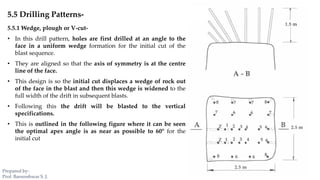
5.5.1 Wedge, plough or V-cut-
• In this drill pattern, holes are first drilled at an angle to the
face in a uniform wedge formation for the initial cut of the
blast sequence.
• They are aligned so that the axis of symmetry is at the centre
line of the face.
• This design is so the initial cut displaces a wedge of rock out
of the face in the blast and then this wedge is widened to the
full width of the drift in subsequent blasts.
• Following this the drift will be blasted to the vertical
specifications.
• This is outlined in the following figure where it can be seen
the optimal apex angle is as near as possible to 60° for the
initial cut
Prepared by-
Prof. Basweshwar S. J.
5.5 Drilling Patterns-
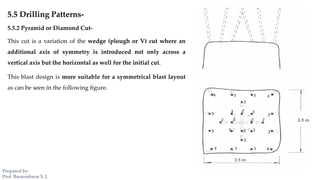
5.5.2 Pyramid or Diamond Cut-
This cut is a variation of the wedge (plough or V) cut where an
additional axis of symmetry is introduced not only across a
vertical axis but the horizontal as well for the initial cut.
This blast design is more suitable for a symmetrical blast layout
as can be seen in the following figure.
Prepared by-
Prof. Basweshwar S. J.
5.5 Drilling Patterns-
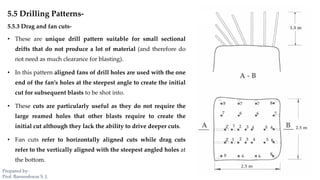
5.5.3 Drag and fan cuts-
• These are unique drill pattern suitable for small sectional
drifts that do not produce a lot of material (and therefore do
not need as much clearance for blasting).
• In this pattern aligned fans of drill holes are used with the one
end of the fan’s holes at the steepest angle to create the initial
cut for subsequent blasts to be shot into.
• These cuts are particularly useful as they do not require the
large reamed holes that other blasts require to create the
initial cut although they lack the ability to drive deeper cuts.
• Fan cuts refer to horizontally aligned cuts while drag cuts
refer to the vertically aligned with the steepest angled holes at
the bottom.
Prepared by-
Prof. Basweshwar S. J.
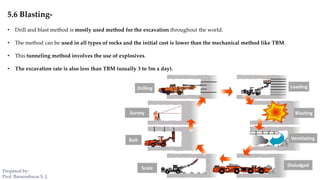
5.6 Blasting-
• Drill and blast method is mostly used method for the excavation throughout the world.
• The method can be used in all types of rocks and the initial cost is lower than the mechanical method like TBM.
• This tunneling method involves the use of explosives.
• The excavation rate is also less than TBM (usually 3 to 5m a day).
Prepared by-
Prof. Basweshwar S. J.
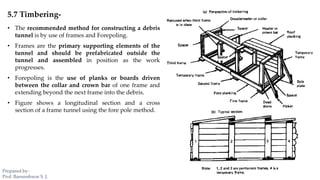
5.7 Timbering-
• The recommended method for constructing a debris
tunnel is by use of frames and Forepoling.
• Frames are the primary supporting elements of the
tunnel and should be prefabricated outside the
tunnel and assembled in position as the work
progresses.
• Forepoling is the use of planks or boards driven
between the collar and crown bar of one frame and
extending beyond the next frame into the debris.
• Figure shows a longitudinal section and a cross
section of a frame tunnel using the fore pole method.
Prepared by-
Prof. Basweshwar S. J.
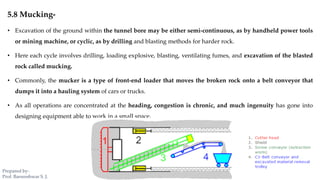
5.8 Mucking-
• Excavation of the ground within the tunnel bore may be either semi-continuous, as by handheld power tools
or mining machine, or cyclic, as by drilling and blasting methods for harder rock.
• Here each cycle involves drilling, loading explosive, blasting, ventilating fumes, and excavation of the blasted
rock called mucking.
• Commonly, the mucker is a type of front-end loader that moves the broken rock onto a belt conveyor that
dumps it into a hauling system of cars or trucks.
• As all operations are concentrated at the heading, congestion is chronic, and much ingenuity has gone into
designing equipment able to work in a small space.
Prepared by-
Prof. Basweshwar S. J.
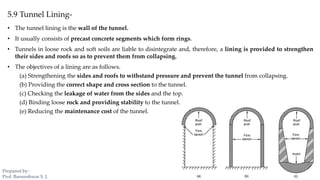
5.9 Tunnel Lining-
• The tunnel lining is the wall of the tunnel.
• It usually consists of precast concrete segments which form rings.
• Tunnels in loose rock and soft soils are liable to disintegrate and, therefore, a lining is provided to strengthen
their sides and roofs so as to prevent them from collapsing.
• The objectives of a lining are as follows.
(a) Strengthening the sides and roofs to withstand pressure and prevent the tunnel from collapsing.
(b) Providing the correct shape and cross section to the tunnel.
(c) Checking the leakage of water from the sides and the top.
(d) Binding loose rock and providing stability to the tunnel.
(e) Reducing the maintenance cost of the tunnel.
Prepared by-
Prof. Basweshwar S. J.
5.10 Advances In Tunneling Methods-
Prepared by-
Prof. Basweshwar S. J.
5.11 Safety Measures-
Tunnelling is an underground construction and there are many types of risk during construction. Therefore, it is
essential to take measure to protect the workers against accident, sometimes fatal, are essential.
1. The floor of the tunnel should be kept dry and clean.
2. Open flames, electric short-circuiting should be avoided by providing proper covering over power line and light.
3. Medical equipment and doctors should always be available at the site.
4. Fire fighting equipment with the excellent operator and sufficient water supply should be available at the site at all the time.
5. Light and electric lines need to be entirely secured and insulated.
6. Unnecessary machines, tools and construction material should be avoided to store in the tunnel.
7. All the machines and tools should be maintained in usable condition.
8. Working platforms should be checked periodically.
9. The communication system (like; telephone) should be installed inside the tunnels for receiving and sending important information
about tunnel condition.
10. All the internal system like communication system, power system, safety devices and lighting should be checked periodically.
Prepared by-
Prof. Basweshwar S. J.
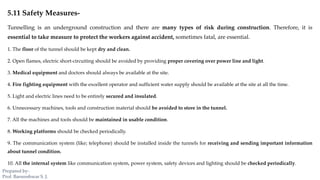
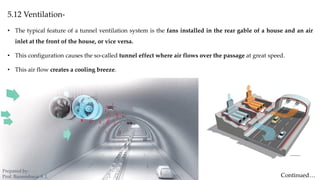
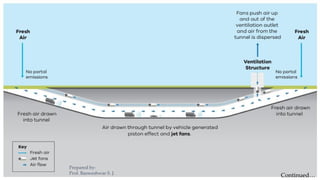
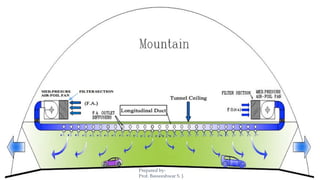
5.12 Ventilation-
• The typical feature of a tunnel ventilation system is the fans installed in the rear gable of a house and an air
inlet at the front of the house, or vice versa.
• This configuration causes the so-called tunnel effect where air flows over the passage at great speed.
• This air flow creates a cooling breeze.
Continued…
Prepared by-
Prof. Basweshwar S. J.
Continued…
Prepared by-
Prof. Basweshwar S. J.
Prepared by-
Prof. Basweshwar S. J.
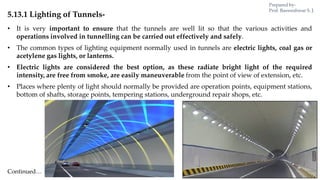
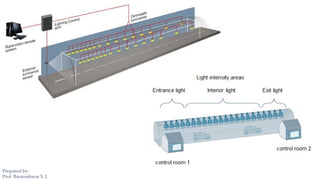
5.13.1 Lighting of Tunnels-
• It is very important to ensure that the tunnels are well lit so that the various activities and
operations involved in tunnelling can be carried out effectively and safely.
• The common types of lighting equipment normally used in tunnels are electric lights, coal gas or
acetylene gas lights, or lanterns.
• Electric lights are considered the best option, as these radiate bright light of the required
intensity, are free from smoke, are easily maneuverable from the point of view of extension, etc.
• Places where plenty of light should normally be provided are operation points, equipment stations,
bottom of shafts, storage points, tempering stations, underground repair shops, etc.
Continued…
Prepared by-
Prof. Basweshwar S. J.
Prepared by-
Prof. Basweshwar S. J.
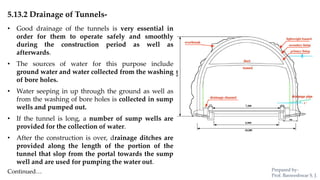
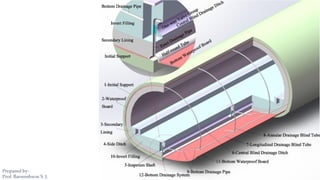
5.13.2 Drainage of Tunnels-
• Good drainage of the tunnels is very essential in
order for them to operate safely and smoothly
during the construction period as well as
afterwards.
• The sources of water for this purpose include
ground water and water collected from the washing
of bore holes.
• Water seeping in up through the ground as well as
from the washing of bore holes is collected in sump
wells and pumped out.
• If the tunnel is long, a number of sump wells are
provided for the collection of water.
• After the construction is over, drainage ditches are
provided along the length of the portion of the
tunnel that slop from the portal towards the sump
well and are used for pumping the water out.
Continued… Prepared by-
Prof. Basweshwar S. J.
Prepared by-
Prof. Basweshwar S. J.
Thank You…!!!Prepared by-
Prof. Basweshwar S. J.

MODULE-V INFRASTRUCTURE ENGINEERING BTCVC702

  • 1.
    5. Tunnel Engineering: Shapeand Size of Tunnel Shafts, Pilot Tunnels, Tunneling in Hard Rock, Tunneling in Soft Materials, Drilling-Patterns, Blasting, Timbering, Mucking, Tunnel Lining, Advances In Tunneling Methods, Safety Measures, Ventilation, Lighting and Drainage of Tunnels Prepared by- Prof. Basweshwar S. J.
  • 2.
    5. Tunnel Engineering: •A tunnel is an underground passageway, dug through the surrounding soil/earth/rock and enclosed except for entrance and exit, commonly at each end. • A pipeline is not a tunnel, though some recent tunnels have used immersed tube construction techniques rather than traditional tunnel boring methods. • A tunnel may be for foot or vehicular road traffic, for rail traffic, or for a canal. • The central portions of a rapid transit network are usually in the tunnel. • Some tunnels are aqueducts to supply water for consumption or for hydroelectric stations or are sewers. • Utility tunnels are used for routing steam, chilled water, electrical power or telecommunication cables, as well as connecting buildings for convenient passage of people and equipment. • Secret tunnels are built for military purposes, or by civilians for smuggling of weapons, contraband, or people. • Special tunnels, such as wildlife crossings, are built to allow wildlife to cross human-made barriers safely. Prepared by- Prof. Basweshwar S. J.
  • 3.
    5.1.1 Shape andSize of Tunnel Shafts- 1. Polycentric- This sort of tunnel shape has a number of centers and provides a sufficient flat base for traffic movement. Advantages: • It can be used for road and railway traffic. • It can resist external and internal pressure for their arch shape. Disadvantages: • The construction of these tunnels is difficult. • The lining of this type of tunnel is difficult. 2. Circular Shaped Tunnels- Circular tunnels are used to carry water under pressure. These are not appropriate for traffic tunnels because more filling is needed to make the base flat. Advantages: • Best to resist the external or internal force. • It provides the greatest cross-sectional area for the least perimeter. Disadvantages: • More filling is required to form a flat base for designing a road or railway track. • In circular tunnels, lining work is very difficult. Continued… Prepared by- Prof. Basweshwar S. J. Prepared by- Prof. Basweshwar S. J.
  • 4.
    5.1 Shape andSize of Tunnel Shafts- 3. Rectangular Shaped Tunnels- • For pedestrian traffic, rectangular shapes of tunnels are appropriate. • These tunnels are sometimes accepted if pre- constructed R.C.C caissons are used. • This types of tunnels not suitable to resist external pressure due to their rectangular shape and these are not in use these days. 4. Egg Shaped Tunnels- This tunnel shape has a number of centers and radius length. These are suitable as sewer tunnels to carry sewage water. Advantages: • It is mostly adopted for carrying sewage water. • Due to their small cross-section at the bottom, it can maintain the self-cleaning velocity of flow of sewage in dry and rainy seasons. • It can resist external and internal pressure due to their circular walls. Disadvantages: • This type of tunnels are not suitable as traffic tunnels • The construction process of these tunnels are very difficult Continued… Prepared by- Prof. Basweshwar S. J.
  • 5.
    5.1 Shape andSize of Tunnel Shafts- 5. Horse Shoe Type Tunnels- • Horseshoe type tunnel shape is a combined shape of arches and circular tunnel. • These type of tunnels shape is quite popular. 6. Elliptical Shaped Tunnels- • For carrying water, elliptical-shaped tunnels are appropriate. • These are suitable in softer material. • For better resistance to external pressure, the major axis of these tunnels is maintained vertically. Continued… Prepared by- Prof. Basweshwar S. J.
  • 6.
    5.1 Shape andSize of Tunnel Shafts- 7. Segmental- • Segmental tunnels are suitable for traffic tunnels. • It is a section with an arched roof and straight sides. • These are generally used for subway or navigation tunnels. Advantages: • It is the most suited in rock tunnels. • It is suitable to resist external load due to their arch-shaped roof. • It has flat floor which is helpful during driving and moving any equipment. Prepared by- Prof. Basweshwar S. J.
  • 7.
    5.1.2 Size ofTunnel Shafts- • The size of the tunnel is determined by its utility. • For irrigation purpose, the tunnel is generally designed to run full & if lining is of concrete, the velocity is taken as 366 cm/sec. • In case of road tunnels, it will depend no. of traffic lanes & in case of railway tunnels, it will depend on the no. of lines & type of gauge. • The shape of tunnel is determined by the material of which the cross-section is built & material through which the tunnel is bored. Prepared by- Prof. Basweshwar S. J.
  • 8.
    5.2 Pilot Tunnels- •A small tunnel or shaft excavated in advance of the main drivage in mining and tunnel building to gain information about the ground, create a free face, and thus simplify the blasting operations. • It is tunnel excavated over the entire length or over part of a larger tunnel, to explore ground conditions and/or to assist in final excavation. • May also be referred to as "pilot drift" Prepared by- Prof. Basweshwar S. J.
  • 9.
    5.2 Pilot Tunnels- •Pilot tunnels serves as the access tunnels to the main tunnels. • The cross section of a pilot tunnel is usually 240 cm or a little bigger and are driven parallel to the main tunnel. • The pilot tunnel is first driven to the full length of the tunnel and is connected to the center line of the main tunnel at many points. • From these points, the work of the main tunnel may be started and also they make is easy to take out the muck. • Uses of the pilot tunnels may be summarized in the following points: • It helps in providing proper ventilation to the main tunnel. • It helps in removing the muck from the main tunnel quickly. • It helps in providing proper lighting in the main tunnel. • Pilot tunnels also offers a path to reach to the main tunnel so that you can access it to go for the further construction. • Pilot tunnels are constructed generally parallel to the main tunnel, and when in connects to the main tunnel path, we get two faces/two directions to excavate our main tunnel. Prepared by- Prof. Basweshwar S. J.
  • 10.
    5.3 Tunneling inHard Rock- • Tunnels are dug in types of materials varying from soft clay to hard rock. • The method of tunnel construction depends on such factors as the ground conditions, the ground water conditions, the length and diameter of the tunnel drive, the depth of the tunnel, the logistics of supporting the tunnel excavation, the final use and shape of the tunnel and appropriate risk management. • Tunnel construction is a subset of underground construction. • Tunneling in hard rocks is carried by one the following methods: • Full face method • Heading and benching method • Drift Method • Pilot tunnel method • Perimeter method Continued… Prepared by- Prof. Basweshwar S. J.
  • 11.
    5.3 Tunneling inHard Rock- 5.3.1 Full face method • The full face method is normally selected for small tunnels whose dimensions do not exceed 3 m. • In this method, the full face or the entire facade of the tunnel is tackled at the same time. • Vertical columns are erected at the face of the tunnel and a large number of drills mounted or fixed on these columns at a suitable height as shown in Fig. • A series of holes measuring 10 mm to 40 mm in diameter with about 1200 mm centre-to-centre distance are then drilled into the rock, preferably in two rows. • These holes are charged with explosives and ignited. • Next the muck is removed before repeating the process of drilling holes. Advantages- (a) Since an entire section of the tunnel is tackled at one time, the method is completed expeditiously. (b) Mucking tracks, which are tracks used for collecting muck, can be laid on the tunnel floor and extended as the work progresses. (c) With the development of the 'jumbo' or drill carriage, this method can be used for larger tunnels too. Disadvantages- (a) The method requires heavy mechanical equipment. (b) It is not very suitable for unstable rocks. (c) It can normally be adopted for small tunnels only. Continued… Prepared by- Prof. Basweshwar S. J.
  • 12.
    5.3 Tunneling inHard Rock- 5.3.2 Heading and benching method • In this method, the heading (top or upper half) of the tunnel is bored first and then the bench (bottom or lower half) follows. • The heading portion lies about 3.70 m to 4.60 m ahead of the bench portion (Fig.). • In hard rock, the drill holes for the bench are driven at the same time as the removal of the muck. • The hard rock permits the roof to stay in place without supports. Advantages (a) The work of drilling of holes for the explosives and the removal of muck can progress simultaneously. (b) This method requires the use of lower quantities of gunpowder than the full face method. Continued… Prepared by- Prof. Basweshwar S. J.
  • 13.
    5.3 Tunneling inHard Rock- 5.3.3 Drift Method • A drift is a small tunnel measuring 3 m x 3 m, which is driven into the rock and whose section is widened in subsequent processes till it equates that of the tunnel. • A number of drill holes are provided all around the drift and these are filled up with explosives and ignited so that the size of the drift expands to become equal to the required cross section of the tunnel. • The position of the drift depends upon local conditions; it may be in the centre, top, bottom, or side as shown in Fig. • Field experience has shown that the central drift is the best choice, as it offers better ventilation and requires lower quantities of explosives. • The side drift, however, has the advantage that it permits the use of timber to support the roof. Advantages (a) If the quality of the rock is bad or if it contains excessive water, this is detected in advance and corrective measures can then be taken in time. (b) A drift assists in the ventilation of tunnels. (c) The quantity of explosives required is less. Disadvantages (a) It is a time-consuming process, as the excavation of the main tunnel gets delayed till the drift is completed. (b) The cost of drilling and removing the muck from the drift is high, as the work has to be done using manually operated power-driven equipment.Prepared by- Prof. Basweshwar S. J.
  • 14.
    5.3 Tunneling inHard Rock- 5.3.4 Pilot tunnel method • This method normally involves the digging of two tunnels, namely, a pilot tunnel and a main tunnel. • The cross section of the pilot tunnel usually measures about 2.4 m x 2.4 m. • The pilot tunnel is driven parallel to the main tunnel and connected to the centre line of the main tunnel with cross cuts at many points. • The main tunnel is then excavated from a number of points. (a) It helps in removing the muck from the main tunnel quickly. (b) It helps in providing proper ventilation and lighting in the main tunnel. The method, however, requires the construction of an additional tunnel and therefore the time and cost of construction are higher as compared to the methods described before. Prepared by- Prof. Basweshwar S. J.
  • 15.
    5.3 Tunneling inHard Rock- 5.3.5 Perimeter method • In this method, the excavation is carried out along the perimeter or periphery of the section. • The method is also known as the German method. Prepared by- Prof. Basweshwar S. J.
  • 16.
    5.4 Tunneling inSoft Materials- • Tunneling in soft ground or soft rock is a specialized job. • It does not involve the use of explosives and the requisite excavation work is done using hard tools such as pickaxes and shovels. • In recent times, compressed air has also been used for this purpose. • During excavation, the rail requires support at the sidewalls and the roofs depending upon the type of soil. • The support could be provided in the form of timber or steel plates or other similar material. The various operations involved in soft rock tunneling are as follows. (a) Excavation or mining (b) Removal of excavated material (c) Scaffolding and shuttering (d) Lining of tunnel surface In the case of soft rock, the selection of the method of tunneling depends upon the following important factors. (a) Nature of ground (b) Size of tunnel (c) Equipment available (d) Sequence of operations Prepared by- Prof. Basweshwar S. J.
  • 17.
    5.4.1 Forepoling method •Forepoling is an old method of tunneling through soft ground. • In this method, a frame is prepared in the shape of the letter A, placed near the face of the tunnel, and covered with suitable planks. • Poles are then inserted at the top of the frame up to a viable depth. • The excavation is carried out below these poles, which are supported by vertical posts. • The excavation is carried out on the sides and the excavated portion is suitably supported by timber. • The entire section of the tunnel is covered thus. The process is repeated as the work progresses. • Forepoling is a slow and tedious process and requires skilled manpower and strict supervision. • The method has to be meticulously repeated in sequence and there is no short cut for the same.Prepared by- Prof. Basweshwar S. J.
  • 18.
    5.4.2 Linear Platemethod • In the linear plate method (Fig.), timber is replaced by standard size pressed steel plates. • The use of pressed steel plates is a recent development. • The method has the following advantages- (a) The linear plates are light and can be handled easily. (b) The number of joints is less, as the linear plates are bigger in size, and as such the maintenance cost is low. (c) The steel plates are fireproof and can be safely used while working in compressed air condition. (d) The necessary work can be done by semi-skilled staff. (e) There is considerable saving in terms of the excavation and concrete required. Prepared by- Prof. Basweshwar S. J.
  • 19.
    5.4.3 Needle Beammethod- • The needle beam method (Fig.) is adopted in terrains where the soil permits the roof of the tunnel section to stand without support for a few minutes. • In this method, a small drift is prepared for inserting a needle beam consisting of two rail steel (RS) joists or I sections and is bolted together with a wooden block in the centre. • The roof is supported on laggings carried on the wooden beam. • The needle beam is placed horizontally with its front end supported on the drift and the rear end supported on a vertical post resting on the lining of the tunnel. • Jacks are fixed on the needle beam and the tunnel section is excavated by suitably incorporating timber. • This method of tunnelling is more economical compared to other methods. Prepared by- Prof. Basweshwar S. J.
  • 20.
    5.4.4 Compressed Airmethod- • This method is possibly the most modern method of tunnelling. • The compressed air, which has a pressure of about 1 kg/cm2, is forced into the enclosed space within the tunnel so that the sides and top of the tunnel do not collapse and remain in their position. • The equipment for tunnelling consists of a bulk head, which is an airtight diaphragm with an airlock. • The airlock is an airtight cylindrical steel chamber with a door at each end opening inwards. • Tunnelling by means of compressed air is quite a difficult process because of the following reasons. (a) The pressure inside the earth varies from the bottom to the top of the tunnel. (b) It is not possible to ascertain the pressure on the floor of the tunnel as it depends upon the nature of the strata. (c) The pressure varies from strata to strata depending upon the moisture content, which is difficult to ascertain. (d) The compressed air normally escapes through the pores and the air pressure diminishes continuously. Prepared by- Prof. Basweshwar S. J.
  • 21.
    5.5 Drilling Patterns- •Various drilling patterns have been developed for approaching the blasting of drifts which are described as- • These patterns refer to the pattern of the initial cuts which are then blasted into from surrounding holes. • This is known as stopping, and the additional holes are known as wall, roof or floor holes (also known as lifters) based on their region of placement while the holes closest to the original cut are known as stopping holes or cut spreading holes. • These are delineated in the following figure. Prepared by- Prof. Basweshwar S. J.
  • 22.
    5.5 Drilling Patterns- 5.5.1Wedge, plough or V-cut- • In this drill pattern, holes are first drilled at an angle to the face in a uniform wedge formation for the initial cut of the blast sequence. • They are aligned so that the axis of symmetry is at the centre line of the face. • This design is so the initial cut displaces a wedge of rock out of the face in the blast and then this wedge is widened to the full width of the drift in subsequent blasts. • Following this the drift will be blasted to the vertical specifications. • This is outlined in the following figure where it can be seen the optimal apex angle is as near as possible to 60° for the initial cut Prepared by- Prof. Basweshwar S. J.
  • 23.
    5.5 Drilling Patterns- 5.5.2Pyramid or Diamond Cut- This cut is a variation of the wedge (plough or V) cut where an additional axis of symmetry is introduced not only across a vertical axis but the horizontal as well for the initial cut. This blast design is more suitable for a symmetrical blast layout as can be seen in the following figure. Prepared by- Prof. Basweshwar S. J.
  • 24.
    5.5 Drilling Patterns- 5.5.3Drag and fan cuts- • These are unique drill pattern suitable for small sectional drifts that do not produce a lot of material (and therefore do not need as much clearance for blasting). • In this pattern aligned fans of drill holes are used with the one end of the fan’s holes at the steepest angle to create the initial cut for subsequent blasts to be shot into. • These cuts are particularly useful as they do not require the large reamed holes that other blasts require to create the initial cut although they lack the ability to drive deeper cuts. • Fan cuts refer to horizontally aligned cuts while drag cuts refer to the vertically aligned with the steepest angled holes at the bottom. Prepared by- Prof. Basweshwar S. J.
  • 25.
    5.6 Blasting- • Drilland blast method is mostly used method for the excavation throughout the world. • The method can be used in all types of rocks and the initial cost is lower than the mechanical method like TBM. • This tunneling method involves the use of explosives. • The excavation rate is also less than TBM (usually 3 to 5m a day). Prepared by- Prof. Basweshwar S. J.
  • 26.
    5.7 Timbering- • Therecommended method for constructing a debris tunnel is by use of frames and Forepoling. • Frames are the primary supporting elements of the tunnel and should be prefabricated outside the tunnel and assembled in position as the work progresses. • Forepoling is the use of planks or boards driven between the collar and crown bar of one frame and extending beyond the next frame into the debris. • Figure shows a longitudinal section and a cross section of a frame tunnel using the fore pole method. Prepared by- Prof. Basweshwar S. J.
  • 27.
    5.8 Mucking- • Excavationof the ground within the tunnel bore may be either semi-continuous, as by handheld power tools or mining machine, or cyclic, as by drilling and blasting methods for harder rock. • Here each cycle involves drilling, loading explosive, blasting, ventilating fumes, and excavation of the blasted rock called mucking. • Commonly, the mucker is a type of front-end loader that moves the broken rock onto a belt conveyor that dumps it into a hauling system of cars or trucks. • As all operations are concentrated at the heading, congestion is chronic, and much ingenuity has gone into designing equipment able to work in a small space. Prepared by- Prof. Basweshwar S. J.
  • 28.
    5.9 Tunnel Lining- •The tunnel lining is the wall of the tunnel. • It usually consists of precast concrete segments which form rings. • Tunnels in loose rock and soft soils are liable to disintegrate and, therefore, a lining is provided to strengthen their sides and roofs so as to prevent them from collapsing. • The objectives of a lining are as follows. (a) Strengthening the sides and roofs to withstand pressure and prevent the tunnel from collapsing. (b) Providing the correct shape and cross section to the tunnel. (c) Checking the leakage of water from the sides and the top. (d) Binding loose rock and providing stability to the tunnel. (e) Reducing the maintenance cost of the tunnel. Prepared by- Prof. Basweshwar S. J.
  • 29.
    5.10 Advances InTunneling Methods- Prepared by- Prof. Basweshwar S. J.
  • 30.
    5.11 Safety Measures- Tunnellingis an underground construction and there are many types of risk during construction. Therefore, it is essential to take measure to protect the workers against accident, sometimes fatal, are essential. 1. The floor of the tunnel should be kept dry and clean. 2. Open flames, electric short-circuiting should be avoided by providing proper covering over power line and light. 3. Medical equipment and doctors should always be available at the site. 4. Fire fighting equipment with the excellent operator and sufficient water supply should be available at the site at all the time. 5. Light and electric lines need to be entirely secured and insulated. 6. Unnecessary machines, tools and construction material should be avoided to store in the tunnel. 7. All the machines and tools should be maintained in usable condition. 8. Working platforms should be checked periodically. 9. The communication system (like; telephone) should be installed inside the tunnels for receiving and sending important information about tunnel condition. 10. All the internal system like communication system, power system, safety devices and lighting should be checked periodically. Prepared by- Prof. Basweshwar S. J.
  • 31.
    5.12 Ventilation- • Thetypical feature of a tunnel ventilation system is the fans installed in the rear gable of a house and an air inlet at the front of the house, or vice versa. • This configuration causes the so-called tunnel effect where air flows over the passage at great speed. • This air flow creates a cooling breeze. Continued… Prepared by- Prof. Basweshwar S. J.
  • 32.
  • 33.
  • 34.
    5.13.1 Lighting ofTunnels- • It is very important to ensure that the tunnels are well lit so that the various activities and operations involved in tunnelling can be carried out effectively and safely. • The common types of lighting equipment normally used in tunnels are electric lights, coal gas or acetylene gas lights, or lanterns. • Electric lights are considered the best option, as these radiate bright light of the required intensity, are free from smoke, are easily maneuverable from the point of view of extension, etc. • Places where plenty of light should normally be provided are operation points, equipment stations, bottom of shafts, storage points, tempering stations, underground repair shops, etc. Continued… Prepared by- Prof. Basweshwar S. J.
  • 35.
  • 36.
    5.13.2 Drainage ofTunnels- • Good drainage of the tunnels is very essential in order for them to operate safely and smoothly during the construction period as well as afterwards. • The sources of water for this purpose include ground water and water collected from the washing of bore holes. • Water seeping in up through the ground as well as from the washing of bore holes is collected in sump wells and pumped out. • If the tunnel is long, a number of sump wells are provided for the collection of water. • After the construction is over, drainage ditches are provided along the length of the portion of the tunnel that slop from the portal towards the sump well and are used for pumping the water out. Continued… Prepared by- Prof. Basweshwar S. J.
  • 37.
  • 38.