TUNNEL CONSTRUCTION
TECHNIQUES
Prepared by
G Nanaji(EPGPH-ACM2024-12) &
V Sravani Nag (EPGPH-ACM2024-06)
CONTENTS
 INTRODUCTION
 REQUIREMENTS OF TUNNEL
 MAIN PURPOSES
 PROCEDURES INVOLVED
 METHODS OF TUNNELING
 METHOD TO SELECTION
 THE OTHER SIDE
INTRODUCTION
 A Tunnel is an underground passageway, completely
enclosed except for openings for egress, commonly at
each end
 A tunnel may be for road traffic, canal, hydro electric
station, sewer etc.
REQUIREMENTS OF TUNNEL
 It is very useful where bridge fail to full fill requirements
like in sea, In urban area , and in mountains.
 Efficient copared to bridges
 In war time it is much difficult to destroy a tunnel but
destruction of bridge is too easy.
 Lots of Land and Time is saved.
MAIN PURPOSES
1) In Road traffics
2) In Sewers
3) In Mining
4) In rail Traffics
5) In hydro electric stations etc.
THE PROCESS FOR BORED TUNNELING INVOLVES
ALL OR SOME OF THE FOLLWING OPERATIONS
 Probe drilling (when needed)
 Grouting (when Needed)
 Excavation (or blasting)
 Supporting
 Transportation of Muck
 Lining or Sealing
 Draining
 Ventilation
PROBE DRILLING
 This type of drilling is done in order to find out suitable
method for drilling.
 It consist of drilling in sample, by various method to find
most suitable.
 It is necessary part of all drilling Operations.
GROUTING
 It is the process of providing additional support to drilled
mine.
 It is done by liquid called grout, consist of water, cement,
color tint and sometime fine gravel.
 Good surface is achieved.
EXCAVATION
 Excavation is the digging and recording of artifacts at an
archaeological site.
 It is necessary to know the archaeological importance of a
site before digging.
 This is performed by experts in a scientific way.
SUPPORTING
 After initial mining, tunnel need supports for further
processing.
 For the sake of life a perfect planning is needed for support.
 In ancient time timber and masonry were the main
methods.
 Today support is provided by injecting final pipe or building
it completely before further tunneling.
TRANSPORTATION OF MUCK
 In ancient time transportation was done by steam engine
and by manual transport.
 Today it is done by modern methods and process in
automatic.
 TBMs are also come with proper arrangement for the
transport of muck.
LINING OR SEALING
 Lining of proper material is done by modern methods like
polishing, painting to prevent wear and tear the corrosion.
 Very necessary part where corrosive metals are being used.
DRAINING
 Draining is the process to remove the water or other liquid
from working site.
 Very important where water level is very high.
 Pumps and Pipes are used for this purpose.
VENTILATION
 Proper ventilation is required for safety of workers.
 This is done by proper checking of oxygen and other
perimeters.
 Proper installations for exit of hazardous gasses coming out
from tunneling.
TUNNEL CONSTRUCTION
METHODS
 Cut & Cover- Bottom-Top & Top-Bottom
 Boring Machines- Earth Pressure Balanced, Bentonite
Shield & Rock TBM
 New Austrian Tunneling Method (NATM)
 Drilling & Blasting- Full Face, Heading & Benching, and
Drag Tunneling
 Clay Kicking
 Shaft
 Pipe Jacking Method
 Box Jacking Method
CUT & COVER- BOTTOM-TOP & TOP-
BOTTOM
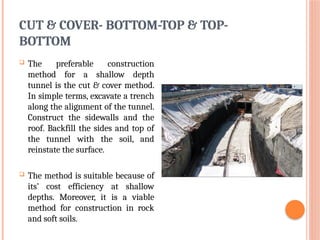
 The preferable construction
method for a shallow depth
tunnel is the cut & cover method.
In simple terms, excavate a trench
along the alignment of the tunnel.
Construct the sidewalls and the
roof. Backfill the sides and top of
the tunnel with the soil, and
reinstate the surface.
 The method is suitable because of
its’ cost efficiency at shallow
depths. Moreover, it is a viable
method for construction in rock
and soft soils.
BORING MACHINES- EARTH PRESSURE BALANCED,
BENTONITE SHIELD & ROCK TBM
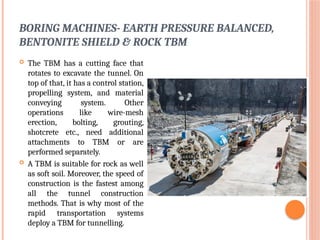
 The TBM has a cutting face that
rotates to excavate the tunnel. On
top of that, it has a control station,
propelling system, and material
conveying system. Other
operations like wire-mesh
erection, bolting, grouting,
shotcrete etc., need additional
attachments to TBM or are
performed separately.
 A TBM is suitable for rock as well
as soft soil. Moreover, the speed of
construction is the fastest among
all the tunnel construction
methods. That is why most of the
rapid transportation systems
deploy a TBM for tunnelling.
SOME OF THE TBM TYPES ARE
Earth Pressure Balanced Shield
 It stores the excavated material in the bulkhead behind the cutting face.
The bulkhead balances the earth pressure of the excavated area. A
conveying system takes out the spoil at a controlled rate.
Bentonite Shield
 The bentonite slurry fills the bulkhead that balances the external earth
pressure. The spoil mixes with the bentonite slurry and is pumped out.
Rock TBM
 Disc cutters mounted on the cutter head cut the rock. The rock fails by
shear. The disc cutters are 300-500 mm in diameter and made of hard
steel.
NEW AUSTRIAN TUNNELING METHOD
(NATM)
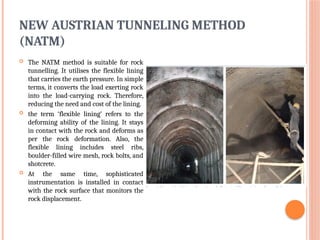
 The NATM method is suitable for rock
tunnelling. It utilises the flexible lining
that carries the earth pressure. In simple
terms, it converts the load exerting rock
into the load-carrying rock. Therefore,
reducing the need and cost of the lining.
 the term ‘flexible lining’ refers to the
deforming ability of the lining. It stays
in contact with the rock and deforms as
per the rock deformation. Also, the
flexible lining includes steel ribs,
boulder-filled wire mesh, rock bolts, and
shotcrete.
 At the same time, sophisticated
instrumentation is installed in contact
with the rock surface that monitors the
rock displacement.
DRILLING & BLASTING- FULL FACE, HEADING &
BENCHING, AND DRAG TUNNELING
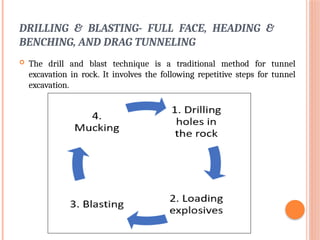
 The drill and blast technique is a traditional method for tunnel
excavation in rock. It involves the following repetitive steps for tunnel
excavation.
STEPS OF DRILLING AND
BLASTING
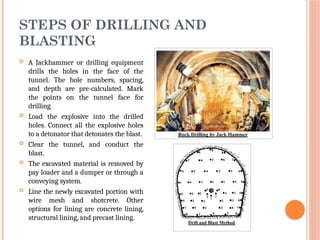
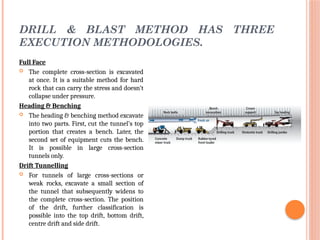
 A Jackhammer or drilling equipment
drills the holes in the face of the
tunnel. The hole numbers, spacing,
and depth are pre-calculated. Mark
the points on the tunnel face for
drilling.
 Load the explosive into the drilled
holes. Connect all the explosive holes
to a detonator that detonates the blast.
 Clear the tunnel, and conduct the
blast.
 The excavated material is removed by
pay loader and a dumper or through a
conveying system.
 Line the newly excavated portion with
wire mesh and shotcrete. Other
options for lining are concrete lining,
structural lining, and precast lining.
DRILL & BLAST METHOD HAS THREE
EXECUTION METHODOLOGIES.
Full Face
 The complete cross-section is excavated
at once. It is a suitable method for hard
rock that can carry the stress and doesn’t
collapse under pressure.
Heading & Benching
 The heading & benching method excavate
into two parts. First, cut the tunnel’s top
portion that creates a bench. Later, the
second set of equipment cuts the bench.
It is possible in large cross-section
tunnels only.
Drift Tunnelling
 For tunnels of large cross-sections or
weak rocks, excavate a small section of
the tunnel that subsequently widens to
the complete cross-section. The position
of the drift, further classification is
possible into the top drift, bottom drift,
centre drift and side drift.
SHAFT TUNNEL
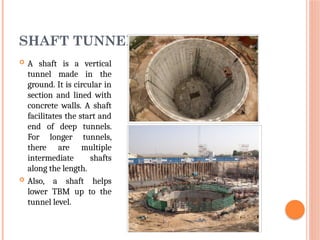
 A shaft is a vertical
tunnel made in the
ground. It is circular in
section and lined with
concrete walls. A shaft
facilitates the start and
end of deep tunnels.
For longer tunnels,
there are multiple
intermediate shafts
along the length.
 Also, a shaft helps
lower TBM up to the
tunnel level.
PIPE JACKING METHOD
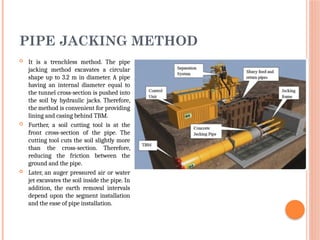
 It is a trenchless method. The pipe
jacking method excavates a circular
shape up to 3.2 m in diameter. A pipe
having an internal diameter equal to
the tunnel cross-section is pushed into
the soil by hydraulic jacks. Therefore,
the method is convenient for providing
lining and casing behind TBM.
 Further, a soil cutting tool is at the
front cross-section of the pipe. The
cutting tool cuts the soil slightly more
than the cross-section. Therefore,
reducing the friction between the
ground and the pipe.
 Later, an auger pressured air or water
jet excavates the soil inside the pipe. In
addition, the earth removal intervals
depend upon the segment installation
and the ease of pipe installation.
BOX JACKING TUNNELING METHOD
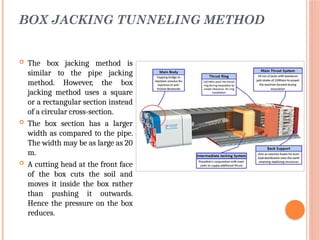
 The box jacking method is
similar to the pipe jacking
method. However, the box
jacking method uses a square
or a rectangular section instead
of a circular cross-section.
 The box section has a larger
width as compared to the pipe.
The width may be as large as 20
m.
 A cutting head at the front face
of the box cuts the soil and
moves it inside the box rather
than pushing it outwards.
Hence the pressure on the box
reduces.
THE CHOICE OF TUNNELING
METHOD MAY BE DICTATED BY
 Geological and Hydrological Conditions
 Cross-section and length of continuous tunnel
 Local experience and time/cost considerations
 Limits of surface disturbance, and many other factors
 Tunnel methods
 Required speed of construction
 Shape of tunnel
 Managing the risk of variations in ground quality.
THE OTHER SIDE
 Beside of many security measures, tunnel is still not full
proof
 High cost than bridges, but more fruitful from previous.
THANK
YOU

Tunnel Construction Techniques/Methods.pptx

  • 1.
    TUNNEL CONSTRUCTION TECHNIQUES Prepared by GNanaji(EPGPH-ACM2024-12) & V Sravani Nag (EPGPH-ACM2024-06)
  • 2.
    CONTENTS  INTRODUCTION  REQUIREMENTSOF TUNNEL  MAIN PURPOSES  PROCEDURES INVOLVED  METHODS OF TUNNELING  METHOD TO SELECTION  THE OTHER SIDE
  • 3.
    INTRODUCTION  A Tunnelis an underground passageway, completely enclosed except for openings for egress, commonly at each end  A tunnel may be for road traffic, canal, hydro electric station, sewer etc.
  • 4.
    REQUIREMENTS OF TUNNEL It is very useful where bridge fail to full fill requirements like in sea, In urban area , and in mountains.  Efficient copared to bridges  In war time it is much difficult to destroy a tunnel but destruction of bridge is too easy.  Lots of Land and Time is saved.
  • 5.
    MAIN PURPOSES 1) InRoad traffics 2) In Sewers 3) In Mining 4) In rail Traffics 5) In hydro electric stations etc.
  • 6.
    THE PROCESS FORBORED TUNNELING INVOLVES ALL OR SOME OF THE FOLLWING OPERATIONS  Probe drilling (when needed)  Grouting (when Needed)  Excavation (or blasting)  Supporting  Transportation of Muck  Lining or Sealing  Draining  Ventilation
  • 7.
    PROBE DRILLING  Thistype of drilling is done in order to find out suitable method for drilling.  It consist of drilling in sample, by various method to find most suitable.  It is necessary part of all drilling Operations.
  • 8.
    GROUTING  It isthe process of providing additional support to drilled mine.  It is done by liquid called grout, consist of water, cement, color tint and sometime fine gravel.  Good surface is achieved.
  • 9.
    EXCAVATION  Excavation isthe digging and recording of artifacts at an archaeological site.  It is necessary to know the archaeological importance of a site before digging.  This is performed by experts in a scientific way.
  • 10.
    SUPPORTING  After initialmining, tunnel need supports for further processing.  For the sake of life a perfect planning is needed for support.  In ancient time timber and masonry were the main methods.  Today support is provided by injecting final pipe or building it completely before further tunneling.
  • 11.
    TRANSPORTATION OF MUCK In ancient time transportation was done by steam engine and by manual transport.  Today it is done by modern methods and process in automatic.  TBMs are also come with proper arrangement for the transport of muck.
  • 12.
    LINING OR SEALING Lining of proper material is done by modern methods like polishing, painting to prevent wear and tear the corrosion.  Very necessary part where corrosive metals are being used.
  • 13.
    DRAINING  Draining isthe process to remove the water or other liquid from working site.  Very important where water level is very high.  Pumps and Pipes are used for this purpose.
  • 14.
    VENTILATION  Proper ventilationis required for safety of workers.  This is done by proper checking of oxygen and other perimeters.  Proper installations for exit of hazardous gasses coming out from tunneling.
  • 15.
    TUNNEL CONSTRUCTION METHODS  Cut& Cover- Bottom-Top & Top-Bottom  Boring Machines- Earth Pressure Balanced, Bentonite Shield & Rock TBM  New Austrian Tunneling Method (NATM)  Drilling & Blasting- Full Face, Heading & Benching, and Drag Tunneling  Clay Kicking  Shaft  Pipe Jacking Method  Box Jacking Method
  • 16.
    CUT & COVER-BOTTOM-TOP & TOP- BOTTOM  The preferable construction method for a shallow depth tunnel is the cut & cover method. In simple terms, excavate a trench along the alignment of the tunnel. Construct the sidewalls and the roof. Backfill the sides and top of the tunnel with the soil, and reinstate the surface.  The method is suitable because of its’ cost efficiency at shallow depths. Moreover, it is a viable method for construction in rock and soft soils.
  • 17.
    BORING MACHINES- EARTHPRESSURE BALANCED, BENTONITE SHIELD & ROCK TBM  The TBM has a cutting face that rotates to excavate the tunnel. On top of that, it has a control station, propelling system, and material conveying system. Other operations like wire-mesh erection, bolting, grouting, shotcrete etc., need additional attachments to TBM or are performed separately.  A TBM is suitable for rock as well as soft soil. Moreover, the speed of construction is the fastest among all the tunnel construction methods. That is why most of the rapid transportation systems deploy a TBM for tunnelling.
  • 18.
    SOME OF THETBM TYPES ARE Earth Pressure Balanced Shield  It stores the excavated material in the bulkhead behind the cutting face. The bulkhead balances the earth pressure of the excavated area. A conveying system takes out the spoil at a controlled rate. Bentonite Shield  The bentonite slurry fills the bulkhead that balances the external earth pressure. The spoil mixes with the bentonite slurry and is pumped out. Rock TBM  Disc cutters mounted on the cutter head cut the rock. The rock fails by shear. The disc cutters are 300-500 mm in diameter and made of hard steel.
  • 19.
    NEW AUSTRIAN TUNNELINGMETHOD (NATM)  The NATM method is suitable for rock tunnelling. It utilises the flexible lining that carries the earth pressure. In simple terms, it converts the load exerting rock into the load-carrying rock. Therefore, reducing the need and cost of the lining.  the term ‘flexible lining’ refers to the deforming ability of the lining. It stays in contact with the rock and deforms as per the rock deformation. Also, the flexible lining includes steel ribs, boulder-filled wire mesh, rock bolts, and shotcrete.  At the same time, sophisticated instrumentation is installed in contact with the rock surface that monitors the rock displacement.
  • 20.
    DRILLING & BLASTING-FULL FACE, HEADING & BENCHING, AND DRAG TUNNELING  The drill and blast technique is a traditional method for tunnel excavation in rock. It involves the following repetitive steps for tunnel excavation.
  • 21.
    STEPS OF DRILLINGAND BLASTING  A Jackhammer or drilling equipment drills the holes in the face of the tunnel. The hole numbers, spacing, and depth are pre-calculated. Mark the points on the tunnel face for drilling.  Load the explosive into the drilled holes. Connect all the explosive holes to a detonator that detonates the blast.  Clear the tunnel, and conduct the blast.  The excavated material is removed by pay loader and a dumper or through a conveying system.  Line the newly excavated portion with wire mesh and shotcrete. Other options for lining are concrete lining, structural lining, and precast lining.
  • 22.
    DRILL & BLASTMETHOD HAS THREE EXECUTION METHODOLOGIES. Full Face  The complete cross-section is excavated at once. It is a suitable method for hard rock that can carry the stress and doesn’t collapse under pressure. Heading & Benching  The heading & benching method excavate into two parts. First, cut the tunnel’s top portion that creates a bench. Later, the second set of equipment cuts the bench. It is possible in large cross-section tunnels only. Drift Tunnelling  For tunnels of large cross-sections or weak rocks, excavate a small section of the tunnel that subsequently widens to the complete cross-section. The position of the drift, further classification is possible into the top drift, bottom drift, centre drift and side drift.
  • 23.
    SHAFT TUNNEL  Ashaft is a vertical tunnel made in the ground. It is circular in section and lined with concrete walls. A shaft facilitates the start and end of deep tunnels. For longer tunnels, there are multiple intermediate shafts along the length.  Also, a shaft helps lower TBM up to the tunnel level.
  • 24.
    PIPE JACKING METHOD It is a trenchless method. The pipe jacking method excavates a circular shape up to 3.2 m in diameter. A pipe having an internal diameter equal to the tunnel cross-section is pushed into the soil by hydraulic jacks. Therefore, the method is convenient for providing lining and casing behind TBM.  Further, a soil cutting tool is at the front cross-section of the pipe. The cutting tool cuts the soil slightly more than the cross-section. Therefore, reducing the friction between the ground and the pipe.  Later, an auger pressured air or water jet excavates the soil inside the pipe. In addition, the earth removal intervals depend upon the segment installation and the ease of pipe installation.
  • 25.
    BOX JACKING TUNNELINGMETHOD  The box jacking method is similar to the pipe jacking method. However, the box jacking method uses a square or a rectangular section instead of a circular cross-section.  The box section has a larger width as compared to the pipe. The width may be as large as 20 m.  A cutting head at the front face of the box cuts the soil and moves it inside the box rather than pushing it outwards. Hence the pressure on the box reduces.
  • 26.
    THE CHOICE OFTUNNELING METHOD MAY BE DICTATED BY  Geological and Hydrological Conditions  Cross-section and length of continuous tunnel  Local experience and time/cost considerations  Limits of surface disturbance, and many other factors  Tunnel methods  Required speed of construction  Shape of tunnel  Managing the risk of variations in ground quality.
  • 27.
    THE OTHER SIDE Beside of many security measures, tunnel is still not full proof  High cost than bridges, but more fruitful from previous.
  • 28.