






Assalam-u-alaikum
Made by-JAVED
Subject:-
pp3TUNNEL ENGINEERING
Subject teacher- NAZNEEN MISS
DEFINITION:
The underground passages which
are constructed without disturbing the
ground surface are known as tunnels.
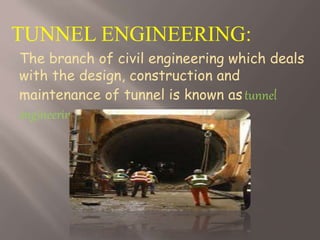
TUNNEL ENGINEERING:
The branch of civil engineering which deals
with the design, construction and
maintenance of tunnel is known astunnel
engineering.
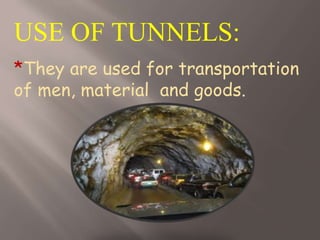
USE OF TUNNELS:
*They are used for transportation
of men, material and goods.
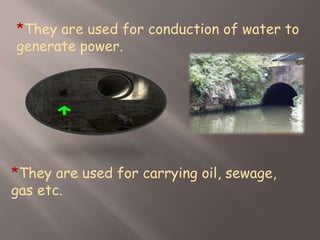
*They are used for conduction of water to
generate power.
*They are used for carrying oil, sewage,
gas etc.
Necessity of tunnels:
*When the two terminal stations,
separated by a
mountain are to be connected by a
shortest route.*When depth of open cut for reaching the
other side of a hill is more than 20m and it
is costlier to construct and maintain it,
than a tunnel.*When the provision of a bridge for
carrying road or railway traffic across the
river is more inconvenient and costlier than
a tunnel under the river bed.
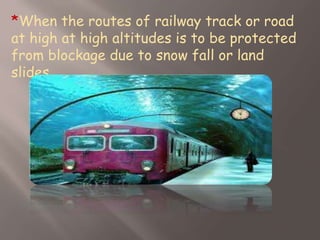
*When the routes of railway track or road
at high at high altitudes is to be protected
from blockage due to snow fall or land
slides.
Advantages of tunnels:
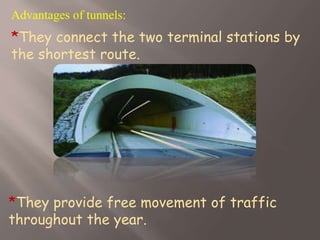
*They connect the two terminal stations by
the shortest route.
*They provide free movement of traffic
throughout the year.
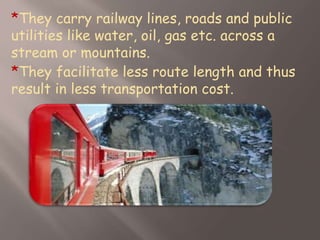
*They carry railway lines, roads and public
utilities like water, oil, gas etc. across a
stream or mountains.
*They facilitate less route length and thus
result in less transportation cost.
disadvantages:
*They require special equipment and
method for their construction.
*They require more time for their
construction.
*Skilled labour and supervision is required in
their construction.
*They may cause suffocation if not properly
ventilated.
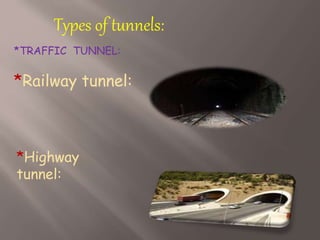
Types of tunnels:
*TRAFFIC TUNNEL:
*Railway tunnel:
*Highway
tunnel:
*Pedestrian
tunnel:
*Subway
tunnel:
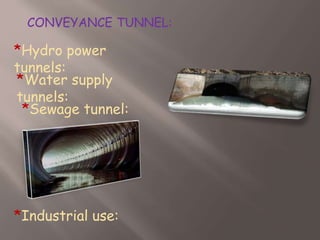
CONVEYANCE TUNNEL:
*Hydro power
tunnels:
*Water supply
tunnels:
*Sewage tunnel:
*Industrial use:
THANK
YOU.
Allah-hafiz.

Tunnel’s