L E S S O N 5 – C O N D I T I O N A L C L A U S E S &
E T H I C S
2ND BATXILERAT 15-16
1
GET YOUR OWN WAY
Winnie is cheating Roo to get his own way!
Get what you want although it might upset other people
3
COVER UP
4
She tried to cover up
her mistakes, but in
the end she was
caught out.
Stop people from discovering the truth
CATCH OUT
5
Liars often try to
cover up their
mistakes, but
sooner or later,
they are usually
caught out.
The last question in the exam caught them all out.
6
Parents want their children to be self-reliant and strong-willed.
RELY ON
7
Trust
8
Before you answer this question, you should take into account studies
showing that…
STAND UP FOR STH / SBD
9
Defend
STAND BY SOMEBODY
10
He stood by his
little brother
during their
parent’s divorce.
Continue to support somebody who is in a difficult situation
UNTRUSTWORTHY
11
Adjective used to define someone who cannot be trusted
I felt like trusting them, but Tom told me they were totally
untrustworthy.
GO WITHOUT
12
Not to have something that you usually have.
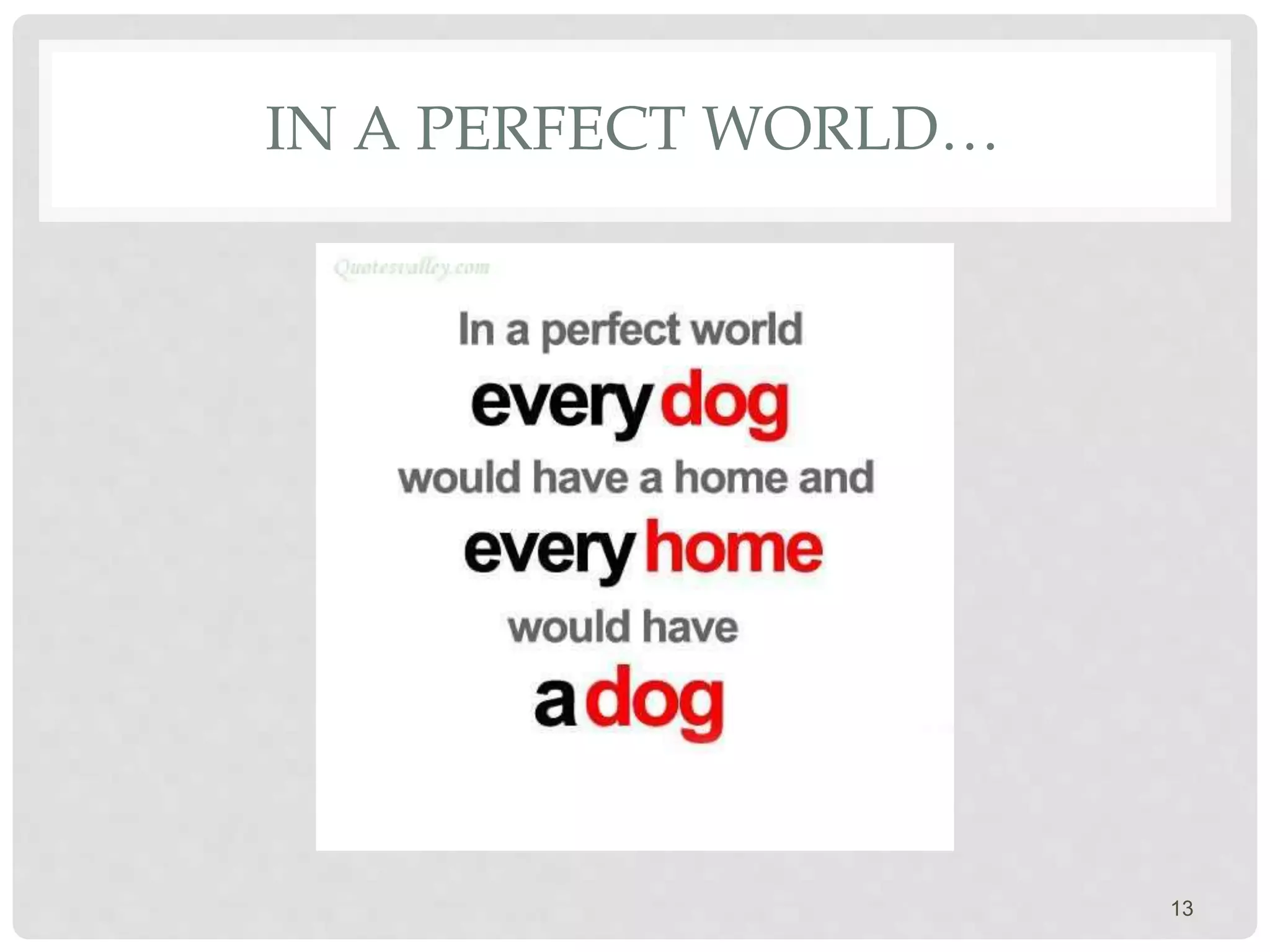
IN A PERFECT WORLD…
13
TURN UP (INFLML)
14
Arrive or appear somewhere
She turned up late for the meeting and was sacked
SWINDLE / RIP (SB) OFF (INFML)
15
Cheat somebody on something related to money
We were ripped off by the taxi driver
CARRY OUT / UNDERTAKE
16
In a treball de Recerca you have to carry out your own research.
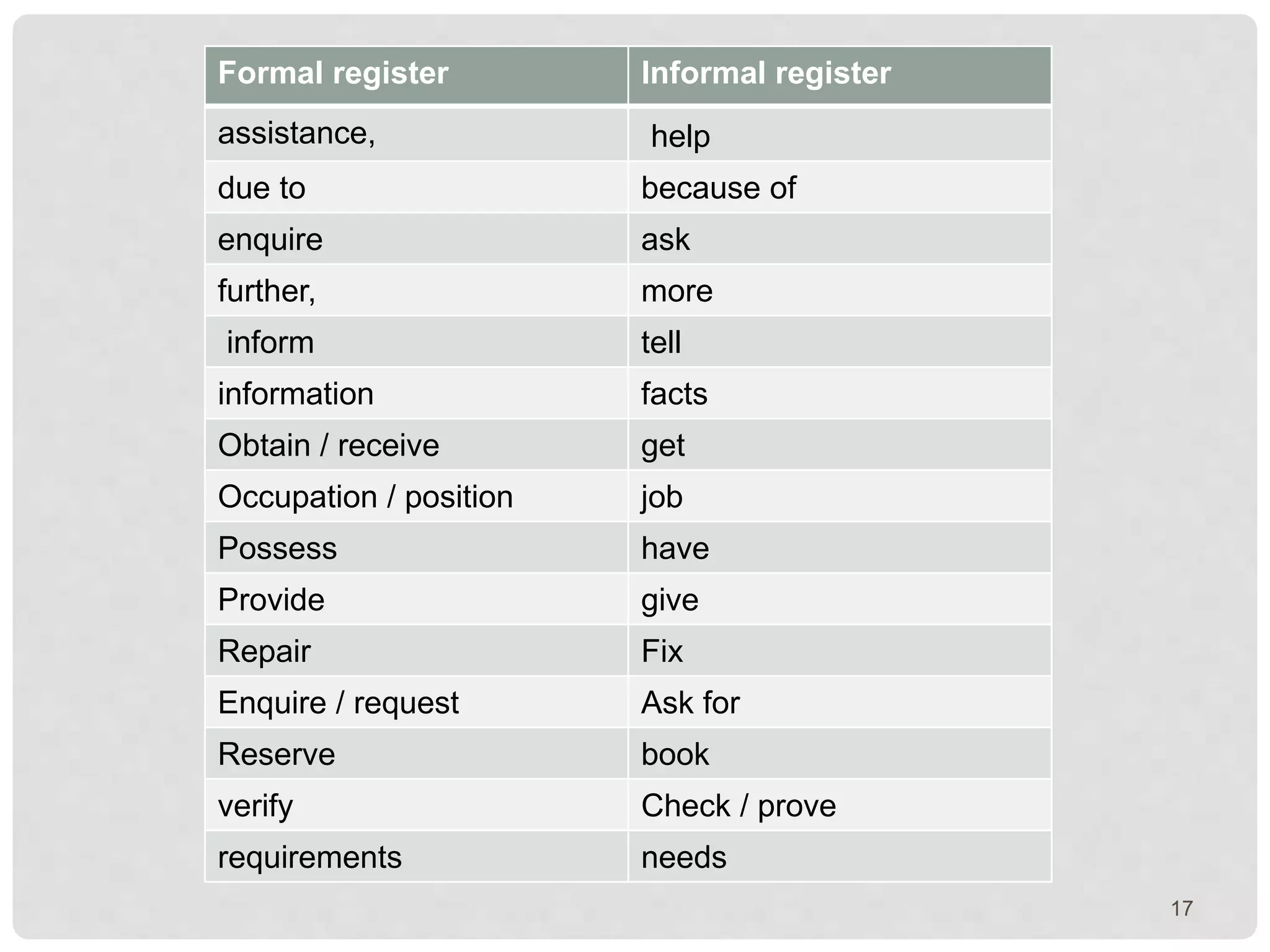
17
Formal register Informal register
assistance, help
due to because of
enquire ask
further, more
inform tell
information facts
Obtain / receive get
Occupation / position job
Possess have
Provide give
Repair Fix
Enquire / request Ask for
Reserve book
verify Check / prove
requirements needs
A FOR AND AGAINST ESSAY
• Some strategies to write your first sentence:
• Rephrase the statement you are going to discuss.
• Say this statement has two sides.
• For example:
• There is heated debate about whether people should be able
to drive a car before they are twenty, or not.
• There are both advantages and disadvantages to driving a car
before you are twenty”.
18
CONDITIONALS
• They have a
• main clause
• A subordinate or “if clause”
• Both the conditional and the subordinate clause can start
the sentence, but if the subordinate clause comes first,
then you must remember to use a comma.
• If I were a rich man, I will build a big house.
• I will build a big house if I were a rich man.
19
FORM FOR CONDITIONALS
• First Conditional:
• If + present simple + will + base form
• Second conditional:
• If + past simple + would + base form
• Third conditional:
• If + past perfect + would + have + past participle
20
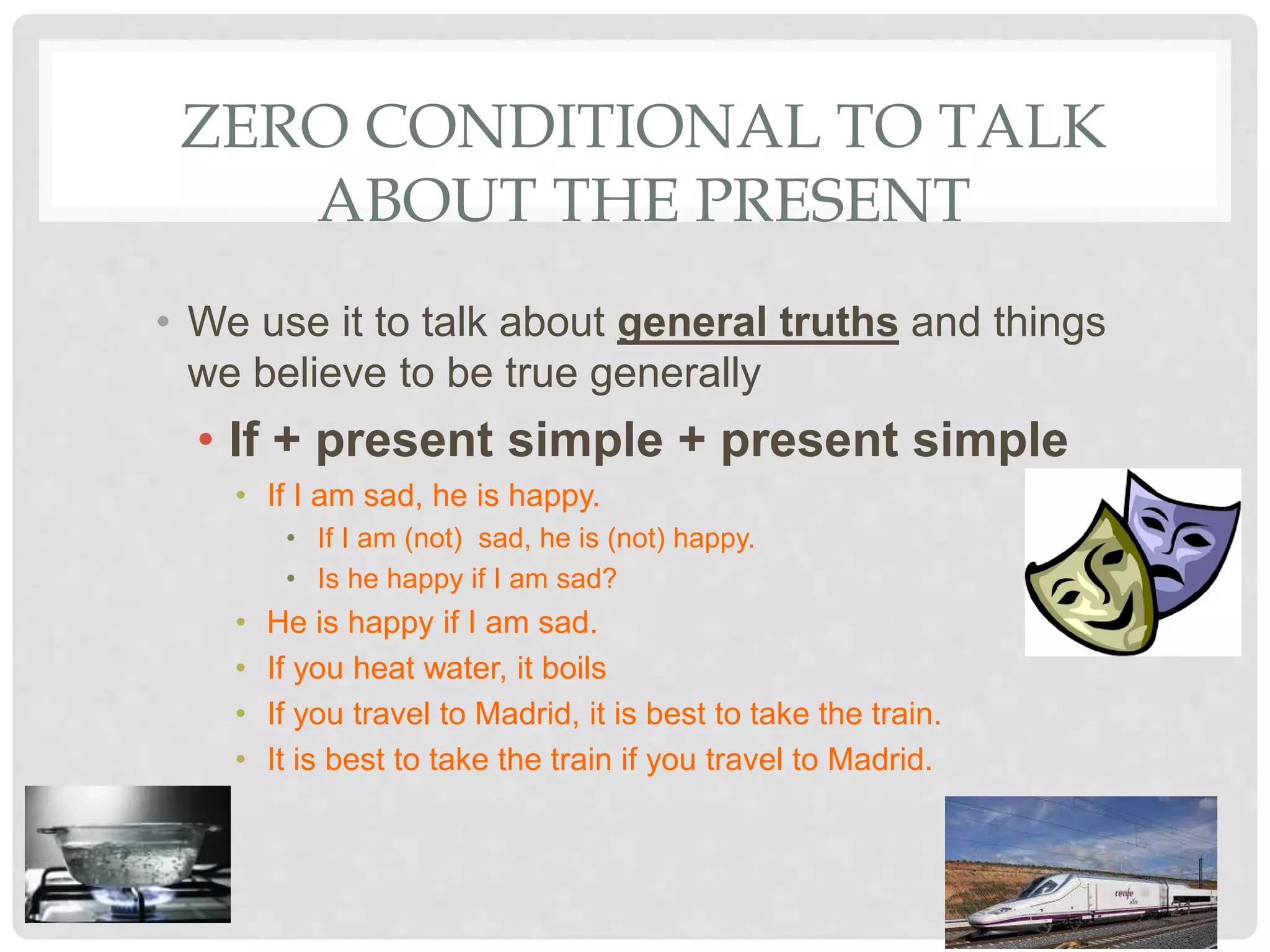
ZERO CONDITIONAL TO TALK
ABOUT THE PRESENT
• We use it to talk about general truths and things
we believe to be true generally
• If + present simple + present simple
• If I am sad, he is happy.
• If I am (not) sad, he is (not) happy.
• Is he happy if I am sad?
• He is happy if I am sad.
• If you heat water, it boils
• If you travel to Madrid, it is best to take the train.
• It is best to take the train if you travel to Madrid.
21
SECOND CONDITIONAL TO
TALK ABOUT THE PRESENT
• We use it to talk about things in the present that are
hypothetical. Things we think are unlikely or
impossible, or things that are opposite of the facts
• If + past simple, + would + base form
• If I worked around here, I’d walk to the office.
• If I were a millionaire, I would have a castle in Ireland.
• If he were younger, he would come with us.
• If I had wings, I would fly to Majorca.
• * We use were with to be for all the persons.
22
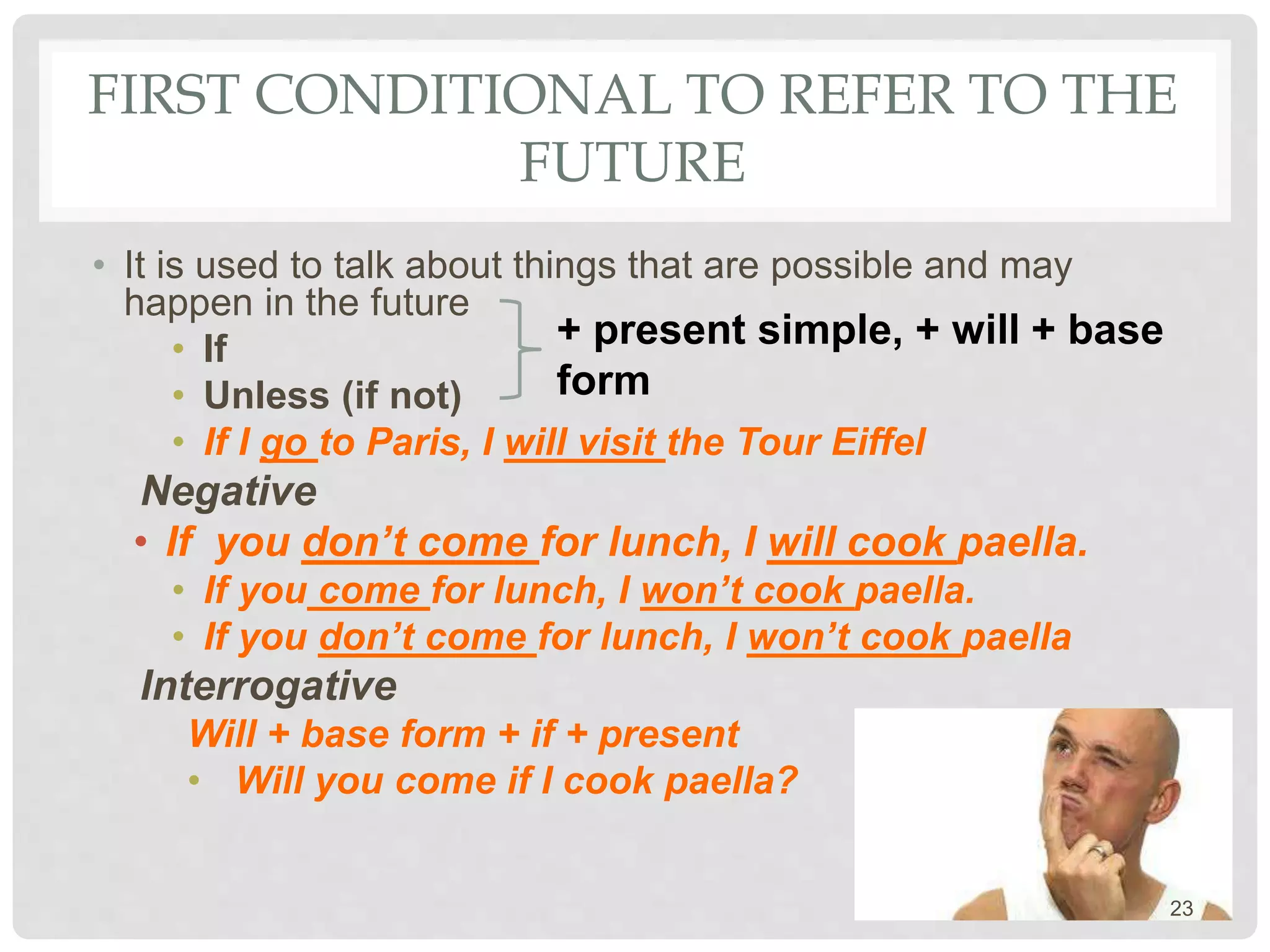
FIRST CONDITIONAL TO REFER TO THE
FUTURE
• It is used to talk about things that are possible and may
happen in the future
• If
• Unless (if not)
• If I go to Paris, I will visit the Tour Eiffel
Negative
• If you don’t come for lunch, I will cook paella.
• If you come for lunch, I won’t cook paella.
• If you don’t come for lunch, I won’t cook paella
Interrogative
Will + base form + if + present
• Will you come if I cook paella?
+ present simple, + will + base
form
23
THIRD CONDITIONAL TO REFER TO THE
PAST
• We use it to reflect on things that happened or didn’t
happen in the past and how changing these events
might have made a difference.
• If + past perfect, + would + have +
past participle
• If he had known his mother was dying, he
would have visited her
more often
24
IF ONLY / I WISH
• Specific situation – Hadn’t
• If only I hadn’t phoned him when I was angry.
• general  past tense or would
• If only they didn’t / wouldn’t treat me as a child.
25
WHAT HAPPENED?
• If only you believed me!
• If I had thought of the consequences, I would never have done it.
• If someone had not seen me reading a note, they would not have accused me
of cheating.
• I wish it had not happened!
• If that man had not seen me reading that note, they would not have accused me
of cheating.
• If they had not caught me cheating I would not have been expelled from
University.
• If only my parents would allow me to return the expensive fees!
26
+
MAKING SUGGESTIONS
• What ___________ we do this summer?
• _______ have dinner at an Italian restaurant!
• How ________ going cycling this weekend?
• ________ don’t we go to the movies tomorrow?
• I ______________ we visit the science museum.
• We ________ go to a concert this weekend
shall
Let’s
about
Why
suggest
could
CHILD SOLDIERS
30
…Let’s / how about… / why don’t we… /
we could
31
GREETINGS AND CLOSINGS IN
FORMAL LETTERS
• When you do not know the last name of the person
you are addressing
• Dear Sir /Madam - Yours faithfully
• When you know their surname
• Ms. – When you do not know if the woman you are
addressing is married or single. It is pronounced “Mizz” –
THE MOST COMMON FORMULA
• Mrs. – a married woman
• Miss – A single woman - Yours sincerely
32
+
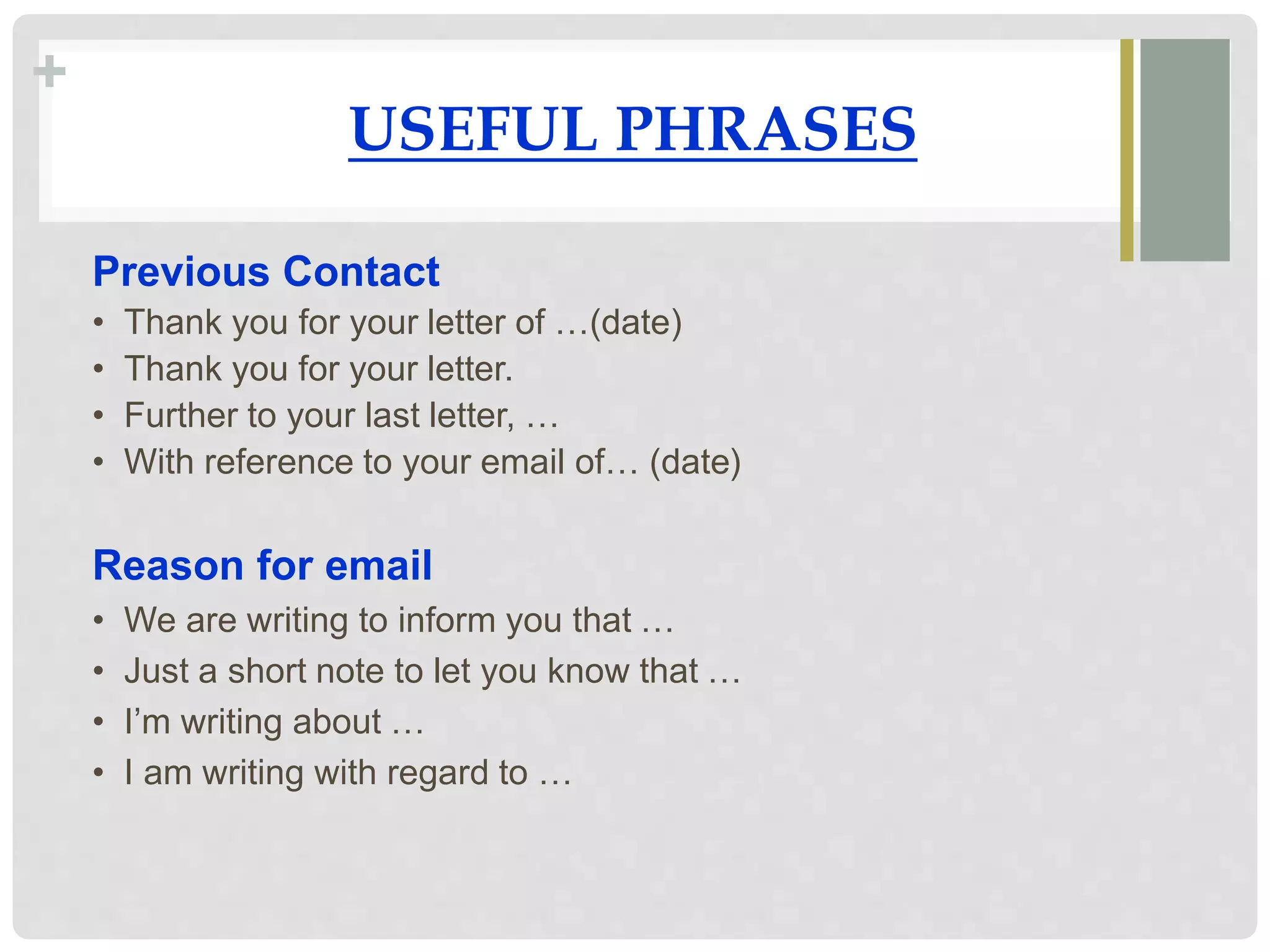
USEFUL PHRASES
Previous Contact
• Thank you for your letter of …(date)
• Thank you for your letter.
• Further to your last letter, …
• With reference to your email of… (date)
Reason for email
• We are writing to inform you that …
• Just a short note to let you know that …
• I’m writing about …
• I am writing with regard to …
+
Adrian O’Donnell – Lado Business
English Specialists
USEFUL PHRASES II
Good news
• You will be pleased to hear that …
• We are able to confirm that …
• We can confirm that …
Bad news/Apologising
• I apologise for …
• We regret to inform you that …
• Sorry for …
• Unfortunately, …
+
Adrian O’Donnell – Lado Business
English Specialists
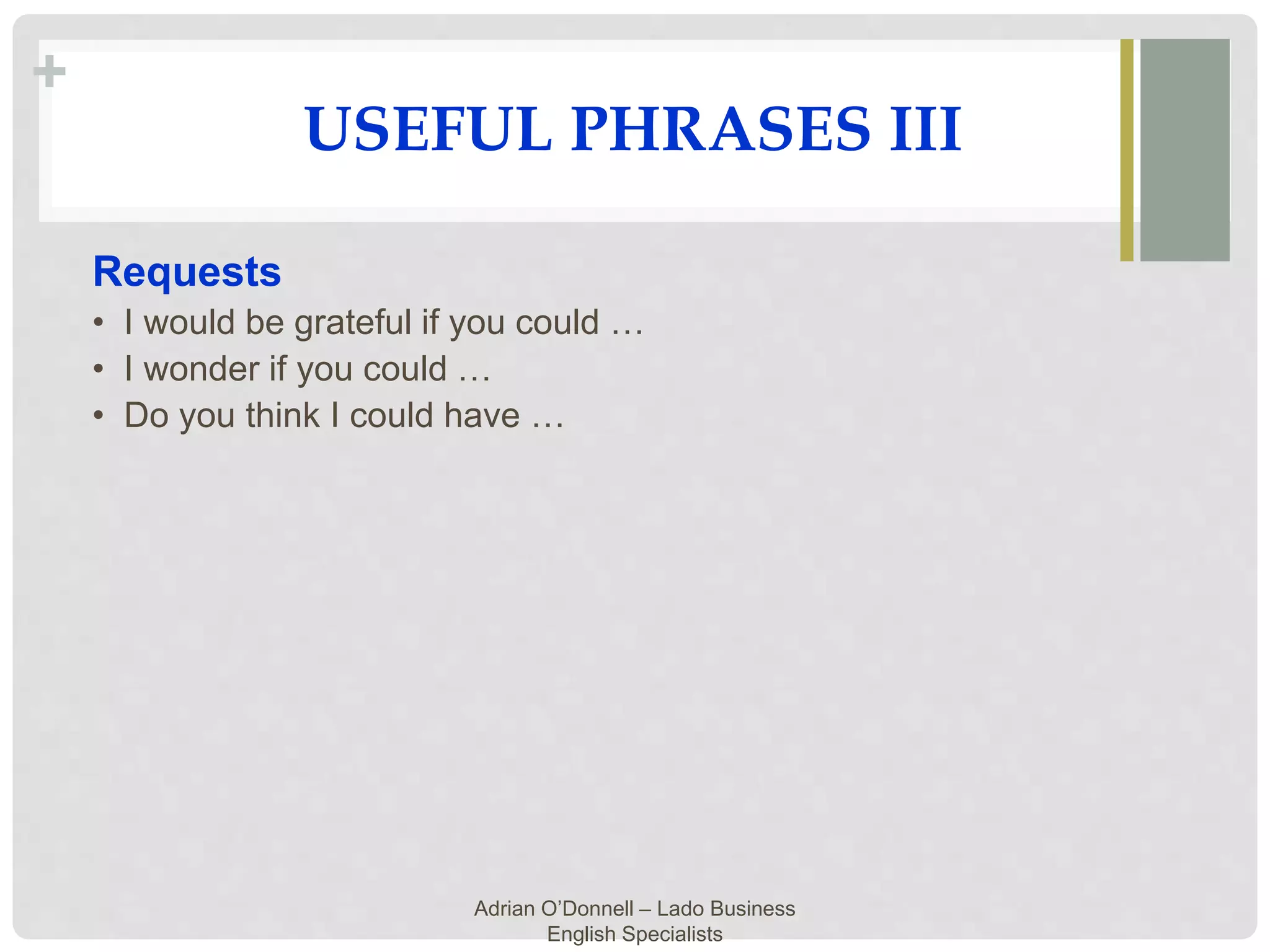
USEFUL PHRASES III
Requests
• I would be grateful if you could …
• I wonder if you could …
• Do you think I could have …

Tt lesson5 2bachi_2016

  • 1.
    L E SS O N 5 – C O N D I T I O N A L C L A U S E S & E T H I C S 2ND BATXILERAT 15-16 1
  • 2.
    GET YOUR OWNWAY Winnie is cheating Roo to get his own way! Get what you want although it might upset other people
  • 3.
  • 4.
    COVER UP 4 She triedto cover up her mistakes, but in the end she was caught out. Stop people from discovering the truth
  • 5.
    CATCH OUT 5 Liars oftentry to cover up their mistakes, but sooner or later, they are usually caught out. The last question in the exam caught them all out.
  • 6.
    6 Parents want theirchildren to be self-reliant and strong-willed.
  • 7.
  • 8.
    8 Before you answerthis question, you should take into account studies showing that…
  • 9.
    STAND UP FORSTH / SBD 9 Defend
  • 10.
    STAND BY SOMEBODY 10 Hestood by his little brother during their parent’s divorce. Continue to support somebody who is in a difficult situation
  • 11.
    UNTRUSTWORTHY 11 Adjective used todefine someone who cannot be trusted I felt like trusting them, but Tom told me they were totally untrustworthy.
  • 12.
    GO WITHOUT 12 Not tohave something that you usually have.
  • 13.
    IN A PERFECTWORLD… 13
  • 14.
    TURN UP (INFLML) 14 Arriveor appear somewhere She turned up late for the meeting and was sacked
  • 15.
    SWINDLE / RIP(SB) OFF (INFML) 15 Cheat somebody on something related to money We were ripped off by the taxi driver
  • 16.
    CARRY OUT /UNDERTAKE 16 In a treball de Recerca you have to carry out your own research.
  • 17.
    17 Formal register Informalregister assistance, help due to because of enquire ask further, more inform tell information facts Obtain / receive get Occupation / position job Possess have Provide give Repair Fix Enquire / request Ask for Reserve book verify Check / prove requirements needs
  • 18.
    A FOR ANDAGAINST ESSAY • Some strategies to write your first sentence: • Rephrase the statement you are going to discuss. • Say this statement has two sides. • For example: • There is heated debate about whether people should be able to drive a car before they are twenty, or not. • There are both advantages and disadvantages to driving a car before you are twenty”. 18
  • 19.
    CONDITIONALS • They havea • main clause • A subordinate or “if clause” • Both the conditional and the subordinate clause can start the sentence, but if the subordinate clause comes first, then you must remember to use a comma. • If I were a rich man, I will build a big house. • I will build a big house if I were a rich man. 19
  • 20.
    FORM FOR CONDITIONALS •First Conditional: • If + present simple + will + base form • Second conditional: • If + past simple + would + base form • Third conditional: • If + past perfect + would + have + past participle 20
  • 21.
    ZERO CONDITIONAL TOTALK ABOUT THE PRESENT • We use it to talk about general truths and things we believe to be true generally • If + present simple + present simple • If I am sad, he is happy. • If I am (not) sad, he is (not) happy. • Is he happy if I am sad? • He is happy if I am sad. • If you heat water, it boils • If you travel to Madrid, it is best to take the train. • It is best to take the train if you travel to Madrid. 21
  • 22.
    SECOND CONDITIONAL TO TALKABOUT THE PRESENT • We use it to talk about things in the present that are hypothetical. Things we think are unlikely or impossible, or things that are opposite of the facts • If + past simple, + would + base form • If I worked around here, I’d walk to the office. • If I were a millionaire, I would have a castle in Ireland. • If he were younger, he would come with us. • If I had wings, I would fly to Majorca. • * We use were with to be for all the persons. 22
  • 23.
    FIRST CONDITIONAL TOREFER TO THE FUTURE • It is used to talk about things that are possible and may happen in the future • If • Unless (if not) • If I go to Paris, I will visit the Tour Eiffel Negative • If you don’t come for lunch, I will cook paella. • If you come for lunch, I won’t cook paella. • If you don’t come for lunch, I won’t cook paella Interrogative Will + base form + if + present • Will you come if I cook paella? + present simple, + will + base form 23
  • 24.
    THIRD CONDITIONAL TOREFER TO THE PAST • We use it to reflect on things that happened or didn’t happen in the past and how changing these events might have made a difference. • If + past perfect, + would + have + past participle • If he had known his mother was dying, he would have visited her more often 24
  • 25.
    IF ONLY /I WISH • Specific situation – Hadn’t • If only I hadn’t phoned him when I was angry. • general  past tense or would • If only they didn’t / wouldn’t treat me as a child. 25
  • 26.
    WHAT HAPPENED? • Ifonly you believed me! • If I had thought of the consequences, I would never have done it. • If someone had not seen me reading a note, they would not have accused me of cheating. • I wish it had not happened! • If that man had not seen me reading that note, they would not have accused me of cheating. • If they had not caught me cheating I would not have been expelled from University. • If only my parents would allow me to return the expensive fees! 26
  • 27.
    + MAKING SUGGESTIONS • What___________ we do this summer? • _______ have dinner at an Italian restaurant! • How ________ going cycling this weekend? • ________ don’t we go to the movies tomorrow? • I ______________ we visit the science museum. • We ________ go to a concert this weekend shall Let’s about Why suggest could
  • 28.
    CHILD SOLDIERS 30 …Let’s /how about… / why don’t we… / we could
  • 29.
  • 30.
    GREETINGS AND CLOSINGSIN FORMAL LETTERS • When you do not know the last name of the person you are addressing • Dear Sir /Madam - Yours faithfully • When you know their surname • Ms. – When you do not know if the woman you are addressing is married or single. It is pronounced “Mizz” – THE MOST COMMON FORMULA • Mrs. – a married woman • Miss – A single woman - Yours sincerely 32
  • 31.
    + USEFUL PHRASES Previous Contact •Thank you for your letter of …(date) • Thank you for your letter. • Further to your last letter, … • With reference to your email of… (date) Reason for email • We are writing to inform you that … • Just a short note to let you know that … • I’m writing about … • I am writing with regard to …
  • 32.
    + Adrian O’Donnell –Lado Business English Specialists USEFUL PHRASES II Good news • You will be pleased to hear that … • We are able to confirm that … • We can confirm that … Bad news/Apologising • I apologise for … • We regret to inform you that … • Sorry for … • Unfortunately, …
  • 33.
    + Adrian O’Donnell –Lado Business English Specialists USEFUL PHRASES III Requests • I would be grateful if you could … • I wonder if you could … • Do you think I could have …