

Unidad 8: Just imagine!.
Temas: Conditionals,Time clauses,
Base and strong adjectives, Making
suggestions.
Diego Hernando Torres Valencia
Pagina web: http://www.ctc.edu.co/
Bilingüismo: Modulo 7
CTC : Centro Tecnológico
de Cúcuta
Formación Académica en Ingles
DIEGO HERNANDO TORRES VALENCIA
si usted no está
dispuesto
aprender,
nadie puede ayudarle.
si usted está decidido
aprender
nadie puede detenerte
Diego Hernando Torres Valencia
CONTENIDO:
CTC: Centro Tecnologico de Cucuta. Diego Hernando Torres Valencia
Sabiduría ante todo; adquiere sabiduría;
Y sobre todas tus posesiones adquiere
inteligencia.
Engrandécela, y ella te engrandecerá.
Proverbios 4:7-9
Dream big : Sueña en Grande
Never give up : Nunca te rindas
Do your best : Haz lo Mejor
CONTENIDO:
1. Conditionals.
2. Time clauses.
3. Base and strong
adjectives.
4. Making suggestions.
5. …
6. Bibliografia
4
New headway Intermediate :
Student Book: Unidad 8 : Just Imagine
Modulo 7:
Unidad 8
Just imagine
New-Headway
Intermediate
5
New-Headway
Intermediate
Modulo 7:
Unidad 8
Just imagine
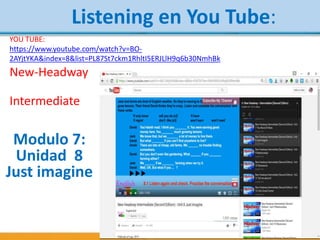
YOU TUBE:
https://www.youtube.com/watch?v=BO-
2AYjtYKA&index=8&list=PL87St7ckm1RhltI5ERJLlH9q6b30NmhBk
Listening en You Tube:
Unit 8: Just imagine !
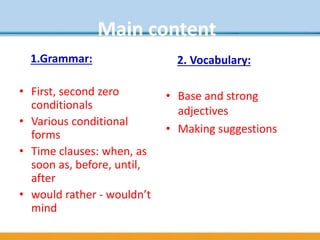
Main content
1.Grammar:
• First, second zero
conditionals
• Various conditional
forms
• Time clauses: when, as
soon as, before, until,
after
• would rather - wouldn’t
mind
2. Vocabulary:
• Base and strong
adjectives
• Making suggestions
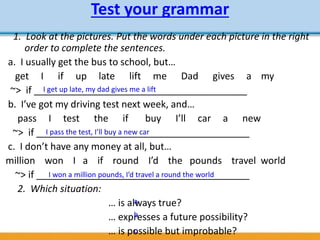
Test your grammar
1. Look at the pictures. Put the words under each picture in the right
order to complete the sentences.
a. I usually get the bus to school, but…
get I if up late lift me Dad gives a my
~> if ________________________________________
b. I’ve got my driving test next week, and…
pass I test the if buy I’ll car a new
~> if ________________________________________
c. I don’t have any money at all, but…
million won I a if round I’d the pounds travel world
~> if ________________________________________
2. Which situation:
… is always true?
… expresses a future possibility?
… is possible but improbable?
I get up late, my dad gives me a lift
I pass the test, I’ll buy a new car
I won a million pounds, I’d travel a round the world
a
b
c
First conditional
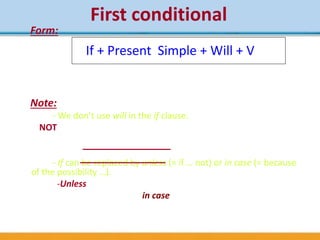
Form:
(+) If I find your wallet, I’ll let you know.
(-) If you lose your ticket, you won’t be able to go
(?) What will you do if you don’t find a job?
Note:
- We don’t use will in the if clause.
NOT * if you will leave now, you‘ll catch the train.
* if I’ll go out tonight, I’ll give you a ring.
- If can be replaced by unless (= if … not) or in case (= because
of the possibility …).
-Unless I hear from you, I’ll arrive at 8 o’clock.
-I’ll take my umbrella in case it rains.
If + Present Simple + Will + V
First conditional
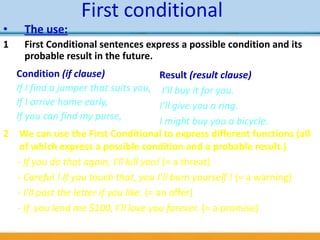
2 We can use the First Conditional to express different functions (all
of which express a possible condition and a probable result.)
- If you do that again, I’ll kill you! (= a threat)
- Careful ! If you touch that, you I’ll burn yourself ! (= a warning)
- I’ll post the letter if you like. (= an offer)
- If you lend me $100, I’ll love you forever. (= a promise)
Condition (if clause)
If I find a jumper that suits you,
If I arrive home early,
If you can find my purse,
Result (result clause)
I’ll buy it for you.
I’ll give you a ring.
I might buy you a bicycle.
• The use:
1 First Conditional sentences express a possible condition and its
probable result in the future.
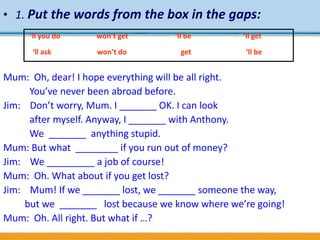
• 1. Put the words from the box in the gaps:
Mum: Oh, dear! I hope everything will be all right.
You’ve never been abroad before.
Jim: Don’t worry, Mum. I _______ OK. I can look
after myself. Anyway, I _______ with Anthony.
We _______ anything stupid.
Mum: But what ________ if you run out of money?
Jim: We _________ a job of course!
Mum: Oh. What about if you get lost?
Jim: Mum! If we _______ lost, we _______ someone the way,
but we _______ lost because we know where we’re going!
Mum: Oh. All right. But what if …?
’ll be
’ll bewon’t do
’ll you do won’t get
get‘ll ask
‘ll get
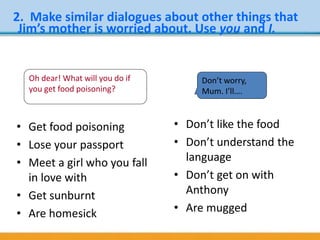
• Get food poisoning
• Lose your passport
• Meet a girl who you fall
in love with
• Get sunburnt
• Are homesick
• Don’t like the food
• Don’t understand the
language
• Don’t get on with
Anthony
• Are mugged
2. Make similar dialogues about other things that
Jim’s mother is worried about. Use you and I.
Oh dear! What will you do if
you get food poisoning?
Don’t worry,
Mum. I’ll….
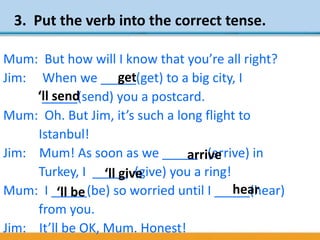
3. Put the verb into the correct tense.
Mum: But how will I know that you’re all right?
Jim: When we _____(get) to a big city, I
_____(send) you a postcard.
Mum: Oh. But Jim, it’s such a long flight to
Istanbul!
Jim: Mum! As soon as we _____ (arrive) in
Turkey, I _____ (give) you a ring!
Mum: I _____(be) so worried until I _____(hear)
from you.
Jim: It’ll be OK, Mum. Honest!
get
‘ll send
‘ll give
‘ll be
arrive
hear
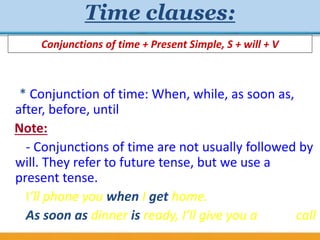
Time clauses:
* Conjunction of time: When, while, as soon as,
after, before, until
Note:
- Conjunctions of time are not usually followed by
will. They refer to future tense, but we use a
present tense.
I’ll phone you when I get home.
As soon as dinner is ready, I’ll give you a call
Conjunctions of time + Present Simple, S + will + V
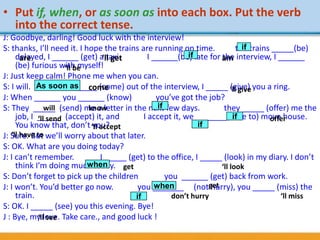
• Put if, when, or as soon as into each box. Put the verb
into the correct tense.
J: Goodbye, darling! Good luck with the interview!
S: thanks, I’ll need it. I hope the trains are running on time. the trains _____(be)
delayed, I ______ (get) a taxi. I ______(be) late for the interview, I ______
(be) furious with myself!
J: Just keep calm! Phone me when you can.
S: I will. I _____ (come) out of the interview, I _____ (give) you a ring.
J: When ______ you ______ (know) you’ve got the job?
S: They _____ (send) me a letter in the next few days. they _____ (offer) me the
job, I _____ (accept) it, and I accept it, we _______(have to) move house.
You know that, don’t you?
J: Sure. But we’ll worry about that later.
S: OK. What are you doing today?
J: I can’t remember. I _____ (get) to the office, I _____ (look) in my diary. I don’t
think I’m doing much today.
S: Don’t forget to pick up the children you ______ (get) back from work.
J: I won’t. You’d better go now. you _______ (not hurry), you _____ (miss) the
train.
S: OK. I _____ (see) you this evening. Bye!
J : Bye, my love. Take care., and good luck !
are ‘ll get am
come ‘ll give
will know
‘ll send offer
‘ll accept
‘ll have to
get ‘ll look
get
don’t hurry ‘ll miss
‘ll see
‘ll be
if
if
As soon as
if
if
if
when
when
if
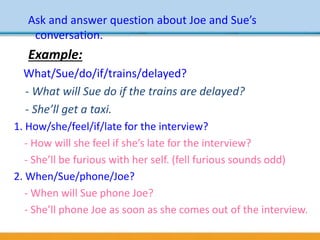
Ask and answer question about Joe and Sue’s
conversation.
Example:
What/Sue/do/if/trains/delayed?
- What will Sue do if the trains are delayed?
- She’ll get a taxi.
1. How/she/feel/if/late for the interview?
- How will she feel if she’s late for the interview?
- She’ll be furious with her self. (fell furious sounds odd)
2. When/Sue/phone/Joe?
- When will Sue phone Joe?
- She’ll phone Joe as soon as she comes out of the interview.
3. When/know/if/she’s got the job?
- When will she know if she’s got the job?
- In the next days.
4. What/she/do/if/they/offer her the job?
- What will she do if they offer her the job?
- She’ll accept it.
5. What/they/have to do/if/she/accept/job?
- What will they have to do if she accepts the job?
- They’ll have to move house.
6. What/Joe/do/when/get/office?
- What will Joe do when he gets to the office?
- He’ll look in his diary.
7. What/happen/if/Sue/not hurry?
- What will happen if Sue doesn’t hurry?
- She’ll miss the train.
Second Conditional
Form:
(+) If I won some money, I’d go round the world.
(-) I’d give up my job if I didn’t like it.
(?) If you needed help, who would you ask?
Note:
- was can change to were in the condition clause
if I were rich, I wouldn’t have to work
If he he
If + Past Simple + would
Second conditional
• The use:
1 - We use Second Conditional to express an unreal situation
and its probable result. The situation or condition is
improbable, impossible, imaginary, or contrary to known
facts.
- If my mother was still alive, she’d be very proud. (But
she’s dead.)
- If Ted needed any money, I’d lend it to him. (But he
doesn’t need it.)
2 - Other modal verbs are possible in the result clause.
-I could buy some new clothes if I had some money.
-If you wanted that job, you’d have to apply very soon.
3 - If I were you, I’d apologize to her.
- I’d take it easy for a while if I were you.
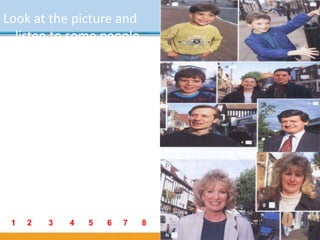
Look at the picture and
listen to some people
saying what they
would do if they won
$2 million. Try to guess
who says what and
write a number in the
box. Write notes on
what they would do
with it. Practise some
of the sentences.
1 2 3 4 5 6 7 8
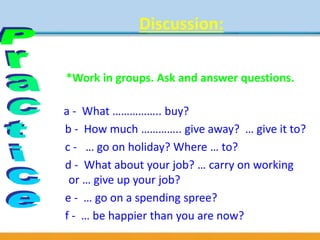
Discussion:
What would you do with two million
pounds?
*Work in groups. Ask and answer questions.
a - What …………….. buy?
b - How much ………….. give away? … give it to?
c - … go on holiday? Where … to?
d - What about your job? … carry on working
or … give up your job?
e - … go on a spending spree?
f - … be happier than you are now?
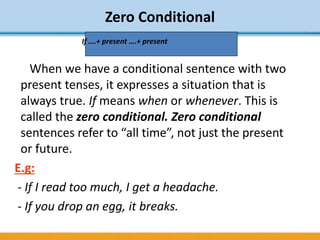
Zero Conditional
When we have a conditional sentence with two
present tenses, it expresses a situation that is
always true. If means when or whenever. This is
called the zero conditional. Zero conditional
sentences refer to “all time”, not just the present
or future.
E.g:
- If I read too much, I get a headache.
- If you drop an egg, it breaks.
If ….+ present ….+ present
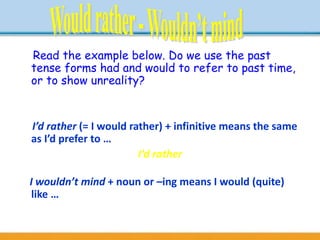
Read the example below. Do we use the past
tense forms had and would to refer to past time,
or to show unreality?
- If I had $2 million, I would go round the world.
I’d rather (= I would rather) + infinitive means the same
as I’d prefer to …
- I don’t like studying. I’d rather be outside playing
tennis.
I wouldn’t mind + noun or –ing means I would (quite)
like …
- I wouldn’t mind a cup of tea.
- I wouldn’t mind having a few weeks off work.
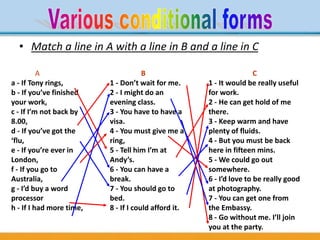
• Match a line in A with a line in B and a line in C
A
a - If Tony rings,
b - If you’ve finished
your work,
c - If I’m not back by
8.00,
d - If you’ve got the
‘flu,
e - If you’re ever in
London,
f - If you go to
Australia,
g - I’d buy a word
processor
h - If I had more time,
B
1 - Don’t wait for me.
2 - I might do an
evening class.
3 - You have to have a
visa.
4 - You must give me a
ring,
5 - Tell him I’m at
Andy’s.
6 - You can have a
break.
7 - You should go to
bed.
8 - If I could afford it.
C
1 - It would be really useful
for work.
2 - He can get hold of me
there.
3 - Keep warm and have
plenty of fluids.
4 - But you must be back
here in fifteen mins.
5 - We could go out
somewhere.
6 - I’d love to be really good
at photography.
7 - You can get one from
the Embassy.
8 - Go without me. I’ll join
you at the party.
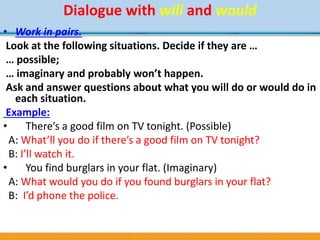
Dialogue with will and would
• Work in pairs.
Look at the following situations. Decide if they are …
… possible;
… imaginary and probably won’t happen.
Ask and answer questions about what you will do or would do in
each situation.
Example:
• There’s a good film on TV tonight. (Possible)
A: What’ll you do if there’s a good film on TV tonight?
B: I’ll watch it.
• You find burglars in your flat. (Imaginary)
A: What would you do if you found burglars in your flat?
B: I’d phone the police.
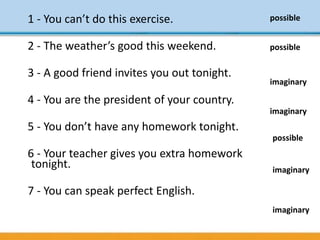
1 - You can’t do this exercise.
2 - The weather’s good this weekend.
3 - A good friend invites you out tonight.
4 - You are the president of your country.
5 - You don’t have any homework tonight.
6 - Your teacher gives you extra homework
tonight.
7 - You can speak perfect English.
possible
possible
imaginary
imaginary
imaginary
imaginary
possible
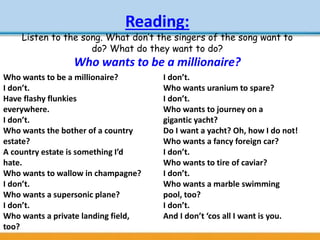
Reading:
Listen to the song. What don’t the singers of the song want to
do? What do they want to do?
Who wants to be a millionaire?
I don’t.
Who wants uranium to spare?
I don’t.
Who wants to journey on a
gigantic yacht?
Do I want a yacht? Oh, how I do not!
Who wants a fancy foreign car?
I don’t.
Who wants to tire of caviar?
I don’t.
Who wants a marble swimming
pool, too?
I don’t.
And I don’t ‘cos all I want is you.
Who wants to be a millionaire?
I don’t.
Have flashy flunkies
everywhere.
I don’t.
Who wants the bother of a country
estate?
A country estate is something I’d
hate.
Who wants to wallow in champagne?
I don’t.
Who wants a supersonic plane?
I don’t.
Who wants a private landing field,
too?
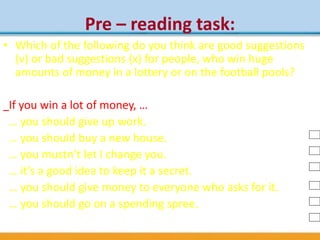
Pre – reading task:
• Which of the following do you think are good suggestions
(v) or bad suggestions (x) for people, who win huge
amounts of money in a lottery or on the football pools?
If you win a lot of money, …
… you should give up work.
… you should buy a new house.
… you mustn’t let I change you.
… it’s a good idea to keep it a secret.
… you should give money to everyone who asks for it.
… you should go on a spending spree.
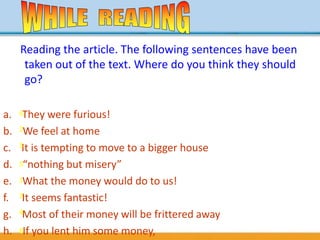
Reading the article. The following sentences have been
taken out of the text. Where do you think they should
go?
a. They were furious!
b. We feel at home
c. It is tempting to move to a bigger house
d. “nothing but misery”
e. What the money would do to us!
f. It seems fantastic!
g. Most of their money will be frittered away
h. If you lent him some money,
1
2
3
4
5
6
7
8
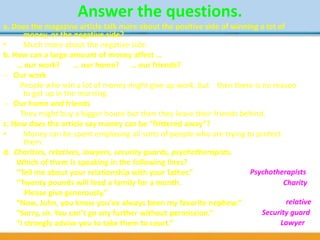
Answer the questions.
a. Does the magazine article talk more about the positive side of winning a lot of
money, or the negative side?
• Much more about the negative side.
b. How can a large amount of money affect …
… our work? … our home? … our friends?
- Our work
People who win a lot of money might give up work, but then there is no reason
to get up in the morning.
- Our home and friends
They might buy a bigger house but then they leave their friends behind.
c. How does the article say money can be “frittered away”?
• Money can be spent employing all sorts of people who are trying to protect
them.
d. Charities, relatives, lawyers, security guards, psychotherapists.
Which of them is speaking in the following lines?
“Tell me about your relationship with your father.”
“Twenty pounds will feed a family for a month.
Please give generously.”
“Now, John, you know you’ve always been my favorite nephew.”
“Sorry, sir. You can’t go any further without permission.”
“I strongly advise you to take them to court.”
Psychotherapists
Charity
relative
Security guard
Lawyer
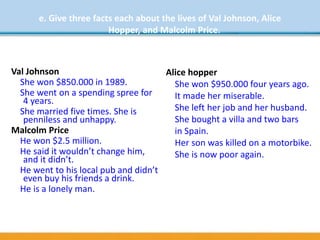
e. Give three facts each about the lives of Val Johnson, Alice
Hopper, and Malcolm Price.
Why are they all mentioned?
Val Johnson
She won $850.000 in 1989.
She went on a spending spree for
4 years.
She married five times. She is
penniless and unhappy.
Malcolm Price
He won $2.5 million.
He said it wouldn’t change him,
and it didn’t.
He went to his local pub and didn’t
even buy his friends a drink.
He is a lonely man.
Alice hopper
She won $950.000 four years ago.
It made her miserable.
She left her job and her husband.
She bought a villa and two bars
in Spain.
Her son was killed on a motorbike.
She is now poor again.
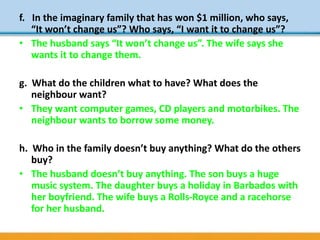
f. In the imaginary family that has won $1 million, who says,
“It won’t change us”? Who says, “I want it to change us”?
• The husband says “It won’t change us”. The wife says she
wants it to change them.
g. What do the children what to have? What does the
neighbour want?
• They want computer games, CD players and motorbikes. The
neighbour wants to borrow some money.
h. Who in the family doesn’t buy anything? What do the others
buy?
• The husband doesn’t buy anything. The son buys a huge
music system. The daughter buys a holiday in Barbados with
her boyfriend. The wife buys a Rolls-Royce and a racehorse
for her husband.
What do you think?
1. In what way is our life like a jigsaw?
Because the different parts of our life, for example, our
work, friends, and house, all go together.
2. How does winning a large amount of money smash
the jigsaw?
If something happens to one part of our lives, the other
parts are affected, too.
3. Why do we need work in our lives?
Work gives our life structure, and something to do
everyday.
4 - In the story of the family that has won $1 million, what is
joke about the toilet seat?
All the husband wants to do is fix the toilet seat, but nobody
else is interested. They want to spend their money on
much more exotic things.
5 - What does he mean when he says, “It won’t change us”?
What does his wife want to change?
He wants their life to be unchanged, presumably because
they are happy. His wife is looking forward to spending lots
of money.
6 - What for you are the answers to the questions in the last
paragraph of “Who wants to be a millionaire”?
Vocabulary
Find a word or words in the text that mean the same as the following
definitions. They are in the same order as they appear in the text.
a. not often
b. very big
c. break violently
d. area around your house
asking (for something)
very strongly
e. keep (something) safe,
defend
f. a time when you go
to the shops and spend
a lot of money
g. having not a penny
h. basic things to eat like
bread, sugar, vegetables
i. a hole through which
water gets in
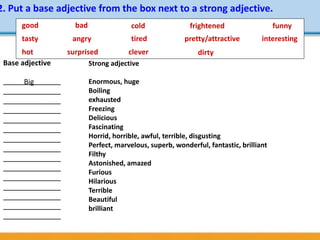
1. Some adjectives have the idea of very. Look at
these examples from the article on pages 80 –
81.
a huge windfall huge means very big
it seems fantastic fantastic means very good
It’ll be brilliant! Brilliant means very good
2. Put a base adjective from the box next to a strong adjective.
Base adjective
_____________
_____________
_____________
_____________
_____________
_____________
_____________
_____________
_____________
_____________
_____________
_____________
_____________
_____________
_____________
Strong adjective
Enormous, huge
Boiling
exhausted
Freezing
Delicious
Fascinating
Horrid, horrible, awful, terrible, disgusting
Perfect, marvelous, superb, wonderful, fantastic, brilliant
Filthy
Astonished, amazed
Furious
Hilarious
Terrible
Beautiful
brilliant
good bad cold frightened funny
tasty angry tired pretty/attractive interesting
hot surprised clever dirty
Big
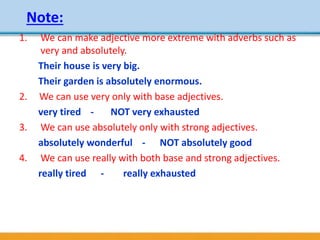
Note:
1. We can make adjective more extreme with adverbs such as
very and absolutely.
Their house is very big.
Their garden is absolutely enormous.
2. We can use very only with base adjectives.
very tired - NOT very exhausted
3. We can use absolutely only with strong adjectives.
absolutely wonderful - NOT absolutely good
4. We can use really with both base and strong adjectives.
really tired - really exhausted
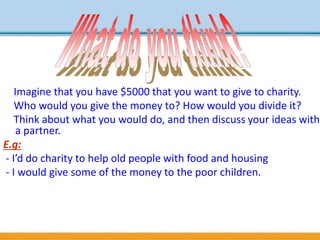
Imagine that you have $5000 that you want to give to charity.
Who would you give the money to? How would you divide it?
Think about what you would do, and then discuss your ideas with
a partner.
E.g:
- I’d do charity to help old people with food and housing
- I would give some of the money to the poor children.
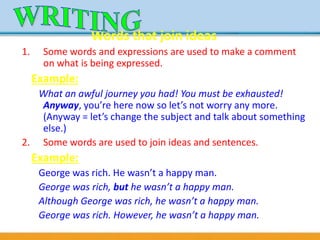
Words that join ideas
1. Some words and expressions are used to make a comment
on what is being expressed.
Example:
What an awful journey you had! You must be exhausted!
Anyway, you’re here now so let’s not worry any more.
(Anyway = let’s change the subject and talk about something
else.)
2. Some words are used to join ideas and sentences.
Example:
George was rich. He wasn’t a happy man.
George was rich, but he wasn’t a happy man.
Although George was rich, he wasn’t a happy man.
George was rich. However, he wasn’t a happy man.
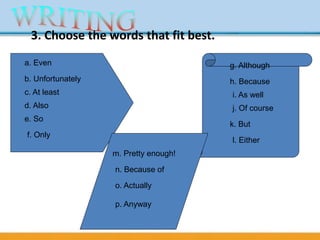
3. Choose the words that fit best.
a. Even
b. Unfortunately
c. At least
d. Also
e. So
f. Only
g. Although
h. Because
i. As well
j. Of course
k. But
l. Either
m. Pretty enough!
n. Because of
o. Actually
p. Anyway
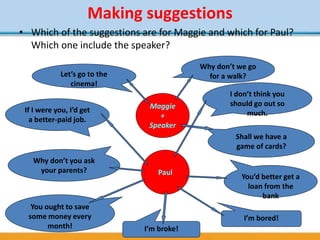
Making suggestions
• Which of the suggestions are for Maggie and which for Paul?
Which one include the speaker?
Let’s go to the
cinema!
Why don’t we go
for a walk?
If I were you, I’d get
a better-paid job.
I don’t think you
should go out so
much.
Why don’t you ask
your parents?
Shall we have a
game of cards?
You ought to save
some money every
month!
You’d better get a
loan from the
bank
I’m broke!
I’m bored!
Maggie
+
Speaker
Paul
Listen to Maggie & Paul.
Give some of the suggestion
Answers:
- Why don’t we … ?
- Let’s …
- Shall we … ?
- If I were you, I’d …
- You’d better …
- Why don’t you …
- You ought to …
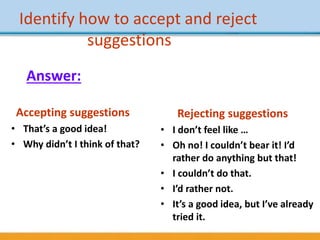
Identify how to accept and reject
suggestions
Accepting suggestions
• That’s a good idea!
• Why didn’t I think of that?
Rejecting suggestions
• I don’t feel like …
• Oh no! I couldn’t bear it! I’d
rather do anything but that!
• I couldn’t do that.
• I’d rather not.
• It’s a good idea, but I’ve already
tried it.
Answer:
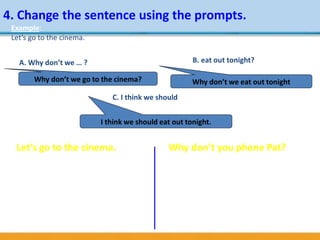
4. Change the sentence using the prompts.
Let’s go to the cinema.
a. Why don’t we … ?
b. redecorate the house
c. If I were you, I’d
d. buy some new clothes
e. Shall we …?
f. go shopping
Why don’t you phone Pat?
a. You’d better
b. tell the truth
c. You should
d. ought to
e. have a break
f. Let’s
Example:
Let’s go to the cinema.
A. Why don’t we … ? B. eat out tonight?
C. I think we should
Why don’t we go to the cinema? Why don’t we eat out tonight
I think we should eat out tonight.
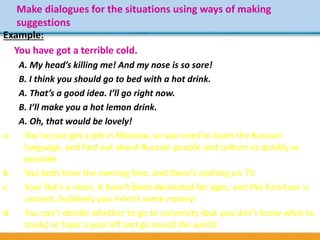
Make dialogues for the situations using ways of making
suggestions
Example:
You have got a terrible cold.
A. My head’s killing me! And my nose is so sore!
B. I think you should go to bed with a hot drink.
A. That’s a good idea. I’ll go right now.
B. I’ll make you a hot lemon drink.
A. Oh, that would be lovely!
a. You’ve just got a job in Moscow, so you need to learn the Russian
language, and find out about Russian people and culture as quickly as
possible.
b. You both have the evening free, and there’s nothing on TV.
c. Your flat’s a mess, it hasn’t been decorated for ages, and the furniture is
ancient. Suddenly you inherit some money!
d. You can’t decide whether to go to university (but you don’t know what to
study) or have a year off and go round the world.
1. Do all the exercises in work book.
2. Learn the conditionals and time clauses.
3. Prepare for the new lesson.
Thanks for your
attention
...
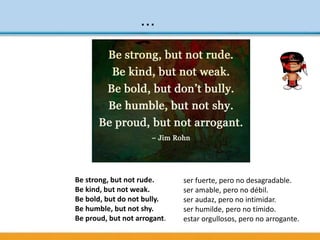
ser fuerte, pero no desagradable.
ser amable, pero no débil.
ser audaz, pero no intimidar.
ser humilde, pero no tímido.
estar orgullosos, pero no arrogante.
Be strong, but not rude.
Be kind, but not weak.
Be bold, but do not bully.
Be humble, but not shy.
Be proud, but not arrogant.
Bibliografia.
https://www.youtube.com/channel/UC6Je3-ZV_x38NqQAxKiCCyQ
https://www.youtube.com/watch?v=bZ_VL4dx3D4
https://www.youtube.com/watch?v=fNVpGqt2Bzs
https://www.youtube.com/watch?v=UayH1NmlzA4
https://www.facebook.com/tastemade/videos
https://www.facebook.com/tastemade/videos/970622743024893/
https://www.facebook.com/tastemade/videos/970620406358460/
http://travel.india.com/articles/10-endangered-animals-india-see-vanish/
Fin de la
presentación.
MUCHAS GRACIAS
Copyright 2016, Todos los Derechos
Reservados.
Sabiduría ante todo; adquiere sabiduría;
Y sobre todas tus posesiones adquiere
inteligencia.
Engrandécela, y ella te engrandecerá.
Proverbios 4:7-9
Dream big : Sueña en Grande
Never give up : Nunca te rindas
Do your best : Haz lo Mejor

New Headway Intermediate - Unit 8 Just imagine

  • 1.
    Unidad 8: Justimagine!. Temas: Conditionals,Time clauses, Base and strong adjectives, Making suggestions. Diego Hernando Torres Valencia Pagina web: http://www.ctc.edu.co/ Bilingüismo: Modulo 7 CTC : Centro Tecnológico de Cúcuta
  • 2.
    Formación Académica enIngles DIEGO HERNANDO TORRES VALENCIA si usted no está dispuesto aprender, nadie puede ayudarle. si usted está decidido aprender nadie puede detenerte Diego Hernando Torres Valencia
  • 3.
    CONTENIDO: CTC: Centro Tecnologicode Cucuta. Diego Hernando Torres Valencia Sabiduría ante todo; adquiere sabiduría; Y sobre todas tus posesiones adquiere inteligencia. Engrandécela, y ella te engrandecerá. Proverbios 4:7-9 Dream big : Sueña en Grande Never give up : Nunca te rindas Do your best : Haz lo Mejor CONTENIDO: 1. Conditionals. 2. Time clauses. 3. Base and strong adjectives. 4. Making suggestions. 5. … 6. Bibliografia
  • 4.
    4 New headway Intermediate: Student Book: Unidad 8 : Just Imagine Modulo 7: Unidad 8 Just imagine New-Headway Intermediate
  • 5.
    5 New-Headway Intermediate Modulo 7: Unidad 8 Justimagine YOU TUBE: https://www.youtube.com/watch?v=BO- 2AYjtYKA&index=8&list=PL87St7ckm1RhltI5ERJLlH9q6b30NmhBk Listening en You Tube:
  • 6.
    Unit 8: Justimagine !
  • 8.
    Main content 1.Grammar: • First,second zero conditionals • Various conditional forms • Time clauses: when, as soon as, before, until, after • would rather - wouldn’t mind 2. Vocabulary: • Base and strong adjectives • Making suggestions
  • 9.
    Test your grammar 1.Look at the pictures. Put the words under each picture in the right order to complete the sentences. a. I usually get the bus to school, but… get I if up late lift me Dad gives a my ~> if ________________________________________ b. I’ve got my driving test next week, and… pass I test the if buy I’ll car a new ~> if ________________________________________ c. I don’t have any money at all, but… million won I a if round I’d the pounds travel world ~> if ________________________________________ 2. Which situation: … is always true? … expresses a future possibility? … is possible but improbable? I get up late, my dad gives me a lift I pass the test, I’ll buy a new car I won a million pounds, I’d travel a round the world a b c
  • 10.
    First conditional Form: (+) IfI find your wallet, I’ll let you know. (-) If you lose your ticket, you won’t be able to go (?) What will you do if you don’t find a job? Note: - We don’t use will in the if clause. NOT * if you will leave now, you‘ll catch the train. * if I’ll go out tonight, I’ll give you a ring. - If can be replaced by unless (= if … not) or in case (= because of the possibility …). -Unless I hear from you, I’ll arrive at 8 o’clock. -I’ll take my umbrella in case it rains. If + Present Simple + Will + V
  • 11.
    First conditional 2 Wecan use the First Conditional to express different functions (all of which express a possible condition and a probable result.) - If you do that again, I’ll kill you! (= a threat) - Careful ! If you touch that, you I’ll burn yourself ! (= a warning) - I’ll post the letter if you like. (= an offer) - If you lend me $100, I’ll love you forever. (= a promise) Condition (if clause) If I find a jumper that suits you, If I arrive home early, If you can find my purse, Result (result clause) I’ll buy it for you. I’ll give you a ring. I might buy you a bicycle. • The use: 1 First Conditional sentences express a possible condition and its probable result in the future.
  • 12.
    • 1. Putthe words from the box in the gaps: Mum: Oh, dear! I hope everything will be all right. You’ve never been abroad before. Jim: Don’t worry, Mum. I _______ OK. I can look after myself. Anyway, I _______ with Anthony. We _______ anything stupid. Mum: But what ________ if you run out of money? Jim: We _________ a job of course! Mum: Oh. What about if you get lost? Jim: Mum! If we _______ lost, we _______ someone the way, but we _______ lost because we know where we’re going! Mum: Oh. All right. But what if …? ’ll be ’ll bewon’t do ’ll you do won’t get get‘ll ask ‘ll get
  • 13.
    • Get foodpoisoning • Lose your passport • Meet a girl who you fall in love with • Get sunburnt • Are homesick • Don’t like the food • Don’t understand the language • Don’t get on with Anthony • Are mugged 2. Make similar dialogues about other things that Jim’s mother is worried about. Use you and I. Oh dear! What will you do if you get food poisoning? Don’t worry, Mum. I’ll….
  • 14.
    3. Put theverb into the correct tense. Mum: But how will I know that you’re all right? Jim: When we _____(get) to a big city, I _____(send) you a postcard. Mum: Oh. But Jim, it’s such a long flight to Istanbul! Jim: Mum! As soon as we _____ (arrive) in Turkey, I _____ (give) you a ring! Mum: I _____(be) so worried until I _____(hear) from you. Jim: It’ll be OK, Mum. Honest! get ‘ll send ‘ll give ‘ll be arrive hear
  • 15.
    Time clauses: * Conjunctionof time: When, while, as soon as, after, before, until Note: - Conjunctions of time are not usually followed by will. They refer to future tense, but we use a present tense. I’ll phone you when I get home. As soon as dinner is ready, I’ll give you a call Conjunctions of time + Present Simple, S + will + V
  • 16.
    • Put if,when, or as soon as into each box. Put the verb into the correct tense. J: Goodbye, darling! Good luck with the interview! S: thanks, I’ll need it. I hope the trains are running on time. the trains _____(be) delayed, I ______ (get) a taxi. I ______(be) late for the interview, I ______ (be) furious with myself! J: Just keep calm! Phone me when you can. S: I will. I _____ (come) out of the interview, I _____ (give) you a ring. J: When ______ you ______ (know) you’ve got the job? S: They _____ (send) me a letter in the next few days. they _____ (offer) me the job, I _____ (accept) it, and I accept it, we _______(have to) move house. You know that, don’t you? J: Sure. But we’ll worry about that later. S: OK. What are you doing today? J: I can’t remember. I _____ (get) to the office, I _____ (look) in my diary. I don’t think I’m doing much today. S: Don’t forget to pick up the children you ______ (get) back from work. J: I won’t. You’d better go now. you _______ (not hurry), you _____ (miss) the train. S: OK. I _____ (see) you this evening. Bye! J : Bye, my love. Take care., and good luck ! are ‘ll get am come ‘ll give will know ‘ll send offer ‘ll accept ‘ll have to get ‘ll look get don’t hurry ‘ll miss ‘ll see ‘ll be if if As soon as if if if when when if
  • 17.
    Ask and answerquestion about Joe and Sue’s conversation. Example: What/Sue/do/if/trains/delayed? - What will Sue do if the trains are delayed? - She’ll get a taxi. 1. How/she/feel/if/late for the interview? - How will she feel if she’s late for the interview? - She’ll be furious with her self. (fell furious sounds odd) 2. When/Sue/phone/Joe? - When will Sue phone Joe? - She’ll phone Joe as soon as she comes out of the interview.
  • 18.
    3. When/know/if/she’s gotthe job? - When will she know if she’s got the job? - In the next days. 4. What/she/do/if/they/offer her the job? - What will she do if they offer her the job? - She’ll accept it. 5. What/they/have to do/if/she/accept/job? - What will they have to do if she accepts the job? - They’ll have to move house. 6. What/Joe/do/when/get/office? - What will Joe do when he gets to the office? - He’ll look in his diary. 7. What/happen/if/Sue/not hurry? - What will happen if Sue doesn’t hurry? - She’ll miss the train.
  • 19.
    Second Conditional Form: (+) IfI won some money, I’d go round the world. (-) I’d give up my job if I didn’t like it. (?) If you needed help, who would you ask? Note: - was can change to were in the condition clause if I were rich, I wouldn’t have to work If he he If + Past Simple + would
  • 20.
    Second conditional • Theuse: 1 - We use Second Conditional to express an unreal situation and its probable result. The situation or condition is improbable, impossible, imaginary, or contrary to known facts. - If my mother was still alive, she’d be very proud. (But she’s dead.) - If Ted needed any money, I’d lend it to him. (But he doesn’t need it.) 2 - Other modal verbs are possible in the result clause. -I could buy some new clothes if I had some money. -If you wanted that job, you’d have to apply very soon. 3 - If I were you, I’d apologize to her. - I’d take it easy for a while if I were you.
  • 21.
    Look at thepicture and listen to some people saying what they would do if they won $2 million. Try to guess who says what and write a number in the box. Write notes on what they would do with it. Practise some of the sentences. 1 2 3 4 5 6 7 8
  • 22.
    Discussion: What would youdo with two million pounds? *Work in groups. Ask and answer questions. a - What …………….. buy? b - How much ………….. give away? … give it to? c - … go on holiday? Where … to? d - What about your job? … carry on working or … give up your job? e - … go on a spending spree? f - … be happier than you are now?
  • 23.
    Zero Conditional When wehave a conditional sentence with two present tenses, it expresses a situation that is always true. If means when or whenever. This is called the zero conditional. Zero conditional sentences refer to “all time”, not just the present or future. E.g: - If I read too much, I get a headache. - If you drop an egg, it breaks. If ….+ present ….+ present
  • 24.
    Read the examplebelow. Do we use the past tense forms had and would to refer to past time, or to show unreality? - If I had $2 million, I would go round the world. I’d rather (= I would rather) + infinitive means the same as I’d prefer to … - I don’t like studying. I’d rather be outside playing tennis. I wouldn’t mind + noun or –ing means I would (quite) like … - I wouldn’t mind a cup of tea. - I wouldn’t mind having a few weeks off work.
  • 25.
    • Match aline in A with a line in B and a line in C A a - If Tony rings, b - If you’ve finished your work, c - If I’m not back by 8.00, d - If you’ve got the ‘flu, e - If you’re ever in London, f - If you go to Australia, g - I’d buy a word processor h - If I had more time, B 1 - Don’t wait for me. 2 - I might do an evening class. 3 - You have to have a visa. 4 - You must give me a ring, 5 - Tell him I’m at Andy’s. 6 - You can have a break. 7 - You should go to bed. 8 - If I could afford it. C 1 - It would be really useful for work. 2 - He can get hold of me there. 3 - Keep warm and have plenty of fluids. 4 - But you must be back here in fifteen mins. 5 - We could go out somewhere. 6 - I’d love to be really good at photography. 7 - You can get one from the Embassy. 8 - Go without me. I’ll join you at the party.
  • 26.
    Dialogue with willand would • Work in pairs. Look at the following situations. Decide if they are … … possible; … imaginary and probably won’t happen. Ask and answer questions about what you will do or would do in each situation. Example: • There’s a good film on TV tonight. (Possible) A: What’ll you do if there’s a good film on TV tonight? B: I’ll watch it. • You find burglars in your flat. (Imaginary) A: What would you do if you found burglars in your flat? B: I’d phone the police.
  • 27.
    1 - Youcan’t do this exercise. 2 - The weather’s good this weekend. 3 - A good friend invites you out tonight. 4 - You are the president of your country. 5 - You don’t have any homework tonight. 6 - Your teacher gives you extra homework tonight. 7 - You can speak perfect English. possible possible imaginary imaginary imaginary imaginary possible
  • 28.
    Reading: Listen to thesong. What don’t the singers of the song want to do? What do they want to do? Who wants to be a millionaire? I don’t. Who wants uranium to spare? I don’t. Who wants to journey on a gigantic yacht? Do I want a yacht? Oh, how I do not! Who wants a fancy foreign car? I don’t. Who wants to tire of caviar? I don’t. Who wants a marble swimming pool, too? I don’t. And I don’t ‘cos all I want is you. Who wants to be a millionaire? I don’t. Have flashy flunkies everywhere. I don’t. Who wants the bother of a country estate? A country estate is something I’d hate. Who wants to wallow in champagne? I don’t. Who wants a supersonic plane? I don’t. Who wants a private landing field, too?
  • 29.
    Pre – readingtask: • Which of the following do you think are good suggestions (v) or bad suggestions (x) for people, who win huge amounts of money in a lottery or on the football pools? If you win a lot of money, … … you should give up work. … you should buy a new house. … you mustn’t let I change you. … it’s a good idea to keep it a secret. … you should give money to everyone who asks for it. … you should go on a spending spree.
  • 30.
    Reading the article.The following sentences have been taken out of the text. Where do you think they should go? a. They were furious! b. We feel at home c. It is tempting to move to a bigger house d. “nothing but misery” e. What the money would do to us! f. It seems fantastic! g. Most of their money will be frittered away h. If you lent him some money, 1 2 3 4 5 6 7 8
  • 31.
    Answer the questions. a.Does the magazine article talk more about the positive side of winning a lot of money, or the negative side? • Much more about the negative side. b. How can a large amount of money affect … … our work? … our home? … our friends? - Our work People who win a lot of money might give up work, but then there is no reason to get up in the morning. - Our home and friends They might buy a bigger house but then they leave their friends behind. c. How does the article say money can be “frittered away”? • Money can be spent employing all sorts of people who are trying to protect them. d. Charities, relatives, lawyers, security guards, psychotherapists. Which of them is speaking in the following lines? “Tell me about your relationship with your father.” “Twenty pounds will feed a family for a month. Please give generously.” “Now, John, you know you’ve always been my favorite nephew.” “Sorry, sir. You can’t go any further without permission.” “I strongly advise you to take them to court.” Psychotherapists Charity relative Security guard Lawyer
  • 32.
    e. Give threefacts each about the lives of Val Johnson, Alice Hopper, and Malcolm Price. Why are they all mentioned? Val Johnson She won $850.000 in 1989. She went on a spending spree for 4 years. She married five times. She is penniless and unhappy. Malcolm Price He won $2.5 million. He said it wouldn’t change him, and it didn’t. He went to his local pub and didn’t even buy his friends a drink. He is a lonely man. Alice hopper She won $950.000 four years ago. It made her miserable. She left her job and her husband. She bought a villa and two bars in Spain. Her son was killed on a motorbike. She is now poor again.
  • 33.
    f. In theimaginary family that has won $1 million, who says, “It won’t change us”? Who says, “I want it to change us”? • The husband says “It won’t change us”. The wife says she wants it to change them. g. What do the children what to have? What does the neighbour want? • They want computer games, CD players and motorbikes. The neighbour wants to borrow some money. h. Who in the family doesn’t buy anything? What do the others buy? • The husband doesn’t buy anything. The son buys a huge music system. The daughter buys a holiday in Barbados with her boyfriend. The wife buys a Rolls-Royce and a racehorse for her husband.
  • 34.
    What do youthink? 1. In what way is our life like a jigsaw? Because the different parts of our life, for example, our work, friends, and house, all go together. 2. How does winning a large amount of money smash the jigsaw? If something happens to one part of our lives, the other parts are affected, too. 3. Why do we need work in our lives? Work gives our life structure, and something to do everyday.
  • 35.
    4 - Inthe story of the family that has won $1 million, what is joke about the toilet seat? All the husband wants to do is fix the toilet seat, but nobody else is interested. They want to spend their money on much more exotic things. 5 - What does he mean when he says, “It won’t change us”? What does his wife want to change? He wants their life to be unchanged, presumably because they are happy. His wife is looking forward to spending lots of money. 6 - What for you are the answers to the questions in the last paragraph of “Who wants to be a millionaire”?
  • 36.
    Vocabulary Find a wordor words in the text that mean the same as the following definitions. They are in the same order as they appear in the text. a. not often b. very big c. break violently d. area around your house asking (for something) very strongly e. keep (something) safe, defend f. a time when you go to the shops and spend a lot of money g. having not a penny h. basic things to eat like bread, sugar, vegetables i. a hole through which water gets in
  • 37.
    1. Some adjectiveshave the idea of very. Look at these examples from the article on pages 80 – 81. a huge windfall huge means very big it seems fantastic fantastic means very good It’ll be brilliant! Brilliant means very good
  • 38.
    2. Put abase adjective from the box next to a strong adjective. Base adjective _____________ _____________ _____________ _____________ _____________ _____________ _____________ _____________ _____________ _____________ _____________ _____________ _____________ _____________ _____________ Strong adjective Enormous, huge Boiling exhausted Freezing Delicious Fascinating Horrid, horrible, awful, terrible, disgusting Perfect, marvelous, superb, wonderful, fantastic, brilliant Filthy Astonished, amazed Furious Hilarious Terrible Beautiful brilliant good bad cold frightened funny tasty angry tired pretty/attractive interesting hot surprised clever dirty Big
  • 39.
    Note: 1. We canmake adjective more extreme with adverbs such as very and absolutely. Their house is very big. Their garden is absolutely enormous. 2. We can use very only with base adjectives. very tired - NOT very exhausted 3. We can use absolutely only with strong adjectives. absolutely wonderful - NOT absolutely good 4. We can use really with both base and strong adjectives. really tired - really exhausted
  • 40.
    Imagine that youhave $5000 that you want to give to charity. Who would you give the money to? How would you divide it? Think about what you would do, and then discuss your ideas with a partner. E.g: - I’d do charity to help old people with food and housing - I would give some of the money to the poor children.
  • 41.
    Words that joinideas 1. Some words and expressions are used to make a comment on what is being expressed. Example: What an awful journey you had! You must be exhausted! Anyway, you’re here now so let’s not worry any more. (Anyway = let’s change the subject and talk about something else.) 2. Some words are used to join ideas and sentences. Example: George was rich. He wasn’t a happy man. George was rich, but he wasn’t a happy man. Although George was rich, he wasn’t a happy man. George was rich. However, he wasn’t a happy man.
  • 42.
    3. Choose thewords that fit best. a. Even b. Unfortunately c. At least d. Also e. So f. Only g. Although h. Because i. As well j. Of course k. But l. Either m. Pretty enough! n. Because of o. Actually p. Anyway
  • 43.
    Making suggestions • Whichof the suggestions are for Maggie and which for Paul? Which one include the speaker? Let’s go to the cinema! Why don’t we go for a walk? If I were you, I’d get a better-paid job. I don’t think you should go out so much. Why don’t you ask your parents? Shall we have a game of cards? You ought to save some money every month! You’d better get a loan from the bank I’m broke! I’m bored! Maggie + Speaker Paul
  • 44.
    Listen to Maggie& Paul. Give some of the suggestion Answers: - Why don’t we … ? - Let’s … - Shall we … ? - If I were you, I’d … - You’d better … - Why don’t you … - You ought to …
  • 45.
    Identify how toaccept and reject suggestions Accepting suggestions • That’s a good idea! • Why didn’t I think of that? Rejecting suggestions • I don’t feel like … • Oh no! I couldn’t bear it! I’d rather do anything but that! • I couldn’t do that. • I’d rather not. • It’s a good idea, but I’ve already tried it. Answer:
  • 46.
    4. Change thesentence using the prompts. Let’s go to the cinema. a. Why don’t we … ? b. redecorate the house c. If I were you, I’d d. buy some new clothes e. Shall we …? f. go shopping Why don’t you phone Pat? a. You’d better b. tell the truth c. You should d. ought to e. have a break f. Let’s Example: Let’s go to the cinema. A. Why don’t we … ? B. eat out tonight? C. I think we should Why don’t we go to the cinema? Why don’t we eat out tonight I think we should eat out tonight.
  • 47.
    Make dialogues forthe situations using ways of making suggestions Example: You have got a terrible cold. A. My head’s killing me! And my nose is so sore! B. I think you should go to bed with a hot drink. A. That’s a good idea. I’ll go right now. B. I’ll make you a hot lemon drink. A. Oh, that would be lovely! a. You’ve just got a job in Moscow, so you need to learn the Russian language, and find out about Russian people and culture as quickly as possible. b. You both have the evening free, and there’s nothing on TV. c. Your flat’s a mess, it hasn’t been decorated for ages, and the furniture is ancient. Suddenly you inherit some money! d. You can’t decide whether to go to university (but you don’t know what to study) or have a year off and go round the world.
  • 48.
    1. Do allthe exercises in work book. 2. Learn the conditionals and time clauses. 3. Prepare for the new lesson.
  • 49.
  • 51.
    ... ser fuerte, perono desagradable. ser amable, pero no débil. ser audaz, pero no intimidar. ser humilde, pero no tímido. estar orgullosos, pero no arrogante. Be strong, but not rude. Be kind, but not weak. Be bold, but do not bully. Be humble, but not shy. Be proud, but not arrogant.
  • 53.
  • 54.
    Fin de la presentación. MUCHASGRACIAS Copyright 2016, Todos los Derechos Reservados. Sabiduría ante todo; adquiere sabiduría; Y sobre todas tus posesiones adquiere inteligencia. Engrandécela, y ella te engrandecerá. Proverbios 4:7-9 Dream big : Sueña en Grande Never give up : Nunca te rindas Do your best : Haz lo Mejor