Reading unit 5
1 Read the text and underline a First and Second Conditional sentence.
2 Answer the questions.
1. Why did Dr Jacobs create the time capsule?
He decided to preserve modern civilisation because he wanted to make it easy for the historians of the future to
understand life in the early 20th century
2. Why are the Bible and the Koranmentioned? Important books were locked in the capsule. They are the Bible and
Koran
.....................................................................................................................................................
2. How did Dr Jacobs try to make sure that the room would remain locked for 6,000years?
he put a sign over the locked door. The sign requests that nobody open the room until the year 8113
3. What are some problems of the time capsule?
It’s possible that the items in the room won’t survive for such a long time. What’s more, we won’t know if the
people in the future will be able to identify the objects, and understand what they were used for
Complete the sentences according to the text. Use conditionals in your answers.
1. If someone opened the time capsule, they would find objects that portray modern civilisation
. 2. Dr Jacobs wouldn’t have been disturbed if there would have been information about
how people lived in ancient times
3. Dr Jacobs wouldn’t have put a sign over the room if nobody had opened the room
THE FIRST MODERN TIME CAPSULE
What would you expect to see if you found a time capsule from thousands of years ago? Well,
at the Ogelthorpe University in Georgia, USA there is a room that was locked more than 70
years ago and it is intended to stay locked for the next 6,000 years. The room is filled with
objects that are meant to portray modern civilisation.
This project was the idea of Dr Thornwell Jacobs. He was a teacher of ancient history and
it disturbed him that there was not a lot of information about how people lived in ancient
times.
He decided to preserve modern civilisation because he wanted to make it easy for the
historians of the future to understand life in the early 20th century. So, he decided to store
items which represent modern civilisation.
Jacobs and his students included famous books, such as the Bible and the Koran, in the time
capsule. They also collected photographs, films and voice recordings of world political
leaders. In addition, they collected items from daily life, including a sewing machine, an
early television and a telephone.
Jacobs was very worried that someone would open the room, so he put a sign over the locked
door. The sign requests that nobody open the room until the year 8113. However, if the time
capsule remains locked for the next 6,000 years, how useful will it be when it’s finally opened?
It’s possible that the items in the room won’t survive for such a long time. What’s more, we
won’t know if the people in the future will be able to identify the objects, and
understand what they were used for. However, if people do make sense of them, they will
certainly learn a lot about life in the 20th century.
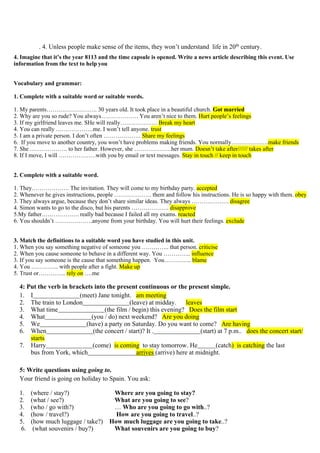
. 4. Unless people make sense of the items, they won’t understand life in 20th
century.
4. Imagine that it’s the year 8113 and the time capsule is opened. Write a news article describing this event. Use
information from the text to help you
Vocabulary and grammar:
1. Complete with a suitable word or suitable words.
1. My parents…………………….. 30 years old. It took place in a beautiful church. Got married
2. Why are you so rude? You always………………. You aren’t nice to them. Hurt people’s feelings
3. If my girlfriend leaves me. SHe will really………………. Break my heart
4. You can really ……………….me. I won’t tell anyone. trust
5. I am a private person. I don’t often ………………. Share my feelings
6. If you move to another country, you won’t have problems making friends. You normally……………….make friends
7. She ………………. to her father. However, she ……………….her mum. Doesn’t take after////// takes after
8. If I move, I will ……………….with you by email or text messages. Stay in touch // keep in touch
2. Complete with a suitable word.
1. They………………. The invitation. They will come to my birthday party. accepted
2. Whenever he gives instructions, people ………………. them and follow his instructions. He is so happy with them. obey
3. They always argue, because they don’t share similar ideas. They always ………………. disagree
4. Simon wants to go to the disco, but his parents ………………. disapprove
5.My father………………. really bad because I failed all my exams. reacted
6. You shouldn’t ……………….anyone from your birthday. You will hurt their feelings. exclude
3. Match the definitions to a suitable word you have studied in this unit.
1. When you say something negative of someone you ………….. that person. criticise
2. When you cause someone to behave in a different way. You ………….. influence
3. If you say someone is the cause that something happen. You………….. blame
4. You ………….. with people after a fight. Make up
5. Trust or………….. rely on ….me
4: Put the verb in brackets into the present continuous or the present simple.
1. I (meet) Jane tonight. am meeting
2. The train to London (leave) at midday. leaves
3. What time (the film / begin) this evening? Does the film start
4. What (you / do) next weekend? Are you doing
5. We (have) a party on Saturday. Do you want to come? Are having
6. When (the concert / start)? It . (start) at 7 p.m.. does the concert start/
starts
7. Harry (come) is coming to stay tomorrow. He (catch) is catching the last
bus from York, which arrives (arrive) here at midnight.
5: Write questions using going to.
Your friend is going on holiday to Spain. You ask:
1. (where / stay?) Where are you going to stay?
2. (what / see?) What are you going to see?
3. (who / go with?) … Who are you going to go with..?
4. (how / travel?) How are you going to travel..?
5. (how much luggage / take?) How much luggage are you going to take..?
6. (what souvenirs / buy?) What souvenirs are you going to buy?
6: Use going to and the words in brackets to say what is going to happen in these situations.
1. There are a lot of black clouds in the sky. (rain) It's going to rain.
2. The cat has seen a mouse. (chase) It is going to chase the mouse
3. There is a large hole in the bottom of the boat. (sink) It is going to sink
4. It is 7:45 and John is asleep. His train leaves at 7:50. (miss) John is going to miss the train
5. A car thief is looking around a car park. (steal) He is going to steal a car
6. A bungee jumper is standing on a high bridge. (jump) He / she is going to jump from the bridge
7: Choose the correct form of the verb.
1. I'll meet / I'm meeting Jane in town tonight.
2. Louise can't come. She is taking / will take the car to the garage at 5 p.m.
3. What time does your train leave / will your train leave tomorrow?
4. 'I'm very thirsty.' 'I'll get / I get you something to drink. Coke or tea?'
5. This bus is stopping / stops at every village, so it's very slow!
6. 'Did you buy some butter?' 'Oh, I forgot. I'll get / I'm getting some now.'
7. I think it rains / will rain later today.
8. 'Have you chosen a new car yet?' 'Yes, we are going to buy / we will buy a Ford Focus.'
9. 'Why have you put the TV on?' I'm going to watch / I will watch the news.'
10. 'Frank, I can't go out because I haven't got any money.' 'Don't worry. I lend you / I'll lend you
some.'
11. Shall / Will I carry that for you?
8. Write sentences with the words below. Use the First Conditional.
1. if / you / exercise / more / you / feel / better
if you exercise more you will feel better
2. she / be / late / if / she / not leave / now
she will be late if she doesn’t leave now
3. Jenny / not forgive / you / if / you / not apologise
Jenny wont forgive you if you don’t apologise
4.he / call / if / he / need / help
he will call if he needs help
9. Complete the sentences with the verbs in brackets. Use the SECOND CONDITIONAL.
1. If I were (be) you, I would tell (tell) John the truth.
2. If the weather were (be) better, we would eat (eat) in the garden.
3. If you won (win) £1 million, would you share (share) it with
me?
4. We wouldn’t ask (not ask) for your help if we didn’t need (not need) it.
5. If I owned (own) a car company, I would produce (produce) solar- powered cars.
6. He would move (move) to London if he found (find) a job there.
10.Write another sentence about what might have happened in the situations
below. Use the Third Conditional and the words in brackets. No for exam
1. Greg missed the bus this morning.
(catch the bus / wake up on time)
If Greg had woken up on time, he would
have caught the bus
2. Diane fell and broke her leg.
(not fall / the floor not be wet)
If the floor hadn’t been wet, Diane wouldn’t have fallen
3. I enjoyed the party because you were there. (you
not come / not have a good time)
If you hadn’t come to the party, I wouldn’t have
had a good time
4. We didn’t know you were in hospital.
(visit you / someone tell us)
If someone had told us you were in hospital, we would have visited you
5. Luckily no one was killed in the fire
If firefighters hadn’t arrived quickly, many people wouldn’t have survived
(firefighters not arrive quickly / many people not survive)
............................................................................................................................................
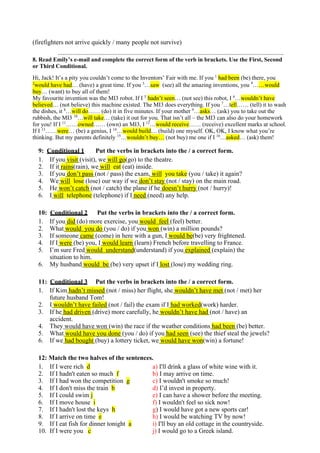
8. Read Emily’s e-mail and complete the correct form of the verb in brackets. Use the First, Second
or Third Conditional.
Hi, Jack! It’s a pity you couldn’t come to the Inventors’ Fair with me. If you 1
had been (be) there, you
2
would have had… (have) a great time. If you 3
…saw (see) all the amazing inventions, you 4
……would
buy… (want) to buy all of them!
My favourite invention was the MI3 robot. If I 5
hadn’t seen… (not see) this robot, I 6
…wouldn’t have
believed… (not believe) this machine existed. The MI3 does everything. If you 7
…tell…… (tell) it to wash
the dishes, it 8
…will do…… (do) it in five minutes. If your mother 9
…asks… (ask) you to take out the
rubbish, the MI3 10
…will take… (take) it out for you. That isn’t all – the MI3 can also do your homework
for you! If I 11
……owned…… (own) an MI3, I 12
…would receive…… (receive) excellent marks at school.
If I 13
……were… (be) a genius, I 14
…would build… (build) one myself. OK, OK, I know what you’re
thinking. But my parents definitely 15
…wouldn’t buy… (not buy) me one if I 16
…asked… (ask) them!
9: Conditional 1 Put the verbs in brackets into the / a correct form.
1. If you visit (visit), we will go(go) to the theatre.
2. If it rains(rain), we will eat (eat) inside.
3. If you don’t pass (not / pass) the exam, will you take (you / take) it again?
4. We will lose (lose) our way if we don’t stay (not / stay) on the main road.
5. He won’t catch (not / catch) the plane if he doesn’t hurry (not / hurry)!
6. I will telephone (telephone) if I need (need) any help.
10: Conditional 2 Put the verbs in brackets into the / a correct form.
1. If you did (do) more exercise, you would feel (feel) better.
2. What would you do (you / do) if you won (win) a million pounds?
3. If someone came (come) in here with a gun, I would be(be) very frightened.
4. If I were (be) you, I would learn (learn) French before travelling to France.
5. I’m sure Fred would understand(understand) if you explained (explain) the
situation to him.
6. My husband would be (be) very upset if I lost (lose) my wedding ring.
11: Conditional 3 Put the verbs in brackets into the / a correct form.
1. If Kim hadn’t missed (not / miss) her flight, she wouldn’t have met (not / met) her
future husband Tom!
2. I wouldn’t have failed (not / fail) the exam if I had worked(work) harder.
3. If he had driven (drive) more carefully, he wouldn’t have had (not / have) an
accident.
4. They would have won (win) the race if the weather conditions had been (be) better.
5. What would have you done (you / do) if you had seen (see) the thief steal the jewels?
6. If we had bought (buy) a lottery ticket, we would have won(win) a fortune!
12: Match the two halves of the sentences.
1. If I were rich d a) I'll drink a glass of white wine with it.
2. If I hadn't eaten so much f b) I may arrive on time.
3. If I had won the competition g c) I wouldn't smoke so much!
4. If I don't miss the train b d) I’d invest in property.
5. If I could swim j e) I can have a shower before the meeting.
6. If I move house i f) I wouldn't feel so sick now!
7. If I hadn't lost the keys h g) I would have got a new sports car!
8. If I arrive on time e h) I would be watching TV by now!
9. If I eat fish for dinner tonight a i) I'll buy an old cottage in the countryside.
10. If I were you c j) I would go to a Greek island.
13: Write sentences beginning I wish...
1. It's raining, and you hate the rain. I wish it wasn't raining.
2. You live in a big city and you don't like it. I wish I lived in a village.
3. You're poor, but you'd like to be rich! I wish I were rich
4. You haven't got a car and you need one. I wish I had a new car
5. You would like to own a dog. I wish I owned a dog
6. You can't speak a foreign language. I wish I could speak a foreign language
7. A friend hasn't arrived and that's a pity. I wish my friend arrived
8. You have eaten too much and feel ill. I wish I didn’t eat too much
9. You have lost your purse. I wish I didn’t lose my purse
10. You have missed the last bus home. I wish I didn’t miss the last bus home
11. You failed your exam because you didn't work hard enough. I wish I worked hard enough
12. You have just watched a terrifying horror film and regret it! I wish I didn’t watch a
terrifying horror film
unit-5-future-and-conditional-sentences-answers-1.pdf

unit-5-future-and-conditional-sentences-answers-1.pdf

  • 1.
    Reading unit 5 1Read the text and underline a First and Second Conditional sentence. 2 Answer the questions. 1. Why did Dr Jacobs create the time capsule? He decided to preserve modern civilisation because he wanted to make it easy for the historians of the future to understand life in the early 20th century 2. Why are the Bible and the Koranmentioned? Important books were locked in the capsule. They are the Bible and Koran ..................................................................................................................................................... 2. How did Dr Jacobs try to make sure that the room would remain locked for 6,000years? he put a sign over the locked door. The sign requests that nobody open the room until the year 8113 3. What are some problems of the time capsule? It’s possible that the items in the room won’t survive for such a long time. What’s more, we won’t know if the people in the future will be able to identify the objects, and understand what they were used for Complete the sentences according to the text. Use conditionals in your answers. 1. If someone opened the time capsule, they would find objects that portray modern civilisation . 2. Dr Jacobs wouldn’t have been disturbed if there would have been information about how people lived in ancient times 3. Dr Jacobs wouldn’t have put a sign over the room if nobody had opened the room THE FIRST MODERN TIME CAPSULE What would you expect to see if you found a time capsule from thousands of years ago? Well, at the Ogelthorpe University in Georgia, USA there is a room that was locked more than 70 years ago and it is intended to stay locked for the next 6,000 years. The room is filled with objects that are meant to portray modern civilisation. This project was the idea of Dr Thornwell Jacobs. He was a teacher of ancient history and it disturbed him that there was not a lot of information about how people lived in ancient times. He decided to preserve modern civilisation because he wanted to make it easy for the historians of the future to understand life in the early 20th century. So, he decided to store items which represent modern civilisation. Jacobs and his students included famous books, such as the Bible and the Koran, in the time capsule. They also collected photographs, films and voice recordings of world political leaders. In addition, they collected items from daily life, including a sewing machine, an early television and a telephone. Jacobs was very worried that someone would open the room, so he put a sign over the locked door. The sign requests that nobody open the room until the year 8113. However, if the time capsule remains locked for the next 6,000 years, how useful will it be when it’s finally opened? It’s possible that the items in the room won’t survive for such a long time. What’s more, we won’t know if the people in the future will be able to identify the objects, and understand what they were used for. However, if people do make sense of them, they will certainly learn a lot about life in the 20th century.
  • 2.
    . 4. Unlesspeople make sense of the items, they won’t understand life in 20th century. 4. Imagine that it’s the year 8113 and the time capsule is opened. Write a news article describing this event. Use information from the text to help you Vocabulary and grammar: 1. Complete with a suitable word or suitable words. 1. My parents…………………….. 30 years old. It took place in a beautiful church. Got married 2. Why are you so rude? You always………………. You aren’t nice to them. Hurt people’s feelings 3. If my girlfriend leaves me. SHe will really………………. Break my heart 4. You can really ……………….me. I won’t tell anyone. trust 5. I am a private person. I don’t often ………………. Share my feelings 6. If you move to another country, you won’t have problems making friends. You normally……………….make friends 7. She ………………. to her father. However, she ……………….her mum. Doesn’t take after////// takes after 8. If I move, I will ……………….with you by email or text messages. Stay in touch // keep in touch 2. Complete with a suitable word. 1. They………………. The invitation. They will come to my birthday party. accepted 2. Whenever he gives instructions, people ………………. them and follow his instructions. He is so happy with them. obey 3. They always argue, because they don’t share similar ideas. They always ………………. disagree 4. Simon wants to go to the disco, but his parents ………………. disapprove 5.My father………………. really bad because I failed all my exams. reacted 6. You shouldn’t ……………….anyone from your birthday. You will hurt their feelings. exclude 3. Match the definitions to a suitable word you have studied in this unit. 1. When you say something negative of someone you ………….. that person. criticise 2. When you cause someone to behave in a different way. You ………….. influence 3. If you say someone is the cause that something happen. You………….. blame 4. You ………….. with people after a fight. Make up 5. Trust or………….. rely on ….me 4: Put the verb in brackets into the present continuous or the present simple. 1. I (meet) Jane tonight. am meeting 2. The train to London (leave) at midday. leaves 3. What time (the film / begin) this evening? Does the film start 4. What (you / do) next weekend? Are you doing 5. We (have) a party on Saturday. Do you want to come? Are having 6. When (the concert / start)? It . (start) at 7 p.m.. does the concert start/ starts 7. Harry (come) is coming to stay tomorrow. He (catch) is catching the last bus from York, which arrives (arrive) here at midnight. 5: Write questions using going to. Your friend is going on holiday to Spain. You ask: 1. (where / stay?) Where are you going to stay? 2. (what / see?) What are you going to see? 3. (who / go with?) … Who are you going to go with..? 4. (how / travel?) How are you going to travel..? 5. (how much luggage / take?) How much luggage are you going to take..? 6. (what souvenirs / buy?) What souvenirs are you going to buy?
  • 3.
    6: Use goingto and the words in brackets to say what is going to happen in these situations. 1. There are a lot of black clouds in the sky. (rain) It's going to rain. 2. The cat has seen a mouse. (chase) It is going to chase the mouse 3. There is a large hole in the bottom of the boat. (sink) It is going to sink 4. It is 7:45 and John is asleep. His train leaves at 7:50. (miss) John is going to miss the train 5. A car thief is looking around a car park. (steal) He is going to steal a car 6. A bungee jumper is standing on a high bridge. (jump) He / she is going to jump from the bridge 7: Choose the correct form of the verb. 1. I'll meet / I'm meeting Jane in town tonight. 2. Louise can't come. She is taking / will take the car to the garage at 5 p.m. 3. What time does your train leave / will your train leave tomorrow? 4. 'I'm very thirsty.' 'I'll get / I get you something to drink. Coke or tea?' 5. This bus is stopping / stops at every village, so it's very slow! 6. 'Did you buy some butter?' 'Oh, I forgot. I'll get / I'm getting some now.' 7. I think it rains / will rain later today. 8. 'Have you chosen a new car yet?' 'Yes, we are going to buy / we will buy a Ford Focus.' 9. 'Why have you put the TV on?' I'm going to watch / I will watch the news.' 10. 'Frank, I can't go out because I haven't got any money.' 'Don't worry. I lend you / I'll lend you some.' 11. Shall / Will I carry that for you? 8. Write sentences with the words below. Use the First Conditional. 1. if / you / exercise / more / you / feel / better if you exercise more you will feel better 2. she / be / late / if / she / not leave / now she will be late if she doesn’t leave now 3. Jenny / not forgive / you / if / you / not apologise Jenny wont forgive you if you don’t apologise 4.he / call / if / he / need / help he will call if he needs help 9. Complete the sentences with the verbs in brackets. Use the SECOND CONDITIONAL. 1. If I were (be) you, I would tell (tell) John the truth. 2. If the weather were (be) better, we would eat (eat) in the garden. 3. If you won (win) £1 million, would you share (share) it with me? 4. We wouldn’t ask (not ask) for your help if we didn’t need (not need) it. 5. If I owned (own) a car company, I would produce (produce) solar- powered cars. 6. He would move (move) to London if he found (find) a job there. 10.Write another sentence about what might have happened in the situations below. Use the Third Conditional and the words in brackets. No for exam 1. Greg missed the bus this morning. (catch the bus / wake up on time) If Greg had woken up on time, he would
  • 4.
    have caught thebus 2. Diane fell and broke her leg. (not fall / the floor not be wet) If the floor hadn’t been wet, Diane wouldn’t have fallen 3. I enjoyed the party because you were there. (you not come / not have a good time) If you hadn’t come to the party, I wouldn’t have had a good time 4. We didn’t know you were in hospital. (visit you / someone tell us) If someone had told us you were in hospital, we would have visited you 5. Luckily no one was killed in the fire If firefighters hadn’t arrived quickly, many people wouldn’t have survived
  • 5.
    (firefighters not arrivequickly / many people not survive) ............................................................................................................................................ 8. Read Emily’s e-mail and complete the correct form of the verb in brackets. Use the First, Second or Third Conditional. Hi, Jack! It’s a pity you couldn’t come to the Inventors’ Fair with me. If you 1 had been (be) there, you 2 would have had… (have) a great time. If you 3 …saw (see) all the amazing inventions, you 4 ……would buy… (want) to buy all of them! My favourite invention was the MI3 robot. If I 5 hadn’t seen… (not see) this robot, I 6 …wouldn’t have believed… (not believe) this machine existed. The MI3 does everything. If you 7 …tell…… (tell) it to wash the dishes, it 8 …will do…… (do) it in five minutes. If your mother 9 …asks… (ask) you to take out the rubbish, the MI3 10 …will take… (take) it out for you. That isn’t all – the MI3 can also do your homework for you! If I 11 ……owned…… (own) an MI3, I 12 …would receive…… (receive) excellent marks at school. If I 13 ……were… (be) a genius, I 14 …would build… (build) one myself. OK, OK, I know what you’re thinking. But my parents definitely 15 …wouldn’t buy… (not buy) me one if I 16 …asked… (ask) them! 9: Conditional 1 Put the verbs in brackets into the / a correct form. 1. If you visit (visit), we will go(go) to the theatre. 2. If it rains(rain), we will eat (eat) inside. 3. If you don’t pass (not / pass) the exam, will you take (you / take) it again? 4. We will lose (lose) our way if we don’t stay (not / stay) on the main road. 5. He won’t catch (not / catch) the plane if he doesn’t hurry (not / hurry)! 6. I will telephone (telephone) if I need (need) any help. 10: Conditional 2 Put the verbs in brackets into the / a correct form. 1. If you did (do) more exercise, you would feel (feel) better. 2. What would you do (you / do) if you won (win) a million pounds? 3. If someone came (come) in here with a gun, I would be(be) very frightened. 4. If I were (be) you, I would learn (learn) French before travelling to France. 5. I’m sure Fred would understand(understand) if you explained (explain) the situation to him. 6. My husband would be (be) very upset if I lost (lose) my wedding ring. 11: Conditional 3 Put the verbs in brackets into the / a correct form. 1. If Kim hadn’t missed (not / miss) her flight, she wouldn’t have met (not / met) her future husband Tom! 2. I wouldn’t have failed (not / fail) the exam if I had worked(work) harder. 3. If he had driven (drive) more carefully, he wouldn’t have had (not / have) an accident. 4. They would have won (win) the race if the weather conditions had been (be) better. 5. What would have you done (you / do) if you had seen (see) the thief steal the jewels? 6. If we had bought (buy) a lottery ticket, we would have won(win) a fortune! 12: Match the two halves of the sentences. 1. If I were rich d a) I'll drink a glass of white wine with it. 2. If I hadn't eaten so much f b) I may arrive on time. 3. If I had won the competition g c) I wouldn't smoke so much! 4. If I don't miss the train b d) I’d invest in property. 5. If I could swim j e) I can have a shower before the meeting. 6. If I move house i f) I wouldn't feel so sick now! 7. If I hadn't lost the keys h g) I would have got a new sports car! 8. If I arrive on time e h) I would be watching TV by now! 9. If I eat fish for dinner tonight a i) I'll buy an old cottage in the countryside. 10. If I were you c j) I would go to a Greek island.
  • 6.
    13: Write sentencesbeginning I wish... 1. It's raining, and you hate the rain. I wish it wasn't raining. 2. You live in a big city and you don't like it. I wish I lived in a village. 3. You're poor, but you'd like to be rich! I wish I were rich 4. You haven't got a car and you need one. I wish I had a new car 5. You would like to own a dog. I wish I owned a dog 6. You can't speak a foreign language. I wish I could speak a foreign language 7. A friend hasn't arrived and that's a pity. I wish my friend arrived 8. You have eaten too much and feel ill. I wish I didn’t eat too much 9. You have lost your purse. I wish I didn’t lose my purse 10. You have missed the last bus home. I wish I didn’t miss the last bus home 11. You failed your exam because you didn't work hard enough. I wish I worked hard enough 12. You have just watched a terrifying horror film and regret it! I wish I didn’t watch a terrifying horror film