Grammar Class - VII
The passive voice / Noun Clauses
Bruno Otilio
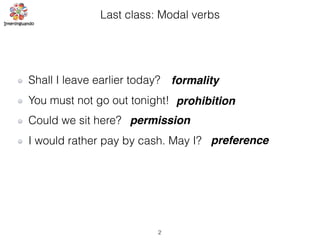
Last class: Modal verbs
Shall I leave earlier today?
You must not go out tonight!
Could we sit here?
I would rather pay by cash. May I?
formality
prohibition
permission
preference
2
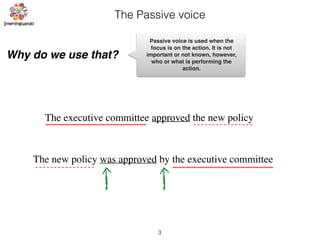
The Passive voice
Why do we use that?
The executive committee approved the new policy
The new policy was approved by the executive committee
Passive voice is used when the
focus is on the action. It is not
important or not known, however,
who or what is performing the
action.
3
4
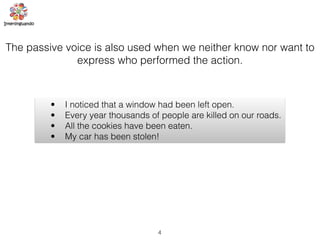
The passive voice is also used when we neither know nor want to
express who performed the action.
• I noticed that a window had been left open.
• Every year thousands of people are killed on our roads.
• All the cookies have been eaten.
• My car has been stolen!
5
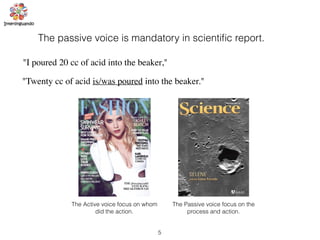
The passive voice is mandatory in scientific report.
"I poured 20 cc of acid into the beaker,"
"Twenty cc of acid is/was poured into the beaker."
The Active voice focus on whom
did the action.
The Passive voice focus on the
process and action.
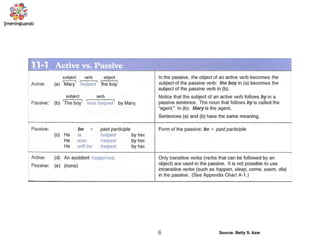
6 Source: Betty S. Azar
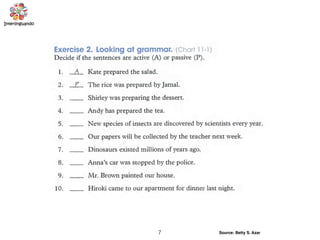
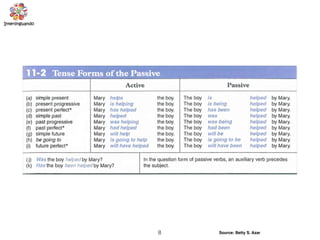
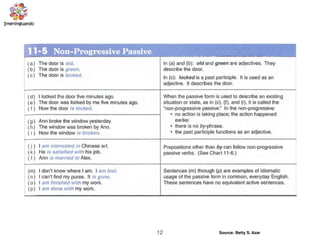
7 Source: Betty S. Azar
8 Source: Betty S. Azar
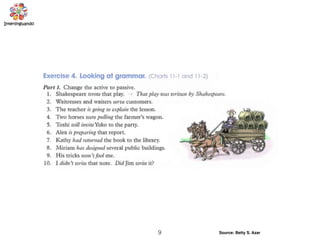
9 Source: Betty S. Azar
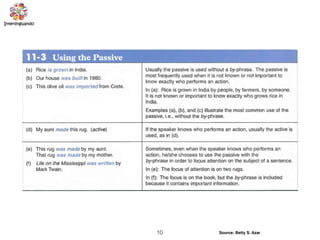
10 Source: Betty S. Azar
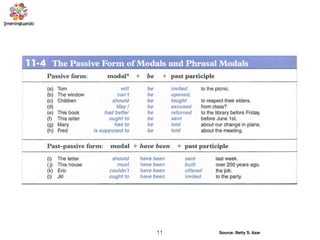
11 Source: Betty S. Azar
12 Source: Betty S. Azar
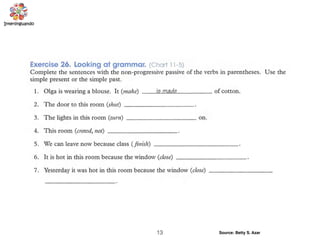
13 Source: Betty S. Azar
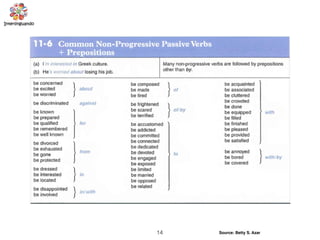
14 Source: Betty S. Azar
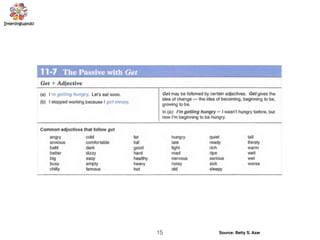
15 Source: Betty S. Azar
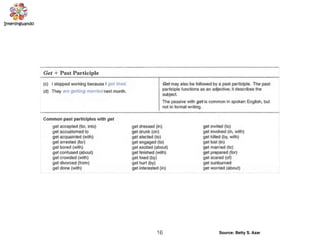
16 Source: Betty S. Azar
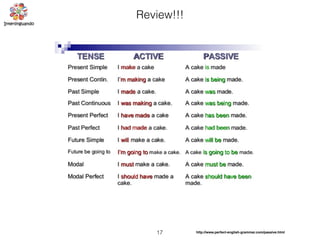
17 http://www.perfect-english-grammar.com/passive.html
Review!!!
18
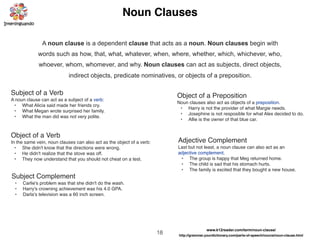
Noun Clauses
A noun clause is a dependent clause that acts as a noun. Noun clauses begin with
words such as how, that, what, whatever, when, where, whether, which, whichever, who,
whoever, whom, whomever, and why. Noun clauses can act as subjects, direct objects,
indirect objects, predicate nominatives, or objects of a preposition.
www.k12reader.com/term/noun-clause/
Subject of a Verb
A noun clause can act as a subject of a verb:
• What Alicia said made her friends cry.
• What Megan wrote surprised her family.
• What the man did was not very polite.
Object of a Verb
In the same vein, noun clauses can also act as the object of a verb:
• She didn't know that the directions were wrong.
• He didn't realize that the stove was off.
• They now understand that you should not cheat on a test.
Subject Complement
• Carlie's problem was that she didn't do the wash.
• Harry's crowning achievement was his 4.0 GPA.
• Darla's television was a 60 inch screen.
Object of a Preposition
Noun clauses also act as objects of a preposition.
• Harry is not the provider of what Margie needs.
• Josephine is not resposible for what Alex decided to do.
• Allie is the owner of that blue car.
Adjective Complement
Last but not least, a noun clause can also act as an
adjective complement.
• The group is happy that Meg returned home.
• The child is sad that his stomach hurts.
• The family is excited that they bought a new house.
http://grammar.yourdictionary.com/parts-of-speech/nouns/noun-clause.html
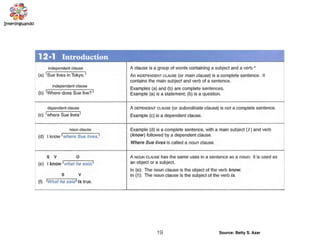
19 Source: Betty S. Azar
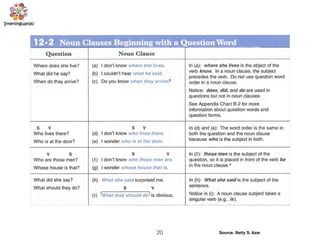
20 Source: Betty S. Azar
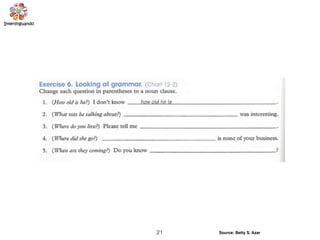
21 Source: Betty S. Azar
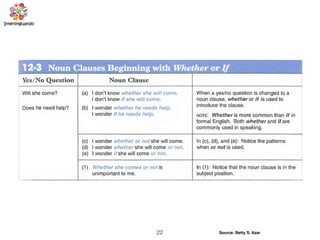
22 Source: Betty S. Azar
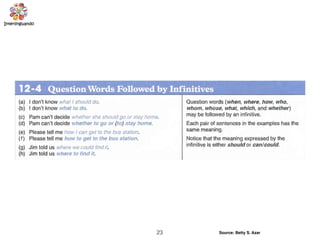
23 Source: Betty S. Azar
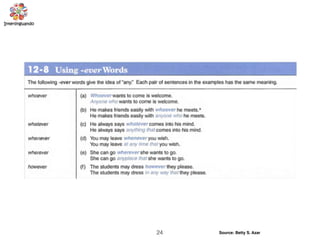
24 Source: Betty S. Azar
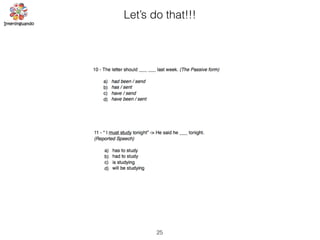
25
Let’s do that!!!

Grammar class VII

  • 1.
    Grammar Class -VII The passive voice / Noun Clauses Bruno Otilio
  • 2.
    Last class: Modalverbs Shall I leave earlier today? You must not go out tonight! Could we sit here? I would rather pay by cash. May I? formality prohibition permission preference 2
  • 3.
    The Passive voice Whydo we use that? The executive committee approved the new policy The new policy was approved by the executive committee Passive voice is used when the focus is on the action. It is not important or not known, however, who or what is performing the action. 3
  • 4.
    4 The passive voiceis also used when we neither know nor want to express who performed the action. • I noticed that a window had been left open. • Every year thousands of people are killed on our roads. • All the cookies have been eaten. • My car has been stolen!
  • 5.
    5 The passive voiceis mandatory in scientific report. "I poured 20 cc of acid into the beaker," "Twenty cc of acid is/was poured into the beaker." The Active voice focus on whom did the action. The Passive voice focus on the process and action.
  • 6.
  • 7.
  • 8.
  • 9.
  • 10.
  • 11.
  • 12.
  • 13.
  • 14.
  • 15.
  • 16.
  • 17.
  • 18.
    18 Noun Clauses A nounclause is a dependent clause that acts as a noun. Noun clauses begin with words such as how, that, what, whatever, when, where, whether, which, whichever, who, whoever, whom, whomever, and why. Noun clauses can act as subjects, direct objects, indirect objects, predicate nominatives, or objects of a preposition. www.k12reader.com/term/noun-clause/ Subject of a Verb A noun clause can act as a subject of a verb: • What Alicia said made her friends cry. • What Megan wrote surprised her family. • What the man did was not very polite. Object of a Verb In the same vein, noun clauses can also act as the object of a verb: • She didn't know that the directions were wrong. • He didn't realize that the stove was off. • They now understand that you should not cheat on a test. Subject Complement • Carlie's problem was that she didn't do the wash. • Harry's crowning achievement was his 4.0 GPA. • Darla's television was a 60 inch screen. Object of a Preposition Noun clauses also act as objects of a preposition. • Harry is not the provider of what Margie needs. • Josephine is not resposible for what Alex decided to do. • Allie is the owner of that blue car. Adjective Complement Last but not least, a noun clause can also act as an adjective complement. • The group is happy that Meg returned home. • The child is sad that his stomach hurts. • The family is excited that they bought a new house. http://grammar.yourdictionary.com/parts-of-speech/nouns/noun-clause.html
  • 19.
  • 20.
  • 21.
  • 22.
  • 23.
  • 24.
  • 25.