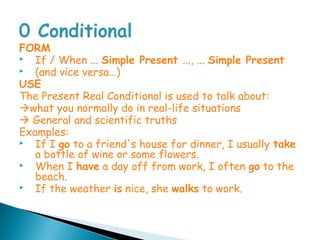
FORM
  If / When ... Simple Present ..., ... Simple Present
  (and vice versa…)
USE
The Present Real Conditional is used to talk about:
what you normally do in real-life situations
 General and scientific truths
Examples:
  If I go to a friend's house for dinner, I usually take
   a bottle of wine or some flowers.
  When I have a day off from work, I often go to the
   beach.
  If the weather is nice, she walks to work.
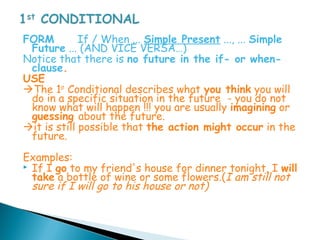
FORM         If / When ... Simple Present ..., ... Simple
 Future ... (AND VICE VERSA…)
Notice that there is no future in the if- or when-
 clause.
USE
The 1st Conditional describes what you think you will
 do in a specific situation in the future - you do not
 know what will happen !!! you are usually imagining or
 guessing about the future.
it is still possible that the action might occur in the
 future.

Examples:
 If I go to my friend's house for dinner tonight, I will
  take a bottle of wine or some flowers.(I am still not
  sure if I will go to his house or not)
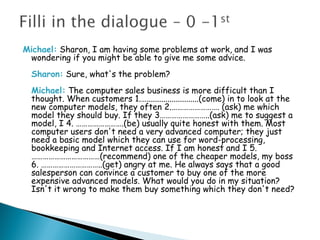
Michael: Sharon, I am having some problems at work, and I was
 wondering if you might be able to give me some advice.
  Sharon: Sure, what's the problem?
  Michael: The computer sales business is more difficult than I
  thought. When customers 1.….........................(come) in to look at the
  new computer models, they often 2.……………………. (ask) me which
  model they should buy. If they 3……………………..(ask) me to suggest a
  model, I 4. …………………….(be) usually quite honest with them. Most
  computer users don't need a very advanced computer; they just
  need a basic model which they can use for word-processing,
  bookkeeping and Internet access. If I am honest and I 5.
  ………………………………(recommend) one of the cheaper models, my boss
  6. …………………………..(get) angry at me. He always says that a good
  salesperson can convince a customer to buy one of the more
  expensive advanced models. What would you do in my situation?
  Isn't it wrong to make them buy something which they don't need?
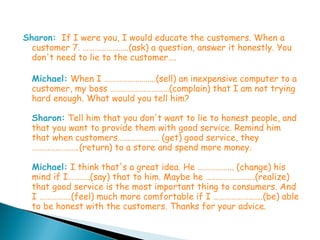
Sharon: If I were you, I would educate the customers. When a
  customer 7. …………………..(ask) a question, answer it honestly. You
  don't need to lie to the customer….

  Michael: When I ……………………..(sell) an inexpensive computer to a
  customer, my boss …………………………(complain) that I am not trying
  hard enough. What would you tell him?

  Sharon: Tell him that you don't want to lie to honest people, and
  that you want to provide them with good service. Remind him
  that when customers………………… (get) good service, they
  ……………………(return) to a store and spend more money.

  Michael: I think that's a great idea. He ……………... (change) his
  mind if I………..(say) that to him. Maybe he …………………….(realize)
  that good service is the most important thing to consumers. And
  I …………….(feel) much more comfortable if I …………………….(be) able
  to be honest with the customers. Thanks for your advice.
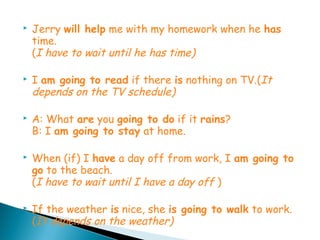
   Jerry will help me with my homework when he has
    time.
    (I have to wait until he has time)

   I am going to read if there is nothing on TV.(It
    depends on the TV schedule)

   A: What are you going to do if it rains?
    B: I am going to stay at home.

   When (if) I have a day off from work, I am going to
    go to the beach.
    (I have to wait until I have a day off )

   If the weather is nice, she is going to walk to work.
    (It depends on the weather)
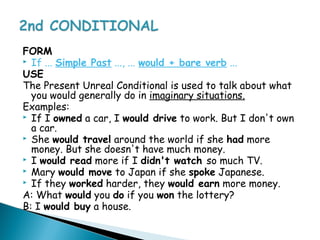
FORM
 If ... Simple Past ..., ... would + bare verb ...

USE
The Present Unreal Conditional is used to talk about what
  you would generally do in imaginary situations.
Examples:
 If I owned a car, I would drive to work. But I don't own
  a car.
 She would travel around the world if she had more
  money. But she doesn't have much money.
 I would read more if I didn't watch so much TV.
 Mary would move to Japan if she spoke Japanese.
 If they worked harder, they would earn more money.

A: What would you do if you won the lottery?
B: I would buy a house.
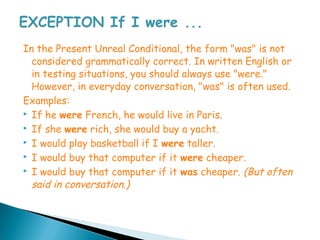
In the Present Unreal Conditional, the form "was" is not
  considered grammatically correct. In written English or
  in testing situations, you should always use "were."
  However, in everyday conversation, "was" is often used.
Examples:
 If he were French, he would live in Paris.

 If she were rich, she would buy a yacht.

 I would play basketball if I were taller.

 I would buy that computer if it were cheaper.

 I would buy that computer if it was cheaper. (But often

  said in conversation.)
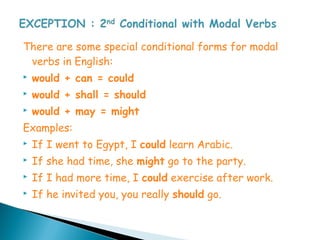
There are some special conditional forms for modal
 verbs in English:
   would + can = could
   would + shall = should
   would + may = might
Examples:
   If I went to Egypt, I could learn Arabic.
   If she had time, she might go to the party.
   If I had more time, I could exercise after work.
   If he invited you, you really should go.
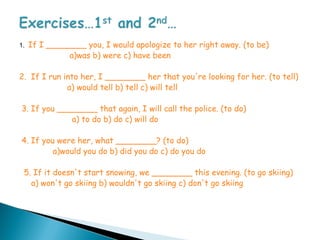
1.   If I ________ you, I would apologize to her right away. (to be)
               a)was b) were c) have been

2. If I run into her, I ________ her that you're looking for her. (to tell)
             a) would tell b) tell c) will tell

3. If you ________ that again, I will call the police. (to do)
             a) to do b) do c) will do

4. If you were her, what ________? (to do)
         a)would you do b) did you do c) do you do

 5. If it doesn't start snowing, we ________ this evening. (to go skiing)
   a) won't go skiing b) wouldn't go skiing c) don't go skiing
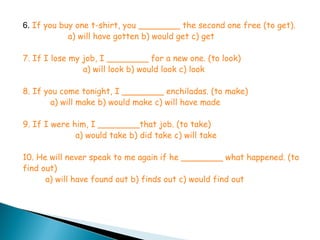
6. If you buy one t-shirt, you ________ the second one free (to get).
            a) will have gotten b) would get c) get

7. If I lose my job, I ________ for a new one. (to look)
                a) will look b) would look c) look

8. If you come tonight, I ________ enchiladas. (to make)
       a) will make b) would make c) will have made

9. If I were him, I ________that job. (to take)
              a) would take b) did take c) will take

10. He will never speak to me again if he ________ what happened. (to
find out)
      a) will have found out b) finds out c) would find out
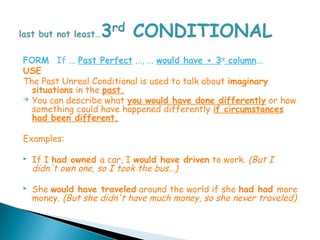
FORM If ... Past Perfect ..., ... would have + 3rd column...
USE
The Past Unreal Conditional is used to talk about imaginary
  situations in the past.
 You can describe what you would have done differently or how
  something could have happened differently if circumstances
  had been different.

Examples:

   If I had owned a car, I would have driven to work. (But I
    didn't own one, so I took the bus…)

   She would have traveled around the world if she had had more
    money. (But she didn't have much money, so she never traveled)
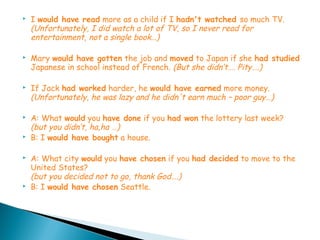
   I would have read more as a child if I hadn't watched so much TV.
    (Unfortunately, I did watch a lot of TV, so I never read for
    entertainment, not a single book…)

   Mary would have gotten the job and moved to Japan if she had studied
    Japanese in school instead of French. (But she didn’t…. Pity….)

   If Jack had worked harder, he would have earned more money.
    (Unfortunately, he was lazy and he didn't earn much – poor guy…)

   A: What would you have done if you had won the lottery last week?
    (but you didn’t, ha,ha …)
   B: I would have bought a house.

   A: What city would you have chosen if you had decided to move to the
    United States?
    (but you decided not to go, thank God….)
   B: I would have chosen Seattle.
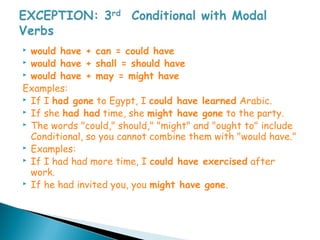
 would have + can = could have
 would have + shall = should have
 would have + may = might have

Examples:
 If I had gone to Egypt, I could have learned Arabic.
 If she had had time, she might have gone to the party.
 The words "could," should," "might" and "ought to" include
  Conditional, so you cannot combine them with "would have."
 Examples:
 If I had had more time, I could have exercised after
  work.
 If he had invited you, you might have gone.
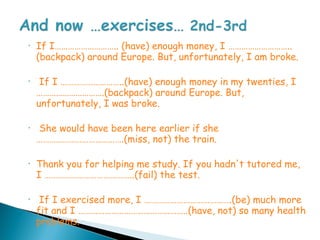
•   If I……………………….. (have) enough money, I ………………………..
    (backpack) around Europe. But, unfortunately, I am broke.

•    If I ………………………..(have) enough money in my twenties, I
    ………………………….(backpack) around Europe. But,
    unfortunately, I was broke.

•   She would have been here earlier if she
    ………………………………….(miss, not) the train.

•   Thank you for helping me study. If you hadn't tutored me,
    I …………………………………..(fail) the test.

•    If I exercised more, I ………………………………….(be) much more
    fit and I …………………………………………..(have, not) so many health
    problems.
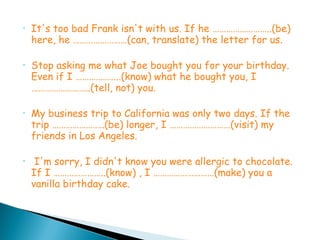
•   It's too bad Frank isn't with us. If he ……………………..(be)
    here, he ……………………(can, translate) the letter for us.

•   Stop asking me what Joe bought you for your birthday.
    Even if I ………………..(know) what he bought you, I
    ……………………..(tell, not) you.

•   My business trip to California was only two days. If the
    trip …………………..(be) longer, I ………………………(visit) my
    friends in Los Angeles.

•    I'm sorry, I didn't know you were allergic to chocolate.
    If I …………………..(know) , I ………………………(make) you a
    vanilla birthday cake.
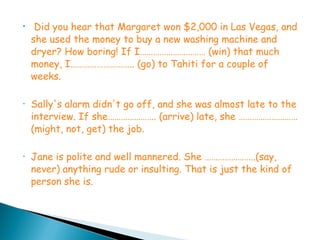
•    Did you hear that Margaret won $2,000 in Las Vegas, and
    she used the money to buy a new washing machine and
    dryer? How boring! If I………………………… (win) that much
    money, I……………………….. (go) to Tahiti for a couple of
    weeks.

•   Sally's alarm didn't go off, and she was almost late to the
    interview. If she…………………. (arrive) late, she ………………………
    (might, not, get) the job.

•   Jane is polite and well mannered. She …………………..(say,
    never) anything rude or insulting. That is just the kind of
    person she is.
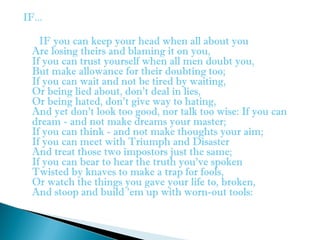
IF...

    IF you can keep your head when all about you
  Are losing theirs and blaming it on you,
  If you can trust yourself when all men doubt you,
  But make allowance for their doubting too;
  If you can wait and not be tired by waiting,
  Or being lied about, don't deal in lies,
  Or being hated, don't give way to hating,
  And yet don't look too good, nor talk too wise: If you can
  dream - and not make dreams your master;
  If you can think - and not make thoughts your aim;
  If you can meet with Triumph and Disaster
  And treat those two impostors just the same;
  If you can bear to hear the truth you've spoken
  Twisted by knaves to make a trap for fools,
  Or watch the things you gave your life to, broken,
  And stoop and build 'em up with worn-out tools:
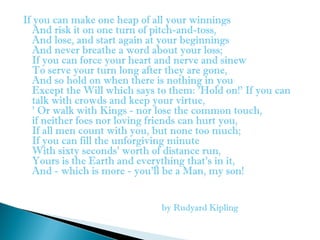
If you can make one heap of all your winnings
   And risk it on one turn of pitch-and-toss,
   And lose, and start again at your beginnings
   And never breathe a word about your loss;
   If you can force your heart and nerve and sinew
   To serve your turn long after they are gone,
   And so hold on when there is nothing in you
   Except the Will which says to them: 'Hold on!' If you can
   talk with crowds and keep your virtue,
   ' Or walk with Kings - nor lose the common touch,
   if neither foes nor loving friends can hurt you,
   If all men count with you, but none too much;
   If you can fill the unforgiving minute
   With sixty seconds' worth of distance run,
   Yours is the Earth and everything that's in it,
   And - which is more - you'll be a Man, my son!


                               by Rudyard Kipling

Conditionals

  • 2.
    FORM  If/ When ... Simple Present ..., ... Simple Present  (and vice versa…) USE The Present Real Conditional is used to talk about: what you normally do in real-life situations  General and scientific truths Examples:  If I go to a friend's house for dinner, I usually take a bottle of wine or some flowers.  When I have a day off from work, I often go to the beach.  If the weather is nice, she walks to work.
  • 3.
    FORM If / When ... Simple Present ..., ... Simple Future ... (AND VICE VERSA…) Notice that there is no future in the if- or when- clause. USE The 1st Conditional describes what you think you will do in a specific situation in the future - you do not know what will happen !!! you are usually imagining or guessing about the future. it is still possible that the action might occur in the future. Examples:  If I go to my friend's house for dinner tonight, I will take a bottle of wine or some flowers.(I am still not sure if I will go to his house or not)
  • 4.
    Michael: Sharon, Iam having some problems at work, and I was wondering if you might be able to give me some advice. Sharon: Sure, what's the problem? Michael: The computer sales business is more difficult than I thought. When customers 1.….........................(come) in to look at the new computer models, they often 2.……………………. (ask) me which model they should buy. If they 3……………………..(ask) me to suggest a model, I 4. …………………….(be) usually quite honest with them. Most computer users don't need a very advanced computer; they just need a basic model which they can use for word-processing, bookkeeping and Internet access. If I am honest and I 5. ………………………………(recommend) one of the cheaper models, my boss 6. …………………………..(get) angry at me. He always says that a good salesperson can convince a customer to buy one of the more expensive advanced models. What would you do in my situation? Isn't it wrong to make them buy something which they don't need?
  • 5.
    Sharon: If Iwere you, I would educate the customers. When a customer 7. …………………..(ask) a question, answer it honestly. You don't need to lie to the customer…. Michael: When I ……………………..(sell) an inexpensive computer to a customer, my boss …………………………(complain) that I am not trying hard enough. What would you tell him? Sharon: Tell him that you don't want to lie to honest people, and that you want to provide them with good service. Remind him that when customers………………… (get) good service, they ……………………(return) to a store and spend more money. Michael: I think that's a great idea. He ……………... (change) his mind if I………..(say) that to him. Maybe he …………………….(realize) that good service is the most important thing to consumers. And I …………….(feel) much more comfortable if I …………………….(be) able to be honest with the customers. Thanks for your advice.
  • 6.
    Jerry will help me with my homework when he has time. (I have to wait until he has time)  I am going to read if there is nothing on TV.(It depends on the TV schedule)  A: What are you going to do if it rains? B: I am going to stay at home.  When (if) I have a day off from work, I am going to go to the beach. (I have to wait until I have a day off )  If the weather is nice, she is going to walk to work. (It depends on the weather)
  • 7.
    FORM  If ...Simple Past ..., ... would + bare verb ... USE The Present Unreal Conditional is used to talk about what you would generally do in imaginary situations. Examples:  If I owned a car, I would drive to work. But I don't own a car.  She would travel around the world if she had more money. But she doesn't have much money.  I would read more if I didn't watch so much TV.  Mary would move to Japan if she spoke Japanese.  If they worked harder, they would earn more money. A: What would you do if you won the lottery? B: I would buy a house.
  • 8.
    In the PresentUnreal Conditional, the form "was" is not considered grammatically correct. In written English or in testing situations, you should always use "were." However, in everyday conversation, "was" is often used. Examples:  If he were French, he would live in Paris.  If she were rich, she would buy a yacht.  I would play basketball if I were taller.  I would buy that computer if it were cheaper.  I would buy that computer if it was cheaper. (But often said in conversation.)
  • 9.
    There are somespecial conditional forms for modal verbs in English:  would + can = could  would + shall = should  would + may = might Examples:  If I went to Egypt, I could learn Arabic.  If she had time, she might go to the party.  If I had more time, I could exercise after work.  If he invited you, you really should go.
  • 10.
    1. If I ________ you, I would apologize to her right away. (to be) a)was b) were c) have been 2. If I run into her, I ________ her that you're looking for her. (to tell) a) would tell b) tell c) will tell 3. If you ________ that again, I will call the police. (to do) a) to do b) do c) will do 4. If you were her, what ________? (to do) a)would you do b) did you do c) do you do 5. If it doesn't start snowing, we ________ this evening. (to go skiing) a) won't go skiing b) wouldn't go skiing c) don't go skiing
  • 11.
    6. If youbuy one t-shirt, you ________ the second one free (to get). a) will have gotten b) would get c) get 7. If I lose my job, I ________ for a new one. (to look) a) will look b) would look c) look 8. If you come tonight, I ________ enchiladas. (to make) a) will make b) would make c) will have made 9. If I were him, I ________that job. (to take) a) would take b) did take c) will take 10. He will never speak to me again if he ________ what happened. (to find out) a) will have found out b) finds out c) would find out
  • 12.
    FORM If ...Past Perfect ..., ... would have + 3rd column... USE The Past Unreal Conditional is used to talk about imaginary situations in the past.  You can describe what you would have done differently or how something could have happened differently if circumstances had been different. Examples:  If I had owned a car, I would have driven to work. (But I didn't own one, so I took the bus…)  She would have traveled around the world if she had had more money. (But she didn't have much money, so she never traveled)
  • 13.
    I would have read more as a child if I hadn't watched so much TV. (Unfortunately, I did watch a lot of TV, so I never read for entertainment, not a single book…)  Mary would have gotten the job and moved to Japan if she had studied Japanese in school instead of French. (But she didn’t…. Pity….)  If Jack had worked harder, he would have earned more money. (Unfortunately, he was lazy and he didn't earn much – poor guy…)  A: What would you have done if you had won the lottery last week? (but you didn’t, ha,ha …)  B: I would have bought a house.  A: What city would you have chosen if you had decided to move to the United States? (but you decided not to go, thank God….)  B: I would have chosen Seattle.
  • 14.
     would have+ can = could have  would have + shall = should have  would have + may = might have Examples:  If I had gone to Egypt, I could have learned Arabic.  If she had had time, she might have gone to the party.  The words "could," should," "might" and "ought to" include Conditional, so you cannot combine them with "would have."  Examples:  If I had had more time, I could have exercised after work.  If he had invited you, you might have gone.
  • 15.
    If I……………………….. (have) enough money, I ……………………….. (backpack) around Europe. But, unfortunately, I am broke. • If I ………………………..(have) enough money in my twenties, I ………………………….(backpack) around Europe. But, unfortunately, I was broke. • She would have been here earlier if she ………………………………….(miss, not) the train. • Thank you for helping me study. If you hadn't tutored me, I …………………………………..(fail) the test. • If I exercised more, I ………………………………….(be) much more fit and I …………………………………………..(have, not) so many health problems.
  • 16.
    It's too bad Frank isn't with us. If he ……………………..(be) here, he ……………………(can, translate) the letter for us. • Stop asking me what Joe bought you for your birthday. Even if I ………………..(know) what he bought you, I ……………………..(tell, not) you. • My business trip to California was only two days. If the trip …………………..(be) longer, I ………………………(visit) my friends in Los Angeles. • I'm sorry, I didn't know you were allergic to chocolate. If I …………………..(know) , I ………………………(make) you a vanilla birthday cake.
  • 17.
    Did you hear that Margaret won $2,000 in Las Vegas, and she used the money to buy a new washing machine and dryer? How boring! If I………………………… (win) that much money, I……………………….. (go) to Tahiti for a couple of weeks. • Sally's alarm didn't go off, and she was almost late to the interview. If she…………………. (arrive) late, she ……………………… (might, not, get) the job. • Jane is polite and well mannered. She …………………..(say, never) anything rude or insulting. That is just the kind of person she is.
  • 18.
    IF... IF you can keep your head when all about you Are losing theirs and blaming it on you, If you can trust yourself when all men doubt you, But make allowance for their doubting too; If you can wait and not be tired by waiting, Or being lied about, don't deal in lies, Or being hated, don't give way to hating, And yet don't look too good, nor talk too wise: If you can dream - and not make dreams your master; If you can think - and not make thoughts your aim; If you can meet with Triumph and Disaster And treat those two impostors just the same; If you can bear to hear the truth you've spoken Twisted by knaves to make a trap for fools, Or watch the things you gave your life to, broken, And stoop and build 'em up with worn-out tools:
  • 19.
    If you canmake one heap of all your winnings And risk it on one turn of pitch-and-toss, And lose, and start again at your beginnings And never breathe a word about your loss; If you can force your heart and nerve and sinew To serve your turn long after they are gone, And so hold on when there is nothing in you Except the Will which says to them: 'Hold on!' If you can talk with crowds and keep your virtue, ' Or walk with Kings - nor lose the common touch, if neither foes nor loving friends can hurt you, If all men count with you, but none too much; If you can fill the unforgiving minute With sixty seconds' worth of distance run, Yours is the Earth and everything that's in it, And - which is more - you'll be a Man, my son! by Rudyard Kipling