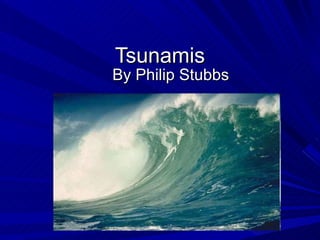
Tsunamis By Philip Stubbs
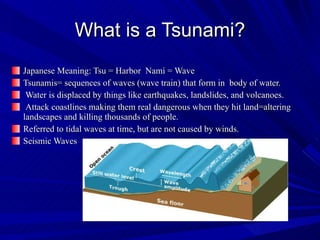
What is a Tsunami? Japanese Meaning: Tsu = Harbor  Nami = Wave Tsunamis= sequences of waves (wave train) that form in  body of water. Water is displaced by things like earthquakes, landslides, and volcanoes. Attack coastlines making them real dangerous when they hit land=altering landscapes and killing thousands of people. Referred to tidal waves at time, but are not caused by winds. Seismic Waves
Characteristics of Tsunami Waves in Deep Water Have characteristics of shallow-water waves in deep water. The ratio between water depth and wavelength is really small. Long periods and long wavelengths. Regular waves= wavelengths of 150m and periods of 10s Tsunami waves=wavelengths over 100 km and periods longer than one hour.  Because of their small heights and long wavelengths, they can go unnoticed deep at sea. Combo of transverse and longitudinal motion=circular motion Speed= square root of the product of  acceleration of gravity (9.8 m/s/s) and water depth. If the water depth is 4000 m, the tsunami travels at a speed of about 200 m/s. In the deepest oceans, the waves can exceed 600 miles per hour. Tsunamis can cross over the Pacific in less than 24 hours.
Tsunami coming towards Land A transformation occurs when a tsunami goes into shallow water. Since water depth is a factor in speed, a tsunami decreases in speed. Since the speed decreases, the tsunami’s height will be taller (conservation of energy). Top of waves travel quicker than bottom half Very little energy lost because the wavelength does not decrease much. When a tsunami hits land, it appears as a sequence of breaking waves.
Tsunami approaching Land
Tsunami on Land As soon as tsunamis enter land, they lose energy. The rate that they lose energy is inversely related to the wavelength. Wavelength decreases=loss of energy Some of the energy is lost due to friction and turbulence. As well as wavelength, period decreases also Since wavelength decreases, frequency increases Can reach heights up to 30 meters and even higher. Run-up height= max vertical height onshore  The waves eventually break and flood  land. Areas within 200 meters of coast most at risk
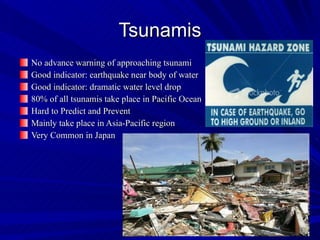
Tsunamis No advance warning of approaching tsunami Good indicator: earthquake near body of water Good indicator: dramatic water level drop 80% of all tsunamis take place in Pacific Ocean Hard to Predict and Prevent Mainly take place in Asia-Pacific region Very Common in Japan
The top picture shows Sri Lanka in 2004 when the tsunami hit SE Asia. (flooding and violent waves) The bottom picture shows Sri Lanka in 2004 a year before the tsunami hit SE Asia. (calm, harmless waves)
Bibliography &quot;ABC News: Fast Facts on Tsunamis.&quot;  ABC News: Online news, breaking news, feature stories and more . 28 Dec. 2004. 06 Jan. 2009 <http://abcnews.go.com/Technology/Weather/story?id=365979>. Newman, David. &quot;The Physics of Tsunamis.&quot;  David Newman's Page . 2005. 06 Jan. 2009 <http://ffden2.phys.uaf.edu/212_spring2005.web.dir/Justin_Priest/Tsunami%20Physics.htm>. &quot;Physics of Tsunamis.&quot;  Earth and Space Sciences (Geology and Geophysics) at UW . 23 Mar. 2005. 06 Jan. 2009 <http://www.geophys.washington.edu/tsunami/general/physics/physics.html>. Uy, Anthony. &quot;The Physics of Tsunamis: The Harbor Wave.&quot;  UBC PhysAstro: Home Page . 2006. 06 Jan. 2009 <http://www.physics.ubc.ca/~outreach/phys420/p420_05/anthony/The%20Physics%20of%20Tsunamis.htm>.

Tsunamis

  • 1.
  • 2.
    What is aTsunami? Japanese Meaning: Tsu = Harbor Nami = Wave Tsunamis= sequences of waves (wave train) that form in body of water. Water is displaced by things like earthquakes, landslides, and volcanoes. Attack coastlines making them real dangerous when they hit land=altering landscapes and killing thousands of people. Referred to tidal waves at time, but are not caused by winds. Seismic Waves
  • 3.
    Characteristics of TsunamiWaves in Deep Water Have characteristics of shallow-water waves in deep water. The ratio between water depth and wavelength is really small. Long periods and long wavelengths. Regular waves= wavelengths of 150m and periods of 10s Tsunami waves=wavelengths over 100 km and periods longer than one hour. Because of their small heights and long wavelengths, they can go unnoticed deep at sea. Combo of transverse and longitudinal motion=circular motion Speed= square root of the product of acceleration of gravity (9.8 m/s/s) and water depth. If the water depth is 4000 m, the tsunami travels at a speed of about 200 m/s. In the deepest oceans, the waves can exceed 600 miles per hour. Tsunamis can cross over the Pacific in less than 24 hours.
  • 4.
    Tsunami coming towardsLand A transformation occurs when a tsunami goes into shallow water. Since water depth is a factor in speed, a tsunami decreases in speed. Since the speed decreases, the tsunami’s height will be taller (conservation of energy). Top of waves travel quicker than bottom half Very little energy lost because the wavelength does not decrease much. When a tsunami hits land, it appears as a sequence of breaking waves.
  • 5.
  • 6.
    Tsunami on LandAs soon as tsunamis enter land, they lose energy. The rate that they lose energy is inversely related to the wavelength. Wavelength decreases=loss of energy Some of the energy is lost due to friction and turbulence. As well as wavelength, period decreases also Since wavelength decreases, frequency increases Can reach heights up to 30 meters and even higher. Run-up height= max vertical height onshore The waves eventually break and flood land. Areas within 200 meters of coast most at risk
  • 7.
    Tsunamis No advancewarning of approaching tsunami Good indicator: earthquake near body of water Good indicator: dramatic water level drop 80% of all tsunamis take place in Pacific Ocean Hard to Predict and Prevent Mainly take place in Asia-Pacific region Very Common in Japan
  • 8.
    The top pictureshows Sri Lanka in 2004 when the tsunami hit SE Asia. (flooding and violent waves) The bottom picture shows Sri Lanka in 2004 a year before the tsunami hit SE Asia. (calm, harmless waves)
  • 9.
    Bibliography &quot;ABC News:Fast Facts on Tsunamis.&quot; ABC News: Online news, breaking news, feature stories and more . 28 Dec. 2004. 06 Jan. 2009 <http://abcnews.go.com/Technology/Weather/story?id=365979>. Newman, David. &quot;The Physics of Tsunamis.&quot; David Newman's Page . 2005. 06 Jan. 2009 <http://ffden2.phys.uaf.edu/212_spring2005.web.dir/Justin_Priest/Tsunami%20Physics.htm>. &quot;Physics of Tsunamis.&quot; Earth and Space Sciences (Geology and Geophysics) at UW . 23 Mar. 2005. 06 Jan. 2009 <http://www.geophys.washington.edu/tsunami/general/physics/physics.html>. Uy, Anthony. &quot;The Physics of Tsunamis: The Harbor Wave.&quot; UBC PhysAstro: Home Page . 2006. 06 Jan. 2009 <http://www.physics.ubc.ca/~outreach/phys420/p420_05/anthony/The%20Physics%20of%20Tsunamis.htm>.