Tsunami Basics
Robert Butler
ANGLE Project
https://serc.carleton.edu/ANGLE
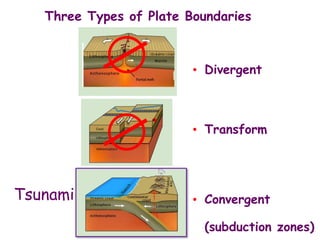
• Divergent
• Transform
• Convergent
(subduction zones)
Three Types of Plate Boundaries
Tsunami
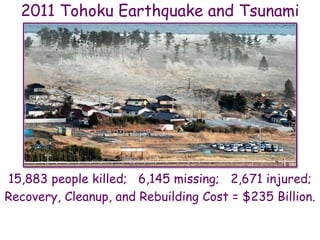
2011 Tohoku Earthquake and Tsunami
15,883 people killed; 6,145 missing; 2,671 injured;
Recovery, Cleanup, and Rebuilding Cost = $235 Billion.
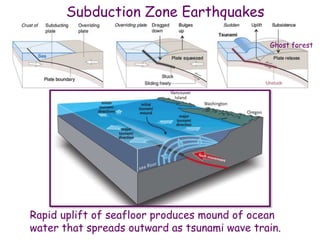
Ghost forest
Subduction Zone Earthquakes
Rapid uplift of seafloor produces mound of ocean
water that spreads outward as tsunami wave train.
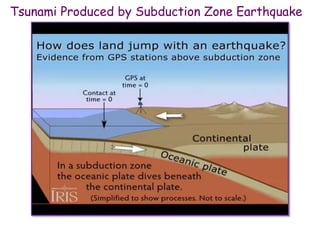
Tsunami Produced by Subduction Zone Earthquake
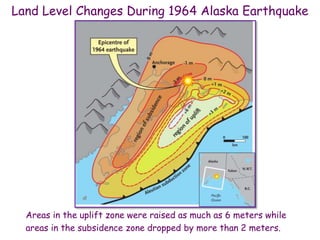
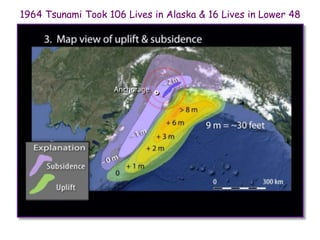
Land Level Changes During 1964 Alaska Earthquake
Areas in the uplift zone were raised as much as 6 meters while
areas in the subsidence zone dropped by more than 2 meters.
Pacific Plate
North American Plate
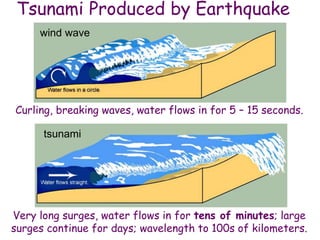
Tsunami Produced by Earthquake
Important points:
LONG period: 20 - 60 minutes.
Can flood on shore for 10 – 15 minutes.
LONG wavelength: >800 kilometers (520 miles)
Moves seawater all the way to floor of ocean.
In deep ocean, tsunami has small amplitude and
travels with speed of jet airliner.
When approaching land, speed slows and amplitude
increases dramatically.
A tsunami is a SERIES of waves, not a single wave.
wind wave
tsunami
Curling, breaking waves, water flows in for 5 – 15 seconds.
Very long surges, water flows in for tens of minutes; large
surges continue for days; wavelength to 100s of kilometers.
Tsunami Produced by Earthquake
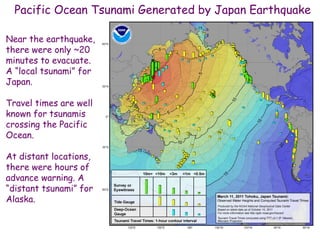
Near the earthquake,
there were only ~20
minutes to evacuate.
A “local tsunami” for
Japan.
Travel times are well
known for tsunamis
crossing the Pacific
Ocean.
At distant locations,
there were hours of
advance warning. A
“distant tsunami” for
Alaska.
Pacific Ocean Tsunami Generated by Japan Earthquake
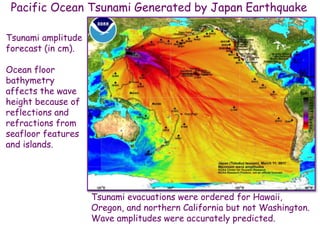
Tsunami amplitude
forecast (in cm).
Ocean floor
bathymetry
affects the wave
height because of
reflections and
refractions from
seafloor features
and islands.
Tsunami evacuations were ordered for Hawaii,
Oregon, and northern California but not Washington.
Wave amplitudes were accurately predicted.
Deep-ocean Assessment and
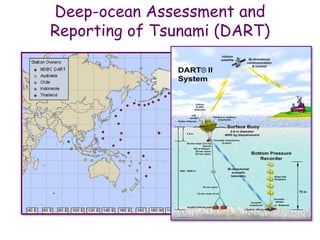
Reporting of Tsunami (DART)
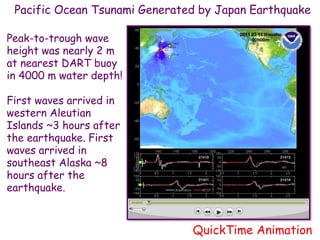
Peak-to-trough wave
height was nearly 2 m
at nearest DART buoy
in 4000 m water depth!
First waves arrived in
western Aleutian
Islands ~3 hours after
the earthquake. First
waves arrived in
southeast Alaska ~8
hours after the
earthquake.
Pacific Ocean Tsunami Generated by Japan Earthquake
QuickTime Animation
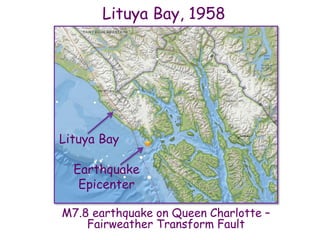
Lituya Bay, 1958
M7.8 earthquake on Queen Charlotte –
Fairweather Transform Fault
Lituya Bay
Earthquake
Epicenter
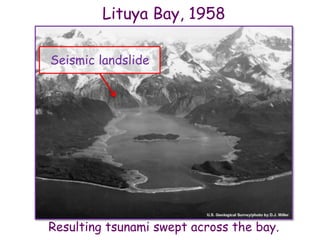
Lituya Bay, 1958
Seismic landslide
Resulting tsunami swept across the bay.
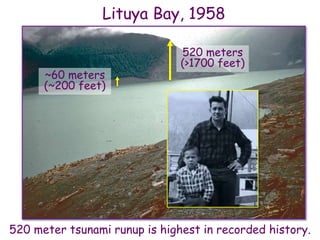
Lituya Bay, 1958
520 meter tsunami runup is highest in recorded history.
520 meters
(>1700 feet)
~60 meters
(~200 feet)
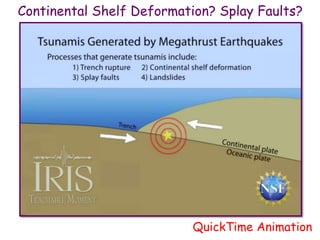
Continental Shelf Deformation? Splay Faults?
QuickTime Animation
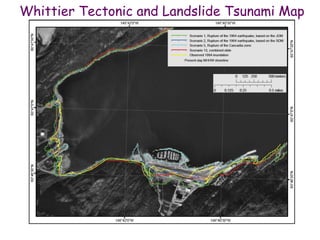
Whittier Tectonic and Landslide Tsunami Map
1964 Tsunami Took 106 Lives in Alaska & 16 Lives in Lower 48

Tsunami Basics Presentation

  • 1.
    Tsunami Basics Robert Butler ANGLEProject https://serc.carleton.edu/ANGLE
  • 2.
    • Divergent • Transform •Convergent (subduction zones) Three Types of Plate Boundaries Tsunami
  • 3.
    2011 Tohoku Earthquakeand Tsunami 15,883 people killed; 6,145 missing; 2,671 injured; Recovery, Cleanup, and Rebuilding Cost = $235 Billion.
  • 4.
    Ghost forest Subduction ZoneEarthquakes Rapid uplift of seafloor produces mound of ocean water that spreads outward as tsunami wave train.
  • 5.
    Tsunami Produced bySubduction Zone Earthquake
  • 6.
    Land Level ChangesDuring 1964 Alaska Earthquake Areas in the uplift zone were raised as much as 6 meters while areas in the subsidence zone dropped by more than 2 meters. Pacific Plate North American Plate
  • 7.
    Tsunami Produced byEarthquake Important points: LONG period: 20 - 60 minutes. Can flood on shore for 10 – 15 minutes. LONG wavelength: >800 kilometers (520 miles) Moves seawater all the way to floor of ocean. In deep ocean, tsunami has small amplitude and travels with speed of jet airliner. When approaching land, speed slows and amplitude increases dramatically. A tsunami is a SERIES of waves, not a single wave.
  • 8.
    wind wave tsunami Curling, breakingwaves, water flows in for 5 – 15 seconds. Very long surges, water flows in for tens of minutes; large surges continue for days; wavelength to 100s of kilometers. Tsunami Produced by Earthquake
  • 9.
    Near the earthquake, therewere only ~20 minutes to evacuate. A “local tsunami” for Japan. Travel times are well known for tsunamis crossing the Pacific Ocean. At distant locations, there were hours of advance warning. A “distant tsunami” for Alaska. Pacific Ocean Tsunami Generated by Japan Earthquake
  • 10.
    Pacific Ocean TsunamiGenerated by Japan Earthquake Tsunami amplitude forecast (in cm). Ocean floor bathymetry affects the wave height because of reflections and refractions from seafloor features and islands. Tsunami evacuations were ordered for Hawaii, Oregon, and northern California but not Washington. Wave amplitudes were accurately predicted.
  • 11.
  • 12.
    Peak-to-trough wave height wasnearly 2 m at nearest DART buoy in 4000 m water depth! First waves arrived in western Aleutian Islands ~3 hours after the earthquake. First waves arrived in southeast Alaska ~8 hours after the earthquake. Pacific Ocean Tsunami Generated by Japan Earthquake QuickTime Animation
  • 13.
    Lituya Bay, 1958 M7.8earthquake on Queen Charlotte – Fairweather Transform Fault Lituya Bay Earthquake Epicenter
  • 14.
    Lituya Bay, 1958 Seismiclandslide Resulting tsunami swept across the bay.
  • 15.
    Lituya Bay, 1958 520meter tsunami runup is highest in recorded history. 520 meters (>1700 feet) ~60 meters (~200 feet)
  • 16.
    Continental Shelf Deformation?Splay Faults? QuickTime Animation
  • 17.
    Whittier Tectonic andLandslide Tsunami Map
  • 18.
    1964 Tsunami Took106 Lives in Alaska & 16 Lives in Lower 48