TSUNAMI
A HAZARD CAUSING DISASTER
WHAT WE WILL LEARN IN THIS
CHAPTER?
 Definition of tsunami.
 Causes of Tsunami
 General characteristics.
 Predictability.
 The places where it occurred.
 Precautions taken during Tsunami.
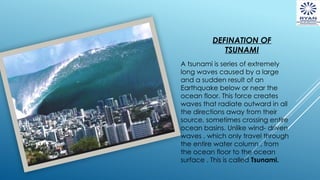
DEFINATION OF
TSUNAMI
A tsunami is series of extremely
long waves caused by a large
and a sudden result of an
Earthquake below or near the
ocean floor. This force creates
waves that radiate outward in all
the directions away from their
source, sometimes crossing entire
ocean basins. Unlike wind- driven
waves , which only travel through
the entire water column , from
the ocean floor to the ocean
surface . This is called Tsunami.
CAUSES OF TSUNAMI
The geological movements that cause
tsunamis are produced in the three major
ways. The most common of these are
fault movements on the sea floor,
accompanied by an earthquake. The
release huge amount of energy and have
the capacity to cross oceans. The degree
of movement depends on how fast the
earthquake occurs and how much water is
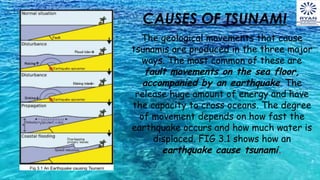
displaced. FIG 3.1 shows how an
earthquake cause tsunami.
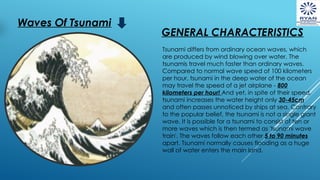
Tsunami differs from ordinary ocean waves, which
are produced by wind blowing over water. The
tsunamis travel much faster than ordinary waves.
Compared to normal wave speed of 100 kilometers
per hour, tsunami in the deep water of the ocean
may travel the speed of a jet airplane - 800
kilometers per hour! And yet, in spite of their speed,
tsunami increases the water height only 30-45cm
and often passes unnoticed by ships at sea. Contrary
to the popular belief, the tsunami is not a single giant
wave. It is possible for a tsunami to consist of ten or
more waves which is then termed as 'tsunami wave
train'. The waves follow each other 5 to 90 minutes
apart. Tsunami normally causes flooding as a huge
wall of water enters the main land.
GENERAL CHARACTERISTICS
Waves Of Tsunami
Tsunamis have occurred in all the oceans
and in the Mediterranean Sea, but the
great
majority of them have occurred in the
Pacific ocean. Since scientists cannot
exactly predict earthquakes, they also
cannot exactly predict when a tsunami
will be generated.
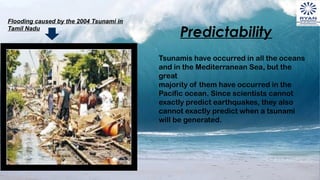
Flooding caused by the 2004 Tsunami in
Tamil Nadu
Predictability
PLACES WHERE TSUNAMI OCCURED
 26TH
DECEMBER 2004 , INDIAN OCEAN TSUNAMI
The devastating 26 December 2004 Indian Ocean tsunami stressed the need for
assessing tsunami hazard in vulnerable coastal areas. Numerical modeling is but one
important tool for understanding past tsunami events and simulating future ones. Here
we
present a robust simulation of the event, which explains the large runups and destruction
observed in coastal Thailand and identifies areas vulnerable to future tsunamis, or safer
for reconstruction. To do so, we use an accurate tsunami source, which was iteratively
calibrated in earlier work to explain the large-scale tsunami features, and apply it over
a
computational domain with a finer grid and more accurate coastal bathymetry in
Thailand.
Computations are performed with a well-validated numerical model based on fully
nonlinear and dispersive Boussinesq equations (FUNWAVE) that adequately models the
physics of tsunami propagation and runup, including dissipation caused by bottom
friction
and wave breaking. Simulated runups in Thailand reproduce field observations with a
surprising degree of accuracy, as well as their high degree of along-coast variation: a
92%
correlation is found between (58) runup observations and computations, while the
model explains 85% of the observed variance; overall, the RMS error is approximately 1
m
or 17% of the mean observed runup value (skill of the simulation). Because we did not
use runup observations to calibrate our coseismic tsunami source, these results are
robust, and thus provide a uniquely accurate synoptic prediction of tsunami impact
along
the Andaman coast of Thailand, including those areas where no observations were
made.
PRECAUTIONS TAKEN BEFORE TSUNAMI PRECAUTIONS TAKEN AFTER TSUNAMI
 If you live in a coastal area, ask your
council about your tsunami risk and local
warning arrangements.
 If you have a disability or special
requirements, arrange with your support
network to alert you of any warnings and
emergency broadcasts.
 Develop a Household Emergency Plan and
have a Getaway Kit ready.
 Know where the nearest high ground is
and how you will reach it. Plan to get as
high up or as far inland as you can. Plan
your escape route for when you are at
home, as well as for when you may be
working or holidaying near the coast.
 Take your getaway kit with you if possible.
Do not travel into the areas at risk to get
your kit or belongings.
 Move immediately to the nearest higher
ground, or as far inland as you can. If
evacuation maps are present, follow the
routes shown.
 If you cannot escape the tsunami, go to
an upper store of a sturdy building or
climb onto a roof or up a tree, or grab a
floating object and hang on until help
arrives.
 Never go to the shore to watch for a
tsunami. Stay away from at-risk areas until
the official all-clear is given.
HOW MUCH YOU HAVE LEARNT?
Fill in the blanks :-
1) A _________ is a large ocean wave usually caused by an underwater
earthquake or a volcanic explosion.
2) Tsunami normally causes _________ as a huge wall of water enters the main
land.
3) The devastating ____________ Indian Ocean tsunami stressed the need for
assessing tsunami hazard in vulnerable coastal areas.
4) Take your __________with you if possible. Do not travel into the areas at risk
to get your kit or belongings.
5) In _______ was the largest tsunami in history was recorded.
6) ________ ocean is the most active tsunami area.
ANSWERS
1.Tsunami
2.Flooding
3. 26 December
2004
4.Gateway kit
5.Japan
6.Pacific
VIDEO EXPLAINING THE CONCEPT OF CHAPTER:-
TSUNAMI
https://youtu.be/MfsugkikLJI
Thank you
(from)

PPT.x tsunami class 4th.pptx easy and accurate content

  • 1.
  • 2.
    WHAT WE WILLLEARN IN THIS CHAPTER?  Definition of tsunami.  Causes of Tsunami  General characteristics.  Predictability.  The places where it occurred.  Precautions taken during Tsunami.
  • 3.
    DEFINATION OF TSUNAMI A tsunamiis series of extremely long waves caused by a large and a sudden result of an Earthquake below or near the ocean floor. This force creates waves that radiate outward in all the directions away from their source, sometimes crossing entire ocean basins. Unlike wind- driven waves , which only travel through the entire water column , from the ocean floor to the ocean surface . This is called Tsunami.
  • 4.
    CAUSES OF TSUNAMI Thegeological movements that cause tsunamis are produced in the three major ways. The most common of these are fault movements on the sea floor, accompanied by an earthquake. The release huge amount of energy and have the capacity to cross oceans. The degree of movement depends on how fast the earthquake occurs and how much water is displaced. FIG 3.1 shows how an earthquake cause tsunami.
  • 5.
    Tsunami differs fromordinary ocean waves, which are produced by wind blowing over water. The tsunamis travel much faster than ordinary waves. Compared to normal wave speed of 100 kilometers per hour, tsunami in the deep water of the ocean may travel the speed of a jet airplane - 800 kilometers per hour! And yet, in spite of their speed, tsunami increases the water height only 30-45cm and often passes unnoticed by ships at sea. Contrary to the popular belief, the tsunami is not a single giant wave. It is possible for a tsunami to consist of ten or more waves which is then termed as 'tsunami wave train'. The waves follow each other 5 to 90 minutes apart. Tsunami normally causes flooding as a huge wall of water enters the main land. GENERAL CHARACTERISTICS Waves Of Tsunami
  • 6.
    Tsunamis have occurredin all the oceans and in the Mediterranean Sea, but the great majority of them have occurred in the Pacific ocean. Since scientists cannot exactly predict earthquakes, they also cannot exactly predict when a tsunami will be generated. Flooding caused by the 2004 Tsunami in Tamil Nadu Predictability
  • 7.
    PLACES WHERE TSUNAMIOCCURED  26TH DECEMBER 2004 , INDIAN OCEAN TSUNAMI The devastating 26 December 2004 Indian Ocean tsunami stressed the need for assessing tsunami hazard in vulnerable coastal areas. Numerical modeling is but one important tool for understanding past tsunami events and simulating future ones. Here we present a robust simulation of the event, which explains the large runups and destruction observed in coastal Thailand and identifies areas vulnerable to future tsunamis, or safer for reconstruction. To do so, we use an accurate tsunami source, which was iteratively calibrated in earlier work to explain the large-scale tsunami features, and apply it over a computational domain with a finer grid and more accurate coastal bathymetry in Thailand. Computations are performed with a well-validated numerical model based on fully nonlinear and dispersive Boussinesq equations (FUNWAVE) that adequately models the physics of tsunami propagation and runup, including dissipation caused by bottom friction and wave breaking. Simulated runups in Thailand reproduce field observations with a surprising degree of accuracy, as well as their high degree of along-coast variation: a 92% correlation is found between (58) runup observations and computations, while the model explains 85% of the observed variance; overall, the RMS error is approximately 1 m or 17% of the mean observed runup value (skill of the simulation). Because we did not use runup observations to calibrate our coseismic tsunami source, these results are robust, and thus provide a uniquely accurate synoptic prediction of tsunami impact along the Andaman coast of Thailand, including those areas where no observations were made.
  • 8.
    PRECAUTIONS TAKEN BEFORETSUNAMI PRECAUTIONS TAKEN AFTER TSUNAMI  If you live in a coastal area, ask your council about your tsunami risk and local warning arrangements.  If you have a disability or special requirements, arrange with your support network to alert you of any warnings and emergency broadcasts.  Develop a Household Emergency Plan and have a Getaway Kit ready.  Know where the nearest high ground is and how you will reach it. Plan to get as high up or as far inland as you can. Plan your escape route for when you are at home, as well as for when you may be working or holidaying near the coast.  Take your getaway kit with you if possible. Do not travel into the areas at risk to get your kit or belongings.  Move immediately to the nearest higher ground, or as far inland as you can. If evacuation maps are present, follow the routes shown.  If you cannot escape the tsunami, go to an upper store of a sturdy building or climb onto a roof or up a tree, or grab a floating object and hang on until help arrives.  Never go to the shore to watch for a tsunami. Stay away from at-risk areas until the official all-clear is given.
  • 9.
    HOW MUCH YOUHAVE LEARNT? Fill in the blanks :- 1) A _________ is a large ocean wave usually caused by an underwater earthquake or a volcanic explosion. 2) Tsunami normally causes _________ as a huge wall of water enters the main land. 3) The devastating ____________ Indian Ocean tsunami stressed the need for assessing tsunami hazard in vulnerable coastal areas. 4) Take your __________with you if possible. Do not travel into the areas at risk to get your kit or belongings. 5) In _______ was the largest tsunami in history was recorded. 6) ________ ocean is the most active tsunami area.
  • 10.
  • 11.
    VIDEO EXPLAINING THECONCEPT OF CHAPTER:- TSUNAMI https://youtu.be/MfsugkikLJI
  • 12.