Chapter 7
Soils and Biomes
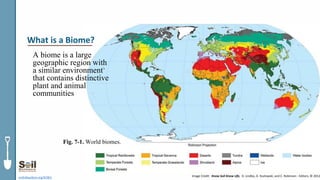
A biome is a large
geographic region with
a similar environment
that contains distinctive
plant and animal
communities
soils4teachers.org/KSKL Image Credit: Know Soil Know Life, D. Lindbo, D. Kozlowski, and C. Robinson - Editors, © 2012
What is a Biome?
Fig. 7-1. World biomes.
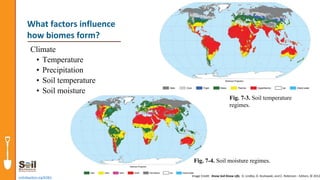
Climate
• Temperature
• Precipitation
• Soil temperature
• Soil moisture
soils4teachers.org/KSKL Image Credit: Know Soil Know Life, D. Lindbo, D. Kozlowski, and C. Robinson - Editors, © 2012
What factors influence
how biomes form?
Fig. 7-3. Soil temperature
regimes.
Fig. 7-4. Soil moisture regimes.
Four types
• Tropical rainforests
• Temperate rainforest
• Temperate forest
• Coniferous/boreal forest
soils4teachers.org/KSKL
Forests
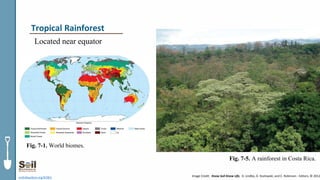
Located near equator
soils4teachers.org/KSKL
Fig. 7-1. World biomes.
Tropical Rainforest
Image Credit: Know Soil Know Life, D. Lindbo, D. Kozlowski, and C. Robinson - Editors, © 2012
Fig. 7-5. A rainforest in Costa Rica.
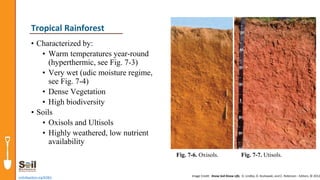
• Characterized by:
• Warm temperatures year-round
(hyperthermic, see Fig. 7-3)
• Very wet (udic moisture regime,
see Fig. 7-4)
• Dense Vegetation
• High biodiversity
• Soils
• Oxisols and Ultisols
• Highly weathered, low nutrient
availability
soils4teachers.org/KSKL
Tropical Rainforest
Image Credit: Know Soil Know Life, D. Lindbo, D. Kozlowski, and C. Robinson - Editors, © 2012
Fig. 7-6. Oxisols. Fig. 7-7. Utisols.
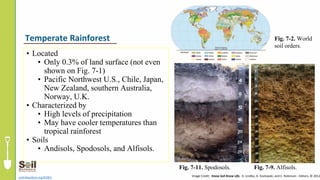
• Located
• Only 0.3% of land surface (not even
shown on Fig. 7-1)
• Pacific Northwest U.S., Chile, Japan,
New Zealand, southern Australia,
Norway, U.K.
• Characterized by
• High levels of precipitation
• May have cooler temperatures than
tropical rainforest
• Soils
• Andisols, Spodosols, and Alfisols.
soils4teachers.org/KSKL
Temperate Rainforest
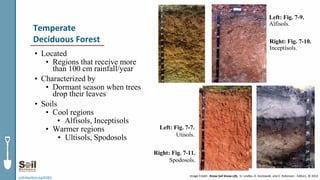
Fig. 7-11. Spodosols. Fig. 7-9. Alfisols.
Image Credit: Know Soil Know Life, D. Lindbo, D. Kozlowski, and C. Robinson - Editors, © 2012
Fig. 7-2. World
soil orders.
• Located
• Regions that receive more
than 100 cm rainfall/year
• Characterized by
• Dormant season when trees
drop their leaves
• Soils
• Cool regions
• Alfisols, Inceptisols
• Warmer regions
• Ultisols, Spodosols
soils4teachers.org/KSKL
Temperate
Deciduous Forest Right: Fig. 7-10.
Inceptisols.
Left: Fig. 7-9.
Alfisols.
Image Credit: Know Soil Know Life, D. Lindbo, D. Kozlowski, and C. Robinson - Editors, © 2012
Right: Fig. 7-11.
Spodosols.
Left: Fig. 7-7.
Utisols.
• Located
• Eastern Canada, Alaska, Europe,
Asia, Russia
• South of tundra
• Characterized by
• Evergreen forests, often with large
areas of a single tree species
• Soils
• Spodosols dominate in sandy areas
• Inceptisols and Entisols in other
areas
soils4teachers.org/KSKL
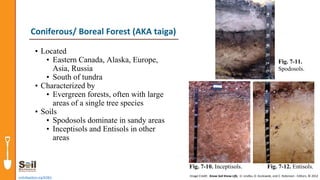
Coniferous/ Boreal Forest (AKA taiga)
Image Credit: Know Soil Know Life, D. Lindbo, D. Kozlowski, and C. Robinson - Editors, © 2012
Fig. 7-12. Entisols.
Fig. 7-11.
Spodosols.
Fig. 7-10. Inceptisols.
Two types
• Tropical savannahs
• Temperate grasslands
soils4teachers.org/KSKL
Grasslands
• Located
• Largest area is in East Africa
• Characterized by
• Tall grasses with occasional
trees and shrubs
• Soils
• Highly weathered
• Alfisols, Ultisols, and some Oxisols
• Low fertility due to heavy rainfalls
and high levels of decomposition
during rainy season
soils4teachers.org/KSKL
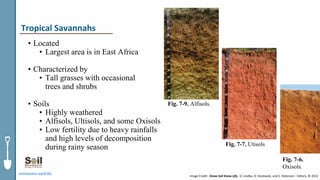
Tropical Savannahs
Fig. 7-9. Alfisols.
Fig. 7-7. Utisols
Fig. 7-6.
Oxisols.
Image Credit: Know Soil Know Life, D. Lindbo, D. Kozlowski, and C. Robinson - Editors, © 2012
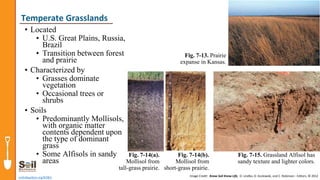
• Located
• U.S. Great Plains, Russia,
Brazil
• Transition between forest
and prairie
• Characterized by
• Grasses dominate
vegetation
• Occasional trees or
shrubs
• Soils
• Predominantly Mollisols,
with organic matter
contents dependent upon
the type of dominant
grass
• Some Alfisols in sandy
areas
soils4teachers.org/KSKL
Temperate Grasslands
Fig. 7-13. Prairie
expanse in Kansas.
Fig. 7-14(a).
Mollisol from
tall-grass prairie.
Fig. 7-14(b).
Mollisol from
short-grass prairie.
Fig. 7-15. Grassland Alfisol has
sandy texture and lighter colors.
Image Credit: Know Soil Know Life, D. Lindbo, D. Kozlowski, and C. Robinson - Editors, © 2012
soils4teachers.org/KSKL
Tundra
Two types
• Arctic tundra
• Alpine tundra
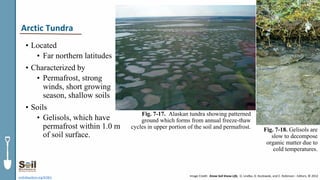
• Located
• Far northern latitudes
• Characterized by
• Permafrost, strong
winds, short growing
season, shallow soils
• Soils
• Gelisols, which have
permafrost within 1.0 m
of soil surface.
soils4teachers.org/KSKL
Fig. 7-17. Alaskan tundra showing patterned
ground which forms from annual freeze-thaw
cycles in upper portion of the soil and permafrost.
Image Credit: Know Soil Know Life, D. Lindbo, D. Kozlowski, and C. Robinson - Editors, © 2012
Arctic Tundra
Fig. 7-18. Gelisols are
slow to decompose
organic matter due to
cold temperatures.
• Located
• High elevations
• Characterized by
• Diurnal (daily) freeze-thaw cycle, rather than seasonal cycle seen in
arctic
• Diverse climatological and vegetation features, depending primarily on
elevation and location on a mountain face
• Soils
• Generally young and not well-formed
• The exception, Spodosols and Andisols, whose parent materials
(Andisols) and organic acids (Spodosols) may lead to greater levels of
soil formation
soils4teachers.org/KSKL
Alpine Tundra
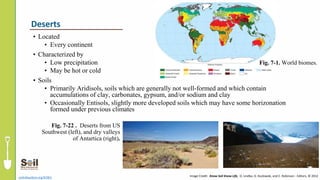
• Located
• Every continent
• Characterized by
• Low precipitation
• May be hot or cold
• Soils
• Primarily Aridisols, soils which are generally not well-formed and which contain
accumulations of clay, carbonates, gypsum, and/or sodium and clay
• Occasionally Entisols, slightly more developed soils which may have some horizonation
formed under previous climates
soils4teachers.org/KSKL
Deserts
Image Credit: Know Soil Know Life, D. Lindbo, D. Kozlowski, and C. Robinson - Editors, © 2012
Fig. 7-22 . Deserts from US
Southwest (left), and dry valleys
of Antartica (right).
Fig. 7-1. World biomes.
• Located
• West coast of N. America, S. America, Australia, S. Africa, and the
Mediterranean coast
• Characterized by
• Evergreen, fire tolerant shrubs, with interspersed grasses in between
• Soils
• Mollisols and Alfisols
soils4teachers.org/KSKL
Shrublands
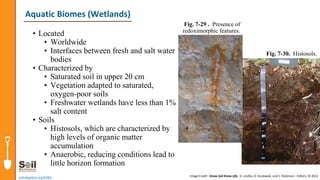
• Located
• Worldwide
• Interfaces between fresh and salt water
bodies
• Characterized by
• Saturated soil in upper 20 cm
• Vegetation adapted to saturated,
oxygen-poor soils
• Freshwater wetlands have less than 1%
salt content
• Soils
• Histosols, which are characterized by
high levels of organic matter
accumulation
• Anaerobic, reducing conditions lead to
little horizon formation
soils4teachers.org/KSKL
Aquatic Biomes (Wetlands)
Image Credit: Know Soil Know Life, D. Lindbo, D. Kozlowski, and C. Robinson - Editors, © 2012
Fig. 7-30. Histosols.
Fig. 7-29 . Presence of
redoximorphic features.
• Soil and plants evolve together
• Biomes are influenced by weather and climate as well as soils
• Not just a one-way interaction; soils and soil formation
are also strongly influenced by climate (“C” in CLORPT)
and plant communities (“O” in CLORPT).
soils4teachers.org/KSKL
Key Points

Educators PPT file chapter 7

  • 1.
  • 2.
    A biome isa large geographic region with a similar environment that contains distinctive plant and animal communities soils4teachers.org/KSKL Image Credit: Know Soil Know Life, D. Lindbo, D. Kozlowski, and C. Robinson - Editors, © 2012 What is a Biome? Fig. 7-1. World biomes.
  • 3.
    Climate • Temperature • Precipitation •Soil temperature • Soil moisture soils4teachers.org/KSKL Image Credit: Know Soil Know Life, D. Lindbo, D. Kozlowski, and C. Robinson - Editors, © 2012 What factors influence how biomes form? Fig. 7-3. Soil temperature regimes. Fig. 7-4. Soil moisture regimes.
  • 4.
    Four types • Tropicalrainforests • Temperate rainforest • Temperate forest • Coniferous/boreal forest soils4teachers.org/KSKL Forests
  • 5.
    Located near equator soils4teachers.org/KSKL Fig.7-1. World biomes. Tropical Rainforest Image Credit: Know Soil Know Life, D. Lindbo, D. Kozlowski, and C. Robinson - Editors, © 2012 Fig. 7-5. A rainforest in Costa Rica.
  • 6.
    • Characterized by: •Warm temperatures year-round (hyperthermic, see Fig. 7-3) • Very wet (udic moisture regime, see Fig. 7-4) • Dense Vegetation • High biodiversity • Soils • Oxisols and Ultisols • Highly weathered, low nutrient availability soils4teachers.org/KSKL Tropical Rainforest Image Credit: Know Soil Know Life, D. Lindbo, D. Kozlowski, and C. Robinson - Editors, © 2012 Fig. 7-6. Oxisols. Fig. 7-7. Utisols.
  • 7.
    • Located • Only0.3% of land surface (not even shown on Fig. 7-1) • Pacific Northwest U.S., Chile, Japan, New Zealand, southern Australia, Norway, U.K. • Characterized by • High levels of precipitation • May have cooler temperatures than tropical rainforest • Soils • Andisols, Spodosols, and Alfisols. soils4teachers.org/KSKL Temperate Rainforest Fig. 7-11. Spodosols. Fig. 7-9. Alfisols. Image Credit: Know Soil Know Life, D. Lindbo, D. Kozlowski, and C. Robinson - Editors, © 2012 Fig. 7-2. World soil orders.
  • 8.
    • Located • Regionsthat receive more than 100 cm rainfall/year • Characterized by • Dormant season when trees drop their leaves • Soils • Cool regions • Alfisols, Inceptisols • Warmer regions • Ultisols, Spodosols soils4teachers.org/KSKL Temperate Deciduous Forest Right: Fig. 7-10. Inceptisols. Left: Fig. 7-9. Alfisols. Image Credit: Know Soil Know Life, D. Lindbo, D. Kozlowski, and C. Robinson - Editors, © 2012 Right: Fig. 7-11. Spodosols. Left: Fig. 7-7. Utisols.
  • 9.
    • Located • EasternCanada, Alaska, Europe, Asia, Russia • South of tundra • Characterized by • Evergreen forests, often with large areas of a single tree species • Soils • Spodosols dominate in sandy areas • Inceptisols and Entisols in other areas soils4teachers.org/KSKL Coniferous/ Boreal Forest (AKA taiga) Image Credit: Know Soil Know Life, D. Lindbo, D. Kozlowski, and C. Robinson - Editors, © 2012 Fig. 7-12. Entisols. Fig. 7-11. Spodosols. Fig. 7-10. Inceptisols.
  • 10.
    Two types • Tropicalsavannahs • Temperate grasslands soils4teachers.org/KSKL Grasslands
  • 11.
    • Located • Largestarea is in East Africa • Characterized by • Tall grasses with occasional trees and shrubs • Soils • Highly weathered • Alfisols, Ultisols, and some Oxisols • Low fertility due to heavy rainfalls and high levels of decomposition during rainy season soils4teachers.org/KSKL Tropical Savannahs Fig. 7-9. Alfisols. Fig. 7-7. Utisols Fig. 7-6. Oxisols. Image Credit: Know Soil Know Life, D. Lindbo, D. Kozlowski, and C. Robinson - Editors, © 2012
  • 12.
    • Located • U.S.Great Plains, Russia, Brazil • Transition between forest and prairie • Characterized by • Grasses dominate vegetation • Occasional trees or shrubs • Soils • Predominantly Mollisols, with organic matter contents dependent upon the type of dominant grass • Some Alfisols in sandy areas soils4teachers.org/KSKL Temperate Grasslands Fig. 7-13. Prairie expanse in Kansas. Fig. 7-14(a). Mollisol from tall-grass prairie. Fig. 7-14(b). Mollisol from short-grass prairie. Fig. 7-15. Grassland Alfisol has sandy texture and lighter colors. Image Credit: Know Soil Know Life, D. Lindbo, D. Kozlowski, and C. Robinson - Editors, © 2012
  • 13.
  • 14.
    • Located • Farnorthern latitudes • Characterized by • Permafrost, strong winds, short growing season, shallow soils • Soils • Gelisols, which have permafrost within 1.0 m of soil surface. soils4teachers.org/KSKL Fig. 7-17. Alaskan tundra showing patterned ground which forms from annual freeze-thaw cycles in upper portion of the soil and permafrost. Image Credit: Know Soil Know Life, D. Lindbo, D. Kozlowski, and C. Robinson - Editors, © 2012 Arctic Tundra Fig. 7-18. Gelisols are slow to decompose organic matter due to cold temperatures.
  • 15.
    • Located • Highelevations • Characterized by • Diurnal (daily) freeze-thaw cycle, rather than seasonal cycle seen in arctic • Diverse climatological and vegetation features, depending primarily on elevation and location on a mountain face • Soils • Generally young and not well-formed • The exception, Spodosols and Andisols, whose parent materials (Andisols) and organic acids (Spodosols) may lead to greater levels of soil formation soils4teachers.org/KSKL Alpine Tundra
  • 16.
    • Located • Everycontinent • Characterized by • Low precipitation • May be hot or cold • Soils • Primarily Aridisols, soils which are generally not well-formed and which contain accumulations of clay, carbonates, gypsum, and/or sodium and clay • Occasionally Entisols, slightly more developed soils which may have some horizonation formed under previous climates soils4teachers.org/KSKL Deserts Image Credit: Know Soil Know Life, D. Lindbo, D. Kozlowski, and C. Robinson - Editors, © 2012 Fig. 7-22 . Deserts from US Southwest (left), and dry valleys of Antartica (right). Fig. 7-1. World biomes.
  • 17.
    • Located • Westcoast of N. America, S. America, Australia, S. Africa, and the Mediterranean coast • Characterized by • Evergreen, fire tolerant shrubs, with interspersed grasses in between • Soils • Mollisols and Alfisols soils4teachers.org/KSKL Shrublands
  • 18.
    • Located • Worldwide •Interfaces between fresh and salt water bodies • Characterized by • Saturated soil in upper 20 cm • Vegetation adapted to saturated, oxygen-poor soils • Freshwater wetlands have less than 1% salt content • Soils • Histosols, which are characterized by high levels of organic matter accumulation • Anaerobic, reducing conditions lead to little horizon formation soils4teachers.org/KSKL Aquatic Biomes (Wetlands) Image Credit: Know Soil Know Life, D. Lindbo, D. Kozlowski, and C. Robinson - Editors, © 2012 Fig. 7-30. Histosols. Fig. 7-29 . Presence of redoximorphic features.
  • 19.
    • Soil andplants evolve together • Biomes are influenced by weather and climate as well as soils • Not just a one-way interaction; soils and soil formation are also strongly influenced by climate (“C” in CLORPT) and plant communities (“O” in CLORPT). soils4teachers.org/KSKL Key Points