

Truth-Telling & Breaking Bad
News (BBN): Ethical Principles
& Practical Steps
Ghaiath Hussein, MBBS (SUD), MHSc. (CAN), PhD (UK)
Alfarabi Medical Colleges
Objectives:
• By the end of this session, you should be able to:
1. Discuss the ethical issues related to truth telling
2. Identify the situations in which truth telling to the
patient needs to be approached with greater caution
3. Describe a systematic approach to breaking bad news
using the 6-step protocol for delivering bad news
Outline
• What do we mean by breaking bad news (BBN)?
• Which news is ‘bad’ in clinical practice?
• Why should we care about BBN?
• BBN as part of the Communication Cycle/Pathway
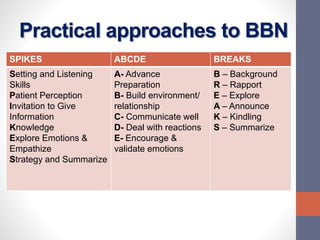
• Practical approaches to BBN: (SPIKES, ABCDE,
BREAKS, & Calgary-Cambridge framework for
breaking bad news)
SHARE YOUR EXPERIENCE
Have you ever been asked to tell someone the ‘bad news’?
What were the news?
How did you do it?
How did the receiver of the news responded?
What constitutes bad news?
• Ideas?
• “…pertaining to situation where there is a feeling of no
hope,
• a threat to a person’s mental or physical well being,
• a risk of upsetting an established lifestyle or
• where a given message conveys to an individual fewer
choices in his or her life” (Ptacek & Eberhardt TL, 1996)
• “any news that drastically and negatively alters the
patient’s view of her or his future” is bad news.
(Buckman, 1984)
What constitutes bad news?
• Unfavourable diagnosis
• Irreversible, un-treatable, or non-stoppable
diseases (or side effects, or complications)
• Disease recurrence
• Spread of disease
• Revealing positive results of genetic tests
• Stigmatization
• Late (to treat) stage diseases
• End of life decisions (DNR, resuscitation)
• Death
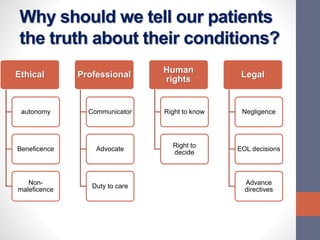
Why should we tell our patients
the truth about their conditions?
Ethical
autonomy
Beneficence
Non-
maleficence
Professional
Communicator
Advocate
Duty to care
Human
rights
Right to know
Right to
decide
Legal
Negligence
EOL decisions
Advance
directives
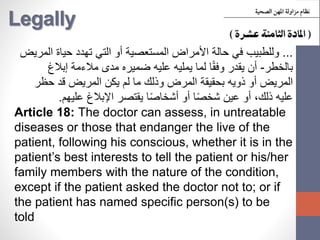
Legally
...‫وللطبيب‬‫المريض‬ ‫حياة‬ ‫تهدد‬ ‫التي‬ ‫أو‬ ‫المستعصية‬ ‫األمراض‬ ‫حالة‬ ‫في‬
‫بالخطر‬-‫إبالغ‬ ‫مالءمة‬ ‫مدى‬ ‫ضميره‬ ‫عليه‬ ‫يمليه‬ ‫لما‬ ‫ا‬ً‫ق‬‫وف‬ ‫يقدر‬ ‫أن‬
‫حظر‬ ‫قد‬ ‫المريض‬ ‫يكن‬ ‫لم‬ ‫ما‬ ‫وذلك‬ ‫المرض‬ ‫بحقيقة‬ ‫ذويه‬ ‫أو‬ ‫المريض‬
‫عليهم‬ ‫اإلبالغ‬ ‫يقتصر‬ ‫ا‬ً‫ص‬‫أشخا‬ ‫أو‬ ‫ا‬ً‫ص‬‫شخ‬ ‫عين‬ ‫أو‬ ،‫ذلك‬ ‫عليه‬.
Article 18: The doctor can assess, in untreatable
diseases or those that endanger the live of the
patient, following his conscious, whether it is in the
patient’s best interests to tell the patient or his/her
family members with the nature of the condition,
except if the patient asked the doctor not to; or if
the patient has named specific person(s) to be
told
HOW DO/CAN PEOPLE REACT TO
BAD NEWS?
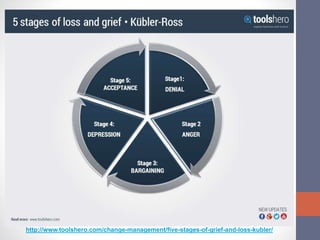
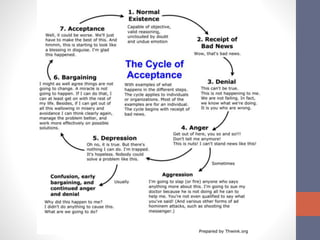
http://www.toolshero.com/change-management/five-stages-of-grief-and-loss-kubler/
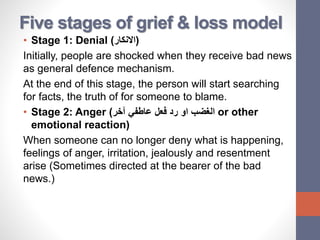
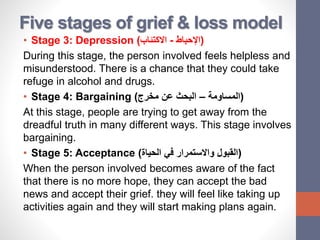
Five stages of grief & loss model
• Stage 1: Denial (‫)االنكار‬
Initially, people are shocked when they receive bad news
as general defence mechanism.
At the end of this stage, the person will start searching
for facts, the truth of for someone to blame.
• Stage 2: Anger (‫آخر‬ ‫عاطفي‬ ‫فعل‬ ‫رد‬ ‫او‬ ‫الغضب‬ or other
emotional reaction)
When someone can no longer deny what is happening,
feelings of anger, irritation, jealously and resentment
arise (Sometimes directed at the bearer of the bad
news.)
Five stages of grief & loss model
• Stage 3: Depression ( ‫اإلحباط‬-‫االكتئاب‬ )
During this stage, the person involved feels helpless and
misunderstood. There is a chance that they could take
refuge in alcohol and drugs.
• Stage 4: Bargaining ( ‫المساومة‬–‫مخرج‬ ‫عن‬ ‫البحث‬ )
At this stage, people are trying to get away from the
dreadful truth in many different ways. This stage involves
bargaining.
• Stage 5: Acceptance (‫الحياة‬ ‫في‬ ‫واالستمرار‬ ‫)القبول‬
When the person involved becomes aware of the fact
that there is no more hope, they can accept the bad
news and accept their grief. they will feel like taking up
activities again and they will start making plans again.
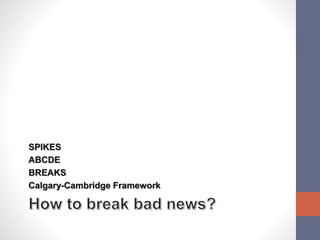
SPIKES
ABCDE
BREAKS
Calgary-Cambridge Framework
context
ChannelSender ReceiverMessage
Feedback
Practical approaches to BBN
SPIKES ABCDE BREAKS
Setting and Listening
Skills
Patient Perception
Invitation to Give
Information
Knowledge
Explore Emotions &
Empathize
Strategy and Summarize
A- Advance
Preparation
B- Build environment/
relationship
C- Communicate well
D- Deal with reactions
E- Encourage &
validate emotions
B – Background
R – Rapport
E – Explore
A – Announce
K – Kindling
S – Summarize
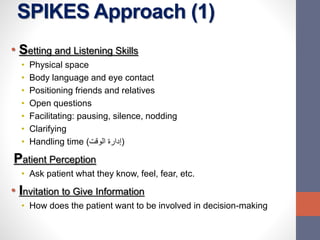
SPIKES Approach (1)
• Setting and Listening Skills
• Physical space
• Body language and eye contact
• Positioning friends and relatives
• Open questions
• Facilitating: pausing, silence, nodding
• Clarifying
• Handling time (‫الوقت‬ ‫)إدارة‬
Patient Perception
• Ask patient what they know, feel, fear, etc.
• Invitation to Give Information
• How does the patient want to be involved in decision-making
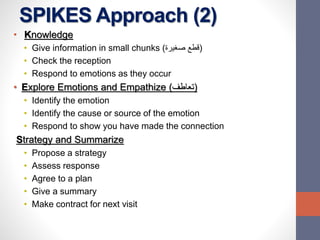
SPIKES Approach (2)
• Knowledge
• Give information in small chunks (‫صغيرة‬ ‫)قطع‬
• Check the reception
• Respond to emotions as they occur
• Explore Emotions and Empathize (‫)تعاطف‬
• Identify the emotion
• Identify the cause or source of the emotion
• Respond to show you have made the connection
Strategy and Summarize
• Propose a strategy
• Assess response
• Agree to a plan
• Give a summary
• Make contract for next visit
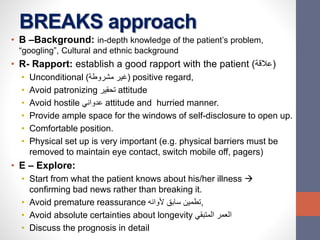
BREAKS approach
• B –Background: in-depth knowledge of the patient’s problem,
“googling”, Cultural and ethnic background
• R- Rapport: establish a good rapport with the patient (‫)عالقة‬
• Unconditional (‫مشروطة‬ ‫)غير‬ positive regard,
• Avoid patronizing ‫تحقير‬ attitude
• Avoid hostile ‫عدواني‬ attitude and hurried manner.
• Provide ample space for the windows of self-disclosure to open up.
• Comfortable position.
• Physical set up is very important (e.g. physical barriers must be
removed to maintain eye contact, switch mobile off, pagers)
• E – Explore:
• Start from what the patient knows about his/her illness 
confirming bad news rather than breaking it.
• Avoid premature reassurance ‫ألوانه‬ ‫سابق‬ ‫,تطمين‬
• Avoid absolute certainties about longevity ‫المتبقي‬ ‫العمر‬
• Discuss the prognosis in detail
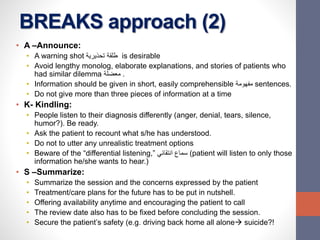
BREAKS approach (2)
• A –Announce:
• A warning shot ‫تحذيرية‬ ‫طلقة‬ is desirable
• Avoid lengthy monolog, elaborate explanations, and stories of patients who
had similar dilemma ‫معضلة‬ .
• Information should be given in short, easily comprehensible ‫مفهومة‬ sentences.
• Do not give more than three pieces of information at a time
• K- Kindling:
• People listen to their diagnosis differently (anger, denial, tears, silence,
humor?). Be ready.
• Ask the patient to recount what s/he has understood.
• Do not to utter any unrealistic treatment options
• Beware of the “differential listening,” ‫انتقائي‬ ‫سماع‬ (patient will listen to only those
information he/she wants to hear.)
• S –Summarize:
• Summarize the session and the concerns expressed by the patient
• Treatment/care plans for the future has to be put in nutshell.
• Offering availability anytime and encouraging the patient to call
• The review date also has to be fixed before concluding the session.
• Secure the patient’s safety (e.g. driving back home all alone suicide?!
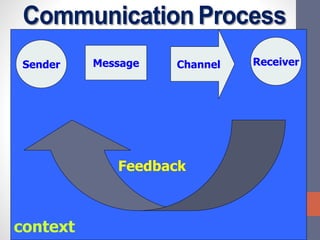
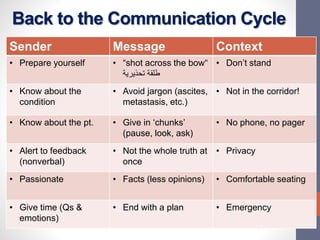
Back to the Communication Cycle
Sender Message Context
• Prepare yourself • “shot across the bow“
‫تحذيرية‬ ‫طلقة‬
• Don’t stand
• Know about the
condition
• Avoid jargon (ascites,
metastasis, etc.)
• Not in the corridor!
• Know about the pt. • Give in ‘chunks’
(pause, look, ask)
• No phone, no pager
• Alert to feedback
(nonverbal)
• Not the whole truth at
once
• Privacy
• Passionate • Facts (less opinions) • Comfortable seating
• Give time (Qs &
emotions)
• End with a plan • Emergency
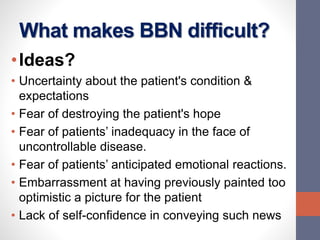
What makes BBN difficult?
•Ideas?
• Uncertainty about the patient's condition &
expectations
• Fear of destroying the patient's hope
• Fear of patients’ inadequacy in the face of
uncontrollable disease.
• Fear of patients’ anticipated emotional reactions.
• Embarrassment at having previously painted too
optimistic a picture for the patient
• Lack of self-confidence in conveying such news
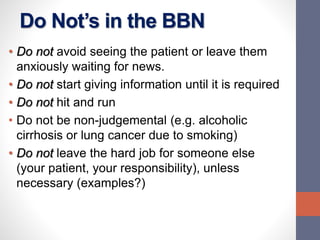
Do Not’s in the BBN
• Do not avoid seeing the patient or leave them
anxiously waiting for news.
• Do not start giving information until it is required
• Do not hit and run
• Do not be non-judgemental (e.g. alcoholic
cirrhosis or lung cancer due to smoking)
• Do not leave the hard job for someone else
(your patient, your responsibility), unless
necessary (examples?)
Do Not’s in the BBN
• Do not share information (e.g. to relatives),
unless appropriate and after consent
• Do not assume (mis)understanding
• Do not lie (really? ;)
• Do not give false hopes (science cannot always
do miracles)
• Do not use terms such as “there is nothing more
we can do for you”. be optimistic but do not
promise success or anything else that may not be
delivered
• Do not abandon patients after the BBN session ‫ال‬
‫مرضاك‬ ‫عن‬ ‫تتخلى‬
Useful resources
• Breaking Bad News ...Regional Guidelines, Developed from
Partnerships in Caring (2000) DHSSPS (February 2003),
http://www.dhsspsni.gov.uk/breaking_bad_news.pdf
• ‘BREAKS’ Protocol for Breaking Bad News, Vijayakumar Narayanan, Bibek
Bista, and Cheriyan Koshy
(http://www.ncbi.nlm.nih.gov/pmc/articles/PMC3144432/#CIT4)
• How to Break Bad News, Edited by Horses4Ever, KnowItSome,
Flickety, Dave Crosby and others (http://www.wikihow.com/Break-
Bad-News)
• Silverman J., Kurtz S.M., Draper J. (1998) Skills for
Communicating with Patients. Radcliffe Medical Press Oxford
• Buckman R. (1994) How to break bad news: a guide for health care
professionals. Papermac, London
• Cushing A.M., Jones A. (1995) Evaluation of a breaking bad news
course for medical students. Medic al Education. 29: 430-35
• Maguire P., Faulkner A. (1988) Improve the counselling skills of
doctors and nurses in cancer care BMJ 297, 847-849
• Sanson Fisher (1992) How to break bad news to cancer
patients. An interactional skills manual for interns. The
Professional Education and Training Committee of the New South
Wales Cancer Council and the Postgraduate Medical Council of
NSW Australia, Kings Cross, NSW Australia
• http://www.alukah.net/culture/0/48344/#ixzz4RqU4EKeX
QUESTIONS AND DISCUSSION

Truth Telling & breaking bad news (BBN)

  • 1.
    Truth-Telling & BreakingBad News (BBN): Ethical Principles & Practical Steps Ghaiath Hussein, MBBS (SUD), MHSc. (CAN), PhD (UK) Alfarabi Medical Colleges
  • 2.
    Objectives: • By theend of this session, you should be able to: 1. Discuss the ethical issues related to truth telling 2. Identify the situations in which truth telling to the patient needs to be approached with greater caution 3. Describe a systematic approach to breaking bad news using the 6-step protocol for delivering bad news
  • 3.
    Outline • What dowe mean by breaking bad news (BBN)? • Which news is ‘bad’ in clinical practice? • Why should we care about BBN? • BBN as part of the Communication Cycle/Pathway • Practical approaches to BBN: (SPIKES, ABCDE, BREAKS, & Calgary-Cambridge framework for breaking bad news)
  • 4.
    SHARE YOUR EXPERIENCE Haveyou ever been asked to tell someone the ‘bad news’? What were the news? How did you do it? How did the receiver of the news responded?
  • 5.
    What constitutes badnews? • Ideas? • “…pertaining to situation where there is a feeling of no hope, • a threat to a person’s mental or physical well being, • a risk of upsetting an established lifestyle or • where a given message conveys to an individual fewer choices in his or her life” (Ptacek & Eberhardt TL, 1996) • “any news that drastically and negatively alters the patient’s view of her or his future” is bad news. (Buckman, 1984)
  • 6.
    What constitutes badnews? • Unfavourable diagnosis • Irreversible, un-treatable, or non-stoppable diseases (or side effects, or complications) • Disease recurrence • Spread of disease • Revealing positive results of genetic tests • Stigmatization • Late (to treat) stage diseases • End of life decisions (DNR, resuscitation) • Death
  • 7.
    Why should wetell our patients the truth about their conditions? Ethical autonomy Beneficence Non- maleficence Professional Communicator Advocate Duty to care Human rights Right to know Right to decide Legal Negligence EOL decisions Advance directives
  • 8.
    Legally ...‫وللطبيب‬‫المريض‬ ‫حياة‬ ‫تهدد‬‫التي‬ ‫أو‬ ‫المستعصية‬ ‫األمراض‬ ‫حالة‬ ‫في‬ ‫بالخطر‬-‫إبالغ‬ ‫مالءمة‬ ‫مدى‬ ‫ضميره‬ ‫عليه‬ ‫يمليه‬ ‫لما‬ ‫ا‬ً‫ق‬‫وف‬ ‫يقدر‬ ‫أن‬ ‫حظر‬ ‫قد‬ ‫المريض‬ ‫يكن‬ ‫لم‬ ‫ما‬ ‫وذلك‬ ‫المرض‬ ‫بحقيقة‬ ‫ذويه‬ ‫أو‬ ‫المريض‬ ‫عليهم‬ ‫اإلبالغ‬ ‫يقتصر‬ ‫ا‬ً‫ص‬‫أشخا‬ ‫أو‬ ‫ا‬ً‫ص‬‫شخ‬ ‫عين‬ ‫أو‬ ،‫ذلك‬ ‫عليه‬. Article 18: The doctor can assess, in untreatable diseases or those that endanger the live of the patient, following his conscious, whether it is in the patient’s best interests to tell the patient or his/her family members with the nature of the condition, except if the patient asked the doctor not to; or if the patient has named specific person(s) to be told
  • 9.
    HOW DO/CAN PEOPLEREACT TO BAD NEWS?
  • 10.
  • 11.
    Five stages ofgrief & loss model • Stage 1: Denial (‫)االنكار‬ Initially, people are shocked when they receive bad news as general defence mechanism. At the end of this stage, the person will start searching for facts, the truth of for someone to blame. • Stage 2: Anger (‫آخر‬ ‫عاطفي‬ ‫فعل‬ ‫رد‬ ‫او‬ ‫الغضب‬ or other emotional reaction) When someone can no longer deny what is happening, feelings of anger, irritation, jealously and resentment arise (Sometimes directed at the bearer of the bad news.)
  • 12.
    Five stages ofgrief & loss model • Stage 3: Depression ( ‫اإلحباط‬-‫االكتئاب‬ ) During this stage, the person involved feels helpless and misunderstood. There is a chance that they could take refuge in alcohol and drugs. • Stage 4: Bargaining ( ‫المساومة‬–‫مخرج‬ ‫عن‬ ‫البحث‬ ) At this stage, people are trying to get away from the dreadful truth in many different ways. This stage involves bargaining. • Stage 5: Acceptance (‫الحياة‬ ‫في‬ ‫واالستمرار‬ ‫)القبول‬ When the person involved becomes aware of the fact that there is no more hope, they can accept the bad news and accept their grief. they will feel like taking up activities again and they will start making plans again.
  • 15.
  • 16.
  • 17.
    Practical approaches toBBN SPIKES ABCDE BREAKS Setting and Listening Skills Patient Perception Invitation to Give Information Knowledge Explore Emotions & Empathize Strategy and Summarize A- Advance Preparation B- Build environment/ relationship C- Communicate well D- Deal with reactions E- Encourage & validate emotions B – Background R – Rapport E – Explore A – Announce K – Kindling S – Summarize
  • 18.
    SPIKES Approach (1) •Setting and Listening Skills • Physical space • Body language and eye contact • Positioning friends and relatives • Open questions • Facilitating: pausing, silence, nodding • Clarifying • Handling time (‫الوقت‬ ‫)إدارة‬ Patient Perception • Ask patient what they know, feel, fear, etc. • Invitation to Give Information • How does the patient want to be involved in decision-making
  • 19.
    SPIKES Approach (2) •Knowledge • Give information in small chunks (‫صغيرة‬ ‫)قطع‬ • Check the reception • Respond to emotions as they occur • Explore Emotions and Empathize (‫)تعاطف‬ • Identify the emotion • Identify the cause or source of the emotion • Respond to show you have made the connection Strategy and Summarize • Propose a strategy • Assess response • Agree to a plan • Give a summary • Make contract for next visit
  • 20.
    BREAKS approach • B–Background: in-depth knowledge of the patient’s problem, “googling”, Cultural and ethnic background • R- Rapport: establish a good rapport with the patient (‫)عالقة‬ • Unconditional (‫مشروطة‬ ‫)غير‬ positive regard, • Avoid patronizing ‫تحقير‬ attitude • Avoid hostile ‫عدواني‬ attitude and hurried manner. • Provide ample space for the windows of self-disclosure to open up. • Comfortable position. • Physical set up is very important (e.g. physical barriers must be removed to maintain eye contact, switch mobile off, pagers) • E – Explore: • Start from what the patient knows about his/her illness  confirming bad news rather than breaking it. • Avoid premature reassurance ‫ألوانه‬ ‫سابق‬ ‫,تطمين‬ • Avoid absolute certainties about longevity ‫المتبقي‬ ‫العمر‬ • Discuss the prognosis in detail
  • 21.
    BREAKS approach (2) •A –Announce: • A warning shot ‫تحذيرية‬ ‫طلقة‬ is desirable • Avoid lengthy monolog, elaborate explanations, and stories of patients who had similar dilemma ‫معضلة‬ . • Information should be given in short, easily comprehensible ‫مفهومة‬ sentences. • Do not give more than three pieces of information at a time • K- Kindling: • People listen to their diagnosis differently (anger, denial, tears, silence, humor?). Be ready. • Ask the patient to recount what s/he has understood. • Do not to utter any unrealistic treatment options • Beware of the “differential listening,” ‫انتقائي‬ ‫سماع‬ (patient will listen to only those information he/she wants to hear.) • S –Summarize: • Summarize the session and the concerns expressed by the patient • Treatment/care plans for the future has to be put in nutshell. • Offering availability anytime and encouraging the patient to call • The review date also has to be fixed before concluding the session. • Secure the patient’s safety (e.g. driving back home all alone suicide?!
  • 22.
    Back to theCommunication Cycle Sender Message Context • Prepare yourself • “shot across the bow“ ‫تحذيرية‬ ‫طلقة‬ • Don’t stand • Know about the condition • Avoid jargon (ascites, metastasis, etc.) • Not in the corridor! • Know about the pt. • Give in ‘chunks’ (pause, look, ask) • No phone, no pager • Alert to feedback (nonverbal) • Not the whole truth at once • Privacy • Passionate • Facts (less opinions) • Comfortable seating • Give time (Qs & emotions) • End with a plan • Emergency
  • 23.
    What makes BBNdifficult? •Ideas? • Uncertainty about the patient's condition & expectations • Fear of destroying the patient's hope • Fear of patients’ inadequacy in the face of uncontrollable disease. • Fear of patients’ anticipated emotional reactions. • Embarrassment at having previously painted too optimistic a picture for the patient • Lack of self-confidence in conveying such news
  • 24.
    Do Not’s inthe BBN • Do not avoid seeing the patient or leave them anxiously waiting for news. • Do not start giving information until it is required • Do not hit and run • Do not be non-judgemental (e.g. alcoholic cirrhosis or lung cancer due to smoking) • Do not leave the hard job for someone else (your patient, your responsibility), unless necessary (examples?)
  • 25.
    Do Not’s inthe BBN • Do not share information (e.g. to relatives), unless appropriate and after consent • Do not assume (mis)understanding • Do not lie (really? ;) • Do not give false hopes (science cannot always do miracles) • Do not use terms such as “there is nothing more we can do for you”. be optimistic but do not promise success or anything else that may not be delivered • Do not abandon patients after the BBN session ‫ال‬ ‫مرضاك‬ ‫عن‬ ‫تتخلى‬
  • 26.
    Useful resources • BreakingBad News ...Regional Guidelines, Developed from Partnerships in Caring (2000) DHSSPS (February 2003), http://www.dhsspsni.gov.uk/breaking_bad_news.pdf • ‘BREAKS’ Protocol for Breaking Bad News, Vijayakumar Narayanan, Bibek Bista, and Cheriyan Koshy (http://www.ncbi.nlm.nih.gov/pmc/articles/PMC3144432/#CIT4) • How to Break Bad News, Edited by Horses4Ever, KnowItSome, Flickety, Dave Crosby and others (http://www.wikihow.com/Break- Bad-News) • Silverman J., Kurtz S.M., Draper J. (1998) Skills for Communicating with Patients. Radcliffe Medical Press Oxford • Buckman R. (1994) How to break bad news: a guide for health care professionals. Papermac, London • Cushing A.M., Jones A. (1995) Evaluation of a breaking bad news course for medical students. Medic al Education. 29: 430-35 • Maguire P., Faulkner A. (1988) Improve the counselling skills of doctors and nurses in cancer care BMJ 297, 847-849 • Sanson Fisher (1992) How to break bad news to cancer patients. An interactional skills manual for interns. The Professional Education and Training Committee of the New South Wales Cancer Council and the Postgraduate Medical Council of NSW Australia, Kings Cross, NSW Australia • http://www.alukah.net/culture/0/48344/#ixzz4RqU4EKeX
  • 27.

Editor's Notes

  • #8 This “right to know” has many ethical principles and duties related to it. Informed decision and respect for autonomy Briefly, this principle states that any competent person should be given the freedom to decide on any decision that is related to his/her body and/or health. She need the facts so she can decide. eople need to know about their conditions in order to make an adequate assessment of harm. How can patients tell what the potential harm of this investigation or that treatment is, if they do not know the “truth”? Hiding, manipulating, or falsifying information given (or not) to the patient could affect their ability to make a decision, which in turn may cause them direct harm if they make a misguided decision, or cause harm that could have been avoided if they knew the “truth.” Non-maleficence One of the most crucial duties of a health care provider is not to harm the patient, i.e., if the provider cannot be part of the solution, then at least he/she should not be part of the problem.  Beneficence This principle is linked in part to both of the earlier principles, as well as others. Harm is usually measured in comparison to benefits and not in absolute terms. Thus, many interventions include a “justifiable” degree of harm because they bring much greater benefit. For example, almost all drugs have side effects, ranging from mild (e.g., nausea or abdominal upset) to severe (e.g., atrial fibrillation or bleeding).