Communication Skills Course
  Consultation Models

                  Fayza Rayes
              (MBBCh. Msc. MRCGP (UK
             Consultant Family Physician
Joint Program of Family & Community Medicine – Jeddah

                www.fayzarayes.com

               fayzarayes@yahoo.com
Case Scenario
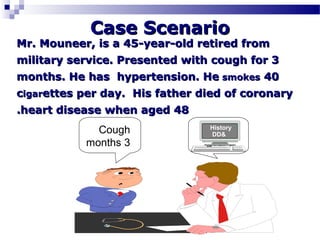
Mr. Mouneer, is a 45-year-old retired from
military service. Presented with cough for 3
months. He has hypertension. He smokes 40
cigarettes per day. His father died of coronary
.heart disease when aged 48
             Cough              History
                                DD&
           months 3
?!What are Mouneer problems
Mr. Mouneer, is a 45-year-old retired from
military service. Presented with cough for 3
months. He has hypertension. He smokes 40
cigarettes per day. His father died of
.coronary heart disease when aged 48


 ?!What does Mouneer need from his physician
What skills do physician need conduct
   ?!this consultation effectively

    Managing cough &     & Empathy    Counseling
    BP & Risk factors   reassurance    & advise


            Cough
             BP
The Traditional Consultation
                Model
         Patient Clerking
Chief Complaint
History of The Present Complaint
Past Medical History
Family History                          This does
Personal & Social History               not cover
Drug & Allergy History Systems Review   patient’s
Physical Examination                      need
Biological Diagnosis

 Disease Management:
       Investigation
       Prescribing
       Follow-up Appointment
Exercise 16 Page 49

The Traditional Medical Model

1.   50% poor compliance ?!
2.   40% pts unsatisfied ?!
3.   Reassurance ?!
4.   Biological diagnosis ?!
5.   Dealing with uncertainty ?!
6.   5-10 min consultation ?!
7.   Unsatisfied doctors ?!
The Traditional Medical Model
:Missing Tasks


1.   Doctor – Patient Relationship
2.   Pt ideas concerns expectations and feelings
3.   Risk assessment
4.   Psycho-social diagnosis
5.   Patient management
6.   Management of time & resources
7.   Management of doctor feelings (Housekeeping)
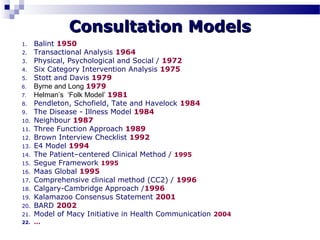
Consultation Models
Consultation Models
1.    Balint 1950
2.    Transactional Analysis 1964
3.    Physical, Psychological and Social / 1972
4.    Six Category Intervention Analysis 1975
5.    Stott and Davis 1979
6.    Byrne and Long 1979
7.    Helman’s ‘Folk Model’ 1981
8.    Pendleton, Schofield, Tate and Havelock 1984
9.    The Disease - Illness Model 1984
10.   Neighbour 1987
11.   Three Function Approach 1989
12.   Brown Interview Checklist 1992
13.   E4 Model 1994
14.   The Patient–centered Clinical Method / 1995
15.   Segue Framework 1995
16.   Maas Global 1995
17.   Comprehensive clinical method (CC2) / 1996
18.   Calgary-Cambridge Approach /1996
19.   Kalamazoo Consensus Statement 2001
20.   BARD 2002
21.   Model of Macy Initiative in Health Communication 2004
22.   …
“The doctor as the drug”
Balint (1950)
     The
Importance of
 therapeutic
doctor–patient
 Relationship


                 Appropriate use of doctor’s authority
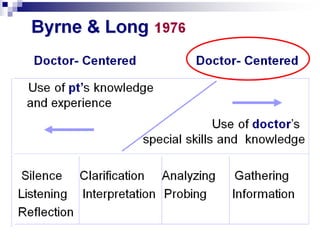
Byrne & Long

   Patient Centred consultation style
     Less   authoritarian doctor
     Encourages    patient to explore their own
      feelings and concerns
     Show   interested in psycho-social aspect of
      illness
Byrne & Long

   Doctor centred consultation style:
     Paternalistic   - doctor is the expert and patient
      expected to cooperate
     Tightly   controlled interviewing style aimed at
      reaching an organic diagnosis.
The Expanded Model of Consultation


   Management of       Modification of Help
Presenting Problem     Seeking Behavior


  Management of        Opportunistic health
Continuous Problem        Promotion
             (Stott & Davis 1979)
Stott & Davis 1979


A 65-year-old retired military officer,
rarely visit the practice, he came today
with back pain, headache and
 generalized weakness

   Management of         Management of
 Presenting Problem    Continuous Problem


     Modification of
                       Opportunistic health
     Help Seeking
                           Promotion
       Behavior
Stott & Davis 1979

Sameera is a 14-month-old girl, her mother is
very anxious because Sameera cannot walk
independently till now. She demands that
something to be done about this. Sameera is
the youngest of five children. Her father is
.unemployed

   Management of          Management of
 Presenting Problem     Continuous Problem


     Modification of
                        Opportunistic health
     Help Seeking
                            Promotion
       Behavior
Stott & Davis 1979


Mrs. Hala is a 28-year-old lady, recently
married presents with vaginal discharge.


  Management of         Management of
Presenting Problem    Continuous Problem


    Modification of
                      Opportunistic health
    Help Seeking
                          Promotion
      Behavior
Stott & Davis 1979


The Expanded Model of Consultation

        Health Education
        Health promotion
(Pendleton 7 Tasks (1984

1.   To define the real reasons for pt attendance
2.   To consider other problems
3.   To choose with the pt. appropriate action for
     each problem
4.   To achieve a share understanding
5.   To involve pt. in the management
6.   To use time & resources effectively
7.   To establish & maintain Dr.-pt. relationship
Neighbour (1992(
The Inner Consultation


                 Connect     Summarize


 Housekeeping   Safety net   Hand over
The Three-Function Approach to the
 (Medical Interview (Cohen-Cole1991
     Functions                  Skills
1.   Gathering data             a)Open-ended questions
                                b)Open to closed one
                                c)Facilitation
                                d)Checking
                                e)Survey of problems
                                f)Negotiate priorities
                                g)Clarification and direction
                                h)Summarizing
                                i)Elicit patient’s expectations
                                j)Elicit patient’s ideas about etiology
                                k)Elicit impact of illness on patient’s quality of life
2    Developing rapport         a)Reflection
                                b)Legitimating
                                c)Support
                                d)Partnership
                                e)Respect
3    Education and motivation   a)Education about illness
                                b)Negotiation and maintenance of a treatment plan
                                c) Motivation of non-adherent patients
Model of Macy Initiative in Health
Communication
The Framework of The Calgary-
Cambridge Guide (Kurtz 1996)
1.Initiating The Session
 Establishing initial rapport
 Identifying the real reason(s) for consultation

2. Gathering Information
 Exploration of problems
 Understanding the patient's perspective
 Providing structure to the consultation

3. Building The Relationship
 Developing rapport
 Involving the patient

4. Explanation And Planning
 Providing the correct amount and type of information
 Aiding accurate recall and understanding
 Achieving a shared understanding: incorporating the patient's perspective
 Shared decision making

5. Closing The Session
The Calgary-Cambridge Guide (Kurtz 1996)
Consultation Models


General Comments about Previous Models

1.   Each model concentrates on particular
     important task(s)


2.   They are far from the traditional hospital model


3.   Not easy to incorporate them in medical records
     and daily clinical practice
The
Comprehensive Model

   Fayza Rayes 2004
The Comprehensive Model

Objectives:

1.   Integrate traditional clinical method with
     effective communication skills

2.   Identify the main skills needed to conduct
     successful consultation.
The Traditional Consultation Model
Patient Clerking
      Doctor – Centered:

  History Taking
  Physical Examination
  Biological Diagnosis
                              This is not
   Disease Management:      suitable for
          Investigation   modern medicine
          Prescribing
          Follow-up
           Appointment
The Traditional Consultation Model
        Patient Clerking
Chief Complaint
History of The Present Complaint : Important Missing Tasks
Past Medical History
                                Doctor – Patient Relationship
Family History
                                 Patient’s ideas concerns expectations
Personal & Social History
                                and effects of the problem
Drug & Allergy History
                                Psycho-social diagnosis
Systems Review
Physical Examination            Patient management
Biological Diagnosis            Management of time & resources
                                Management of doctor feelings
 Disease Management:
                                ((Housekeeping
       Investigation
       Prescribing
       Follow-up Appointment
The New Comprehensive Consultation Model

   It is characterized by :
       Value doctor-patient relationship
       Patient – centered
       Holistic approach
       Reassurance, prevention & health education are
        basic component of its contents
       Practical and easy to incorporate it in the current
        medical records and daily clinical practice.
Integrating Comprehensive Model
in Hospital medical Records
 1.  Chief complaint
 2. History of the present complaint
 3. Pt ideas concerns expectation and feelings
 4. Risk assessment
 5. Past medical history
 6. Family History
 7. Social History           ”USER FRIENDLY“
 8. Systems Review
 9. Physical examination
 10.Bio-psycho-social diagnosis
 11. Disease management & Patient management
Integrating Comprehensive Consultation
   Model in Hospital medical Records


Tasks done but not written:
13.   Doctor – Patient Relationship
14.   Management of time & resources
15.   Management of doctor feelings (Housekeeping)
NEW
      The New Comprehensive
      Consultation Model

   What is new in this model?
     Patient    – centered
     Holistic   approach
       Practical and easy
     Practical and easy      to incorporate it
     in to the current medical records and
     apply it in daily clinical practice.
Respecting the Experience
of Our Trainees

The New Consultation Model:

      1. Comprehensive
      2. Complementary
      3. User friendly
Page 45
A Guide for Comprehensive Consultation Model
          Physician-Patient Relationship:
          1.Establish the relationship
          2.Facilitation
          3.Building Rapport
          4.Empathy
          5.Making use of physical examination
          6.Partnership
          7.Closing & maintaining the relationship Diagnosis:
          Comprehensive Bio-psycho-social
          8.     Gathering information about disease & illness
          9.     Broad thinking and exclusion of all possible differential
                 diagnosis
          10.    Exclusion of possible serious complications
          11.    Identification of at risk factors & continuous problem
          Comprehensive Management:
                Patient Management:
          12.   Explanation and Health Education
          13.   Reassurance: (remember: you are the most effective drug)
          14.   Health Promotion
          15.   Modification of help seeking behavior (Denial, displacement)
          16.   Disease Management: intervention by investigations or
                treatment
          17.   Management of time & resources
          18.   Management of physician’s feeling (House-keeping)
Comprehensive Consultation Model:
A Guide for Training

Physician-Patient Relationship:
1.   Establish the relationship
2.   Facilitation
3.   Building Rapport
4.   Empathy
5.   Making use of physical examination
6.   Partnership
7.   Closing & maintaining the relationship
Comprehensive Consultation
Model: A Guide for Training

Comprehensive Bio-psycho-social Diagnosis:

8.    Gathering information about disease & illness
9.    Broad thinking and exclusion of all possible
      differential diagnosis
10.   Exclusion of possible serious complications
11.   Identification of at risk factors & continuous
      problem
Comprehensive Consultation
Model: A Guide for Training
Comprehensive Management:
         Patient Management:
12.   Explanation and Health Education
13.   Reassurance: (remember: you are the most effective
      drug)
14.   Health Promotion
15.   Modification of help seeking behavior (Denial,
      displacement)
16.   Disease Management: intervention by investigations or
      treatment
17.   Management of time & resources
18.   Management of physician’s feeling (House-keeping)
Final Message & Conclusions
    Traditional Model of Consultation is not suitable for
     modern medicine
    The New Comprehensive Model of Consultation
     is characterized by :

        1.   Making use of the most existing and update
             consultation models and guides.

        2.   Integrating the traditional clinical method with
             effective communication skills

        3.   Building on what the physicians already know, so it
             complements, it does not destruct nor neglect the
             traditional medical model.
:RECOMMENDATIONS


We recommend all physicians in all medical
      specialties to change to this new
 comprehensive consultation model in their
           daily clinical practice
‫‪Consultation Models‬‬


   ‫)إن ا يحب أحدكم إذا عمل‬
 ‫عمال ف ً فليتقنه ( وفي رواية )فليتمه(‬


       ‫صدق الرسول الكريم صلى ا عليه وسلم‬
References

Consultation models

  • 1.
    Communication Skills Course Consultation Models Fayza Rayes (MBBCh. Msc. MRCGP (UK Consultant Family Physician Joint Program of Family & Community Medicine – Jeddah www.fayzarayes.com fayzarayes@yahoo.com
  • 2.
    Case Scenario Mr. Mouneer,is a 45-year-old retired from military service. Presented with cough for 3 months. He has hypertension. He smokes 40 cigarettes per day. His father died of coronary .heart disease when aged 48 Cough History DD& months 3
  • 3.
    ?!What are Mouneerproblems Mr. Mouneer, is a 45-year-old retired from military service. Presented with cough for 3 months. He has hypertension. He smokes 40 cigarettes per day. His father died of .coronary heart disease when aged 48 ?!What does Mouneer need from his physician
  • 4.
    What skills dophysician need conduct ?!this consultation effectively Managing cough & & Empathy Counseling BP & Risk factors reassurance & advise Cough BP
  • 5.
    The Traditional Consultation Model Patient Clerking Chief Complaint History of The Present Complaint Past Medical History Family History This does Personal & Social History not cover Drug & Allergy History Systems Review patient’s Physical Examination need Biological Diagnosis  Disease Management:  Investigation  Prescribing  Follow-up Appointment
  • 6.
    Exercise 16 Page49 The Traditional Medical Model 1. 50% poor compliance ?! 2. 40% pts unsatisfied ?! 3. Reassurance ?! 4. Biological diagnosis ?! 5. Dealing with uncertainty ?! 6. 5-10 min consultation ?! 7. Unsatisfied doctors ?!
  • 7.
    The Traditional MedicalModel :Missing Tasks 1. Doctor – Patient Relationship 2. Pt ideas concerns expectations and feelings 3. Risk assessment 4. Psycho-social diagnosis 5. Patient management 6. Management of time & resources 7. Management of doctor feelings (Housekeeping)
  • 8.
  • 9.
    Consultation Models 1. Balint 1950 2. Transactional Analysis 1964 3. Physical, Psychological and Social / 1972 4. Six Category Intervention Analysis 1975 5. Stott and Davis 1979 6. Byrne and Long 1979 7. Helman’s ‘Folk Model’ 1981 8. Pendleton, Schofield, Tate and Havelock 1984 9. The Disease - Illness Model 1984 10. Neighbour 1987 11. Three Function Approach 1989 12. Brown Interview Checklist 1992 13. E4 Model 1994 14. The Patient–centered Clinical Method / 1995 15. Segue Framework 1995 16. Maas Global 1995 17. Comprehensive clinical method (CC2) / 1996 18. Calgary-Cambridge Approach /1996 19. Kalamazoo Consensus Statement 2001 20. BARD 2002 21. Model of Macy Initiative in Health Communication 2004 22. …
  • 10.
    “The doctor asthe drug” Balint (1950) The Importance of therapeutic doctor–patient Relationship Appropriate use of doctor’s authority
  • 12.
    Byrne & Long  Patient Centred consultation style  Less authoritarian doctor  Encourages patient to explore their own feelings and concerns  Show interested in psycho-social aspect of illness
  • 13.
    Byrne & Long  Doctor centred consultation style:  Paternalistic - doctor is the expert and patient expected to cooperate  Tightly controlled interviewing style aimed at reaching an organic diagnosis.
  • 14.
    The Expanded Modelof Consultation Management of Modification of Help Presenting Problem Seeking Behavior Management of Opportunistic health Continuous Problem Promotion (Stott & Davis 1979)
  • 15.
    Stott & Davis1979 A 65-year-old retired military officer, rarely visit the practice, he came today with back pain, headache and generalized weakness Management of Management of Presenting Problem Continuous Problem Modification of Opportunistic health Help Seeking Promotion Behavior
  • 16.
    Stott & Davis1979 Sameera is a 14-month-old girl, her mother is very anxious because Sameera cannot walk independently till now. She demands that something to be done about this. Sameera is the youngest of five children. Her father is .unemployed Management of Management of Presenting Problem Continuous Problem Modification of Opportunistic health Help Seeking Promotion Behavior
  • 17.
    Stott & Davis1979 Mrs. Hala is a 28-year-old lady, recently married presents with vaginal discharge. Management of Management of Presenting Problem Continuous Problem Modification of Opportunistic health Help Seeking Promotion Behavior
  • 19.
    Stott & Davis1979 The Expanded Model of Consultation  Health Education  Health promotion
  • 20.
    (Pendleton 7 Tasks(1984 1. To define the real reasons for pt attendance 2. To consider other problems 3. To choose with the pt. appropriate action for each problem 4. To achieve a share understanding 5. To involve pt. in the management 6. To use time & resources effectively 7. To establish & maintain Dr.-pt. relationship
  • 21.
    Neighbour (1992( The InnerConsultation Connect Summarize Housekeeping Safety net Hand over
  • 22.
    The Three-Function Approachto the (Medical Interview (Cohen-Cole1991 Functions Skills 1. Gathering data a)Open-ended questions b)Open to closed one c)Facilitation d)Checking e)Survey of problems f)Negotiate priorities g)Clarification and direction h)Summarizing i)Elicit patient’s expectations j)Elicit patient’s ideas about etiology k)Elicit impact of illness on patient’s quality of life 2 Developing rapport a)Reflection b)Legitimating c)Support d)Partnership e)Respect 3 Education and motivation a)Education about illness b)Negotiation and maintenance of a treatment plan c) Motivation of non-adherent patients
  • 23.
    Model of MacyInitiative in Health Communication
  • 24.
    The Framework ofThe Calgary- Cambridge Guide (Kurtz 1996) 1.Initiating The Session  Establishing initial rapport  Identifying the real reason(s) for consultation 2. Gathering Information  Exploration of problems  Understanding the patient's perspective  Providing structure to the consultation 3. Building The Relationship  Developing rapport  Involving the patient 4. Explanation And Planning  Providing the correct amount and type of information  Aiding accurate recall and understanding  Achieving a shared understanding: incorporating the patient's perspective  Shared decision making 5. Closing The Session
  • 25.
  • 26.
    Consultation Models General Commentsabout Previous Models 1. Each model concentrates on particular important task(s) 2. They are far from the traditional hospital model 3. Not easy to incorporate them in medical records and daily clinical practice
  • 27.
    The Comprehensive Model Fayza Rayes 2004
  • 28.
    The Comprehensive Model Objectives: 1. Integrate traditional clinical method with effective communication skills 2. Identify the main skills needed to conduct successful consultation.
  • 29.
    The Traditional ConsultationModel Patient Clerking Doctor – Centered: History Taking Physical Examination Biological Diagnosis This is not  Disease Management: suitable for  Investigation modern medicine  Prescribing  Follow-up Appointment
  • 30.
    The Traditional ConsultationModel Patient Clerking Chief Complaint History of The Present Complaint : Important Missing Tasks Past Medical History Doctor – Patient Relationship Family History Patient’s ideas concerns expectations Personal & Social History and effects of the problem Drug & Allergy History Psycho-social diagnosis Systems Review Physical Examination Patient management Biological Diagnosis Management of time & resources Management of doctor feelings  Disease Management: ((Housekeeping  Investigation  Prescribing  Follow-up Appointment
  • 32.
    The New ComprehensiveConsultation Model  It is characterized by :  Value doctor-patient relationship  Patient – centered  Holistic approach  Reassurance, prevention & health education are basic component of its contents  Practical and easy to incorporate it in the current medical records and daily clinical practice.
  • 33.
    Integrating Comprehensive Model inHospital medical Records 1. Chief complaint 2. History of the present complaint 3. Pt ideas concerns expectation and feelings 4. Risk assessment 5. Past medical history 6. Family History 7. Social History ”USER FRIENDLY“ 8. Systems Review 9. Physical examination 10.Bio-psycho-social diagnosis 11. Disease management & Patient management
  • 34.
    Integrating Comprehensive Consultation Model in Hospital medical Records Tasks done but not written: 13. Doctor – Patient Relationship 14. Management of time & resources 15. Management of doctor feelings (Housekeeping)
  • 35.
    NEW The New Comprehensive Consultation Model  What is new in this model?  Patient – centered  Holistic approach Practical and easy  Practical and easy to incorporate it in to the current medical records and apply it in daily clinical practice.
  • 36.
    Respecting the Experience ofOur Trainees The New Consultation Model: 1. Comprehensive 2. Complementary 3. User friendly
  • 37.
    Page 45 A Guidefor Comprehensive Consultation Model Physician-Patient Relationship: 1.Establish the relationship 2.Facilitation 3.Building Rapport 4.Empathy 5.Making use of physical examination 6.Partnership 7.Closing & maintaining the relationship Diagnosis: Comprehensive Bio-psycho-social 8. Gathering information about disease & illness 9. Broad thinking and exclusion of all possible differential diagnosis 10. Exclusion of possible serious complications 11. Identification of at risk factors & continuous problem Comprehensive Management: Patient Management: 12. Explanation and Health Education 13. Reassurance: (remember: you are the most effective drug) 14. Health Promotion 15. Modification of help seeking behavior (Denial, displacement) 16. Disease Management: intervention by investigations or treatment 17. Management of time & resources 18. Management of physician’s feeling (House-keeping)
  • 38.
    Comprehensive Consultation Model: AGuide for Training Physician-Patient Relationship: 1. Establish the relationship 2. Facilitation 3. Building Rapport 4. Empathy 5. Making use of physical examination 6. Partnership 7. Closing & maintaining the relationship
  • 39.
    Comprehensive Consultation Model: AGuide for Training Comprehensive Bio-psycho-social Diagnosis: 8. Gathering information about disease & illness 9. Broad thinking and exclusion of all possible differential diagnosis 10. Exclusion of possible serious complications 11. Identification of at risk factors & continuous problem
  • 40.
    Comprehensive Consultation Model: AGuide for Training Comprehensive Management: Patient Management: 12. Explanation and Health Education 13. Reassurance: (remember: you are the most effective drug) 14. Health Promotion 15. Modification of help seeking behavior (Denial, displacement) 16. Disease Management: intervention by investigations or treatment 17. Management of time & resources 18. Management of physician’s feeling (House-keeping)
  • 41.
    Final Message &Conclusions  Traditional Model of Consultation is not suitable for modern medicine  The New Comprehensive Model of Consultation is characterized by : 1. Making use of the most existing and update consultation models and guides. 2. Integrating the traditional clinical method with effective communication skills 3. Building on what the physicians already know, so it complements, it does not destruct nor neglect the traditional medical model.
  • 42.
    :RECOMMENDATIONS We recommend allphysicians in all medical specialties to change to this new comprehensive consultation model in their daily clinical practice
  • 43.
    ‫‪Consultation Models‬‬ ‫)إن ا يحب أحدكم إذا عمل‬ ‫عمال ف ً فليتقنه ( وفي رواية )فليتمه(‬ ‫صدق الرسول الكريم صلى ا عليه وسلم‬
  • 44.