
Truck Tyre Rolling Resistance
and Fuel Economy
&
Safety
Prepare By
Adnan Masood
Manager QHSE
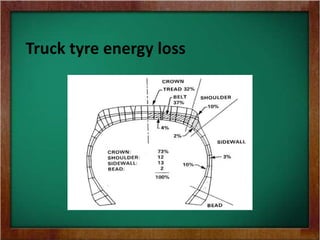
Truck tyre energy loss
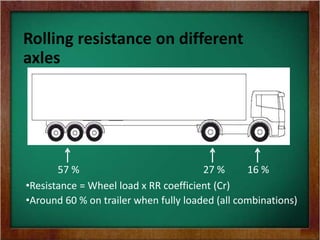
Rolling resistance on different
axles
57 % 27 % 16 %
•Resistance = Wheel load x RR coefficient (Cr)
•Around 60 % on trailer when fully loaded (all combinations)
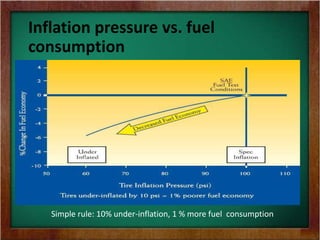
Inflation pressure vs. fuel
consumption
Simple rule: 10% under-inflation, 1 % more fuel consumption
Tyre use in winter time
• It is essential that in winter time tyres are
suitable winter use, which means that the tread
pattern is enough deep and open with sipping
and also having right kind of rubber
compound.
• Climate warming means more changes in
weather conditions. The temperature varies
more near to zero degree which is the most
demanding for the tyre grip. Also amount of
snow might be more at one time.
Steer axle tyres
• On steer axles typically so called All-Season tyres with
M+S marking are used on main road operations.
• Also Winter Steer tyres are used typically if there is
driving on roads with less maintenance. These tyres are
fitted in autumn time. Typically tyres are used the year
around.
• Not recommended to use retreaded tyres on steer
axle.
Only on local driving retreads are used.
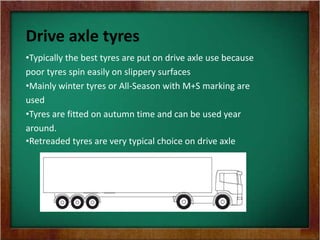
Drive axle tyres
•Typically the best tyres are put on drive axle use because
poor tyres spin easily on slippery surfaces
•Mainly winter tyres or All-Season with M+S marking are
used
•Tyres are fitted on autumn time and can be used year
around.
•Retreaded tyres are very typical choice on drive axle
Trailer tyres
• On trailers various kind of tyres are used, both new and
retreaded
• Normally tyres are changed by axles when fully worn
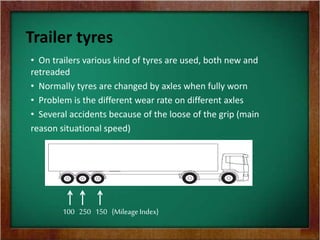
• Problem is the different wear rate on different axles
• Several accidents because of the loose of the grip (main
reason situational speed)
100 250 150 {Mileage Index}
Background
• Trailer behavior with different tyres on slippery surfaces
not studied
• Actual testing on ice/snow surfaces very difficult. For
example lane change maneuvers would need a very large
track with safety areas
• What is the meaning of different type of tyres for trailer
stability (lateral movements)?
• What would be the optimal tyres considering the safety
and economy?
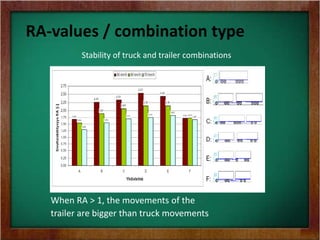
RA-values / combination type
Stability of truck and trailer combinations
When RA > 1, the movements of the
trailer are bigger than truck movements
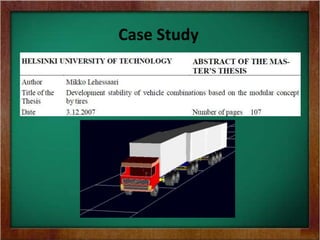
Case Study
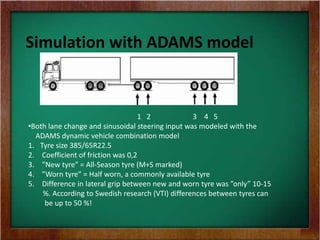
Simulation with ADAMS model
1 2 3 4 5
•Both lane change and sinusoidal steering input was modeled with the
ADAMS dynamic vehicle combination model
1. Tyre size 385/65R22.5
2. Coefficient of friction was 0,2
3. ”New tyre” = All-Season tyre (M+S marked)
4. ”Worn tyre” = Half worn, a commonly available tyre
5. Difference in lateral grip between new and worn tyre was ”only” 10-15
%. According to Swedish research (VTI) differences between tyres can
be up to 50 %!
Simulation results
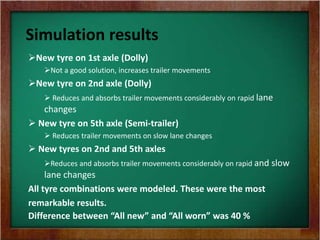
New tyre on 1st axle (Dolly)
Not a good solution, increases trailer movements
New tyre on 2nd axle (Dolly)
 Reduces and absorbs trailer movements considerably on rapid lane
changes
 New tyre on 5th axle (Semi-trailer)
 Reduces trailer movements on slow lane changes
 New tyres on 2nd and 5th axles
Reduces and absorbs trailer movements considerably on rapid and slow
lane changes
All tyre combinations were modeled. These were the most
remarkable results.
Difference between “All new” and “All worn” was 40 %
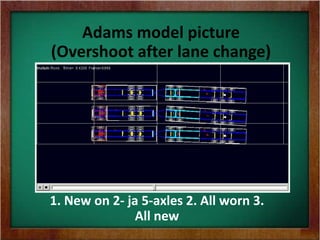
Adams model picture
(Overshoot after lane change)
1. New on 2- ja 5-axles 2. All worn 3.
All new
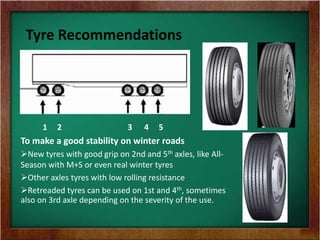
Tyre Recommendations
1 2 3 4 5
To make a good stability on winter roads
New tyres with good grip on 2nd and 5th axles, like All-
Season with M+S or even real winter tyres
Other axles tyres with low rolling resistance
Retreaded tyres can be used on 1st and 4th, sometimes
also on 3rd axle depending on the severity of the use.
Thanks
Prepare by:
Adnan Masood
Manager QHSE at TCG
0336-2350594

Truck tyre rolling resistance

  • 1.
    Truck Tyre RollingResistance and Fuel Economy & Safety Prepare By Adnan Masood Manager QHSE
  • 2.
  • 3.
    Rolling resistance ondifferent axles 57 % 27 % 16 % •Resistance = Wheel load x RR coefficient (Cr) •Around 60 % on trailer when fully loaded (all combinations)
  • 4.
    Inflation pressure vs.fuel consumption Simple rule: 10% under-inflation, 1 % more fuel consumption
  • 5.
    Tyre use inwinter time • It is essential that in winter time tyres are suitable winter use, which means that the tread pattern is enough deep and open with sipping and also having right kind of rubber compound. • Climate warming means more changes in weather conditions. The temperature varies more near to zero degree which is the most demanding for the tyre grip. Also amount of snow might be more at one time.
  • 6.
    Steer axle tyres •On steer axles typically so called All-Season tyres with M+S marking are used on main road operations. • Also Winter Steer tyres are used typically if there is driving on roads with less maintenance. These tyres are fitted in autumn time. Typically tyres are used the year around. • Not recommended to use retreaded tyres on steer axle. Only on local driving retreads are used.
  • 7.
    Drive axle tyres •Typicallythe best tyres are put on drive axle use because poor tyres spin easily on slippery surfaces •Mainly winter tyres or All-Season with M+S marking are used •Tyres are fitted on autumn time and can be used year around. •Retreaded tyres are very typical choice on drive axle
  • 8.
    Trailer tyres • Ontrailers various kind of tyres are used, both new and retreaded • Normally tyres are changed by axles when fully worn • Problem is the different wear rate on different axles • Several accidents because of the loose of the grip (main reason situational speed) 100 250 150 {Mileage Index}
  • 9.
    Background • Trailer behaviorwith different tyres on slippery surfaces not studied • Actual testing on ice/snow surfaces very difficult. For example lane change maneuvers would need a very large track with safety areas • What is the meaning of different type of tyres for trailer stability (lateral movements)? • What would be the optimal tyres considering the safety and economy?
  • 10.
    RA-values / combinationtype Stability of truck and trailer combinations When RA > 1, the movements of the trailer are bigger than truck movements
  • 11.
  • 12.
    Simulation with ADAMSmodel 1 2 3 4 5 •Both lane change and sinusoidal steering input was modeled with the ADAMS dynamic vehicle combination model 1. Tyre size 385/65R22.5 2. Coefficient of friction was 0,2 3. ”New tyre” = All-Season tyre (M+S marked) 4. ”Worn tyre” = Half worn, a commonly available tyre 5. Difference in lateral grip between new and worn tyre was ”only” 10-15 %. According to Swedish research (VTI) differences between tyres can be up to 50 %!
  • 13.
    Simulation results New tyreon 1st axle (Dolly) Not a good solution, increases trailer movements New tyre on 2nd axle (Dolly)  Reduces and absorbs trailer movements considerably on rapid lane changes  New tyre on 5th axle (Semi-trailer)  Reduces trailer movements on slow lane changes  New tyres on 2nd and 5th axles Reduces and absorbs trailer movements considerably on rapid and slow lane changes All tyre combinations were modeled. These were the most remarkable results. Difference between “All new” and “All worn” was 40 %
  • 14.
    Adams model picture (Overshootafter lane change) 1. New on 2- ja 5-axles 2. All worn 3. All new
  • 15.
    Tyre Recommendations 1 23 4 5 To make a good stability on winter roads New tyres with good grip on 2nd and 5th axles, like All- Season with M+S or even real winter tyres Other axles tyres with low rolling resistance Retreaded tyres can be used on 1st and 4th, sometimes also on 3rd axle depending on the severity of the use.
  • 16.