BND TechSource
BND TechSource https://bndtechsource.wixsite.com/home
Vehicle Load Transfer
Part I of III
General Load Transfer
Wm Harbin
Technical Director
BND TechSource
(revised 04JUL21)
BND TechSource
BND TechSource https://bndtechsource.wixsite.com/home
Factors in vehicle dynamics
▪ Within any modern vehicle suspension there are many factors to consider
during design and development.
▪ Factors in vehicle dynamics:
• Vehicle Configuration
• Vehicle Type (i.e. 2dr Coupe, 4dr Sedan, Minivan, Truck, etc.)
• Vehicle Architecture (i.e. FWD vs. RWD, 2WD vs.4WD, etc.)
• Chassis Architecture (i.e. type: tubular, monocoque, etc. ; material: steel,
aluminum, carbon fiber, etc. ; fabrication: welding, stamping, forming, etc.)
• Front Suspension System Type (i.e. MacPherson strut, SLA Double Wishbone, etc.)
• Type of Steering Actuator (i.e. Rack and Pinion vs. Recirculating Ball)
• Type of Braking System (i.e. Disc (front & rear) vs. Disc (front) & Drum (rear))
• Rear Suspension System Type (i.e. Beam Axle, Multi-link, Solid Axle, etc.)
• Suspension/Braking Control Systems (i.e. ABS, Electronic Stability Control,
• Electronic Damping Control, etc.)
2
BND TechSource
BND TechSource https://bndtechsource.wixsite.com/home
Factors in vehicle dynamics (continued):
• Vehicle Suspension Geometry
• Vehicle Wheelbase
• Vehicle Track Width Front and Rear
• Wheels and Tires
• Vehicle Weight and Distribution
• Vehicle Center of Gravity
• Sprung and Unsprung Weight
• Springs Motion Ratio
• Chassis Ride Height and Static Deflection
• Turning Circle or Turning Radius (Ackermann Steering Geometry)
• Suspension Jounce and Rebound
3
BND TechSource
BND TechSource https://bndtechsource.wixsite.com/home
Factors in vehicle dynamics (continued):
• Vehicle Suspension Geometry (continued):
•Vehicle Suspension Hard Points:
• Front Suspension
• Scrub (Pivot) Radius
• Steering (Kingpin) Inclination Angle (SAI)
• Caster Angle
• Mechanical (or caster) trail
• Toe Angle
• Camber Angle
• Ball Joint Pivot Points
• Control Arm Chassis Attachment Points
• Knuckle/Brakes/Steering
• Springs/Shock Absorbers/Struts
• ARB (anti-roll bar)
4
BND TechSource
BND TechSource https://bndtechsource.wixsite.com/home
Factors in vehicle dynamics (continued):
• Vehicle Suspension Geometry (continued)
•Vehicle Suspension Hard Points (continued):
• Rear Suspension
• Scrub (Pivot) Radius
• Steering (Kingpin) Inclination Angle (SAI)
• Caster Angle (if applicable)
• Mechanical (or caster) trail (if applicable)
• Toe Angle
• Camber Angle
• Knuckle and Chassis Attachment Points
• Various links and arms depend upon the Rear Suspension configuration.
(i.e. Dependent vs. Semi-Independent vs. Independent Suspension)
• Knuckle/Brakes
• Springs/Shock Absorbers
• ARB (anti-roll bar)
5
BND TechSource
BND TechSource https://bndtechsource.wixsite.com/home
Factors in vehicle dynamics (continued):
• Vehicle Dynamic Considerations
• Suspension Dynamic Targets
• Wheel Frequency
• Bushing Compliance
• Lateral Load Transfer with and w/o ARB
• Roll moment
• Roll Stiffness (degrees per g of lateral acceleration)
• Maximum Steady State lateral acceleration (in understeer mode)
• Rollover Threshold (lateral g load)
• Linear Range Understeer (typically between 0g and 0.4g)
• Suspension Dynamic Analysis
•Steering Analysis
• Bump Steer Analysis
• Roll Steer Analysis
• Tractive Force Steer Analysis
• Brake Force Steer Analysis
• Ackerman change with steering angle
6
BND TechSource
BND TechSource https://bndtechsource.wixsite.com/home
Factors in vehicle dynamics (continued):
• Suspension Dynamic Analysis (continued)
• Roll Analysis
• Camber gain in roll (front & rear)
• Caster gain in roll (front & rear – if applicable)
• Roll Axis Analysis
• Roll Center Height Analysis
• Instantaneous Center Analysis
• Track Analysis
• Load Transfer Analysis
• Unsprung and Sprung weight transfer
• Jacking Forces
• Roll Couple Percentage Analysis
• Total Lateral Load Transfer Distribution (TLLTD)
• Bundorf Analysis
• Slip angles (degrees per lateral force)
• Tire Cornering Coefficient (lateral force as a percent of rated vertical load per
degree slip angle)
• Tire Cornering Forces (lateral cornering force as a function of slip angle)
• Linear Range Understeer
7
BND TechSource
BND TechSource https://bndtechsource.wixsite.com/home
Vehicle Load Transfer
• While the total amount of factors may seem a bit overwhelming, it may be
easier to digest if we break it down into certain aspects of the total.
• The intent of this document is to give the reader a better understanding of
vehicle dynamic longitudinal and lateral load transfer as a vehicle
accelerates/decelerates in a particular direction.
• The discussion will include:
Part I – General Load
Transfer
• Load vs. Weight Transfer
• Rotational Moments of Inertia
• Sprung and Unsprung Weight
Part II – Longitudinal Load
Transfer
• Vehicle Center of Gravity
• Longitudinal Load Transfer
• Suspension Geometry
• Instant Centers
• Side View Swing Arm
• Anti-squat, Anti-dive, and Anti-
lift
Part III – Lateral Load Transfer
• Cornering Forces
• Suspension Geometry
• Front View Swing Arm
• Roll Center Heights
• Roll Axis
• Roll Stiffness
• Anti-roll bars
• Tire Rates
• Roll Gradient
• Lateral Load Transfer
8
BND TechSource
BND TechSource https://bndtechsource.wixsite.com/home
Load vs. Weight Transfer
9
BND TechSource
BND TechSource https://bndtechsource.wixsite.com/home
Load vs. Weight Transfer
▪ In automobiles, load transfer is the imaginary "shifting" of weight around a
motor vehicle during acceleration (both longitudinal and lateral). This
includes braking, or deceleration (which can be viewed as acceleration at
a negative rate). Load transfer is a crucial concept in understanding
vehicle dynamics.
▪ Often load transfer is misguidedly referred to as weight transfer due to
their close relationship. The difference being load transfer is an imaginary
shift in weight due to an imbalance of forces, while weight transfer involves
the actual movement of the vehicles center of gravity (Cg). Both result in a
redistribution of the total vehicle load between the individual tires.
10
BND TechSource
BND TechSource https://bndtechsource.wixsite.com/home
Load vs. Weight Transfer (continued):
▪ Weight transfer involves the actual (small) movement of the vehicle Cg
relative to the wheel axes due to displacement of liquids within the vehicle,
which results in a redistribution of the total vehicle load between the
individual tires.
▪ Liquids, such as fuel, readily flow within their containers, causing changes
in the vehicle's Cg. As fuel is consumed, not only does the position of the
Cg change, but the total weight of the vehicle is also reduced.
▪ Another factor that changes the vehicle’s Cg is the expansion of the tires
during rotation. This is called “dynamic rolling radius” and is effected by
wheel-speed, temperature, inflation pressure, tire compound, and tire
construction. It raises the vehicle’s Cg slightly as the wheel-speed
increases.
11
BND TechSource
BND TechSource https://bndtechsource.wixsite.com/home
Load vs. Weight Transfer (continued):
▪ The major forces that accelerate a vehicle occur at the tires contact patch.
Since these forces are not directed through the vehicle's Cg, one or more
moments are generated. It is these moments that cause variation in the
load distributed between the tires.
▪ Lowering the Cg towards the ground is one method of reducing load
transfer. As a result load transfer is reduced in both the longitudinal and
lateral directions. Another method of reducing load transfer is by
increasing the wheel spacings. Increasing the vehicles wheel base (length)
reduces longitudinal load transfer. While increasing the vehicles track
(width) reduces lateral load transfer.
12
BND TechSource
BND TechSource https://bndtechsource.wixsite.com/home
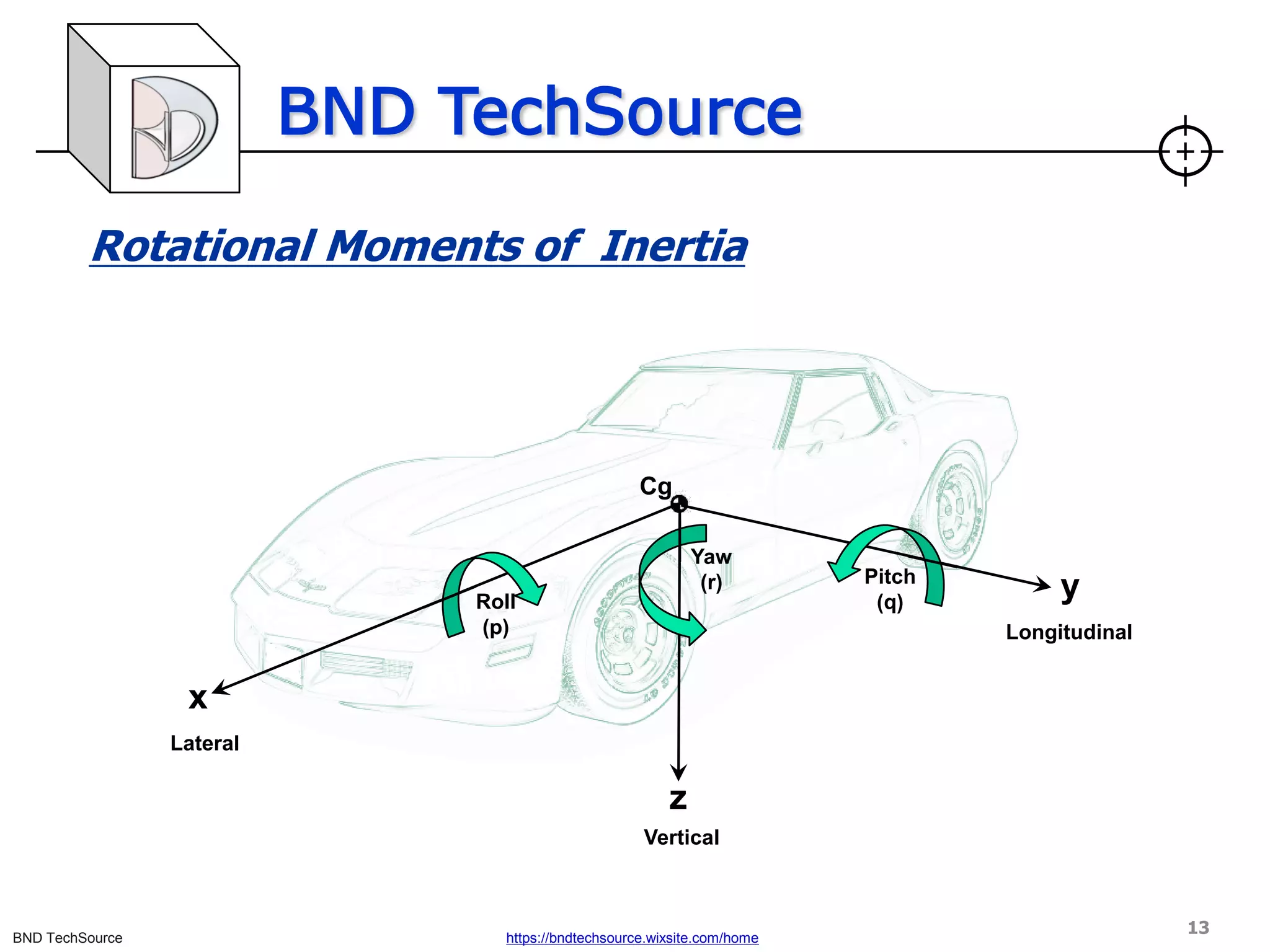
Rotational Moments of Inertia
y
x
z
Vertical
Lateral
Longitudinal
Roll
(p)
Yaw
(r) Pitch
(q)
Cg
13
BND TechSource
BND TechSource https://bndtechsource.wixsite.com/home
Moment of Inertia
▪ Polar moment of inertia
▪ A simple demonstration of polar moment of inertia is to compare a
dumbbell vs. a barbell both at the same weight. Hold each in the
middle and twist to feel the force reacting at the center. Notice the
dumbbell (which has a lower polar moment) reacts quickly and the
barbell (which has a higher polar moment) reacts slowly.
Wd
o
2
=

d1 d1
C
L
d2 d2
C
L
W W
Example:
W = 50 lb (25 lb
at each end)
d1 = 8 in
d2 = 30 in
2
2
1 3200
)
8
(
*
25
*
2 in
lb
=
=
 2
2
2 000
,
45
)
30
(
*
25
*
2 in
lb
=
=

14
BND TechSource
BND TechSource https://bndtechsource.wixsite.com/home
Moment of Inertia (continued):
▪ Sum the polar moments of inertia
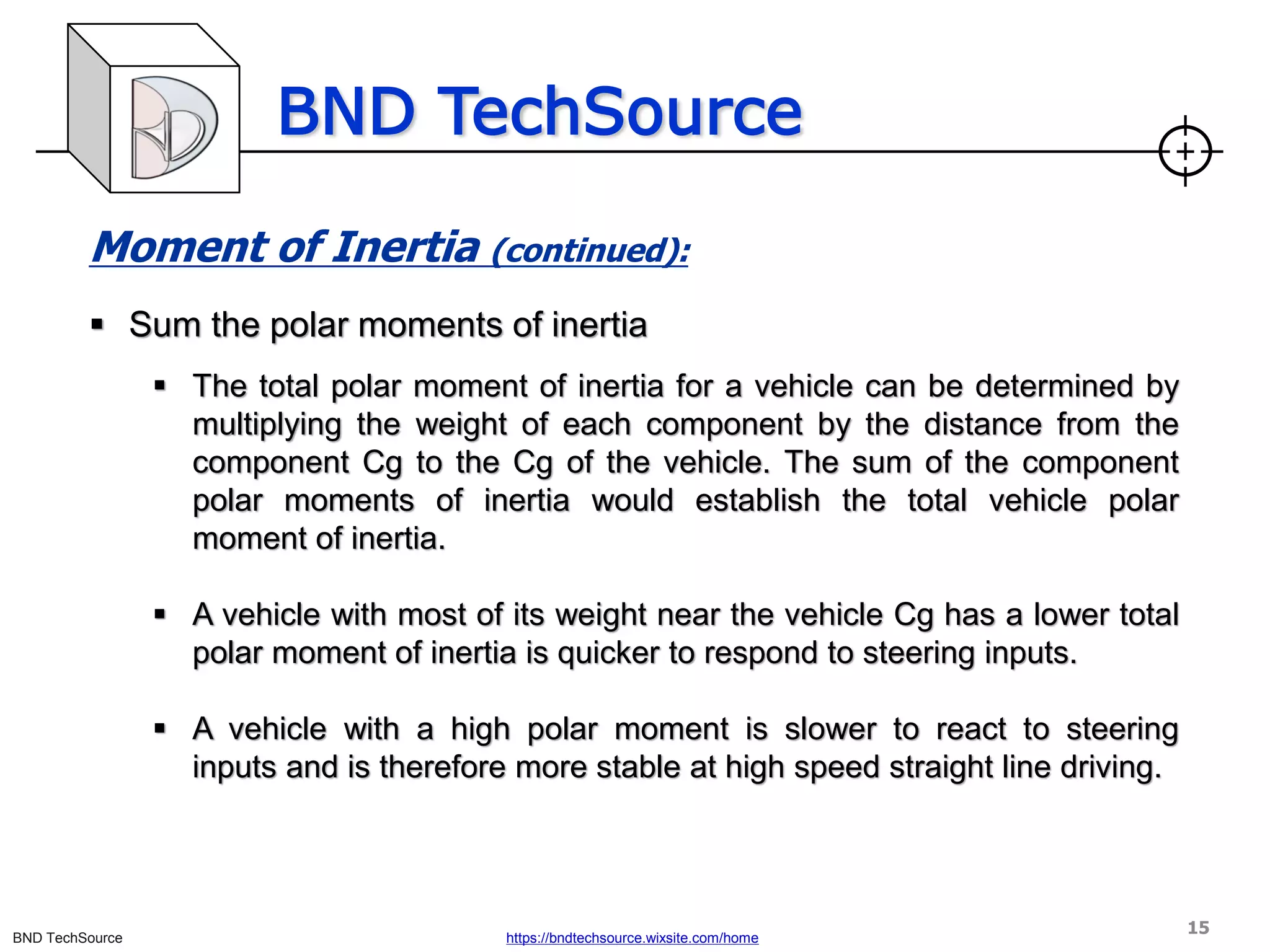
▪ The total polar moment of inertia for a vehicle can be determined by
multiplying the weight of each component by the distance from the
component Cg to the Cg of the vehicle. The sum of the component
polar moments of inertia would establish the total vehicle polar
moment of inertia.
▪ A vehicle with most of its weight near the vehicle Cg has a lower total
polar moment of inertia is quicker to respond to steering inputs.
▪ A vehicle with a high polar moment is slower to react to steering
inputs and is therefore more stable at high speed straight line driving.
15
BND TechSource
BND TechSource https://bndtechsource.wixsite.com/home
Moment of Inertia (continued):
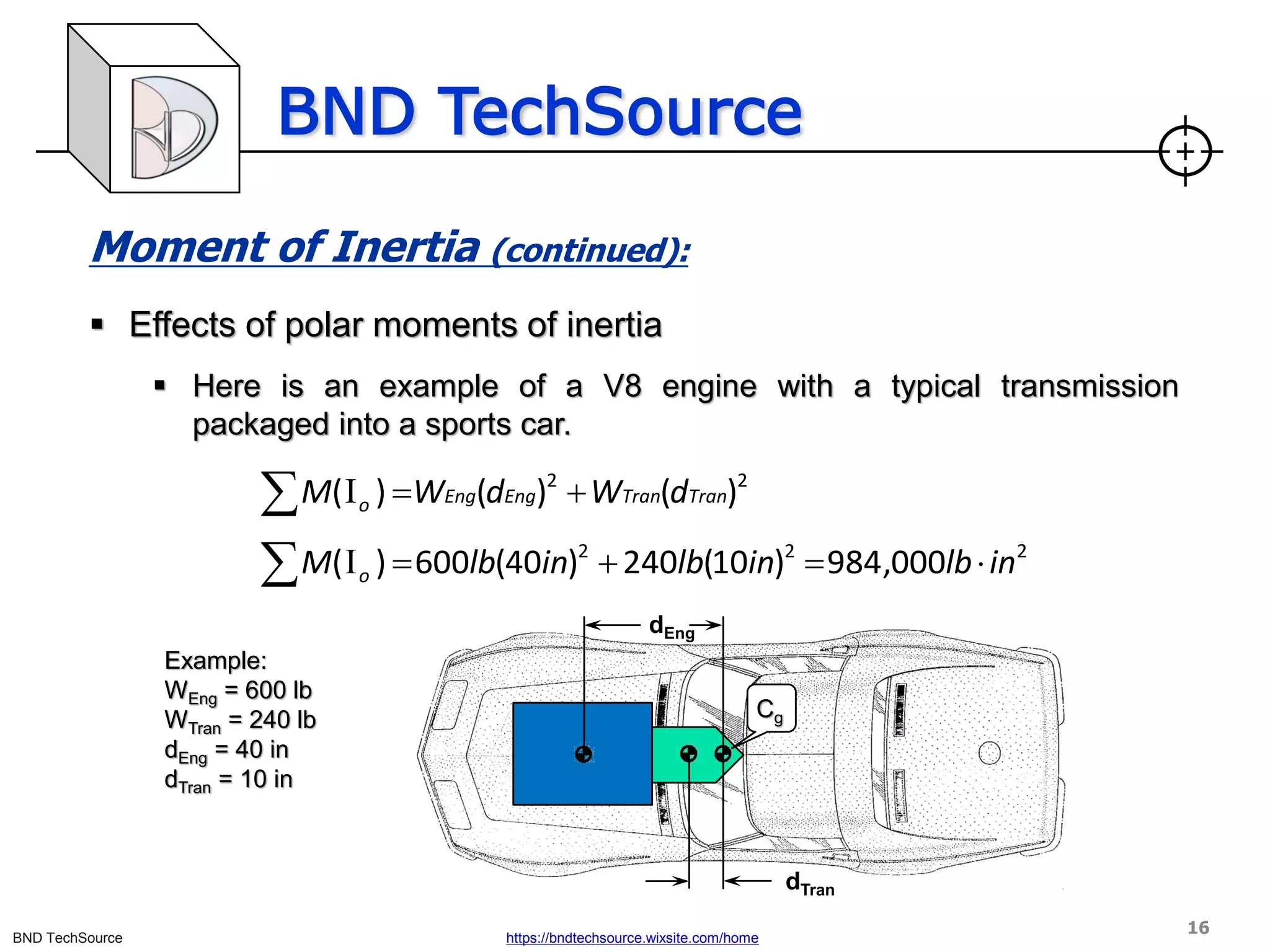
▪ Effects of polar moments of inertia
▪ Here is an example of a V8 engine with a typical transmission
packaged into a sports car.
Example:
WEng = 600 lb
WTran = 240 lb
dEng = 40 in
dTran = 10 in
d
W
d
W
M Tran
Tran
Eng
Eng
o
2
2
)
(
)
(
)
( +
=


2
2
2
000
,
984
)
10
(
240
)
40
(
600
)
( in
lb
in
lb
in
lb
M o 
=
+
=


dEng
dTran
Cg
16
BND TechSource
BND TechSource https://bndtechsource.wixsite.com/home
Moment of Inertia (continued):
▪ Effects of polar moments of inertia
▪ Here is an example of a V8 engine with a typical transmission
packaged into a sedan.
d
W
d
W
M Tran
Tran
Eng
Eng
o
2
2
)
(
)
(
)
( +
=


Example:
WEng = 600 lb
WTran = 240 lb
dEng = 70 in
dTran = 40 in
dEng
dTran
2
2
2
000
,
324
,
3
)
40
(
240
)
70
(
600
)
( in
lb
in
lb
in
lb
M o 
=
+
=


Cg
17
BND TechSource
BND TechSource https://bndtechsource.wixsite.com/home
Load Transfer
18
BND TechSource
BND TechSource https://bndtechsource.wixsite.com/home
Load Transfer
▪ The forces that enable a road vehicle to accelerate and stop all act
at the road surface.
▪ The center of gravity, which is located considerably above the road
surface, and which is acted upon by the accelerations resulting
from the longitudinal forces at the tire patches, generates a
moment which transfers load.
▪ As asymmetric load results in differing traction limits, a vehicles
handling is affected by the “dynamic load distribution”.
19
BND TechSource
BND TechSource https://bndtechsource.wixsite.com/home
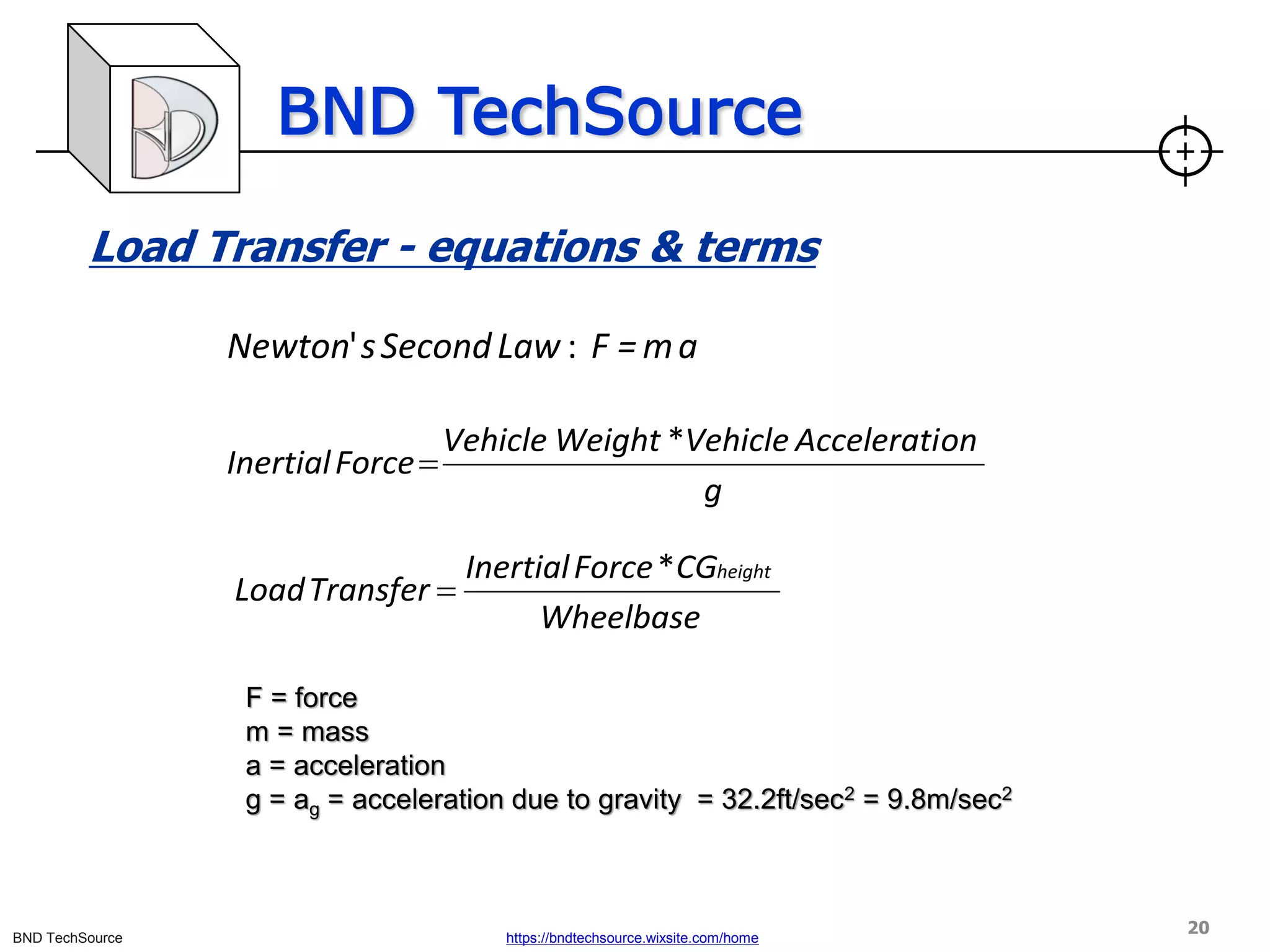
Load Transfer - equations & terms
g
on
Accelerati
Vehicle
Weight
Vehicle
Force
Inertial
*
=
Wheelbase
CG
Force
Inertial
Transfer
Load
height
*
=
a
m
=
F
Law
Second
s
Newton :
'
F = force
m = mass
a = acceleration
g = ag = acceleration due to gravity = 32.2ft/sec2 = 9.8m/sec2
20
BND TechSource
BND TechSource https://bndtechsource.wixsite.com/home
Load Transfer (continued):
▪ Load transfers between the Center of Gravity and the road surface
through a variety of paths.
▪ Suspension Geometry
▪ Front: Location of instant centers
(Side View Swing Arm)
▪ Rear: Instant centers, Lift Bars
(Side View Swing Arm)
▪ Suspension Springs
▪ Front:Coils, Air Springs, leafs or Torsion bars and Anti-roll bars
▪ Rear: Coils, Air Springs, leafs or Torsion bars and Anti-roll bars
21
BND TechSource
BND TechSource https://bndtechsource.wixsite.com/home
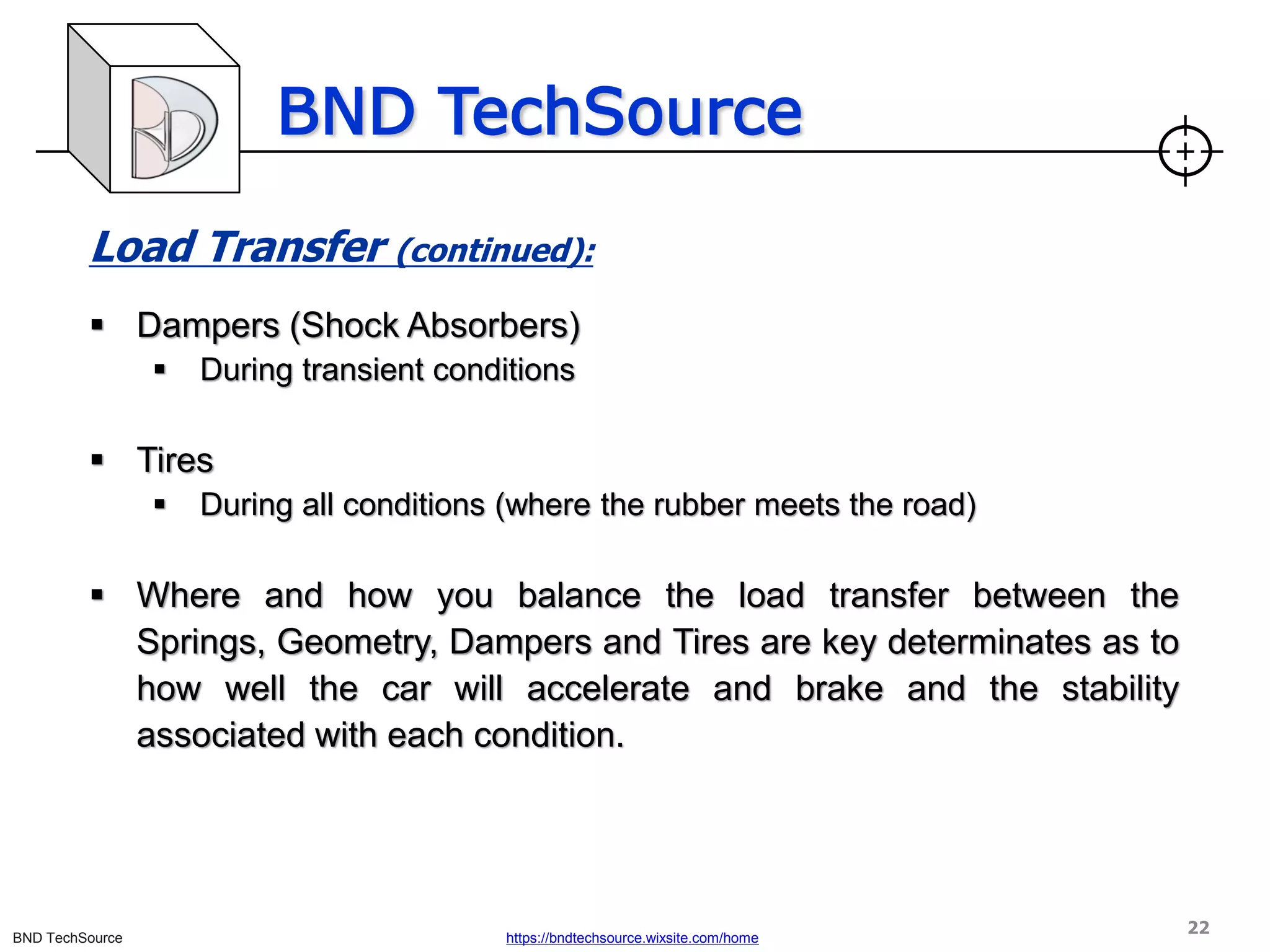
Load Transfer (continued):
▪ Dampers (Shock Absorbers)
▪ During transient conditions
▪ Tires
▪ During all conditions (where the rubber meets the road)
▪ Where and how you balance the load transfer between the
Springs, Geometry, Dampers and Tires are key determinates as to
how well the car will accelerate and brake and the stability
associated with each condition.
22
BND TechSource
BND TechSource https://bndtechsource.wixsite.com/home
Load Transfer Control Devices
▪ Dampers (Shock Absorbers)
▪ Along with the springs, dampers transfer the load of the rolling
(pitching) component of the vehicle. They determine how the load is
transferred to and from the individual wheels while the chassis is
rolling and/or pitching.
▪ Within 65-70% critically damped is said to be the ideal damper setting
for both handling and comfort simultaneously. Most modern dampers
show some digression to them as well, meaning they may be 70%
critically damped at low piston speeds but move lower to allow the
absorption of large bumps. Damping is most important below 4
in/second as this is where car control tuning takes place.
23
BND TechSource
BND TechSource https://bndtechsource.wixsite.com/home
Load Transfer Control Devices (continued):
▪ Springs
▪ Along with the dampers (shock absorbers), springs transfer the load of
the sprung mass of the car to the road surface. During maneuvers,
depending on instant center locations, the springs and dampers transfer
some portion of the (m x a), mass x acceleration, forces to the ground.
▪ Spring Rate is force per unit displacement for a suspension spring alone .
▪ For coil springs this is measured axially along the centerline.
▪ For torsion bar springs it is measured at the attachment arm.
▪ For leaf springs it is measured at the axle seat.
▪ The spring rate may be linear (force increases proportionally with
displacement) or nonlinear (increasing or decreasing rate with increasing
displacement).
▪ Units are typically lb/in (imperial) and kg/mm (metric).
https://coiloverdepot.com/pages/spring-rates-suspension-102
24
BND TechSource
BND TechSource https://bndtechsource.wixsite.com/home
Load Transfer Control Devices (continued):
▪ Anti-roll bars
▪ [Drawing 1] shows how an anti-roll bar (ARB) is twisted when the body rolls in
a turn. This creates forces at the four points where the bar is attached to the
vehicle. The forces are shown in [Drawing 2]. Forces A on the suspension
increase [load] transfer to the outside tire. Forces B on the frame resist body
roll. The effect is a reduction of body roll and an increase in [load] transfer at
the end of the chassis which has the anti-roll bar. Because the total [load]
transfer due to centripetal force is not changed, the opposite end of the
chassis has reduced [load] transfer. [6]
Drawing 2 Drawing 1
Direction of Turn
A A
B
B
25
BND TechSource
BND TechSource https://bndtechsource.wixsite.com/home
Load Transfer Control Devices (continued):
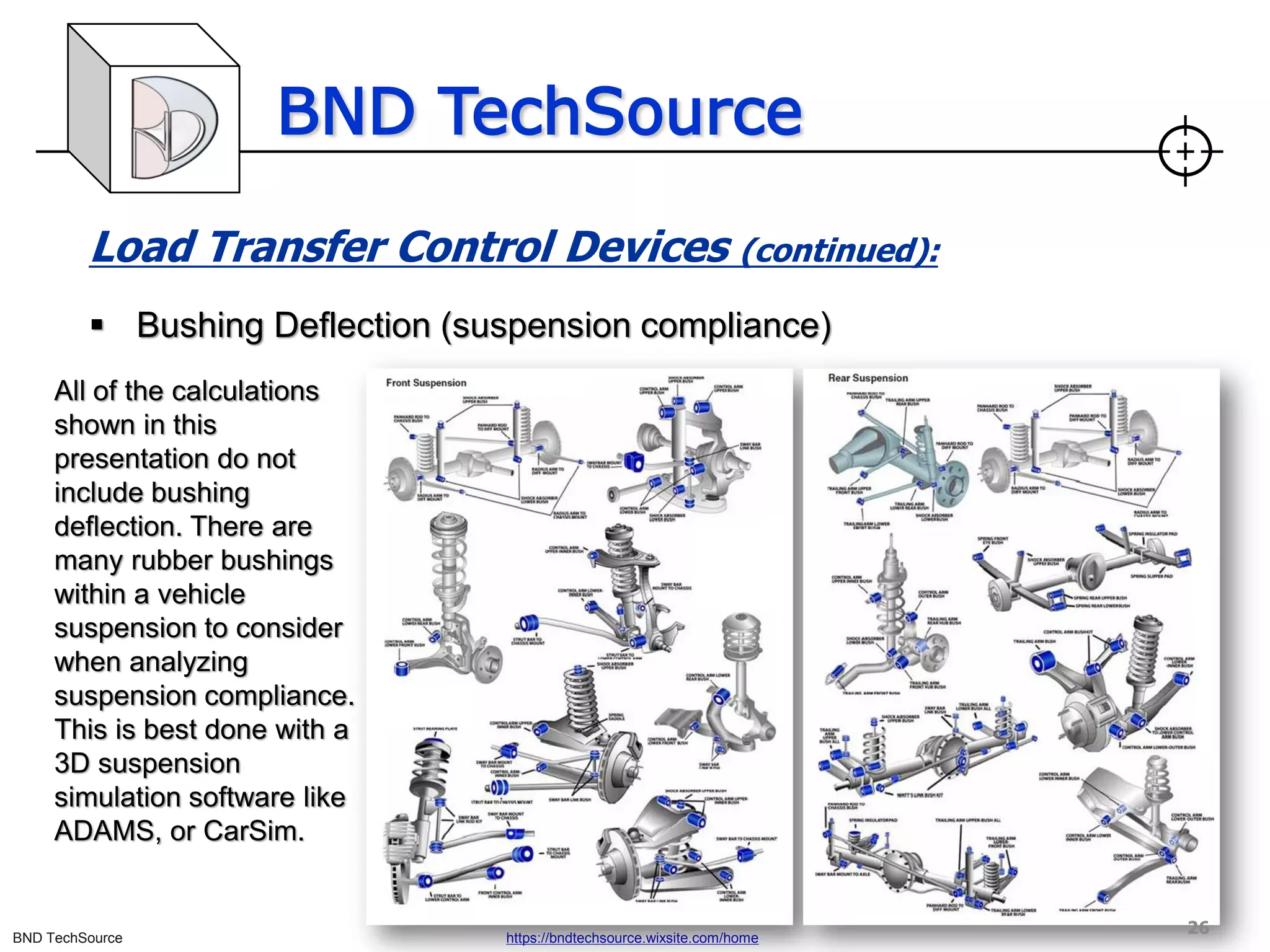
▪ Bushing Deflection (suspension compliance)
All of the calculations
shown in this
presentation do not
include bushing
deflection. There are
many rubber bushings
within a vehicle
suspension to consider
when analyzing
suspension compliance.
This is best done with a
3D suspension
simulation software like
ADAMS, or CarSim.
26
BND TechSource
BND TechSource https://bndtechsource.wixsite.com/home
Load Transfer Control Devices (continued):
▪ Frame/Chassis Deflection
▪ All of the calculations shown in this presentation are made
under the assumption that the frame or chassis is
completely rigid (both in torsion and bending). Of course
any flexing within the frame/chassis will adversely effect the
performance of the suspension which is attached to it.
27
BND TechSource
BND TechSource https://bndtechsource.wixsite.com/home
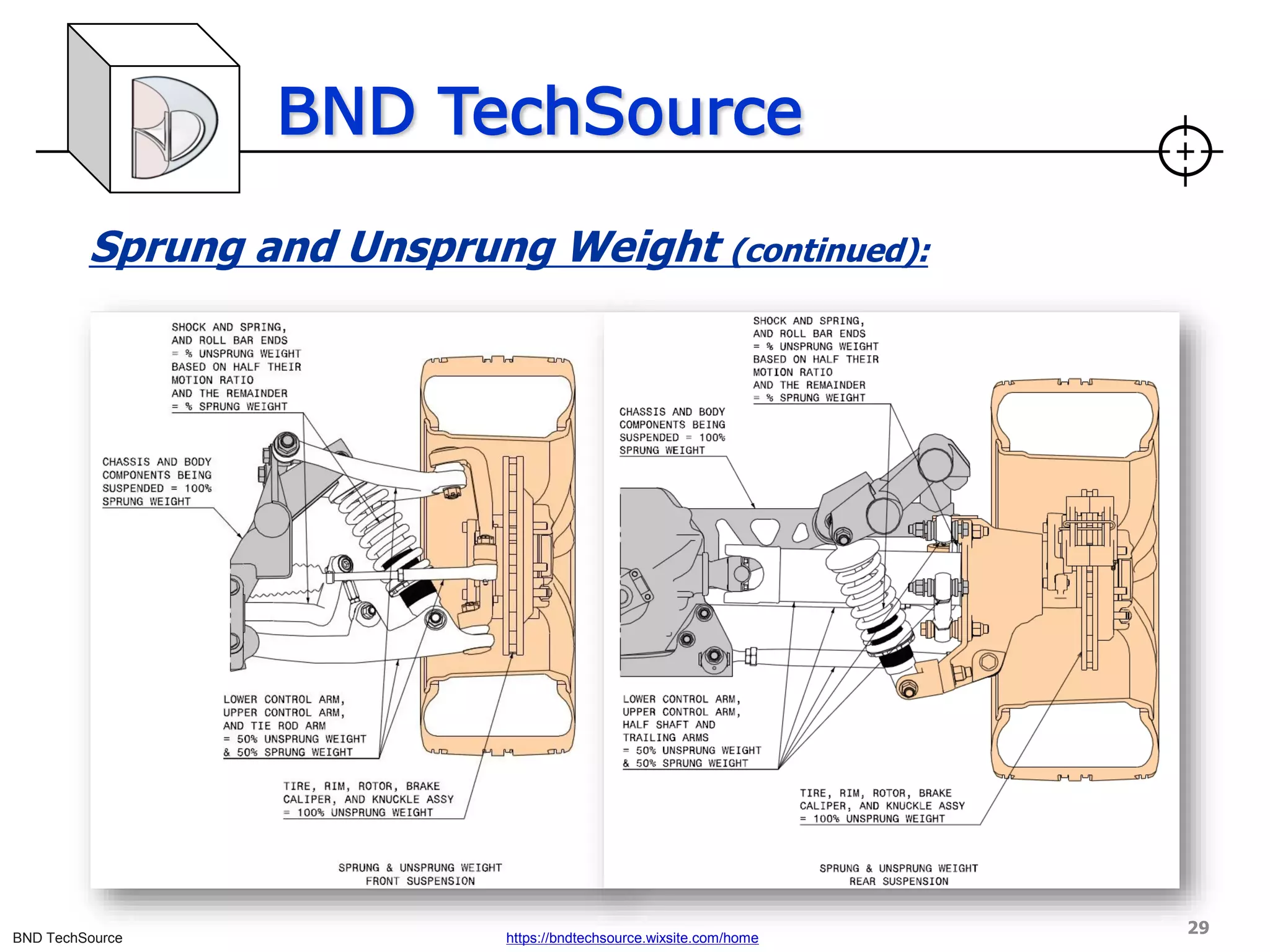
Sprung and Unsprung Weight
▪ 100% Unsprung weight includes the mass of the tires, rims, brake
rotors, brake calipers, knuckle assemblies, and ball joints which
move in unison with the wheels.
▪ 50% unsprung and 50% sprung weight would be comprised of the
linkages of the wheel assembly to the chassis.
▪ The % unsprung weight of the shocks, springs and anti-roll bar
ends would be a function of their motion ratio/2 with the remainder
as % sprung weight.
▪ The rest of the mass is on the vehicle side of the springs is
suspended and is 100% sprung weight.
28
BND TechSource
BND TechSource https://bndtechsource.wixsite.com/home
Sprung and Unsprung Weight (continued):
29
BND TechSource
BND TechSource https://bndtechsource.wixsite.com/home
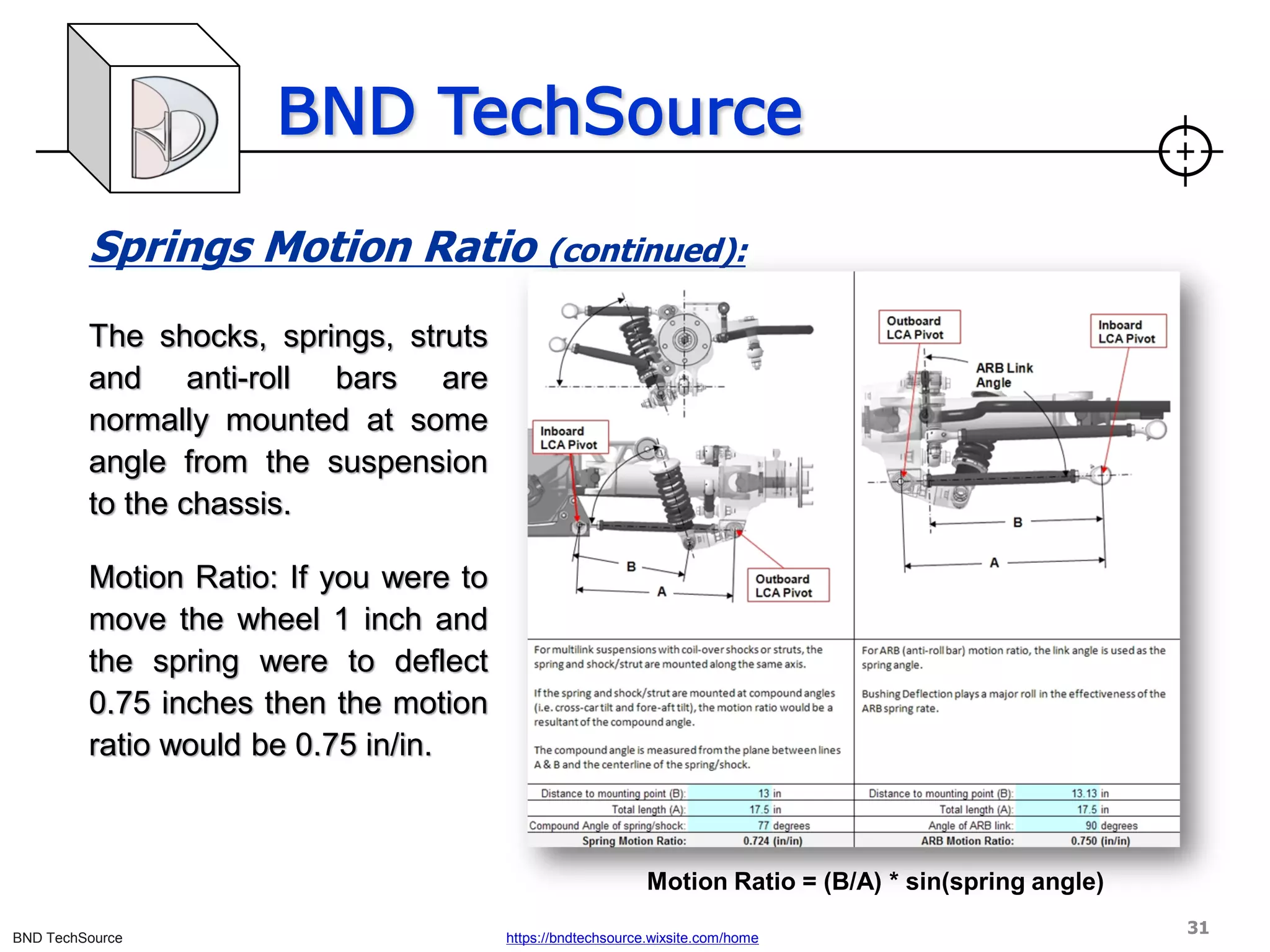
Springs Motion Ratio
▪ The shocks, springs, struts and anti-roll bars are normally mounted at
some angle from the suspension to the chassis.
▪ Motion Ratio: If you were to move the wheel 1 inch and the spring were to
deflect 0.75 inches then the motion ratio would be 0.75 in/in.
Motion Ratio = (B/A) * sin(spring angle)
30
BND TechSource
BND TechSource https://bndtechsource.wixsite.com/home
Springs Motion Ratio (continued):
Motion Ratio = (B/A) * sin(spring angle)
The shocks, springs, struts
and anti-roll bars are
normally mounted at some
angle from the suspension
to the chassis.
Motion Ratio: If you were to
move the wheel 1 inch and
the spring were to deflect
0.75 inches then the motion
ratio would be 0.75 in/in.
31
BND TechSource
BND TechSource https://bndtechsource.wixsite.com/home
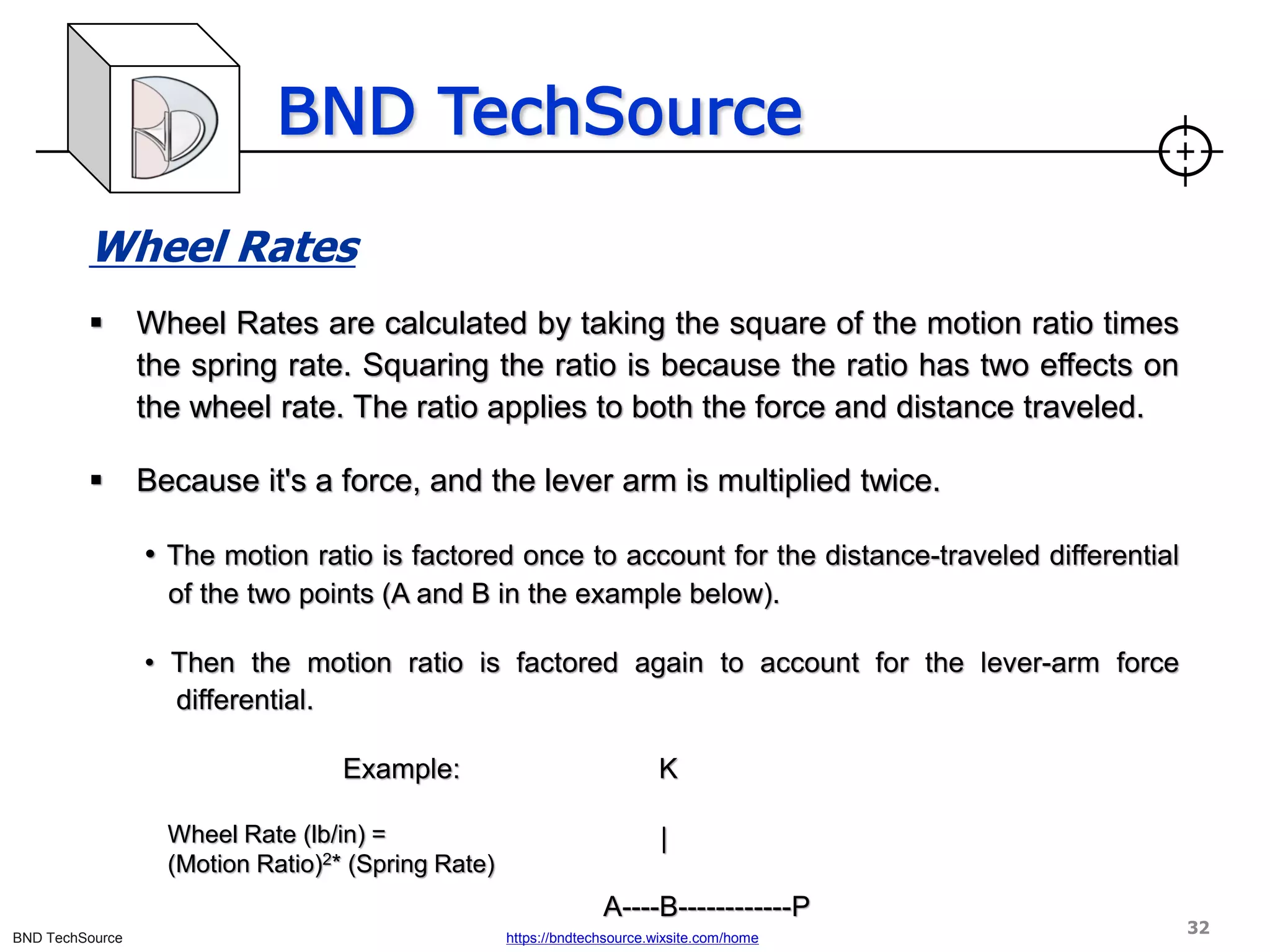
Wheel Rates
▪ Wheel Rates are calculated by taking the square of the motion ratio times
the spring rate. Squaring the ratio is because the ratio has two effects on
the wheel rate. The ratio applies to both the force and distance traveled.
▪ Because it's a force, and the lever arm is multiplied twice.
• The motion ratio is factored once to account for the distance-traveled differential
of the two points (A and B in the example below).
• Then the motion ratio is factored again to account for the lever-arm force
differential.
Example: K
|
A----B------------P
Wheel Rate (lb/in) =
(Motion Ratio)2* (Spring Rate)
32
BND TechSource
BND TechSource https://bndtechsource.wixsite.com/home
Wheel Rates (continued):
Example: K
|
A----B------------P
▪ P is the pivot point, B is the spring mount, and A is the wheel. Here the motion
ration (MR) is 0.75... imagine a spring K that is rated at 100 lb/in placed at B
perpendicular to the line AP. If you want to move A 1 in vertically upward, B would
only move (1in)(MR) = 0.75 in. Since K is 100 lb/in, and B has only moved 0.75 in,
there's a force at B of 75 lb. If you balance the moments about P, you get
75(B)=X(A), and we know B = 0.75A, so you get 75(0.75A) = X(A). A's cancel and
you get X=75(0.75)=56.25. Which is [100(MR)](MR) or 100(MR)2.
Wheel Rate (lb/in) =
(Motion Ratio)2* (Spring Rate)
33
BND TechSource
BND TechSource https://bndtechsource.wixsite.com/home
Wheel Rates (continued):
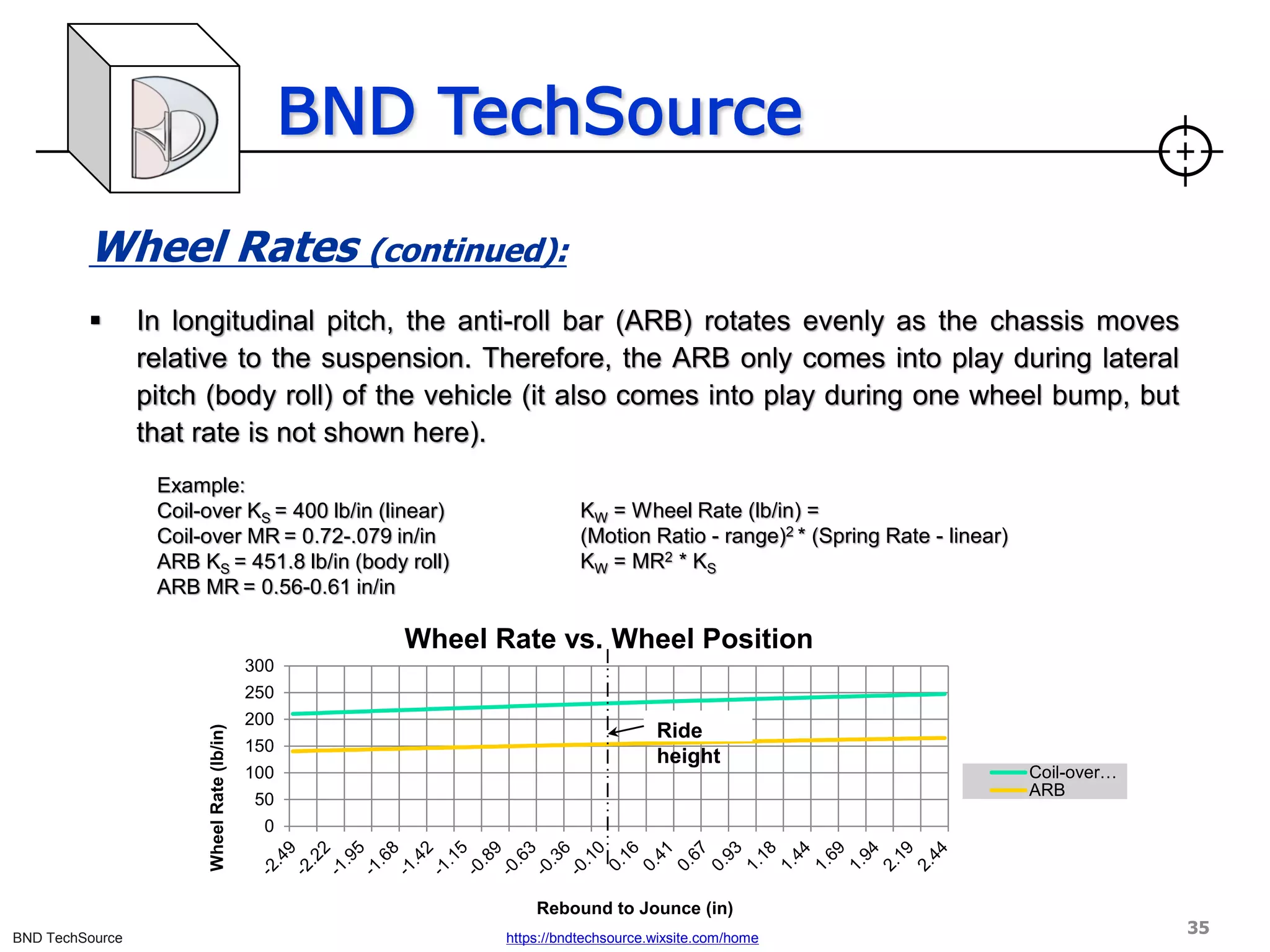
▪ Since the linkages pivot, the spring angles change as the components swing along
an arc path. This causes the motion ratio to be calculated through a range. The
graph below shows an example of these results for both coil-over shock and anti-
roll bar for an independent front suspension from rebound to jounce positions.
0
50
100
150
200
250
300
Wheel
Rate
(lb/in)
Rebound to Jounce (in)
Wheel Rate vs. Wheel Position
Coil-over…
ARB
Ride
height
KW = Wheel Rate (lb/in) =
(Motion Ratio - range)2 * (Spring Rate - linear)
KW = MR2 * KS
Example:
Coil-over KS = 400 lb/in (linear)
Coil-over MR = 0.72-.079 in/in
ARB KS = 451.8 lb/in (body roll)
ARB MR = 0.56-0.61 in/in
34
BND TechSource
BND TechSource https://bndtechsource.wixsite.com/home
Wheel Rates (continued):
▪ In longitudinal pitch, the anti-roll bar (ARB) rotates evenly as the chassis moves
relative to the suspension. Therefore, the ARB only comes into play during lateral
pitch (body roll) of the vehicle (it also comes into play during one wheel bump, but
that rate is not shown here).
0
50
100
150
200
250
300
Wheel
Rate
(lb/in)
Rebound to Jounce (in)
Wheel Rate vs. Wheel Position
Coil-over…
ARB
Ride
height
KW = Wheel Rate (lb/in) =
(Motion Ratio - range)2 * (Spring Rate - linear)
KW = MR2 * KS
Example:
Coil-over KS = 400 lb/in (linear)
Coil-over MR = 0.72-.079 in/in
ARB KS = 451.8 lb/in (body roll)
ARB MR = 0.56-0.61 in/in
35
BND TechSource
BND TechSource https://bndtechsource.wixsite.com/home
Spring Rates/Ride Frequency
▪ The static deflection of the suspension determines its natural frequency.
▪ Static deflection is the rate at which the suspension compresses in
response to weight.
0
20
40
60
80
100
120
140
160
180
200
0 10 20 30 40 50 60 70 80 90 100
w
=
Frequency
(cycles/min)
x = Static Deflection (in)
Ride Natural Frequency vs. Static Wheel Deflection
36
BND TechSource
BND TechSource https://bndtechsource.wixsite.com/home
Spring Rates/Ride Frequency (continued):
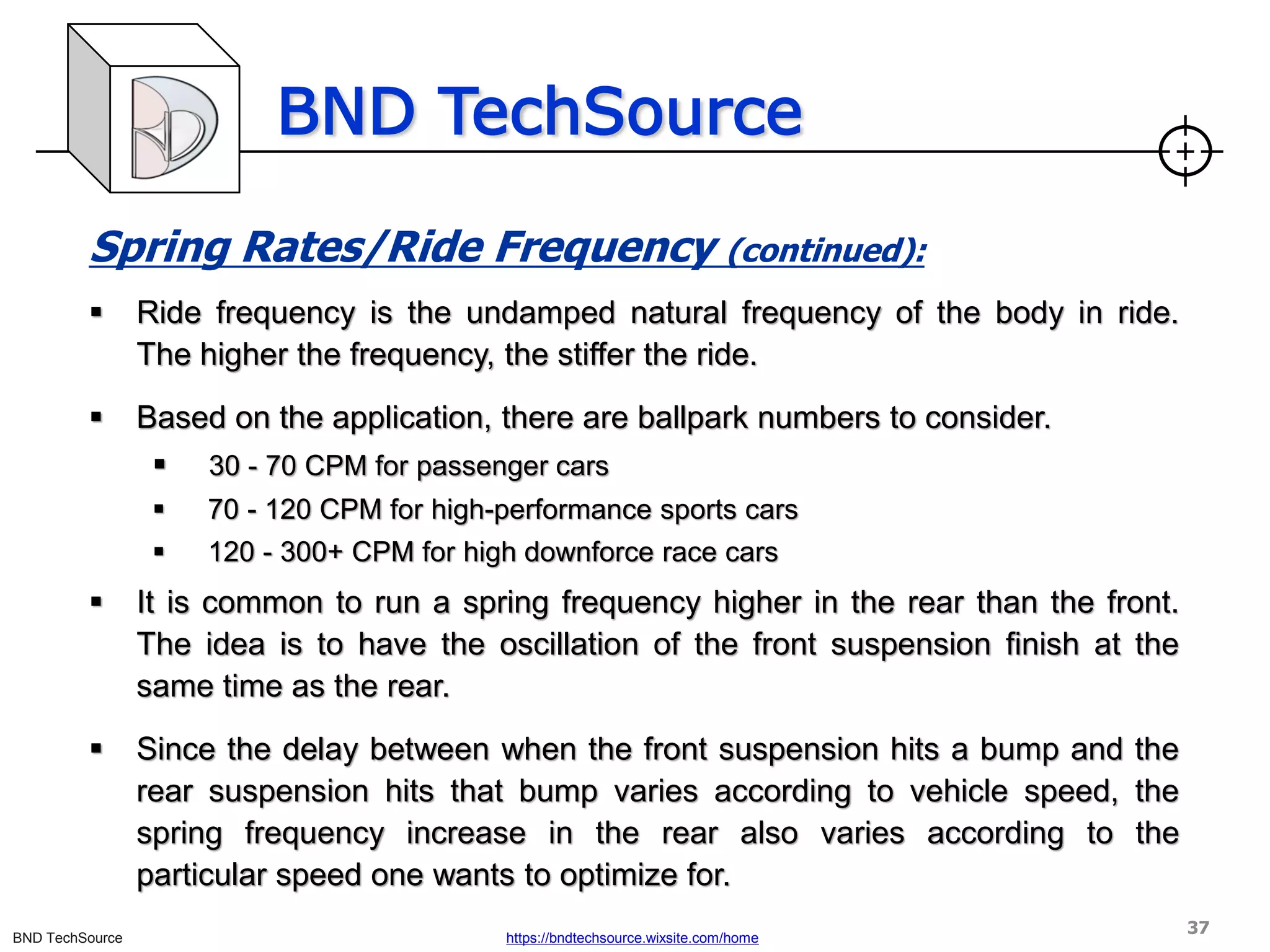
▪ Ride frequency is the undamped natural frequency of the body in ride.
The higher the frequency, the stiffer the ride.
▪ Based on the application, there are ballpark numbers to consider.
▪ 30 - 70 CPM for passenger cars
▪ 70 - 120 CPM for high-performance sports cars
▪ 120 - 300+ CPM for high downforce race cars
▪ It is common to run a spring frequency higher in the rear than the front.
The idea is to have the oscillation of the front suspension finish at the
same time as the rear.
▪ Since the delay between when the front suspension hits a bump and the
rear suspension hits that bump varies according to vehicle speed, the
spring frequency increase in the rear also varies according to the
particular speed one wants to optimize for.
37
BND TechSource
BND TechSource https://bndtechsource.wixsite.com/home
Spring Rates/Ride Frequency (continued):
▪ Once the motion ratios has been established, the front and rear spring
rates can be optimized for a “flat” ride at a particular speed.
38
BND TechSource
BND TechSource https://bndtechsource.wixsite.com/home
Spring Rates/Ride Frequency (continued):
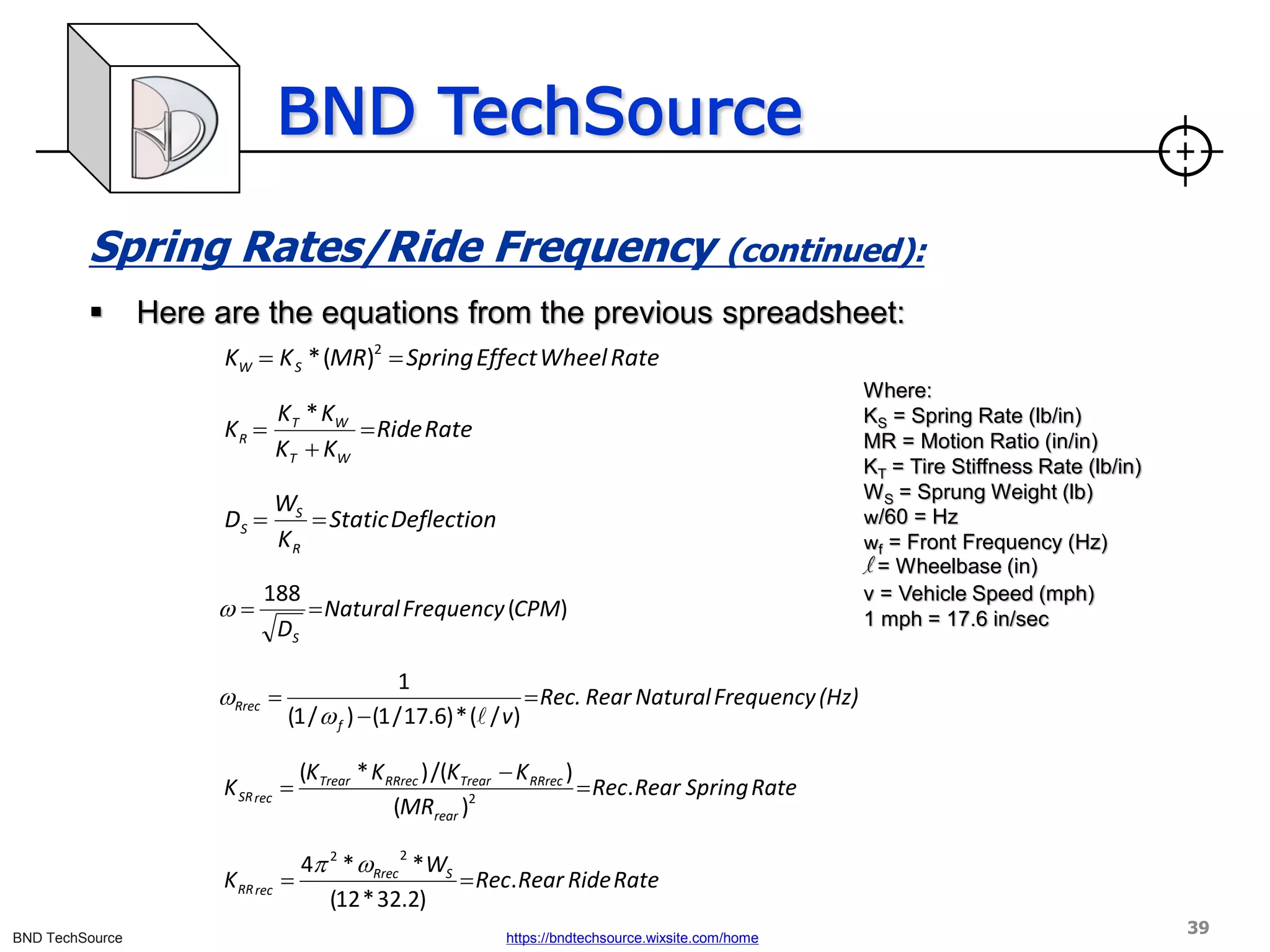
▪ Here are the equations from the previous spreadsheet:
Rate
Wheel
Effect
Spring
MR
K
K S
W =
= 2
)
(
*
Rate
Ride
K
K
K
K
K
W
T
W
T
R =
+
=
*
Deflection
Static
K
W
D
R
S
S =
=
Where:
KS = Spring Rate (lb/in)
MR = Motion Ratio (in/in)
KT = Tire Stiffness Rate (lb/in)
WS = Sprung Weight (lb)
w/60 = Hz
wf = Front Frequency (Hz)
l = Wheelbase (in)
v = Vehicle Speed (mph)
1 mph = 17.6 in/sec
)
(
188
CPM
Frequency
Natural
DS
=
=

Rate
Ride
Rear
Rec
W
K S
Rrec
rec
RR .
)
2
.
32
*
12
(
*
*
4 2
2
=
=


(Hz)
Frequency
Natural
Rear
Rec.
v
f
Rrec =
−
=
)
/
(
*
)
6
.
17
/
1
(
)
/
1
(
1



Rate
Spring
Rear
Rec
MR
K
K
K
K
K
rear
RRrec
Trear
RRrec
Trear
rec
SR .
)
(
)
/(
)
*
(
2
=
−
=
39
BND TechSource
BND TechSource https://bndtechsource.wixsite.com/home
Ride Rate
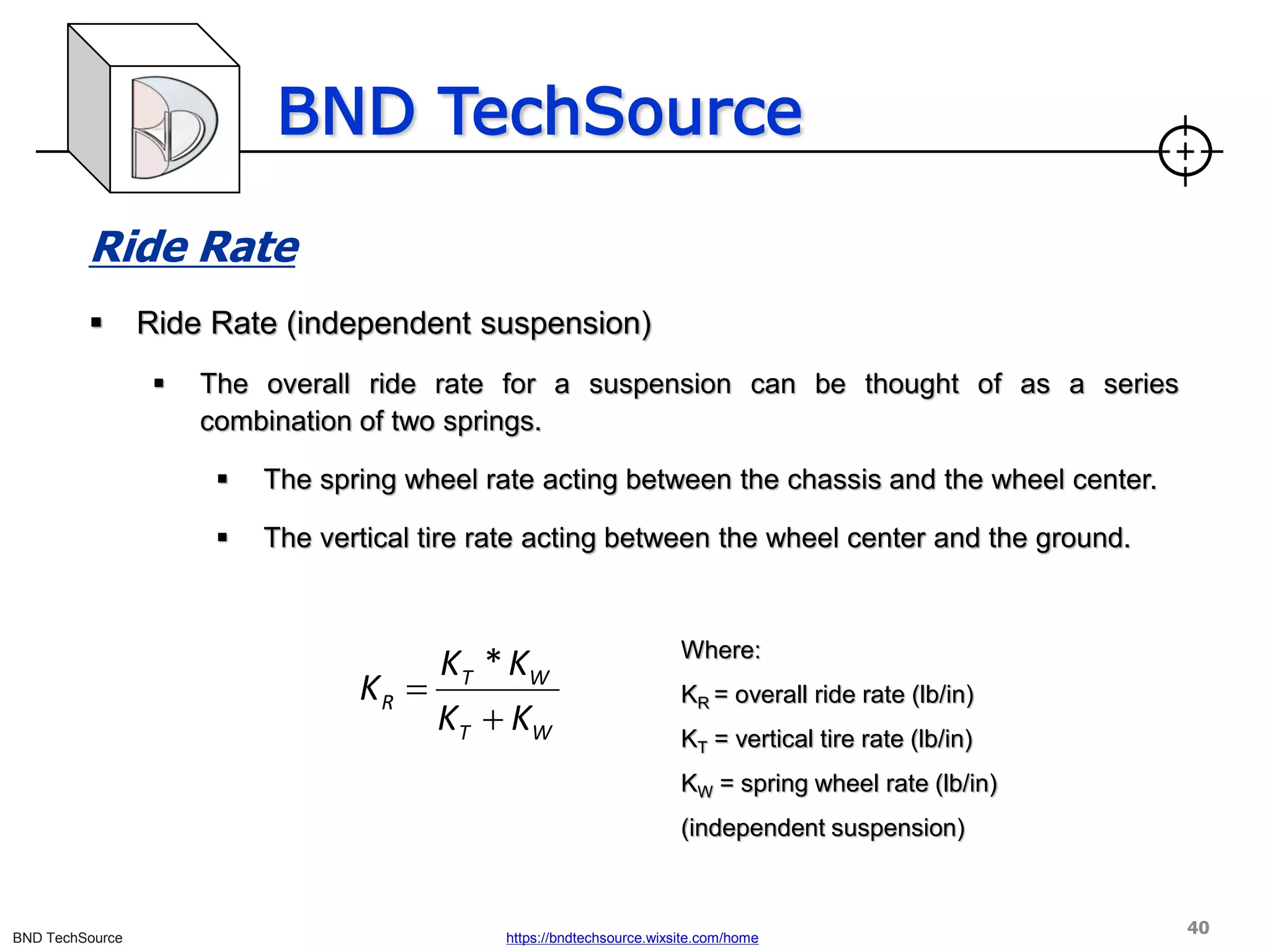
▪ Ride Rate (independent suspension)
▪ The overall ride rate for a suspension can be thought of as a series
combination of two springs.
▪ The spring wheel rate acting between the chassis and the wheel center.
▪ The vertical tire rate acting between the wheel center and the ground.
Where:
KR = overall ride rate (lb/in)
KT = vertical tire rate (lb/in)
KW = spring wheel rate (lb/in)
(independent suspension)
W
T
W
T
R
K
K
K
K
K
+
=
*
40
BND TechSource
BND TechSource https://bndtechsource.wixsite.com/home
Ride Rate
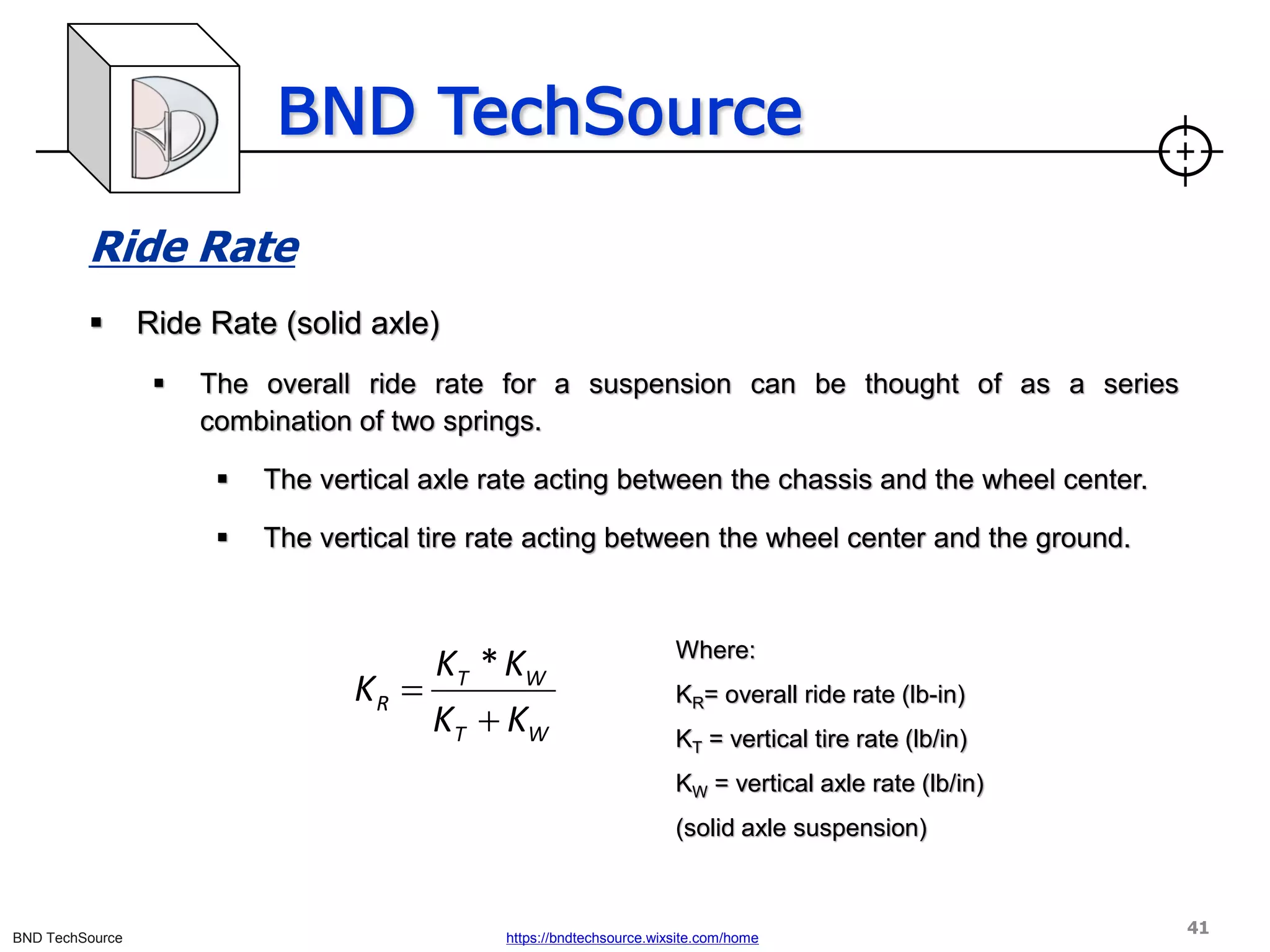
▪ Ride Rate (solid axle)
▪ The overall ride rate for a suspension can be thought of as a series
combination of two springs.
▪ The vertical axle rate acting between the chassis and the wheel center.
▪ The vertical tire rate acting between the wheel center and the ground.
Where:
KR= overall ride rate (lb-in)
KT = vertical tire rate (lb/in)
KW = vertical axle rate (lb/in)
(solid axle suspension)
W
T
W
T
R
K
K
K
K
K
+
=
*
41
BND TechSource
BND TechSource https://bndtechsource.wixsite.com/home
Ride
▪ “One can start with a desired frequency or with a maximum wheel travel / maximum load. Either
one determines how hard/soft the ride/handling will be. Generally it is desirable to have the
suspension as soft as practical in light of packaging, aerodynamic down load, banked turn
loads, roll stiffness (and roll stiffness distribution). The undamped ride frequency for a given
configuration (the frequency of the body moving up and down on the springs) can be
determined from the graph on page 34, once the static deflection has been estimated. Ride
frequencies for sports cars typically run from 70-90 cycles per minute. Older Indy type cars
without ground effects run 95-120 cpm. With ground effects the frequencies can become very
high-several hundred cpm. Passenger cars, by comparison, can be very ---30-50 cpm.”[5]
▪ Wheel travels for several classes of vehicles are typically:
▪ Off-road trucks ±12 in.
▪ Passenger cars ±4 in.
▪ Sports cars and small formula cars ±2 to ±4 in.
▪ Indy type cars (ground effects) ±0.5 in. (or less)
42
BND TechSource
BND TechSource https://bndtechsource.wixsite.com/home
Roll
▪ “The stiffness in roll is conveniently expressed in normalized form as degrees of roll per unit
lateral acceleration (deg./g). This is called the roll gradient.”[5]
43
BND TechSource
BND TechSource https://bndtechsource.wixsite.com/home
References:
1. Ziech, J., “Weight Distribution and Longitudinal Weight Transfer - Session 8,”
Mechanical and Aeronautical Engineering, Western Michigan University.
2. Hathaway, R. Ph.D, “Spring Rates, Wheel Rates, Motion Ratios and Roll Stiffness,” Mechanical
and Aeronautical Engineering, Western Michigan University.
3. Gillespie, T. Ph.D, Fundamentals of Vehicle Dynamics, Society of Automotive Engineers
International, Warrendale, PA, February, 1992, (ISBN: 978-1-56091-199-9).
4. Reimpell, J., Stoll, H., Betzler, J. Ph.D, The Automotive Chassis: Engineering Principles, 2nd
Ed., Butterworth-Heinemann, Woburn, MA, 2001, (ISBN 0 7506 5054 0).
5. Milliken, W., Milliken, D., Race Car Vehicle Dynamics, Society of Automotive Engineers
International, Warrendale, PA, February, 1994, (ISBN: 978-1-56091-526-3).
6. Puhn, F., How to Make Your Car Handle, H.P. Books, Tucson, AZ, 1976 (ISBN 0-912656-46-8).
44
BND TechSource
BND TechSource https://bndtechsource.wixsite.com/home
- END -
Vehicle Load Transfer
Part I of III
General Load Transfer

Vehicle load transfer part I 2021

  • 1.
    BND TechSource BND TechSourcehttps://bndtechsource.wixsite.com/home Vehicle Load Transfer Part I of III General Load Transfer Wm Harbin Technical Director BND TechSource (revised 04JUL21)
  • 2.
    BND TechSource BND TechSourcehttps://bndtechsource.wixsite.com/home Factors in vehicle dynamics ▪ Within any modern vehicle suspension there are many factors to consider during design and development. ▪ Factors in vehicle dynamics: • Vehicle Configuration • Vehicle Type (i.e. 2dr Coupe, 4dr Sedan, Minivan, Truck, etc.) • Vehicle Architecture (i.e. FWD vs. RWD, 2WD vs.4WD, etc.) • Chassis Architecture (i.e. type: tubular, monocoque, etc. ; material: steel, aluminum, carbon fiber, etc. ; fabrication: welding, stamping, forming, etc.) • Front Suspension System Type (i.e. MacPherson strut, SLA Double Wishbone, etc.) • Type of Steering Actuator (i.e. Rack and Pinion vs. Recirculating Ball) • Type of Braking System (i.e. Disc (front & rear) vs. Disc (front) & Drum (rear)) • Rear Suspension System Type (i.e. Beam Axle, Multi-link, Solid Axle, etc.) • Suspension/Braking Control Systems (i.e. ABS, Electronic Stability Control, • Electronic Damping Control, etc.) 2
  • 3.
    BND TechSource BND TechSourcehttps://bndtechsource.wixsite.com/home Factors in vehicle dynamics (continued): • Vehicle Suspension Geometry • Vehicle Wheelbase • Vehicle Track Width Front and Rear • Wheels and Tires • Vehicle Weight and Distribution • Vehicle Center of Gravity • Sprung and Unsprung Weight • Springs Motion Ratio • Chassis Ride Height and Static Deflection • Turning Circle or Turning Radius (Ackermann Steering Geometry) • Suspension Jounce and Rebound 3
  • 4.
    BND TechSource BND TechSourcehttps://bndtechsource.wixsite.com/home Factors in vehicle dynamics (continued): • Vehicle Suspension Geometry (continued): •Vehicle Suspension Hard Points: • Front Suspension • Scrub (Pivot) Radius • Steering (Kingpin) Inclination Angle (SAI) • Caster Angle • Mechanical (or caster) trail • Toe Angle • Camber Angle • Ball Joint Pivot Points • Control Arm Chassis Attachment Points • Knuckle/Brakes/Steering • Springs/Shock Absorbers/Struts • ARB (anti-roll bar) 4
  • 5.
    BND TechSource BND TechSourcehttps://bndtechsource.wixsite.com/home Factors in vehicle dynamics (continued): • Vehicle Suspension Geometry (continued) •Vehicle Suspension Hard Points (continued): • Rear Suspension • Scrub (Pivot) Radius • Steering (Kingpin) Inclination Angle (SAI) • Caster Angle (if applicable) • Mechanical (or caster) trail (if applicable) • Toe Angle • Camber Angle • Knuckle and Chassis Attachment Points • Various links and arms depend upon the Rear Suspension configuration. (i.e. Dependent vs. Semi-Independent vs. Independent Suspension) • Knuckle/Brakes • Springs/Shock Absorbers • ARB (anti-roll bar) 5
  • 6.
    BND TechSource BND TechSourcehttps://bndtechsource.wixsite.com/home Factors in vehicle dynamics (continued): • Vehicle Dynamic Considerations • Suspension Dynamic Targets • Wheel Frequency • Bushing Compliance • Lateral Load Transfer with and w/o ARB • Roll moment • Roll Stiffness (degrees per g of lateral acceleration) • Maximum Steady State lateral acceleration (in understeer mode) • Rollover Threshold (lateral g load) • Linear Range Understeer (typically between 0g and 0.4g) • Suspension Dynamic Analysis •Steering Analysis • Bump Steer Analysis • Roll Steer Analysis • Tractive Force Steer Analysis • Brake Force Steer Analysis • Ackerman change with steering angle 6
  • 7.
    BND TechSource BND TechSourcehttps://bndtechsource.wixsite.com/home Factors in vehicle dynamics (continued): • Suspension Dynamic Analysis (continued) • Roll Analysis • Camber gain in roll (front & rear) • Caster gain in roll (front & rear – if applicable) • Roll Axis Analysis • Roll Center Height Analysis • Instantaneous Center Analysis • Track Analysis • Load Transfer Analysis • Unsprung and Sprung weight transfer • Jacking Forces • Roll Couple Percentage Analysis • Total Lateral Load Transfer Distribution (TLLTD) • Bundorf Analysis • Slip angles (degrees per lateral force) • Tire Cornering Coefficient (lateral force as a percent of rated vertical load per degree slip angle) • Tire Cornering Forces (lateral cornering force as a function of slip angle) • Linear Range Understeer 7
  • 8.
    BND TechSource BND TechSourcehttps://bndtechsource.wixsite.com/home Vehicle Load Transfer • While the total amount of factors may seem a bit overwhelming, it may be easier to digest if we break it down into certain aspects of the total. • The intent of this document is to give the reader a better understanding of vehicle dynamic longitudinal and lateral load transfer as a vehicle accelerates/decelerates in a particular direction. • The discussion will include: Part I – General Load Transfer • Load vs. Weight Transfer • Rotational Moments of Inertia • Sprung and Unsprung Weight Part II – Longitudinal Load Transfer • Vehicle Center of Gravity • Longitudinal Load Transfer • Suspension Geometry • Instant Centers • Side View Swing Arm • Anti-squat, Anti-dive, and Anti- lift Part III – Lateral Load Transfer • Cornering Forces • Suspension Geometry • Front View Swing Arm • Roll Center Heights • Roll Axis • Roll Stiffness • Anti-roll bars • Tire Rates • Roll Gradient • Lateral Load Transfer 8
  • 9.
    BND TechSource BND TechSourcehttps://bndtechsource.wixsite.com/home Load vs. Weight Transfer 9
  • 10.
    BND TechSource BND TechSourcehttps://bndtechsource.wixsite.com/home Load vs. Weight Transfer ▪ In automobiles, load transfer is the imaginary "shifting" of weight around a motor vehicle during acceleration (both longitudinal and lateral). This includes braking, or deceleration (which can be viewed as acceleration at a negative rate). Load transfer is a crucial concept in understanding vehicle dynamics. ▪ Often load transfer is misguidedly referred to as weight transfer due to their close relationship. The difference being load transfer is an imaginary shift in weight due to an imbalance of forces, while weight transfer involves the actual movement of the vehicles center of gravity (Cg). Both result in a redistribution of the total vehicle load between the individual tires. 10
  • 11.
    BND TechSource BND TechSourcehttps://bndtechsource.wixsite.com/home Load vs. Weight Transfer (continued): ▪ Weight transfer involves the actual (small) movement of the vehicle Cg relative to the wheel axes due to displacement of liquids within the vehicle, which results in a redistribution of the total vehicle load between the individual tires. ▪ Liquids, such as fuel, readily flow within their containers, causing changes in the vehicle's Cg. As fuel is consumed, not only does the position of the Cg change, but the total weight of the vehicle is also reduced. ▪ Another factor that changes the vehicle’s Cg is the expansion of the tires during rotation. This is called “dynamic rolling radius” and is effected by wheel-speed, temperature, inflation pressure, tire compound, and tire construction. It raises the vehicle’s Cg slightly as the wheel-speed increases. 11
  • 12.
    BND TechSource BND TechSourcehttps://bndtechsource.wixsite.com/home Load vs. Weight Transfer (continued): ▪ The major forces that accelerate a vehicle occur at the tires contact patch. Since these forces are not directed through the vehicle's Cg, one or more moments are generated. It is these moments that cause variation in the load distributed between the tires. ▪ Lowering the Cg towards the ground is one method of reducing load transfer. As a result load transfer is reduced in both the longitudinal and lateral directions. Another method of reducing load transfer is by increasing the wheel spacings. Increasing the vehicles wheel base (length) reduces longitudinal load transfer. While increasing the vehicles track (width) reduces lateral load transfer. 12
  • 13.
    BND TechSource BND TechSourcehttps://bndtechsource.wixsite.com/home Rotational Moments of Inertia y x z Vertical Lateral Longitudinal Roll (p) Yaw (r) Pitch (q) Cg 13
  • 14.
    BND TechSource BND TechSourcehttps://bndtechsource.wixsite.com/home Moment of Inertia ▪ Polar moment of inertia ▪ A simple demonstration of polar moment of inertia is to compare a dumbbell vs. a barbell both at the same weight. Hold each in the middle and twist to feel the force reacting at the center. Notice the dumbbell (which has a lower polar moment) reacts quickly and the barbell (which has a higher polar moment) reacts slowly. Wd o 2 =  d1 d1 C L d2 d2 C L W W Example: W = 50 lb (25 lb at each end) d1 = 8 in d2 = 30 in 2 2 1 3200 ) 8 ( * 25 * 2 in lb = =  2 2 2 000 , 45 ) 30 ( * 25 * 2 in lb = =  14
  • 15.
    BND TechSource BND TechSourcehttps://bndtechsource.wixsite.com/home Moment of Inertia (continued): ▪ Sum the polar moments of inertia ▪ The total polar moment of inertia for a vehicle can be determined by multiplying the weight of each component by the distance from the component Cg to the Cg of the vehicle. The sum of the component polar moments of inertia would establish the total vehicle polar moment of inertia. ▪ A vehicle with most of its weight near the vehicle Cg has a lower total polar moment of inertia is quicker to respond to steering inputs. ▪ A vehicle with a high polar moment is slower to react to steering inputs and is therefore more stable at high speed straight line driving. 15
  • 16.
    BND TechSource BND TechSourcehttps://bndtechsource.wixsite.com/home Moment of Inertia (continued): ▪ Effects of polar moments of inertia ▪ Here is an example of a V8 engine with a typical transmission packaged into a sports car. Example: WEng = 600 lb WTran = 240 lb dEng = 40 in dTran = 10 in d W d W M Tran Tran Eng Eng o 2 2 ) ( ) ( ) ( + =   2 2 2 000 , 984 ) 10 ( 240 ) 40 ( 600 ) ( in lb in lb in lb M o  = + =   dEng dTran Cg 16
  • 17.
    BND TechSource BND TechSourcehttps://bndtechsource.wixsite.com/home Moment of Inertia (continued): ▪ Effects of polar moments of inertia ▪ Here is an example of a V8 engine with a typical transmission packaged into a sedan. d W d W M Tran Tran Eng Eng o 2 2 ) ( ) ( ) ( + =   Example: WEng = 600 lb WTran = 240 lb dEng = 70 in dTran = 40 in dEng dTran 2 2 2 000 , 324 , 3 ) 40 ( 240 ) 70 ( 600 ) ( in lb in lb in lb M o  = + =   Cg 17
  • 18.
    BND TechSource BND TechSourcehttps://bndtechsource.wixsite.com/home Load Transfer 18
  • 19.
    BND TechSource BND TechSourcehttps://bndtechsource.wixsite.com/home Load Transfer ▪ The forces that enable a road vehicle to accelerate and stop all act at the road surface. ▪ The center of gravity, which is located considerably above the road surface, and which is acted upon by the accelerations resulting from the longitudinal forces at the tire patches, generates a moment which transfers load. ▪ As asymmetric load results in differing traction limits, a vehicles handling is affected by the “dynamic load distribution”. 19
  • 20.
    BND TechSource BND TechSourcehttps://bndtechsource.wixsite.com/home Load Transfer - equations & terms g on Accelerati Vehicle Weight Vehicle Force Inertial * = Wheelbase CG Force Inertial Transfer Load height * = a m = F Law Second s Newton : ' F = force m = mass a = acceleration g = ag = acceleration due to gravity = 32.2ft/sec2 = 9.8m/sec2 20
  • 21.
    BND TechSource BND TechSourcehttps://bndtechsource.wixsite.com/home Load Transfer (continued): ▪ Load transfers between the Center of Gravity and the road surface through a variety of paths. ▪ Suspension Geometry ▪ Front: Location of instant centers (Side View Swing Arm) ▪ Rear: Instant centers, Lift Bars (Side View Swing Arm) ▪ Suspension Springs ▪ Front:Coils, Air Springs, leafs or Torsion bars and Anti-roll bars ▪ Rear: Coils, Air Springs, leafs or Torsion bars and Anti-roll bars 21
  • 22.
    BND TechSource BND TechSourcehttps://bndtechsource.wixsite.com/home Load Transfer (continued): ▪ Dampers (Shock Absorbers) ▪ During transient conditions ▪ Tires ▪ During all conditions (where the rubber meets the road) ▪ Where and how you balance the load transfer between the Springs, Geometry, Dampers and Tires are key determinates as to how well the car will accelerate and brake and the stability associated with each condition. 22
  • 23.
    BND TechSource BND TechSourcehttps://bndtechsource.wixsite.com/home Load Transfer Control Devices ▪ Dampers (Shock Absorbers) ▪ Along with the springs, dampers transfer the load of the rolling (pitching) component of the vehicle. They determine how the load is transferred to and from the individual wheels while the chassis is rolling and/or pitching. ▪ Within 65-70% critically damped is said to be the ideal damper setting for both handling and comfort simultaneously. Most modern dampers show some digression to them as well, meaning they may be 70% critically damped at low piston speeds but move lower to allow the absorption of large bumps. Damping is most important below 4 in/second as this is where car control tuning takes place. 23
  • 24.
    BND TechSource BND TechSourcehttps://bndtechsource.wixsite.com/home Load Transfer Control Devices (continued): ▪ Springs ▪ Along with the dampers (shock absorbers), springs transfer the load of the sprung mass of the car to the road surface. During maneuvers, depending on instant center locations, the springs and dampers transfer some portion of the (m x a), mass x acceleration, forces to the ground. ▪ Spring Rate is force per unit displacement for a suspension spring alone . ▪ For coil springs this is measured axially along the centerline. ▪ For torsion bar springs it is measured at the attachment arm. ▪ For leaf springs it is measured at the axle seat. ▪ The spring rate may be linear (force increases proportionally with displacement) or nonlinear (increasing or decreasing rate with increasing displacement). ▪ Units are typically lb/in (imperial) and kg/mm (metric). https://coiloverdepot.com/pages/spring-rates-suspension-102 24
  • 25.
    BND TechSource BND TechSourcehttps://bndtechsource.wixsite.com/home Load Transfer Control Devices (continued): ▪ Anti-roll bars ▪ [Drawing 1] shows how an anti-roll bar (ARB) is twisted when the body rolls in a turn. This creates forces at the four points where the bar is attached to the vehicle. The forces are shown in [Drawing 2]. Forces A on the suspension increase [load] transfer to the outside tire. Forces B on the frame resist body roll. The effect is a reduction of body roll and an increase in [load] transfer at the end of the chassis which has the anti-roll bar. Because the total [load] transfer due to centripetal force is not changed, the opposite end of the chassis has reduced [load] transfer. [6] Drawing 2 Drawing 1 Direction of Turn A A B B 25
  • 26.
    BND TechSource BND TechSourcehttps://bndtechsource.wixsite.com/home Load Transfer Control Devices (continued): ▪ Bushing Deflection (suspension compliance) All of the calculations shown in this presentation do not include bushing deflection. There are many rubber bushings within a vehicle suspension to consider when analyzing suspension compliance. This is best done with a 3D suspension simulation software like ADAMS, or CarSim. 26
  • 27.
    BND TechSource BND TechSourcehttps://bndtechsource.wixsite.com/home Load Transfer Control Devices (continued): ▪ Frame/Chassis Deflection ▪ All of the calculations shown in this presentation are made under the assumption that the frame or chassis is completely rigid (both in torsion and bending). Of course any flexing within the frame/chassis will adversely effect the performance of the suspension which is attached to it. 27
  • 28.
    BND TechSource BND TechSourcehttps://bndtechsource.wixsite.com/home Sprung and Unsprung Weight ▪ 100% Unsprung weight includes the mass of the tires, rims, brake rotors, brake calipers, knuckle assemblies, and ball joints which move in unison with the wheels. ▪ 50% unsprung and 50% sprung weight would be comprised of the linkages of the wheel assembly to the chassis. ▪ The % unsprung weight of the shocks, springs and anti-roll bar ends would be a function of their motion ratio/2 with the remainder as % sprung weight. ▪ The rest of the mass is on the vehicle side of the springs is suspended and is 100% sprung weight. 28
  • 29.
    BND TechSource BND TechSourcehttps://bndtechsource.wixsite.com/home Sprung and Unsprung Weight (continued): 29
  • 30.
    BND TechSource BND TechSourcehttps://bndtechsource.wixsite.com/home Springs Motion Ratio ▪ The shocks, springs, struts and anti-roll bars are normally mounted at some angle from the suspension to the chassis. ▪ Motion Ratio: If you were to move the wheel 1 inch and the spring were to deflect 0.75 inches then the motion ratio would be 0.75 in/in. Motion Ratio = (B/A) * sin(spring angle) 30
  • 31.
    BND TechSource BND TechSourcehttps://bndtechsource.wixsite.com/home Springs Motion Ratio (continued): Motion Ratio = (B/A) * sin(spring angle) The shocks, springs, struts and anti-roll bars are normally mounted at some angle from the suspension to the chassis. Motion Ratio: If you were to move the wheel 1 inch and the spring were to deflect 0.75 inches then the motion ratio would be 0.75 in/in. 31
  • 32.
    BND TechSource BND TechSourcehttps://bndtechsource.wixsite.com/home Wheel Rates ▪ Wheel Rates are calculated by taking the square of the motion ratio times the spring rate. Squaring the ratio is because the ratio has two effects on the wheel rate. The ratio applies to both the force and distance traveled. ▪ Because it's a force, and the lever arm is multiplied twice. • The motion ratio is factored once to account for the distance-traveled differential of the two points (A and B in the example below). • Then the motion ratio is factored again to account for the lever-arm force differential. Example: K | A----B------------P Wheel Rate (lb/in) = (Motion Ratio)2* (Spring Rate) 32
  • 33.
    BND TechSource BND TechSourcehttps://bndtechsource.wixsite.com/home Wheel Rates (continued): Example: K | A----B------------P ▪ P is the pivot point, B is the spring mount, and A is the wheel. Here the motion ration (MR) is 0.75... imagine a spring K that is rated at 100 lb/in placed at B perpendicular to the line AP. If you want to move A 1 in vertically upward, B would only move (1in)(MR) = 0.75 in. Since K is 100 lb/in, and B has only moved 0.75 in, there's a force at B of 75 lb. If you balance the moments about P, you get 75(B)=X(A), and we know B = 0.75A, so you get 75(0.75A) = X(A). A's cancel and you get X=75(0.75)=56.25. Which is [100(MR)](MR) or 100(MR)2. Wheel Rate (lb/in) = (Motion Ratio)2* (Spring Rate) 33
  • 34.
    BND TechSource BND TechSourcehttps://bndtechsource.wixsite.com/home Wheel Rates (continued): ▪ Since the linkages pivot, the spring angles change as the components swing along an arc path. This causes the motion ratio to be calculated through a range. The graph below shows an example of these results for both coil-over shock and anti- roll bar for an independent front suspension from rebound to jounce positions. 0 50 100 150 200 250 300 Wheel Rate (lb/in) Rebound to Jounce (in) Wheel Rate vs. Wheel Position Coil-over… ARB Ride height KW = Wheel Rate (lb/in) = (Motion Ratio - range)2 * (Spring Rate - linear) KW = MR2 * KS Example: Coil-over KS = 400 lb/in (linear) Coil-over MR = 0.72-.079 in/in ARB KS = 451.8 lb/in (body roll) ARB MR = 0.56-0.61 in/in 34
  • 35.
    BND TechSource BND TechSourcehttps://bndtechsource.wixsite.com/home Wheel Rates (continued): ▪ In longitudinal pitch, the anti-roll bar (ARB) rotates evenly as the chassis moves relative to the suspension. Therefore, the ARB only comes into play during lateral pitch (body roll) of the vehicle (it also comes into play during one wheel bump, but that rate is not shown here). 0 50 100 150 200 250 300 Wheel Rate (lb/in) Rebound to Jounce (in) Wheel Rate vs. Wheel Position Coil-over… ARB Ride height KW = Wheel Rate (lb/in) = (Motion Ratio - range)2 * (Spring Rate - linear) KW = MR2 * KS Example: Coil-over KS = 400 lb/in (linear) Coil-over MR = 0.72-.079 in/in ARB KS = 451.8 lb/in (body roll) ARB MR = 0.56-0.61 in/in 35
  • 36.
    BND TechSource BND TechSourcehttps://bndtechsource.wixsite.com/home Spring Rates/Ride Frequency ▪ The static deflection of the suspension determines its natural frequency. ▪ Static deflection is the rate at which the suspension compresses in response to weight. 0 20 40 60 80 100 120 140 160 180 200 0 10 20 30 40 50 60 70 80 90 100 w = Frequency (cycles/min) x = Static Deflection (in) Ride Natural Frequency vs. Static Wheel Deflection 36
  • 37.
    BND TechSource BND TechSourcehttps://bndtechsource.wixsite.com/home Spring Rates/Ride Frequency (continued): ▪ Ride frequency is the undamped natural frequency of the body in ride. The higher the frequency, the stiffer the ride. ▪ Based on the application, there are ballpark numbers to consider. ▪ 30 - 70 CPM for passenger cars ▪ 70 - 120 CPM for high-performance sports cars ▪ 120 - 300+ CPM for high downforce race cars ▪ It is common to run a spring frequency higher in the rear than the front. The idea is to have the oscillation of the front suspension finish at the same time as the rear. ▪ Since the delay between when the front suspension hits a bump and the rear suspension hits that bump varies according to vehicle speed, the spring frequency increase in the rear also varies according to the particular speed one wants to optimize for. 37
  • 38.
    BND TechSource BND TechSourcehttps://bndtechsource.wixsite.com/home Spring Rates/Ride Frequency (continued): ▪ Once the motion ratios has been established, the front and rear spring rates can be optimized for a “flat” ride at a particular speed. 38
  • 39.
    BND TechSource BND TechSourcehttps://bndtechsource.wixsite.com/home Spring Rates/Ride Frequency (continued): ▪ Here are the equations from the previous spreadsheet: Rate Wheel Effect Spring MR K K S W = = 2 ) ( * Rate Ride K K K K K W T W T R = + = * Deflection Static K W D R S S = = Where: KS = Spring Rate (lb/in) MR = Motion Ratio (in/in) KT = Tire Stiffness Rate (lb/in) WS = Sprung Weight (lb) w/60 = Hz wf = Front Frequency (Hz) l = Wheelbase (in) v = Vehicle Speed (mph) 1 mph = 17.6 in/sec ) ( 188 CPM Frequency Natural DS = =  Rate Ride Rear Rec W K S Rrec rec RR . ) 2 . 32 * 12 ( * * 4 2 2 = =   (Hz) Frequency Natural Rear Rec. v f Rrec = − = ) / ( * ) 6 . 17 / 1 ( ) / 1 ( 1    Rate Spring Rear Rec MR K K K K K rear RRrec Trear RRrec Trear rec SR . ) ( ) /( ) * ( 2 = − = 39
  • 40.
    BND TechSource BND TechSourcehttps://bndtechsource.wixsite.com/home Ride Rate ▪ Ride Rate (independent suspension) ▪ The overall ride rate for a suspension can be thought of as a series combination of two springs. ▪ The spring wheel rate acting between the chassis and the wheel center. ▪ The vertical tire rate acting between the wheel center and the ground. Where: KR = overall ride rate (lb/in) KT = vertical tire rate (lb/in) KW = spring wheel rate (lb/in) (independent suspension) W T W T R K K K K K + = * 40
  • 41.
    BND TechSource BND TechSourcehttps://bndtechsource.wixsite.com/home Ride Rate ▪ Ride Rate (solid axle) ▪ The overall ride rate for a suspension can be thought of as a series combination of two springs. ▪ The vertical axle rate acting between the chassis and the wheel center. ▪ The vertical tire rate acting between the wheel center and the ground. Where: KR= overall ride rate (lb-in) KT = vertical tire rate (lb/in) KW = vertical axle rate (lb/in) (solid axle suspension) W T W T R K K K K K + = * 41
  • 42.
    BND TechSource BND TechSourcehttps://bndtechsource.wixsite.com/home Ride ▪ “One can start with a desired frequency or with a maximum wheel travel / maximum load. Either one determines how hard/soft the ride/handling will be. Generally it is desirable to have the suspension as soft as practical in light of packaging, aerodynamic down load, banked turn loads, roll stiffness (and roll stiffness distribution). The undamped ride frequency for a given configuration (the frequency of the body moving up and down on the springs) can be determined from the graph on page 34, once the static deflection has been estimated. Ride frequencies for sports cars typically run from 70-90 cycles per minute. Older Indy type cars without ground effects run 95-120 cpm. With ground effects the frequencies can become very high-several hundred cpm. Passenger cars, by comparison, can be very ---30-50 cpm.”[5] ▪ Wheel travels for several classes of vehicles are typically: ▪ Off-road trucks ±12 in. ▪ Passenger cars ±4 in. ▪ Sports cars and small formula cars ±2 to ±4 in. ▪ Indy type cars (ground effects) ±0.5 in. (or less) 42
  • 43.
    BND TechSource BND TechSourcehttps://bndtechsource.wixsite.com/home Roll ▪ “The stiffness in roll is conveniently expressed in normalized form as degrees of roll per unit lateral acceleration (deg./g). This is called the roll gradient.”[5] 43
  • 44.
    BND TechSource BND TechSourcehttps://bndtechsource.wixsite.com/home References: 1. Ziech, J., “Weight Distribution and Longitudinal Weight Transfer - Session 8,” Mechanical and Aeronautical Engineering, Western Michigan University. 2. Hathaway, R. Ph.D, “Spring Rates, Wheel Rates, Motion Ratios and Roll Stiffness,” Mechanical and Aeronautical Engineering, Western Michigan University. 3. Gillespie, T. Ph.D, Fundamentals of Vehicle Dynamics, Society of Automotive Engineers International, Warrendale, PA, February, 1992, (ISBN: 978-1-56091-199-9). 4. Reimpell, J., Stoll, H., Betzler, J. Ph.D, The Automotive Chassis: Engineering Principles, 2nd Ed., Butterworth-Heinemann, Woburn, MA, 2001, (ISBN 0 7506 5054 0). 5. Milliken, W., Milliken, D., Race Car Vehicle Dynamics, Society of Automotive Engineers International, Warrendale, PA, February, 1994, (ISBN: 978-1-56091-526-3). 6. Puhn, F., How to Make Your Car Handle, H.P. Books, Tucson, AZ, 1976 (ISBN 0-912656-46-8). 44
  • 45.
    BND TechSource BND TechSourcehttps://bndtechsource.wixsite.com/home - END - Vehicle Load Transfer Part I of III General Load Transfer