Associate Professor
Dept. of.Mechanical Engg
Dr.S.S.Saravanakumar
Solving the Harmonic Oscillator
Contents
1. Simple illustrative example: Spring-mass system
2. Free Vibrations: Undamped
3. Free Vibrations: Damped
4. Forced Vibrations: Beats and Resonance
5. Will this work for the beam?
6. Writing as a First Order System
7. Summary & References
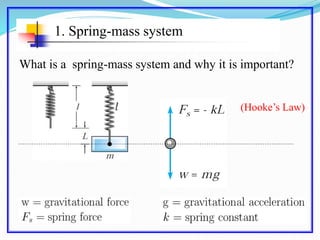
1. Spring-mass system
What is a spring-mass system and why it is important?
(Hooke’s Law)
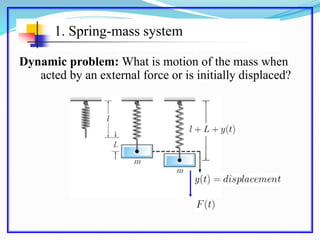
1. Spring-mass system
Dynamic problem: What is motion of the mass when
acted by an external force or is initially displaced?
1. Spring-mass system
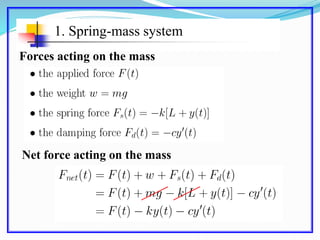
Forces acting on the mass
Net force acting on the mass
1. Spring-mass system
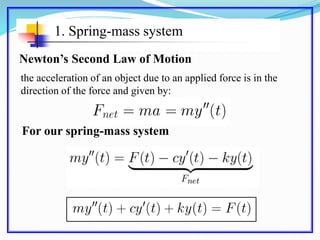
Newton’s Second Law of Motion
the acceleration of an object due to an applied force is in the
direction of the force and given by:
For our spring-mass system
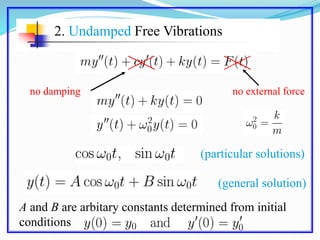
2. Undamped Free Vibrations
no damping no external force
(general solution)
(particular solutions)
A and B are arbitary constants determined from initial
conditions
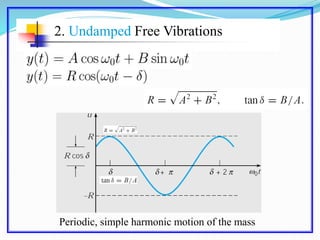
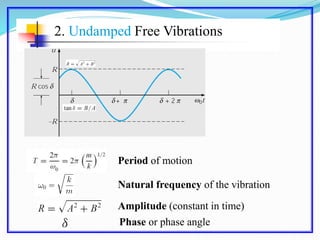
2. Undamped Free Vibrations
Periodic, simple harmonic motion of the mass
2. Undamped Free Vibrations
Period of motion
Natural frequency of the vibration
Amplitude (constant in time)
Phase or phase angle
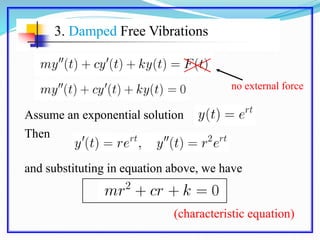
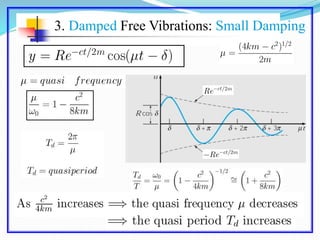
3. Damped Free Vibrations
no external force
Assume an exponential solution
Then
and substituting in equation above, we have
(characteristic equation)
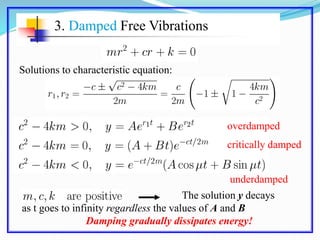
3. Damped Free Vibrations
Solutions to characteristic equation:
The solution y decays
as t goes to infinity regardless the values of A and B
Damping gradually dissipates energy!
overdamped
critically damped
underdamped
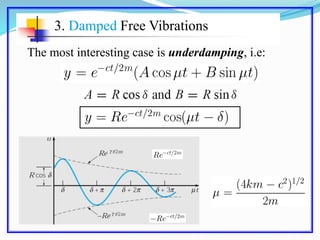
3. Damped Free Vibrations
The most interesting case is underdamping, i.e:
3. Damped Free Vibrations: Small Damping
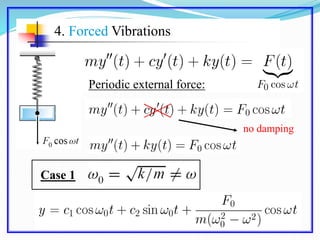
4. Forced Vibrations
no damping
Periodic external force:
Case 1
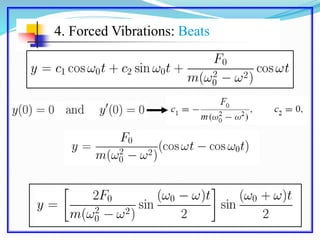
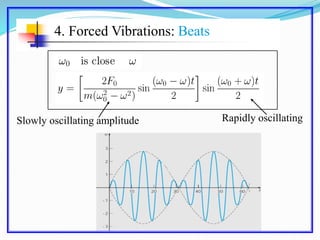
4. Forced Vibrations: Beats
Rapidly oscillatingSlowly oscillating amplitude
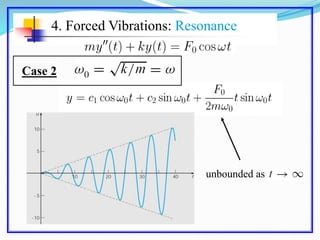
4. Forced Vibrations: Resonance
unbounded as
Case 2
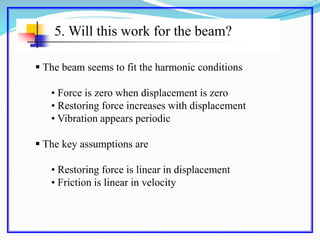
5. Will this work for the beam?
 The beam seems to fit the harmonic conditions
• Force is zero when displacement is zero
• Restoring force increases with displacement
• Vibration appears periodic
 The key assumptions are
• Restoring force is linear in displacement
• Friction is linear in velocity
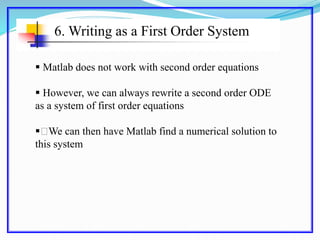
6. Writing as a First Order System
 Matlab does not work with second order equations
 However, we can always rewrite a second order ODE
as a system of first order equations
􀂆We can then have Matlab find a numerical solution to
this system
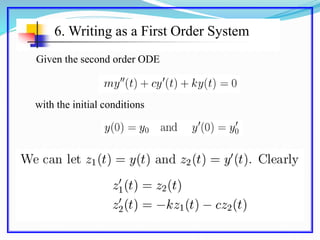
6. Writing as a First Order System
Given the second order ODE
with the initial conditions
6. Writing as a First Order System
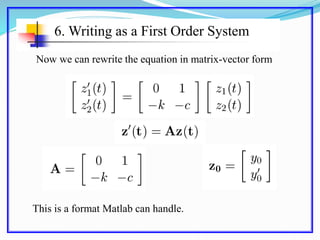
Now we can rewrite the equation in matrix-vector form
This is a format Matlab can handle.
6. Constants are not independent
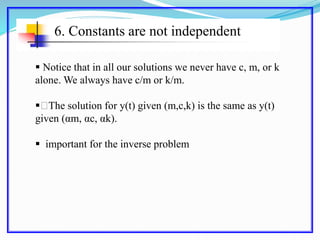
 Notice that in all our solutions we never have c, m, or k
alone. We always have c/m or k/m.
􀂆The solution for y(t) given (m,c,k) is the same as y(t)
given (αm, αc, αk).
 important for the inverse problem
7. Summary
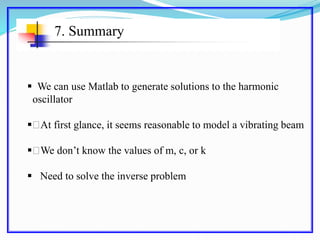
 We can use Matlab to generate solutions to the harmonic
oscillator
􀂆At first glance, it seems reasonable to model a vibrating beam
􀂆We don’t know the values of m, c, or k
 Need to solve the inverse problem
8. References
W. Boyce and R.C. DiPrima: Elementary Differential Equations
and Boundary Value Problems

Free vibration

  • 1.
    Associate Professor Dept. of.MechanicalEngg Dr.S.S.Saravanakumar Solving the Harmonic Oscillator
  • 2.
    Contents 1. Simple illustrativeexample: Spring-mass system 2. Free Vibrations: Undamped 3. Free Vibrations: Damped 4. Forced Vibrations: Beats and Resonance 5. Will this work for the beam? 6. Writing as a First Order System 7. Summary & References
  • 3.
    1. Spring-mass system Whatis a spring-mass system and why it is important? (Hooke’s Law)
  • 4.
    1. Spring-mass system Dynamicproblem: What is motion of the mass when acted by an external force or is initially displaced?
  • 5.
    1. Spring-mass system Forcesacting on the mass Net force acting on the mass
  • 6.
    1. Spring-mass system Newton’sSecond Law of Motion the acceleration of an object due to an applied force is in the direction of the force and given by: For our spring-mass system
  • 7.
    2. Undamped FreeVibrations no damping no external force (general solution) (particular solutions) A and B are arbitary constants determined from initial conditions
  • 8.
    2. Undamped FreeVibrations Periodic, simple harmonic motion of the mass
  • 9.
    2. Undamped FreeVibrations Period of motion Natural frequency of the vibration Amplitude (constant in time) Phase or phase angle
  • 10.
    3. Damped FreeVibrations no external force Assume an exponential solution Then and substituting in equation above, we have (characteristic equation)
  • 11.
    3. Damped FreeVibrations Solutions to characteristic equation: The solution y decays as t goes to infinity regardless the values of A and B Damping gradually dissipates energy! overdamped critically damped underdamped
  • 12.
    3. Damped FreeVibrations The most interesting case is underdamping, i.e:
  • 13.
    3. Damped FreeVibrations: Small Damping
  • 14.
    4. Forced Vibrations nodamping Periodic external force: Case 1
  • 15.
  • 16.
    4. Forced Vibrations:Beats Rapidly oscillatingSlowly oscillating amplitude
  • 17.
    4. Forced Vibrations:Resonance unbounded as Case 2
  • 18.
    5. Will thiswork for the beam?  The beam seems to fit the harmonic conditions • Force is zero when displacement is zero • Restoring force increases with displacement • Vibration appears periodic  The key assumptions are • Restoring force is linear in displacement • Friction is linear in velocity
  • 19.
    6. Writing asa First Order System  Matlab does not work with second order equations  However, we can always rewrite a second order ODE as a system of first order equations 􀂆We can then have Matlab find a numerical solution to this system
  • 20.
    6. Writing asa First Order System Given the second order ODE with the initial conditions
  • 21.
    6. Writing asa First Order System Now we can rewrite the equation in matrix-vector form This is a format Matlab can handle.
  • 22.
    6. Constants arenot independent  Notice that in all our solutions we never have c, m, or k alone. We always have c/m or k/m. 􀂆The solution for y(t) given (m,c,k) is the same as y(t) given (αm, αc, αk).  important for the inverse problem
  • 23.
    7. Summary  Wecan use Matlab to generate solutions to the harmonic oscillator 􀂆At first glance, it seems reasonable to model a vibrating beam 􀂆We don’t know the values of m, c, or k  Need to solve the inverse problem
  • 24.
    8. References W. Boyceand R.C. DiPrima: Elementary Differential Equations and Boundary Value Problems