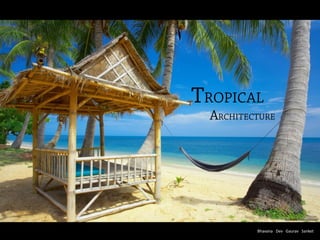
TROPICAL ARCHITECTURE Bhavana Dev Gaurav SanketBhavana Dev Gaurav Sanket
TROPICAL ARCHITECTURE Bhavana Dev Gaurav Sanket
The Collins dictionary defines tropical as:
tropical (ˈtrɒpɪkəl)adj
1. (Physical Geography) situated in, used in
, characteristic of, or relating to the tropics
2. (of weather) very hot, esp when humid
3. (Rhetoric) rhetoric of or relating to a trope
ˌtropiˈcality n ˈtropically adv
TROPICAL ARCHITECTURE Bhavana Dev Gaurav Sanket
TROPICAL CLIMATE
IS CLIMATE WHERE HEAT IS THE
DOMINANT PROBLEM,
WHERE, FOR THE GREATER PART OF
THE YEAR BUILDINGS SERVE TO
KEEP THE OCCUPANTS COOL, RATHER
THAN WARM.
TROPICAL ARCHITECTURE Bhavana Dev Gaurav Sanket
THE TROPICS LIE ALONG THE EQUATOR,
BETWEEN 23 AND -23 DEGREES LATITUDE
AND CAN BE DISTINGUISHED BY HOT HUMID
CONDITIONS.
MEAN ANNUAL TEMPERATURES REACH A
MAXIMUM OF 30 DC DURING THE SAY AND
24DC AT NIGHT.
HUMIDITY LEVELS VARY BETWEEN 60% -
100%
A TROPICAL CLIMATE IS ACCOMPANIED
RAINFALL IS VERY HIGH, USUALLY FROM 2,500
TO 3,500 MM (98 TO 138 IN) PER YEAR.
AVERAGE RAINY DAYS ARE AROUND 200 PER
YEAR AND AVERAGE ANNUAL SUNSHINE HOURS
AROUND 2,000.
TROPICAL ARCHITECTURE Bhavana Dev Gaurav Sanket
THE MAIN STRESS OF A TROPICAL CLIMATE :
• HIGH HUMIDITY LEVELS
• TEMPERATURES
• SOLAR RADIATION
TROPICAL ARCHITECTURE Bhavana Dev Gaurav Sanket
TROPICAL ARCHITECTURE…
TROPICAL ARCHITECTURE Bhavana Dev Gaurav Sanket
MANY CONFUSE THE TERM TROPICAL
ARCHITECTURE WITH A PARTICULAR DESIGN
STYLE.
IN REALITY, TROPICAL ARCHITECTURE IS ALL
ABOUT ACHIEVING THERMAL COMFORT
THROUGH THE USE OF PASSIVE DESIGN
TROPICAL ARCHITECTURE
THERMAL COMFORT
PASSIVE DESIGN
THE PROCESS OF ACHIEVING
THIS COMFORT LEVEL
WITHOUT THE USE OF
MECHANICAL SYSTEMS.
TROPICAL ARCHITECTURE IS
ALL ABOUT TACKLING URBAN
HEAT ISLAND EFFECT.
SUNSHADES
CAVITY WALLS
LIGHT SHELVES
OVERHANGS
ROOF AND WALL INSULATION
SHADING FROM LARGE TREES
TO BLOCK THE SUN. IT CAN
LOOK VERY TRADITIONAL,
ULTRAMODERN OR EVEN
HIGH-TECH.
TROPICAL ARCHITECTURE Bhavana Dev Gaurav Sanket
TROPICAL ARCHITECTURE IS A BRANCH OF THE ARCHITECTURE,
THE STUDY OF THE CLIMATE OF THE ORIENTED
ARCHITECTURE THE WEATHER IN A PLACE WHERE THE MASS OF
THE BUILDING OR GROUP OF BUILDINGS, AND THE IMPACT OR
IMPACT ON THE ENVIRONMENTAL LINK OR INFLUENCE ON THE
TROPICAL SURROUNDINGS.
BUILDINGS WITH TROPICAL ARCHITECTURAL
DESIGN, CHARACTERIZED BY SETTING OR CHARACTERS WITH
TROPICAL WEATHER CONDITIONS, OR HAVE A TROPICAL FORM.
BUT WITH THE DEVELOPMENT OF THE CONCEPT AND
TECHNOLOGY, THE BUILDING WITH THE CONCEPT OR HOW
MODERN OR HIGH-TECH, WHICH MIGHT BE CALLED TROPICAL
BUILDINGS THIS IS MITIGATED BY A SYSTEM OF AIR
CIRCULATION, VENTILATION, VIEW OPENINGS, AND THE
ORIENTATION OF THE BUILDINGS AND THE USE OF MODERN
HIGH TECH MATERIALS WHICH DOES NOT DAMAGE THE
ENVIRONMENT.
TROPICAL ARCHITECTURE Bhavana Dev Gaurav Sanket
PASSIVE SOLAR DESIGN
REFERS TO THE USE OF SUN’S ENERGY FOR THE HEATING AND COOLING OF LIVING SPACES
IN THIS APPROACH THE BUILDING ITSELF OF ITS ELEMENTS TAKE ADVANTAGE OF THE NATURAL ENERGY
PASSIVE SYSTEM ARE SIMPLE AND REQUIRE MINIMAL MAINTENANCE THEREFORE MORE OR LESS NO
MECHANICAL SYSTEMS
TROPICAL ARCHITECTURE Bhavana Dev Gaurav Sanket
BASIC PRINCIPLES
•Movement of air is an important
•Open up houses as much as possible
•Use lightweight materials for the walls and roof
•So they do not store much heat and shed heat quickly
•ie steel or timber stud frame with metal, timber or fibre cement claddings
•Avoid Heavy mass products, such as brick and block
•Such mass re-radiate the heat they have stored during the day, which keeps the house hot
after sunset
•If must use, ensure they are well shaded
•Windows should be shaded from the sun and protected from rain
•The roof and/or ceiling should be insulated and roof space is well vented
•Living room + bedroom has at least two openings
•The building should be engineered to withstand cyclones
•Develop a long, thin floor plan with as many rooms as possible having windows or openings on
at least two walls to achieve maximum cross-ventilation
•Provide covered external living areas that are positioned to catch the prevailing breezes in
both the wet and dry seasons
•Insulate the eastern and western walls
•Using lighter, more reflective colours on roofs and walls
•Raise the ceiling height to greater than 2700mm or using sloping ceilings with a minimum height
of 2400mm
•Choose windows that catch the breeze and can be left open in wet conditions,
•ie louvres, casements or awning windows
•Use awnings to shade windows and provide rain protection
•Put high level windows or vents in all rooms, to let out the hot air and draw in cooler air
•However it is important that windows or vents can be closed in storms
•Avoid shrubs and dense planting up to 2100mm high that will block breezes, make
internal rooms darker, and provide breeding areas for mosquitoes and other pests
TROPICAL ARCHITECTURE Bhavana Dev Gaurav Sanket
Design for Natural Ventilation
•Use the breeze for cross ventilation through openings in opposite walls
and internal partitions
•Maximise the area of windows (e.g. louvres) that can be opened
•Orientate house to catch the breeze (whilst still minimising sun on east
and west walls)
•A long narrow floor plan catches the breeze best.
•Trees and shrubs act to cool the air passing through the house.
•Don’t use exposed concrete on ground immediately outside the house
as it heats the air.
•Roof space ventilation draws the heat out.
•Dirty flyscreens block more breeze. Consider using
openable/removable flyscreen shutters
Minimum Insulation Standard
•Light coloured well ventilated roofs: foil/sisalation
•Other roofs: R1.5 batts and foil/sisalation
•Full shading of wall is much more important than wall R-value.
Unshaded, masonry walls store heat and release it well into the night.
•Shelter windows with louvres, canopies, shutters or fixed overhangs –
then you can enjoy the cooling effect of rain.
TROPICAL ARCHITECTURE Bhavana Dev Gaurav Sanket
Basic design principles
•The external features of the building envelope and its relation to the site should be
designed to fully utilize air movement. Interior partitions should not block air
movements.
•Air velocity can be reduced when the interior walls are placed close to the inlet
opening or each time it is diverted around obstructions.
•If interior walls are unavoidable, air flow can still be ensured if the partitions have
openings at the lower and upper portions. This is a common strategy in the old
Filipino bahay na bato, with its transom panels covered with intricate wood carvings
or wood louvers.
•Maximize window openings for cross ventilation of internal spaces. Vents in the roof
cavity can also be very effective in drawing out heat from the room interiors.
•Since hot air goes upward, and cool air goes downward, openings at the top of
staircases and in clerestory windows facilitate air change.
•It is generally cooler at night, so ventilation of internal spaces can be continuous for
nighttime cooling. This means designing the building with operable windows to let
hot air escape at night and to capture prevailing night winds.
•To supplement natural ventilation, fans can be placed at various heights and areas
to increase comfort conditions. Fans are effective in generating internal air
movement, improve air distribution and increase air velocities.
•Window openings are advisable at the body level for evaporative human body
cooling. And room width should not exceed five times ceiling height for good air
movement.
•Sunshades and sun protection devices on openings reduce heat gain and glare,
and also help in internal daylighting. Louvres that are adjustable can alter the
direction of air flow and lighting.
Asian houses have big roof overhangs to protect interior spaces from heat gain and
glare. Shading materials should reflect heat, and not be another source of heat.
Roof insulation is a must in our warm climate. This reduces the temperature
significantly inside the house.
TROPICAL ARCHITECTURE Bhavana Dev Gaurav Sanket
SO WHAT EXACTLY IS THE HEAT ISLAND EFFECT?
THIS PHENOMENON IS WHAT RESULTS FROM CITIES
THAT HAVE VERY LITTLE GREENERY AND VERY MANY
CONCRETE SURFACES. THE CITY WILL HAVE 2 TO 3
DEGREES CELSIUS HIGHER TEMPERATURE THAN
THAT OF THE SURROUNDING SUBURBS AND
COUNTRYSIDE. FIGURATIVELY, IT FORMS AN
“ISLAND” OF HOTTER LAND, WHILE BEING
SURROUNDED BY COOLER LAND IN THE CITY
OUTSKIRTS.
DARK-COLORED ROOFS ADD TO THE HEAT ISLAND
EFFECT. SOME OF THE HEAT ABSORBED BY DARK-
COLORED ROOFS IS TRANSMITTED TO THE ROOM
OR SPACE BELOW.
TROPICAL ARCHITECTURE Bhavana Dev Gaurav Sanket
TROPICAL ARCHITECTURE EXPLAINED
TROPICAL ARCHITECTURE CAN BE REGARDED AS A TYPE OF GREEN
BUILDING APPLICABLE SPECIFICALLY FOR TROPICAL CLIMATES,
USING DESIGN TO OPTIMALLY REDUCE BUILDINGS’ ENERGY
CONSUMPTION, PARTICULARLY THE COOLING LOAD.
TROPICAL ARCHITECTURE IS NOT A NEW CONCEPT. COUNTRIES IN
THE ASIA-PACIFIC REGION HAVE ADOPTED VERNACULAR
DESIGNS ADAPTING TO THEIR CLIMATIC NEEDS OVER MANY
CENTURIES. FOR INSTANCE, A HIGH CEILING DEMONSTRATES AN
UNDERSTANDING OF THE STACK EFFECT. MALAY HOMES INSTALL A
LARGE ROOF OVERHANG AND THE WEST INDIANS USE VERANDAS
TO REDUCE SOLAR GAINS. THESE DESIGN SOLUTIONS ALLOW
WINDOWS TO REMAIN OPEN FOR NATURAL VENTILATION IN A
BUILDING
DURING RAINY SEASON. SAMOANS LONG AGO DID NOT INSTALL
WALLS TO ALLOW FREE-FLOW BREEZES. MALAYAN HOMES’ PLENTIFUL
WINDOWS AIM TO MAXIMIZE CROSS-VENTILATION.
TROPICAL ARCHITECTURE Bhavana Dev Gaurav Sanket
Golconde in Pondicherry, South India
Golconde in Pondicherry, South India is a multi-storey dormitory built from 1936 to
1942 and based on design principles of simplicity, economy, directness and closeness
to nature. The building is an interesting example of how vernacular design can be
integrated into modern tropical architecture. The Golconde’s specific design
features include:
• Rooms separated from the corridor by sliding doors: This allows air to circulate
freely when the doors are open. Staggered slats allow for ventilation even when the
doors are closed. The topmost part of all the doors has a skylight with a sliding glass
pane that also allows for air movement.
• Room walls finished with eggshells: The walls aid in the natural lighting because
they reflect more light and the rooms are better illuminated with the natural light.
Unlike with concrete walls, there is less heat in the room.
• Double-thick roof made of precast curved cement concrete tiles: The convection of
air keeps the roof
and the top-floor rooms as cool as the lower floors.
• Large operable horizontal louvers: The entire building on both the north and south
sides is equipped with large operable horizontal louvers that protect from sunlight,
wind and rain while allowing for natural ventilation. By avoiding direct sunlight, the
building allows rooms to remain cool without the need for mechanical ventilation.
• Landscaping with surrounding garden: Trees, grass and shallow pools are used to
create a cooling effect.
High walls around the property are installed to avoid the heat island effect from non-
shaded areas.
TROPICAL ARCHITECTURE Bhavana Dev Gaurav Sanket
Many confuse the term tropical architecture with a particular design style. In reality, tropical architecture is all about achieving thermal comfort through the
use of passive design elements like sunshades, cavity walls, light shelves, overhangs, roof and wall insulation and even shading from large trees to block the
sun. It can look very traditional, ultramodern or even high-tech.
Passive design is the process of achieving this comfort level without the use of mechanical systems. Tropical architecture is all about tackling urban heat island
effect.
So what exactly is the heat island effect?
This phenomenon is what results from cities that have very little greenery and very many concrete surfaces. The city will have 2 to 3 degrees Celsius higher
temperature than that of the surrounding suburbs and countryside. Figuratively, it forms an “island” of hotter land, while being surrounded by cooler land in the
city outskirts.
Dark-colored roofs add to the heat island effect. Some of the heat absorbed by dark-colored roofs is transmitted to the room or space below.
Basic design principles
For the Philippines, having a warm humid climate, there are a few basic design principles regarding natural ventilation to cool a home or a building.
•The external features of the building envelope and its relation to the site should be designed to fully utilize air movement. Interior partitions should not block air
movements.
•Air velocity can be reduced when the interior walls are placed close to the inlet opening or each time it is diverted around obstructions.
•If interior walls are unavoidable, air flow can still be ensured if the partitions have openings at the lower and upper portions. This is a common strategy in the
old Filipino bahay na bato, with its transom panels covered with intricate wood carvings or wood louvers.
•Maximize window openings for cross ventilation of internal spaces. Vents in the roof cavity can also be very effective in drawing out heat from the room
interiors.
•Since hot air goes upward, and cool air goes downward, openings at the top of staircases and in clerestory windows facilitate air change.
•It is generally cooler at night, so ventilation of internal spaces can be continuous for nighttime cooling. This means designing the building with operable
windows to let hot air escape at night and to capture prevailing night winds.
•To supplement natural ventilation, fans can be placed at various heights and areas to increase comfort conditions. Fans are effective in generating internal air
movement, improve air distribution and increase air velocities.
•Window openings are advisable at the body level for evaporative human body cooling. And room width should not exceed five times ceiling height for good air
movement.
•Sunshades and sun protection devices on openings reduce heat gain and glare, and also help in internal daylighting. Louvres that are adjustable can alter the
direction of air flow and lighting.
Asian houses have big roof overhangs to protect interior spaces from heat gain and glare. Shading materials should reflect heat, and not be another source of
heat.
Roof insulation is a must in our warm climate. This reduces the temperature significantly inside the house.
http://business.inquirer.net/19613/tropical-architecture
TROPICAL ARCHITECTURE Bhavana Dev Gaurav Sanket
CONSIDERATIONS FOR REPLICATING
THE CHALLENGE OF INTRODUCING TROPICAL ARCHITECTURE IS TO ADAPT IT TO THE
MODERN LIFESTYLE – THE TRANSFORMATION OF LOCAL CULTURES TO THE MODERN
CITY. WHILE IT IS POSSIBLE TO RETAIN ENOUGH OF THE VERNACULAR LIFESTYLE FOR
RESIDENTIAL DESIGNS, OTHER TYPES OF BUILDINGS, SUCH AS OFFICES AND
SHOPPING CENTRES, HAVE GENERALLY NOT DONE SO.
THERE IS GROWING INTEREST IN DEVELOPING MODERN TROPICAL ARCHITECTURE IN
URBANIZED COUNTRIES LIKE MALAYSIA AND SINGAPORE.
MODERN ARCHITECTURE ALIGNED WITH EXISTING TECHNOLOGIES INCLUDES: THE
ANGLE OF THE INCLINATION OF THE ROOF WHEN USING TILE ROOF COVERING
MATERIALS, LONG OVERHANGS, THE USE OF A VENTILATION CRUSADE TO REDUCE
THE HUMIDITY AND HOT AIR TEMPERATURES AND THE CORRECT DIRECTION OF THE
ORIENTATION OF THE BUILDING.
TROPICAL ARCHITECTURE Bhavana Dev Gaurav Sanket
…yet to edit and rectify
THANK U
TROPICAL ARCHITECTURE Bhavana Dev Gaurav Sanket
THANK YOU

Tropical Archtecture

  • 1.
    TROPICAL ARCHITECTURE BhavanaDev Gaurav SanketBhavana Dev Gaurav Sanket
  • 2.
  • 3.
    TROPICAL ARCHITECTURE BhavanaDev Gaurav Sanket The Collins dictionary defines tropical as: tropical (ˈtrɒpɪkəl)adj 1. (Physical Geography) situated in, used in , characteristic of, or relating to the tropics 2. (of weather) very hot, esp when humid 3. (Rhetoric) rhetoric of or relating to a trope ˌtropiˈcality n ˈtropically adv
  • 4.
    TROPICAL ARCHITECTURE BhavanaDev Gaurav Sanket TROPICAL CLIMATE IS CLIMATE WHERE HEAT IS THE DOMINANT PROBLEM, WHERE, FOR THE GREATER PART OF THE YEAR BUILDINGS SERVE TO KEEP THE OCCUPANTS COOL, RATHER THAN WARM.
  • 5.
    TROPICAL ARCHITECTURE BhavanaDev Gaurav Sanket THE TROPICS LIE ALONG THE EQUATOR, BETWEEN 23 AND -23 DEGREES LATITUDE AND CAN BE DISTINGUISHED BY HOT HUMID CONDITIONS. MEAN ANNUAL TEMPERATURES REACH A MAXIMUM OF 30 DC DURING THE SAY AND 24DC AT NIGHT. HUMIDITY LEVELS VARY BETWEEN 60% - 100% A TROPICAL CLIMATE IS ACCOMPANIED RAINFALL IS VERY HIGH, USUALLY FROM 2,500 TO 3,500 MM (98 TO 138 IN) PER YEAR. AVERAGE RAINY DAYS ARE AROUND 200 PER YEAR AND AVERAGE ANNUAL SUNSHINE HOURS AROUND 2,000.
  • 6.
  • 7.
    TROPICAL ARCHITECTURE BhavanaDev Gaurav Sanket THE MAIN STRESS OF A TROPICAL CLIMATE : • HIGH HUMIDITY LEVELS • TEMPERATURES • SOLAR RADIATION
  • 8.
  • 9.
    TROPICAL ARCHITECTURE BhavanaDev Gaurav Sanket TROPICAL ARCHITECTURE…
  • 10.
    TROPICAL ARCHITECTURE BhavanaDev Gaurav Sanket MANY CONFUSE THE TERM TROPICAL ARCHITECTURE WITH A PARTICULAR DESIGN STYLE. IN REALITY, TROPICAL ARCHITECTURE IS ALL ABOUT ACHIEVING THERMAL COMFORT THROUGH THE USE OF PASSIVE DESIGN TROPICAL ARCHITECTURE THERMAL COMFORT PASSIVE DESIGN THE PROCESS OF ACHIEVING THIS COMFORT LEVEL WITHOUT THE USE OF MECHANICAL SYSTEMS. TROPICAL ARCHITECTURE IS ALL ABOUT TACKLING URBAN HEAT ISLAND EFFECT. SUNSHADES CAVITY WALLS LIGHT SHELVES OVERHANGS ROOF AND WALL INSULATION SHADING FROM LARGE TREES TO BLOCK THE SUN. IT CAN LOOK VERY TRADITIONAL, ULTRAMODERN OR EVEN HIGH-TECH.
  • 11.
  • 12.
    TROPICAL ARCHITECTURE BhavanaDev Gaurav Sanket TROPICAL ARCHITECTURE IS A BRANCH OF THE ARCHITECTURE, THE STUDY OF THE CLIMATE OF THE ORIENTED ARCHITECTURE THE WEATHER IN A PLACE WHERE THE MASS OF THE BUILDING OR GROUP OF BUILDINGS, AND THE IMPACT OR IMPACT ON THE ENVIRONMENTAL LINK OR INFLUENCE ON THE TROPICAL SURROUNDINGS. BUILDINGS WITH TROPICAL ARCHITECTURAL DESIGN, CHARACTERIZED BY SETTING OR CHARACTERS WITH TROPICAL WEATHER CONDITIONS, OR HAVE A TROPICAL FORM. BUT WITH THE DEVELOPMENT OF THE CONCEPT AND TECHNOLOGY, THE BUILDING WITH THE CONCEPT OR HOW MODERN OR HIGH-TECH, WHICH MIGHT BE CALLED TROPICAL BUILDINGS THIS IS MITIGATED BY A SYSTEM OF AIR CIRCULATION, VENTILATION, VIEW OPENINGS, AND THE ORIENTATION OF THE BUILDINGS AND THE USE OF MODERN HIGH TECH MATERIALS WHICH DOES NOT DAMAGE THE ENVIRONMENT.
  • 13.
  • 14.
    TROPICAL ARCHITECTURE BhavanaDev Gaurav Sanket PASSIVE SOLAR DESIGN REFERS TO THE USE OF SUN’S ENERGY FOR THE HEATING AND COOLING OF LIVING SPACES IN THIS APPROACH THE BUILDING ITSELF OF ITS ELEMENTS TAKE ADVANTAGE OF THE NATURAL ENERGY PASSIVE SYSTEM ARE SIMPLE AND REQUIRE MINIMAL MAINTENANCE THEREFORE MORE OR LESS NO MECHANICAL SYSTEMS
  • 15.
  • 16.
    TROPICAL ARCHITECTURE BhavanaDev Gaurav Sanket BASIC PRINCIPLES •Movement of air is an important •Open up houses as much as possible •Use lightweight materials for the walls and roof •So they do not store much heat and shed heat quickly •ie steel or timber stud frame with metal, timber or fibre cement claddings •Avoid Heavy mass products, such as brick and block •Such mass re-radiate the heat they have stored during the day, which keeps the house hot after sunset •If must use, ensure they are well shaded •Windows should be shaded from the sun and protected from rain •The roof and/or ceiling should be insulated and roof space is well vented •Living room + bedroom has at least two openings •The building should be engineered to withstand cyclones •Develop a long, thin floor plan with as many rooms as possible having windows or openings on at least two walls to achieve maximum cross-ventilation •Provide covered external living areas that are positioned to catch the prevailing breezes in both the wet and dry seasons •Insulate the eastern and western walls •Using lighter, more reflective colours on roofs and walls •Raise the ceiling height to greater than 2700mm or using sloping ceilings with a minimum height of 2400mm •Choose windows that catch the breeze and can be left open in wet conditions, •ie louvres, casements or awning windows •Use awnings to shade windows and provide rain protection •Put high level windows or vents in all rooms, to let out the hot air and draw in cooler air •However it is important that windows or vents can be closed in storms •Avoid shrubs and dense planting up to 2100mm high that will block breezes, make internal rooms darker, and provide breeding areas for mosquitoes and other pests
  • 17.
    TROPICAL ARCHITECTURE BhavanaDev Gaurav Sanket Design for Natural Ventilation •Use the breeze for cross ventilation through openings in opposite walls and internal partitions •Maximise the area of windows (e.g. louvres) that can be opened •Orientate house to catch the breeze (whilst still minimising sun on east and west walls) •A long narrow floor plan catches the breeze best. •Trees and shrubs act to cool the air passing through the house. •Don’t use exposed concrete on ground immediately outside the house as it heats the air. •Roof space ventilation draws the heat out. •Dirty flyscreens block more breeze. Consider using openable/removable flyscreen shutters Minimum Insulation Standard •Light coloured well ventilated roofs: foil/sisalation •Other roofs: R1.5 batts and foil/sisalation •Full shading of wall is much more important than wall R-value. Unshaded, masonry walls store heat and release it well into the night. •Shelter windows with louvres, canopies, shutters or fixed overhangs – then you can enjoy the cooling effect of rain.
  • 18.
    TROPICAL ARCHITECTURE BhavanaDev Gaurav Sanket Basic design principles •The external features of the building envelope and its relation to the site should be designed to fully utilize air movement. Interior partitions should not block air movements. •Air velocity can be reduced when the interior walls are placed close to the inlet opening or each time it is diverted around obstructions. •If interior walls are unavoidable, air flow can still be ensured if the partitions have openings at the lower and upper portions. This is a common strategy in the old Filipino bahay na bato, with its transom panels covered with intricate wood carvings or wood louvers. •Maximize window openings for cross ventilation of internal spaces. Vents in the roof cavity can also be very effective in drawing out heat from the room interiors. •Since hot air goes upward, and cool air goes downward, openings at the top of staircases and in clerestory windows facilitate air change. •It is generally cooler at night, so ventilation of internal spaces can be continuous for nighttime cooling. This means designing the building with operable windows to let hot air escape at night and to capture prevailing night winds. •To supplement natural ventilation, fans can be placed at various heights and areas to increase comfort conditions. Fans are effective in generating internal air movement, improve air distribution and increase air velocities. •Window openings are advisable at the body level for evaporative human body cooling. And room width should not exceed five times ceiling height for good air movement. •Sunshades and sun protection devices on openings reduce heat gain and glare, and also help in internal daylighting. Louvres that are adjustable can alter the direction of air flow and lighting. Asian houses have big roof overhangs to protect interior spaces from heat gain and glare. Shading materials should reflect heat, and not be another source of heat. Roof insulation is a must in our warm climate. This reduces the temperature significantly inside the house.
  • 19.
    TROPICAL ARCHITECTURE BhavanaDev Gaurav Sanket SO WHAT EXACTLY IS THE HEAT ISLAND EFFECT? THIS PHENOMENON IS WHAT RESULTS FROM CITIES THAT HAVE VERY LITTLE GREENERY AND VERY MANY CONCRETE SURFACES. THE CITY WILL HAVE 2 TO 3 DEGREES CELSIUS HIGHER TEMPERATURE THAN THAT OF THE SURROUNDING SUBURBS AND COUNTRYSIDE. FIGURATIVELY, IT FORMS AN “ISLAND” OF HOTTER LAND, WHILE BEING SURROUNDED BY COOLER LAND IN THE CITY OUTSKIRTS. DARK-COLORED ROOFS ADD TO THE HEAT ISLAND EFFECT. SOME OF THE HEAT ABSORBED BY DARK- COLORED ROOFS IS TRANSMITTED TO THE ROOM OR SPACE BELOW.
  • 20.
    TROPICAL ARCHITECTURE BhavanaDev Gaurav Sanket TROPICAL ARCHITECTURE EXPLAINED TROPICAL ARCHITECTURE CAN BE REGARDED AS A TYPE OF GREEN BUILDING APPLICABLE SPECIFICALLY FOR TROPICAL CLIMATES, USING DESIGN TO OPTIMALLY REDUCE BUILDINGS’ ENERGY CONSUMPTION, PARTICULARLY THE COOLING LOAD. TROPICAL ARCHITECTURE IS NOT A NEW CONCEPT. COUNTRIES IN THE ASIA-PACIFIC REGION HAVE ADOPTED VERNACULAR DESIGNS ADAPTING TO THEIR CLIMATIC NEEDS OVER MANY CENTURIES. FOR INSTANCE, A HIGH CEILING DEMONSTRATES AN UNDERSTANDING OF THE STACK EFFECT. MALAY HOMES INSTALL A LARGE ROOF OVERHANG AND THE WEST INDIANS USE VERANDAS TO REDUCE SOLAR GAINS. THESE DESIGN SOLUTIONS ALLOW WINDOWS TO REMAIN OPEN FOR NATURAL VENTILATION IN A BUILDING DURING RAINY SEASON. SAMOANS LONG AGO DID NOT INSTALL WALLS TO ALLOW FREE-FLOW BREEZES. MALAYAN HOMES’ PLENTIFUL WINDOWS AIM TO MAXIMIZE CROSS-VENTILATION.
  • 21.
    TROPICAL ARCHITECTURE BhavanaDev Gaurav Sanket Golconde in Pondicherry, South India Golconde in Pondicherry, South India is a multi-storey dormitory built from 1936 to 1942 and based on design principles of simplicity, economy, directness and closeness to nature. The building is an interesting example of how vernacular design can be integrated into modern tropical architecture. The Golconde’s specific design features include: • Rooms separated from the corridor by sliding doors: This allows air to circulate freely when the doors are open. Staggered slats allow for ventilation even when the doors are closed. The topmost part of all the doors has a skylight with a sliding glass pane that also allows for air movement. • Room walls finished with eggshells: The walls aid in the natural lighting because they reflect more light and the rooms are better illuminated with the natural light. Unlike with concrete walls, there is less heat in the room. • Double-thick roof made of precast curved cement concrete tiles: The convection of air keeps the roof and the top-floor rooms as cool as the lower floors. • Large operable horizontal louvers: The entire building on both the north and south sides is equipped with large operable horizontal louvers that protect from sunlight, wind and rain while allowing for natural ventilation. By avoiding direct sunlight, the building allows rooms to remain cool without the need for mechanical ventilation. • Landscaping with surrounding garden: Trees, grass and shallow pools are used to create a cooling effect. High walls around the property are installed to avoid the heat island effect from non- shaded areas.
  • 22.
    TROPICAL ARCHITECTURE BhavanaDev Gaurav Sanket Many confuse the term tropical architecture with a particular design style. In reality, tropical architecture is all about achieving thermal comfort through the use of passive design elements like sunshades, cavity walls, light shelves, overhangs, roof and wall insulation and even shading from large trees to block the sun. It can look very traditional, ultramodern or even high-tech. Passive design is the process of achieving this comfort level without the use of mechanical systems. Tropical architecture is all about tackling urban heat island effect. So what exactly is the heat island effect? This phenomenon is what results from cities that have very little greenery and very many concrete surfaces. The city will have 2 to 3 degrees Celsius higher temperature than that of the surrounding suburbs and countryside. Figuratively, it forms an “island” of hotter land, while being surrounded by cooler land in the city outskirts. Dark-colored roofs add to the heat island effect. Some of the heat absorbed by dark-colored roofs is transmitted to the room or space below. Basic design principles For the Philippines, having a warm humid climate, there are a few basic design principles regarding natural ventilation to cool a home or a building. •The external features of the building envelope and its relation to the site should be designed to fully utilize air movement. Interior partitions should not block air movements. •Air velocity can be reduced when the interior walls are placed close to the inlet opening or each time it is diverted around obstructions. •If interior walls are unavoidable, air flow can still be ensured if the partitions have openings at the lower and upper portions. This is a common strategy in the old Filipino bahay na bato, with its transom panels covered with intricate wood carvings or wood louvers. •Maximize window openings for cross ventilation of internal spaces. Vents in the roof cavity can also be very effective in drawing out heat from the room interiors. •Since hot air goes upward, and cool air goes downward, openings at the top of staircases and in clerestory windows facilitate air change. •It is generally cooler at night, so ventilation of internal spaces can be continuous for nighttime cooling. This means designing the building with operable windows to let hot air escape at night and to capture prevailing night winds. •To supplement natural ventilation, fans can be placed at various heights and areas to increase comfort conditions. Fans are effective in generating internal air movement, improve air distribution and increase air velocities. •Window openings are advisable at the body level for evaporative human body cooling. And room width should not exceed five times ceiling height for good air movement. •Sunshades and sun protection devices on openings reduce heat gain and glare, and also help in internal daylighting. Louvres that are adjustable can alter the direction of air flow and lighting. Asian houses have big roof overhangs to protect interior spaces from heat gain and glare. Shading materials should reflect heat, and not be another source of heat. Roof insulation is a must in our warm climate. This reduces the temperature significantly inside the house. http://business.inquirer.net/19613/tropical-architecture
  • 23.
    TROPICAL ARCHITECTURE BhavanaDev Gaurav Sanket CONSIDERATIONS FOR REPLICATING THE CHALLENGE OF INTRODUCING TROPICAL ARCHITECTURE IS TO ADAPT IT TO THE MODERN LIFESTYLE – THE TRANSFORMATION OF LOCAL CULTURES TO THE MODERN CITY. WHILE IT IS POSSIBLE TO RETAIN ENOUGH OF THE VERNACULAR LIFESTYLE FOR RESIDENTIAL DESIGNS, OTHER TYPES OF BUILDINGS, SUCH AS OFFICES AND SHOPPING CENTRES, HAVE GENERALLY NOT DONE SO. THERE IS GROWING INTEREST IN DEVELOPING MODERN TROPICAL ARCHITECTURE IN URBANIZED COUNTRIES LIKE MALAYSIA AND SINGAPORE. MODERN ARCHITECTURE ALIGNED WITH EXISTING TECHNOLOGIES INCLUDES: THE ANGLE OF THE INCLINATION OF THE ROOF WHEN USING TILE ROOF COVERING MATERIALS, LONG OVERHANGS, THE USE OF A VENTILATION CRUSADE TO REDUCE THE HUMIDITY AND HOT AIR TEMPERATURES AND THE CORRECT DIRECTION OF THE ORIENTATION OF THE BUILDING.
  • 24.
  • 25.
  • 26.
  • 27.
  • 28.
    TROPICAL ARCHITECTURE BhavanaDev Gaurav Sanket …yet to edit and rectify THANK U
  • 29.
    TROPICAL ARCHITECTURE BhavanaDev Gaurav Sanket THANK YOU