ENERGY EFFICIENT ARCH.
CAMPUS DESIGN CONSIDERING WARM HUMID CLIMATE
PRESENTATION BY-
SAMAN ALMAS - 3PD17AT047
SHAIMA CHOUDHARY - 3PD17AT053
UMME AAISHA AMAAN - 3PD17AT068
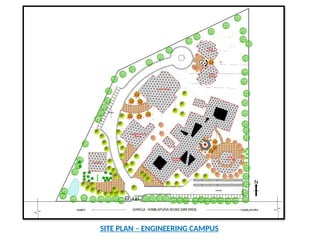
SITE PLAN – ENGINEERING CAMPUS
General recommendations for building design in warm & humid climate:
SITE
Landform :
• For flat sites, for design consideration for the
landform is immaterial.
• In case of slopes and depressions, the building
should be located on windward side or crest
to take advantage of cool breeze.
Open spaces & build form :
• Buildings should be spread out with large
open spaces in between for unrestricted air
movement.
• In cities, buildings on stilts can promote
ventilation and cause cooling at ground level.
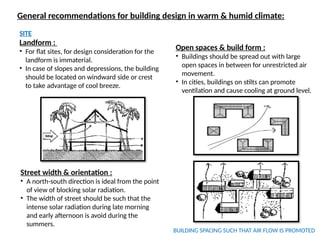
BUILDING SPACING SUCH THAT AIR FLOW IS PROMOTED
Street width & orientation :
• A north-south direction is ideal from the point
of view of blocking solar radiation.
• The width of street should be such that the
intense solar radiation during late morning
and early afternoon is avoid during the
summers.
ORIENTATION & PLATFORM
Orient the buildings with the long axes in the east-
west direction so that the longest walls face north
and south, and only the short wall face east and
west.
Design to minimize solar heat gain: West- and east-
facing glass can have nearly five times the solar heat
gain of north-facing glass, and more than triple that
of south-facing glass.
Although the amount of radiant heat at west and
east exposures is the same, west is most important
to protect, because it occurs during the hottest time
of the day.
Design to minimize west and east glass and wall
surface, and shade it. Try to place most of the home’s
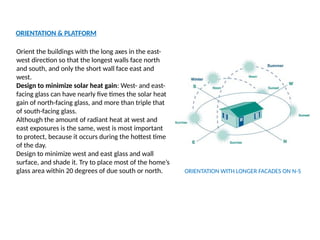
glass area within 20 degrees of due south or north. ORIENTATION WITH LONGER FACADES ON N-S
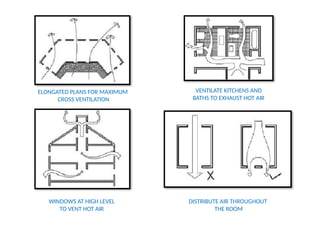
ELONGATED PLANS FOR MAXIMUM
CROSS VENTILATION
VENTILATE KITCHENS AND
BATHS TO EXHAUST HOT AIR
WINDOWS AT HIGH LEVEL
TO VENT HOT AIR
DISTRIBUTE AIR THROUGHOUT
THE ROOM
BUILDING ENVELOPE
Roof :
• In addition to provide shelter from
rain and heat, the form of roof should
be planned to promote air flow.
• Vents at the rooftop effectively induce
ventilation and draw hot air out.
• Insulation doesn’t provide any
additional benefit.
• A double roof with a ventilated space
in between can also be used to
promote air flow.
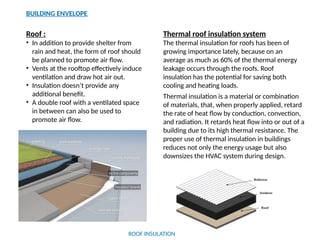
Thermal roof insulation system
The thermal insulation for roofs has been of
growing importance lately, because on an
average as much as 60% of the thermal energy
leakage occurs through the roofs. Roof
insulation has the potential for saving both
cooling and heating loads.
Thermal insulation is a material or combination
of materials, that, when properly applied, retard
the rate of heat flow by conduction, convection,
and radiation. It retards heat flow into or out of a
building due to its high thermal resistance. The
proper use of thermal insulation in buildings
reduces not only the energy usage but also
downsizes the HVAC system during design.
ROOF INSULATION
Walls :
Lightweight concrete (LWC) refers to any concrete produced with
a density of less than 2000kg/m3. For structural purposes. The
LWC density often ranges between 1600 and 2000 kg/m3 along
with a strength grade of 15 MPa. Whereas for thermal insulation
purposes the density if often less than 1450 kg/m3 along with
strength grade as low as 0.5 MPa. The thermal resistance of light
weight concrete can be improved by mixing with light weight
aggregates.
Fenestration :
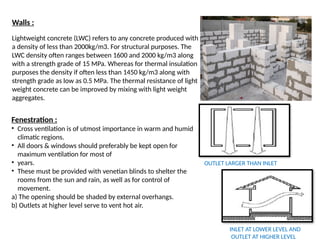
• Cross ventilation is of utmost importance in warm and humid
climatic regions.
• All doors & windows should preferably be kept open for
maximum ventilation for most of
• years.
• These must be provided with venetian blinds to shelter the
rooms from the sun and rain, as well as for control of
movement.
a) The opening should be shaded by external overhangs.
b) Outlets at higher level serve to vent hot air.
OUTLET LARGER THAN INLET
INLET AT LOWER LEVEL AND
OUTLET AT HIGHER LEVEL
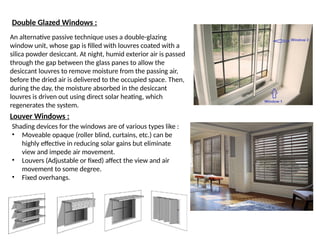
Double Glazed Windows :
An alternative passive technique uses a double-glazing
window unit, whose gap is filled with louvres coated with a
silica powder desiccant. At night, humid exterior air is passed
through the gap between the glass panes to allow the
desiccant louvres to remove moisture from the passing air,
before the dried air is delivered to the occupied space. Then,
during the day, the moisture absorbed in the desiccant
louvres is driven out using direct solar heating, which
regenerates the system.
Louver Windows :
Shading devices for the windows are of various types like :
• Moveable opaque (roller blind, curtains, etc.) can be
highly effective in reducing solar gains but eliminate
view and impede air movement.
• Louvers (Adjustable or fixed) affect the view and air
movement to some degree.
• Fixed overhangs.
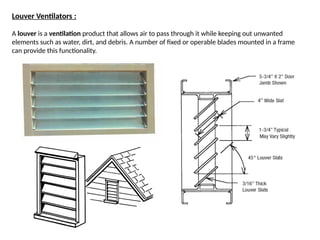
Louver Ventilators :
A louver is a ventilation product that allows air to pass through it while keeping out unwanted
elements such as water, dirt, and debris. A number of fixed or operable blades mounted in a frame
can provide this functionality.
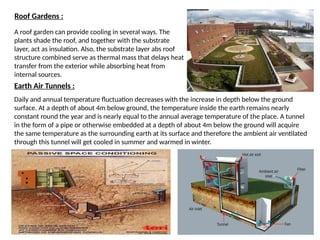
Roof Gardens :
A roof garden can provide cooling in several ways. The
plants shade the roof, and together with the substrate
layer, act as insulation. Also, the substrate layer abs roof
structure combined serve as thermal mass that delays heat
transfer from the exterior while absorbing heat from
internal sources.
Earth Air Tunnels :
Daily and annual temperature fluctuation decreases with the increase in depth below the ground
surface. At a depth of about 4m below ground, the temperature inside the earth remains nearly
constant round the year and is nearly equal to the annual average temperature of the place. A tunnel
in the form of a pipe or otherwise embedded at a depth of about 4m below the ground will acquire
the same temperature as the surrounding earth at its surface and therefore the ambient air ventilated
through this tunnel will get cooled in summer and warmed in winter.
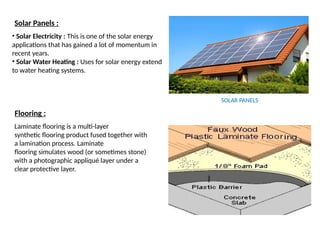
Solar Panels :
• Solar Electricity : This is one of the solar energy
applications that has gained a lot of momentum in
recent years.
• Solar Water Heating : Uses for solar energy extend
to water heating systems.
SOLAR PANELS
Flooring :
Laminate flooring is a multi-layer
synthetic flooring product fused together with
a lamination process. Laminate
flooring simulates wood (or sometimes stone)
with a photographic appliqué layer under a
clear protective layer.
Courtyard :
Courtyard effects: Due to incident solar radiation in a
courtyard, the air gets warmer and rises. Cool air from the
ground level flows through the louvered openings of
rooms surrounding a courtyard, thus producing air flows.
At night, the warm roof surfaces get cooled by convection
and radiation. If this heat exchange reduces roof surface
temperature to wet bulb temperature of air, condensation
of atmosphere moisture occurs on the roof and the gain
due to condensation limits further cooling.
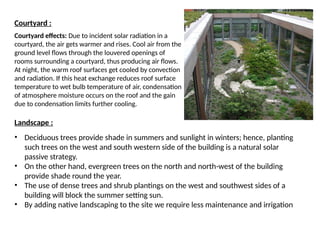
Landscape :
• Deciduous trees provide shade in summers and sunlight in winters; hence, planting
such trees on the west and south western side of the building is a natural solar
passive strategy.
• On the other hand, evergreen trees on the north and north-west of the building
provide shade round the year.
• The use of dense trees and shrub plantings on the west and southwest sides of a
building will block the summer setting sun.
• By adding native landscaping to the site we require less maintenance and irrigation
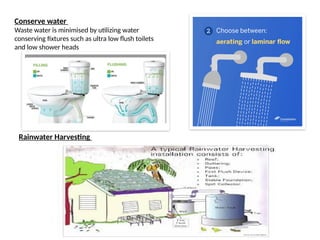
Conserve water
Waste water is minimised by utilizing water
conserving fixtures such as ultra low flush toilets
and low shower heads
Rainwater Harvesting
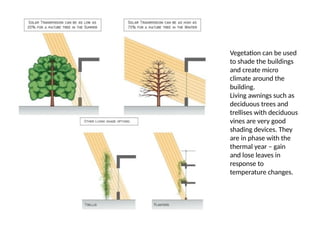
Vegetation can be used
to shade the buildings
and create micro
climate around the
building.
Living awnings such as
deciduous trees and
trellises with deciduous
vines are very good
shading devices. They
are in phase with the
thermal year – gain
and lose leaves in
response to
temperature changes.
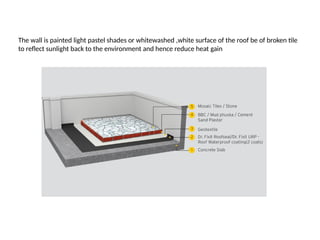
The wall is painted light pastel shades or whitewashed ,white surface of the roof be of broken tile
to reflect sunlight back to the environment and hence reduce heat gain

Energy Efficient Building Design in Architecture

  • 1.
    ENERGY EFFICIENT ARCH. CAMPUSDESIGN CONSIDERING WARM HUMID CLIMATE PRESENTATION BY- SAMAN ALMAS - 3PD17AT047 SHAIMA CHOUDHARY - 3PD17AT053 UMME AAISHA AMAAN - 3PD17AT068
  • 2.
    SITE PLAN –ENGINEERING CAMPUS
  • 3.
    General recommendations forbuilding design in warm & humid climate: SITE Landform : • For flat sites, for design consideration for the landform is immaterial. • In case of slopes and depressions, the building should be located on windward side or crest to take advantage of cool breeze. Open spaces & build form : • Buildings should be spread out with large open spaces in between for unrestricted air movement. • In cities, buildings on stilts can promote ventilation and cause cooling at ground level. BUILDING SPACING SUCH THAT AIR FLOW IS PROMOTED Street width & orientation : • A north-south direction is ideal from the point of view of blocking solar radiation. • The width of street should be such that the intense solar radiation during late morning and early afternoon is avoid during the summers.
  • 4.
    ORIENTATION & PLATFORM Orientthe buildings with the long axes in the east- west direction so that the longest walls face north and south, and only the short wall face east and west. Design to minimize solar heat gain: West- and east- facing glass can have nearly five times the solar heat gain of north-facing glass, and more than triple that of south-facing glass. Although the amount of radiant heat at west and east exposures is the same, west is most important to protect, because it occurs during the hottest time of the day. Design to minimize west and east glass and wall surface, and shade it. Try to place most of the home’s glass area within 20 degrees of due south or north. ORIENTATION WITH LONGER FACADES ON N-S
  • 5.
    ELONGATED PLANS FORMAXIMUM CROSS VENTILATION VENTILATE KITCHENS AND BATHS TO EXHAUST HOT AIR WINDOWS AT HIGH LEVEL TO VENT HOT AIR DISTRIBUTE AIR THROUGHOUT THE ROOM
  • 6.
    BUILDING ENVELOPE Roof : •In addition to provide shelter from rain and heat, the form of roof should be planned to promote air flow. • Vents at the rooftop effectively induce ventilation and draw hot air out. • Insulation doesn’t provide any additional benefit. • A double roof with a ventilated space in between can also be used to promote air flow. Thermal roof insulation system The thermal insulation for roofs has been of growing importance lately, because on an average as much as 60% of the thermal energy leakage occurs through the roofs. Roof insulation has the potential for saving both cooling and heating loads. Thermal insulation is a material or combination of materials, that, when properly applied, retard the rate of heat flow by conduction, convection, and radiation. It retards heat flow into or out of a building due to its high thermal resistance. The proper use of thermal insulation in buildings reduces not only the energy usage but also downsizes the HVAC system during design. ROOF INSULATION
  • 7.
    Walls : Lightweight concrete(LWC) refers to any concrete produced with a density of less than 2000kg/m3. For structural purposes. The LWC density often ranges between 1600 and 2000 kg/m3 along with a strength grade of 15 MPa. Whereas for thermal insulation purposes the density if often less than 1450 kg/m3 along with strength grade as low as 0.5 MPa. The thermal resistance of light weight concrete can be improved by mixing with light weight aggregates. Fenestration : • Cross ventilation is of utmost importance in warm and humid climatic regions. • All doors & windows should preferably be kept open for maximum ventilation for most of • years. • These must be provided with venetian blinds to shelter the rooms from the sun and rain, as well as for control of movement. a) The opening should be shaded by external overhangs. b) Outlets at higher level serve to vent hot air. OUTLET LARGER THAN INLET INLET AT LOWER LEVEL AND OUTLET AT HIGHER LEVEL
  • 8.
    Double Glazed Windows: An alternative passive technique uses a double-glazing window unit, whose gap is filled with louvres coated with a silica powder desiccant. At night, humid exterior air is passed through the gap between the glass panes to allow the desiccant louvres to remove moisture from the passing air, before the dried air is delivered to the occupied space. Then, during the day, the moisture absorbed in the desiccant louvres is driven out using direct solar heating, which regenerates the system. Louver Windows : Shading devices for the windows are of various types like : • Moveable opaque (roller blind, curtains, etc.) can be highly effective in reducing solar gains but eliminate view and impede air movement. • Louvers (Adjustable or fixed) affect the view and air movement to some degree. • Fixed overhangs.
  • 9.
    Louver Ventilators : Alouver is a ventilation product that allows air to pass through it while keeping out unwanted elements such as water, dirt, and debris. A number of fixed or operable blades mounted in a frame can provide this functionality.
  • 10.
    Roof Gardens : Aroof garden can provide cooling in several ways. The plants shade the roof, and together with the substrate layer, act as insulation. Also, the substrate layer abs roof structure combined serve as thermal mass that delays heat transfer from the exterior while absorbing heat from internal sources. Earth Air Tunnels : Daily and annual temperature fluctuation decreases with the increase in depth below the ground surface. At a depth of about 4m below ground, the temperature inside the earth remains nearly constant round the year and is nearly equal to the annual average temperature of the place. A tunnel in the form of a pipe or otherwise embedded at a depth of about 4m below the ground will acquire the same temperature as the surrounding earth at its surface and therefore the ambient air ventilated through this tunnel will get cooled in summer and warmed in winter.
  • 11.
    Solar Panels : •Solar Electricity : This is one of the solar energy applications that has gained a lot of momentum in recent years. • Solar Water Heating : Uses for solar energy extend to water heating systems. SOLAR PANELS Flooring : Laminate flooring is a multi-layer synthetic flooring product fused together with a lamination process. Laminate flooring simulates wood (or sometimes stone) with a photographic appliqué layer under a clear protective layer.
  • 12.
    Courtyard : Courtyard effects:Due to incident solar radiation in a courtyard, the air gets warmer and rises. Cool air from the ground level flows through the louvered openings of rooms surrounding a courtyard, thus producing air flows. At night, the warm roof surfaces get cooled by convection and radiation. If this heat exchange reduces roof surface temperature to wet bulb temperature of air, condensation of atmosphere moisture occurs on the roof and the gain due to condensation limits further cooling. Landscape : • Deciduous trees provide shade in summers and sunlight in winters; hence, planting such trees on the west and south western side of the building is a natural solar passive strategy. • On the other hand, evergreen trees on the north and north-west of the building provide shade round the year. • The use of dense trees and shrub plantings on the west and southwest sides of a building will block the summer setting sun. • By adding native landscaping to the site we require less maintenance and irrigation
  • 13.
    Conserve water Waste wateris minimised by utilizing water conserving fixtures such as ultra low flush toilets and low shower heads Rainwater Harvesting
  • 14.
    Vegetation can beused to shade the buildings and create micro climate around the building. Living awnings such as deciduous trees and trellises with deciduous vines are very good shading devices. They are in phase with the thermal year – gain and lose leaves in response to temperature changes.
  • 15.
    The wall ispainted light pastel shades or whitewashed ,white surface of the roof be of broken tile to reflect sunlight back to the environment and hence reduce heat gain