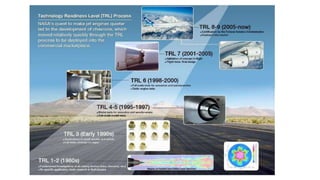
Technology Readiness Level (TRL)
• Technology readiness levels (TRLs) - Measurement of the maturity level of a particular
technology
• TRLs are based on a scale from 1 to 9, with 9 being the most mature technology.
• Systematic addressing of TRLs is required, allowing a technology to evolve from conception
through to research, development and deployment.
• Universities, along with government funding sources, focus on TRLs 1-4, while the private
sector focuses on TRLs 7-9.
• The term ‘Valley of Death’ represents the often neglected addressing of TRLs 4 through to
7, where neither academia nor the private sector prioritize investment.
Purpose of TRL
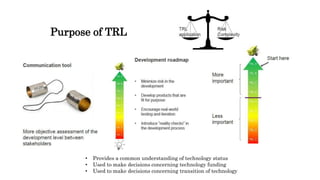
• Provides a common understanding of technology status
• Used to make decisions concerning technology funding
• Used to make decisions concerning transition of technology
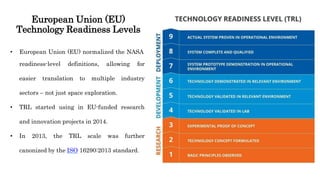
• European Union (EU) normalized the NASA
readiness-level definitions, allowing for
easier translation to multiple industry
sectors – not just space exploration.
• TRL started using in EU-funded research
and innovation projects in 2014.
• In 2013, the TRL scale was further
canonized by the ISO 16290:2013 standard.
European Union (EU)
Technology Readiness Levels
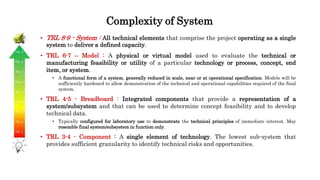
Complexity of System
• TRL 8-9 - System : All technical elements that comprise the project operating as a single
system to deliver a defined capacity.
• TRL 6-7 – Model : A physical or virtual model used to evaluate the technical or
manufacturing feasibility or utility of a particular technology or process, concept, end
item, or system.
• A functional form of a system, generally reduced in scale, near or at operational specification. Models will be
sufficiently hardened to allow demonstration of the technical and operational capabilities required of the final
system.
• TRL 4-5 - Breadboard : Integrated components that provide a representation of a
system/subsystem and that can be used to determine concept feasibility and to develop
technical data.
• Typically configured for laboratory use to demonstrate the technical principles of immediate interest. May
resemble final system/subsystem in function only.
• TRL 3-4 - Component : A single element of technology. The lowest sub-system that
provides sufficient granularity to identify technical risks and opportunities.
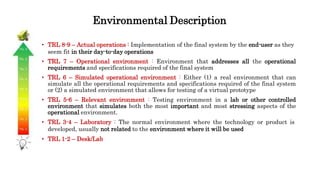
Environmental Description
• TRL 8-9 – Actual operations : Implementation of the final system by the end-user as they
seem fit in their day-to-day operations
• TRL 7 – Operational environment : Environment that addresses all the operational
requirements and specifications required of the final system
• TRL 6 – Simulated operational environment : Either (1) a real environment that can
simulate all the operational requirements and specifications required of the final system
or (2) a simulated environment that allows for testing of a virtual prototype
• TRL 5-6 – Relevant environment : Testing environment in a lab or other controlled
environment that simulates both the most important and most stressing aspects of the
operational environment.
• TRL 3-4 – Laboratory : The normal environment where the technology or product is
developed, usually not related to the environment where it will be used
• TRL 1-2 – Desk/Lab
Technology Readiness Level – Development Stages
TRL Description
Basic principles
observed
Technology concept
formulated
Example
• Scientific observations made and reported. Examples could include
paper-based studies of a technology’s basic properties.
• Envisioned applications are speculative at this stage. Examples are
often limited to analytical studies.
• Effective research and development initiated. Examples include
studies and laboratory measurements to validate analytical
predictions.
• Technology validated through designed investigation. Examples
might include analysis of the technology parameter operating range.
The results provide evidence that envisioned application performance
requirements might be attainable.
1
2
3
Experimental proof of
concept
4
Technology validated
in lab
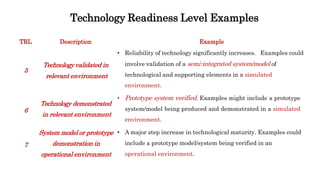
Technology Readiness Level Examples
TRL Description Example
• Reliability of technology significantly increases. Examples could
involve validation of a semi-integrated system/model of
technological and supporting elements in a simulated
environment.
• Prototype system verified. Examples might include a prototype
system/model being produced and demonstrated in a simulated
environment.
• A major step increase in technological maturity. Examples could
include a prototype model/system being verified in an
operational environment.
5
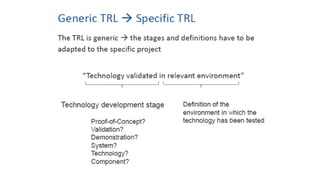
Technology validated in
relevant environment
6
Technology demonstrated
in relevant environment
7
System model or prototype
demonstration in
operational environment
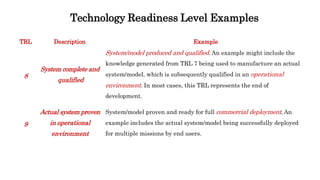
Technology Readiness Level Examples
TRL Description Example
System/model produced and qualified. An example might include the
knowledge generated from TRL 7 being used to manufacture an actual
system/model, which is subsequently qualified in an operational
environment. In most cases, this TRL represents the end of
development.
8
System complete and
qualified
9
Actual system proven
in operational
environment
System/model proven and ready for full commercial deployment. An
example includes the actual system/model being successfully deployed
for multiple missions by end users.
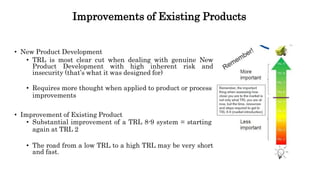
Improvements of Existing Products
• New Product Development
• TRL is most clear cut when dealing with genuine New
Product Development with high inherent risk and
insecurity (that’s what it was designed for)
• Requires more thought when applied to product or process
improvements
• Improvement of Existing Product
• Substantial improvement of a TRL 8-9 system = starting
again at TRL 2
• The road from a low TRL to a high TRL may be very short
and fast.
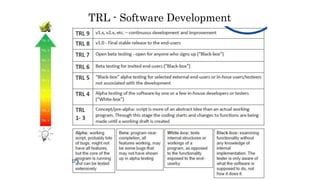
TRL - Software Development
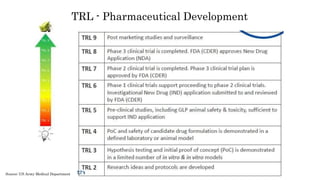
TRL - Pharmaceutical Development
Source: US Army Medical Department
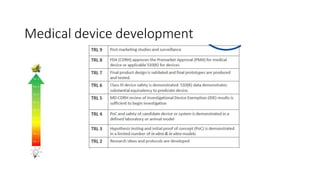
Medical device development
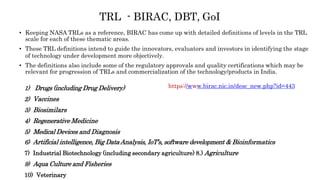
TRL - BIRAC, DBT, GoI
• Keeping NASA TRLs as a reference, BIRAC has come up with detailed definitions of levels in the TRL
scale for each of these thematic areas.
• These TRL definitions intend to guide the innovators, evaluators and investors in identifying the stage
of technology under development more objectively.
• The definitions also include some of the regulatory approvals and quality certifications which may be
relevant for progression of TRLs and commercialization of the technology/products in India.
1) Drugs (including Drug Delivery)
2) Vaccines
3) Biosimilars
4) Regenerative Medicine
5) Medical Devices and Diagnosis
6) Artificial intelligence, Big DataAnalysis, IoT’s, software development & Bioinformatics
7) Industrial Biotechnology (including secondary agriculture) 8.) Agriculture
9) Aqua Culture and Fisheries
10) Veterinary
https://www.birac.nic.in/desc_new.php?id=443

TRL technology readiness level of p.pptx

  • 1.
    Technology Readiness Level(TRL) • Technology readiness levels (TRLs) - Measurement of the maturity level of a particular technology • TRLs are based on a scale from 1 to 9, with 9 being the most mature technology. • Systematic addressing of TRLs is required, allowing a technology to evolve from conception through to research, development and deployment. • Universities, along with government funding sources, focus on TRLs 1-4, while the private sector focuses on TRLs 7-9. • The term ‘Valley of Death’ represents the often neglected addressing of TRLs 4 through to 7, where neither academia nor the private sector prioritize investment.
  • 2.
    Purpose of TRL •Provides a common understanding of technology status • Used to make decisions concerning technology funding • Used to make decisions concerning transition of technology
  • 3.
    • European Union(EU) normalized the NASA readiness-level definitions, allowing for easier translation to multiple industry sectors – not just space exploration. • TRL started using in EU-funded research and innovation projects in 2014. • In 2013, the TRL scale was further canonized by the ISO 16290:2013 standard. European Union (EU) Technology Readiness Levels
  • 5.
    Complexity of System •TRL 8-9 - System : All technical elements that comprise the project operating as a single system to deliver a defined capacity. • TRL 6-7 – Model : A physical or virtual model used to evaluate the technical or manufacturing feasibility or utility of a particular technology or process, concept, end item, or system. • A functional form of a system, generally reduced in scale, near or at operational specification. Models will be sufficiently hardened to allow demonstration of the technical and operational capabilities required of the final system. • TRL 4-5 - Breadboard : Integrated components that provide a representation of a system/subsystem and that can be used to determine concept feasibility and to develop technical data. • Typically configured for laboratory use to demonstrate the technical principles of immediate interest. May resemble final system/subsystem in function only. • TRL 3-4 - Component : A single element of technology. The lowest sub-system that provides sufficient granularity to identify technical risks and opportunities.
  • 6.
    Environmental Description • TRL8-9 – Actual operations : Implementation of the final system by the end-user as they seem fit in their day-to-day operations • TRL 7 – Operational environment : Environment that addresses all the operational requirements and specifications required of the final system • TRL 6 – Simulated operational environment : Either (1) a real environment that can simulate all the operational requirements and specifications required of the final system or (2) a simulated environment that allows for testing of a virtual prototype • TRL 5-6 – Relevant environment : Testing environment in a lab or other controlled environment that simulates both the most important and most stressing aspects of the operational environment. • TRL 3-4 – Laboratory : The normal environment where the technology or product is developed, usually not related to the environment where it will be used • TRL 1-2 – Desk/Lab
  • 7.
    Technology Readiness Level– Development Stages TRL Description Basic principles observed Technology concept formulated Example • Scientific observations made and reported. Examples could include paper-based studies of a technology’s basic properties. • Envisioned applications are speculative at this stage. Examples are often limited to analytical studies. • Effective research and development initiated. Examples include studies and laboratory measurements to validate analytical predictions. • Technology validated through designed investigation. Examples might include analysis of the technology parameter operating range. The results provide evidence that envisioned application performance requirements might be attainable. 1 2 3 Experimental proof of concept 4 Technology validated in lab
  • 8.
    Technology Readiness LevelExamples TRL Description Example • Reliability of technology significantly increases. Examples could involve validation of a semi-integrated system/model of technological and supporting elements in a simulated environment. • Prototype system verified. Examples might include a prototype system/model being produced and demonstrated in a simulated environment. • A major step increase in technological maturity. Examples could include a prototype model/system being verified in an operational environment. 5 Technology validated in relevant environment 6 Technology demonstrated in relevant environment 7 System model or prototype demonstration in operational environment
  • 9.
    Technology Readiness LevelExamples TRL Description Example System/model produced and qualified. An example might include the knowledge generated from TRL 7 being used to manufacture an actual system/model, which is subsequently qualified in an operational environment. In most cases, this TRL represents the end of development. 8 System complete and qualified 9 Actual system proven in operational environment System/model proven and ready for full commercial deployment. An example includes the actual system/model being successfully deployed for multiple missions by end users.
  • 12.
    Improvements of ExistingProducts • New Product Development • TRL is most clear cut when dealing with genuine New Product Development with high inherent risk and insecurity (that’s what it was designed for) • Requires more thought when applied to product or process improvements • Improvement of Existing Product • Substantial improvement of a TRL 8-9 system = starting again at TRL 2 • The road from a low TRL to a high TRL may be very short and fast.
  • 13.
    TRL - SoftwareDevelopment
  • 14.
    TRL - PharmaceuticalDevelopment Source: US Army Medical Department
  • 15.
  • 16.
    TRL - BIRAC,DBT, GoI • Keeping NASA TRLs as a reference, BIRAC has come up with detailed definitions of levels in the TRL scale for each of these thematic areas. • These TRL definitions intend to guide the innovators, evaluators and investors in identifying the stage of technology under development more objectively. • The definitions also include some of the regulatory approvals and quality certifications which may be relevant for progression of TRLs and commercialization of the technology/products in India. 1) Drugs (including Drug Delivery) 2) Vaccines 3) Biosimilars 4) Regenerative Medicine 5) Medical Devices and Diagnosis 6) Artificial intelligence, Big DataAnalysis, IoT’s, software development & Bioinformatics 7) Industrial Biotechnology (including secondary agriculture) 8.) Agriculture 9) Aqua Culture and Fisheries 10) Veterinary https://www.birac.nic.in/desc_new.php?id=443