Understanding Technology Readiness Level (TRL)
& Monetizing Your Research
1
Dr. Alok Nikhil Jha
Tech Transfer & Resource Generation
http://linkedin.com/in/aloknikhil
Questions …
 What is the relevance of your Research or Projects?
 What is the outcome and future of your research projects, Ideas?
 Is your research industry friendly or can we take your ideas to
industry/companies?
 Can it be used for any other similar areas/domains?
 Is it worth filing a patent?
 When is the right time to think of building a venture from your tech
ideas?
How can we make our research more valuable?
Actually implementing it, making a prototype, or MVP …
Publications and patents
Starting a Company or
Let some one else use my idea to start a company
Let a company use my idea to build products/projects
Technology Transfer and Research Commercialization
Questions
o How to we determine when a research solution is ready to help an
industry to solve a challenge?
o When should it go from the lab to the field testing?
o How do you currently assess the maturity of a technology or
innovation within your organization?
o When a research is appropriate for commercialization?
o When it is ready for full implementation?
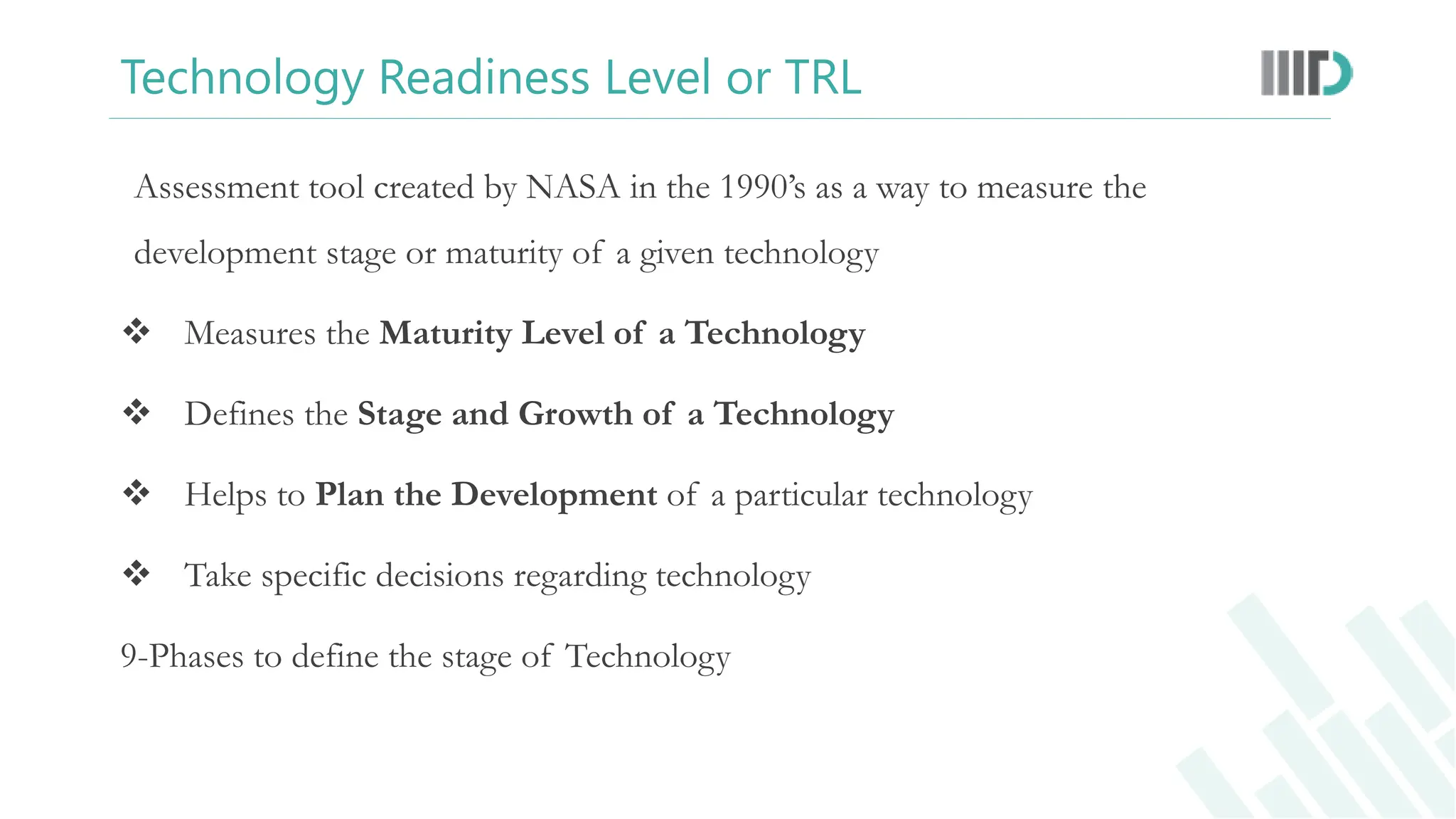
Technology Readiness Level or TRL
Assessment tool created by NASA in the 1990’s as a way to measure the
development stage or maturity of a given technology
 Measures the Maturity Level of a Technology
 Defines the Stage and Growth of a Technology
 Helps to Plan the Development of a particular technology
 Take specific decisions regarding technology
9-Phases to define the stage of Technology
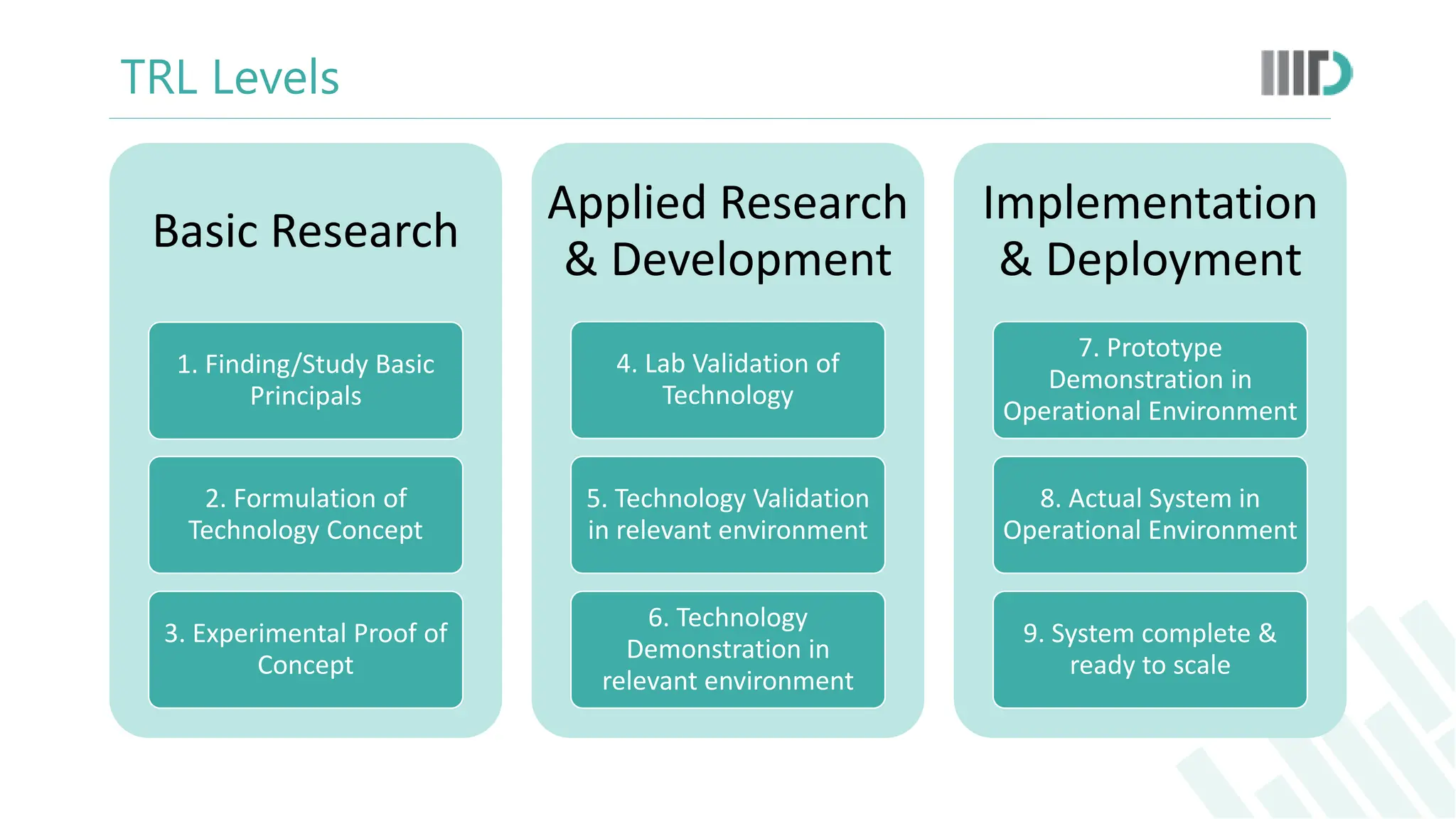
TRL Levels
Basic Research
1. Finding/Study Basic
Principals
2. Formulation of
Technology Concept
3. Experimental Proof of
Concept
Applied Research
& Development
4. Lab Validation of
Technology
5. Technology Validation
in relevant environment
6. Technology
Demonstration in
relevant environment
Implementation
& Deployment
7. Prototype
Demonstration in
Operational Environment
8. Actual System in
Operational Environment
9. System complete &
ready to scale
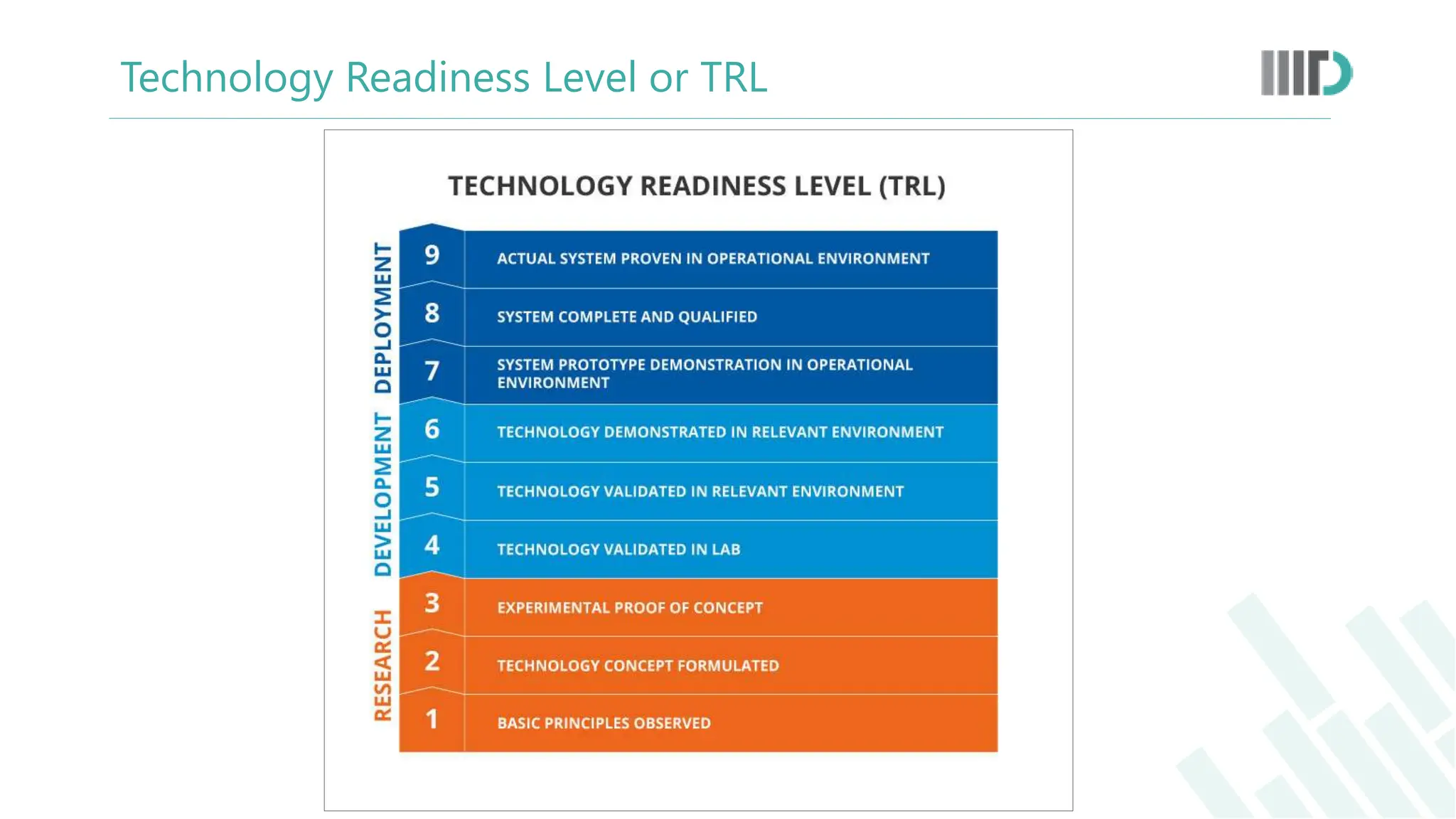
Technology Readiness Level or TRL
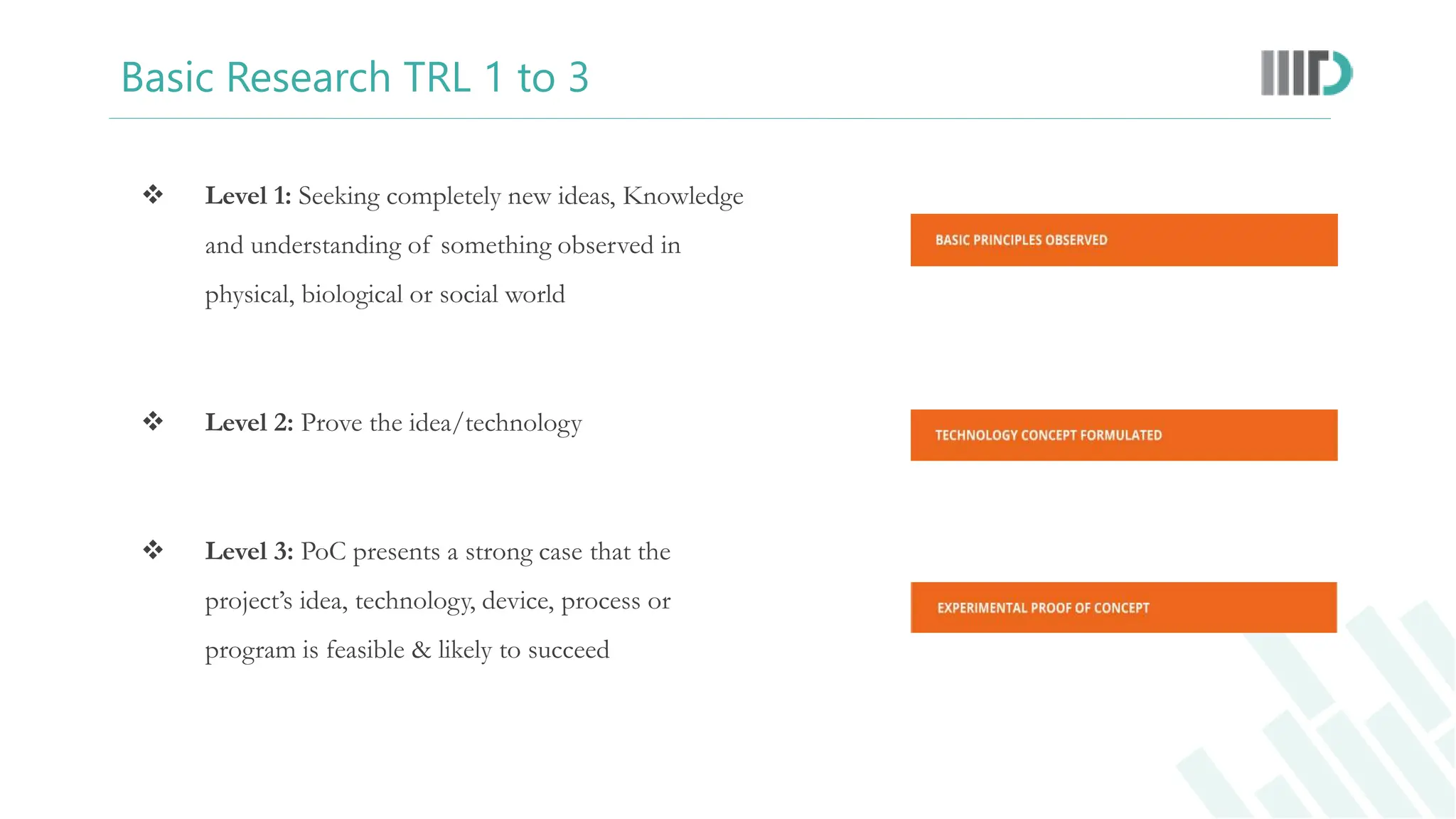
Basic Research TRL 1 to 3
 Level 1: Seeking completely new ideas, Knowledge
and understanding of something observed in
physical, biological or social world
 Level 2: Prove the idea/technology
 Level 3: PoC presents a strong case that the
project’s idea, technology, device, process or
program is feasible & likely to succeed
TRL 1: Basic Principals Observed
1. Lowest level of technology readiness, Basic research
2. Scientific research begins to be translated into applied research and development (R&D)
3. Scientific knowledge generated
4. Literature studies
Examples –
1. Paper studies of a technology’s basic properties,
2. Study of observation of physical world systems
3. Development of basic use case, basic properties of software architecture
4. Mathematical formulations, and general algorithms
TRL 2: Technology concept formulated
1. Invention stage, applied research activities
2. Focus more toward solving specific problems
3. Potential system applications are identified,
4. Applications are speculative, there may be no proof or detailed analysis to support assumptions
Examples –
1. Experimental work to corroborate scientific observations
2. Research studies and experiments and analysis
3. Analytical studies, publications
TRL 3: Experimental Proof of Concept
Work has moved beyond the paper phase to experimental phase to verify the concept works as expected on
simulants
1. Active R&D is initiated, explore scientific feasibility
2. Includes analytical studies and laboratory-scale studies to physically validate the analytical predictions of
elements
3. Development of limited functionality to validate critical properties and predictions
4. Components of the technology are validated individually
5. PoC presents a strong case that the project’s idea, technology, device, process or program is feasible &
likely to succeed
6. First assessment of concept through actual research assessing technical and market feasibility
Examples –
1. Modeling and simulations
2. Research studies and experiments and analytical Publications
3. Basic PoC
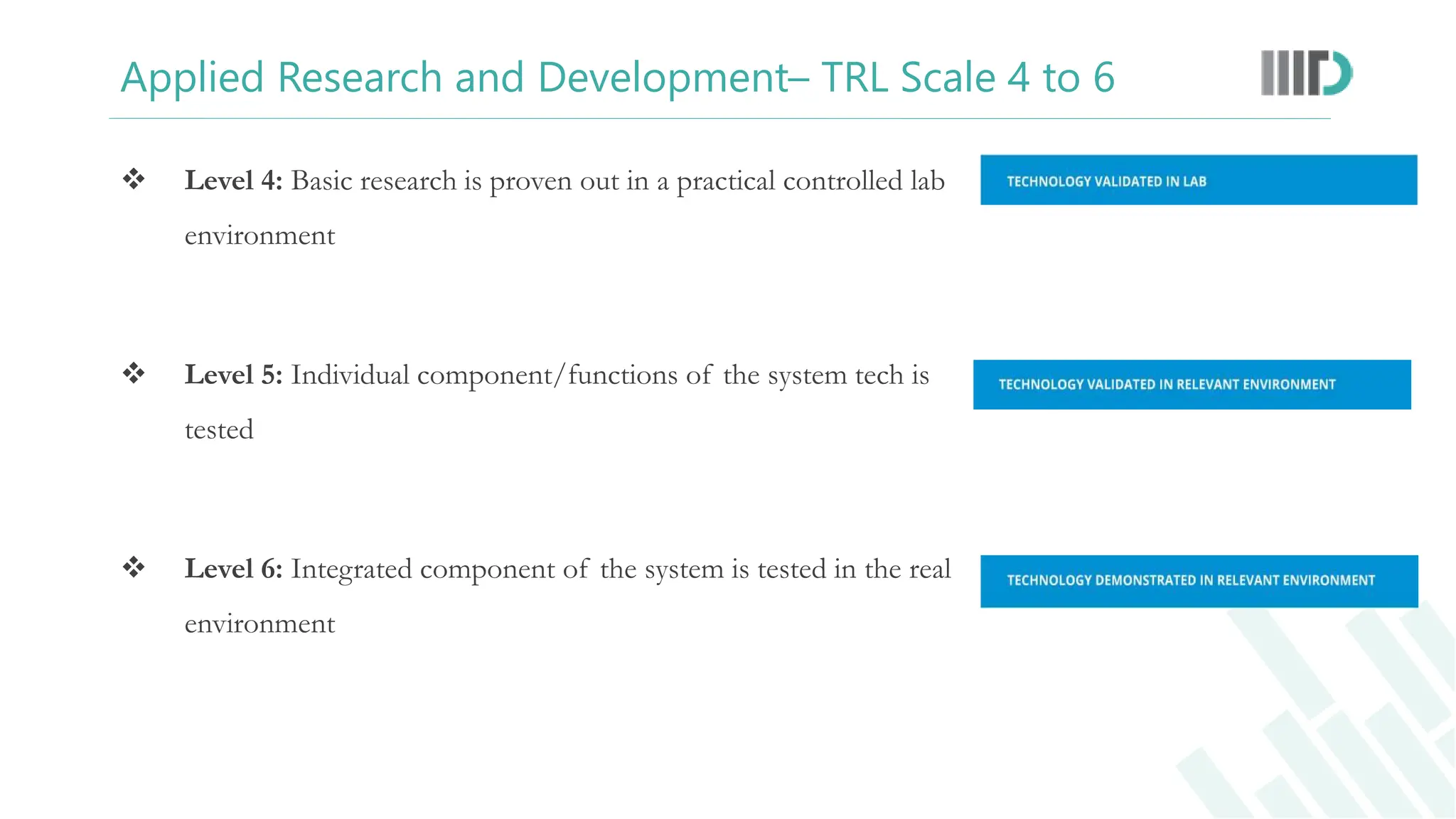
Applied Research and Development– TRL Scale 4 to 6
 Level 4: Basic research is proven out in a practical controlled lab
environment
 Level 5: Individual component/functions of the system tech is
tested
 Level 6: Integrated component of the system is tested in the real
environment
TRL 4: Technology Component Validation in Lab
TRL 4 is the first step in determining whether the individual components will work together as a
system
1. Lab-scale demonstration (“low fidelity”) proving basic research
2. Basic technological components are integrated to establish that they will work together
3. A primitive form with regard to efficiency and robustness
Examples/Outcomes –
1. Prototypes developed to demonstrate basic functionalities
2. A product implementation plan document, with components identification
3. A breadboard based prototype
TRL 5: Technology Component Validation in Environment
At TRL 5 we determine whether our technology works when components integrated in simulated
setting
1. Basic technological components are integrated to establish that they will work together in
simulated operational environment
2. Increased fidelity of the system
3. Technology prototype implementations conform to target environment
Examples/Outcomes –
1. A brass board based prototype
2. Algorithms running on processor with realistic characteristics
3. Ascertain behavior in expected operational environment
4. Find the behavior of test results and expectations and evaluate problems and refinements
TRL 6: Technology Demonstration in Relevant Environment
TRL 6 begins true engineering development of the technology as an operational
system
1. System integrated with support elements, and prototype design is created
2. Prototype system is tested in a relevant environment
3. Ensure prototype is able to fulfill all functions required in operational system
Examples/Outcomes –
1. Prototypes developed to demonstrate different aspects of eventual system.
2. Software demonstrated on realistic problems
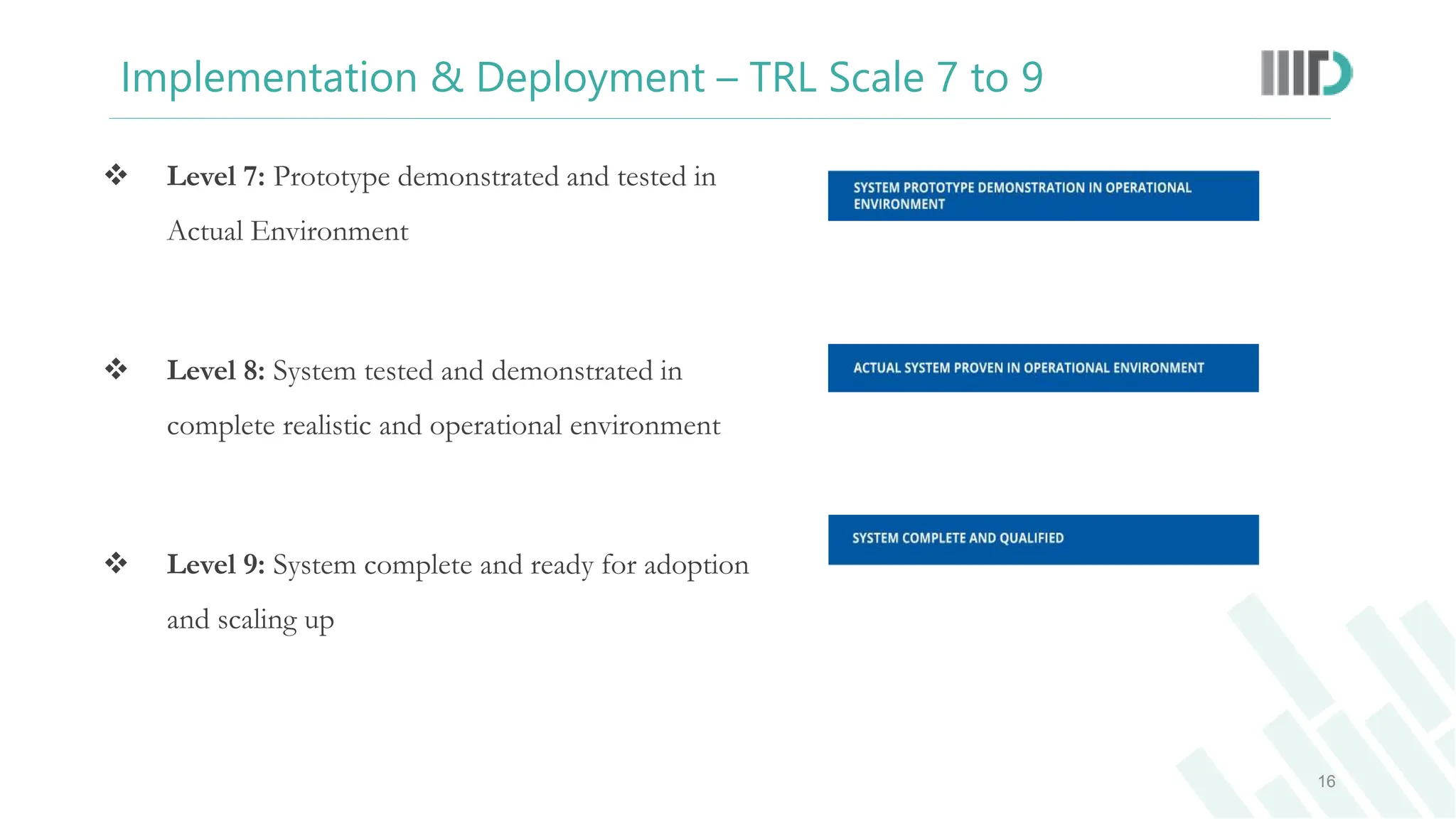
 Level 7: Prototype demonstrated and tested in
Actual Environment
 Level 8: System tested and demonstrated in
complete realistic and operational environment
 Level 9: System complete and ready for adoption
and scaling up
16
Implementation & Deployment – TRL Scale 7 to 9
At TRL 7 demonstration of system/technology is performed
1. Demonstration of an actual system prototype in a real operational environment
2. Prototype system is tested in a relevant environment
3. Ensure prototype is able to fulfill all functions required in operational system
Examples/Outcomes –
1. Full scale prototype deployment in real scenario
2. Testing and analysis of the technology
3. Final design ascertained based on feedback in operational environments
17
TRL 7: Prototype Demonstration in Operational Environment
TRL 8: Actual System Proven in Operational Environment
TRL 8 represents end of true system development
1. Technology has been proven to work in its final form and under expected conditions
2. All functionality tested in simulated and operational scenarios
3. We ensure system components form and function-compatible with each other and with the
operational environment
Examples/Outcomes –
1. Completion of software application with all documents – training, maintenance etc
2. Hardware product is ready to be scaled
TRL 9: System Complete and Qualified
1. Actual application of the technology in its final form and ready to scale
2. System fully operational
3. Technology ready for adoption or large scale deployment based on operational scenarios
Example
 An R&D group in a company developed the design and built a prototype of a new car
engine for unmanned cars.
 It has been through a set of comprehensive lab tests, which provide excellent results in
terms of system performance.
 What technology readiness level can be assigned to this development?
 TRL 2
 TRL 4
 TRL 6
 TRL 8
 TRL 6
Example
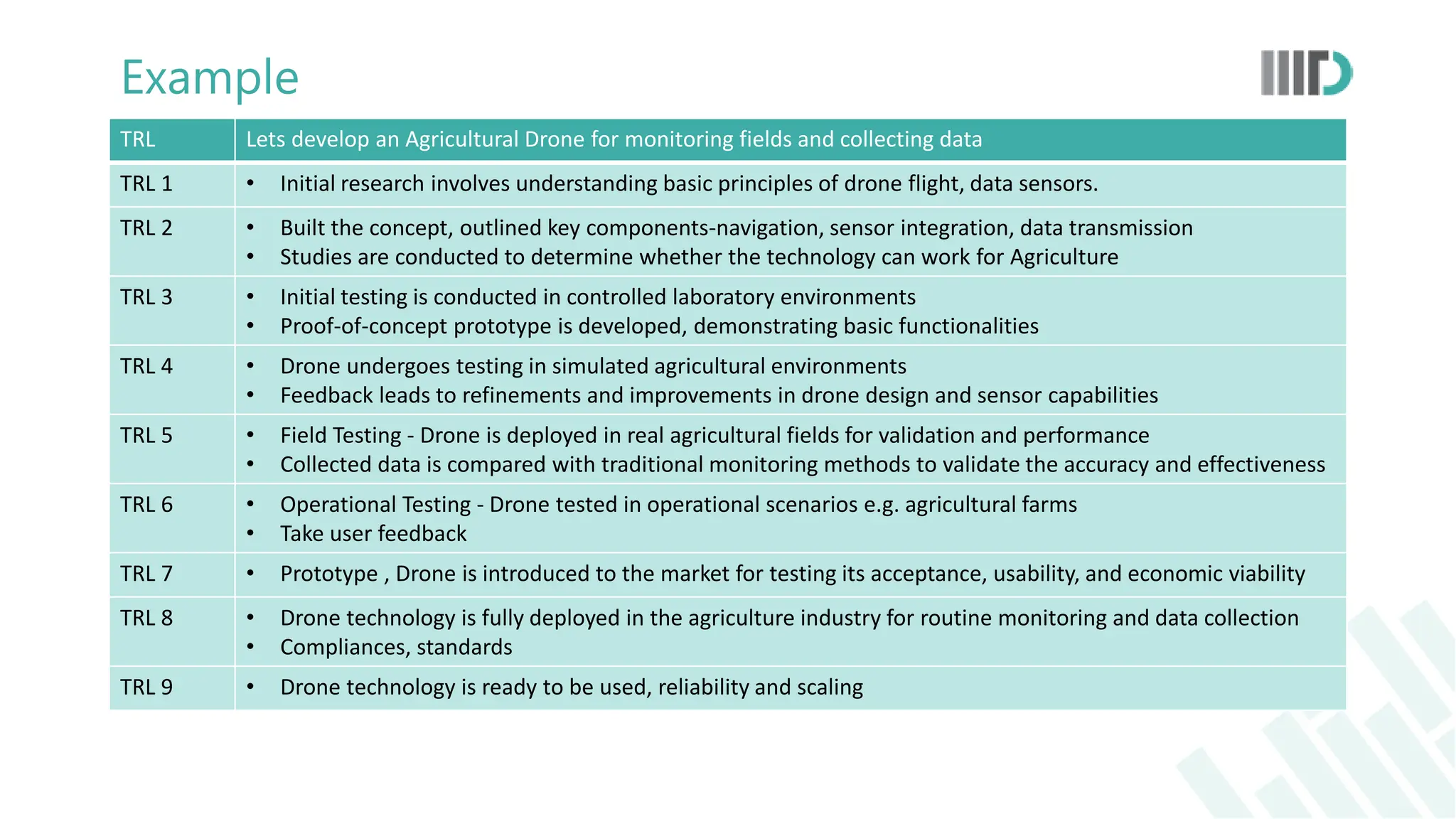
TRL Lets develop an Agricultural Drone for monitoring fields and collecting data
TRL 1 • Initial research involves understanding basic principles of drone flight, data sensors.
TRL 2 • Built the concept, outlined key components-navigation, sensor integration, data transmission
• Studies are conducted to determine whether the technology can work for Agriculture
TRL 3 • Initial testing is conducted in controlled laboratory environments
• Proof-of-concept prototype is developed, demonstrating basic functionalities
TRL 4 • Drone undergoes testing in simulated agricultural environments
• Feedback leads to refinements and improvements in drone design and sensor capabilities
TRL 5 • Field Testing - Drone is deployed in real agricultural fields for validation and performance
• Collected data is compared with traditional monitoring methods to validate the accuracy and effectiveness
TRL 6 • Operational Testing - Drone tested in operational scenarios e.g. agricultural farms
• Take user feedback
TRL 7 • Prototype , Drone is introduced to the market for testing its acceptance, usability, and economic viability
TRL 8 • Drone technology is fully deployed in the agriculture industry for routine monitoring and data collection
• Compliances, standards
TRL 9 • Drone technology is ready to be used, reliability and scaling
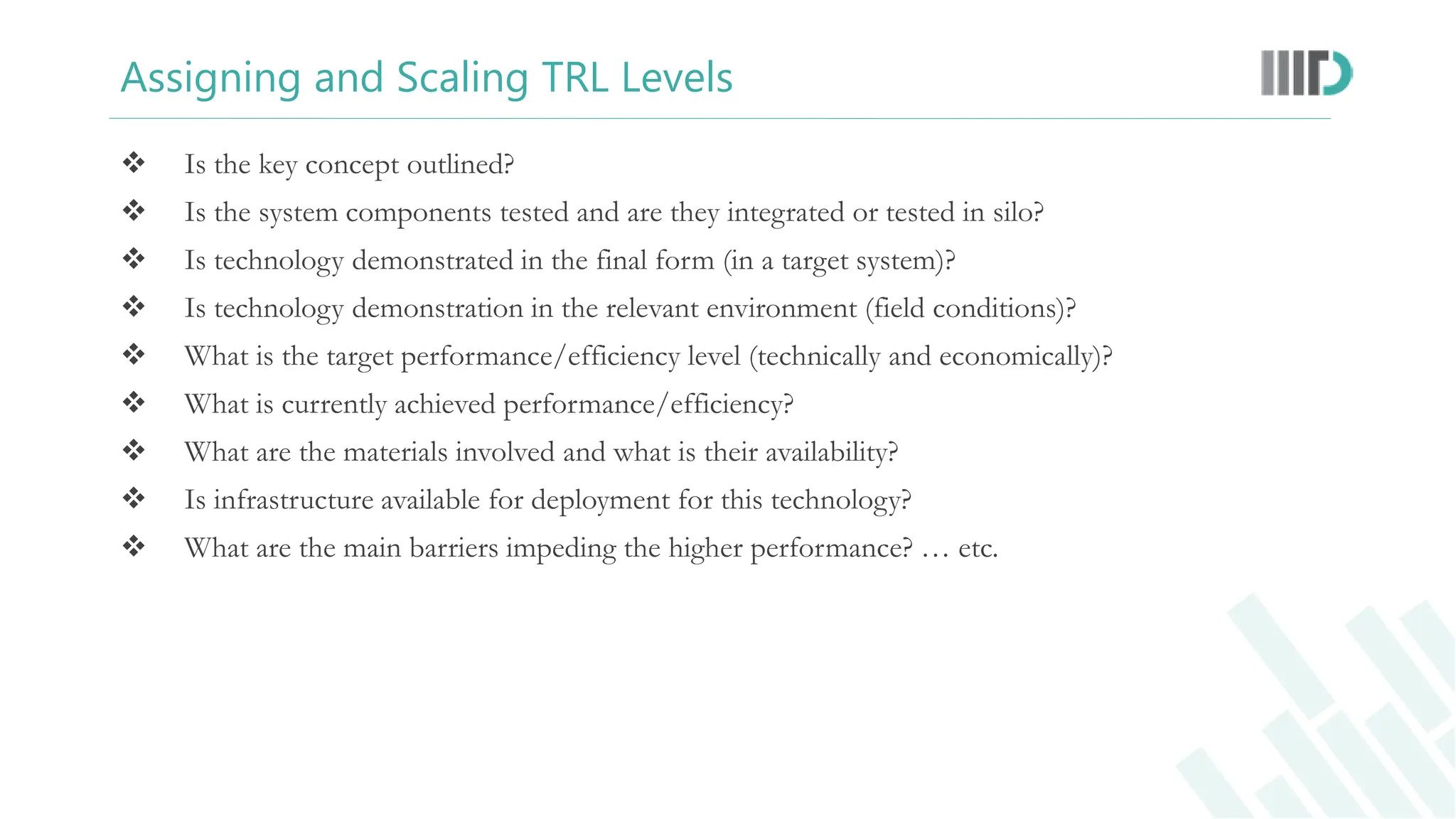
Assigning and Scaling TRL Levels
 Is the key concept outlined?
 Is the system components tested and are they integrated or tested in silo?
 Is technology demonstrated in the final form (in a target system)?
 Is technology demonstration in the relevant environment (field conditions)?
 What is the target performance/efficiency level (technically and economically)?
 What is currently achieved performance/efficiency?
 What are the materials involved and what is their availability?
 Is infrastructure available for deployment for this technology?
 What are the main barriers impeding the higher performance? … etc.
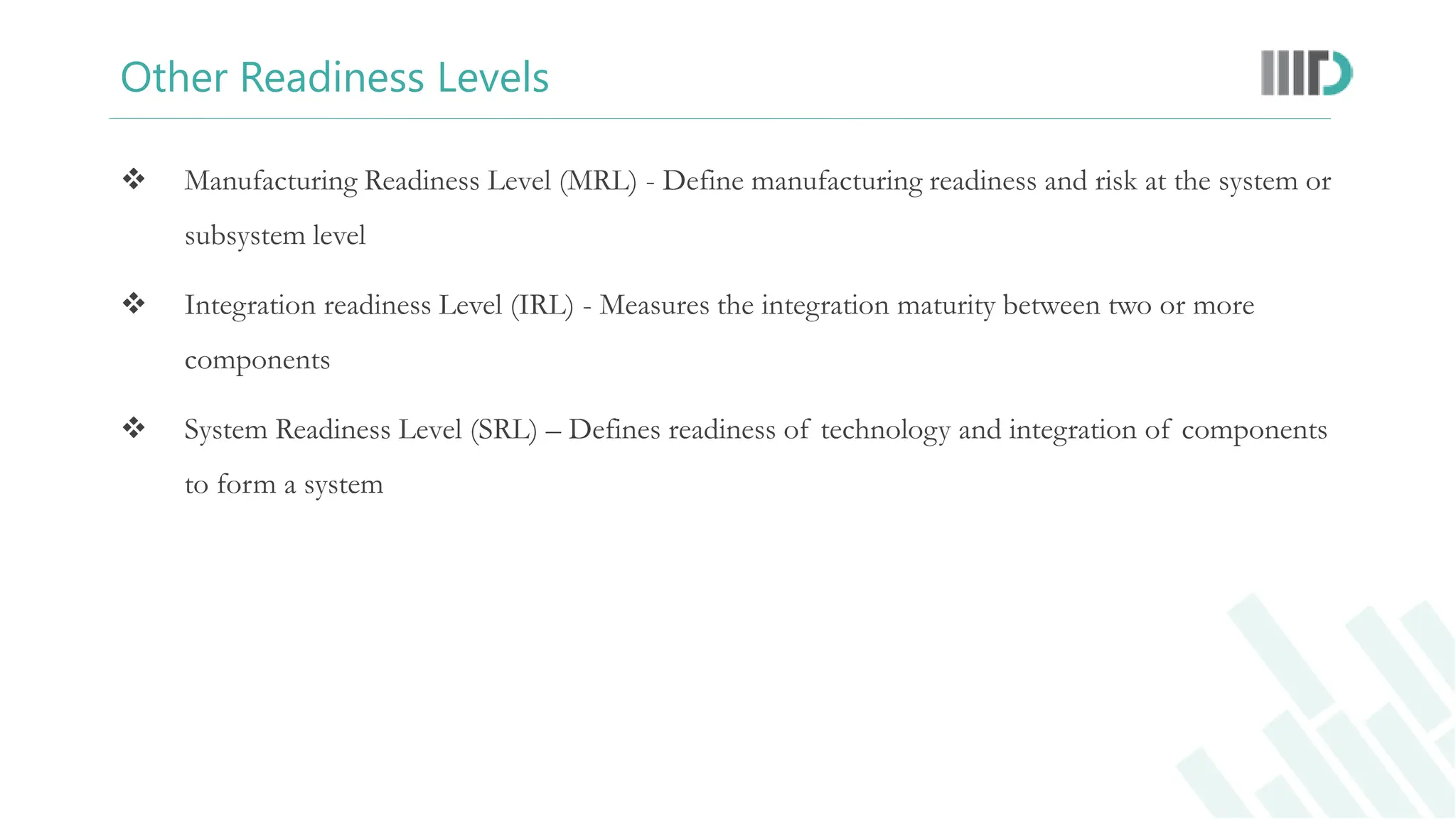
Other Readiness Levels
 Manufacturing Readiness Level (MRL) - Define manufacturing readiness and risk at the system or
subsystem level
 Integration readiness Level (IRL) - Measures the integration maturity between two or more
components
 System Readiness Level (SRL) – Defines readiness of technology and integration of components
to form a system
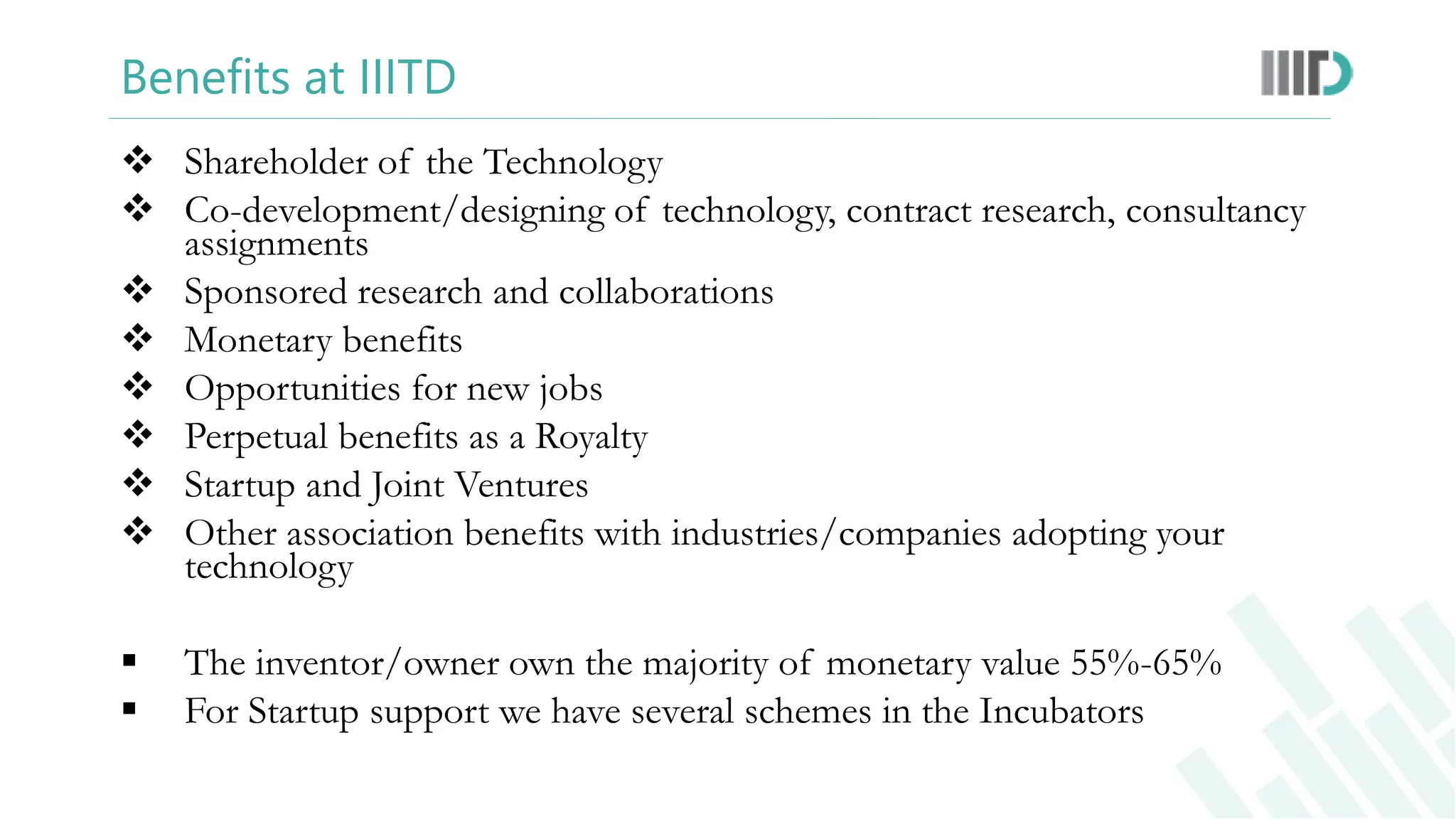
Benefits at IIITD
 Shareholder of the Technology
 Co-development/designing of technology, contract research, consultancy
assignments
 Sponsored research and collaborations
 Monetary benefits
 Opportunities for new jobs
 Perpetual benefits as a Royalty
 Startup and Joint Ventures
 Other association benefits with industries/companies adopting your
technology
 The inventor/owner own the majority of monetary value 55%-65%
 For Startup support we have several schemes in the Incubators
Share Your Ongoing Research
http://tiny.cc/techtr
Thank You
Schedule a Meeting today to discuss more on Technology
Commercialization, IPR & Patent Support, and Starting your Startup..
Visit http://tiny.cc/trcontact or Scan QR

Understanding Technology Readiness Levels (TRL)

  • 1.
    Understanding Technology ReadinessLevel (TRL) & Monetizing Your Research 1 Dr. Alok Nikhil Jha Tech Transfer & Resource Generation http://linkedin.com/in/aloknikhil
  • 2.
    Questions …  Whatis the relevance of your Research or Projects?  What is the outcome and future of your research projects, Ideas?  Is your research industry friendly or can we take your ideas to industry/companies?  Can it be used for any other similar areas/domains?  Is it worth filing a patent?  When is the right time to think of building a venture from your tech ideas?
  • 3.
    How can wemake our research more valuable? Actually implementing it, making a prototype, or MVP … Publications and patents Starting a Company or Let some one else use my idea to start a company Let a company use my idea to build products/projects Technology Transfer and Research Commercialization
  • 4.
    Questions o How towe determine when a research solution is ready to help an industry to solve a challenge? o When should it go from the lab to the field testing? o How do you currently assess the maturity of a technology or innovation within your organization? o When a research is appropriate for commercialization? o When it is ready for full implementation?
  • 5.
    Technology Readiness Levelor TRL Assessment tool created by NASA in the 1990’s as a way to measure the development stage or maturity of a given technology  Measures the Maturity Level of a Technology  Defines the Stage and Growth of a Technology  Helps to Plan the Development of a particular technology  Take specific decisions regarding technology 9-Phases to define the stage of Technology
  • 6.
    TRL Levels Basic Research 1.Finding/Study Basic Principals 2. Formulation of Technology Concept 3. Experimental Proof of Concept Applied Research & Development 4. Lab Validation of Technology 5. Technology Validation in relevant environment 6. Technology Demonstration in relevant environment Implementation & Deployment 7. Prototype Demonstration in Operational Environment 8. Actual System in Operational Environment 9. System complete & ready to scale
  • 7.
  • 8.
    Basic Research TRL1 to 3  Level 1: Seeking completely new ideas, Knowledge and understanding of something observed in physical, biological or social world  Level 2: Prove the idea/technology  Level 3: PoC presents a strong case that the project’s idea, technology, device, process or program is feasible & likely to succeed
  • 9.
    TRL 1: BasicPrincipals Observed 1. Lowest level of technology readiness, Basic research 2. Scientific research begins to be translated into applied research and development (R&D) 3. Scientific knowledge generated 4. Literature studies Examples – 1. Paper studies of a technology’s basic properties, 2. Study of observation of physical world systems 3. Development of basic use case, basic properties of software architecture 4. Mathematical formulations, and general algorithms
  • 10.
    TRL 2: Technologyconcept formulated 1. Invention stage, applied research activities 2. Focus more toward solving specific problems 3. Potential system applications are identified, 4. Applications are speculative, there may be no proof or detailed analysis to support assumptions Examples – 1. Experimental work to corroborate scientific observations 2. Research studies and experiments and analysis 3. Analytical studies, publications
  • 11.
    TRL 3: ExperimentalProof of Concept Work has moved beyond the paper phase to experimental phase to verify the concept works as expected on simulants 1. Active R&D is initiated, explore scientific feasibility 2. Includes analytical studies and laboratory-scale studies to physically validate the analytical predictions of elements 3. Development of limited functionality to validate critical properties and predictions 4. Components of the technology are validated individually 5. PoC presents a strong case that the project’s idea, technology, device, process or program is feasible & likely to succeed 6. First assessment of concept through actual research assessing technical and market feasibility Examples – 1. Modeling and simulations 2. Research studies and experiments and analytical Publications 3. Basic PoC
  • 12.
    Applied Research andDevelopment– TRL Scale 4 to 6  Level 4: Basic research is proven out in a practical controlled lab environment  Level 5: Individual component/functions of the system tech is tested  Level 6: Integrated component of the system is tested in the real environment
  • 13.
    TRL 4: TechnologyComponent Validation in Lab TRL 4 is the first step in determining whether the individual components will work together as a system 1. Lab-scale demonstration (“low fidelity”) proving basic research 2. Basic technological components are integrated to establish that they will work together 3. A primitive form with regard to efficiency and robustness Examples/Outcomes – 1. Prototypes developed to demonstrate basic functionalities 2. A product implementation plan document, with components identification 3. A breadboard based prototype
  • 14.
    TRL 5: TechnologyComponent Validation in Environment At TRL 5 we determine whether our technology works when components integrated in simulated setting 1. Basic technological components are integrated to establish that they will work together in simulated operational environment 2. Increased fidelity of the system 3. Technology prototype implementations conform to target environment Examples/Outcomes – 1. A brass board based prototype 2. Algorithms running on processor with realistic characteristics 3. Ascertain behavior in expected operational environment 4. Find the behavior of test results and expectations and evaluate problems and refinements
  • 15.
    TRL 6: TechnologyDemonstration in Relevant Environment TRL 6 begins true engineering development of the technology as an operational system 1. System integrated with support elements, and prototype design is created 2. Prototype system is tested in a relevant environment 3. Ensure prototype is able to fulfill all functions required in operational system Examples/Outcomes – 1. Prototypes developed to demonstrate different aspects of eventual system. 2. Software demonstrated on realistic problems
  • 16.
     Level 7:Prototype demonstrated and tested in Actual Environment  Level 8: System tested and demonstrated in complete realistic and operational environment  Level 9: System complete and ready for adoption and scaling up 16 Implementation & Deployment – TRL Scale 7 to 9
  • 17.
    At TRL 7demonstration of system/technology is performed 1. Demonstration of an actual system prototype in a real operational environment 2. Prototype system is tested in a relevant environment 3. Ensure prototype is able to fulfill all functions required in operational system Examples/Outcomes – 1. Full scale prototype deployment in real scenario 2. Testing and analysis of the technology 3. Final design ascertained based on feedback in operational environments 17 TRL 7: Prototype Demonstration in Operational Environment
  • 18.
    TRL 8: ActualSystem Proven in Operational Environment TRL 8 represents end of true system development 1. Technology has been proven to work in its final form and under expected conditions 2. All functionality tested in simulated and operational scenarios 3. We ensure system components form and function-compatible with each other and with the operational environment Examples/Outcomes – 1. Completion of software application with all documents – training, maintenance etc 2. Hardware product is ready to be scaled
  • 19.
    TRL 9: SystemComplete and Qualified 1. Actual application of the technology in its final form and ready to scale 2. System fully operational 3. Technology ready for adoption or large scale deployment based on operational scenarios
  • 20.
    Example  An R&Dgroup in a company developed the design and built a prototype of a new car engine for unmanned cars.  It has been through a set of comprehensive lab tests, which provide excellent results in terms of system performance.  What technology readiness level can be assigned to this development?  TRL 2  TRL 4  TRL 6  TRL 8  TRL 6
  • 21.
    Example TRL Lets developan Agricultural Drone for monitoring fields and collecting data TRL 1 • Initial research involves understanding basic principles of drone flight, data sensors. TRL 2 • Built the concept, outlined key components-navigation, sensor integration, data transmission • Studies are conducted to determine whether the technology can work for Agriculture TRL 3 • Initial testing is conducted in controlled laboratory environments • Proof-of-concept prototype is developed, demonstrating basic functionalities TRL 4 • Drone undergoes testing in simulated agricultural environments • Feedback leads to refinements and improvements in drone design and sensor capabilities TRL 5 • Field Testing - Drone is deployed in real agricultural fields for validation and performance • Collected data is compared with traditional monitoring methods to validate the accuracy and effectiveness TRL 6 • Operational Testing - Drone tested in operational scenarios e.g. agricultural farms • Take user feedback TRL 7 • Prototype , Drone is introduced to the market for testing its acceptance, usability, and economic viability TRL 8 • Drone technology is fully deployed in the agriculture industry for routine monitoring and data collection • Compliances, standards TRL 9 • Drone technology is ready to be used, reliability and scaling
  • 22.
    Assigning and ScalingTRL Levels  Is the key concept outlined?  Is the system components tested and are they integrated or tested in silo?  Is technology demonstrated in the final form (in a target system)?  Is technology demonstration in the relevant environment (field conditions)?  What is the target performance/efficiency level (technically and economically)?  What is currently achieved performance/efficiency?  What are the materials involved and what is their availability?  Is infrastructure available for deployment for this technology?  What are the main barriers impeding the higher performance? … etc.
  • 23.
    Other Readiness Levels Manufacturing Readiness Level (MRL) - Define manufacturing readiness and risk at the system or subsystem level  Integration readiness Level (IRL) - Measures the integration maturity between two or more components  System Readiness Level (SRL) – Defines readiness of technology and integration of components to form a system
  • 24.
    Benefits at IIITD Shareholder of the Technology  Co-development/designing of technology, contract research, consultancy assignments  Sponsored research and collaborations  Monetary benefits  Opportunities for new jobs  Perpetual benefits as a Royalty  Startup and Joint Ventures  Other association benefits with industries/companies adopting your technology  The inventor/owner own the majority of monetary value 55%-65%  For Startup support we have several schemes in the Incubators
  • 25.
    Share Your OngoingResearch http://tiny.cc/techtr
  • 26.
    Thank You Schedule aMeeting today to discuss more on Technology Commercialization, IPR & Patent Support, and Starting your Startup.. Visit http://tiny.cc/trcontact or Scan QR