MAHARSHI DAYANAND UNIVERSITY
Rohtak
DEPARTMENT OF PHARMACEUTICAL SCIENCES
“Triphenylmethane & its derivative”
Triphenylmethane
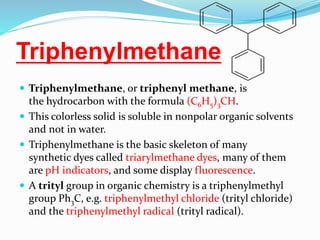
 Triphenylmethane, or triphenyl methane, is
the hydrocarbon with the formula (C6H5)3CH.
 This colorless solid is soluble in nonpolar organic solvents
and not in water.
 Triphenylmethane is the basic skeleton of many
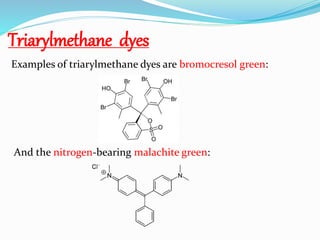
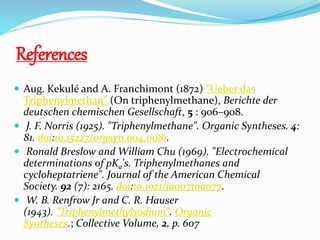
synthetic dyes called triarylmethane dyes, many of them
are pH indicators, and some display fluorescence.
 A trityl group in organic chemistry is a triphenylmethyl
group Ph3C, e.g. triphenylmethyl chloride (trityl chloride)
and the triphenylmethyl radical (trityl radical).
Properties
 Chemical formula
 Molar mass
 Density
 Melting point
 Boiling point
 Solubility in water
 Solubility
 Acidity
 C19H16
 244.337 g·mol−1Appearance
Colorless solid
 1.014 g/cm3
 92 to 94 °C (198 to 201 °F;
365 to 367 K)
 359 °C (678 °F; 632 K)
 Insoluble
 soluble in dioxane and
hexane
 (pKa)33.3
Preparation
 Heating diphenylmercury Hg(C6H5)2 with benzal chloride C6H5CHCl2
Triphenylmethane can be synthesized by Friedel-Crafts
reaction from benzene and chloroform with aluminium
chloride catalyst:
3 C6H6 + CHCl3 → Ph3CH + 3 HCl
 Alternatively, benzene may react with carbon tetrachloride using the
same catalyst to obtain the trityl chloride-aluminium chloride adduct,
which is hydrolyzed with dilute acid:
3 C6H6 + CCl4 + AlCl3 → Ph3CCl·AlCl3Ph3CCl·AlCl3 + HCl → Ph3CH
 Synthesis from benzylidene chloride, prepared
from benzaldehyde and phosphorus pentachloride, is used as
well.
Acidity
 The pKa is 33.3. Triphenylmethane is significantly more acidic than most
other hydrocarbons because the charge is delocalized over three phenyl
rings. Steric effects however prevent all three phenyl rings from
achieving coplanarity simultaneously. Consequently diphenylmethane is
even more acidic, because in its anion the charge is spread over two
phenyl rings at the same time. The trityl anion is red. This colour can be
used as an indicator in acid-base titrations.
The sodium salt can be prepared also from the chloride:
(C6H5)3CCl + 2 Na → (C6H5)3CNa + NaCl
 The use of tritylsodium as a strong, non-nucleophilic base has been
eclipsed by the popularization of butyllithium and related strong
bases.
Triarylmethane dyes
Examples of triarylmethane dyes are bromocresol green:
And the nitrogen-bearing malachite green:
References
 Aug. Kekulé and A. Franchimont (1872) "Ueber das
Triphenylmethan" (On triphenylmethane), Berichte der
deutschen chemischen Gesellschaft, 5 : 906–908.
 J. F. Norris (1925). "Triphenylmethane". Organic Syntheses. 4:
81. doi:10.15227/orgsyn.004.0081.
 Ronald Breslow and William Chu (1969). "Electrochemical
determinations of pKa's. Triphenylmethanes and
cycloheptatriene". Journal of the American Chemical
Society. 92 (7): 2165. doi:10.1021/ja00710a077.
 W. B. Renfrow Jr and C. R. Hauser
(1943). "Triphenylmethylsodium“. Organic
Syntheses.; Collective Volume, 2, p. 607
THANK YOU

Triphenylmethane and derivatives

  • 1.
    MAHARSHI DAYANAND UNIVERSITY Rohtak DEPARTMENTOF PHARMACEUTICAL SCIENCES “Triphenylmethane & its derivative”
  • 2.
    Triphenylmethane  Triphenylmethane, ortriphenyl methane, is the hydrocarbon with the formula (C6H5)3CH.  This colorless solid is soluble in nonpolar organic solvents and not in water.  Triphenylmethane is the basic skeleton of many synthetic dyes called triarylmethane dyes, many of them are pH indicators, and some display fluorescence.  A trityl group in organic chemistry is a triphenylmethyl group Ph3C, e.g. triphenylmethyl chloride (trityl chloride) and the triphenylmethyl radical (trityl radical).
  • 3.
    Properties  Chemical formula Molar mass  Density  Melting point  Boiling point  Solubility in water  Solubility  Acidity  C19H16  244.337 g·mol−1Appearance Colorless solid  1.014 g/cm3  92 to 94 °C (198 to 201 °F; 365 to 367 K)  359 °C (678 °F; 632 K)  Insoluble  soluble in dioxane and hexane  (pKa)33.3
  • 4.
    Preparation  Heating diphenylmercuryHg(C6H5)2 with benzal chloride C6H5CHCl2 Triphenylmethane can be synthesized by Friedel-Crafts reaction from benzene and chloroform with aluminium chloride catalyst: 3 C6H6 + CHCl3 → Ph3CH + 3 HCl  Alternatively, benzene may react with carbon tetrachloride using the same catalyst to obtain the trityl chloride-aluminium chloride adduct, which is hydrolyzed with dilute acid: 3 C6H6 + CCl4 + AlCl3 → Ph3CCl·AlCl3Ph3CCl·AlCl3 + HCl → Ph3CH  Synthesis from benzylidene chloride, prepared from benzaldehyde and phosphorus pentachloride, is used as well.
  • 5.
    Acidity  The pKais 33.3. Triphenylmethane is significantly more acidic than most other hydrocarbons because the charge is delocalized over three phenyl rings. Steric effects however prevent all three phenyl rings from achieving coplanarity simultaneously. Consequently diphenylmethane is even more acidic, because in its anion the charge is spread over two phenyl rings at the same time. The trityl anion is red. This colour can be used as an indicator in acid-base titrations. The sodium salt can be prepared also from the chloride: (C6H5)3CCl + 2 Na → (C6H5)3CNa + NaCl  The use of tritylsodium as a strong, non-nucleophilic base has been eclipsed by the popularization of butyllithium and related strong bases.
  • 6.
    Triarylmethane dyes Examples oftriarylmethane dyes are bromocresol green: And the nitrogen-bearing malachite green:
  • 7.
    References  Aug. Kekuléand A. Franchimont (1872) "Ueber das Triphenylmethan" (On triphenylmethane), Berichte der deutschen chemischen Gesellschaft, 5 : 906–908.  J. F. Norris (1925). "Triphenylmethane". Organic Syntheses. 4: 81. doi:10.15227/orgsyn.004.0081.  Ronald Breslow and William Chu (1969). "Electrochemical determinations of pKa's. Triphenylmethanes and cycloheptatriene". Journal of the American Chemical Society. 92 (7): 2165. doi:10.1021/ja00710a077.  W. B. Renfrow Jr and C. R. Hauser (1943). "Triphenylmethylsodium“. Organic Syntheses.; Collective Volume, 2, p. 607
  • 8.