14.08.08 Games and Learning Conferences 2008 Steve Vosloo Trip report
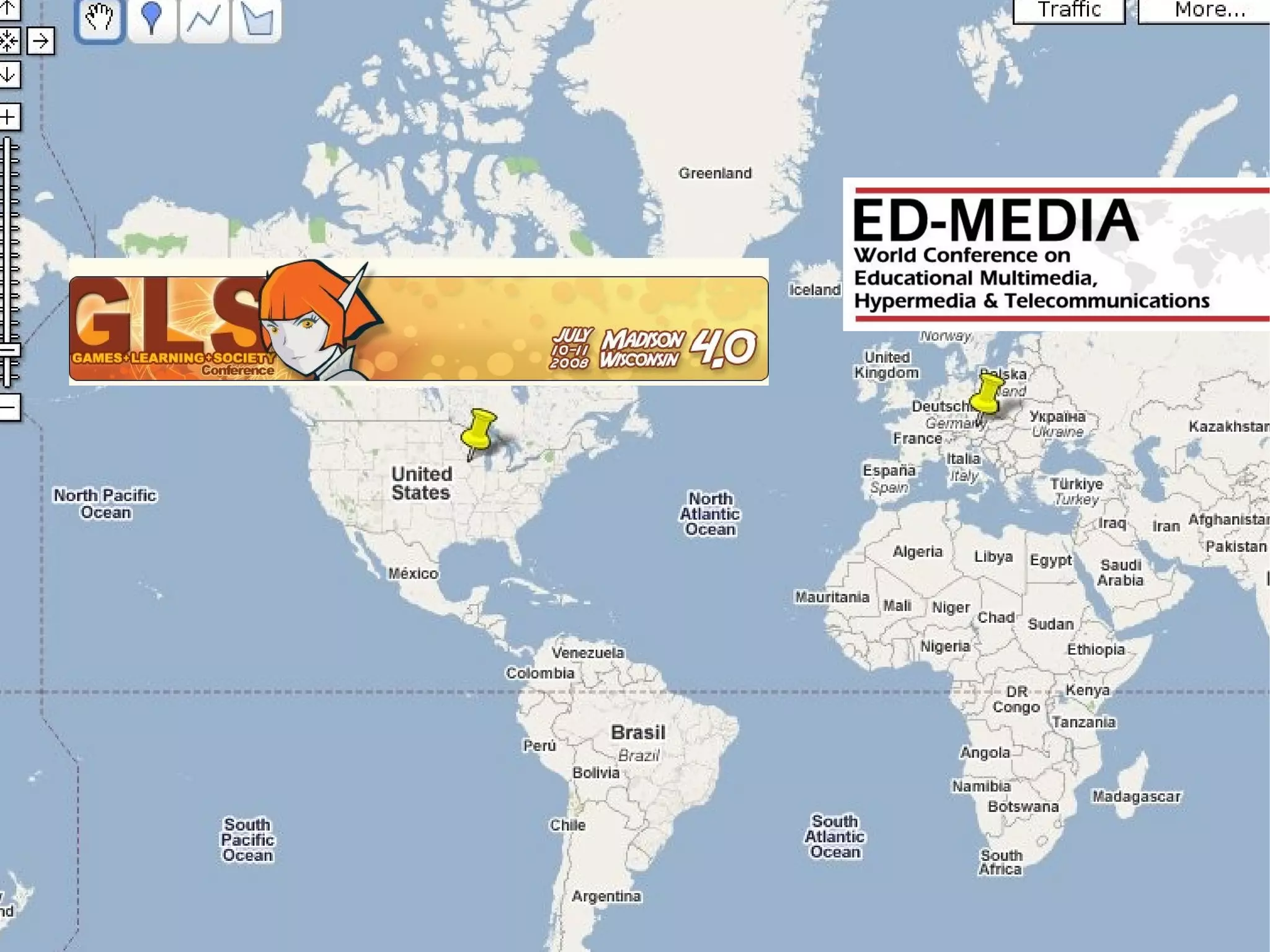
I presented at the 2008  Games, Learning and Society  and  ED-MEDIA  conferences Projects, insights, sessions notes etc. at  delicious.com/tag/galsa  or  innovatingeducation.wordpress.com In this presentation are broad  themes  related to digital game-based learning ...
 
Themes “Ecology” of games Expanding definitions of literacy to include skills developed through gaming: New media literacies, visual literacy, gaming literacy Kids as game creators Games: mobile games, language learning games, MUVEs, ARGs Challenges: assessment, design, etc etc
“ Beyond their value as entertainment media, games ... are currently key entry points for many young people into productive literacies, social communities, and digitally rich identities.” Katie Salen (2008)
Ecology of games It's not just through the “black box” (PC, console or mobile phone) that the learning happens, it's also through everything around the actual game play: Strategy, dialogue with peers, mentoring Players belong to communities of practice: News, FAQs, discussion forums Develop community-related social practices
Kids as game creators “ Creative production as a pathway to critical reflection” (Peppler & Kafai, 2007a/b) Scratch (software) and ScratchR (community) Gamestar Mechanic An online multiplayer role-playing game designed to teach middle school children key principles of good game design A design tool to create games A community of learners Interactive fiction for History lessons (stand-alone) (PTO)
Recreating Past Worlds  An approach to student-designed, text-based history simulations ( Link ) High school learners design their own historical simulation games using Inform 7.  “ Designing a simulation that faithfully reflects a system or process in the past requires the historian’s critical skills: the ability to analyze and contextualize evidence, distinguish between the trivial and the essential, advance a defensible account of causation, and, in doing so, construct a plausible interpretation of the past.” LA: History but ... the Skills: writing, imagining, interpretation, argumentation, etc.
Mobile games Mostly augmented reality games, where a virtual game is overlaid onto physical space Players as field researchers Advanced (GPS): location-aware Simple (SMS): location disclosure
Language learning games Open Language Learning Initiative (OLLI), funded primarily by the Hewlett Foundation EFL: English to Mandarin-speakers ESL: English to Spanish-speakers 2 games: Episodic (comic and games) Community (social network and games)
“ Games can immerse kids in learning experiences that are rich, engaging and improve their disposition to constructivist learning.” Melissa Gresalfi (2008)
MUVEs Quest Atlantis: 3D multi-user virtual environment to immerse children, ages 9-15, in educational tasks  Improved disposition to information and learning, specifically science topics Want to pilot in SA
ARGs An alternate reality game (ARG) is an interactive narrative that uses the real world as a platform, often involving multiple media and game elements, to tell a story that may be affected by participants' ideas or actions. (Wikipedia) “Puppetmaster”, “rabbit hole” Examples: i love bees, The Lost Ring
The challenge of assessment Difficult to assess game-based learning David Shaffer : current educational assessment models only focus on knowledge and skills, but that is only half of an epistemic frame where there are four interconnected aspects: knowledge, identity, skills and value
Design challenges Beyond “chocolate covered broccoli” (Bruckman 1999) There can be a contradiction between playing the game and learning There can be too much interactivity with a game and not enough reflection Learning happens through social interaction – how to achieve this?
Other challenges No panacea Violent / stereotypical / misogynistic Teachers: “Play” is not work Gaming is not for everyone (is anything?) “ Competing” against commercial games An emergent field: Theories of learning are  new
Some opportunities US researchers interested in working with us (Gee, Steinkueler, Parsons, etc) Mobile games / MIM, e.g. Interactive fiction games Open area in SA (in Africa)

Trip report: Games and Learning Conferences 2008

  • 1.
    14.08.08 Games andLearning Conferences 2008 Steve Vosloo Trip report
  • 2.
    I presented atthe 2008 Games, Learning and Society and ED-MEDIA conferences Projects, insights, sessions notes etc. at delicious.com/tag/galsa or innovatingeducation.wordpress.com In this presentation are broad themes related to digital game-based learning ...
  • 3.
  • 4.
    Themes “Ecology” ofgames Expanding definitions of literacy to include skills developed through gaming: New media literacies, visual literacy, gaming literacy Kids as game creators Games: mobile games, language learning games, MUVEs, ARGs Challenges: assessment, design, etc etc
  • 5.
    “ Beyond theirvalue as entertainment media, games ... are currently key entry points for many young people into productive literacies, social communities, and digitally rich identities.” Katie Salen (2008)
  • 6.
    Ecology of gamesIt's not just through the “black box” (PC, console or mobile phone) that the learning happens, it's also through everything around the actual game play: Strategy, dialogue with peers, mentoring Players belong to communities of practice: News, FAQs, discussion forums Develop community-related social practices
  • 7.
    Kids as gamecreators “ Creative production as a pathway to critical reflection” (Peppler & Kafai, 2007a/b) Scratch (software) and ScratchR (community) Gamestar Mechanic An online multiplayer role-playing game designed to teach middle school children key principles of good game design A design tool to create games A community of learners Interactive fiction for History lessons (stand-alone) (PTO)
  • 8.
    Recreating Past Worlds An approach to student-designed, text-based history simulations ( Link ) High school learners design their own historical simulation games using Inform 7. “ Designing a simulation that faithfully reflects a system or process in the past requires the historian’s critical skills: the ability to analyze and contextualize evidence, distinguish between the trivial and the essential, advance a defensible account of causation, and, in doing so, construct a plausible interpretation of the past.” LA: History but ... the Skills: writing, imagining, interpretation, argumentation, etc.
  • 9.
    Mobile games Mostlyaugmented reality games, where a virtual game is overlaid onto physical space Players as field researchers Advanced (GPS): location-aware Simple (SMS): location disclosure
  • 10.
    Language learning gamesOpen Language Learning Initiative (OLLI), funded primarily by the Hewlett Foundation EFL: English to Mandarin-speakers ESL: English to Spanish-speakers 2 games: Episodic (comic and games) Community (social network and games)
  • 11.
    “ Games canimmerse kids in learning experiences that are rich, engaging and improve their disposition to constructivist learning.” Melissa Gresalfi (2008)
  • 12.
    MUVEs Quest Atlantis:3D multi-user virtual environment to immerse children, ages 9-15, in educational tasks Improved disposition to information and learning, specifically science topics Want to pilot in SA
  • 13.
    ARGs An alternatereality game (ARG) is an interactive narrative that uses the real world as a platform, often involving multiple media and game elements, to tell a story that may be affected by participants' ideas or actions. (Wikipedia) “Puppetmaster”, “rabbit hole” Examples: i love bees, The Lost Ring
  • 14.
    The challenge ofassessment Difficult to assess game-based learning David Shaffer : current educational assessment models only focus on knowledge and skills, but that is only half of an epistemic frame where there are four interconnected aspects: knowledge, identity, skills and value
  • 15.
    Design challenges Beyond“chocolate covered broccoli” (Bruckman 1999) There can be a contradiction between playing the game and learning There can be too much interactivity with a game and not enough reflection Learning happens through social interaction – how to achieve this?
  • 16.
    Other challenges Nopanacea Violent / stereotypical / misogynistic Teachers: “Play” is not work Gaming is not for everyone (is anything?) “ Competing” against commercial games An emergent field: Theories of learning are new
  • 17.
    Some opportunities USresearchers interested in working with us (Gee, Steinkueler, Parsons, etc) Mobile games / MIM, e.g. Interactive fiction games Open area in SA (in Africa)