+
    Gaming: Harnessing
        the Power
        of the Wii


                         Kelly Czarnecki, Librarian
                         Charlotte, North Carolina
                         Contact: kellyczarnecki1@gmail.com
+
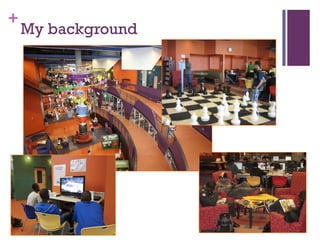
    My background
+
    Gaming and Libraries:
    The Literacy and Asset Building Connection
+
    Why Gaming and Libraries?


                       Popular for more than 30
                        years

                       Increases socialization

                       Implements literacy

                       Helps build developmental
                        assets
+
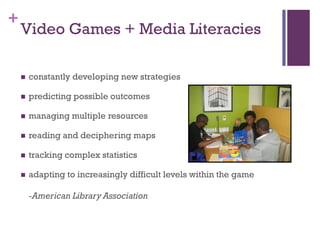
    Video Games + Media Literacies

       constantly developing new strategies

       predicting possible outcomes

       managing multiple resources

       reading and deciphering maps

       tracking complex statistics

       adapting to increasingly difficult levels within the game

        -American Library Association
+
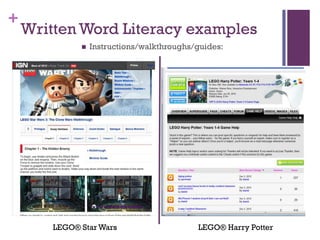
    Written Word Literacy examples
                 Instructions/walkthroughs/guides:


        LEGO® Star Wars                     LEGO® Harry Potter
+
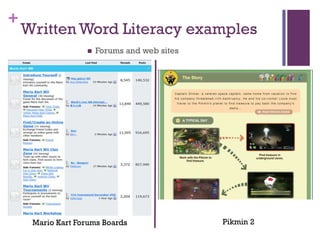
    Written Word Literacy examples
                     Forums and web sites


     Mario Kart Forums Boards                Pikmin 2
+
    Written Word Literacy examples
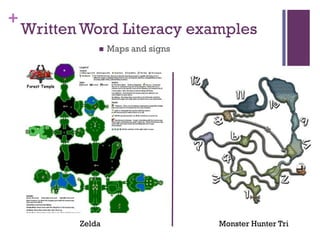
                  Maps and signs


           Zelda                    Monster Hunter Tri
+
    Board Games and AASL Standards
    for the 21st Century Learner
            AASL = American Association of School Librarians

       Standard 1: Inquire, think critically and gain knowledge

       Standard 2: Draw conclusions, make informed
        decisions, apply knowledge to new situations, and create
        new knowledge

       Standard 3: Share knowledge and participate ethically and
        productively as members of our democratic society

       Standard 4: Pursue personal and aesthetic growth
+
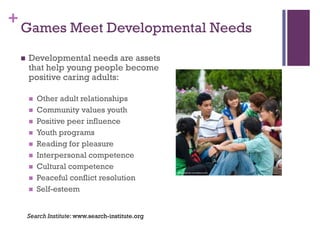
    Games Meet Developmental Needs

       Developmental needs are assets
        that help young people become
        positive caring adults:

           Other adult relationships
           Community values youth
           Positive peer influence
           Youth programs
           Reading for pleasure
           Interpersonal competence
           Cultural competence
           Peaceful conflict resolution
           Self-esteem


        Search Institute: www.search-institute.org
+
    Landscape of Gaming:
    in United States Libraries
+
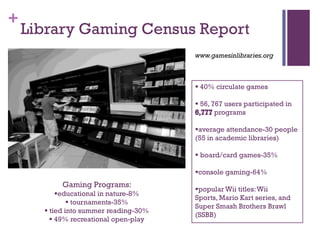
    Library Gaming Census Report
                                       www.gamesinlibraries.org


                                        40% circulate games

                                        56, 767 users participated in
                                              programs

                                       average attendance-30 people
                                       (55 in academic libraries)

                                        board/card games-35%

                                       console gaming-64%
           Gaming Programs:
                                       popular Wii titles: Wii
          educational in nature-8%
                                       Sports, Mario Kart series, and
               tournaments-35%
                                       Super Smash Brothers Brawl
       tied into summer reading-30%
                                       (SSBB)
         49% recreational open-play
+ Library Gaming Census Report cont’d:
  Common Outcomes
     Improved reputation of the library

     Returned to the library at another time for non-gaming
      services

     Attended gaming program and used other services while
      there

     Improved social connections w/friends

     Improved social connections w/ those previously unknown

     Additional publicity
+
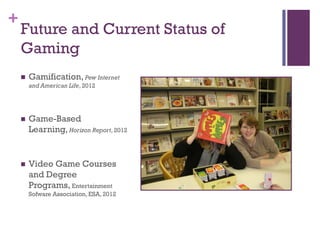
    Future and Current Status of
    Gaming
       Gamification, Pew Internet
        and American Life, 2012


       Game-Based
        Learning, Horizon Report, 2012


       Video Game Courses
        and Degree
        Programs, Entertainment
        Sofware Association, ESA, 2012
+
    You’ve got board games and
    a Wii, now what?
    Programming!
+
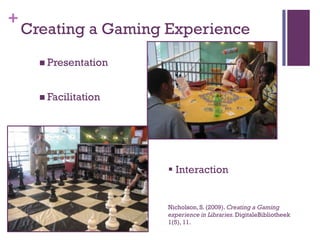
    Creating a Gaming Experience
       Presentation


       Facilitation


                        Interaction


                       Nicholson, S. (2009). Creating a Gaming
                       experience in Libraries. DigitaleBibliotheek
                       1(5), 11.
+
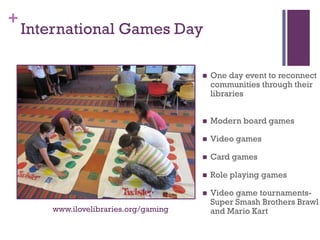
    International Games Day

                                           One day event to reconnect
                                            communities through their
                                            libraries


                                           Modern board games

                                           Video games

                                           Card games

                                           Role playing games

                                           Video game tournaments-
                                            Super Smash Brothers Brawl
        www.ilovelibraries.org/gaming       and Mario Kart
+
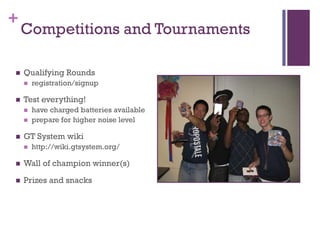
    Competitions and Tournaments

   Qualifying Rounds
       registration/signup

   Test everything!
       have charged batteries available
       prepare for higher noise level

   GT System wiki
       http://wiki.gtsystem.org/

   Wall of champion winner(s)

   Prizes and snacks
+
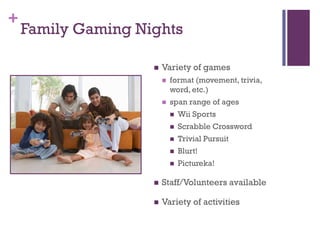
    Family Gaming Nights

                       Variety of games
                           format (movement, trivia,
                            word, etc.)
                           span range of ages
                               Wii Sports
                               Scrabble Crossword
                               Trivial Pursuit
                               Blurt!
                               Pictureka!

                       Staff/Volunteers available

                       Variety of activities
+
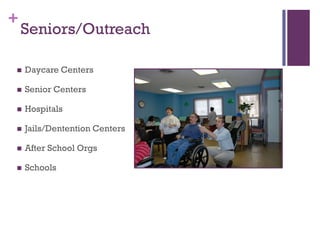
    Seniors/Outreach

   Daycare Centers

   Senior Centers

   Hospitals

   Jails/Dentention Centers

   After School Orgs

   Schools
+
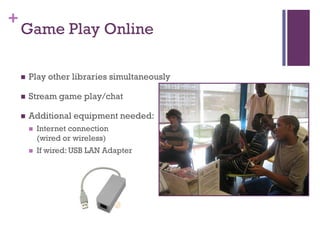
    Game Play Online

       Play other libraries simultaneously

       Stream game play/chat

       Additional equipment needed:
           Internet connection
            (wired or wireless)
           If wired: USB LAN Adapter
+
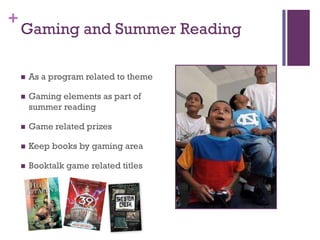
    Gaming and Summer Reading

       As a program related to theme

       Gaming elements as part of
        summer reading

       Game related prizes

       Keep books by gaming area

       Booktalk game related titles
+
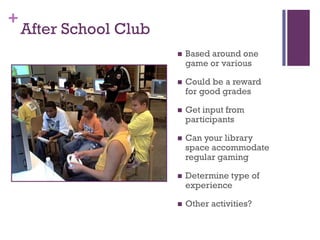
    After School Club
                           Based around one
                            game or various

                           Could be a reward
                            for good grades

                           Get input from
                            participants

                           Can your library
                            space accommodate
                            regular gaming

                           Determine type of
                            experience

                           Other activities?
+
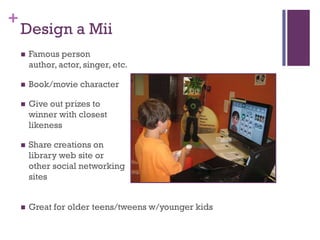
    Design a Mii
       Famous person
        author, actor, singer, etc.

       Book/movie character

       Give out prizes to
        winner with closest
        likeness

       Share creations on
        library web site or
        other social networking
        sites


       Great for older teens/tweens w/younger kids
+
    Best Practices
    Examples of Libraries and Gaming Programs
+
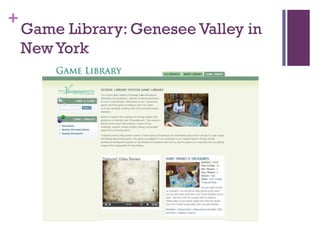
    Game Library: Genesee Valley in
    New York
+
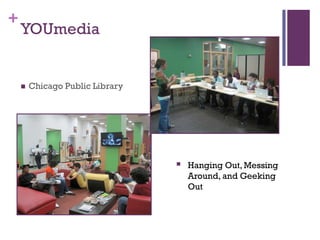
    YOUmedia


       Chicago Public Library


                                    Hanging Out, Messing
                                     Around, and Geeking
                                     Out
+
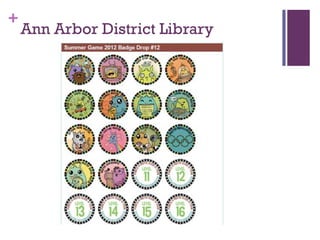
    Ann Arbor District Library
+
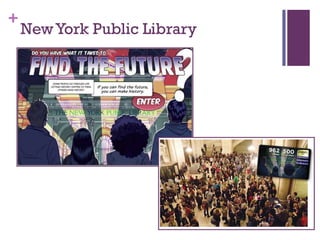
    New York Public Library
+
    Trace Effects
    Learning English through
    Gaming
+
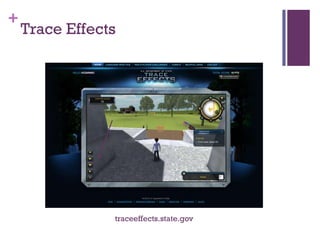
    Trace Effects


                traceeffects.state.gov
+
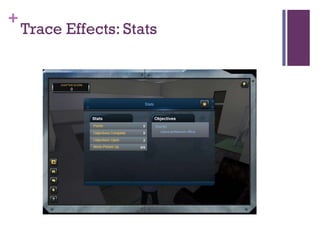
    Trace Effects: Stats
+
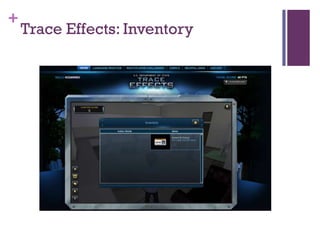
    Trace Effects: Inventory
+
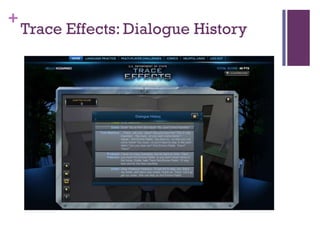
    Trace Effects: Dialogue History
+
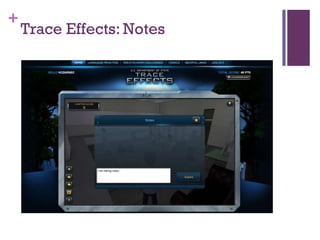
    Trace Effects: Notes
+
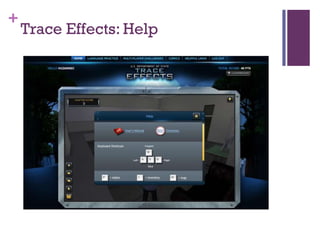
    Trace Effects: Help
+
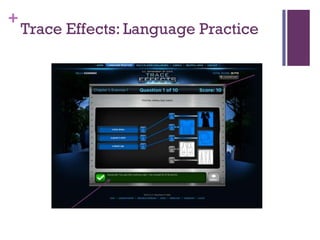
    Trace Effects: Language Practice
+
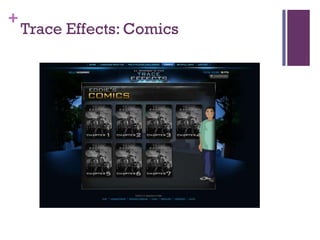
    Trace Effects: Comics
+
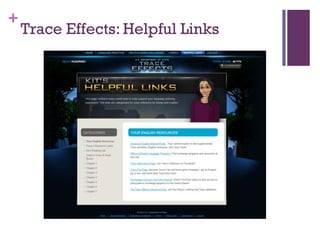
    Trace Effects: Helpful Links
+
    Gaming Resources for Further
    Reading
       Game On! Gaming at the Library (Neal-Schuman Publishers)
        by Beth Gallaway, 2009

       Everyone Plays at the Library: Creating Great Gaming
        Experiences for All Ages (Information Today) by Scott
        Nicholson, 2010

       Libraries Got Game: Aligned Learning Through Modern Board
        Games (American Library Association) by Brian Mayer and
        Christopher Harris, 2009

       A Board Game Education (R&L Education) by Jeffrey P.
        Hinebaugh, 2009
+
    Questions?

    Contact: Kelly Czarnecki
     kellyczarnecki1@gmail.com

Gaming presentation

  • 1.
    + Gaming: Harnessing the Power of the Wii Kelly Czarnecki, Librarian Charlotte, North Carolina Contact: kellyczarnecki1@gmail.com
  • 2.
    + My background
  • 3.
    + Gaming and Libraries: The Literacy and Asset Building Connection
  • 4.
    + Why Gaming and Libraries?  Popular for more than 30 years  Increases socialization  Implements literacy  Helps build developmental assets
  • 5.
    + Video Games + Media Literacies  constantly developing new strategies  predicting possible outcomes  managing multiple resources  reading and deciphering maps  tracking complex statistics  adapting to increasingly difficult levels within the game -American Library Association
  • 6.
    + Written Word Literacy examples  Instructions/walkthroughs/guides: LEGO® Star Wars LEGO® Harry Potter
  • 7.
    + Written Word Literacy examples  Forums and web sites Mario Kart Forums Boards Pikmin 2
  • 8.
    + Written Word Literacy examples  Maps and signs Zelda Monster Hunter Tri
  • 9.
    + Board Games and AASL Standards for the 21st Century Learner AASL = American Association of School Librarians  Standard 1: Inquire, think critically and gain knowledge  Standard 2: Draw conclusions, make informed decisions, apply knowledge to new situations, and create new knowledge  Standard 3: Share knowledge and participate ethically and productively as members of our democratic society  Standard 4: Pursue personal and aesthetic growth
  • 10.
    + Games Meet Developmental Needs  Developmental needs are assets that help young people become positive caring adults:  Other adult relationships  Community values youth  Positive peer influence  Youth programs  Reading for pleasure  Interpersonal competence  Cultural competence  Peaceful conflict resolution  Self-esteem Search Institute: www.search-institute.org
  • 11.
    + Landscape of Gaming: in United States Libraries
  • 12.
    + Library Gaming Census Report www.gamesinlibraries.org  40% circulate games  56, 767 users participated in programs average attendance-30 people (55 in academic libraries)  board/card games-35% console gaming-64% Gaming Programs: popular Wii titles: Wii educational in nature-8% Sports, Mario Kart series, and  tournaments-35% Super Smash Brothers Brawl  tied into summer reading-30% (SSBB)  49% recreational open-play
  • 13.
    + Library GamingCensus Report cont’d: Common Outcomes  Improved reputation of the library  Returned to the library at another time for non-gaming services  Attended gaming program and used other services while there  Improved social connections w/friends  Improved social connections w/ those previously unknown  Additional publicity
  • 14.
    + Future and Current Status of Gaming  Gamification, Pew Internet and American Life, 2012  Game-Based Learning, Horizon Report, 2012  Video Game Courses and Degree Programs, Entertainment Sofware Association, ESA, 2012
  • 15.
    + You’ve got board games and a Wii, now what? Programming!
  • 16.
    + Creating a Gaming Experience  Presentation  Facilitation  Interaction Nicholson, S. (2009). Creating a Gaming experience in Libraries. DigitaleBibliotheek 1(5), 11.
  • 17.
    + International Games Day  One day event to reconnect communities through their libraries  Modern board games  Video games  Card games  Role playing games  Video game tournaments- Super Smash Brothers Brawl www.ilovelibraries.org/gaming and Mario Kart
  • 18.
    + Competitions and Tournaments  Qualifying Rounds  registration/signup  Test everything!  have charged batteries available  prepare for higher noise level  GT System wiki  http://wiki.gtsystem.org/  Wall of champion winner(s)  Prizes and snacks
  • 19.
    + Family Gaming Nights  Variety of games  format (movement, trivia, word, etc.)  span range of ages  Wii Sports  Scrabble Crossword  Trivial Pursuit  Blurt!  Pictureka!  Staff/Volunteers available  Variety of activities
  • 20.
    + Seniors/Outreach  Daycare Centers  Senior Centers  Hospitals  Jails/Dentention Centers  After School Orgs  Schools
  • 21.
    + Game Play Online  Play other libraries simultaneously  Stream game play/chat  Additional equipment needed:  Internet connection (wired or wireless)  If wired: USB LAN Adapter
  • 22.
    + Gaming and Summer Reading  As a program related to theme  Gaming elements as part of summer reading  Game related prizes  Keep books by gaming area  Booktalk game related titles
  • 23.
    + After School Club  Based around one game or various  Could be a reward for good grades  Get input from participants  Can your library space accommodate regular gaming  Determine type of experience  Other activities?
  • 24.
    + Design a Mii  Famous person author, actor, singer, etc.  Book/movie character  Give out prizes to winner with closest likeness  Share creations on library web site or other social networking sites  Great for older teens/tweens w/younger kids
  • 25.
    + Best Practices Examples of Libraries and Gaming Programs
  • 26.
    + Game Library: Genesee Valley in New York
  • 27.
    + YOUmedia  Chicago Public Library  Hanging Out, Messing Around, and Geeking Out
  • 28.
    + Ann Arbor District Library
  • 29.
    + New York Public Library
  • 30.
    + Trace Effects Learning English through Gaming
  • 31.
    + Trace Effects traceeffects.state.gov
  • 32.
    + Trace Effects: Stats
  • 33.
    + Trace Effects: Inventory
  • 34.
    + Trace Effects: Dialogue History
  • 35.
    + Trace Effects: Notes
  • 36.
    + Trace Effects: Help
  • 37.
    + Trace Effects: Language Practice
  • 38.
    + Trace Effects: Comics
  • 39.
    + Trace Effects: Helpful Links
  • 40.
    + Gaming Resources for Further Reading  Game On! Gaming at the Library (Neal-Schuman Publishers) by Beth Gallaway, 2009  Everyone Plays at the Library: Creating Great Gaming Experiences for All Ages (Information Today) by Scott Nicholson, 2010  Libraries Got Game: Aligned Learning Through Modern Board Games (American Library Association) by Brian Mayer and Christopher Harris, 2009  A Board Game Education (R&L Education) by Jeffrey P. Hinebaugh, 2009
  • 41.
    + Questions? Contact: Kelly Czarnecki kellyczarnecki1@gmail.com

Editor's Notes

  • #2 -going to talk about why games and libraries-board games-programming-resources to continue your reading
  • #5 -carry DVDs, CDs-games are just another information format-important activity to so many of our library users-socialization-play with a diverse group, share expertise, and be surrounded by books and knowledge
  • #6 -observe players-play games yourself-skills are important to have in the corporate or non-profit world
  • #7 -incorporating this with game play-making available as resources
  • #8 -communicate with others on forums boards-reading narrative of game
  • #9 Doors-normal/locked/sealedlight or extinguish the torches, rescue the monkeys, use the boomerang, know the enemies-all to move forwardAreas for gathering, mining, and insects (monster hunter tri)
  • #10 -1. develop student’s knowledge in a curricular subject area. Use prior background knowledge for new learning-2. using various strategies to draw new conclusions. Encourage players to collaborate with others.-3. develop leadership skills. Motivate others to share ideas beyond the classroom.-4. mentally organize info. to use in the future. Motivate to improve gaming skills to experience success in the future.
  • #11 -the more assets, the less likely youth are to engage in high-risk behaviors-Young person receives support from three or more nonparent adults.-Young person perceives that adults in the community value youth.-Young person's best friends model responsible behavior.-Young person spends three or more hours per week in sports, clubs, or organizations at school and/or in community organizations-Young person reads for pleasure three or more hours per week. Commitment to learning.-Young person has empathy, sensitivity, and friendship skills.-Young person has knowledge of and comfort with people of different cultural/racial/ethnic backgrounds.-Young person seeks to resolve conflict nonviolently.-Young person reports having a high self-esteem.
  • #13 -programs in 2006-2007-Web based survey sent out to over 400 libraries (public, school, academic, and special)-2006-313 libraries responded-2007-404 responded
  • #14 -65% improved reputation of the library-64% returned to the library for non-gaming services-61% used other services-60% improved social connections w/friends-52% previously unknown
  • #15 -incorporates the use of rewards to drive action (points, badges, discounts –status indicators such as friend counts, leaderboards, achievement data-Developers and researchers are working in every area of game-based learning, games that are goal-oriented; social game environments; games developed expressly for education-record 381 colleges, universities, art and trade schools across the country offer courses, professional certificates, undergraduate or graduate degrees in video game design, development and programming.For the first time, schools in all 50 states will be preparing students for a career in the video game industry.
  • #17 -Gamers are more social, want more interaction and more strategy. You can help make room for those opportunities to happen. It’s about creating a larger experience around the game-Presentation-projecting a video game on a large screen. Laying out all the board games available instead of leaving them in their boxes.-Facilitation-staff and volunteers available to teach (not necessarily play unless really needed) the games. Help find games that meet interest and capabilities.-Interaction-relations between players is positive. Good sportsmanship. Help match players to each other. Tournament style game vs. open play.
  • #18 -Initiative of the American Library Association--originally called National Gaming Day-2012 5th annual event-typically happens in November-variety of gaming activities-1,281 libraries registered; 17,152 participants played games in libraries worldwide. Participation on all six continents-Three gaming companies helped sponsor the event and donated games to libraries that registered (up to 500?)-Quotes:-Library in New York:"While many adults shared stories about their hardships following Hurricane Sandy, the children were entertained with three hours of playing time.  Families all expressed gratitude for diversion from the tough week and commented how the library always seems to come through for the community! One Mom asked if there were any games that would improve her son's math facts in addition and subtraction.  I was able to show here two games at our event that focused on this skill, but I also mentioned that games that use two dice work on this skill constantly since you have to add the two dice together.  She was surprised to hear that and was very glad she came to the library to play games with her children." -Library in Texas "Our Youth Services Department had a "Play Your Way Around the World" event that included a storyteller kicking things off with tales from around the world. The children then each received a world map and proceeded to ten different stations, each of which had a game from a different country to play. Games included Afghanistan kite making, Mayan ancient basket ball, Japanese card match game, etc. The children had such fun--there was much laughter in our Youth Department!" -Librarian in Oregon”watching younger teens get to know older teens while they were playing Yu-gi-oh! and seeing them help each other learn and understand the game rules was great. And watching older teens share the Wii game controls with younger elementary school players who then began to beat them at their own game."
  • #19 -card, video, board games all work well-GT system-Ann Arbor-online tournament scoring and management, registration/blog/brackets, Leaderboards-local/national/International, tournament rules and histories, synchronized tournament days
  • #20 -drawing/coloring-LEGOs-reading
  • #23 -points/score/create avatars-giftcards-Vivian VandeVelde, 39 Clues, Patrick Carman,EionColfer, Rick Riordan Kane Chronicles
  • #24 -write game reviews-gaming podcast
  • #27 -collection of games (board/card) to use in school libraries-linked to curriculum standards-organized by grade-elementary, middle, and high school-examples of modifications given
  • #29 -based on game play. Earn points and rewards in the form of badges-integrate information literacy into the activities-answering questions about putting books on hold, going into records, etc.-interacting with the catalog-tagging items, writing reviews, etc.
  • #32 -Part of a web site-AE-American English-a web site for teachers and learners of English as a Foreign Language Abroad-U.S. Department of State with the Bureau of Educational and Cultural Affairs-English speaking characters designed in manga style-immersive exploration of American culture-intended for 12-16 year olds-Premise-Trace is one of the main characters that is from 2045 and goes back to the present through a time machine-complete missions to find his way back to the future-7 chapters of game play, 28 practice activities, 4 multi-player language practice games, teacher and student materials, apps for smartphones, and offline DVD play
  • #39 -comic/graphic novel tie-ins
  • #40 -connections with social networks-Facebook-join Trace’s followers and learn game strategies-YouTube videos to participate in exchange programs in U.S. -Join the Ning to continue adventure