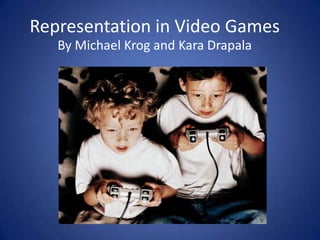
Representation in Video GamesBy Michael Krog and Kara Drapala
You can just hang outside in the sun all day tossing a ball around or you can sit at your computer and do something that matters.		-Eric Gartman, South Park Episode No. 1008, "Make Love, Not Warcraft“Make Love, Not Warcraft
IntroductionElisabeth Hayes (2007) writes: "Video gaming is now often children's first and most compelling introduction to digital technologies and is presumed to be a door to a broader range of digital tools and applications.“However, many are fearful about the repercussions of allowing children to consume video games without prior knowledge of the biased representations of society hidden within them.
Gaming and Children’s Culture?ESA estimates that the average US gamer is 33 years old.67% of American head of households play gamesThe average adult gamer has been playing for 13 years.
Gaming and Children’s CultureDespite these statistics and growing adult market, video games are still considered to be “for children”, with marketing and academic research focused primarily on younger demographics. Kaiser Family Foundation's survey of American youth reported that 52% of kids, 8 - 18, play some kind of videogame daily.
            HistoryNintendo: the first company to “brand” the video game marketFocus on family friendly gamesCreated legacy franchises such as Mario Brothers, Zelda, and Donkey Kong that appealed toyoung people of both sexes. These games allowed parents to place trust in the content Nintendo provided and marketed towards      children. The “Disney” of video-gaming.
History ContinuedSega began marketing games to older teen boys at the height of their rebellious yearsMarketing games as more “mature”, “cooler”, and “rebellious”, rather than following Nintendo’s universal character designs.
History ContinuedSony, on the other hand, produced games for players of all ages, specifically the wide range of 12-24 year olds. This demographic had access to disposable income, leading to the purchase of games without parental consent or knowledge. Taking parental control out of the equation, a wider variety of games: from Spyro the Dragon to the Grand Theft Auto Series.
EdutainmentChildren’s computer software was designed to encourage learning through entertaining games.This created a contradiction in the way games were viewed in society:Games are also depicted as threats to kids' social and physical well-being.While kids who play games for leisure are seen as “antisocial”, “nerdy”, “overweight”, and “lethargic”, Kids who play games sanctioned by parents and teachers are seen as “digital whiz kids who hold the future in the palms of their nimble, button-pushing hands.”
Media Moral PanicsAs with every new media medium that enters mainstream culture, an outcry has arisen over the supposed moral discrepancies found in video games because of the social networking and access to information that was previously controlled by those in power (i.e., parents, teachers, and the government.)
Boys’ ClubVideo games have largely been considered as a male hobby. When video games debuted, they were marketed almost exclusively to boys.Video games follow a tenet of television marketing, which states:“Girls will watch boys' shows, but boys will not watch girls' shows”. It took until the early 1990s for a girl-based game, Barbie Fashion Designer, for girls to become a sought-after segment of the market.
Girl Gaming MovementIn this movement, games were designed meet girls’ specific needs and desires. Avoidance of violenceInterest in relationshipsCommunicationPreference for problem solving rather than competitive tasksTell us about it, Dan
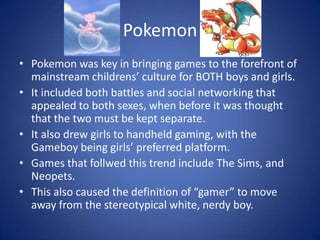
PokemonPokemon was key in bringing games to the forefront of mainstream childrens’ culture for BOTH boys and girls. It included both battles and social networking that appealed to both sexes, when before it was thought that the two must be kept separate. It also drew girls to handheld gaming, with the Gameboy being girls’ preferred platform. Games that follwed this trend include The Sims, and Neopets. This also caused the definition of “gamer” to move away from the stereotypical white, nerdy boy.
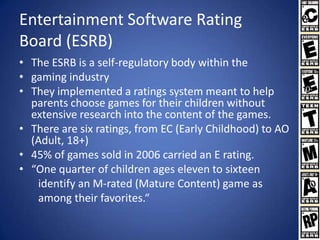
Entertainment Software Rating Board (ESRB)The ESRB is a self-regulatory body within the gaming industryThey implemented a ratings system meant to help parents choose games for their children without extensive research into the content of the games. There are six ratings, from EC (Early Childhood) to AO (Adult, 18+)45% of games sold in 2006 carried an E rating.“One quarter of children ages eleven to sixteen identify an M-rated (Mature Content) game as among their favorites.“
RepresentationsThere is major concern about the impact of representations in video games due to the fact that children occupy an innocent state which can be easily influenced be the media they interact with.There are 2 systems of representation involved in the production of meaning through language: Mental representation: our thoughts and ways of understanding systems and conceptsIndividual, but similar to the rest of society allowing us to communicate in similar waysLanguage allows mental representation to be shared with others: syntax, symbols, sounds, images
RepresentationsAll representations, especially media messages, are “unpacked” and “read” by the audience. This allows the audience to understand the views of the message creators. There are three possible ways to read a message:Dominant (encoded)Negotiated (pick and choose)Oppositional (subversive)
RepresentationsVideo games differ from more traditional mediums by offering more interactivity to users. “However, interactivity begins to bridge the binary between designers and players by allowing players space to customize the playing experience, an opportunity with implications for enjoyment and engagement as well as for representation.”Gamers today are able to immerse themselves in another world with countless hours of play time, as opposed to television or film, which is limited and will always be limited.
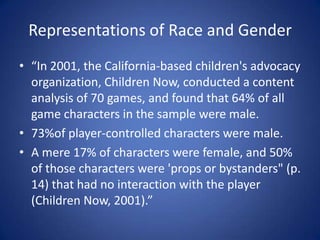
Representations of Race and Gender“In 2001, the California-based children's advocacy organization, Children Now, conducted a content analysis of 70 games, and found that 64% of all game characters in the sample were male. 73%of player-controlled characters were male. A mere 17% of characters were female, and 50% of those characters were 'props or bystanders" (p. 14) that had no interaction with the player (Children Now, 2001).”
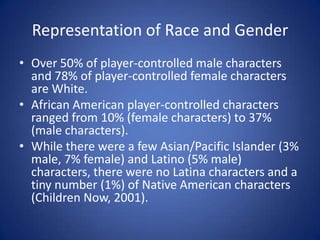
Representation of Race and GenderOver 50% of player-controlled male characters and 78% of player-controlled female characters are White. African American player-controlled characters ranged from 10% (female characters) to 37% (male characters). While there were a few Asian/Pacific Islander (3% male, 7% female) and Latino (5% male) characters, there were no Latina characters and a tiny number (1%) of Native American characters (Children Now, 2001).
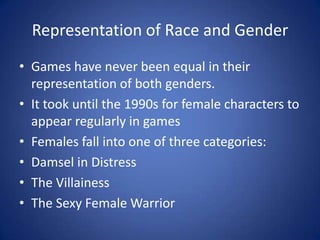
Representation of Race and GenderGames have never been equal in their representation of both genders.It took until the 1990s for female characters to appear regularly in gamesFemales fall into one of three categories:Damsel in DistressThe VillainessThe Sexy Female Warrior
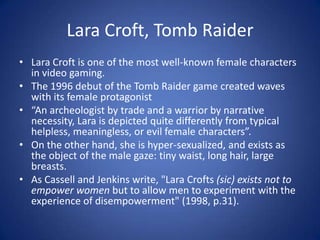
Lara Croft, Tomb RaiderLara Croft is one of the most well-known female characters in video gaming.The 1996 debut of the Tomb Raider game created waves with its female protagonist“An archeologist by trade and a warrior by narrative necessity, Lara is depicted quite differently from typical helpless, meaningless, or evil female characters”.On the other hand, she is hyper-sexualized, and exists as the object of the male gaze: tiny waist, long hair, large breasts.As Cassell and Jenkins write, "Lara Crofts (sic) exists not to empower women but to allow men to experiment with the experience of disempowerment" (1998, p.31).
Lara Croft: positive or negative?Although the character was groundbreaking for storytelling and marketing reasons, she is often reduced to debate over whether or not she is a suitable role model for young women. Known as “the Lara Phenomenon”, she set the standard for female characters in games today.
Racial RepresentationsRacial representations in video games specifically have not really been a focus of academic study until recentlyRather, racial representations in online gaming interactions are the focus of most studies. “As Kolko, Nakamura, and Rodman (2000) write, "race matters in cyberspace precisely because all of us who spend time online are already shaped by the ways in which race matters offline, and we can't help but bring our own knowledge, experiences, and values with us when we log on" (pp. 4-5).”Racial characters are largely invisible or merely background characters and victims. Game characters of different races are usually depicted in stereotypical waysFor example, “8 out of 10 black male video game characters are sports competitors.”
Creating an “avatar”In early RPGs, players were able to create a virtual representation of the self. Early commands did not allow users to create different races, ages, or genders. Default white male avatarsHowever, contemporary RPGs allow more flexibility when creating avatars, and the consideration of race is an important aspect of gameplay, albeit in a fantastical way.
WoW AvatarsWhen a player starts the game, they are able to choose one of ten races for their character, and also one of nine classes. Not every class is available to every race.This reflects a real-world tendency to react and interact with different races, and also reveals how players conceptualize themselves. This creates a virtual political landscape based on preconceptions attached to certain races.
MMORPGsThese games allow for more social interaction, as they are based on the need to work in teams and network with other players. The scale of these games mean that this interaction is taking place with players from every corner of the globe, often allowing identities to emerge. i.e., “The Brits always log on drunk.”Not only do these games contain pre-existing worldviews, but these worldviews are reinforced or even expanded through gameplay.
Chinese “Gold Farmers”One example of a stereotype is the Chinese “Gold Farmers”Hired to earn in-game currency. In the offline world, they exist in poor working conditions for low pay. This creates a stereotype based on game play situationsThis may lead to unfair labeling as not all “gold-farmers” are Chinese, nor is every player trying to level up in a specific area a “gold-farmer.”
ConclusionVideo games are complex, ideological, and frequently problematic. Much research is emerging that focusing on using games as educational tools.Games are not inherently dangerous, but they are important media artifacts that deserve critical attention.
FIN

Video Gaming

  • 1.
    Representation in VideoGamesBy Michael Krog and Kara Drapala
  • 2.
    You can justhang outside in the sun all day tossing a ball around or you can sit at your computer and do something that matters. -Eric Gartman, South Park Episode No. 1008, "Make Love, Not Warcraft“Make Love, Not Warcraft
  • 3.
    IntroductionElisabeth Hayes (2007)writes: "Video gaming is now often children's first and most compelling introduction to digital technologies and is presumed to be a door to a broader range of digital tools and applications.“However, many are fearful about the repercussions of allowing children to consume video games without prior knowledge of the biased representations of society hidden within them.
  • 4.
    Gaming and Children’sCulture?ESA estimates that the average US gamer is 33 years old.67% of American head of households play gamesThe average adult gamer has been playing for 13 years.
  • 5.
    Gaming and Children’sCultureDespite these statistics and growing adult market, video games are still considered to be “for children”, with marketing and academic research focused primarily on younger demographics. Kaiser Family Foundation's survey of American youth reported that 52% of kids, 8 - 18, play some kind of videogame daily.
  • 6.
    HistoryNintendo: the first company to “brand” the video game marketFocus on family friendly gamesCreated legacy franchises such as Mario Brothers, Zelda, and Donkey Kong that appealed toyoung people of both sexes. These games allowed parents to place trust in the content Nintendo provided and marketed towards children. The “Disney” of video-gaming.
  • 7.
    History ContinuedSega beganmarketing games to older teen boys at the height of their rebellious yearsMarketing games as more “mature”, “cooler”, and “rebellious”, rather than following Nintendo’s universal character designs.
  • 8.
    History ContinuedSony, onthe other hand, produced games for players of all ages, specifically the wide range of 12-24 year olds. This demographic had access to disposable income, leading to the purchase of games without parental consent or knowledge. Taking parental control out of the equation, a wider variety of games: from Spyro the Dragon to the Grand Theft Auto Series.
  • 9.
    EdutainmentChildren’s computer softwarewas designed to encourage learning through entertaining games.This created a contradiction in the way games were viewed in society:Games are also depicted as threats to kids' social and physical well-being.While kids who play games for leisure are seen as “antisocial”, “nerdy”, “overweight”, and “lethargic”, Kids who play games sanctioned by parents and teachers are seen as “digital whiz kids who hold the future in the palms of their nimble, button-pushing hands.”
  • 10.
    Media Moral PanicsAswith every new media medium that enters mainstream culture, an outcry has arisen over the supposed moral discrepancies found in video games because of the social networking and access to information that was previously controlled by those in power (i.e., parents, teachers, and the government.)
  • 11.
    Boys’ ClubVideo gameshave largely been considered as a male hobby. When video games debuted, they were marketed almost exclusively to boys.Video games follow a tenet of television marketing, which states:“Girls will watch boys' shows, but boys will not watch girls' shows”. It took until the early 1990s for a girl-based game, Barbie Fashion Designer, for girls to become a sought-after segment of the market.
  • 12.
    Girl Gaming MovementInthis movement, games were designed meet girls’ specific needs and desires. Avoidance of violenceInterest in relationshipsCommunicationPreference for problem solving rather than competitive tasksTell us about it, Dan
  • 13.
    PokemonPokemon was keyin bringing games to the forefront of mainstream childrens’ culture for BOTH boys and girls. It included both battles and social networking that appealed to both sexes, when before it was thought that the two must be kept separate. It also drew girls to handheld gaming, with the Gameboy being girls’ preferred platform. Games that follwed this trend include The Sims, and Neopets. This also caused the definition of “gamer” to move away from the stereotypical white, nerdy boy.
  • 14.
    Entertainment Software RatingBoard (ESRB)The ESRB is a self-regulatory body within the gaming industryThey implemented a ratings system meant to help parents choose games for their children without extensive research into the content of the games. There are six ratings, from EC (Early Childhood) to AO (Adult, 18+)45% of games sold in 2006 carried an E rating.“One quarter of children ages eleven to sixteen identify an M-rated (Mature Content) game as among their favorites.“
  • 15.
    RepresentationsThere is majorconcern about the impact of representations in video games due to the fact that children occupy an innocent state which can be easily influenced be the media they interact with.There are 2 systems of representation involved in the production of meaning through language: Mental representation: our thoughts and ways of understanding systems and conceptsIndividual, but similar to the rest of society allowing us to communicate in similar waysLanguage allows mental representation to be shared with others: syntax, symbols, sounds, images
  • 16.
    RepresentationsAll representations, especiallymedia messages, are “unpacked” and “read” by the audience. This allows the audience to understand the views of the message creators. There are three possible ways to read a message:Dominant (encoded)Negotiated (pick and choose)Oppositional (subversive)
  • 17.
    RepresentationsVideo games differfrom more traditional mediums by offering more interactivity to users. “However, interactivity begins to bridge the binary between designers and players by allowing players space to customize the playing experience, an opportunity with implications for enjoyment and engagement as well as for representation.”Gamers today are able to immerse themselves in another world with countless hours of play time, as opposed to television or film, which is limited and will always be limited.
  • 18.
    Representations of Raceand Gender“In 2001, the California-based children's advocacy organization, Children Now, conducted a content analysis of 70 games, and found that 64% of all game characters in the sample were male. 73%of player-controlled characters were male. A mere 17% of characters were female, and 50% of those characters were 'props or bystanders" (p. 14) that had no interaction with the player (Children Now, 2001).”
  • 19.
    Representation of Raceand GenderOver 50% of player-controlled male characters and 78% of player-controlled female characters are White. African American player-controlled characters ranged from 10% (female characters) to 37% (male characters). While there were a few Asian/Pacific Islander (3% male, 7% female) and Latino (5% male) characters, there were no Latina characters and a tiny number (1%) of Native American characters (Children Now, 2001).
  • 20.
    Representation of Raceand GenderGames have never been equal in their representation of both genders.It took until the 1990s for female characters to appear regularly in gamesFemales fall into one of three categories:Damsel in DistressThe VillainessThe Sexy Female Warrior
  • 21.
    Lara Croft, TombRaiderLara Croft is one of the most well-known female characters in video gaming.The 1996 debut of the Tomb Raider game created waves with its female protagonist“An archeologist by trade and a warrior by narrative necessity, Lara is depicted quite differently from typical helpless, meaningless, or evil female characters”.On the other hand, she is hyper-sexualized, and exists as the object of the male gaze: tiny waist, long hair, large breasts.As Cassell and Jenkins write, "Lara Crofts (sic) exists not to empower women but to allow men to experiment with the experience of disempowerment" (1998, p.31).
  • 22.
    Lara Croft: positiveor negative?Although the character was groundbreaking for storytelling and marketing reasons, she is often reduced to debate over whether or not she is a suitable role model for young women. Known as “the Lara Phenomenon”, she set the standard for female characters in games today.
  • 23.
    Racial RepresentationsRacial representationsin video games specifically have not really been a focus of academic study until recentlyRather, racial representations in online gaming interactions are the focus of most studies. “As Kolko, Nakamura, and Rodman (2000) write, "race matters in cyberspace precisely because all of us who spend time online are already shaped by the ways in which race matters offline, and we can't help but bring our own knowledge, experiences, and values with us when we log on" (pp. 4-5).”Racial characters are largely invisible or merely background characters and victims. Game characters of different races are usually depicted in stereotypical waysFor example, “8 out of 10 black male video game characters are sports competitors.”
  • 24.
    Creating an “avatar”Inearly RPGs, players were able to create a virtual representation of the self. Early commands did not allow users to create different races, ages, or genders. Default white male avatarsHowever, contemporary RPGs allow more flexibility when creating avatars, and the consideration of race is an important aspect of gameplay, albeit in a fantastical way.
  • 25.
    WoW AvatarsWhen aplayer starts the game, they are able to choose one of ten races for their character, and also one of nine classes. Not every class is available to every race.This reflects a real-world tendency to react and interact with different races, and also reveals how players conceptualize themselves. This creates a virtual political landscape based on preconceptions attached to certain races.
  • 27.
    MMORPGsThese games allowfor more social interaction, as they are based on the need to work in teams and network with other players. The scale of these games mean that this interaction is taking place with players from every corner of the globe, often allowing identities to emerge. i.e., “The Brits always log on drunk.”Not only do these games contain pre-existing worldviews, but these worldviews are reinforced or even expanded through gameplay.
  • 28.
    Chinese “Gold Farmers”Oneexample of a stereotype is the Chinese “Gold Farmers”Hired to earn in-game currency. In the offline world, they exist in poor working conditions for low pay. This creates a stereotype based on game play situationsThis may lead to unfair labeling as not all “gold-farmers” are Chinese, nor is every player trying to level up in a specific area a “gold-farmer.”
  • 29.
    ConclusionVideo games arecomplex, ideological, and frequently problematic. Much research is emerging that focusing on using games as educational tools.Games are not inherently dangerous, but they are important media artifacts that deserve critical attention.
  • 30.