Trends in Leadership thought
Quiz (1)  How would you define leadership? Where would you expect to find the earliest recorded descriptions of leaders? Who wrote about the lives of great engineers?  What assumption lies behind trait theories of leadership What do we remember as Stogdill’s contribution to leadership
Quiz (2)  What assumption lies behind style theories of leadership? Suggest two contrasting leadership styles found in experimental studies What is a contingency theory What leadership style is associated with ‘New Leadership’ theories of the 1980s What is distributed leadership?
Quiz (3)  What leadership concept was central to Weber’s social theorizing? How did the theory re-emerge in later leadership studies? What are usually listed as the historical periods of leadership thought? What led to changes in leadership thought?
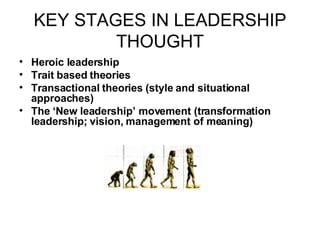
KEY STAGES IN LEADERSHIP THOUGHT Heroic leadership  Trait based theories  Transactional theories (style and situational approaches) The ‘New leadership’ movement (transformation leadership; vision, management of meaning)
Definitions: It depends what you mean by leadership .. Influence processes Mobilizing resources to arouse, engage, satisfy the motives of followers  Making sense [of what people are doing] …articulating purpose and values
HEROIC LEADERSHIP Ancient ideas of leadership can be found in all cultures Heroic leaders were historic and mythic figures later analysed by Weber (Charisma)  Other 8th/19th century studies examined  contemporary and historic figures Influential accounts by Thomas Carlisle, Samuel Smiles, Friedrich Nietzsche
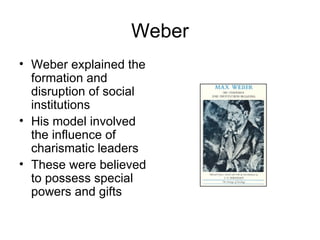
Weber Weber explained the formation and disruption of social institutions His model involved the influence of charismatic leaders These were believed to possess special powers and gifts
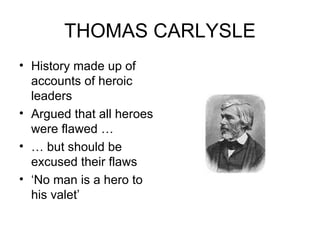
THOMAS CARLYSLE History made up of accounts of heroic leaders Argued that all heroes were flawed … …  but should be excused their flaws ‘ No man is a hero to his valet’
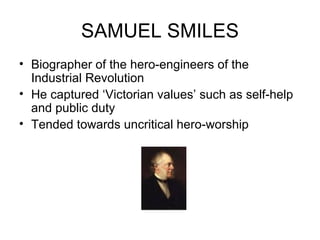
SAMUEL SMILES Biographer of the hero-engineers of the Industrial Revolution He captured ‘Victorian values’ such as self-help and public duty Tended towards uncritical hero-worship
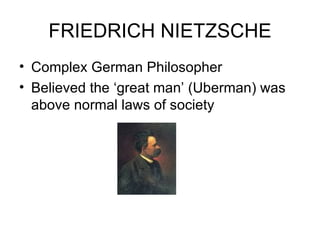
FRIEDRICH NIETZSCHE Complex German Philosopher Believed the ‘great man’ (Uberman) was above normal laws of society
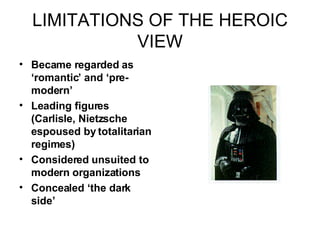
LIMITATIONS OF THE HEROIC VIEW Became regarded as ‘romantic’ and ‘pre-modern’ Leading figures (Carlisle, Nietzsche espoused by totalitarian regimes) Considered unsuited to modern organizations Concealed ‘the dark side’
TRAIT THEORIES Seek the essence of leaders (‘born to lead’) Francis Galton pioneered an empirical  approach anticipating subsequent psychometric methods Studies produced many different traits, failed to establish a ‘universal’ theory Thurstone’s five factors proposal ignored for many years (but partially rehabilitated)
DECLINE IN TRAIT THEORIES  The multiplicity of traits identified became a problem Stogdill’s Handbook called for a new approach (1960s) This helped in the rise of Style theories, and other Transactional theories [Co-editor Bass later associated with transformational leadership]
STOGDILL AND STYLE THEORIES  Stogdill’s group at Ohio State pioneered style (what leaders do) over traits (what leaders are) Labelled main styles as  consideration  [towards others], and  initiation of structure  (‘People, and Task ‘ styles)
DECLINE OF STYLE THEORIES Approach failed to demonstrate a ‘universally effective leadership style’  It overlooked ‘situational’ or contextual effects (which made effectiveness ‘contingent’ or ‘sometimes influenced by’ non-style factors)
STYLE AND CONTINGENCY AS TRANSACTIONAL THEORIES Style and contingency can be seen as transactional theories A transactional leader is the term applied to leaders studied in terms of their behaviours, and specifically in their transactions with others .
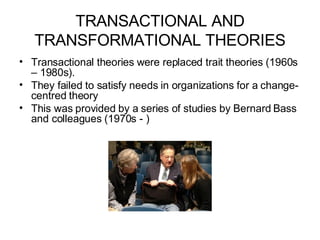
TRANSACTIONAL AND TRANSFORMATIONAL THEORIES Transactional theories were replaced trait theories (1960s – 1980s). They failed to satisfy needs in organizations for a change-centred theory This was provided by a series of studies by Bernard Bass and colleagues (1970s - )
BOTH AND … NOT EITHER/OR Bass and Avolio’s ‘Full Range’ leadership model indicated that transformational leadership was an ‘ add-on ’ not a ‘ replacement for ’ transactional behaviours The factors were important in developing a New Leadership era (1980s)
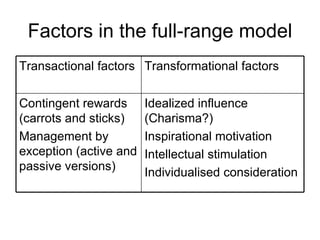
Factors in the full-range model Idealized influence (Charisma?) Inspirational motivation Intellectual stimulation Individualised consideration Contingent rewards (carrots and sticks) Management by exception (active and passive versions) Transformational factors Transactional factors
NEW LEADERSHIP Term was coined by Alan Bryman Became widely-cited Focused on  transformational change   Regarded leaders as  providers of vision   Theory is an  interpretative one
WHAT’S BEYOND NEW LEADERSHIP?  New Leadership left a lot of issues unanswered These include ‘post-charismatic’ ideas such as 5 th -level leadership; distributed leadership; and leaderless groups
Post- charismatic ideas (1990S-) Fifth-level leaders (Jim Collins) were found to be ‘modest but of fierce resolve’ Distributed leadership suggests that a team ‘owns’ different parts of the leadership process Leaderless groups have been proposed as the ‘natural’ condition of informal social activities
Distributed leadership Model The Slone Distributed Leadership Model (DLM) is based on Sensemaking   Relating   Visioning   Inventing  (collaborative designing to realize a shared vision)  DLM ‘seeks to help each leader discover a personal  Change Signature  (an individual approach grounded in personal beliefs)
How many quiz questions are easier to answer now?
To go more deeply Rickards & Clark (2005), Dilemmas of Leadership, Routledge,  http://www.routledge.com/textbooks/0415355850/ Bryman, A., Leadership,  h ttp:// www.amazon.com  /SAGE-Handbook-Organization-Studies/dp/0761949968 http://sloanleadership.mit.edu/pdf/LeadershipinanAgeofUncertainty-researchbrief.pdf

Trends In Leadership Thought

  • 1.
  • 2.
    Quiz (1) How would you define leadership? Where would you expect to find the earliest recorded descriptions of leaders? Who wrote about the lives of great engineers? What assumption lies behind trait theories of leadership What do we remember as Stogdill’s contribution to leadership
  • 3.
    Quiz (2) What assumption lies behind style theories of leadership? Suggest two contrasting leadership styles found in experimental studies What is a contingency theory What leadership style is associated with ‘New Leadership’ theories of the 1980s What is distributed leadership?
  • 4.
    Quiz (3) What leadership concept was central to Weber’s social theorizing? How did the theory re-emerge in later leadership studies? What are usually listed as the historical periods of leadership thought? What led to changes in leadership thought?
  • 5.
    KEY STAGES INLEADERSHIP THOUGHT Heroic leadership Trait based theories Transactional theories (style and situational approaches) The ‘New leadership’ movement (transformation leadership; vision, management of meaning)
  • 6.
    Definitions: It dependswhat you mean by leadership .. Influence processes Mobilizing resources to arouse, engage, satisfy the motives of followers Making sense [of what people are doing] …articulating purpose and values
  • 7.
    HEROIC LEADERSHIP Ancientideas of leadership can be found in all cultures Heroic leaders were historic and mythic figures later analysed by Weber (Charisma) Other 8th/19th century studies examined contemporary and historic figures Influential accounts by Thomas Carlisle, Samuel Smiles, Friedrich Nietzsche
  • 8.
    Weber Weber explainedthe formation and disruption of social institutions His model involved the influence of charismatic leaders These were believed to possess special powers and gifts
  • 9.
    THOMAS CARLYSLE Historymade up of accounts of heroic leaders Argued that all heroes were flawed … … but should be excused their flaws ‘ No man is a hero to his valet’
  • 10.
    SAMUEL SMILES Biographerof the hero-engineers of the Industrial Revolution He captured ‘Victorian values’ such as self-help and public duty Tended towards uncritical hero-worship
  • 11.
    FRIEDRICH NIETZSCHE ComplexGerman Philosopher Believed the ‘great man’ (Uberman) was above normal laws of society
  • 12.
    LIMITATIONS OF THEHEROIC VIEW Became regarded as ‘romantic’ and ‘pre-modern’ Leading figures (Carlisle, Nietzsche espoused by totalitarian regimes) Considered unsuited to modern organizations Concealed ‘the dark side’
  • 13.
    TRAIT THEORIES Seekthe essence of leaders (‘born to lead’) Francis Galton pioneered an empirical approach anticipating subsequent psychometric methods Studies produced many different traits, failed to establish a ‘universal’ theory Thurstone’s five factors proposal ignored for many years (but partially rehabilitated)
  • 14.
    DECLINE IN TRAITTHEORIES The multiplicity of traits identified became a problem Stogdill’s Handbook called for a new approach (1960s) This helped in the rise of Style theories, and other Transactional theories [Co-editor Bass later associated with transformational leadership]
  • 15.
    STOGDILL AND STYLETHEORIES Stogdill’s group at Ohio State pioneered style (what leaders do) over traits (what leaders are) Labelled main styles as consideration [towards others], and initiation of structure (‘People, and Task ‘ styles)
  • 16.
    DECLINE OF STYLETHEORIES Approach failed to demonstrate a ‘universally effective leadership style’ It overlooked ‘situational’ or contextual effects (which made effectiveness ‘contingent’ or ‘sometimes influenced by’ non-style factors)
  • 17.
    STYLE AND CONTINGENCYAS TRANSACTIONAL THEORIES Style and contingency can be seen as transactional theories A transactional leader is the term applied to leaders studied in terms of their behaviours, and specifically in their transactions with others .
  • 18.
    TRANSACTIONAL AND TRANSFORMATIONALTHEORIES Transactional theories were replaced trait theories (1960s – 1980s). They failed to satisfy needs in organizations for a change-centred theory This was provided by a series of studies by Bernard Bass and colleagues (1970s - )
  • 19.
    BOTH AND …NOT EITHER/OR Bass and Avolio’s ‘Full Range’ leadership model indicated that transformational leadership was an ‘ add-on ’ not a ‘ replacement for ’ transactional behaviours The factors were important in developing a New Leadership era (1980s)
  • 20.
    Factors in thefull-range model Idealized influence (Charisma?) Inspirational motivation Intellectual stimulation Individualised consideration Contingent rewards (carrots and sticks) Management by exception (active and passive versions) Transformational factors Transactional factors
  • 21.
    NEW LEADERSHIP Termwas coined by Alan Bryman Became widely-cited Focused on transformational change Regarded leaders as providers of vision Theory is an interpretative one
  • 22.
    WHAT’S BEYOND NEWLEADERSHIP? New Leadership left a lot of issues unanswered These include ‘post-charismatic’ ideas such as 5 th -level leadership; distributed leadership; and leaderless groups
  • 23.
    Post- charismatic ideas(1990S-) Fifth-level leaders (Jim Collins) were found to be ‘modest but of fierce resolve’ Distributed leadership suggests that a team ‘owns’ different parts of the leadership process Leaderless groups have been proposed as the ‘natural’ condition of informal social activities
  • 24.
    Distributed leadership ModelThe Slone Distributed Leadership Model (DLM) is based on Sensemaking Relating Visioning Inventing (collaborative designing to realize a shared vision) DLM ‘seeks to help each leader discover a personal Change Signature (an individual approach grounded in personal beliefs)
  • 25.
    How many quizquestions are easier to answer now?
  • 26.
    To go moredeeply Rickards & Clark (2005), Dilemmas of Leadership, Routledge, http://www.routledge.com/textbooks/0415355850/ Bryman, A., Leadership, h ttp:// www.amazon.com /SAGE-Handbook-Organization-Studies/dp/0761949968 http://sloanleadership.mit.edu/pdf/LeadershipinanAgeofUncertainty-researchbrief.pdf