Does Leadership 
Development need to 
change?
Harvard Business School
70:20:10 
Tough jobs People (mainly boss) 
Coaching, mentoring. 
Social networks 
Action Learning 
360 feedback 
Formal training, books
“Competencies–they don’t add value.” 
Competencies
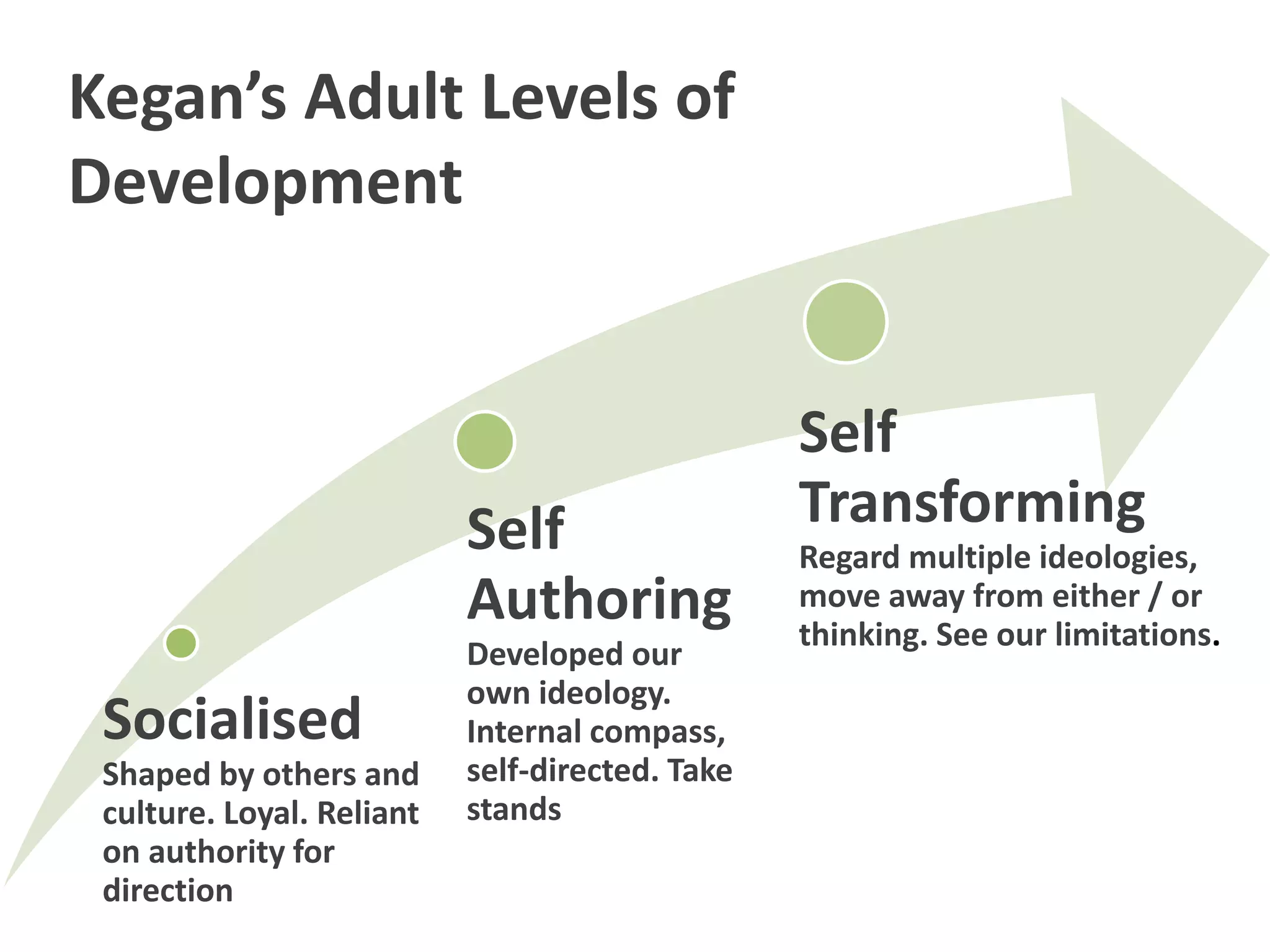
Socialised 
Shaped by others and 
culture. Loyal. Reliant 
on authority for 
direction 
Self 
Authoring 
Developed our 
own ideology. 
Internal compass, 
self-directed. Take 
stands 
Self 
Transforming 
Regard multiple ideologies, 
move away from either / or 
thinking. See our limitations. 
Kegan’s Adult Levels of 
Development
Autonomy over 
development 
The manager chooses what to focus 
on, not the coach. 
The process is customized for each 
person. 
The coach guides the process 
(through questions) 
The coach is a thinking partner, not 
an authority/expert. 
There is no “content” to cover. 
It is a developmental process over 
time, not an event.
While many organisations say that 
they need leaders at all levels of the 
business, a number of interviewees 
pointed out that this statement 
appears inconsistent with their 
practices, as long as they continue to 
train and develop only their “elite” 
managers.
A development partner whose main role is to innovate new 
structures and processes for development….shift 
responsibility for developing leaders away from HR and 
toward the current leaders of the organisation….. For 
L&D professionals this would mean partnering with 
senior leaders to build a true culture of development.
Emphasis on ethics in Leadership 
Innovation in development methods 
Vertical as well as horizontal development 
Self-directed learning 
Expand the reach of leadership development beyond the 
elite
£16,000 
per year
92% drop out rate
Flipped Classroom 
Students watch lectures before 
class 
Class time is spent on applied 
learning, higher order thinking skills 
Traditional Classroom 
Teacher lectures, students take 
notes 
Students apply knowledge and 
demonstrate understanding in 
homework
Quanta Leadership Development Forum 
17th March 2015

Future trends in leadership development

  • 1.
  • 2.
  • 3.
    70:20:10 Tough jobsPeople (mainly boss) Coaching, mentoring. Social networks Action Learning 360 feedback Formal training, books
  • 4.
    “Competencies–they don’t addvalue.” Competencies
  • 6.
    Socialised Shaped byothers and culture. Loyal. Reliant on authority for direction Self Authoring Developed our own ideology. Internal compass, self-directed. Take stands Self Transforming Regard multiple ideologies, move away from either / or thinking. See our limitations. Kegan’s Adult Levels of Development
  • 7.
    Autonomy over development The manager chooses what to focus on, not the coach. The process is customized for each person. The coach guides the process (through questions) The coach is a thinking partner, not an authority/expert. There is no “content” to cover. It is a developmental process over time, not an event.
  • 9.
    While many organisationssay that they need leaders at all levels of the business, a number of interviewees pointed out that this statement appears inconsistent with their practices, as long as they continue to train and develop only their “elite” managers.
  • 10.
    A development partnerwhose main role is to innovate new structures and processes for development….shift responsibility for developing leaders away from HR and toward the current leaders of the organisation….. For L&D professionals this would mean partnering with senior leaders to build a true culture of development.
  • 11.
    Emphasis on ethicsin Leadership Innovation in development methods Vertical as well as horizontal development Self-directed learning Expand the reach of leadership development beyond the elite
  • 12.
  • 14.
  • 15.
    Flipped Classroom Studentswatch lectures before class Class time is spent on applied learning, higher order thinking skills Traditional Classroom Teacher lectures, students take notes Students apply knowledge and demonstrate understanding in homework
  • 16.
    Quanta Leadership DevelopmentForum 17th March 2015

Editor's Notes

  • #2 I will be referring to a recent white paper – Future Trends in LD by CCL
  • #3 So how are leaders currently developed? Well in USA – many of them come from this place What They Teach You at Harvard Business School by Philip Delves Broughton They talk about leadership - mission – “We educate leaders who make a difference in the world”. – yet grow hedge fund managers and investment bankers and venture capitalists. Introduced Corporate course accountability in 2003 but in 2006 when he graduated he said that this was an unpopular course shunned by most students as unnecessary and not going to help them make lots of money Handbook for Teaching Leadership - ” an economic narrative that dominates business school thinking … gives a distorted view of the fundamentals of leadership” But of course certainly in the UK most of us don’t learn what we know from Harvard. Unless we have enrolled for a MOOC of course
  • #4 Assuming we’re not at Harvard - how do the rest of us learn to lead? Well those in L & D probably familiar with this formula – not framework, - my personal life - true 70% - running Quanta, if interested biggest lesson – employ the right people, everything else is easier 20% - Julian - lucky, colleagues, associates, (coaching?), observing 10% - formal – leadership trust – not sure what I learnt –sleep deprivation is not conducive to leadership - enjoyable, train the trainer – learnt much more in classroom – Learn by mistakes – be present , rather than perfect
  • #5  So what did the respondents to the CCL survey say they didn’t like – well competencies “competencies don’t add value” some said although most agreed they had a place but should be de-emphasised. Whilst I understand what they are saying I can’t help but think what a world without leaders trained in competencies would be like. – a world of Incompetent.
  • #6 So what do they suggest in its place: Leaders need to become more adaptive they say to deal with this collaborative environment. They need to be open to the views and expertise of others. They need not to develop competencies but meta-competencies Horizontal development is the expansion of knowledge and skills but we make sense of these new skills from the same perspective, the same framework Vertical development is transforming the way we see the world which allows us a new way of making sense of everything that surrounds us. Horizontal development is like filling up a bucket with more water, whereas vertical development is growing the capacity of the bucket.
  • #7 Robert Kegan, Harvard professor – which a lot of this is based upon 3–Socialized mind: At this level we are shaped by the expectations of those around us. What we think and say is strongly influenced by what we think others want to hear. • 4–Self-authoring mind: We have developed our own ideology or internal compass to guide us. Our sense of self is aligned with our own belief system, personal code, and values. We can take stands, set limits on behalf of our own internal “voice.” • 5–Self-transforming mind: We have our own ideology, but can now step back from that ideology and see it as limited or partial. We can hold more contradiction and oppositeness in our thinking and no longer feel the need to gravitate towards polarized thinking. Frederic Laloux - Reinventing Organisations - suggests that humanity is undergoing these stages of development and that we are entering another – so organisations need to develop – Morning Star Tomatoes We at Quanta have always tried to develop both.
  • #8 Focus group – most successful – exclusive, limited spaces, apply
  • #9 And CCL suggest that whilst leaders will still remain -much Like we saw in the Douglas Kirkpatrick video, they believe that organisational structures are changing with an ever increasing importance of supplier and customer relationships and internal relationships that will start to change from this… to more like this so if we move to a more of a collective sense of leadership where everyone is a leader this means that certain organisations will have to change their behaviours when it comes to leadership development:
  • #10 Spending on leadership development remains very high.  As in prior years the research shows that the #1 areas of spending is management and leadership (35%). US spending on corporate training grew by 15% last year (the highest growth rate in seven years) to over $70 Billion in the US 
  • #11 Partnering with leaders – GE Innovation Facilitating learning rather than simply putting on training sessions L & D depts need to expand opportunities – not just focus on 10%
  • #12 So are we going to see the disappearance of leaders over the next few years? I think that’s unlikely. There’s too much self-interest for a start. And old systems take a while to collapse - reinstated in Egypt - but I am convinced we will see a shift towards many more collaborative organisations. More Wikipedias and Linuxs, More Morning Stars, more employee ownership. Because if nothing else the people want it. Perhaps we won’t call leaders, “leaders” in the future 0 but we’ll call them - enablers, experts, founders, Ethics – cannot afford repeats of financial crisis, scandals rocked corporate world - a move away from the economic narrative Innovative – chalk and talk not sufficient as we’ve known for along time but online has its flaws as well. But a move towards a Collective leadership model means that everyone needs competencies and self-awareness So that’s the end of that but I want to end with something tangible you can take away and to do that I want take a look two key recent developments in the wider world of education that I don’t think anyone in L & D can ignore
  • #13 Working at university last year Universities are now charging high fees, meaning that many potential students are looking at other options. Andrew Hamilton, vice-chancellor of Oxford University is pushing for an increase too for the Russell Group Universities. At the moment it costs the same money to go to Oxford or Worcester
  • #14 On the flip side we’ve seen the meteoric rise of online training, much of it free, with organisations like Coursera, EDX (founded by MIT & Harvard) offering MOOCs. So perhaps in the future many of us will be studying at Harvard 3 million people registered on Coursera in its first year 2012 - 13% in business, 23 per cent in IT and nearly 5% of students from UK. These two seemingly disparate moves in education have big implications for anyone involved in training. Why would I pay a private training company a £1000 for a week of training when I could get taught the same subject in my own time by Harvard professors for free? well I’ll tell you why We can’t ignore this rise in free online learning . Secondly I believe like any challenges they present opportunities, because there is a problem with MOOCs –
  • #15 For example, Duke Universitys Fall 2012 offering of Bioelectricity had 12,175 students registered. However, only 7,761 students ever watched a video, 3,658 students took at least one quiz, 345 students attempted the final exam, and finally only 313 passed with a certificate Stats from Wharton. University of Pennsylvania Even so these are key developments that we ignore at our peril and we’ll come back to later Face the threat of free education - opportunities of university fees - training companies and corporations that used to offer graduate programmes should now offer degrees MOOCs part of future but cannot replace all classroom for 2 reasons : engagement (drop out rates) and practise – e.g negotiation, difficult conversations. Flipped classroom and that’s where I want to end really on something that we here at Quanta are working on.
  • #16 And this is where I am certainly placing my efforts over the next few months