The Sternoclavicular Joint (SCJ)
Great White Shark,
Port Lincoln, 2016
Declaration of Interest
I declare that in the past three years:
• held shares in : Nil
• received royalties from: Nil
• done consulting work for: Nil
• given paid presentation for: Nil
• received institutional support from: Nil
• Signed: Ash Moaveni
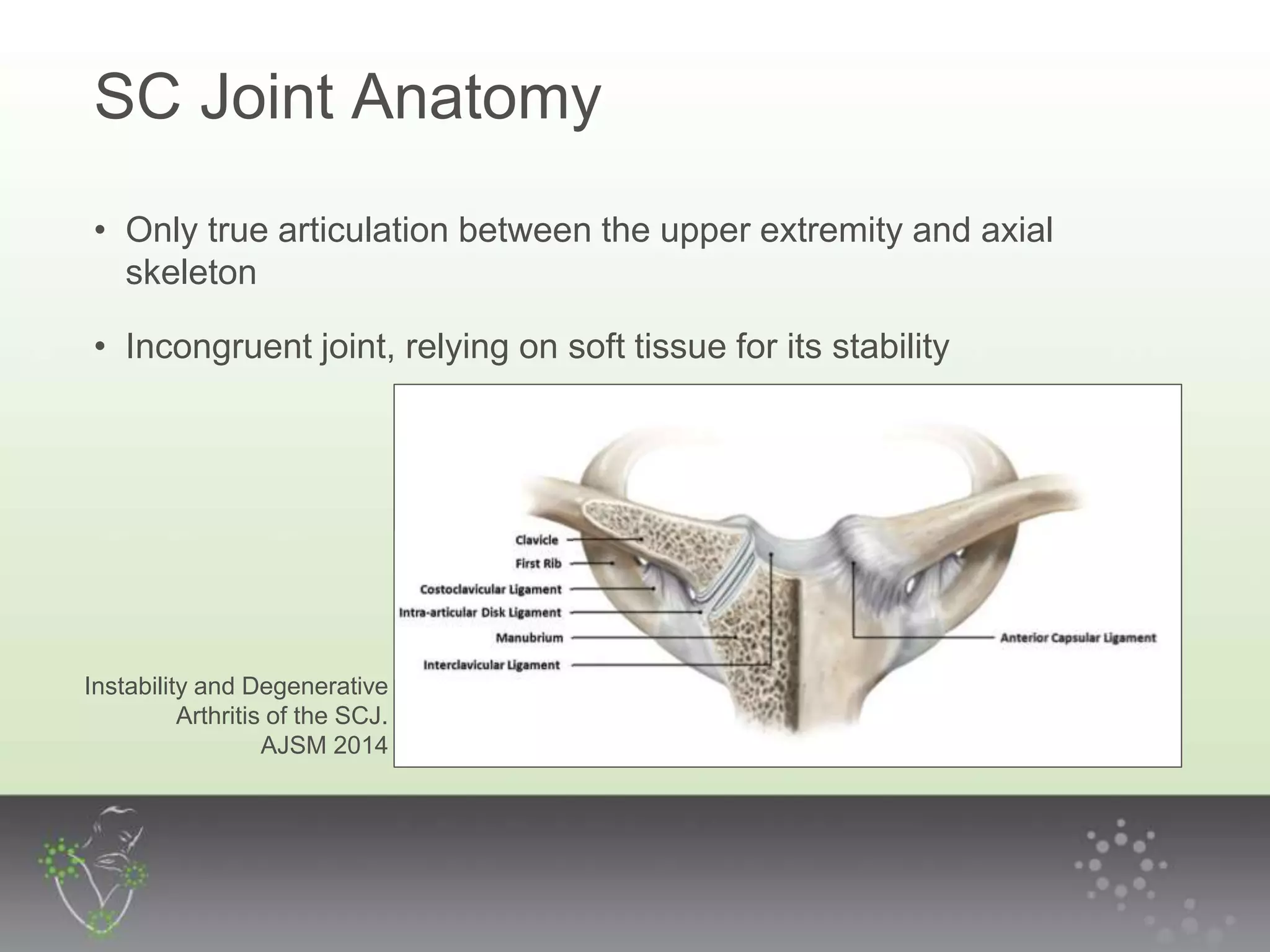
SC Joint Anatomy
Instability and Degenerative
Arthritis of the SCJ.
AJSM 2014
• Only true articulation between the upper extremity and axial
skeleton
• Incongruent joint, relying on soft tissue for its stability
SC Joint Anatomy
• Medial epiphysis is the last of
the long bones to appear (18-
20) and close (23-25)
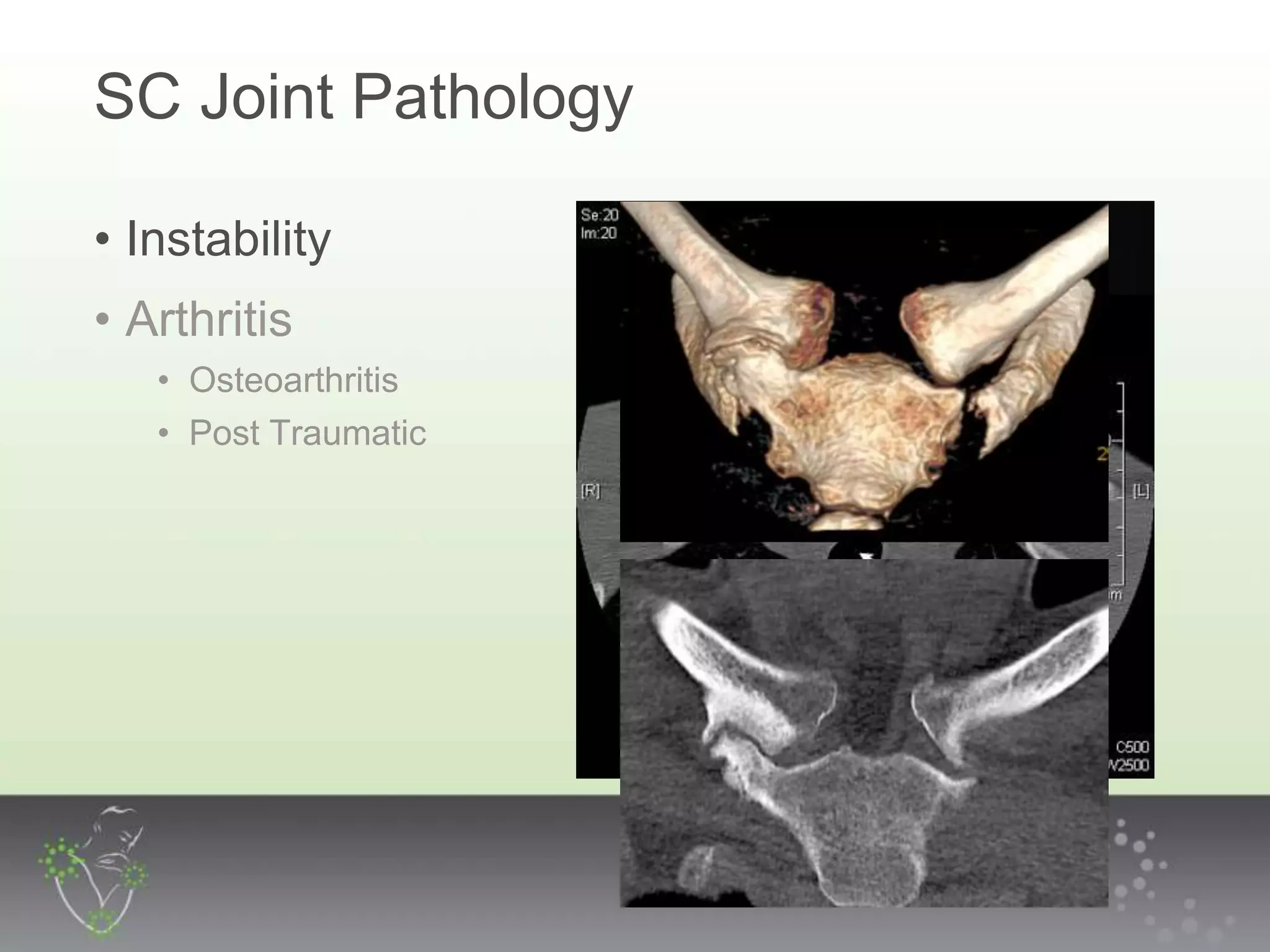
SC Joint Pathology
• Instability
• Arthritis
• Osteoarthritis
• Post Traumatic
SC Joint Instability - Classification
Direction - Anterior
Anterior dislocation of
the right SC joint
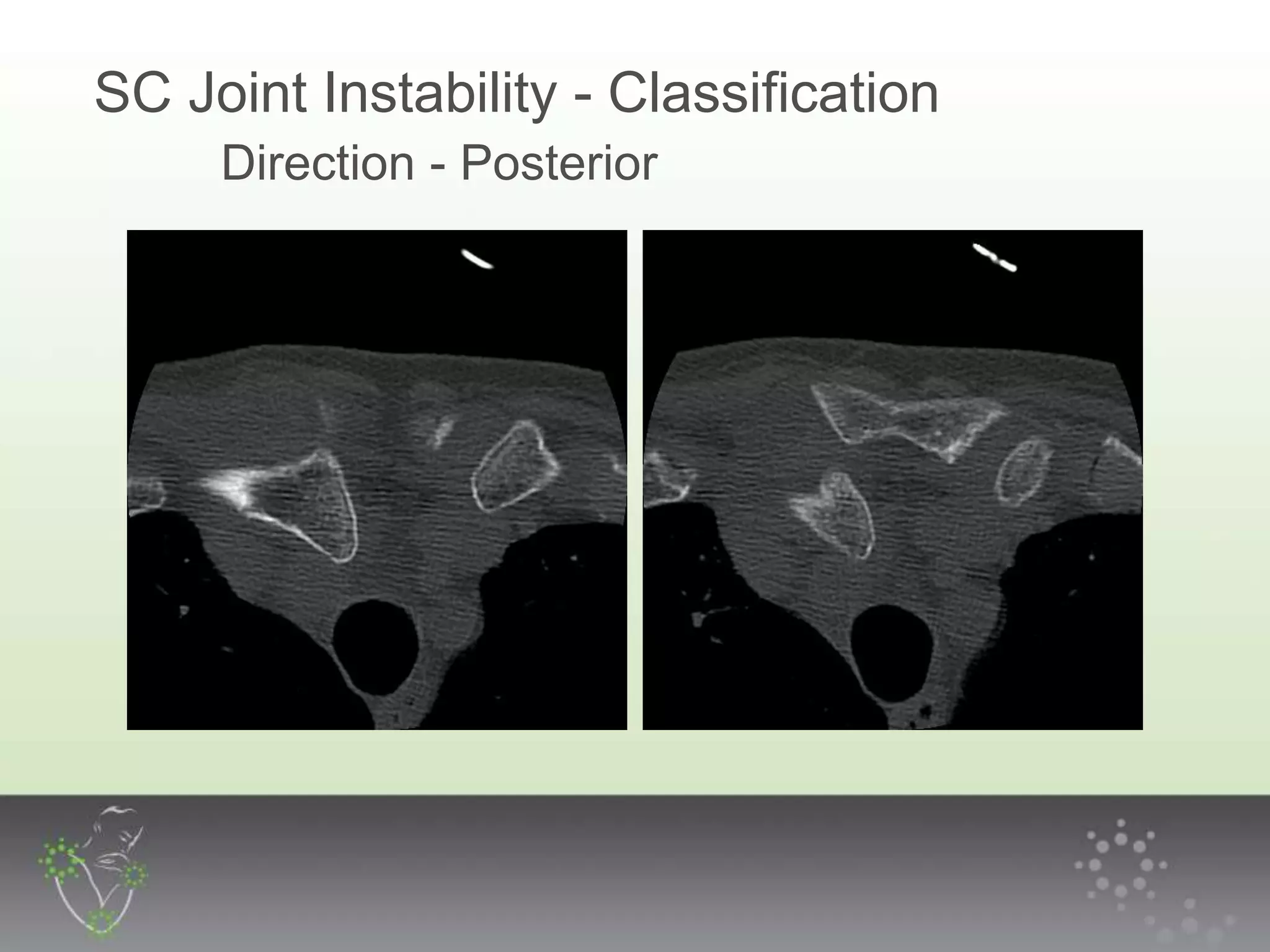
SC Joint Instability - Classification
Direction - Posterior
SC Joint Instability - Classification
Direction - Superior
Management and
functional outcomes
following SCJ
dislocation. Injury 2015.
SC Joint Instability - Classification
• Direction
• Anterior/Posterior/
Superior
• Cause
• Traumatic/Atraumatic
With shoulder in extension,
medial end of right clavicle is
prominent
SC Joint Instability - Classification
• Direction
• Anterior/Posterior/
Superior
• Cause
• Traumatic/Atraumatic
• Chronicity
• Acute/Chronic
• Severity
• Sprain/Subluxation/
Dislocation
SC Joint Instability - Evaluation
• High energy trauma
• Football
• MVA
• Mediastinal compromise
• Up to 50%
• Examination
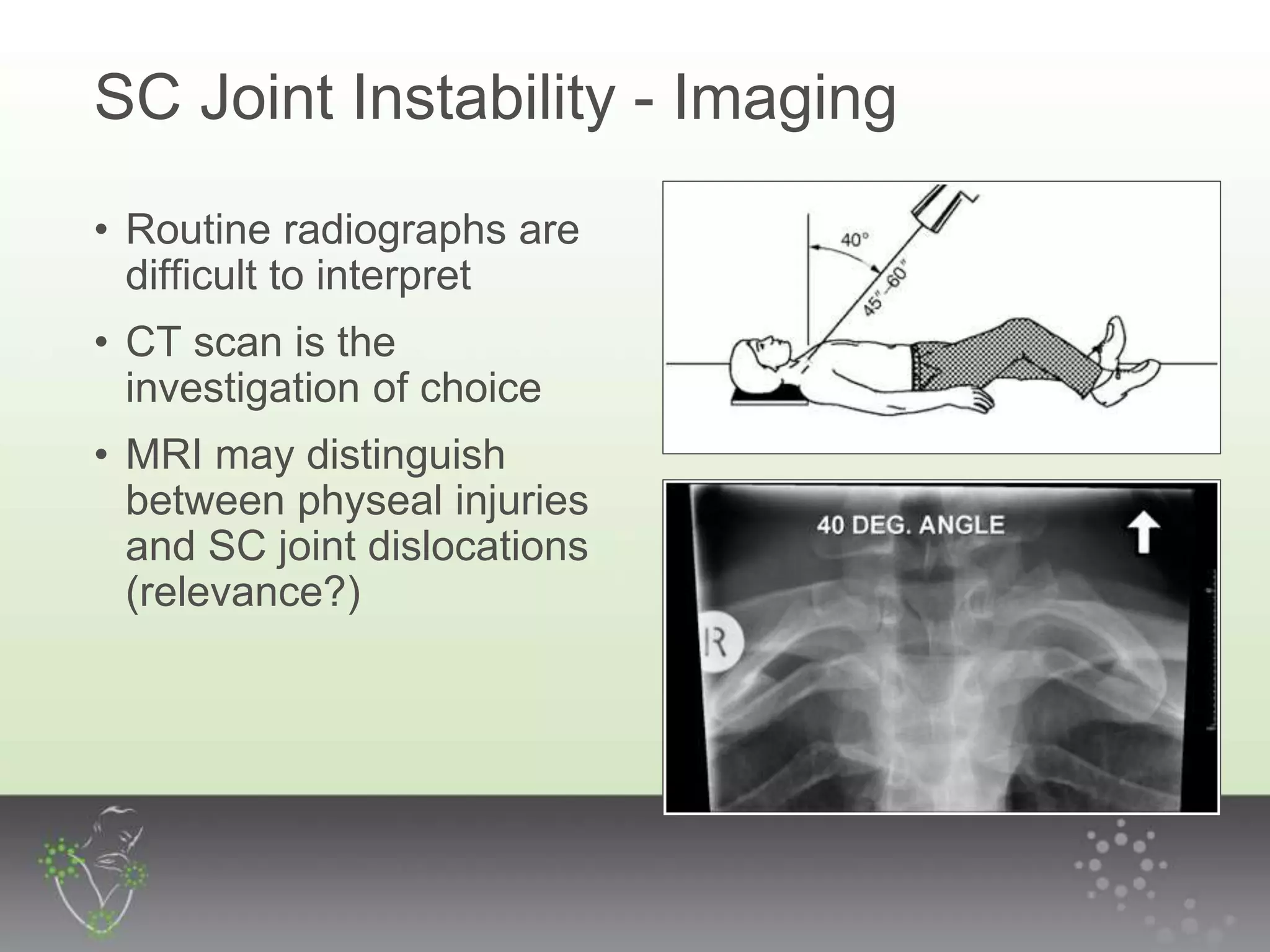
SC Joint Instability - Imaging
• Routine radiographs are
difficult to interpret
• CT scan is the
investigation of choice
• MRI may distinguish
between physeal injuries
and SC joint dislocations
(relevance?)
SC Joint Instability – 4D CT
SC Joint Instability - Acute
Traction
• Majority of SCJ injuries are managed non-operatively
• There is role for reduction of acute posterior SC joint
dislocations
• Patients with mediastinal compromise
CombinationTowel Clamp
Difficult to achieve reduction with closed manoeuvres
SC Joint Instability - Acute
• Open reduction may be
justified given the high
failure rate of closed
reduction
• Have a cardiothoracic
surgeon available
• Secure fixation with
Mersilene Tape
• Avoid hardware if at all possible
SC Joint Instability - Acute
• Open reduction may be
justified given the high
failure rate of closed
reduction
• Have a cardiothoracic
surgeon available
• Secure fixation with
Mersilene Tape
• Avoid hardware if at all possible
Dr. Sergei, Cardiothoracic
Surgeon
SC Joint Instability - Acute
• Open reduction may be
justified given the high
failure rate of closed
reduction
• Have a cardiothoracic
surgeon available
• Secure fixation with
Mersilene Tape
• Avoid hardware if at all possible
Dr. Sergei, Cardiothoracic
Surgeon
SC Joint Instability - Acute
• Open reduction may be
justified given the high
failure rate of closed
reduction
• Have a cardiothoracic
surgeon available
• Secure fixation with
Mersilene Tape
• Avoid hardware if at all
possible
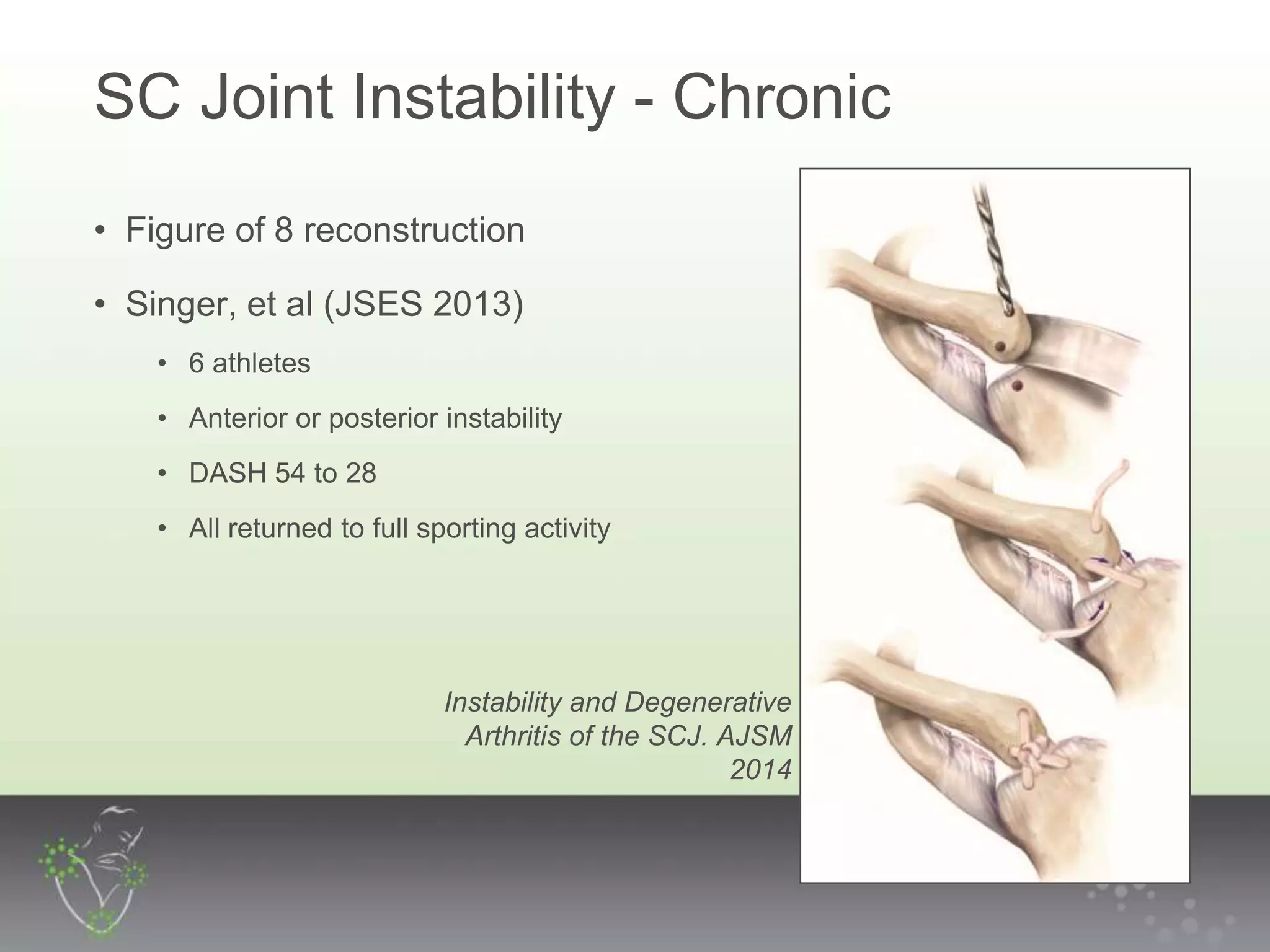
SC Joint Instability - Outcome
• 22 patients with acute SCJ
dislocations
• Average 3.5 years follow up (1-9
years)
• SSV 88%, ASES 94
• Results maintained over time
• Anterior chest avulsion (SSV
50%, ASES 62)
Anterior chest avulsion
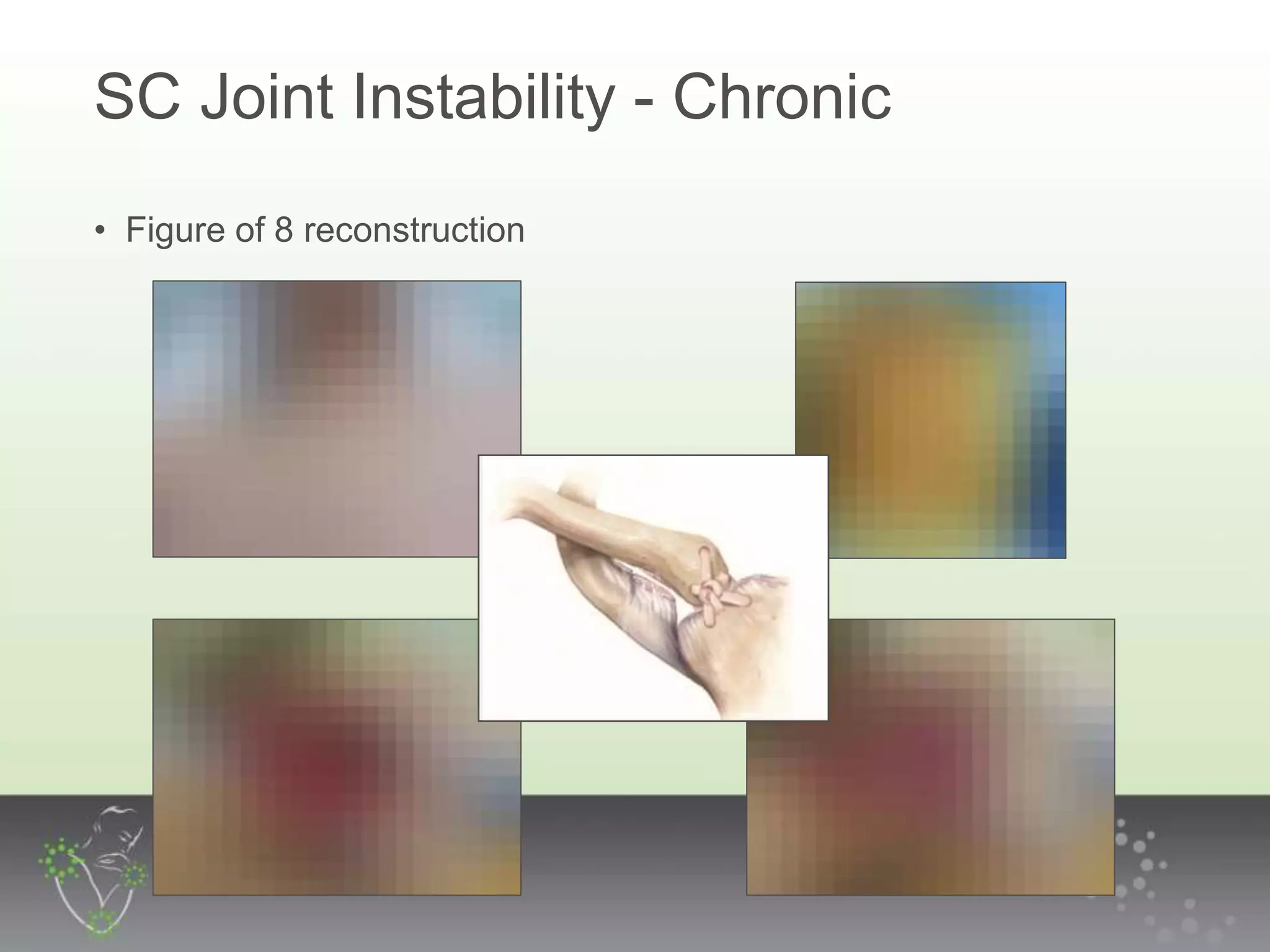
SC Joint Instability - Chronic
• Figure of 8 reconstruction
• Singer, et al (JSES 2013)
• 6 athletes
• Anterior or posterior instability
• DASH 54 to 28
• All returned to full sporting activity
Instability and Degenerative
Arthritis of the SCJ. AJSM
2014
SC Joint Instability - Chronic
• Figure of 8 reconstruction
SC Joint Pathology
• Instability
• Arthritis
• Osteoarthritis
• Post Traumatic
SC Joint Arthritis
• Non operative Management
• Rest/Ice
• NSAIDs
• Activity modification
• I/A Cortisone
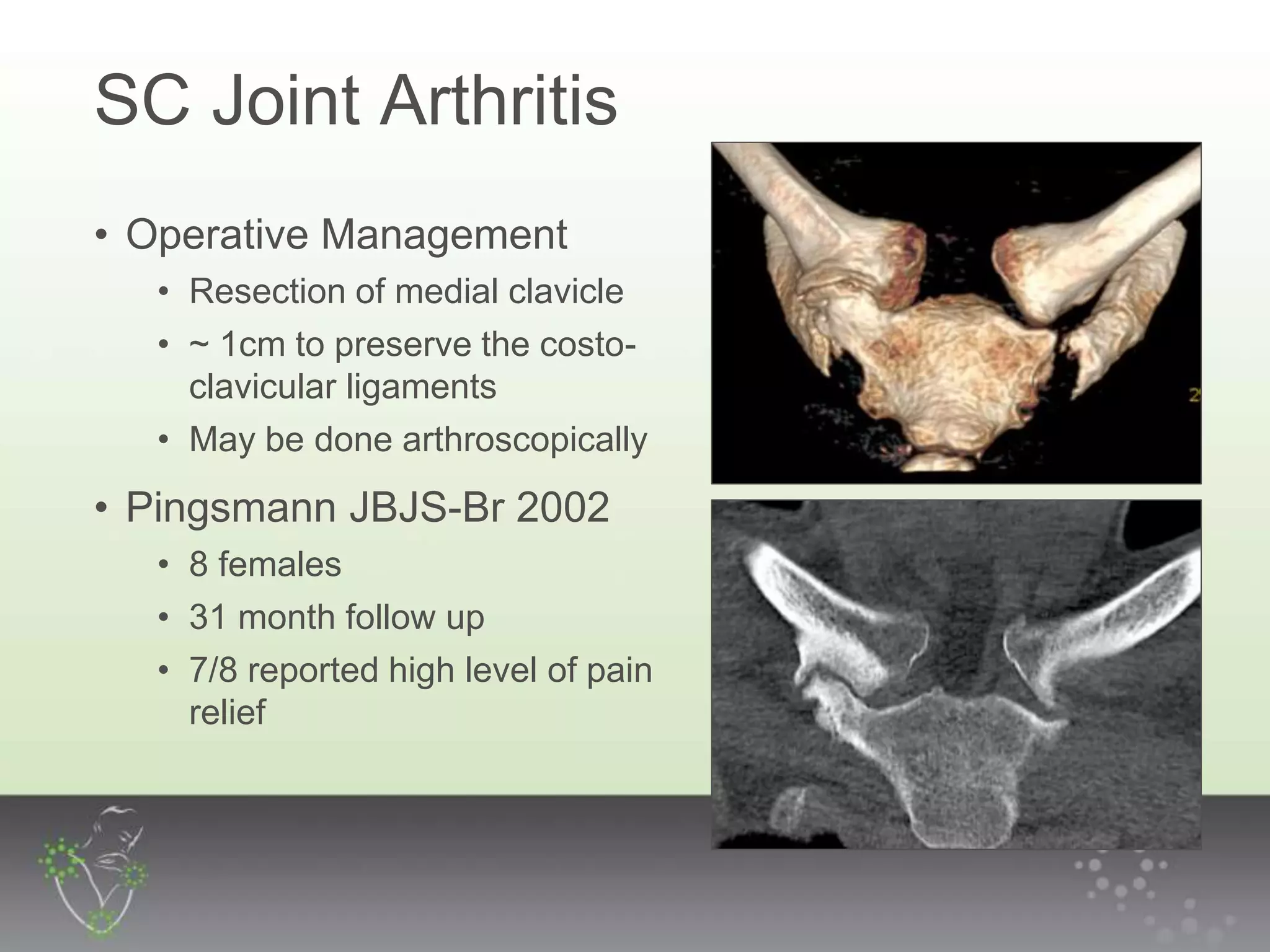
SC Joint Arthritis
• Operative Management
• Resection of medial clavicle
• ~ 1cm to preserve the costo-
clavicular ligaments
• May be done arthroscopically
• Pingsmann JBJS-Br 2002
• 8 females
• 31 month follow up
• 7/8 reported high level of pain
relief
Is it safe?
• Be prepared
• Cardiothoracic Support
• What to do
• Reverse Trendelenburg
• Moist pack in the wound to avoid an
air embolus
• Osteotomy of the clavicle for surgical
access
In Conclusion
• Majority of SC joint dislocations are
anterior and can be managed non
operatively
• SC joint arthritis may be painful
and can be treated with surgical
excision
Ash Moaveni, Melbourne
ash@moaveni.com.au

The Sternoclavicular Joint

  • 1.
    The Sternoclavicular Joint(SCJ) Great White Shark, Port Lincoln, 2016
  • 2.
    Declaration of Interest Ideclare that in the past three years: • held shares in : Nil • received royalties from: Nil • done consulting work for: Nil • given paid presentation for: Nil • received institutional support from: Nil • Signed: Ash Moaveni
  • 3.
    SC Joint Anatomy Instabilityand Degenerative Arthritis of the SCJ. AJSM 2014 • Only true articulation between the upper extremity and axial skeleton • Incongruent joint, relying on soft tissue for its stability
  • 4.
    SC Joint Anatomy •Medial epiphysis is the last of the long bones to appear (18- 20) and close (23-25)
  • 5.
    SC Joint Pathology •Instability • Arthritis • Osteoarthritis • Post Traumatic
  • 6.
    SC Joint Instability- Classification Direction - Anterior Anterior dislocation of the right SC joint
  • 7.
    SC Joint Instability- Classification Direction - Posterior
  • 8.
    SC Joint Instability- Classification Direction - Superior Management and functional outcomes following SCJ dislocation. Injury 2015.
  • 9.
    SC Joint Instability- Classification • Direction • Anterior/Posterior/ Superior • Cause • Traumatic/Atraumatic With shoulder in extension, medial end of right clavicle is prominent
  • 10.
    SC Joint Instability- Classification • Direction • Anterior/Posterior/ Superior • Cause • Traumatic/Atraumatic • Chronicity • Acute/Chronic • Severity • Sprain/Subluxation/ Dislocation
  • 11.
    SC Joint Instability- Evaluation • High energy trauma • Football • MVA • Mediastinal compromise • Up to 50% • Examination
  • 12.
    SC Joint Instability- Imaging • Routine radiographs are difficult to interpret • CT scan is the investigation of choice • MRI may distinguish between physeal injuries and SC joint dislocations (relevance?)
  • 13.
  • 14.
    SC Joint Instability- Acute Traction • Majority of SCJ injuries are managed non-operatively • There is role for reduction of acute posterior SC joint dislocations • Patients with mediastinal compromise CombinationTowel Clamp Difficult to achieve reduction with closed manoeuvres
  • 15.
    SC Joint Instability- Acute • Open reduction may be justified given the high failure rate of closed reduction • Have a cardiothoracic surgeon available • Secure fixation with Mersilene Tape • Avoid hardware if at all possible
  • 16.
    SC Joint Instability- Acute • Open reduction may be justified given the high failure rate of closed reduction • Have a cardiothoracic surgeon available • Secure fixation with Mersilene Tape • Avoid hardware if at all possible Dr. Sergei, Cardiothoracic Surgeon
  • 17.
    SC Joint Instability- Acute • Open reduction may be justified given the high failure rate of closed reduction • Have a cardiothoracic surgeon available • Secure fixation with Mersilene Tape • Avoid hardware if at all possible Dr. Sergei, Cardiothoracic Surgeon
  • 18.
    SC Joint Instability- Acute • Open reduction may be justified given the high failure rate of closed reduction • Have a cardiothoracic surgeon available • Secure fixation with Mersilene Tape • Avoid hardware if at all possible
  • 19.
    SC Joint Instability- Outcome • 22 patients with acute SCJ dislocations • Average 3.5 years follow up (1-9 years) • SSV 88%, ASES 94 • Results maintained over time • Anterior chest avulsion (SSV 50%, ASES 62) Anterior chest avulsion
  • 20.
    SC Joint Instability- Chronic • Figure of 8 reconstruction • Singer, et al (JSES 2013) • 6 athletes • Anterior or posterior instability • DASH 54 to 28 • All returned to full sporting activity Instability and Degenerative Arthritis of the SCJ. AJSM 2014
  • 21.
    SC Joint Instability- Chronic • Figure of 8 reconstruction
  • 22.
    SC Joint Pathology •Instability • Arthritis • Osteoarthritis • Post Traumatic
  • 23.
    SC Joint Arthritis •Non operative Management • Rest/Ice • NSAIDs • Activity modification • I/A Cortisone
  • 24.
    SC Joint Arthritis •Operative Management • Resection of medial clavicle • ~ 1cm to preserve the costo- clavicular ligaments • May be done arthroscopically • Pingsmann JBJS-Br 2002 • 8 females • 31 month follow up • 7/8 reported high level of pain relief
  • 25.
    Is it safe? •Be prepared • Cardiothoracic Support • What to do • Reverse Trendelenburg • Moist pack in the wound to avoid an air embolus • Osteotomy of the clavicle for surgical access
  • 26.
    In Conclusion • Majorityof SC joint dislocations are anterior and can be managed non operatively • SC joint arthritis may be painful and can be treated with surgical excision Ash Moaveni, Melbourne ash@moaveni.com.au