Presented by :
Dr. Sujay Patil
M.D.S Part I
 Introduction
 The Golden Hour
 Trauma care staging
 Pre hospital stage
 B.L.S
 Triage
 Preparation at receiving hospital
 Initial assessment of the patient
 Primary survey and Resuscitation
 A.T.L.S
 Secondary survey
 Maxillofacial aspects
 Of all trauma deaths, 50% occur within minutes at the
site of the accident. However statistically for every
trauma death 200 other patients sustain injuries
requiring medical attention and of these 24 will require
hospitalisation.
 In an article published in The Times of India, according
to a WHO survey, India leads the world in road deaths.
Around 1,50,000 people lose there lives every year in
RTA’s, which they say is actually half the number
because of many unaccounted deaths. Half a million
people receive serious but non fatal injuries.
 Andhra pradesh followed by Maharashtra are the states
leading in RTA deaths.
4
△ Road traffic accident (RTA)
35-60%
Rowe and Killey 1968;
Vincent-Towned and Shepherd 1994
△ Fight and assault (interpersonal violence)
△ Sport and athletic injuries
△ Industrial accidents
△ Domestic injuries and falls
 Origin of the term
 Late Dr. R Adams Cowley is credited with
promoting this concept, first in his capacity as
a military surgeon and later as head of the
University of Maryland Shock Trauma Center.
The concept of the "Golden Hour" may have
been derived from French military World War
I data .
 The R Adams Cowley Shock Trauma Center
section of the University of Maryland Medical
Center’s website quotes Cowley as saying,
"There is a golden hour between life and
death. If a patient is critically injured he has
less than 60 minutes to survive. He may not
die right then; it may be a few days, weeks, a
month or a year later -- but something has
happened in its body that is irreparable.
 Golden Hour may be defined as the period
during which all efforts are made to save a life
before irreversible pathological changes can
occur thereby reducing or preventing death in
the second and third phase. This period may
range from the time of injury to definitive
treatment in a hospital.
Pre Hospital Care
Basic Life Support
Triage
Preparation at receiving hospital
Hospital Care
Initial assessment of the patient
Primary survey and Resuscitation
A.T.L.S
Secondary survey
Hospital rehabilitation
Rescue workers like doctors, ambulance crews,
fire fighters, or any other trained person in
BLS are the front runners for pre hospital care.
They primarily handle airway, respiratory
support, immobilisation of patient and control
of external bleeding and shock which require
urgent attention in saving a life. This group
generally covers the “Platinum 10 Minutes”.
 The first 10 Platinum Minutes become
important to make this golden hour effective
and should be distributed as follows to make it
fruitful.
 Assessment of the victim and primary survey
1 minute
 Resuscitation and stabilization 5 minutes
 Immobilization and transport to nearby
hospital 4 minutes
 CPR is a emergency procedure that can be
used to maintain some blood flow to the brain,
heart, and other vital organs until trained
medical personnel are available to provide
more advanced treatment. It involves
performing a series of chest compressions and
rescue breathing after establishing a clear
airway.
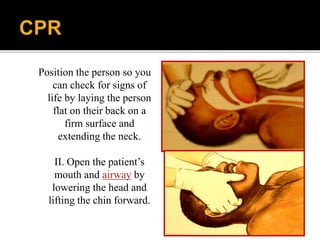
Position the person so you
can check for signs of
life by laying the person
flat on their back on a
firm surface and
extending the neck.
II. Open the patient’s
mouth and airway by
lowering the head and
lifting the chin forward.
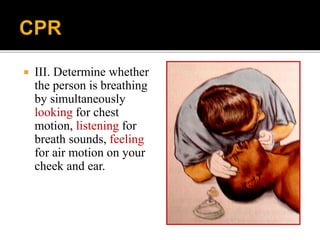
 III. Determine whether
the person is breathing
by simultaneously
looking for chest
motion, listening for
breath sounds, feeling
for air motion on your
cheek and ear.
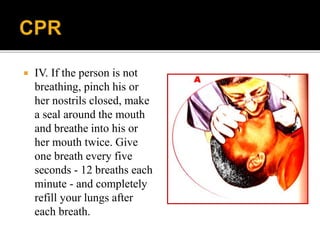
 IV. If the person is not
breathing, pinch his or
her nostrils closed, make
a seal around the mouth
and breathe into his or
her mouth twice. Give
one breath every five
seconds - 12 breaths each
minute - and completely
refill your lungs after
each breath.
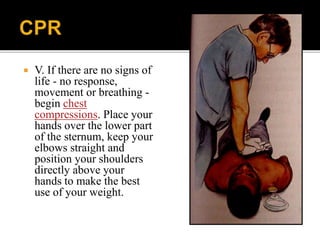
 V. If there are no signs of
life - no response,
movement or breathing -
begin chest
compressions. Place your
hands over the lower part
of the sternum, keep your
elbows straight and
position your shoulders
directly above your
hands to make the best
use of your weight.
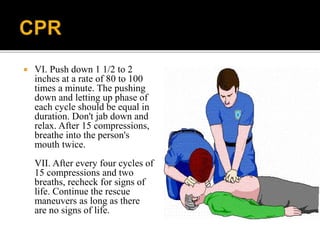
 VI. Push down 1 1/2 to 2
inches at a rate of 80 to 100
times a minute. The pushing
down and letting up phase of
each cycle should be equal in
duration. Don't jab down and
relax. After 15 compressions,
breathe into the person's
mouth twice.
VII. After every four cycles of
15 compressions and two
breaths, recheck for signs of
life. Continue the rescue
maneuvers as long as there
are no signs of life.
 Triage is the sorting of patients based on the
level for treatment needed and the available
resources to provide that treatment.
 Triage is a very important decisive criteria
when management of mass and multiple
casualties is needed.
 It basically aims on management of patients
with greatest chance of survival first, with
least expenditure of time, supplies, equipment
and personnel.
18
 Pre-hospital care (field triage)
Care delivered by fully trained paramedic in maintaining airway, controlling
cervical spine, securing intravenous and initiating fluid resuscitation
 Hospital care (inter-hospital triage)
Senior medical staff organized team to ensure that medical resources are
deployed to maximum overall benefit
 Mass casualty triage
triage decisions are crucial in
determining individual patients survival
 The trauma centre must be fully equipped and staffed
resuscitation room, with comprehensive backup of all
the necessary support teams such as radiology, blood
bank, ICU, etc.
 Basic trauma team should comprise of Specialist
Anaesthetic, Cranio-Maxillofacial surgeon along with
General, Orthopaedic , Neuro and Cardiothoracic
surgeons plus paramedics and nurses.
 The absolute minimum in a resuscitation room should
be rubber latex gloves, plastic aprons and eye
protection, considering any blood or body fluid to be
HIV or HBsAg positive.
 Deaths following trauma follow a trimodal
distribution.
 The initial assessment generally defines 3
Peaks
 First peak
Occurs within seconds or minutes of the
injury.
death generally follows as a result of
• Lacerations of the brain
• Brain stem
• High spinal cord
• Heart, Aorta or any large blood vessels
 Second peak
Occurs between a few minutes after injury to
about one hour later (golden hour)
Deaths are generally due to
• Severe chest injuries with Hemothorax
• Cardiac tamponade
• Abdominal trauma with a ruptured Spleen
• Lacerations of the liver
• Fractures particularly Pelvic or with other
multiple major bones.
 Third peak
Occurs some days or weeks after injury as a
result of
• Multi organ failure
• Respiratory distress
• Sepsis
 Airway maintainance and Cervical spine
control
 Breathing and ventilation
 Circulation and Hemmorhage Control
 Disability- Neurological status
 Exposure and complete examination of patient
25
 Satisfactory airway signifies the implication of
breathing and ventilation and cerebral and vital organ
function.
 Management of maxillofacial trauma is an integral
part in securing an unobstructed airway.
 Immobilization in a natural position by a semi-rigid
collar until damaged spine is excluded.
26
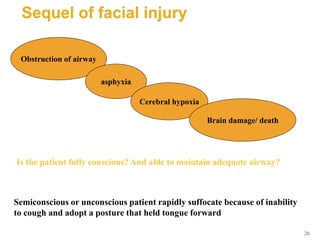
Is the patient fully conscious? And able to maintain adequate airway?
Semiconscious or unconscious patient rapidly suffocate because of inability
to cough and adopt a posture that held tongue forward
Obstruction of airway
asphyxia
Cerebral hypoxia
Brain damage/ death
27
 Clearing of blood clot and mucous of the mouth and nares and
head position that lead to escape of secretions ( lateral
position)
 Removal of foreign bodies as a broken denture or avulsed
teeth which can be inhaled and ensuring the patency of the
mouth and oropharynx
 Controlling the tongue position in case of symphysial bilateral
fracture of mandible and when voluntary control of intrinsic
musculature is lost
 Maintaining airway using artificial airway in unconscious
patient with maxillary fracture or by nasophryngeal tube with
periodic aspiration
 Continuous supervision
 Supplemental Oxygen via a well fitted mask
 OroPharyngeal Airway
 Naso-pharyngeal Airway
 Supplemental oxygen given through a well
fitted mask at 15 ltrs/min should be initially
given to any trauma patient , to achieve
maximum oxygenation of tissues.
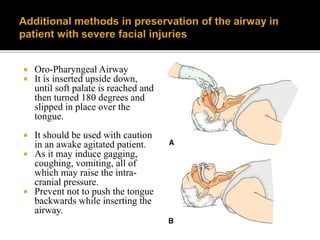
 Oro-Pharyngeal Airway
 It is inserted upside down,
until soft palate is reached and
then turned 180 degrees and
slipped in place over the
tongue.
 It should be used with caution
in an awake agitated patient.
 As it may induce gagging,
coughing, vomiting, all of
which may raise the intra-
cranial pressure.
 Prevent not to push the tongue
backwards while inserting the
airway.
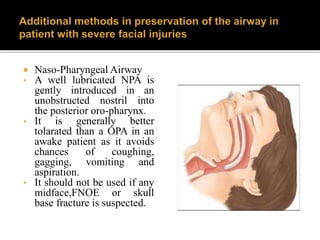
 Naso-Pharyngeal Airway
• A well lubricated NPA is
gently introduced in an
unobstructed nostril into
the posterior oro-pharynx.
• It is generally better
tolarated than a OPA in an
awake patient as it avoids
chances of coughing,
gagging, vomiting and
aspiration.
• It should not be used if any
midface,FNOE or skull
base fracture is suspected.
31
 Definitive Airway
 This provides oxygen assisted ventilation via a cuffed tube present in a
trachea with the cuff inflated and the tube secured in place with a tape.
Definitive airways are of three types
1. Oro-Tracheal tubes
2. Naso-tracheal tubes
3. Surgical airway
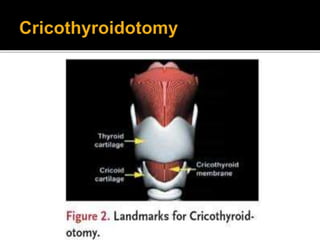
• Crico-thyroidotomy
• Tracheostomy
 Indications
• Apnea
• Inability to maintain a patent airway by other means
• Potential compromise of airway following inhalational injury, facial
fractures, retro-pharyngeal hematoma
• Sustained seizure activity
• Closed head injury requiring assisted ventilation (GCS <8 )
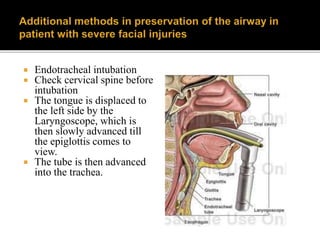
 Endotracheal intubation
 Check cervical spine before
intubation
 The tongue is displaced to
the left side by the
Laryngoscope, which is
then slowly advanced till
the epiglottis comes to
view.
 The tube is then advanced
into the trachea.
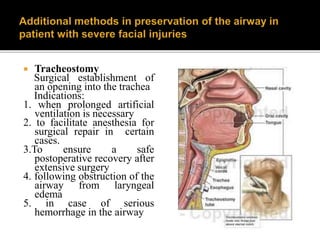
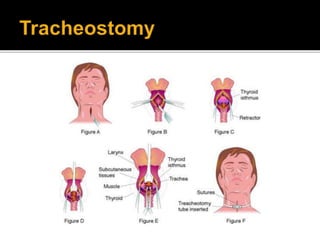
 Tracheostomy
Surgical establishment of
an opening into the trachea
Indications:
1. when prolonged artificial
ventilation is necessary
2. to facilitate anesthesia for
surgical repair in certain
cases.
3.To ensure a safe
postoperative recovery after
extensive surgery
4. following obstruction of the
airway from laryngeal
edema
5. in case of serious
hemorrhage in the airway
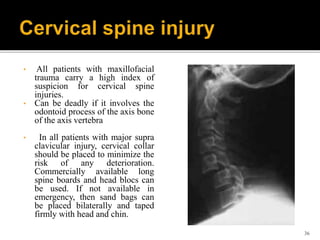
• All patients with maxillofacial
trauma carry a high index of
suspicion for cervical spine
injuries.
• Can be deadly if it involves the
odontoid process of the axis bone
of the axis vertebra
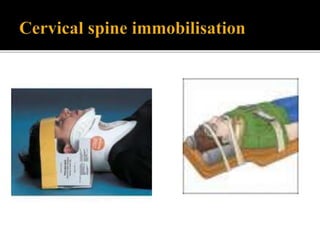
• In all patients with major supra
clavicular injury, cervical collar
should be placed to minimize the
risk of any deterioration.
Commercially available long
spine boards and head blocs can
be used. If not available in
emergency, then sand bags can
be placed bilaterally and taped
firmly with head and chin.
36
38
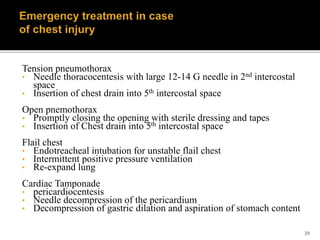
Chest injuries:
• Tension pneumothorax
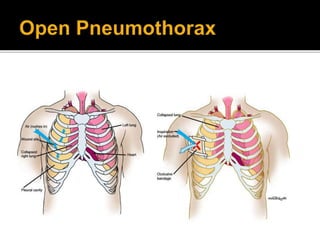
• Open pneumothorax
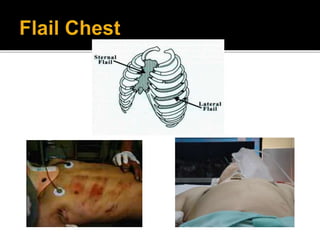
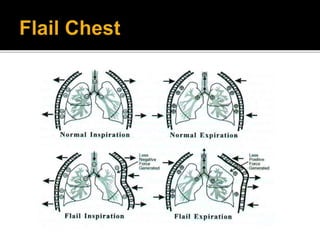
• Flail chest
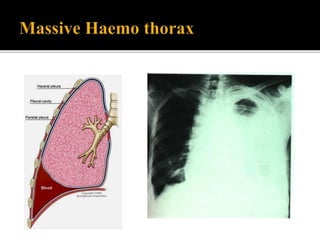
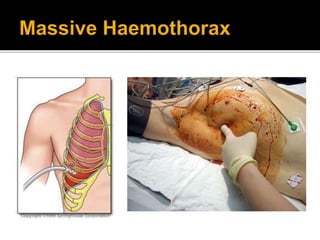
• Massive haemothorax
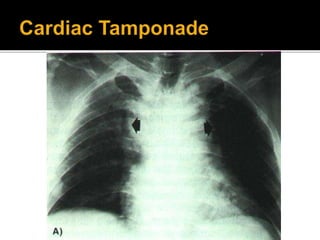
• Cardiac tamponade
Clinical features
• Deviated trachea
• Absence of breath sound
• Dullness to percussion
• Paradoxical movements
• Hyper-response with a large pneumothorax
• Muffled heart sounds
Radiological features
• Loss of lung marking
• Deviation of trachea
• Raised hemi-diaphragm
• Fluid levels
• Fracture of ribs
39
Tension pneumothorax
• Needle thoracocentesis with large 12-14 G needle in 2nd intercostal
space
• Insertion of chest drain into 5th intercostal space
Open pnemothorax
• Promptly closing the opening with sterile dressing and tapes
• Insertion of Chest drain into 5th intercostal space
Flail chest
• Endotreacheal intubation for unstable flail chest
• Intermittent positive pressure ventilation
• Re-expand lung
Cardiac Tamponade
• pericardiocentesis
• Needle decompression of the pericardium
• Decompression of gastric dilation and aspiration of stomach content
46
Shock is defined as an abnormality of the circulation
that results in inadequate organ perfusion and tissue
oxygenation.
Haemmorhage is an acute loss of circulating blood
volume
Patient resuscitation
Restoration of cardio-respiratory function
Shock management
Replacement of lost fluid
Central pulse (carotid/femoral)-
• Normal-full,slow and regular
• thready pulse indicative of hypovolemia.
Skin colour
• Normal-pinkish
• Ashen gray skin of face and pale-whitened in
extremities depicts hypovolemia.
• Level of conciousness is low with confussion,
agression, drowsiness and coma.
• Tachypnea due to hypoxia and acidosis
• Generalised weakness.
• Low urinary output.
 Class I
• Less than15% blood loss
• Equivalent to a unit of blood donation.
• No tachycardia, no P/BP/Resp changes
• Blood volume restored in 24 hrs.
 Class II
• 15-30% or 750-1500 ml blood loss.
• Tachycardia, tachypnea, low pulse pressure
• Urinary output mildly less.
• No blood transfusion but crystalloids are needed.
 Class III
• 30-40% or >2000 ml blood loss
• Marked tachycardia, tachypnea
• Significant fall in systolic BP
• Always requires blood transfusion
 Class IV
 >40% blood loss
 Immediately life threatning
 Requires urgent rapid transfusion and surgical intervention
 Marked tachycardia, tachypnea
 Significant fall in systolic BP
 Mental status markedly depressed
 Urinary output negligible
☞Adequate venous access at two points, prefarably ante-
cubital veins or in emergency femoral or sub-clavian veins.
☞ Hypotension assumed to be due to hypovolaemia
☞ Resuscitation fluid can be crystalloid, colloid or blood
2 ltrs of warmed crystalline prefarably Ringers Lactate. Then
patient re-assessed to be a Responder, Transient responder
or a Non responder.
☞ Surgical shock requires blood transfusion, preferably with
cross matching or group O. Rh –ve for females of child
bearing age to prevent sensitisation and future
complications.
☞ Urine output must be monitored as an indicator of
cardiac out put
50
 Usually not life threatning.
 Mostlt due to cut Facial or Superficial Temporal
arteries.
 Facial-to be compressed against mandible body
anterior to masseter.
 Superficial temporal to be compresed against
cranium anterior to the ear.
 Also closed bleeding from midface # and FNOE
complex may be complex to define the exact
source of bleeding.
 Do trans nasal packing with adrenalin soaked
ribbon gauze.
51
52
Rapid assessment of neurological disability is made by noting the
patient response on four points scale:
 A alert
 V Responds to verbal stimuli
 P Responds to painful stimuli
 U unresponsive to all stimulus
53
All trauma patient must be fully exposed in a
warm environment to disclose any other hidden
injuries
When the airway is adequately secured the second
survey of the whole body is to be carried out for:
▪ Accurate diagnosis
▪ Maintenance of a stable state
▪ Determination of priorities in treatment
▪ Appropriate specialist referral
 ECG
 EEG
 CXR
 Cervical spine- AP & Lateral
 USG
 Diagnostic Peritoneal Lavage
 Lab Reports
 CT
 MRI
 Head to toe and front to back evaluation.
 History
 A- Allergies
 M- Medications currently used.
 P- Past illness/ Pregnancy
 L-last meal
 E- Events/environment related to the injury
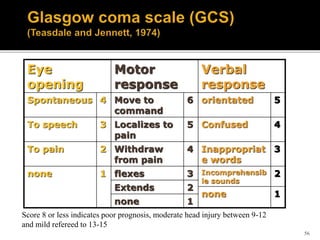
56
Eye
opening
Motor
response
Verbal
response
Spontaneous 4 Move to
command
6 orientated 5
To speech 3 Localizes to
pain
5 Confused 4
To pain 2 Withdraw
from pain
4 Inappropriat
e words
3
none 1 flexes 3 Incomprehensib
le sounds
2
Extends 2
none 1
none 1
Score 8 or less indicates poor prognosis, moderate head injury between 9-12
and mild refereed to 13-15
57
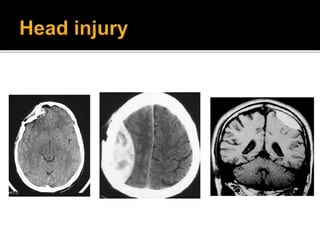
 Head injury
 Abdominal injury
 Injury to extremities
58
 Open
 Closed
it is ranged from Mild concussion to brain death
59
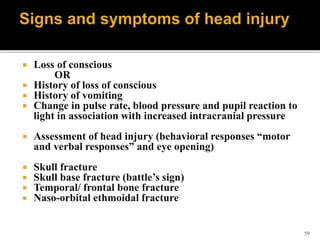
 Loss of conscious
OR
 History of loss of conscious
 History of vomiting
 Change in pulse rate, blood pressure and pupil reaction to
light in association with increased intracranial pressure
 Assessment of head injury (behavioral responses “motor
and verbal responses” and eye opening)
 Skull fracture
 Skull base fracture (battle’s sign)
 Temporal/ frontal bone fracture
 Naso-orbital ethmoidal fracture
61
slow reaction and fixation of dilated pupil denotes
a rise in intra-cranial pressure
Rise in intercranial pressure as a result of acute
subdural or extradural hemorrhage deteriorate the
patient’s neurological status
Apparently stable patient with suspicion of head injury must be
monitored at intervals up to one hour for 24 hour after the
trauma
62
Acute bleeding may lead to hemorrhagic shock and
circulatory collapse
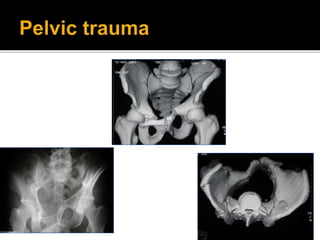
 Abdominal and pelvis injury; liver and internal
organs injury (peritonism)
 Fracture of the extremities (femur)
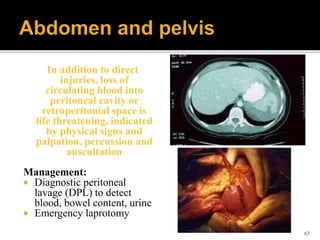
In addition to direct
injuries, loss of
circulating blood into
peritoneal cavity or
retroperitonial space is
life threatening, indicated
by physical signs and
palpation, percussion and
auscultation
Management:
 Diagnostic peritoneal
lavage (DPL) to detect
blood, bowel content, urine
 Emergency laprotomy
63
65
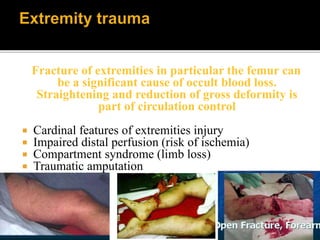
Fracture of extremities in particular the femur can
be a significant cause of occult blood loss.
Straightening and reduction of gross deformity is
part of circulation control
 Cardinal features of extremities injury
 Impaired distal perfusion (risk of ischemia)
 Compartment syndrome (limb loss)
 Traumatic amputation
66
△ emergency cases require instant admission
△ conditions that may progress to emergency
△ cases with no urgency
67
 Soft tissue laceration (8 hours of injury with no delay beyond
24 hours)
 Support of the bone fragments
 Injury to the eye
As a result of trauma, 1.6 million are blind, 2.3 million are suffering
serious bilateral visual impairment and 19 million with unilateral loss
of sight (Macewen 1999)
▪ Ocular damage
▪ Reduction in visual acuity
▪ Eyelid injury
68
 Diagnosis:
Laboratory investigation, CT and MRI scan
 Management:
 Dressing of external wounds
 Closure of open wounds
 Reposition and immobilization of the fractures
 Repair of the dura matter
 Antibacterial prophylaxis (as part of the general management )
Prevention of infection
69
Management:
☞ Non-steroidal anti-inflammatory drugs can be prescribed
(Diclofenac acid)
☞ Reduction of fracture
☞ sedation
70
 Necessary medications
 Diet (fluid, semi-fluid and solid food) intake and
output (fluid balance chart)
 Hygiene and physiotherapy
 Proper timing for surgical intervention
 Maxillofacial Trauma & Esthetic Facial
Reconstruction – Peter Ward Booth
 Oral & Maxillofacial Surgery Volume 3
Trauma- Fonseca
 Oral & Maxillofacial Surgery- Neelima Malik
 Oral & Maxillofacial Surgery- S.M.Balaji
 Internal Medicine- Harrisons
 The Times of India, article August 17, 2009
 Internet source
Golden hour

Golden hour

  • 1.
    Presented by : Dr.Sujay Patil M.D.S Part I
  • 2.
     Introduction  TheGolden Hour  Trauma care staging  Pre hospital stage  B.L.S  Triage  Preparation at receiving hospital  Initial assessment of the patient  Primary survey and Resuscitation  A.T.L.S  Secondary survey  Maxillofacial aspects
  • 3.
     Of alltrauma deaths, 50% occur within minutes at the site of the accident. However statistically for every trauma death 200 other patients sustain injuries requiring medical attention and of these 24 will require hospitalisation.  In an article published in The Times of India, according to a WHO survey, India leads the world in road deaths. Around 1,50,000 people lose there lives every year in RTA’s, which they say is actually half the number because of many unaccounted deaths. Half a million people receive serious but non fatal injuries.  Andhra pradesh followed by Maharashtra are the states leading in RTA deaths.
  • 4.
    4 △ Road trafficaccident (RTA) 35-60% Rowe and Killey 1968; Vincent-Towned and Shepherd 1994 △ Fight and assault (interpersonal violence) △ Sport and athletic injuries △ Industrial accidents △ Domestic injuries and falls
  • 5.
     Origin ofthe term  Late Dr. R Adams Cowley is credited with promoting this concept, first in his capacity as a military surgeon and later as head of the University of Maryland Shock Trauma Center. The concept of the "Golden Hour" may have been derived from French military World War I data .
  • 6.
     The RAdams Cowley Shock Trauma Center section of the University of Maryland Medical Center’s website quotes Cowley as saying, "There is a golden hour between life and death. If a patient is critically injured he has less than 60 minutes to survive. He may not die right then; it may be a few days, weeks, a month or a year later -- but something has happened in its body that is irreparable.
  • 7.
     Golden Hourmay be defined as the period during which all efforts are made to save a life before irreversible pathological changes can occur thereby reducing or preventing death in the second and third phase. This period may range from the time of injury to definitive treatment in a hospital.
  • 8.
    Pre Hospital Care BasicLife Support Triage Preparation at receiving hospital Hospital Care Initial assessment of the patient Primary survey and Resuscitation A.T.L.S Secondary survey Hospital rehabilitation
  • 9.
    Rescue workers likedoctors, ambulance crews, fire fighters, or any other trained person in BLS are the front runners for pre hospital care. They primarily handle airway, respiratory support, immobilisation of patient and control of external bleeding and shock which require urgent attention in saving a life. This group generally covers the “Platinum 10 Minutes”.
  • 10.
     The first10 Platinum Minutes become important to make this golden hour effective and should be distributed as follows to make it fruitful.  Assessment of the victim and primary survey 1 minute  Resuscitation and stabilization 5 minutes  Immobilization and transport to nearby hospital 4 minutes
  • 11.
     CPR isa emergency procedure that can be used to maintain some blood flow to the brain, heart, and other vital organs until trained medical personnel are available to provide more advanced treatment. It involves performing a series of chest compressions and rescue breathing after establishing a clear airway.
  • 12.
    Position the personso you can check for signs of life by laying the person flat on their back on a firm surface and extending the neck. II. Open the patient’s mouth and airway by lowering the head and lifting the chin forward.
  • 13.
     III. Determinewhether the person is breathing by simultaneously looking for chest motion, listening for breath sounds, feeling for air motion on your cheek and ear.
  • 14.
     IV. Ifthe person is not breathing, pinch his or her nostrils closed, make a seal around the mouth and breathe into his or her mouth twice. Give one breath every five seconds - 12 breaths each minute - and completely refill your lungs after each breath.
  • 15.
     V. Ifthere are no signs of life - no response, movement or breathing - begin chest compressions. Place your hands over the lower part of the sternum, keep your elbows straight and position your shoulders directly above your hands to make the best use of your weight.
  • 16.
     VI. Pushdown 1 1/2 to 2 inches at a rate of 80 to 100 times a minute. The pushing down and letting up phase of each cycle should be equal in duration. Don't jab down and relax. After 15 compressions, breathe into the person's mouth twice. VII. After every four cycles of 15 compressions and two breaths, recheck for signs of life. Continue the rescue maneuvers as long as there are no signs of life.
  • 17.
     Triage isthe sorting of patients based on the level for treatment needed and the available resources to provide that treatment.  Triage is a very important decisive criteria when management of mass and multiple casualties is needed.  It basically aims on management of patients with greatest chance of survival first, with least expenditure of time, supplies, equipment and personnel.
  • 18.
    18  Pre-hospital care(field triage) Care delivered by fully trained paramedic in maintaining airway, controlling cervical spine, securing intravenous and initiating fluid resuscitation  Hospital care (inter-hospital triage) Senior medical staff organized team to ensure that medical resources are deployed to maximum overall benefit  Mass casualty triage triage decisions are crucial in determining individual patients survival
  • 19.
     The traumacentre must be fully equipped and staffed resuscitation room, with comprehensive backup of all the necessary support teams such as radiology, blood bank, ICU, etc.  Basic trauma team should comprise of Specialist Anaesthetic, Cranio-Maxillofacial surgeon along with General, Orthopaedic , Neuro and Cardiothoracic surgeons plus paramedics and nurses.  The absolute minimum in a resuscitation room should be rubber latex gloves, plastic aprons and eye protection, considering any blood or body fluid to be HIV or HBsAg positive.
  • 20.
     Deaths followingtrauma follow a trimodal distribution.  The initial assessment generally defines 3 Peaks
  • 21.
     First peak Occurswithin seconds or minutes of the injury. death generally follows as a result of • Lacerations of the brain • Brain stem • High spinal cord • Heart, Aorta or any large blood vessels
  • 22.
     Second peak Occursbetween a few minutes after injury to about one hour later (golden hour) Deaths are generally due to • Severe chest injuries with Hemothorax • Cardiac tamponade • Abdominal trauma with a ruptured Spleen • Lacerations of the liver • Fractures particularly Pelvic or with other multiple major bones.
  • 23.
     Third peak Occurssome days or weeks after injury as a result of • Multi organ failure • Respiratory distress • Sepsis
  • 24.
     Airway maintainanceand Cervical spine control  Breathing and ventilation  Circulation and Hemmorhage Control  Disability- Neurological status  Exposure and complete examination of patient
  • 25.
    25  Satisfactory airwaysignifies the implication of breathing and ventilation and cerebral and vital organ function.  Management of maxillofacial trauma is an integral part in securing an unobstructed airway.  Immobilization in a natural position by a semi-rigid collar until damaged spine is excluded.
  • 26.
    26 Is the patientfully conscious? And able to maintain adequate airway? Semiconscious or unconscious patient rapidly suffocate because of inability to cough and adopt a posture that held tongue forward Obstruction of airway asphyxia Cerebral hypoxia Brain damage/ death
  • 27.
    27  Clearing ofblood clot and mucous of the mouth and nares and head position that lead to escape of secretions ( lateral position)  Removal of foreign bodies as a broken denture or avulsed teeth which can be inhaled and ensuring the patency of the mouth and oropharynx  Controlling the tongue position in case of symphysial bilateral fracture of mandible and when voluntary control of intrinsic musculature is lost  Maintaining airway using artificial airway in unconscious patient with maxillary fracture or by nasophryngeal tube with periodic aspiration  Continuous supervision
  • 28.
     Supplemental Oxygenvia a well fitted mask  OroPharyngeal Airway  Naso-pharyngeal Airway  Supplemental oxygen given through a well fitted mask at 15 ltrs/min should be initially given to any trauma patient , to achieve maximum oxygenation of tissues.
  • 29.
     Oro-Pharyngeal Airway It is inserted upside down, until soft palate is reached and then turned 180 degrees and slipped in place over the tongue.  It should be used with caution in an awake agitated patient.  As it may induce gagging, coughing, vomiting, all of which may raise the intra- cranial pressure.  Prevent not to push the tongue backwards while inserting the airway.
  • 30.
     Naso-Pharyngeal Airway •A well lubricated NPA is gently introduced in an unobstructed nostril into the posterior oro-pharynx. • It is generally better tolarated than a OPA in an awake patient as it avoids chances of coughing, gagging, vomiting and aspiration. • It should not be used if any midface,FNOE or skull base fracture is suspected.
  • 31.
    31  Definitive Airway This provides oxygen assisted ventilation via a cuffed tube present in a trachea with the cuff inflated and the tube secured in place with a tape. Definitive airways are of three types 1. Oro-Tracheal tubes 2. Naso-tracheal tubes 3. Surgical airway • Crico-thyroidotomy • Tracheostomy  Indications • Apnea • Inability to maintain a patent airway by other means • Potential compromise of airway following inhalational injury, facial fractures, retro-pharyngeal hematoma • Sustained seizure activity • Closed head injury requiring assisted ventilation (GCS <8 )
  • 32.
     Endotracheal intubation Check cervical spine before intubation  The tongue is displaced to the left side by the Laryngoscope, which is then slowly advanced till the epiglottis comes to view.  The tube is then advanced into the trachea.
  • 33.
     Tracheostomy Surgical establishmentof an opening into the trachea Indications: 1. when prolonged artificial ventilation is necessary 2. to facilitate anesthesia for surgical repair in certain cases. 3.To ensure a safe postoperative recovery after extensive surgery 4. following obstruction of the airway from laryngeal edema 5. in case of serious hemorrhage in the airway
  • 36.
    • All patientswith maxillofacial trauma carry a high index of suspicion for cervical spine injuries. • Can be deadly if it involves the odontoid process of the axis bone of the axis vertebra • In all patients with major supra clavicular injury, cervical collar should be placed to minimize the risk of any deterioration. Commercially available long spine boards and head blocs can be used. If not available in emergency, then sand bags can be placed bilaterally and taped firmly with head and chin. 36
  • 38.
    38 Chest injuries: • Tensionpneumothorax • Open pneumothorax • Flail chest • Massive haemothorax • Cardiac tamponade Clinical features • Deviated trachea • Absence of breath sound • Dullness to percussion • Paradoxical movements • Hyper-response with a large pneumothorax • Muffled heart sounds Radiological features • Loss of lung marking • Deviation of trachea • Raised hemi-diaphragm • Fluid levels • Fracture of ribs
  • 39.
    39 Tension pneumothorax • Needlethoracocentesis with large 12-14 G needle in 2nd intercostal space • Insertion of chest drain into 5th intercostal space Open pnemothorax • Promptly closing the opening with sterile dressing and tapes • Insertion of Chest drain into 5th intercostal space Flail chest • Endotreacheal intubation for unstable flail chest • Intermittent positive pressure ventilation • Re-expand lung Cardiac Tamponade • pericardiocentesis • Needle decompression of the pericardium • Decompression of gastric dilation and aspiration of stomach content
  • 46.
    46 Shock is definedas an abnormality of the circulation that results in inadequate organ perfusion and tissue oxygenation. Haemmorhage is an acute loss of circulating blood volume Patient resuscitation Restoration of cardio-respiratory function Shock management Replacement of lost fluid
  • 47.
    Central pulse (carotid/femoral)- •Normal-full,slow and regular • thready pulse indicative of hypovolemia. Skin colour • Normal-pinkish • Ashen gray skin of face and pale-whitened in extremities depicts hypovolemia. • Level of conciousness is low with confussion, agression, drowsiness and coma. • Tachypnea due to hypoxia and acidosis • Generalised weakness. • Low urinary output.
  • 48.
     Class I •Less than15% blood loss • Equivalent to a unit of blood donation. • No tachycardia, no P/BP/Resp changes • Blood volume restored in 24 hrs.  Class II • 15-30% or 750-1500 ml blood loss. • Tachycardia, tachypnea, low pulse pressure • Urinary output mildly less. • No blood transfusion but crystalloids are needed.
  • 49.
     Class III •30-40% or >2000 ml blood loss • Marked tachycardia, tachypnea • Significant fall in systolic BP • Always requires blood transfusion  Class IV  >40% blood loss  Immediately life threatning  Requires urgent rapid transfusion and surgical intervention  Marked tachycardia, tachypnea  Significant fall in systolic BP  Mental status markedly depressed  Urinary output negligible
  • 50.
    ☞Adequate venous accessat two points, prefarably ante- cubital veins or in emergency femoral or sub-clavian veins. ☞ Hypotension assumed to be due to hypovolaemia ☞ Resuscitation fluid can be crystalloid, colloid or blood 2 ltrs of warmed crystalline prefarably Ringers Lactate. Then patient re-assessed to be a Responder, Transient responder or a Non responder. ☞ Surgical shock requires blood transfusion, preferably with cross matching or group O. Rh –ve for females of child bearing age to prevent sensitisation and future complications. ☞ Urine output must be monitored as an indicator of cardiac out put 50
  • 51.
     Usually notlife threatning.  Mostlt due to cut Facial or Superficial Temporal arteries.  Facial-to be compressed against mandible body anterior to masseter.  Superficial temporal to be compresed against cranium anterior to the ear.  Also closed bleeding from midface # and FNOE complex may be complex to define the exact source of bleeding.  Do trans nasal packing with adrenalin soaked ribbon gauze. 51
  • 52.
    52 Rapid assessment ofneurological disability is made by noting the patient response on four points scale:  A alert  V Responds to verbal stimuli  P Responds to painful stimuli  U unresponsive to all stimulus
  • 53.
    53 All trauma patientmust be fully exposed in a warm environment to disclose any other hidden injuries When the airway is adequately secured the second survey of the whole body is to be carried out for: ▪ Accurate diagnosis ▪ Maintenance of a stable state ▪ Determination of priorities in treatment ▪ Appropriate specialist referral
  • 54.
     ECG  EEG CXR  Cervical spine- AP & Lateral  USG  Diagnostic Peritoneal Lavage  Lab Reports  CT  MRI
  • 55.
     Head totoe and front to back evaluation.  History  A- Allergies  M- Medications currently used.  P- Past illness/ Pregnancy  L-last meal  E- Events/environment related to the injury
  • 56.
    56 Eye opening Motor response Verbal response Spontaneous 4 Moveto command 6 orientated 5 To speech 3 Localizes to pain 5 Confused 4 To pain 2 Withdraw from pain 4 Inappropriat e words 3 none 1 flexes 3 Incomprehensib le sounds 2 Extends 2 none 1 none 1 Score 8 or less indicates poor prognosis, moderate head injury between 9-12 and mild refereed to 13-15
  • 57.
    57  Head injury Abdominal injury  Injury to extremities
  • 58.
    58  Open  Closed itis ranged from Mild concussion to brain death
  • 59.
    59  Loss ofconscious OR  History of loss of conscious  History of vomiting  Change in pulse rate, blood pressure and pupil reaction to light in association with increased intracranial pressure  Assessment of head injury (behavioral responses “motor and verbal responses” and eye opening)  Skull fracture  Skull base fracture (battle’s sign)  Temporal/ frontal bone fracture  Naso-orbital ethmoidal fracture
  • 61.
    61 slow reaction andfixation of dilated pupil denotes a rise in intra-cranial pressure Rise in intercranial pressure as a result of acute subdural or extradural hemorrhage deteriorate the patient’s neurological status Apparently stable patient with suspicion of head injury must be monitored at intervals up to one hour for 24 hour after the trauma
  • 62.
    62 Acute bleeding maylead to hemorrhagic shock and circulatory collapse  Abdominal and pelvis injury; liver and internal organs injury (peritonism)  Fracture of the extremities (femur)
  • 63.
    In addition todirect injuries, loss of circulating blood into peritoneal cavity or retroperitonial space is life threatening, indicated by physical signs and palpation, percussion and auscultation Management:  Diagnostic peritoneal lavage (DPL) to detect blood, bowel content, urine  Emergency laprotomy 63
  • 65.
    65 Fracture of extremitiesin particular the femur can be a significant cause of occult blood loss. Straightening and reduction of gross deformity is part of circulation control  Cardinal features of extremities injury  Impaired distal perfusion (risk of ischemia)  Compartment syndrome (limb loss)  Traumatic amputation
  • 66.
    66 △ emergency casesrequire instant admission △ conditions that may progress to emergency △ cases with no urgency
  • 67.
    67  Soft tissuelaceration (8 hours of injury with no delay beyond 24 hours)  Support of the bone fragments  Injury to the eye As a result of trauma, 1.6 million are blind, 2.3 million are suffering serious bilateral visual impairment and 19 million with unilateral loss of sight (Macewen 1999) ▪ Ocular damage ▪ Reduction in visual acuity ▪ Eyelid injury
  • 68.
    68  Diagnosis: Laboratory investigation,CT and MRI scan  Management:  Dressing of external wounds  Closure of open wounds  Reposition and immobilization of the fractures  Repair of the dura matter  Antibacterial prophylaxis (as part of the general management ) Prevention of infection
  • 69.
    69 Management: ☞ Non-steroidal anti-inflammatorydrugs can be prescribed (Diclofenac acid) ☞ Reduction of fracture ☞ sedation
  • 70.
    70  Necessary medications Diet (fluid, semi-fluid and solid food) intake and output (fluid balance chart)  Hygiene and physiotherapy  Proper timing for surgical intervention
  • 71.
     Maxillofacial Trauma& Esthetic Facial Reconstruction – Peter Ward Booth  Oral & Maxillofacial Surgery Volume 3 Trauma- Fonseca  Oral & Maxillofacial Surgery- Neelima Malik  Oral & Maxillofacial Surgery- S.M.Balaji  Internal Medicine- Harrisons  The Times of India, article August 17, 2009  Internet source