Session 2, Slide 1
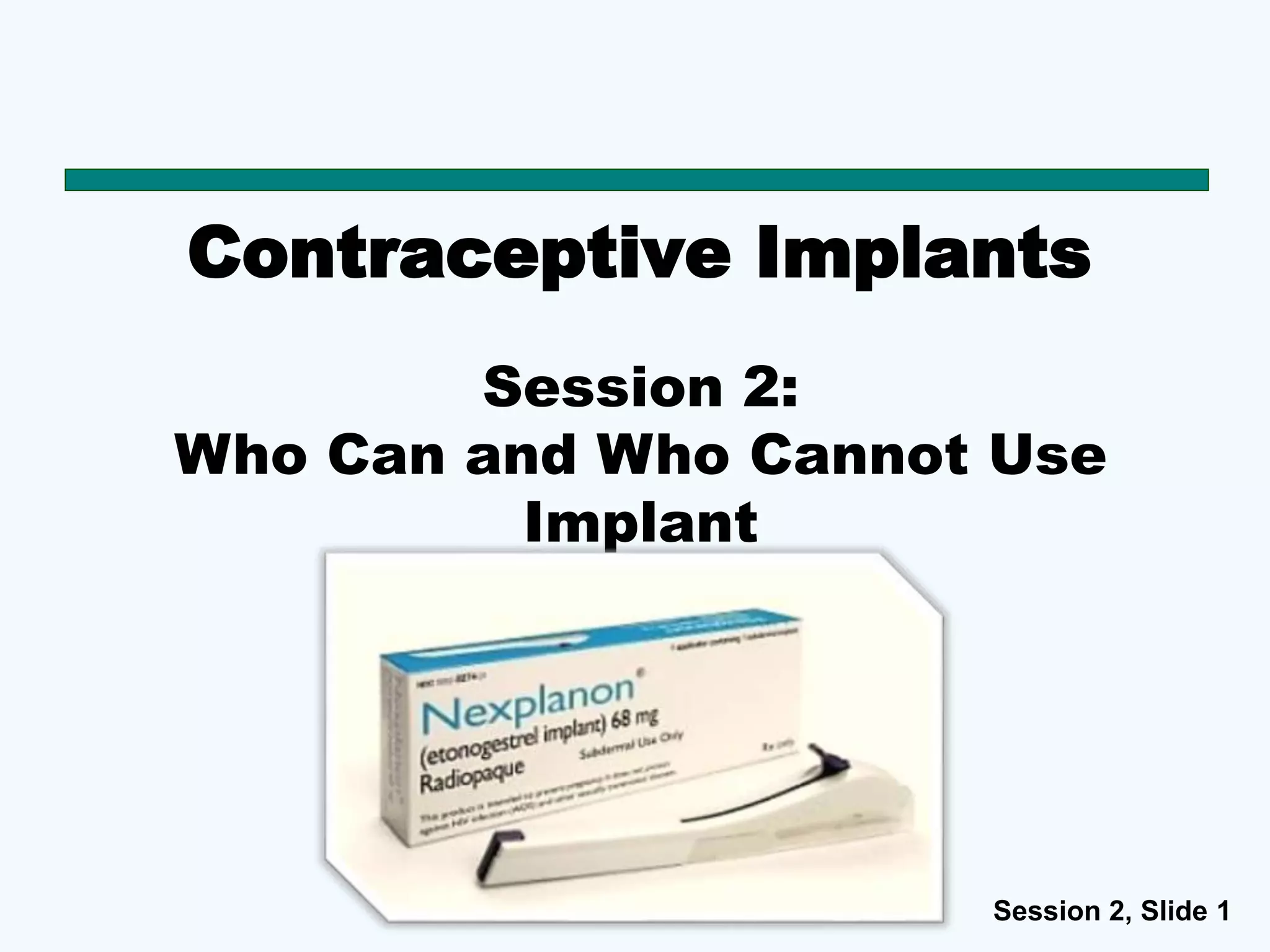
Contraceptive Implants
Session 2:
Who Can and Who Cannot Use
Implant
s
Session 2, Slide 2
Characteristics of Implants
Why might these women be interested in using
implants?
• Breastfeeding mother
• Adolescent
• Infected with HIV
• Has little to no access to a health care facility
• Desires no more children
Session 2, Slide 3
Implants Are Safe for Nearly All
Women
– Have just had an abortion,
miscarriage or ectopic pregnancy
– Are breastfeeding (starting as
soon as 6 weeks after childbirth,
WHO/MEC)
– Have anemia now or in the past
– Have varicose veins
• Almost all women can use implants safely, including
women who:
– Have or have not had children
– Are not married
– Are of any age including
adolescents and women over
40 years old
– Are infected with HIV
• Most health conditions do not affect safe and effective use of
implants.
• Many women who cannot use methods that contain estrogen
can safely use implants.
Session 2, Slide 4
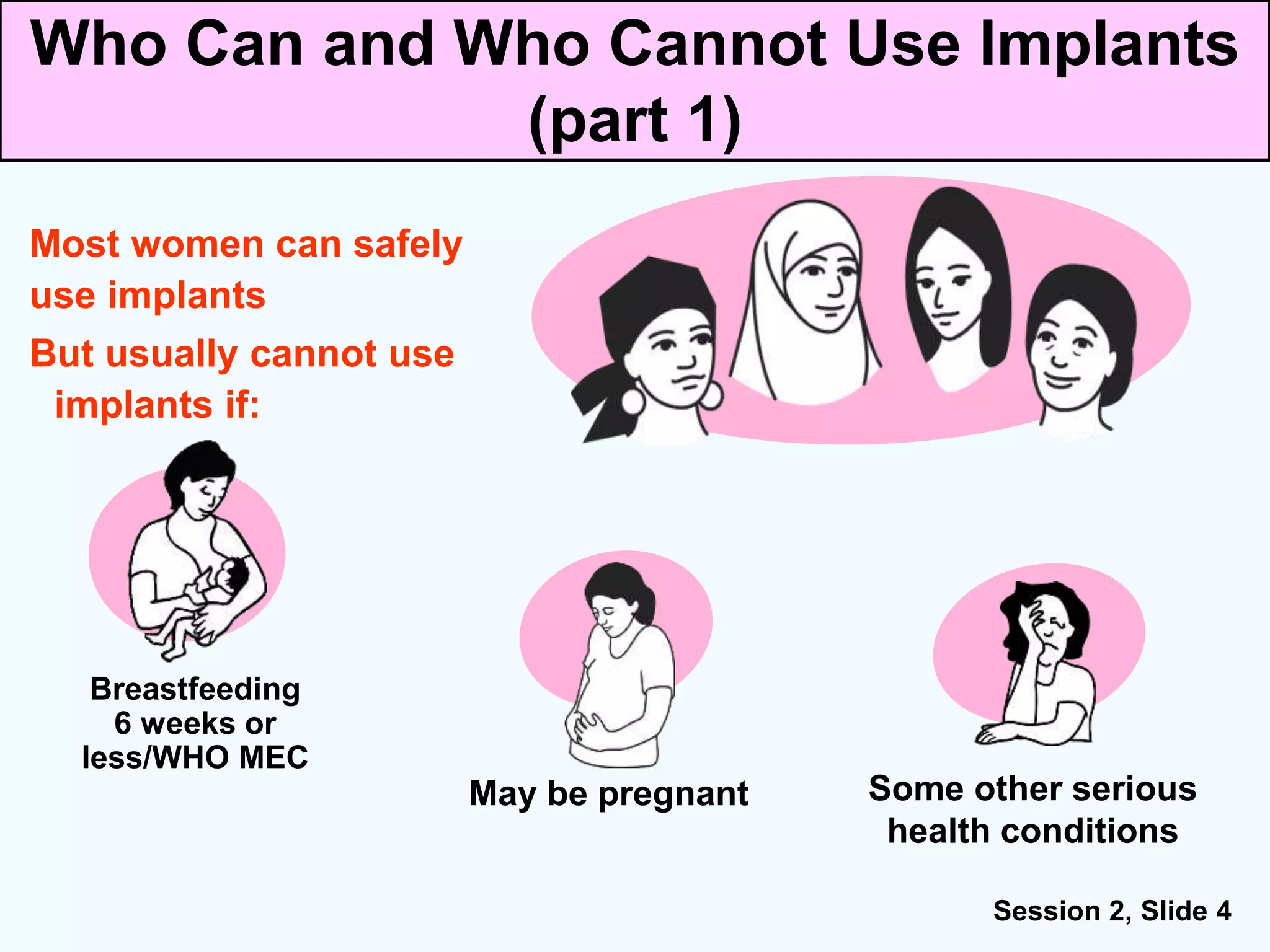
But usually cannot use
implants if:
Most women can safely
use implants
Breastfeeding
6 weeks or
less/WHO MEC
May be pregnant Some other serious
health conditions
Who Can and Who Cannot Use Implants
(part 1)
Session 2, Slide 5
Who Can and Cannot Use Implants
(part 2)
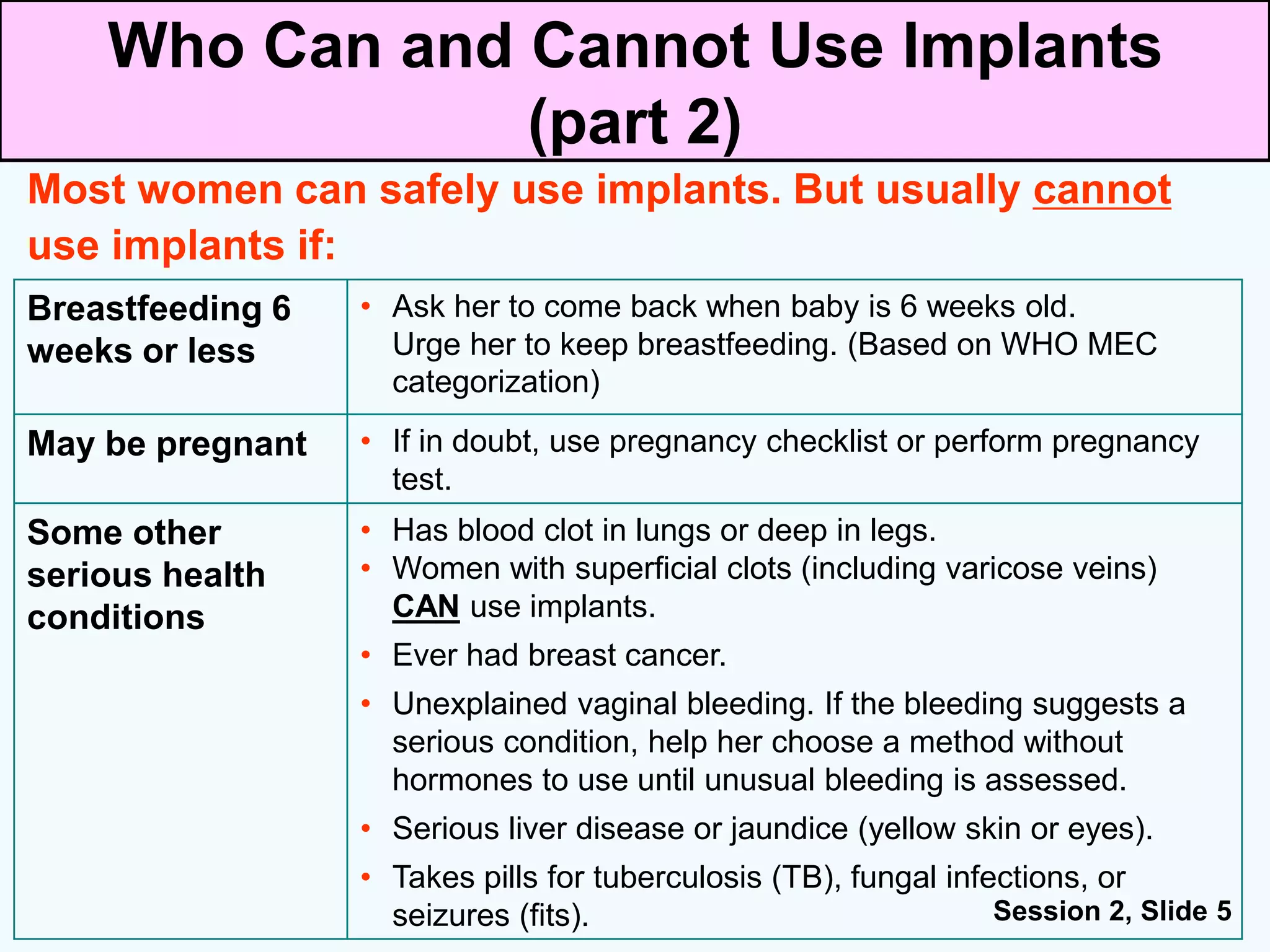
Most women can safely use implants. But usually cannot
use implants if:
Breastfeeding 6
weeks or less
• Ask her to come back when baby is 6 weeks old.
Urge her to keep breastfeeding. (Based on WHO MEC
categorization)
May be pregnant • If in doubt, use pregnancy checklist or perform pregnancy
test.
Some other
serious health
conditions
• Has blood clot in lungs or deep in legs.
• Women with superficial clots (including varicose veins)
CAN use implants.
• Ever had breast cancer.
• Unexplained vaginal bleeding. If the bleeding suggests a
serious condition, help her choose a method without
hormones to use until unusual bleeding is assessed.
• Serious liver disease or jaundice (yellow skin or eyes).
• Takes pills for tuberculosis (TB), fungal infections, or
seizures (fits).
Session 2, Slide 6
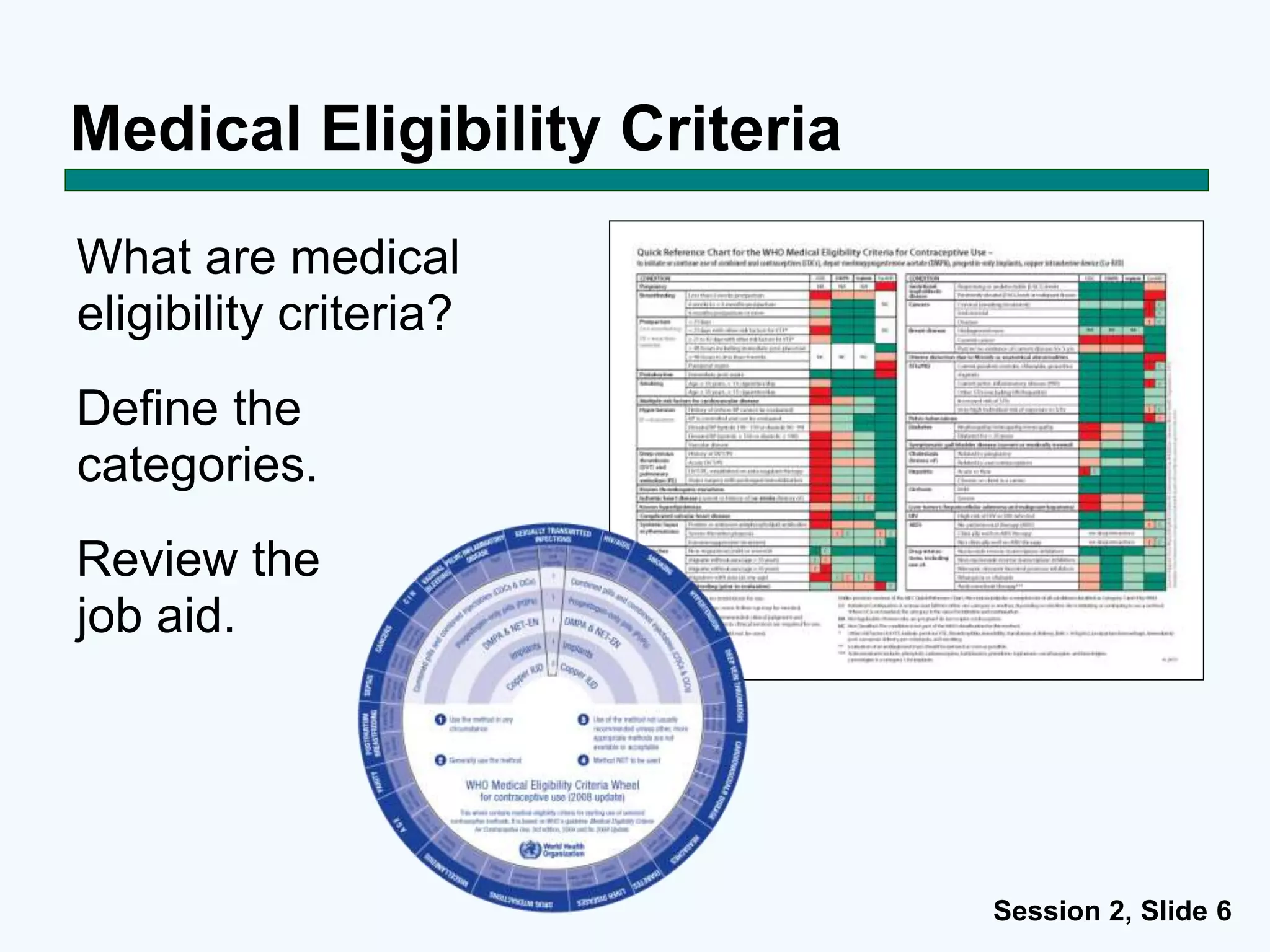
Medical Eligibility Criteria
What are medical
eligibility criteria?
Define the
categories.
Review the
job aid.
Session 2, Slide 7
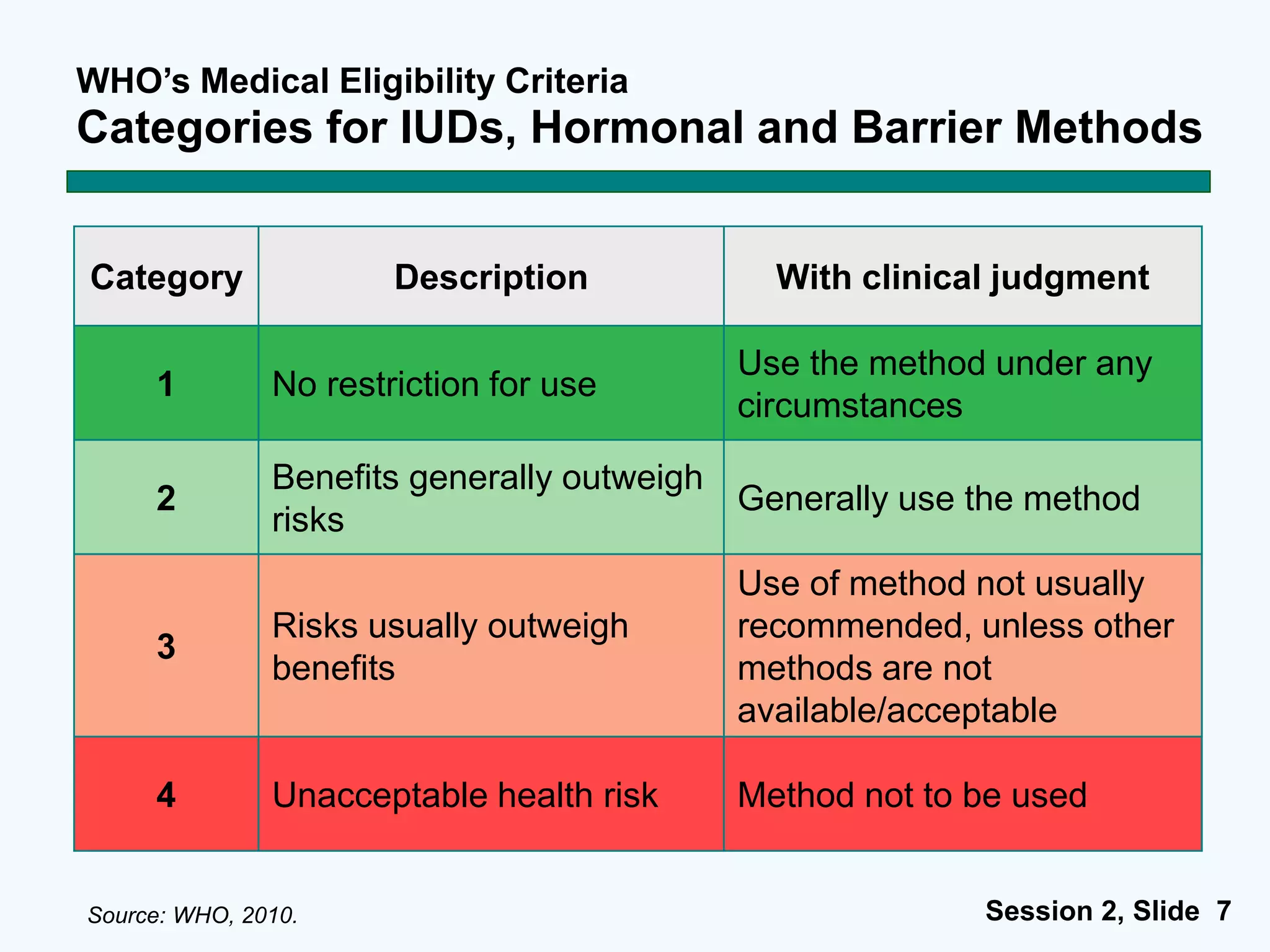
WHO’s Medical Eligibility Criteria
Categories for IUDs, Hormonal and Barrier Methods
Source: WHO, 2010.
Category Description With clinical judgment
1 No restriction for use
Use the method under any
circumstances
2
Benefits generally outweigh
risks
Generally use the method
3
Risks usually outweigh
benefits
Use of method not usually
recommended, unless other
methods are not
available/acceptable
4 Unacceptable health risk Method not to be used
Session 2, Slide 8
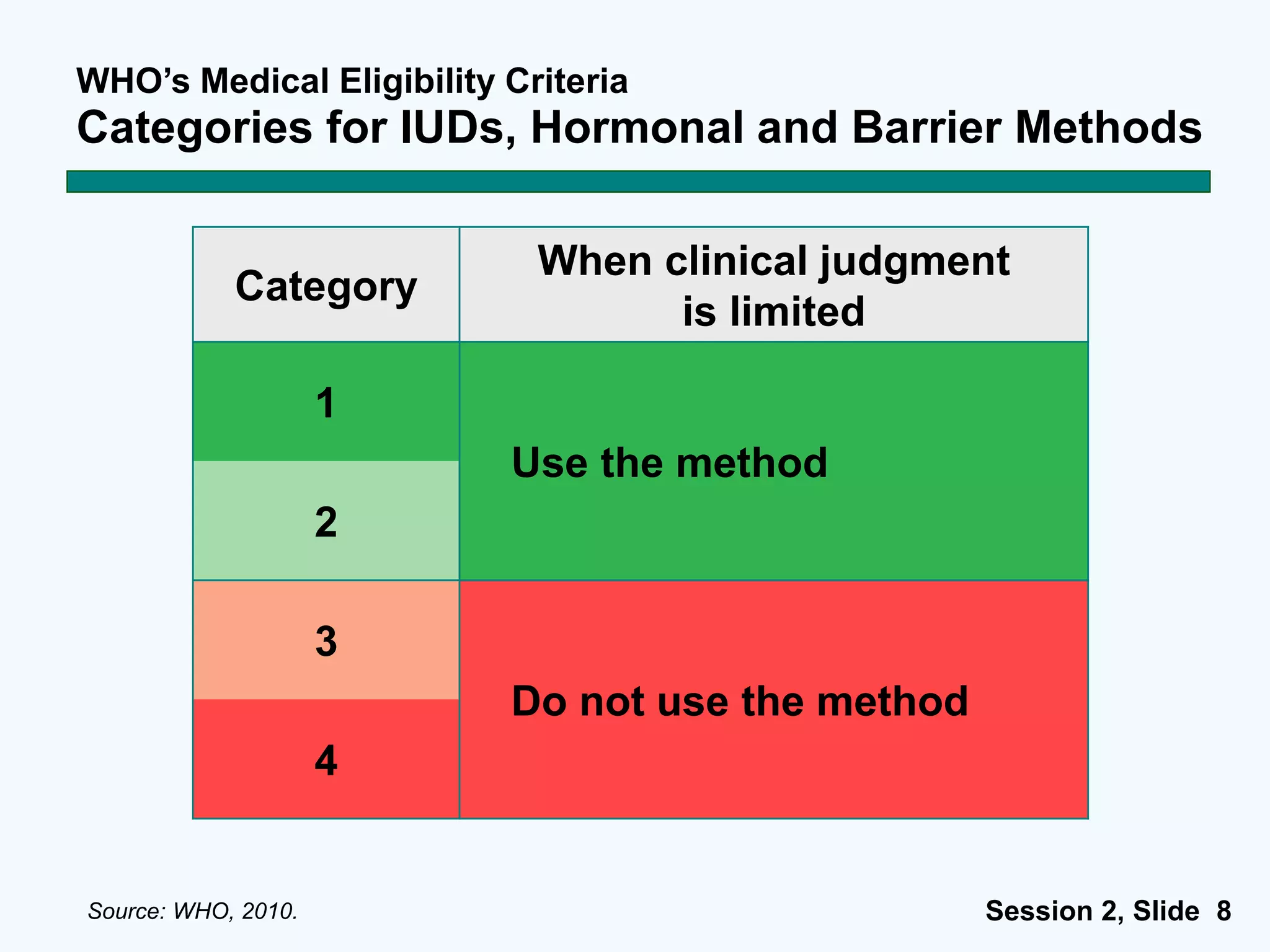
WHO’s Medical Eligibility Criteria
Categories for IUDs, Hormonal and Barrier Methods
Source: WHO, 2010.
Category
When clinical judgment
is limited
1
Use the method
2
3
Do not use the method
4
Session 2, Slide 9
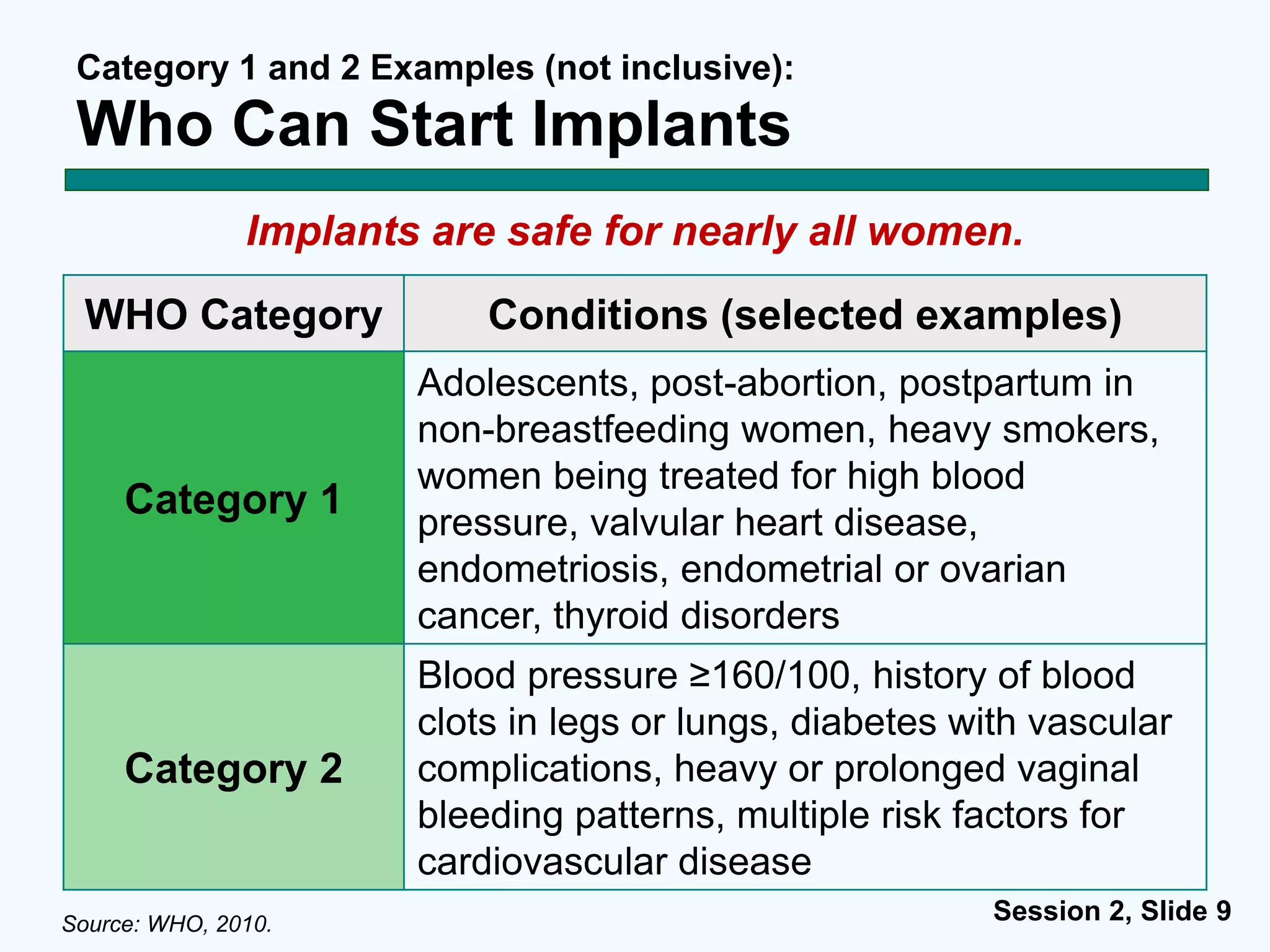
Category 1 and 2 Examples (not inclusive):
Who Can Start Implants
WHO Category Conditions (selected examples)
Category 1
Adolescents, post-abortion, postpartum in
non-breastfeeding women, heavy smokers,
women being treated for high blood
pressure, valvular heart disease,
endometriosis, endometrial or ovarian
cancer, thyroid disorders
Category 2
Blood pressure ≥160/100, history of blood
clots in legs or lungs, diabetes with vascular
complications, heavy or prolonged vaginal
bleeding patterns, multiple risk factors for
cardiovascular disease
Implants are safe for nearly all women.
Source: WHO, 2010.
Session 2, Slide 10
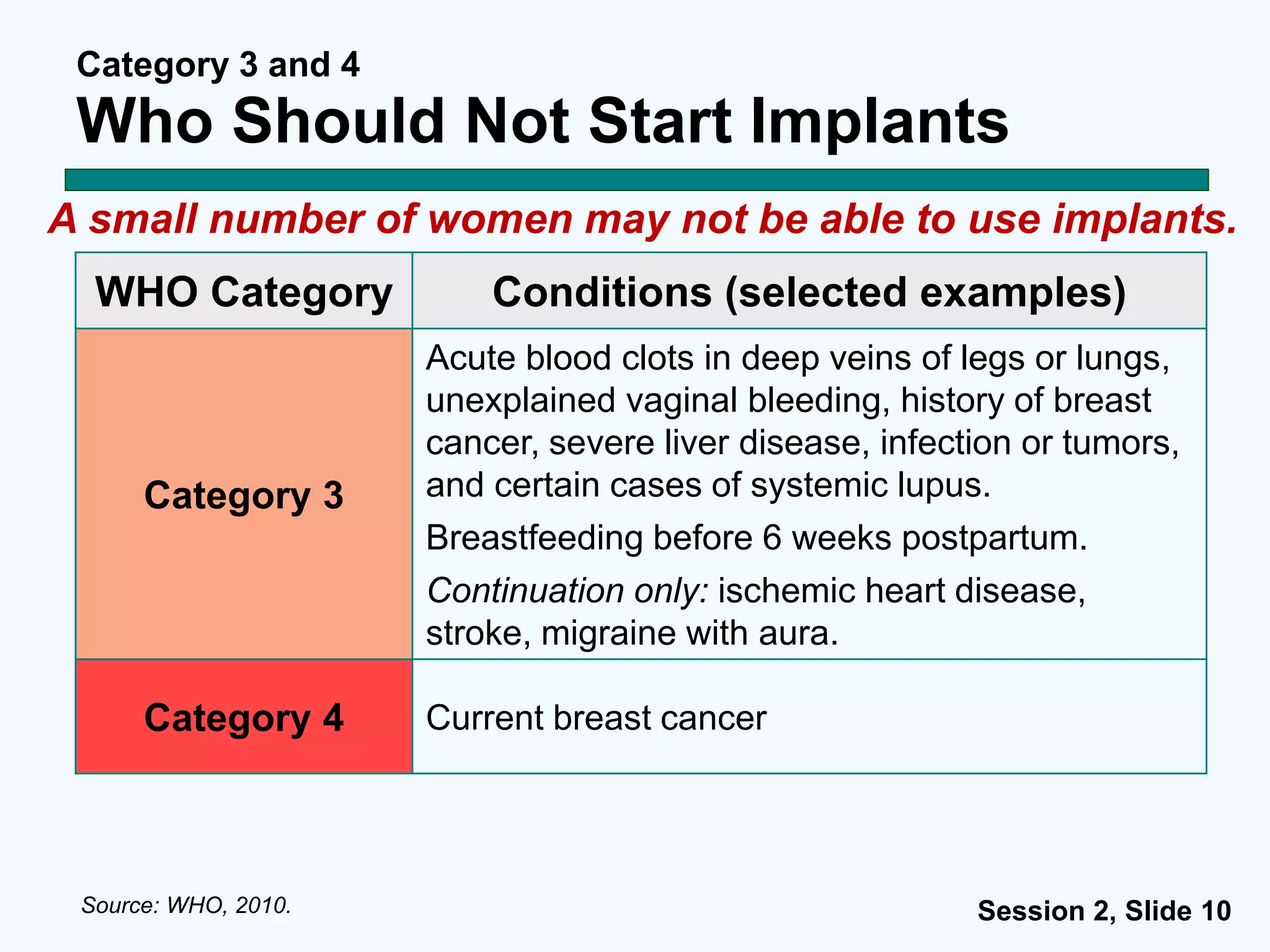
Category 3 and 4
Who Should Not Start Implants
A small number of women may not be able to use implants.
WHO Category Conditions (selected examples)
Category 3
Acute blood clots in deep veins of legs or lungs,
unexplained vaginal bleeding, history of breast
cancer, severe liver disease, infection or tumors,
and certain cases of systemic lupus.
Breastfeeding before 6 weeks postpartum.
Continuation only: ischemic heart disease,
stroke, migraine with aura.
Category 4 Current breast cancer
Source: WHO, 2010.
Session 2, Slide 11
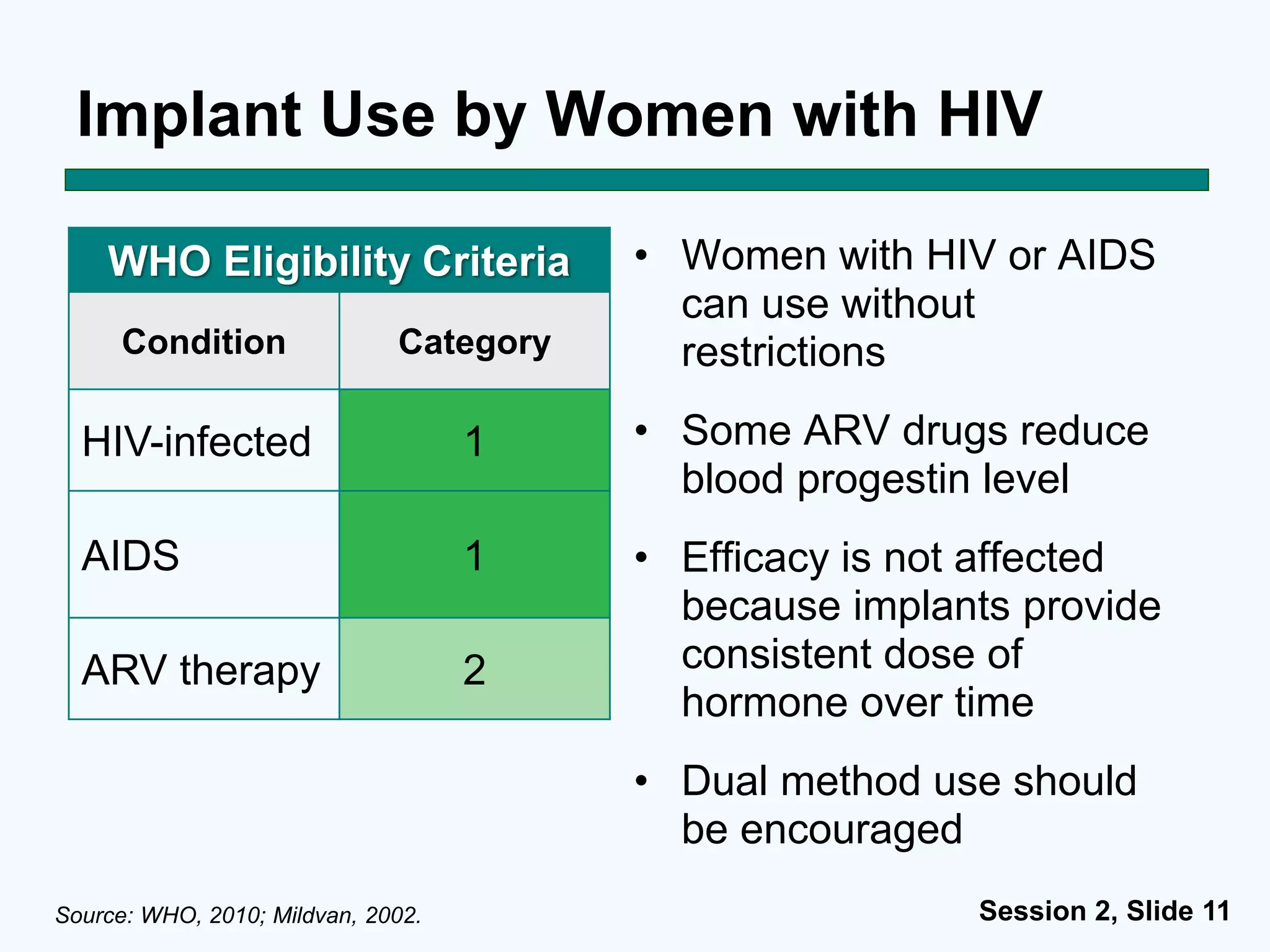
Implant Use by Women with HIV
• Women with HIV or AIDS
can use without
restrictions
• Some ARV drugs reduce
blood progestin level
• Efficacy is not affected
because implants provide
consistent dose of
hormone over time
• Dual method use should
be encouraged
Source: WHO, 2010; Mildvan, 2002.
WHO Eligibility Criteria
Condition Category
HIV-infected 1
AIDS 1
ARV therapy 2
Session 2, Slide 12
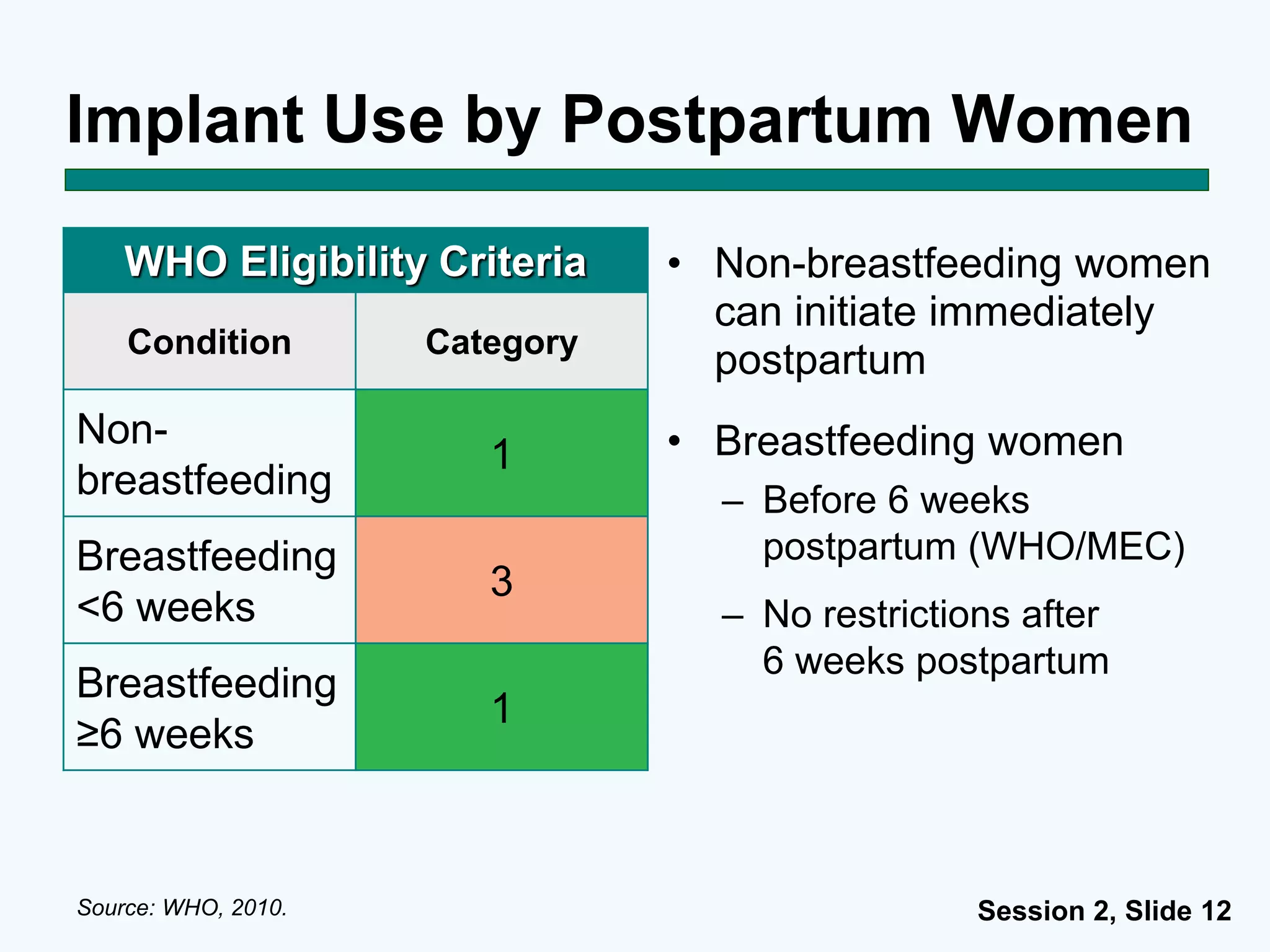
Implant Use by Postpartum Women
• Non-breastfeeding women
can initiate immediately
postpartum
• Breastfeeding women
– Before 6 weeks
postpartum (WHO/MEC)
– No restrictions after
6 weeks postpartum
Source: WHO, 2010.
WHO Eligibility Criteria
Condition Category
Non-
breastfeeding
1
Breastfeeding
<6 weeks
3
Breastfeeding
≥6 weeks
1
Session 2, Slide 13
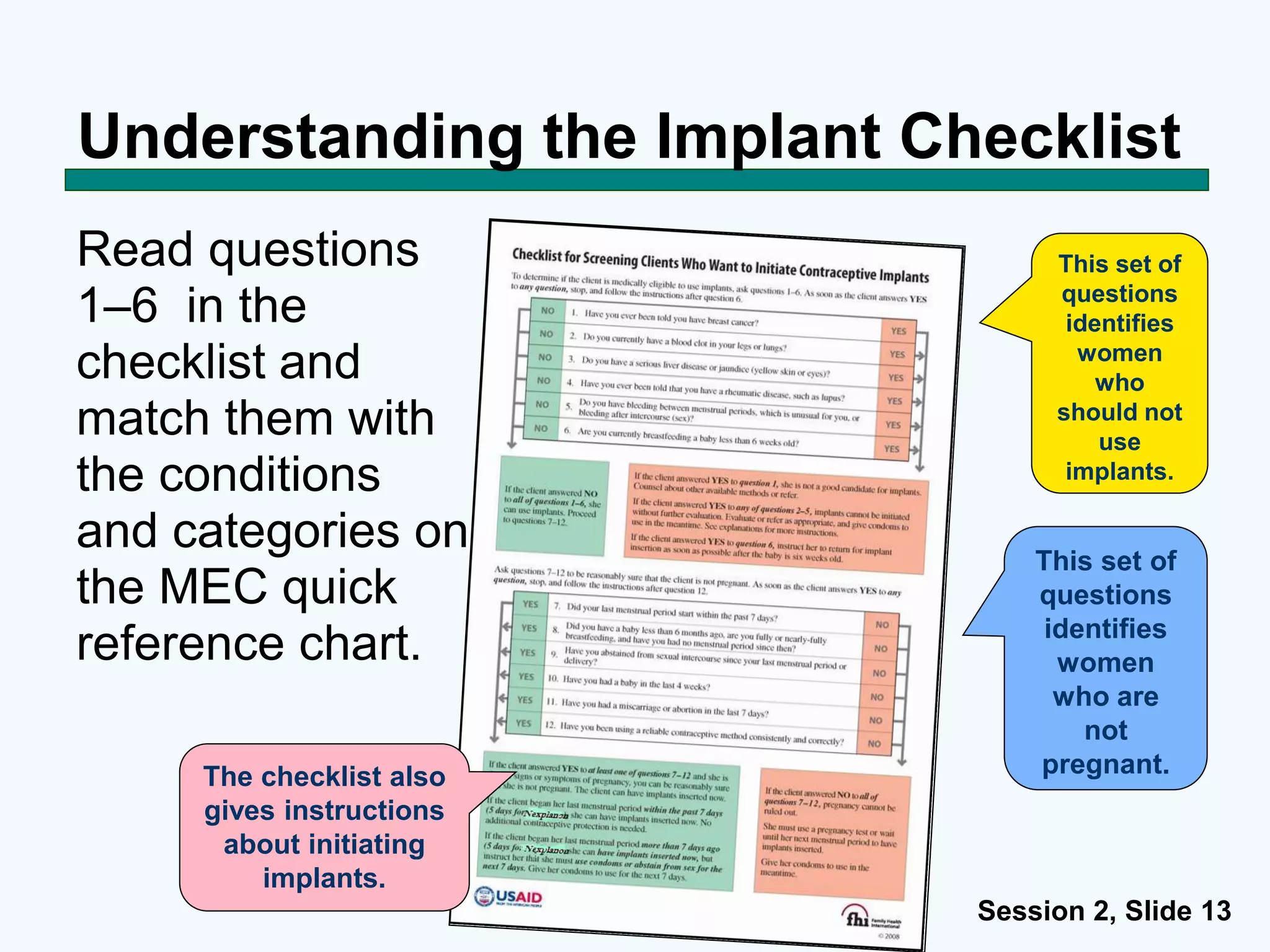
Understanding the Implant Checklist
Read questions
1–6 in the
checklist and
match them with
the conditions
and categories on
the MEC quick
reference chart.
This set of
questions
identifies
women
who
should not
use
implants.
This set of
questions
identifies
women
who are
not
pregnant.The checklist also
gives instructions
about initiating
implants.
Session 2, Slide 14
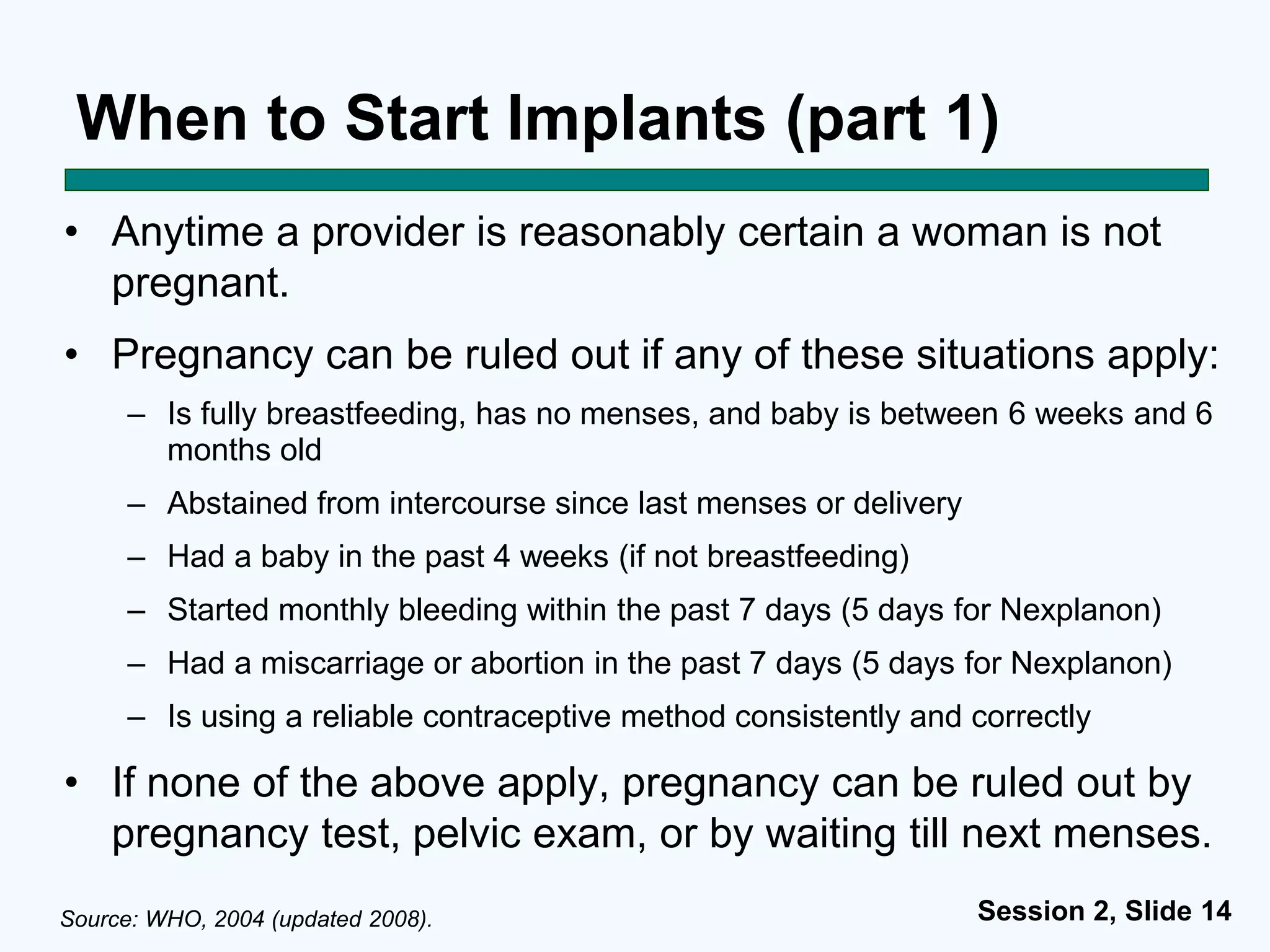
When to Start Implants (part 1)
• Anytime a provider is reasonably certain a woman is not
pregnant.
• Pregnancy can be ruled out if any of these situations apply:
– Is fully breastfeeding, has no menses, and baby is between 6 weeks and 6
months old
– Abstained from intercourse since last menses or delivery
– Had a baby in the past 4 weeks (if not breastfeeding)
– Started monthly bleeding within the past 7 days (5 days for Nexplanon)
– Had a miscarriage or abortion in the past 7 days (5 days for Nexplanon)
– Is using a reliable contraceptive method consistently and correctly
• If none of the above apply, pregnancy can be ruled out by
pregnancy test, pelvic exam, or by waiting till next menses.
Source: WHO, 2004 (updated 2008).
Session 2, Slide 15
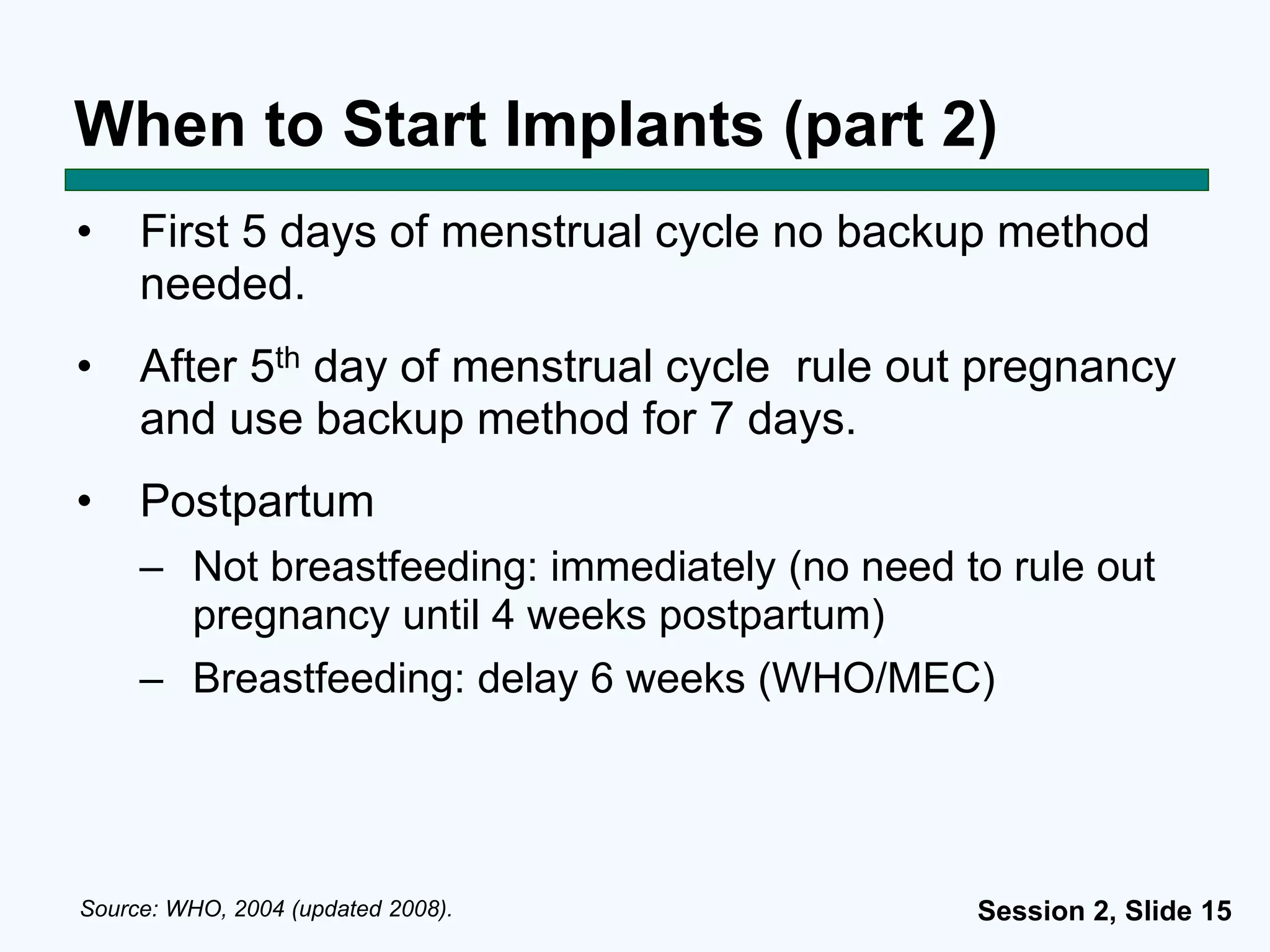
When to Start Implants (part 2)
• First 5 days of menstrual cycle no backup method
needed.
• After 5th day of menstrual cycle rule out pregnancy
and use backup method for 7 days.
• Postpartum
– Not breastfeeding: immediately (no need to rule out
pregnancy until 4 weeks postpartum)
– Breastfeeding: delay 6 weeks (WHO/MEC)
Source: WHO, 2004 (updated 2008).
Session 2, Slide 16
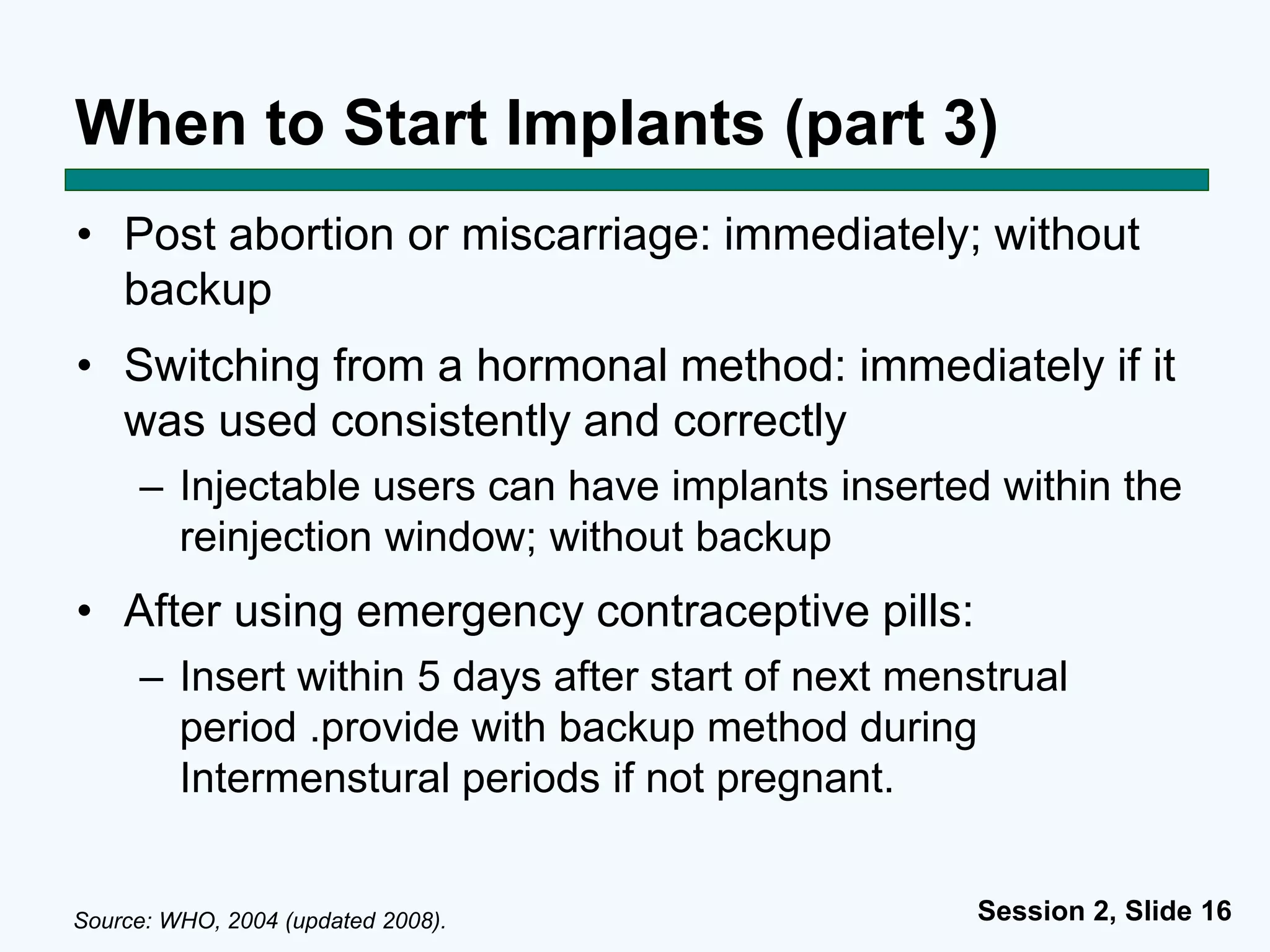
When to Start Implants (part 3)
• Post abortion or miscarriage: immediately; without
backup
• Switching from a hormonal method: immediately if it
was used consistently and correctly
– Injectable users can have implants inserted within the
reinjection window; without backup
• After using emergency contraceptive pills:
– Insert within 5 days after start of next menstrual
period .provide with backup method during
Intermenstural periods if not pregnant.
Source: WHO, 2004 (updated 2008).

Session 2 implanon next training module

  • 1.
    Session 2, Slide1 Contraceptive Implants Session 2: Who Can and Who Cannot Use Implant s
  • 2.
    Session 2, Slide2 Characteristics of Implants Why might these women be interested in using implants? • Breastfeeding mother • Adolescent • Infected with HIV • Has little to no access to a health care facility • Desires no more children
  • 3.
    Session 2, Slide3 Implants Are Safe for Nearly All Women – Have just had an abortion, miscarriage or ectopic pregnancy – Are breastfeeding (starting as soon as 6 weeks after childbirth, WHO/MEC) – Have anemia now or in the past – Have varicose veins • Almost all women can use implants safely, including women who: – Have or have not had children – Are not married – Are of any age including adolescents and women over 40 years old – Are infected with HIV • Most health conditions do not affect safe and effective use of implants. • Many women who cannot use methods that contain estrogen can safely use implants.
  • 4.
    Session 2, Slide4 But usually cannot use implants if: Most women can safely use implants Breastfeeding 6 weeks or less/WHO MEC May be pregnant Some other serious health conditions Who Can and Who Cannot Use Implants (part 1)
  • 5.
    Session 2, Slide5 Who Can and Cannot Use Implants (part 2) Most women can safely use implants. But usually cannot use implants if: Breastfeeding 6 weeks or less • Ask her to come back when baby is 6 weeks old. Urge her to keep breastfeeding. (Based on WHO MEC categorization) May be pregnant • If in doubt, use pregnancy checklist or perform pregnancy test. Some other serious health conditions • Has blood clot in lungs or deep in legs. • Women with superficial clots (including varicose veins) CAN use implants. • Ever had breast cancer. • Unexplained vaginal bleeding. If the bleeding suggests a serious condition, help her choose a method without hormones to use until unusual bleeding is assessed. • Serious liver disease or jaundice (yellow skin or eyes). • Takes pills for tuberculosis (TB), fungal infections, or seizures (fits).
  • 6.
    Session 2, Slide6 Medical Eligibility Criteria What are medical eligibility criteria? Define the categories. Review the job aid.
  • 7.
    Session 2, Slide7 WHO’s Medical Eligibility Criteria Categories for IUDs, Hormonal and Barrier Methods Source: WHO, 2010. Category Description With clinical judgment 1 No restriction for use Use the method under any circumstances 2 Benefits generally outweigh risks Generally use the method 3 Risks usually outweigh benefits Use of method not usually recommended, unless other methods are not available/acceptable 4 Unacceptable health risk Method not to be used
  • 8.
    Session 2, Slide8 WHO’s Medical Eligibility Criteria Categories for IUDs, Hormonal and Barrier Methods Source: WHO, 2010. Category When clinical judgment is limited 1 Use the method 2 3 Do not use the method 4
  • 9.
    Session 2, Slide9 Category 1 and 2 Examples (not inclusive): Who Can Start Implants WHO Category Conditions (selected examples) Category 1 Adolescents, post-abortion, postpartum in non-breastfeeding women, heavy smokers, women being treated for high blood pressure, valvular heart disease, endometriosis, endometrial or ovarian cancer, thyroid disorders Category 2 Blood pressure ≥160/100, history of blood clots in legs or lungs, diabetes with vascular complications, heavy or prolonged vaginal bleeding patterns, multiple risk factors for cardiovascular disease Implants are safe for nearly all women. Source: WHO, 2010.
  • 10.
    Session 2, Slide10 Category 3 and 4 Who Should Not Start Implants A small number of women may not be able to use implants. WHO Category Conditions (selected examples) Category 3 Acute blood clots in deep veins of legs or lungs, unexplained vaginal bleeding, history of breast cancer, severe liver disease, infection or tumors, and certain cases of systemic lupus. Breastfeeding before 6 weeks postpartum. Continuation only: ischemic heart disease, stroke, migraine with aura. Category 4 Current breast cancer Source: WHO, 2010.
  • 11.
    Session 2, Slide11 Implant Use by Women with HIV • Women with HIV or AIDS can use without restrictions • Some ARV drugs reduce blood progestin level • Efficacy is not affected because implants provide consistent dose of hormone over time • Dual method use should be encouraged Source: WHO, 2010; Mildvan, 2002. WHO Eligibility Criteria Condition Category HIV-infected 1 AIDS 1 ARV therapy 2
  • 12.
    Session 2, Slide12 Implant Use by Postpartum Women • Non-breastfeeding women can initiate immediately postpartum • Breastfeeding women – Before 6 weeks postpartum (WHO/MEC) – No restrictions after 6 weeks postpartum Source: WHO, 2010. WHO Eligibility Criteria Condition Category Non- breastfeeding 1 Breastfeeding <6 weeks 3 Breastfeeding ≥6 weeks 1
  • 13.
    Session 2, Slide13 Understanding the Implant Checklist Read questions 1–6 in the checklist and match them with the conditions and categories on the MEC quick reference chart. This set of questions identifies women who should not use implants. This set of questions identifies women who are not pregnant.The checklist also gives instructions about initiating implants.
  • 14.
    Session 2, Slide14 When to Start Implants (part 1) • Anytime a provider is reasonably certain a woman is not pregnant. • Pregnancy can be ruled out if any of these situations apply: – Is fully breastfeeding, has no menses, and baby is between 6 weeks and 6 months old – Abstained from intercourse since last menses or delivery – Had a baby in the past 4 weeks (if not breastfeeding) – Started monthly bleeding within the past 7 days (5 days for Nexplanon) – Had a miscarriage or abortion in the past 7 days (5 days for Nexplanon) – Is using a reliable contraceptive method consistently and correctly • If none of the above apply, pregnancy can be ruled out by pregnancy test, pelvic exam, or by waiting till next menses. Source: WHO, 2004 (updated 2008).
  • 15.
    Session 2, Slide15 When to Start Implants (part 2) • First 5 days of menstrual cycle no backup method needed. • After 5th day of menstrual cycle rule out pregnancy and use backup method for 7 days. • Postpartum – Not breastfeeding: immediately (no need to rule out pregnancy until 4 weeks postpartum) – Breastfeeding: delay 6 weeks (WHO/MEC) Source: WHO, 2004 (updated 2008).
  • 16.
    Session 2, Slide16 When to Start Implants (part 3) • Post abortion or miscarriage: immediately; without backup • Switching from a hormonal method: immediately if it was used consistently and correctly – Injectable users can have implants inserted within the reinjection window; without backup • After using emergency contraceptive pills: – Insert within 5 days after start of next menstrual period .provide with backup method during Intermenstural periods if not pregnant. Source: WHO, 2004 (updated 2008).

Editor's Notes