INDIAN 
RAILWAYS
* The effect of INDUSTRIAL REVOLUTION (2nd half of 18th c to 1st half of 19th 
c.), Great Britain 
* Invention of “Steam engine” by James Watt for railways led to radical 
changes in transport system all over the world. 
* Railways are the convenient mode of transport for long distances. 
* Suitable for carrying heavy and bulky goods like. Iron & steel, ores .. 
* Carries raw materials from mines and quarries .. and other interior 
areas of the country to industrial centres. 
* Link up the various regions of the economy and increase the 
occupational mobility of the people. 
* In short, They play a crucial role in the economic development of 
the nation.
ELEVENTH PLAN ( 2007-12) 
- Major initiative in shifting to PPP for building and operation of selected 
railway infrastructure. 
- Provision of quality passenger amenities at terminals, overall 
improvement in the sanitation. 
- Outsourcing routine activities to private companies. 
-Introduction of modern Rolling stock 
-Appropriate changes in designs of wagons.
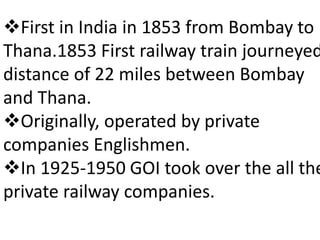
First in India in 1853 from Bombay to 
Thana.1853 First railway train journeyed 
distance of 22 miles between Bombay 
and Thana. 
Originally, operated by private 
companies Englishmen. 
In 1925-1950 GOI took over the all the 
private railway companies.
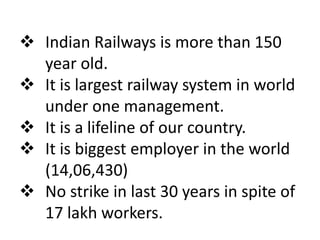
 Indian Railways is more than 150 
year old. 
 It is largest railway system in world 
under one management. 
 It is a lifeline of our country. 
 It is biggest employer in the world 
(14,06,430) 
 No strike in last 30 years in spite of 
17 lakh workers.
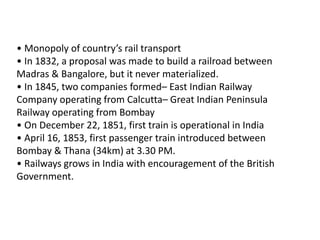
• Monopoly of country’s rail transport 
• In 1832, a proposal was made to build a railroad between 
Madras & Bangalore, but it never materialized. 
• In 1845, two companies formed– East Indian Railway 
Company operating from Calcutta– Great Indian Peninsula 
Railway operating from Bombay 
• On December 22, 1851, first train is operational in India 
• April 16, 1853, first passenger train introduced between 
Bombay & Thana (34km) at 3.30 PM. 
• Railways grows in India with encouragement of the British 
Government.
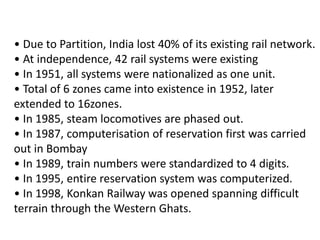
• Due to Partition, India lost 40% of its existing rail network. 
• At independence, 42 rail systems were existing 
• In 1951, all systems were nationalized as one unit. 
• Total of 6 zones came into existence in 1952, later 
extended to 16zones. 
• In 1985, steam locomotives are phased out. 
• In 1987, computerisation of reservation first was carried 
out in Bombay 
• In 1989, train numbers were standardized to 4 digits. 
• In 1995, entire reservation system was computerized. 
• In 1998, Konkan Railway was opened spanning difficult 
terrain through the Western Ghats.
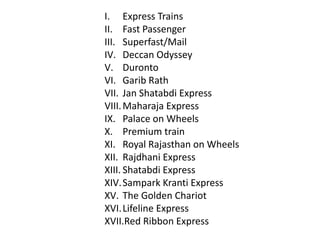
I. Express Trains 
II. Fast Passenger 
III. Superfast/Mail 
IV. Deccan Odyssey 
V. Duronto 
VI. Garib Rath 
VII. Jan Shatabdi Express 
VIII.Maharaja Express 
IX. Palace on Wheels 
X. Premium train 
XI. Royal Rajasthan on Wheels 
XII. Rajdhani Express 
XIII. Shatabdi Express 
XIV.Sampark Kranti Express 
XV. The Golden Chariot 
XVI. Lifeline Express 
XVII.Red Ribbon Express
• Freight– Contributes to 70%of revenues– Last 2 
decades, shifted to large container movement.–
Types of Freight Trains
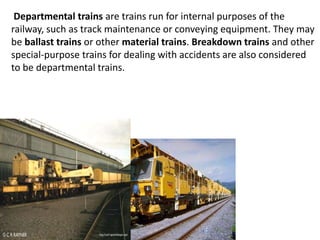
Departmental trains are trains run for internal purposes of the 
railway, such as track maintenance or conveying equipment. They may 
be ballast trains or other material trains. Breakdown trains and other 
special-purpose trains for dealing with accidents are also considered 
to be departmental trains.
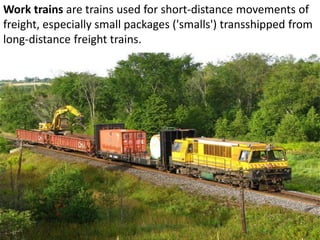
Work trains are trains used for short-distance movements of 
freight, especially small packages ('smalls') transshipped from 
long-distance freight trains.
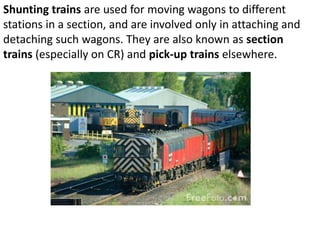
Shunting trains are used for moving wagons to different 
stations in a section, and are involved only in attaching and 
detaching such wagons. They are also known as section 
trains (especially on CR) and pick-up trains elsewhere.
Through goods trains are freight trains transporting goods 
from one goods yard to the next without stoppage at 
intermediate points. Long-distance goods, also known 
as solid trains include various special long-distance freight 
trains that get precedence, such as the Freight Chief or 
other Express Goods trains with timetabled operations and 
guaranteed delivery time (including QTS or Quick Transit 
Service goods), Jumbo trains, and Sherpa trains. The 
remainder of the through goods trains, which run at lower 
precedence, are known as Ordinary Through trains.
What are the typical 
freight loads carried by IR?
IR carries the entire gamut of goods, 
ranging from parcel traffic and small 
consignments, agricultural products, 
raw materials like iron ore and 
petroleum, and finished goods like 
automobiles.
The 'Green Bogey' (Green Bogie) 
service provides for the transport of 
perishable agricultural products (fruits 
and vegetables) in refrigerated and 
non-refrigerated wagons attached to 
passenger trains.
How are freight trains scheduled?
Some trains are run as pre-scheduled or timetabled services. The 
majority of goods trains run as requirements arise. The process 
of arranging for a goods train to run is known as ordering a 
goods train. Ordering a goods train involves the issuance of 
written advice to the yard or station and loco shed that a certain 
train will run, starting from the station or yard at a certain time 
and running to a certain schedule. The written advice is known 
as the Train Notice. The train notice is normally issued at least 3 
hours before the advertised departure of the train, so that the 
rake can be marshalled and the locomotives prepared for the 
trip. Once the train departs, it is under the control of the section 
controllers until it reaches the next goods yard (where the next 
section controller picks it up). Apart from coordinating with 
station staff for through running on the main or loop lines, 
normally goods trains run without attention from station staff.
Who carries container traffic in 
India?
Most rail container traffic in India is handled by CONCOR (the 
Container Corporation of India) which until recently was the 
only such organization. CONCOR is a public-sector concern, 
but it maintains its own fleet of wagons and other assets that 
are separate from IR's, although the traffic moves on IR's 
tracks. 
Recently [1999] CONCOR has begun running some fast (up to 
100km/h) guaranteed delivery container freight trains on 
certain routes (35 rail corridors have been identified as 
suitable for such service). The rakes consist of 5-wagon 
groups of flat cars; the flat cars are low flat cars which allow 
loading 'Tallboy' containers.
International freight: Are there direct 
freight trains running between India and 
neighboring countries?
Freight trains run regularly between India and Pakistan via the 
Attari (Punjab) - Lahore route. The Munabao - Khokhrapar 
route is under consideration [2007] for goods traffic (it is 
currently only used for the Thar Express passenger traffic). 
Freight trains have also been running regularly between India 
and Bangladesh on the Gede-Darshana and Petrapole - 
Benapole routes. Another route connecting India and 
Bangladesh is Singhbad (India) - Rohanpur (Bangladesh). The 
Bongaon (India) - Jessore (Bangladesh) direct BG route has 
been proposed, and needs a 10km link constructed between 
Akhaura and Agartala. Nepal is connected to India by rail by 
the Birgunj - Raxaul line.
IN-BOUND TRAINS - LOCAL 
TRAINS 
OUT-BOUND TRAINS - TRAINS 
CONNECTING TO STATES & 
OTHER CITIES.
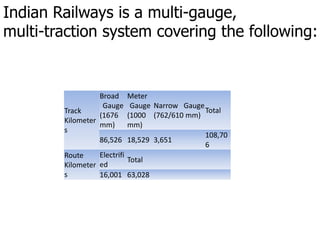
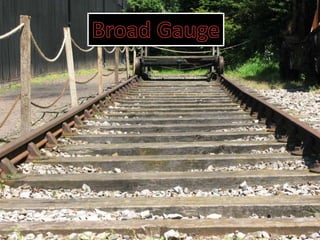
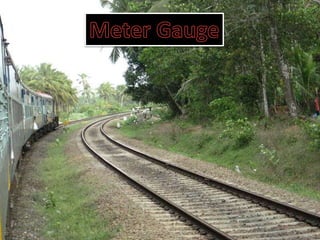
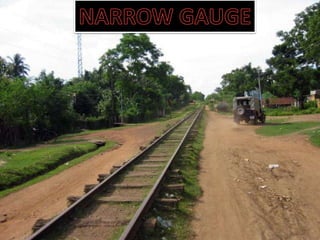
Indian Railways is a multi-gauge, 
multi-traction system covering the following: 
Track 
Kilometer 
s 
Broad 
Gauge 
(1676 
mm) 
Meter 
Gauge 
(1000 
mm) 
Narrow Gauge 
(762/610 mm) 
Total 
86,526 18,529 3,651 
108,70 
6 
Route 
Kilometer 
s 
Electrifi 
ed 
Total 
16,001 63,028
What are CONCOR depots and 
where are they located?
CONCOR (Container Corporation of India) operates 
several container depots throughout the country. As 
of there were 31 Inland Container Depots (ICDs) with 
facilities for international freight and connected to 
ports. These are classified based on whether or not 
they have a Container Freight Station (CFS), and 
whether they are equipped to handle port freight. A 
CFS facility allows freight to be loaded / unloaded to 
or from containers, and aggregated or distributed; at 
an ICD without a CFS, containers can only be routed 
to different destinations without being opened and 
loaded or unloaded.
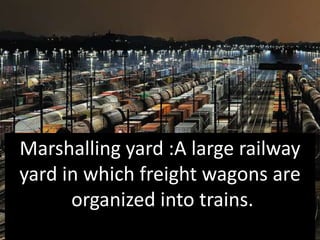
Marshalling yard :A large railway 
yard in which freight wagons are 
organized into trains.
References : 
http://www.irfca.org/faq/faq-freight.html 
http://www.irfca.org/faq/faq-freight.html

Indian Freight Trains

  • 1.
  • 3.
    * The effectof INDUSTRIAL REVOLUTION (2nd half of 18th c to 1st half of 19th c.), Great Britain * Invention of “Steam engine” by James Watt for railways led to radical changes in transport system all over the world. * Railways are the convenient mode of transport for long distances. * Suitable for carrying heavy and bulky goods like. Iron & steel, ores .. * Carries raw materials from mines and quarries .. and other interior areas of the country to industrial centres. * Link up the various regions of the economy and increase the occupational mobility of the people. * In short, They play a crucial role in the economic development of the nation.
  • 4.
    ELEVENTH PLAN (2007-12) - Major initiative in shifting to PPP for building and operation of selected railway infrastructure. - Provision of quality passenger amenities at terminals, overall improvement in the sanitation. - Outsourcing routine activities to private companies. -Introduction of modern Rolling stock -Appropriate changes in designs of wagons.
  • 7.
    First in Indiain 1853 from Bombay to Thana.1853 First railway train journeyed distance of 22 miles between Bombay and Thana. Originally, operated by private companies Englishmen. In 1925-1950 GOI took over the all the private railway companies.
  • 8.
     Indian Railwaysis more than 150 year old.  It is largest railway system in world under one management.  It is a lifeline of our country.  It is biggest employer in the world (14,06,430)  No strike in last 30 years in spite of 17 lakh workers.
  • 10.
    • Monopoly ofcountry’s rail transport • In 1832, a proposal was made to build a railroad between Madras & Bangalore, but it never materialized. • In 1845, two companies formed– East Indian Railway Company operating from Calcutta– Great Indian Peninsula Railway operating from Bombay • On December 22, 1851, first train is operational in India • April 16, 1853, first passenger train introduced between Bombay & Thana (34km) at 3.30 PM. • Railways grows in India with encouragement of the British Government.
  • 11.
    • Due toPartition, India lost 40% of its existing rail network. • At independence, 42 rail systems were existing • In 1951, all systems were nationalized as one unit. • Total of 6 zones came into existence in 1952, later extended to 16zones. • In 1985, steam locomotives are phased out. • In 1987, computerisation of reservation first was carried out in Bombay • In 1989, train numbers were standardized to 4 digits. • In 1995, entire reservation system was computerized. • In 1998, Konkan Railway was opened spanning difficult terrain through the Western Ghats.
  • 12.
    I. Express Trains II. Fast Passenger III. Superfast/Mail IV. Deccan Odyssey V. Duronto VI. Garib Rath VII. Jan Shatabdi Express VIII.Maharaja Express IX. Palace on Wheels X. Premium train XI. Royal Rajasthan on Wheels XII. Rajdhani Express XIII. Shatabdi Express XIV.Sampark Kranti Express XV. The Golden Chariot XVI. Lifeline Express XVII.Red Ribbon Express
  • 13.
    • Freight– Contributesto 70%of revenues– Last 2 decades, shifted to large container movement.–
  • 14.
  • 15.
    Departmental trains aretrains run for internal purposes of the railway, such as track maintenance or conveying equipment. They may be ballast trains or other material trains. Breakdown trains and other special-purpose trains for dealing with accidents are also considered to be departmental trains.
  • 16.
    Work trains aretrains used for short-distance movements of freight, especially small packages ('smalls') transshipped from long-distance freight trains.
  • 17.
    Shunting trains areused for moving wagons to different stations in a section, and are involved only in attaching and detaching such wagons. They are also known as section trains (especially on CR) and pick-up trains elsewhere.
  • 18.
    Through goods trainsare freight trains transporting goods from one goods yard to the next without stoppage at intermediate points. Long-distance goods, also known as solid trains include various special long-distance freight trains that get precedence, such as the Freight Chief or other Express Goods trains with timetabled operations and guaranteed delivery time (including QTS or Quick Transit Service goods), Jumbo trains, and Sherpa trains. The remainder of the through goods trains, which run at lower precedence, are known as Ordinary Through trains.
  • 19.
    What are thetypical freight loads carried by IR?
  • 20.
    IR carries theentire gamut of goods, ranging from parcel traffic and small consignments, agricultural products, raw materials like iron ore and petroleum, and finished goods like automobiles.
  • 21.
    The 'Green Bogey'(Green Bogie) service provides for the transport of perishable agricultural products (fruits and vegetables) in refrigerated and non-refrigerated wagons attached to passenger trains.
  • 22.
    How are freighttrains scheduled?
  • 23.
    Some trains arerun as pre-scheduled or timetabled services. The majority of goods trains run as requirements arise. The process of arranging for a goods train to run is known as ordering a goods train. Ordering a goods train involves the issuance of written advice to the yard or station and loco shed that a certain train will run, starting from the station or yard at a certain time and running to a certain schedule. The written advice is known as the Train Notice. The train notice is normally issued at least 3 hours before the advertised departure of the train, so that the rake can be marshalled and the locomotives prepared for the trip. Once the train departs, it is under the control of the section controllers until it reaches the next goods yard (where the next section controller picks it up). Apart from coordinating with station staff for through running on the main or loop lines, normally goods trains run without attention from station staff.
  • 24.
    Who carries containertraffic in India?
  • 25.
    Most rail containertraffic in India is handled by CONCOR (the Container Corporation of India) which until recently was the only such organization. CONCOR is a public-sector concern, but it maintains its own fleet of wagons and other assets that are separate from IR's, although the traffic moves on IR's tracks. Recently [1999] CONCOR has begun running some fast (up to 100km/h) guaranteed delivery container freight trains on certain routes (35 rail corridors have been identified as suitable for such service). The rakes consist of 5-wagon groups of flat cars; the flat cars are low flat cars which allow loading 'Tallboy' containers.
  • 26.
    International freight: Arethere direct freight trains running between India and neighboring countries?
  • 27.
    Freight trains runregularly between India and Pakistan via the Attari (Punjab) - Lahore route. The Munabao - Khokhrapar route is under consideration [2007] for goods traffic (it is currently only used for the Thar Express passenger traffic). Freight trains have also been running regularly between India and Bangladesh on the Gede-Darshana and Petrapole - Benapole routes. Another route connecting India and Bangladesh is Singhbad (India) - Rohanpur (Bangladesh). The Bongaon (India) - Jessore (Bangladesh) direct BG route has been proposed, and needs a 10km link constructed between Akhaura and Agartala. Nepal is connected to India by rail by the Birgunj - Raxaul line.
  • 29.
    IN-BOUND TRAINS -LOCAL TRAINS OUT-BOUND TRAINS - TRAINS CONNECTING TO STATES & OTHER CITIES.
  • 31.
    Indian Railways isa multi-gauge, multi-traction system covering the following: Track Kilometer s Broad Gauge (1676 mm) Meter Gauge (1000 mm) Narrow Gauge (762/610 mm) Total 86,526 18,529 3,651 108,70 6 Route Kilometer s Electrifi ed Total 16,001 63,028
  • 35.
    What are CONCORdepots and where are they located?
  • 36.
    CONCOR (Container Corporationof India) operates several container depots throughout the country. As of there were 31 Inland Container Depots (ICDs) with facilities for international freight and connected to ports. These are classified based on whether or not they have a Container Freight Station (CFS), and whether they are equipped to handle port freight. A CFS facility allows freight to be loaded / unloaded to or from containers, and aggregated or distributed; at an ICD without a CFS, containers can only be routed to different destinations without being opened and loaded or unloaded.
  • 37.
    Marshalling yard :Alarge railway yard in which freight wagons are organized into trains.
  • 39.
    References : http://www.irfca.org/faq/faq-freight.html http://www.irfca.org/faq/faq-freight.html