Introduction to PHP
Prepared by
V.SANTHI
Assistant Professor,
Department of Computer Applications,
Thanjavur
PHP Introduction
 PHP is a recursive acronym for “PHP: Hypertext
Preprocessor” -- It is a widely-used open source general-
purpose scripting language that is especially suited for web
development and can be embedded into HTML.
PHP Introduction
 > PHP is a server-side scripting language
 > PHP scripts are executed on the server
 > PHP supports many databases (MySQL, Informix,
Oracle, Sybase, Solid, PostgreSQL, Generic ODBC, etc.)
 > PHP is open source software
 > PHP is free to download and use
PHP Introduction
 > PHP runs on different platforms (Windows, Linux, Unix,
etc.)
 > PHP is compatible with almost all servers used today
(Apache, IIS, etc.)
 > PHP is FREE to download from the official PHP
resource: www.php.net
 > PHP is easy to learn and runs efficiently on the server
side
PHP Introduction
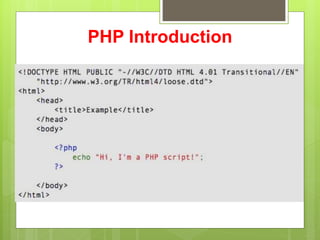
Instead of lots of commands to output HTML (as seen in C
or Perl), PHP pages contain HTML with embedded code that
does "something" (like in the next slide, it outputs "Hi, I'm a
PHP script!").
The PHP code is enclosed in special start and end
processing instructions <?php and ?> that allow you to
jump into and out of "PHP mode."
PHP Introduction
PHP Introduction
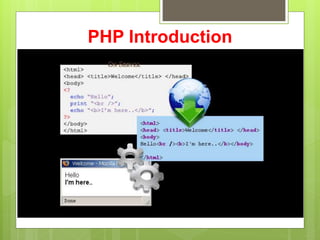
PHP code is executed on the server, generating HTML
which is then sent to the client. The client would receive the
results of running that script, but would not know what the
underlying code was.
A visual, if you please...
PHP Introduction
PHP Getting Started
 On windows, you can download and install WAMP. With
one installation and you get an Apache webserver,
database server and php.
 http://www.wampserver.com
 On mac, you can download and install MAMP.
 http://www.mamp.info/en/index.html
PHP Hello World
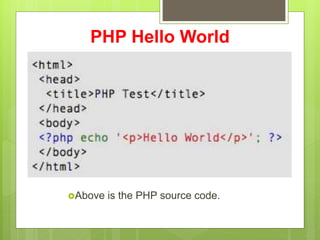
Above is the PHP source code.
PHP Hello World
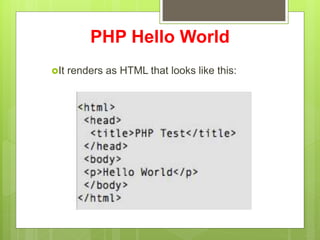
It renders as HTML that looks like this:
PHP Hello World
 This program is extremely simple and you really did not
need to use PHP to create a page like this. All it does is
display: Hello World using the PHP echo() statement.
 Think of this as a normal HTML file which happens to
have a set of special tags available to you that do a lot of
interesting things.
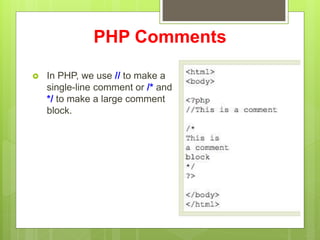
PHP Comments
 In PHP, we use // to make a
single-line comment or /* and
*/ to make a large comment
block.
PHP Variables
 > Variables are used for storing values, like text strings,
numbers or arrays.
 > When a variable is declared, it can be used over and
over again in your script.
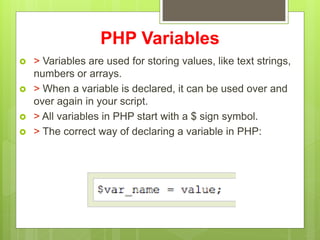
 > All variables in PHP start with a $ sign symbol.
 > The correct way of declaring a variable in PHP:
PHP Variables
> In PHP, a variable does not need to be declared before
adding a value to it.
> In the example above, you see that you do not have to
tell PHP which data type the variable is.
> PHP automatically converts the variable to the correct
data type, depending on its value.
PHP Variables
 > A variable name must start with a letter or an
underscore "_" -- not a number
 > A variable name can only contain alpha-numeric
characters, underscores (a-z, A-Z, 0-9, and _ )
 > A variable name should not contain spaces. If a
variable name is more than one word, it should be
separated with an underscore ($my_string) or with
capitalization ($myString)
PHP Concatenation
 > The concatenation operator (.) is used to put two string
values together.
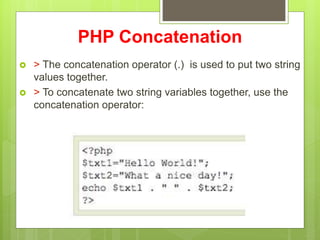
 > To concatenate two string variables together, use the
concatenation operator:
PHP Concatenation
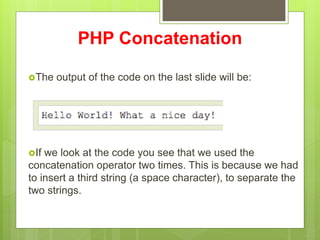
The output of the code on the last slide will be:
If we look at the code you see that we used the
concatenation operator two times. This is because we had
to insert a third string (a space character), to separate the
two strings.
PHP Operators
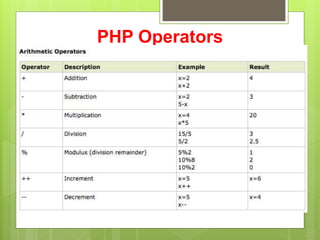
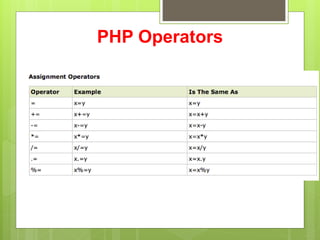
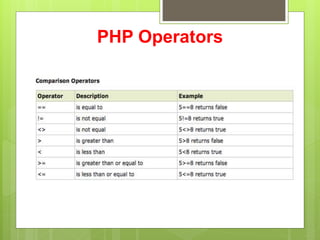
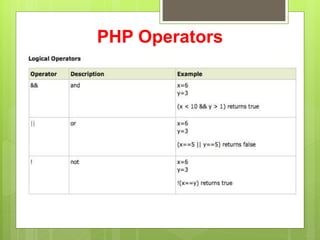
 Operators are used to operate on values. There are four
classifications of operators:
 > Arithmetic
 > Assignment
 > Comparison
 > Logical
PHP Operators
PHP Operators
PHP Operators
PHP Operators

Introduction to PHP.ppt

  • 1.
    Introduction to PHP Preparedby V.SANTHI Assistant Professor, Department of Computer Applications, Thanjavur
  • 2.
    PHP Introduction  PHPis a recursive acronym for “PHP: Hypertext Preprocessor” -- It is a widely-used open source general- purpose scripting language that is especially suited for web development and can be embedded into HTML.
  • 3.
    PHP Introduction  >PHP is a server-side scripting language  > PHP scripts are executed on the server  > PHP supports many databases (MySQL, Informix, Oracle, Sybase, Solid, PostgreSQL, Generic ODBC, etc.)  > PHP is open source software  > PHP is free to download and use
  • 4.
    PHP Introduction  >PHP runs on different platforms (Windows, Linux, Unix, etc.)  > PHP is compatible with almost all servers used today (Apache, IIS, etc.)  > PHP is FREE to download from the official PHP resource: www.php.net  > PHP is easy to learn and runs efficiently on the server side
  • 5.
    PHP Introduction Instead oflots of commands to output HTML (as seen in C or Perl), PHP pages contain HTML with embedded code that does "something" (like in the next slide, it outputs "Hi, I'm a PHP script!"). The PHP code is enclosed in special start and end processing instructions <?php and ?> that allow you to jump into and out of "PHP mode."
  • 6.
  • 7.
    PHP Introduction PHP codeis executed on the server, generating HTML which is then sent to the client. The client would receive the results of running that script, but would not know what the underlying code was. A visual, if you please...
  • 8.
  • 9.
    PHP Getting Started On windows, you can download and install WAMP. With one installation and you get an Apache webserver, database server and php.  http://www.wampserver.com  On mac, you can download and install MAMP.  http://www.mamp.info/en/index.html
  • 10.
    PHP Hello World Aboveis the PHP source code.
  • 11.
    PHP Hello World Itrenders as HTML that looks like this:
  • 12.
    PHP Hello World This program is extremely simple and you really did not need to use PHP to create a page like this. All it does is display: Hello World using the PHP echo() statement.  Think of this as a normal HTML file which happens to have a set of special tags available to you that do a lot of interesting things.
  • 13.
    PHP Comments  InPHP, we use // to make a single-line comment or /* and */ to make a large comment block.
  • 14.
    PHP Variables  >Variables are used for storing values, like text strings, numbers or arrays.  > When a variable is declared, it can be used over and over again in your script.  > All variables in PHP start with a $ sign symbol.  > The correct way of declaring a variable in PHP:
  • 15.
    PHP Variables > InPHP, a variable does not need to be declared before adding a value to it. > In the example above, you see that you do not have to tell PHP which data type the variable is. > PHP automatically converts the variable to the correct data type, depending on its value.
  • 16.
    PHP Variables  >A variable name must start with a letter or an underscore "_" -- not a number  > A variable name can only contain alpha-numeric characters, underscores (a-z, A-Z, 0-9, and _ )  > A variable name should not contain spaces. If a variable name is more than one word, it should be separated with an underscore ($my_string) or with capitalization ($myString)
  • 17.
    PHP Concatenation  >The concatenation operator (.) is used to put two string values together.  > To concatenate two string variables together, use the concatenation operator:
  • 18.
    PHP Concatenation The outputof the code on the last slide will be: If we look at the code you see that we used the concatenation operator two times. This is because we had to insert a third string (a space character), to separate the two strings.
  • 19.
    PHP Operators  Operatorsare used to operate on values. There are four classifications of operators:  > Arithmetic  > Assignment  > Comparison  > Logical
  • 20.
  • 21.
  • 22.
  • 23.