Features of Java
Presented by
V.Santhi
Assistant Professor
Department of Computer Applications
Bon Secours College for Women
Thanjavur
OThe primary objective of Java
programming language creation was to
make it portable, simple and secure
programming language. Apart from this,
there are also some excellent features
which play an important role in the
popularity of this language. The features of
Java are also known as Java buzzwords
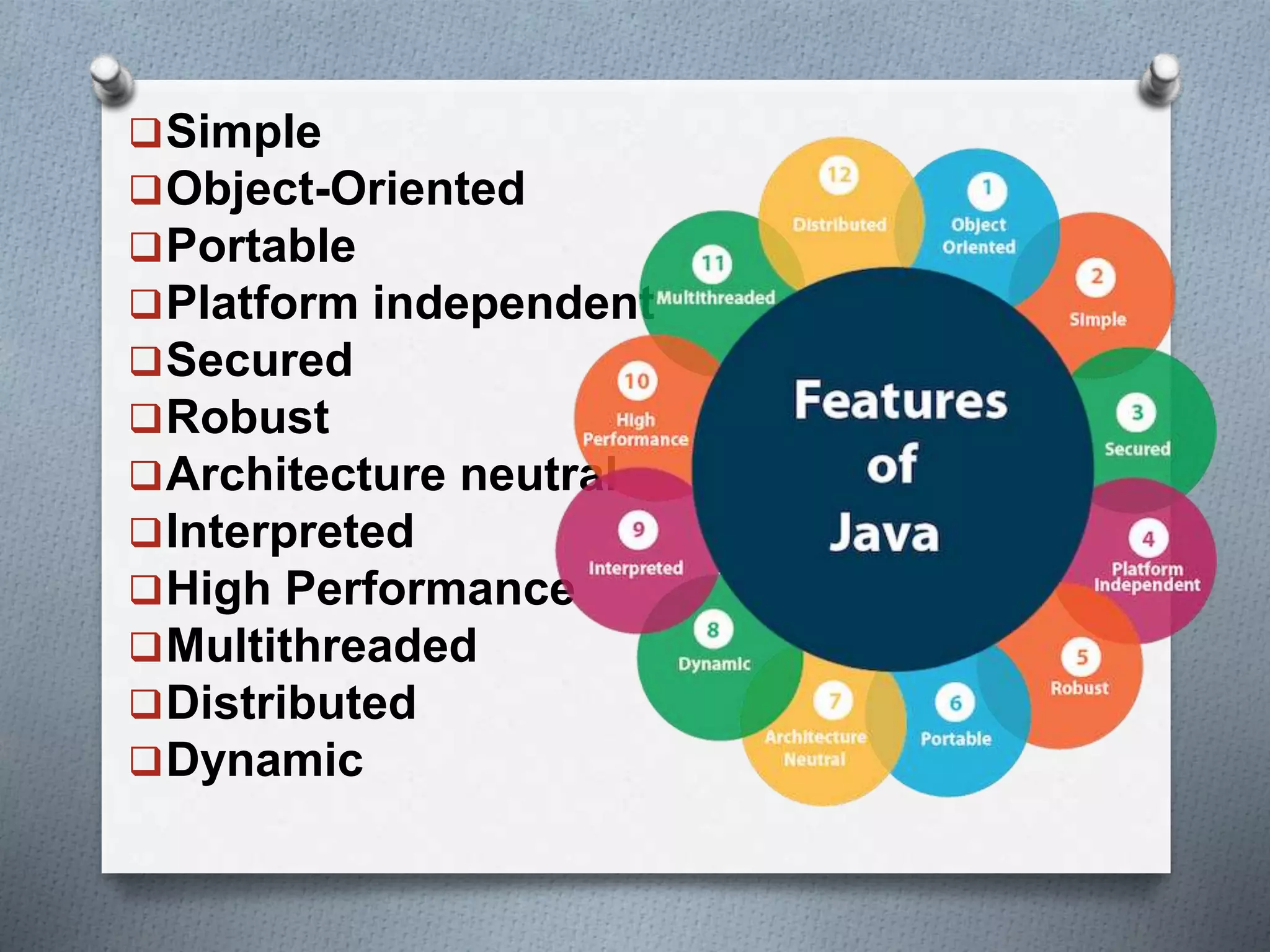
Simple
Object-Oriented
Portable
Platform independent
Secured
Robust
Architecture neutral
Interpreted
High Performance
Multithreaded
Distributed
Dynamic
Simple
O Java is very easy to learn, and its syntax is simple,
clean and easy to understand. According to Sun
Microsystem, Java language is a simple
programming language because:
O Java syntax is based on C++ (so easier for
programmers to learn it after C++).
O Java has removed many complicated and rarely-
used features, for example, explicit pointers,
operator overloading, etc.
O There is no need to remove unreferenced objects
because there is an Automatic Garbage Collection
in Java.
Object-oriented
O Java is an object-oriented programming
language. Everything in Java is an object.
Object-oriented means we organize our
software as a combination of different types of
objects that incorporate both data and
behaviour.
O Object-oriented programming (OOPs) is a
methodology that simplifies software
development and maintenance by providing
some rules.
O Basic concepts of OOPs are:
Object
Class
Inheritance
Polymorphism
Abstraction
Encapsulation
Platform Independent
O Java is platform independent because it is different
from other languages like C, C++, etc. which are
compiled into platform specific machines while Java
is a write once, run anywhere language. A platform
is the hardware or software environment in which a
program runs.
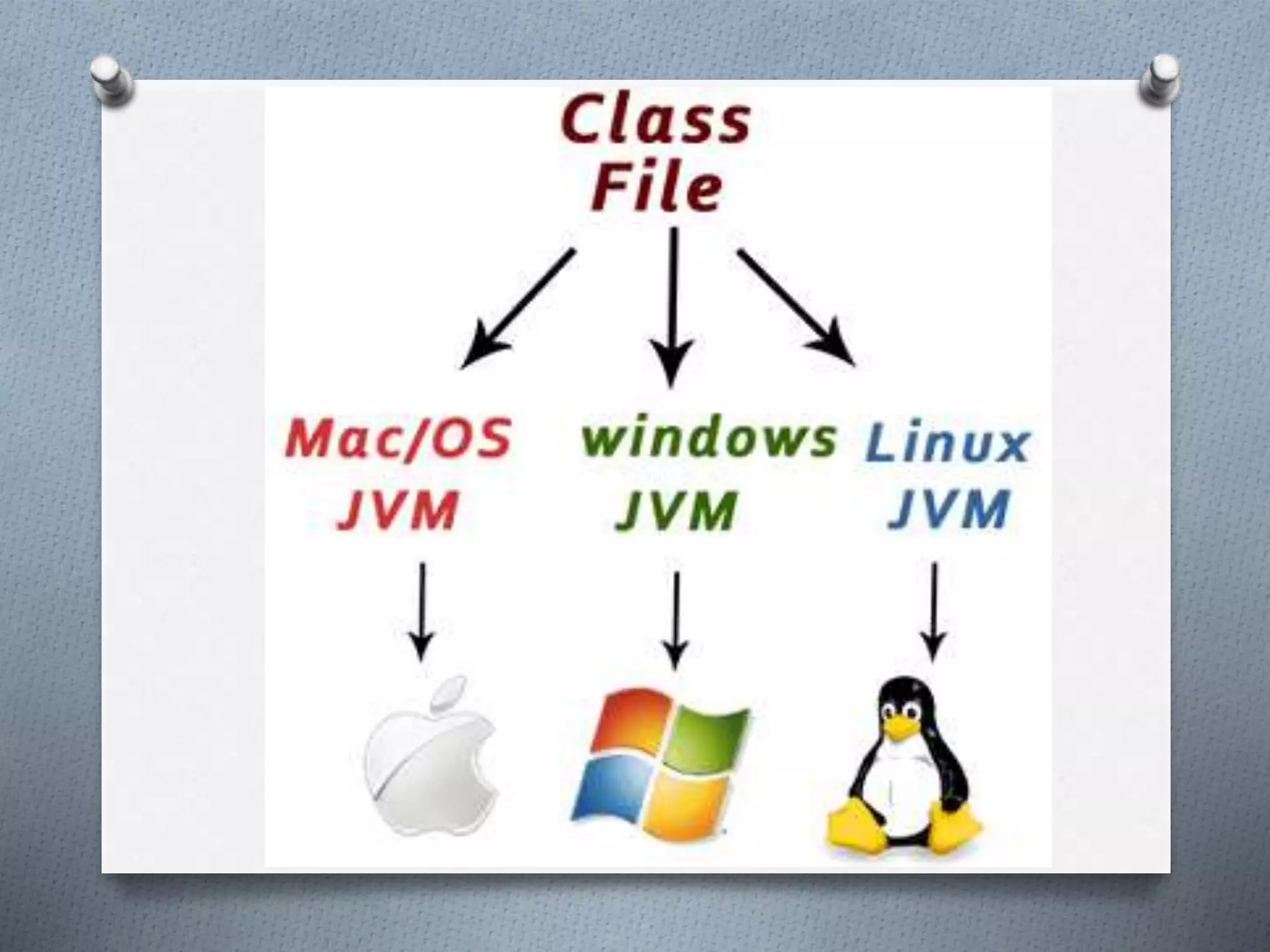
O Java code can be executed on multiple platforms,
for example, Windows, Linux, Sun Solaris, Mac/OS,
etc. Java code is compiled by the compiler and
converted into bytecode. This bytecode is a
platform-independent code because it can be run
on multiple platforms, i.e., Write Once and Run
Anywhere (WORA).
Secured
OJava is best known for its security. With
Java, we can develop virus-free systems.
Java is secured because:
ONo explicit pointer
OJava Programs run inside a virtual
machine sandbox
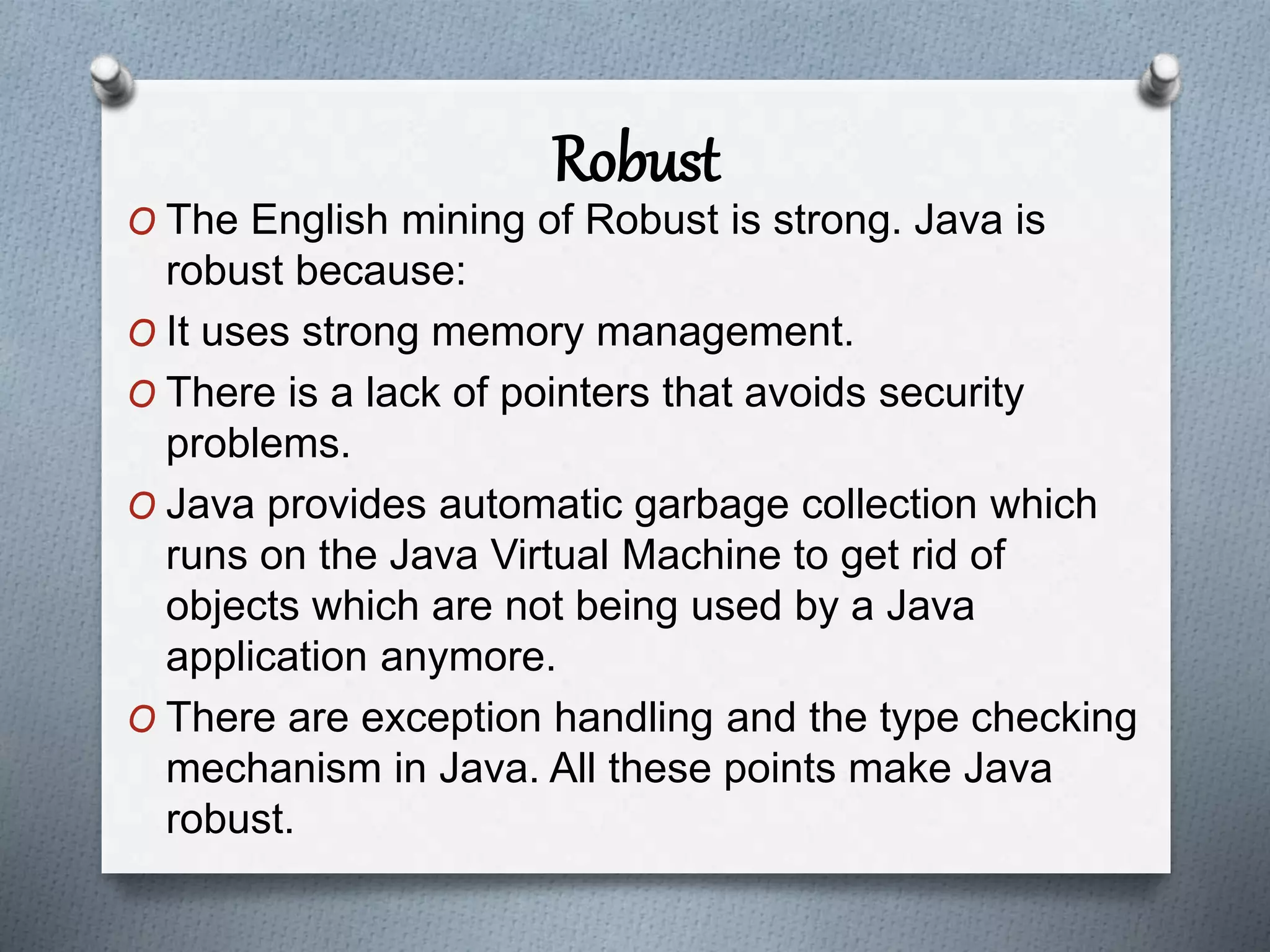
Robust
O The English mining of Robust is strong. Java is
robust because:
O It uses strong memory management.
O There is a lack of pointers that avoids security
problems.
O Java provides automatic garbage collection which
runs on the Java Virtual Machine to get rid of
objects which are not being used by a Java
application anymore.
O There are exception handling and the type checking
mechanism in Java. All these points make Java
robust.
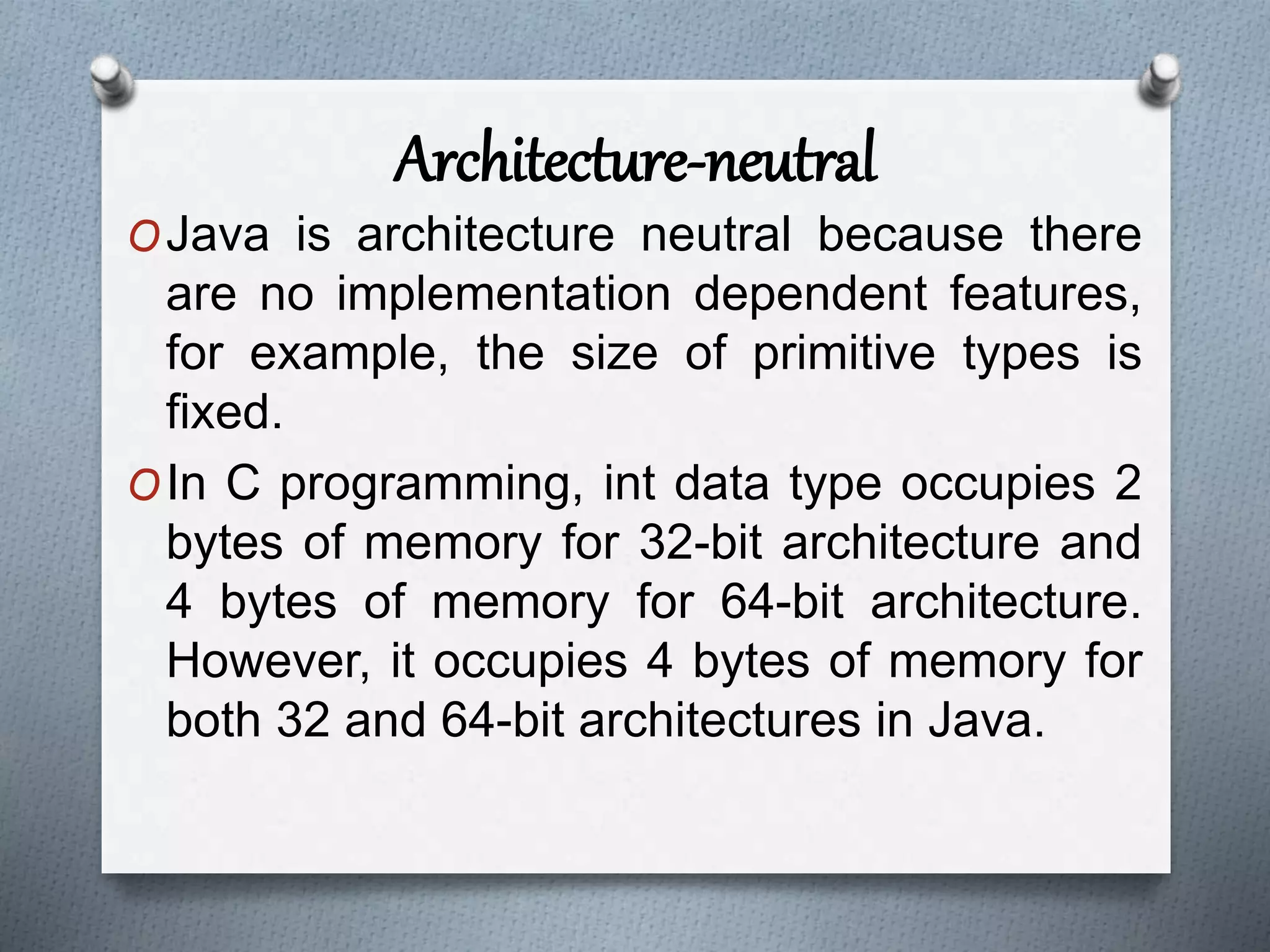
Architecture-neutral
OJava is architecture neutral because there
are no implementation dependent features,
for example, the size of primitive types is
fixed.
OIn C programming, int data type occupies 2
bytes of memory for 32-bit architecture and
4 bytes of memory for 64-bit architecture.
However, it occupies 4 bytes of memory for
both 32 and 64-bit architectures in Java.
Portable
OJava is portable because it facilitates
you to carry the Java bytecode to any
platform. It doesn't require any
implementation.
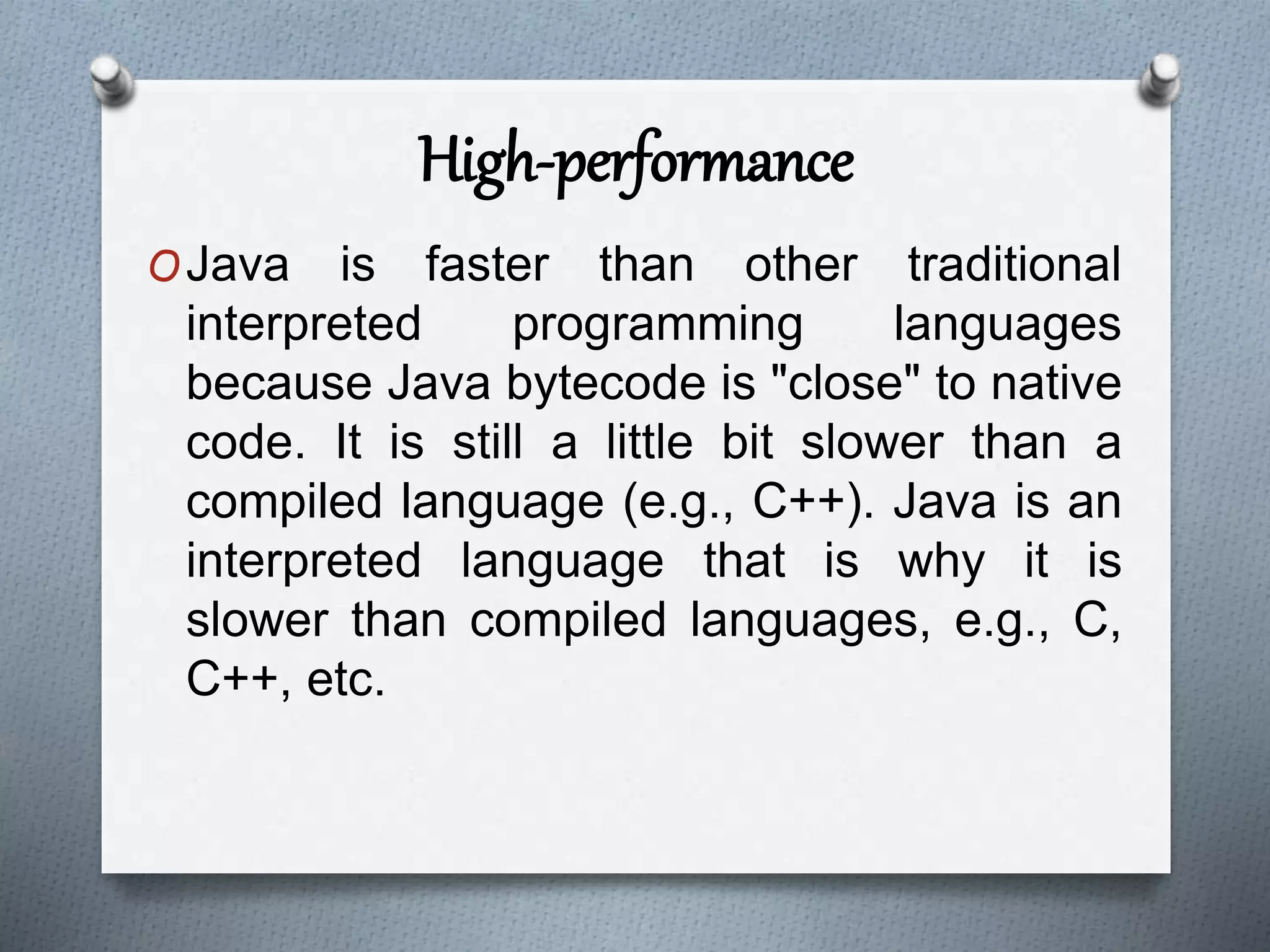
High-performance
OJava is faster than other traditional
interpreted programming languages
because Java bytecode is "close" to native
code. It is still a little bit slower than a
compiled language (e.g., C++). Java is an
interpreted language that is why it is
slower than compiled languages, e.g., C,
C++, etc.
Distributed
OJava is distributed because it facilitates
users to create distributed applications
in Java. RMI and EJB are used for
creating distributed applications. This
feature of Java makes us able to
access files by calling the methods
from any machine on the internet.
Multi-threaded
OA thread is like a separate program,
executing concurrently. We can write Java
programs that deal with many tasks at
once by defining multiple threads. The
main advantage of multi-threading is that it
doesn't occupy memory for each thread. It
shares a common memory area. Threads
are important for multi-media, Web
applications, etc.
Dynamic
OJava is a dynamic language. It supports the
dynamic loading of classes. It means
classes are loaded on demand. It also
supports functions from its native
languages, i.e., C and C++.
OJava supports dynamic compilation and
automatic memory management (garbage
collection).

Features of Java.pptx

  • 1.
    Features of Java Presentedby V.Santhi Assistant Professor Department of Computer Applications Bon Secours College for Women Thanjavur
  • 2.
    OThe primary objectiveof Java programming language creation was to make it portable, simple and secure programming language. Apart from this, there are also some excellent features which play an important role in the popularity of this language. The features of Java are also known as Java buzzwords
  • 3.
  • 4.
    Simple O Java isvery easy to learn, and its syntax is simple, clean and easy to understand. According to Sun Microsystem, Java language is a simple programming language because: O Java syntax is based on C++ (so easier for programmers to learn it after C++). O Java has removed many complicated and rarely- used features, for example, explicit pointers, operator overloading, etc. O There is no need to remove unreferenced objects because there is an Automatic Garbage Collection in Java.
  • 5.
    Object-oriented O Java isan object-oriented programming language. Everything in Java is an object. Object-oriented means we organize our software as a combination of different types of objects that incorporate both data and behaviour. O Object-oriented programming (OOPs) is a methodology that simplifies software development and maintenance by providing some rules. O Basic concepts of OOPs are: Object Class Inheritance Polymorphism Abstraction Encapsulation
  • 6.
    Platform Independent O Javais platform independent because it is different from other languages like C, C++, etc. which are compiled into platform specific machines while Java is a write once, run anywhere language. A platform is the hardware or software environment in which a program runs. O Java code can be executed on multiple platforms, for example, Windows, Linux, Sun Solaris, Mac/OS, etc. Java code is compiled by the compiler and converted into bytecode. This bytecode is a platform-independent code because it can be run on multiple platforms, i.e., Write Once and Run Anywhere (WORA).
  • 8.
    Secured OJava is bestknown for its security. With Java, we can develop virus-free systems. Java is secured because: ONo explicit pointer OJava Programs run inside a virtual machine sandbox
  • 9.
    Robust O The Englishmining of Robust is strong. Java is robust because: O It uses strong memory management. O There is a lack of pointers that avoids security problems. O Java provides automatic garbage collection which runs on the Java Virtual Machine to get rid of objects which are not being used by a Java application anymore. O There are exception handling and the type checking mechanism in Java. All these points make Java robust.
  • 10.
    Architecture-neutral OJava is architectureneutral because there are no implementation dependent features, for example, the size of primitive types is fixed. OIn C programming, int data type occupies 2 bytes of memory for 32-bit architecture and 4 bytes of memory for 64-bit architecture. However, it occupies 4 bytes of memory for both 32 and 64-bit architectures in Java.
  • 11.
    Portable OJava is portablebecause it facilitates you to carry the Java bytecode to any platform. It doesn't require any implementation.
  • 12.
    High-performance OJava is fasterthan other traditional interpreted programming languages because Java bytecode is "close" to native code. It is still a little bit slower than a compiled language (e.g., C++). Java is an interpreted language that is why it is slower than compiled languages, e.g., C, C++, etc.
  • 13.
    Distributed OJava is distributedbecause it facilitates users to create distributed applications in Java. RMI and EJB are used for creating distributed applications. This feature of Java makes us able to access files by calling the methods from any machine on the internet.
  • 14.
    Multi-threaded OA thread islike a separate program, executing concurrently. We can write Java programs that deal with many tasks at once by defining multiple threads. The main advantage of multi-threading is that it doesn't occupy memory for each thread. It shares a common memory area. Threads are important for multi-media, Web applications, etc.
  • 15.
    Dynamic OJava is adynamic language. It supports the dynamic loading of classes. It means classes are loaded on demand. It also supports functions from its native languages, i.e., C and C++. OJava supports dynamic compilation and automatic memory management (garbage collection).