Transition Metals
Do Now (Prior Knowledge Test):
1. What kind of ions will group 1 elements form?
2. What kind of ions will group 7 elements form?
3. How does reactivity change down group 1?
4. Why do group 7 elements get less reactive as you go down
the group?
5. What is an ionic bond?
Aim: To describe the properties of transition elements in comparison to Group 1 and 2
metals.
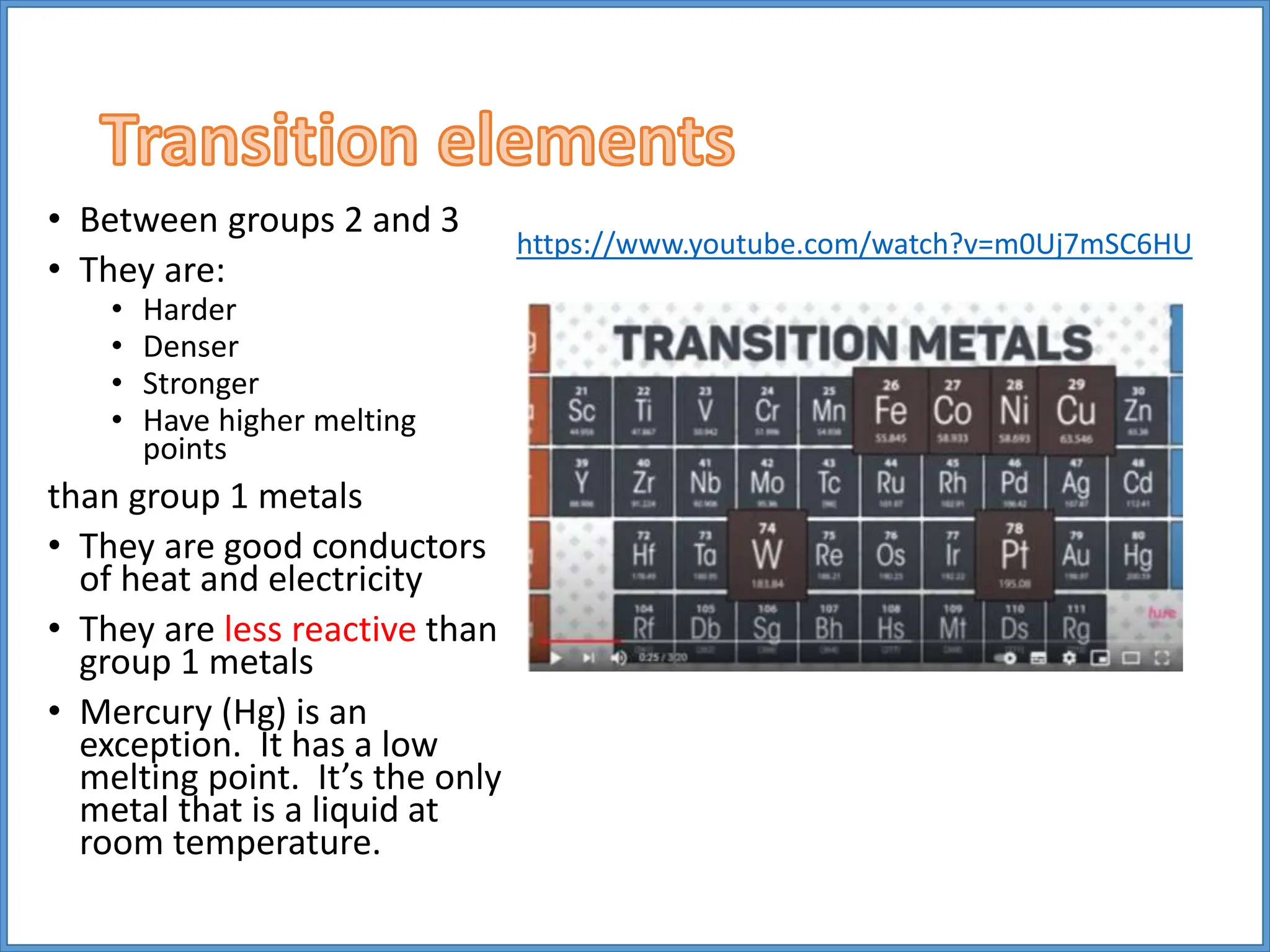
• Between groups 2 and 3
• They are:
• Harder
• Denser
• Stronger
• Have higher melting
points
than group 1 metals
• They are good conductors
of heat and electricity
• They are less reactive than
group 1 metals
• Mercury (Hg) is an
exception. It has a low
melting point. It’s the only
metal that is a liquid at
room temperature.
https://www.youtube.com/watch?v=m0Uj7mSC6HU
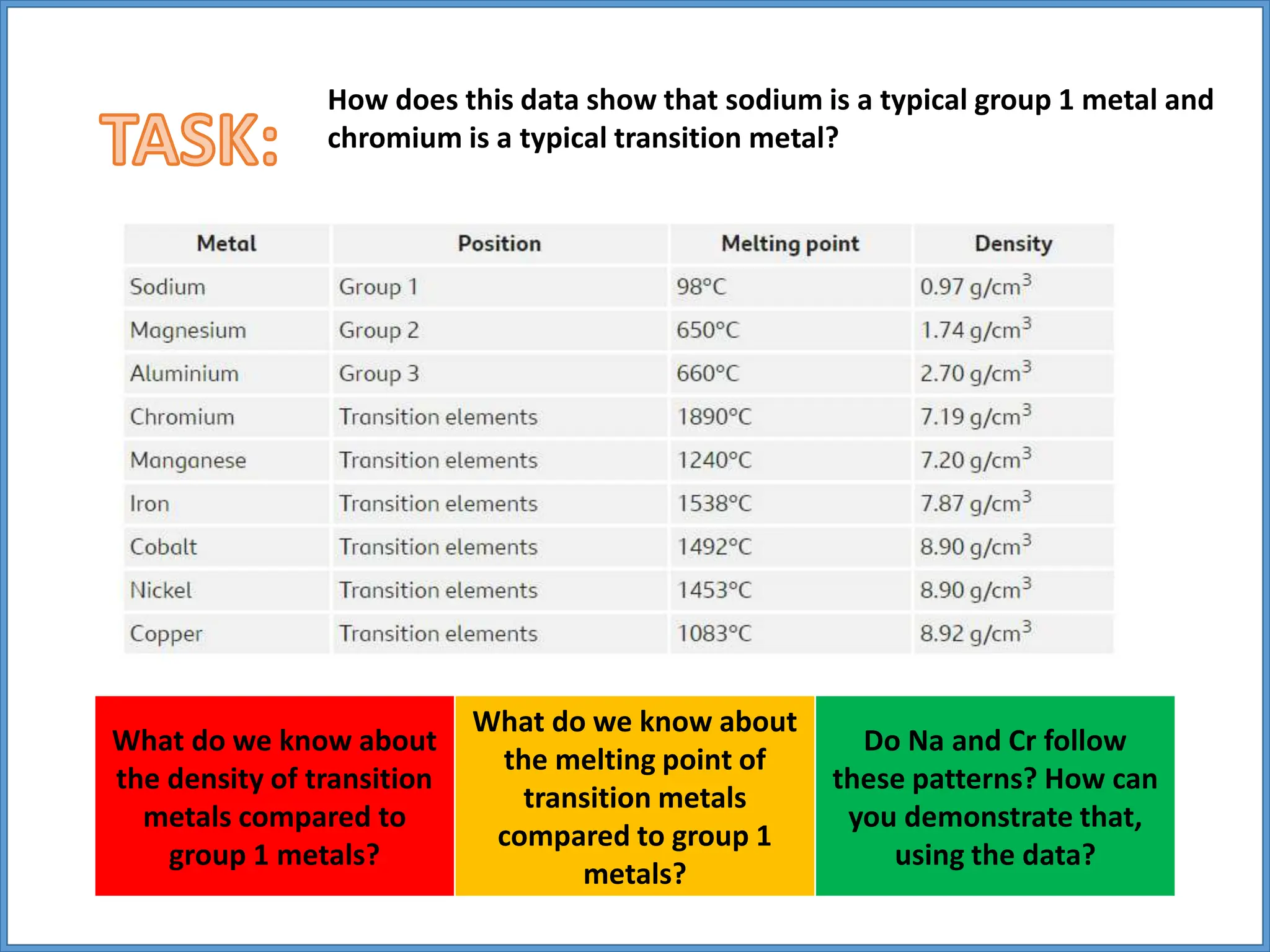
How does this data show that sodium is a typical group 1 metal and
chromium is a typical transition metal?
What do we know about
the density of transition
metals compared to
group 1 metals?
What do we know about
the melting point of
transition metals
compared to group 1
metals?
Do Na and Cr follow
these patterns? How can
you demonstrate that,
using the data?
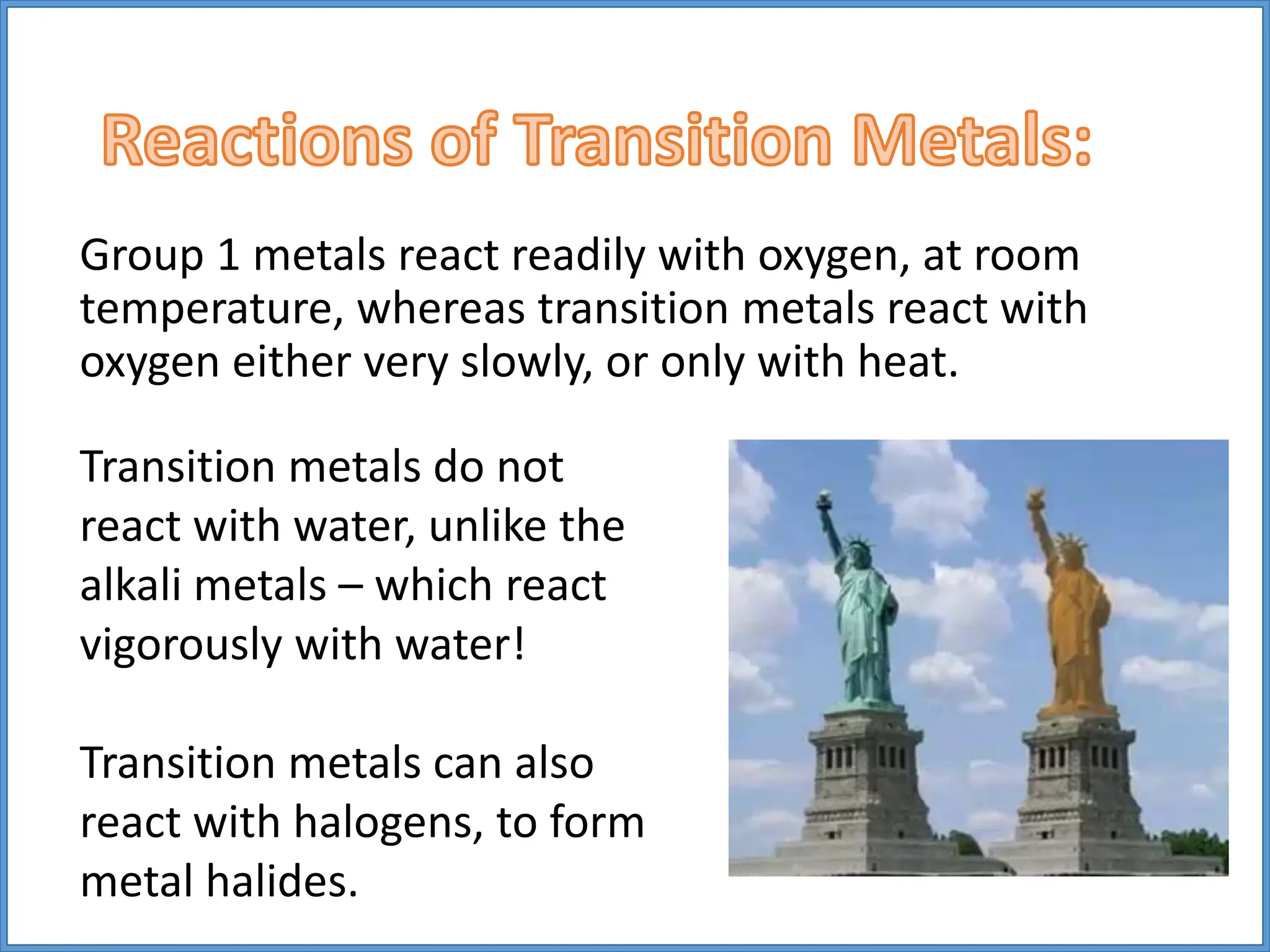
Group 1 metals react readily with oxygen, at room
temperature, whereas transition metals react with
oxygen either very slowly, or only with heat.
Transition metals do not
react with water, unlike the
alkali metals – which react
vigorously with water!
Transition metals can also
react with halogens, to form
metal halides.
Transition metals form positive ions like all metals
However, each transition metal can form positive ions with
different charges.
• E.g. copper can form Cu+ and Cu2+.
• E.g. chromium can form Cr2+ and Cr3+.
• E.g. iron can form Fe2+ and Fe3+
In transition metal compounds we use roman numerals to
show the charge
E.g. iron (III) oxide tells you the iron is a 3+ ion
copper (II) oxide tells you the copper is a 2+ ion
Copper + oxygen → copper (II) oxide
Iron + oxygen  Iron (III) oxide
Chromium + oxygen  Chromium (III) oxide
Manganese + oxygen  Manganese(II) oxide
Write a balanced symbol equations for each of these reactions
HINT:
The number in brackets tells you
the charge on the metal ion. So,
Nickel (II) oxide shows that the Ni
ion has a +2 charge.
Remember that the oxide ion has
a -2 charge. The overall compound
should be neutral – the charges
should balance.
Challenge:
Try writing the symbol equation for the reactions of the +2 and +3 ions for each metal
How does that affect the compound and the balancing of the equations?
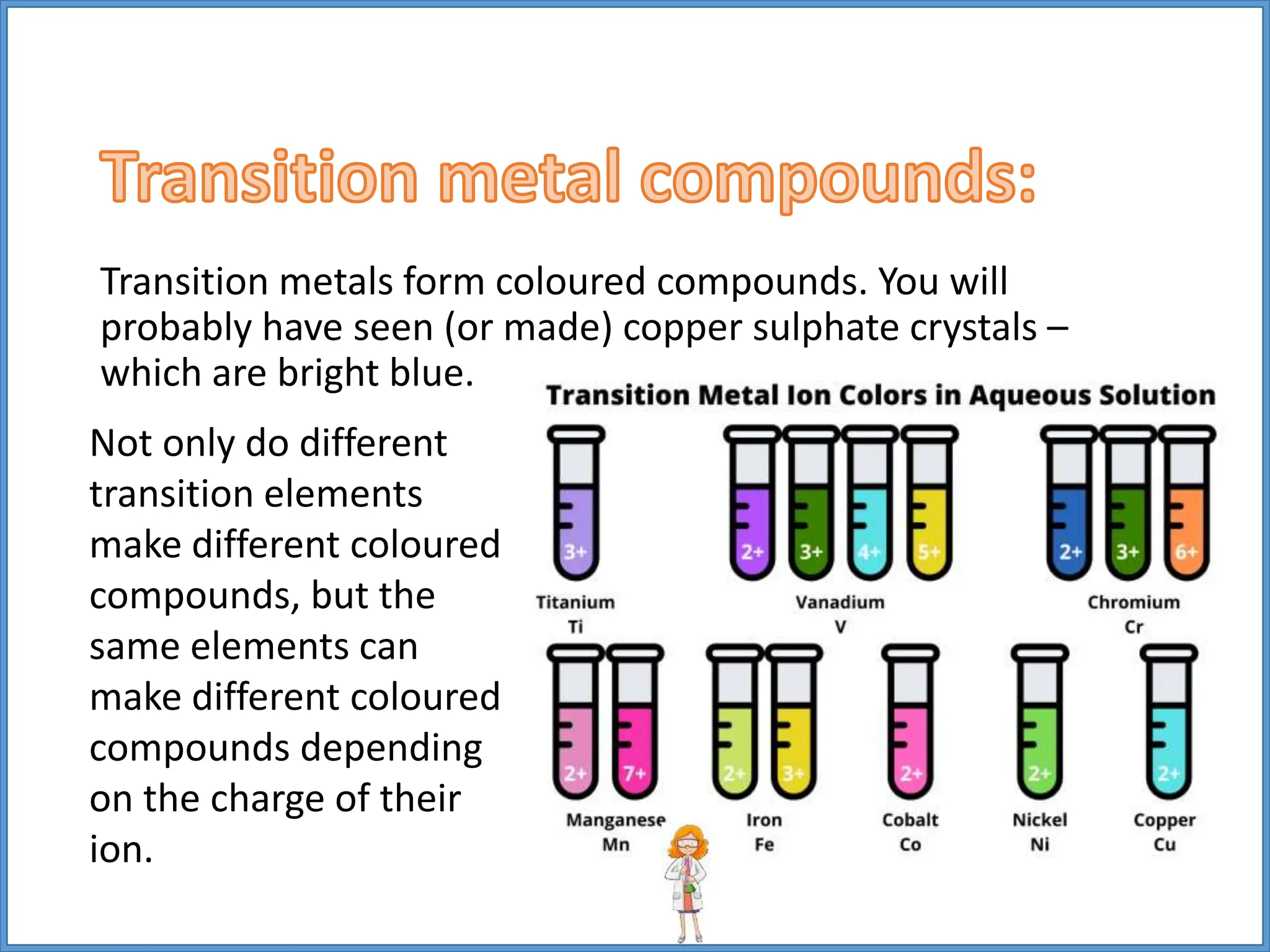
Transition metals form coloured compounds. You will
probably have seen (or made) copper sulphate crystals –
which are bright blue.
Not only do different
transition elements
make different coloured
compounds, but the
same elements can
make different coloured
compounds depending
on the charge of their
ion.
Carry out some research to find the names of the
transition metal compounds that are the catalysts in
the following reactions:
1. Haber process (making ammonia)
2. Contact process (making sulphuric acid)
3. Decomposition of Hydrogen Peroxide

Transition-Metals.pptx

  • 1.
    Transition Metals Do Now(Prior Knowledge Test): 1. What kind of ions will group 1 elements form? 2. What kind of ions will group 7 elements form? 3. How does reactivity change down group 1? 4. Why do group 7 elements get less reactive as you go down the group? 5. What is an ionic bond? Aim: To describe the properties of transition elements in comparison to Group 1 and 2 metals.
  • 2.
    • Between groups2 and 3 • They are: • Harder • Denser • Stronger • Have higher melting points than group 1 metals • They are good conductors of heat and electricity • They are less reactive than group 1 metals • Mercury (Hg) is an exception. It has a low melting point. It’s the only metal that is a liquid at room temperature. https://www.youtube.com/watch?v=m0Uj7mSC6HU
  • 3.
    How does thisdata show that sodium is a typical group 1 metal and chromium is a typical transition metal? What do we know about the density of transition metals compared to group 1 metals? What do we know about the melting point of transition metals compared to group 1 metals? Do Na and Cr follow these patterns? How can you demonstrate that, using the data?
  • 4.
    Group 1 metalsreact readily with oxygen, at room temperature, whereas transition metals react with oxygen either very slowly, or only with heat. Transition metals do not react with water, unlike the alkali metals – which react vigorously with water! Transition metals can also react with halogens, to form metal halides.
  • 5.
    Transition metals formpositive ions like all metals However, each transition metal can form positive ions with different charges. • E.g. copper can form Cu+ and Cu2+. • E.g. chromium can form Cr2+ and Cr3+. • E.g. iron can form Fe2+ and Fe3+ In transition metal compounds we use roman numerals to show the charge E.g. iron (III) oxide tells you the iron is a 3+ ion copper (II) oxide tells you the copper is a 2+ ion
  • 6.
    Copper + oxygen→ copper (II) oxide Iron + oxygen  Iron (III) oxide Chromium + oxygen  Chromium (III) oxide Manganese + oxygen  Manganese(II) oxide Write a balanced symbol equations for each of these reactions HINT: The number in brackets tells you the charge on the metal ion. So, Nickel (II) oxide shows that the Ni ion has a +2 charge. Remember that the oxide ion has a -2 charge. The overall compound should be neutral – the charges should balance. Challenge: Try writing the symbol equation for the reactions of the +2 and +3 ions for each metal How does that affect the compound and the balancing of the equations?
  • 7.
    Transition metals formcoloured compounds. You will probably have seen (or made) copper sulphate crystals – which are bright blue. Not only do different transition elements make different coloured compounds, but the same elements can make different coloured compounds depending on the charge of their ion.
  • 8.
    Carry out someresearch to find the names of the transition metal compounds that are the catalysts in the following reactions: 1. Haber process (making ammonia) 2. Contact process (making sulphuric acid) 3. Decomposition of Hydrogen Peroxide