Curves
• Curves are the geometrical arcs provided at the change in gradient
or alignment of a road.
Necessity of providing curves :-
• To lay the road according to topography of the country.
• To avoid the costly land.
• To avoid excessive cutting and filling.
• To avoid certain important structures.
• To make use of the existing road, bridges etc.
• To provide access to the particular area.
Types of curves :-
Curves have two types -
• Horizontal curves
• Vertical curves
Horizontal curves
• A horizontal curve is a curve in plan to provide change in direction to
the central line of a road.
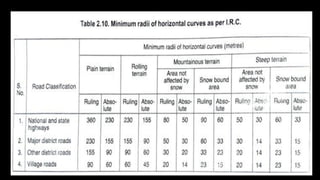
• The minimum radius of a horizontal curve depends on the permissible
design speed for the road.
• The values of minimum radii for various categories of roads in
different areas are recommended by IRC.
Types of horizontal curves :-
a. Simple curve
b. Compound curve
c. Reverse curve
d. Transition curve
Simplecurve
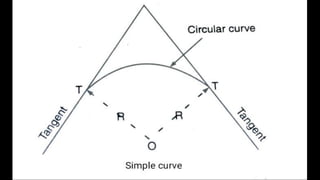
➢It is a circular curve which consists of a single arc of uniform radius.
➢This curve is expressed in terms of degree of the curve, which is the
angle subtended at the centre by a chord of 30 m length.
➢This type of curve is suitable for large radius and for slow moving
traffic.
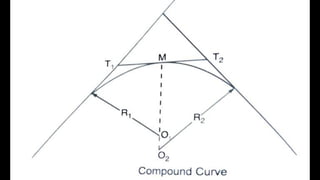
Compound curve
• This is a circular curve which consists of a series of two or more
simple curves of different radii which turn in the same direction.
• This type of curve is used to avoid cutting through hard rocks, heavy
cutting or filling etc.
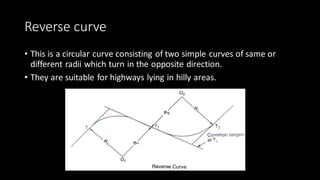
Reverse curve
• This is a circular curve consisting of two simple curves of same or
different radii which turn in the opposite direction.
• They are suitable for highways lying in hilly areas.
Transition curve
• A transition curve is the curve having a radius which decreases from
infinity at the tangent point to a designed radius of the circular curve.
• This type of curve is generally introduced on highways between a
straight and circular curve to provide ease and gradual change in
direction of a road alignment.
Object of providing transition curve :-
❑To provide and easy transformation from straight to circular curve
and from circular curve to the straight roads.
❑To provide a gradual change of curvature from zero at the tangent
point, to that of circular curve at their junction point.
❑To enable gradual introduction of designed superelevation and extra
widening of pavement at the start of the circular curve.
❑To improve the aesthetic appearance of the road.
Types of transition curve :-
The following three types of transition curve are commonly adopted in
horizontal alignment.
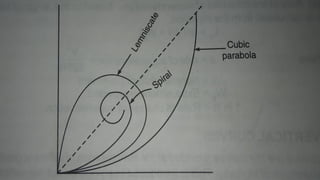
a) Lemniscate
b) Spiral
c) Cubic parabola
Out of three transition curves, the I.R.C. has recommended the use of
spiral in the horizontal alignment of highways.
Length of transition curve :-
Generally, the length of transition curve is determined from the
following considerations and larger of the values should be adopted for
design purpose.
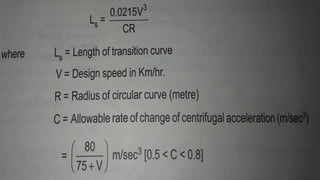
(a) Rate of change of centrifugal acceleration :- Rate of change of
centrifugal acceleration should be such that it will not cause discomfort
for the passengers of a vehicle moving with design speed. Based on the
consideration, the length of transition curve can be calculated by using
the equation.
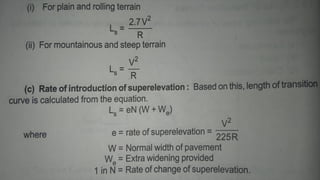
(b) By empirical formula – As per IRC , the length of transition curve Ls
for the geometric design of road should not be less than that calculated
from the following equations.
Source :- Transportation engineering by A K
Upadhyay.

Curves on highway alignment

  • 1.
  • 2.
    • Curves arethe geometrical arcs provided at the change in gradient or alignment of a road.
  • 3.
    Necessity of providingcurves :- • To lay the road according to topography of the country. • To avoid the costly land. • To avoid excessive cutting and filling. • To avoid certain important structures. • To make use of the existing road, bridges etc. • To provide access to the particular area.
  • 4.
    Types of curves:- Curves have two types - • Horizontal curves • Vertical curves
  • 5.
    Horizontal curves • Ahorizontal curve is a curve in plan to provide change in direction to the central line of a road. • The minimum radius of a horizontal curve depends on the permissible design speed for the road. • The values of minimum radii for various categories of roads in different areas are recommended by IRC.
  • 7.
    Types of horizontalcurves :- a. Simple curve b. Compound curve c. Reverse curve d. Transition curve
  • 8.
    Simplecurve ➢It is acircular curve which consists of a single arc of uniform radius. ➢This curve is expressed in terms of degree of the curve, which is the angle subtended at the centre by a chord of 30 m length. ➢This type of curve is suitable for large radius and for slow moving traffic.
  • 10.
    Compound curve • Thisis a circular curve which consists of a series of two or more simple curves of different radii which turn in the same direction. • This type of curve is used to avoid cutting through hard rocks, heavy cutting or filling etc.
  • 12.
    Reverse curve • Thisis a circular curve consisting of two simple curves of same or different radii which turn in the opposite direction. • They are suitable for highways lying in hilly areas.
  • 13.
    Transition curve • Atransition curve is the curve having a radius which decreases from infinity at the tangent point to a designed radius of the circular curve. • This type of curve is generally introduced on highways between a straight and circular curve to provide ease and gradual change in direction of a road alignment.
  • 14.
    Object of providingtransition curve :- ❑To provide and easy transformation from straight to circular curve and from circular curve to the straight roads. ❑To provide a gradual change of curvature from zero at the tangent point, to that of circular curve at their junction point. ❑To enable gradual introduction of designed superelevation and extra widening of pavement at the start of the circular curve. ❑To improve the aesthetic appearance of the road.
  • 16.
    Types of transitioncurve :- The following three types of transition curve are commonly adopted in horizontal alignment. a) Lemniscate b) Spiral c) Cubic parabola Out of three transition curves, the I.R.C. has recommended the use of spiral in the horizontal alignment of highways.
  • 18.
    Length of transitioncurve :- Generally, the length of transition curve is determined from the following considerations and larger of the values should be adopted for design purpose. (a) Rate of change of centrifugal acceleration :- Rate of change of centrifugal acceleration should be such that it will not cause discomfort for the passengers of a vehicle moving with design speed. Based on the consideration, the length of transition curve can be calculated by using the equation.
  • 20.
    (b) By empiricalformula – As per IRC , the length of transition curve Ls for the geometric design of road should not be less than that calculated from the following equations.
  • 22.
    Source :- Transportationengineering by A K Upadhyay.