Kanto-Koshinetsu Block Blood Center
1
Ten Peaks, Banff
09/27/15
CANADA
Transfusion Medicine
Shoichi Inaba MD
January19, 2016
Kanto-Koshinetsu Block Blood Center
2
1.Supplement of Oxygen carrying capacity
(Red Blood Cells; RBCs)
2.Supplement of coagulation factors
a) Fresh Frozen Plasma (FFP)
Mainly supplement of Fibrinogen
b) Platelets (PCs)
3.Supplement of Blood Volume (Albumin, RBCs)
Transfusion is not a cure therapy, it’s only a supplement therapy
Indication of transfusion therapy
Kanto-Koshinetsu Block Blood Center
3
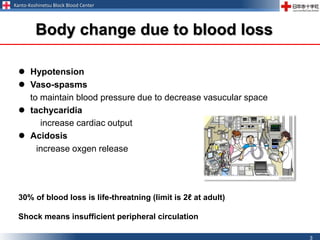
Body change due to blood loss
 Hypotension
 Vaso-spasms
to maintain blood pressure due to decrease vasucular space
 tachycaridia
increase cardiac output
 Acidosis
increase oxgen release
30% of blood loss is life-threatning (limit is 2ℓ at adult)
Shock means insufficient peripheral circulation
Kanto-Koshinetsu Block Blood Center
4
Vital signs
Blood gas analyses
Cell blood count
Coagulation tests
Patient prognosis
Age (young patients should endure and elder is loose )
Evidencies for decision making of
transfusion therapy
Kanto-Koshinetsu Block Blood Center
5
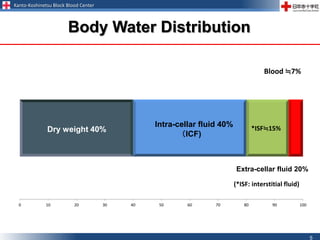
Body Water Distribution
0 10 20 30 40 50 60 70 80 90 100
Intra-cellar fluid 40%
(ICF)
Extra-cellar fluid 20%
*ISF≒15%
Blood ≒7%
(*ISF: interstitial fluid)
Dry weight 40%
Kanto-Koshinetsu Block Blood Center
6
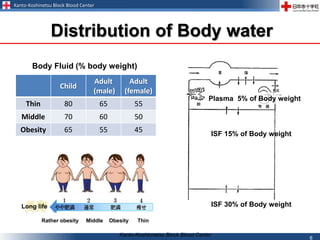
Distribution of Body water
Kanto-Koshinnetsu Block Blood Center
ISF 15% of Body weight
ISF 30% of Body weight
Plasma 5% of Body weight
Rather obesity Middle Obesity Thin
Long life
Body Fluid (% body weight)
Child
Adult
(male)
Adult
(female)
Thin 80 65 55
Middle 70 60 50
Obesity 65 55 45
Kanto-Koshinetsu Block Blood Center
7
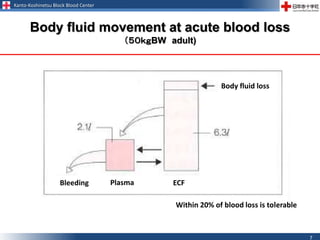
Body fluid movement at acute blood loss
(50kgBW adult)
Bleeding Plasma ECF
Body fluid loss
Within 20% of blood loss is tolerable
Kanto-Koshinetsu Block Blood Center
8
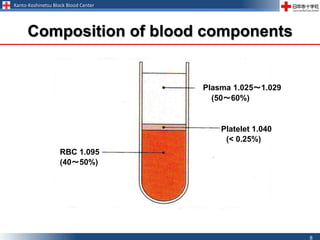
Composition of blood components
Plasma 1.025~1.029
Platelet 1.040
RBC 1.095
(40~50%)
(50~60%)
(< 0.25%)
Kanto-Koshinetsu Block Blood Center
9
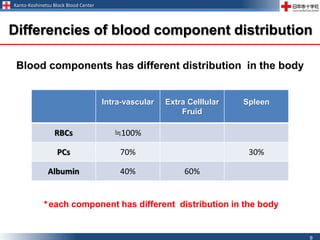
Blood components has different distribution in the body
*each component has different distribution in the body
Differencies of blood component distribution
Intra-vascular Extra Celllular
Fruid
Spleen
RBCs ≒100%
PCs 70% 30%
Albumin 40% 60%
Kanto-Koshinetsu Block Blood Center
10
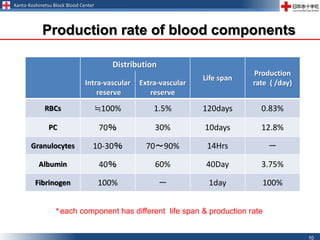
Production rate of blood components
*each component has different life span & production rate
Intra-vascular
reserve
Extra-vascular
reserve
Life span
Production
rate ( /day)
RBCs ≒100% 1.5% 120days 0.83%
PC 70% 30% 10days 12.8%
Granulocytes 10-30% 70~90% 14Hrs -
Albumin 40% 60% 40Day 3.75%
Fibrinogen 100% - 1day 100%
Distribution
Kanto-Koshinetsu Block Blood Center
11
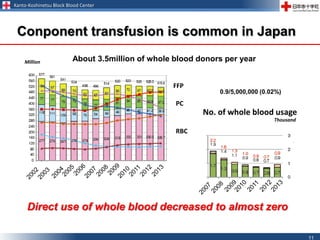
Conponent transfusion is common in Japan
血液製剤調査機構作成
Direct use of whole blood decreased to almost zero
Million
Thousand
RBC
FFP
PC
No. of whole blood usage
0.9/5,000,000 (0.02%)
About 3.5million of whole blood donors per year
Kanto-Koshinetsu Block Blood Center
12
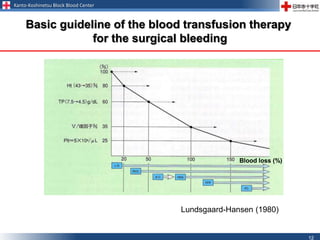
Basic guideline of the blood transfusion therapy
for the surgical bleeding
Lundsgaard-Hansen (1980)
Blood loss (%)
Kanto-Koshinetsu Block Blood Center
13
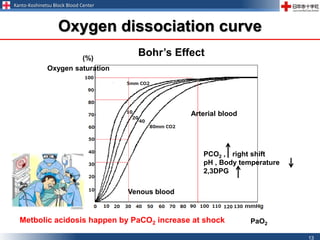
Oxygen dissociation curve
PCO2 , right shift
pH , Body temperature
2,3DPG
(
動
脈
血
)
(静
脈
血
)
PaO2
Bohr’s Effect
Arterial blood
Venous blood
(%)
Oxygen saturation
Metbolic acidosis happen by PaCO2 increase at shock
Kanto-Koshinetsu Block Blood Center
14
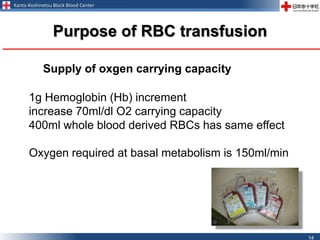
Supply of oxgen carrying capacity
1g Hemoglobin (Hb) increment
increase 70ml/dl O2 carrying capacity
400ml whole blood derived RBCs has same effect
Oxygen required at basal metabolism is 150ml/min
Purpose of RBC transfusion
Kanto-Koshinetsu Block Blood Center
15
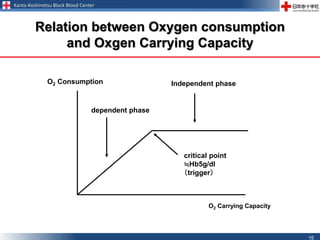
Relation between Oxygen consumption
and Oxgen Carrying Capacity
O2 Carrying Capacity
dependent phase
Independent phase
critical point
≒Hb5g/dl
(trigger)
O2 Consumption
Kanto-Koshinetsu Block Blood Center
16
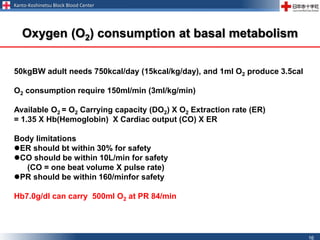
50kgBW adult needs 750kcal/day (15kcal/kg/day), and 1ml O2 produce 3.5cal
O2 consumption require 150ml/min (3ml/kg/min)
Available O2 = O2 Carrying capacity (DO2) X O2 Extraction rate (ER)
= 1.35 X Hb(Hemoglobin) X Cardiac output (CO) X ER
Body limitations
ER should bt within 30% for safety
CO should be within 10L/min for safety
(CO = one beat volume X pulse rate)
PR should be within 160/minfor safety
Hb7.0g/dl can carry 500ml O2 at PR 84/min
Oxygen (O2) consumption at basal metabolism
Kanto-Koshinetsu Block Blood Center
17
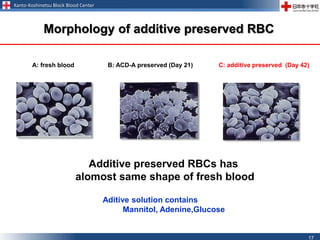
C: additive preserved (Day 42)B: ACD-A preserved (Day 21)A: fresh blood
Morphology of additive preserved RBC
Additive preserved RBCs has
alomost same shape of fresh blood
Aditive solution contains
Mannitol, Adenine,Glucose
Kanto-Koshinetsu Block Blood Center
18
O2 O2
O2O2
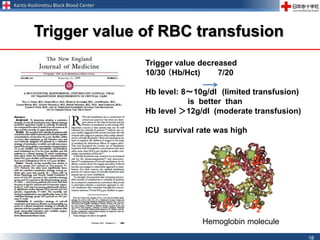
Hemoglobin molecule
Trigger value of RBC transfusion
Trigger value decreased
10/30 (Hb/Hct) 7/20
Hb level: 8~10g/dl (limited transfusion)
is better than
Hb level >12g/dl (moderate transfusion)
ICU survival rate was high
Kanto-Koshinetsu Block Blood Center
19
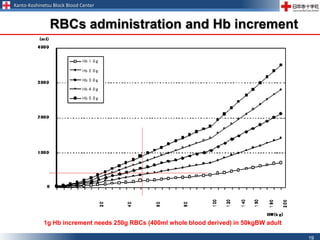
1g Hb increment needs 250g RBCs (400ml whole blood derived) in 50kgBW adult
RBCs administration and Hb increment
Kanto-Koshinetsu Block Blood Center
20
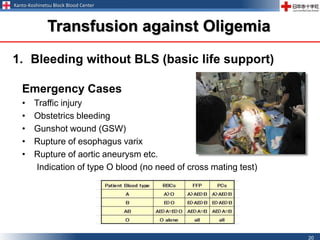
Emergency Cases
• Traffic injury
• Obstetrics bleeding
• Gunshot wound (GSW)
• Rupture of esophagus varix
• Rupture of aortic aneurysm etc.
Indication of type O blood (no need of cross mating test)
Transfusion against Oligemia
1. Bleeding without BLS (basic life support)
Kanto-Koshinetsu Block Blood Center
21
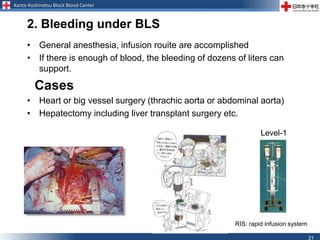
2. Bleeding under BLS
• General anesthesia, infusion rouite are accomplished
• If there is enough of blood, the bleeding of dozens of liters can
support.
Cases
• Heart or big vessel surgery (thrachic aorta or abdominal aorta)
• Hepatectomy including liver transplant surgery etc.
Level-1
RIS: rapid infusion system
Kanto-Koshinetsu Block Blood Center
22
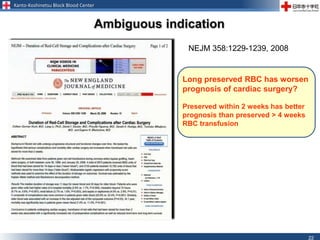
Long preserved RBC has worsen
prognosis of cardiac surgery?
Preserved within 2 weeks has better
prognosis than preserved > 4 weeks
RBC transfusion
Ambiguous indication
NEJM 358:1229-1239, 2008
Kanto-Koshinetsu Block Blood Center
23
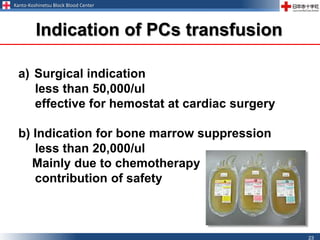
a) Surgical indication
less than 50,000/ul
effective for hemostat at cardiac surgery
b) Indication for bone marrow suppression
less than 20,000/ul
Mainly due to chemotherapy
contribution of safety
Indication of PCs transfusion
Kanto-Koshinetsu Block Blood Center
24
Pletelet recovery rate
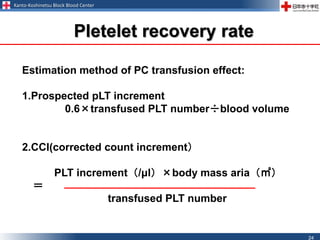
Estimation method of PC transfusion effect:
1.Prospected pLT increment
0.6×transfused PLT number÷blood volume
2.CCI(corrected count increment)
PLT increment(/μl)×body mass aria(㎡)
=
transfused PLT number
Kanto-Koshinetsu Block Blood Center
25
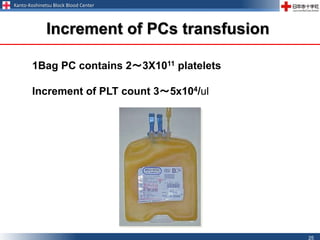
Increment of PCs transfusion
1Bag PC contains 2~3X10¹¹ platelets
Increment of PLT count 3~5x10⁴/ul
Kanto-Koshinetsu Block Blood Center
26
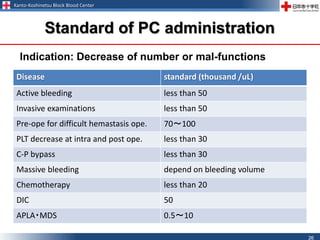
Standard of PC administration
Indication: Decrease of number or mal-functions
Disease standard (thousand /uL)
Active bleeding less than 50
Invasive examinations less than 50
Pre-ope for difficult hemastasis ope. 70~100
PLT decrease at intra and post ope. less than 30
C-P bypass less than 30
Massive bleeding depend on bleeding volume
Chemotherapy less than 20
DIC 50
APLA・MDS 0.5~10
Kanto-Koshinetsu Block Blood Center
27
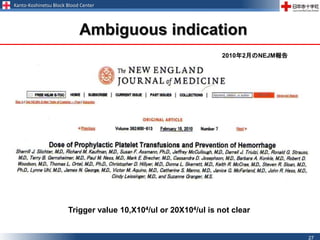
Ambiguous indication
Trigger value 10,X104/ul or 20X104/ul is not clear
2010年2月のNEJM報告
Kanto-Koshinetsu Block Blood Center
28
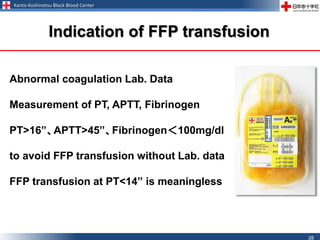
Abnormal coagulation Lab. Data
Measurement of PT, APTT, Fibrinogen
PT>16”、APTT>45”、Fibrinogen<100mg/dl
to avoid FFP transfusion without Lab. data
FFP transfusion at PT<14” is meaningless
Indication of FFP transfusion
Kanto-Koshinetsu Block Blood Center
29
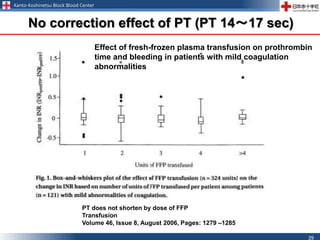
No correction effect of PT (PT 14~17 sec)
PT does not shorten by dose of FFP
Transfusion
Volume 46, Issue 8, August 2006, Pages: 1279 –1285
Effect of fresh-frozen plasma transfusion on prothrombin
time and bleeding in patients with mild coagulation
abnormalities
Kanto-Koshinetsu Block Blood Center
30
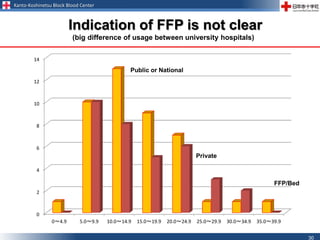
Indication of FFP is not clear
(big difference of usage between university hospitals)
0
2
4
6
8
10
12
14
0~4.9 5.0~9.9 10.0~14.9 15.0~19.9 20.0~24.9 25.0~29.9 30.0~34.9 35.0~39.9
FFP/Bed
Public or National
Private
Kanto-Koshinetsu Block Blood Center
31
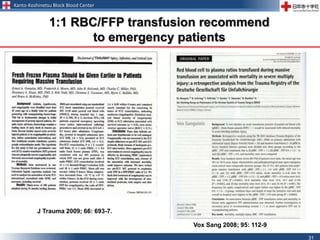
1:1 RBC/FFP transfusion recommend
to emergency patients
J Trauma 2009; 66: 693-7.
Vox Sang 2008; 95: 112-9
Kanto-Koshinetsu Block Blood Center
32
1) minimum requirement
2) Zero risk is impossible at transfusion therapy
3) Transfusion therapy is thought to be
necessary evil
Transfusion without Lab. test is not desirable
Reasonable transfusion therapy
Kanto-Koshinetsu Block Blood Center
33
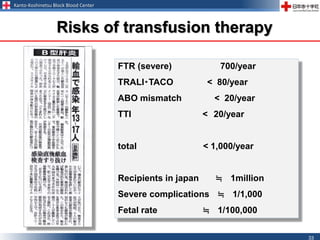
Risks of transfusion therapy
FTR (severe) 700/year
TRALI・TACO < 80/year
ABO mismatch < 20/year
TTI < 20/year
total < 1,000/year
Recipients in japan ≒ 1million
Severe complications ≒ 1/1,000
Fetal rate ≒ 1/100,000
Kanto-Koshinetsu Block Blood Center
34
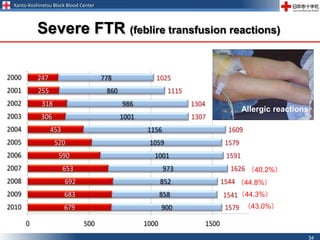
(44.8%)
(44.3%)
(40.2%)
(43.0%)
Allergic reactions
Severe FTR (feblire transfusion reactions)
Kanto-Koshinetsu Block Blood Center
35
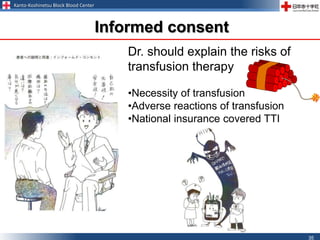
Informed consent
Dr. should explain the risks of
transfusion therapy
•Necessity of transfusion
•Adverse reactions of transfusion
•National insurance covered TTI
Kanto-Koshinetsu Block Blood Center
36
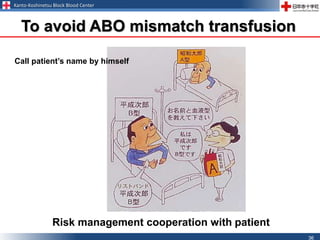
Risk management cooperation with patient
Call patient’s name by himself
To avoid ABO mismatch transfusion
Kanto-Koshinetsu Block Blood Center
37
Problems of transfusion teaching stuffs
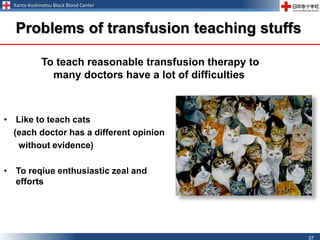
• Like to teach cats
(each doctor has a different opinion
without evidence)
• To reqiue enthusiastic zeal and
efforts
To teach reasonable transfusion therapy to
many doctors have a lot of difficulties
Kanto-Koshinetsu Block Blood Center
38
Thank you for your attention!
Mt.Fuji from Shonan bay
Big Budda at Kamakura

transfusion medicine

  • 1.
    Kanto-Koshinetsu Block BloodCenter 1 Ten Peaks, Banff 09/27/15 CANADA Transfusion Medicine Shoichi Inaba MD January19, 2016
  • 2.
    Kanto-Koshinetsu Block BloodCenter 2 1.Supplement of Oxygen carrying capacity (Red Blood Cells; RBCs) 2.Supplement of coagulation factors a) Fresh Frozen Plasma (FFP) Mainly supplement of Fibrinogen b) Platelets (PCs) 3.Supplement of Blood Volume (Albumin, RBCs) Transfusion is not a cure therapy, it’s only a supplement therapy Indication of transfusion therapy
  • 3.
    Kanto-Koshinetsu Block BloodCenter 3 Body change due to blood loss  Hypotension  Vaso-spasms to maintain blood pressure due to decrease vasucular space  tachycaridia increase cardiac output  Acidosis increase oxgen release 30% of blood loss is life-threatning (limit is 2ℓ at adult) Shock means insufficient peripheral circulation
  • 4.
    Kanto-Koshinetsu Block BloodCenter 4 Vital signs Blood gas analyses Cell blood count Coagulation tests Patient prognosis Age (young patients should endure and elder is loose ) Evidencies for decision making of transfusion therapy
  • 5.
    Kanto-Koshinetsu Block BloodCenter 5 Body Water Distribution 0 10 20 30 40 50 60 70 80 90 100 Intra-cellar fluid 40% (ICF) Extra-cellar fluid 20% *ISF≒15% Blood ≒7% (*ISF: interstitial fluid) Dry weight 40%
  • 6.
    Kanto-Koshinetsu Block BloodCenter 6 Distribution of Body water Kanto-Koshinnetsu Block Blood Center ISF 15% of Body weight ISF 30% of Body weight Plasma 5% of Body weight Rather obesity Middle Obesity Thin Long life Body Fluid (% body weight) Child Adult (male) Adult (female) Thin 80 65 55 Middle 70 60 50 Obesity 65 55 45
  • 7.
    Kanto-Koshinetsu Block BloodCenter 7 Body fluid movement at acute blood loss (50kgBW adult) Bleeding Plasma ECF Body fluid loss Within 20% of blood loss is tolerable
  • 8.
    Kanto-Koshinetsu Block BloodCenter 8 Composition of blood components Plasma 1.025~1.029 Platelet 1.040 RBC 1.095 (40~50%) (50~60%) (< 0.25%)
  • 9.
    Kanto-Koshinetsu Block BloodCenter 9 Blood components has different distribution in the body *each component has different distribution in the body Differencies of blood component distribution Intra-vascular Extra Celllular Fruid Spleen RBCs ≒100% PCs 70% 30% Albumin 40% 60%
  • 10.
    Kanto-Koshinetsu Block BloodCenter 10 Production rate of blood components *each component has different life span & production rate Intra-vascular reserve Extra-vascular reserve Life span Production rate ( /day) RBCs ≒100% 1.5% 120days 0.83% PC 70% 30% 10days 12.8% Granulocytes 10-30% 70~90% 14Hrs - Albumin 40% 60% 40Day 3.75% Fibrinogen 100% - 1day 100% Distribution
  • 11.
    Kanto-Koshinetsu Block BloodCenter 11 Conponent transfusion is common in Japan 血液製剤調査機構作成 Direct use of whole blood decreased to almost zero Million Thousand RBC FFP PC No. of whole blood usage 0.9/5,000,000 (0.02%) About 3.5million of whole blood donors per year
  • 12.
    Kanto-Koshinetsu Block BloodCenter 12 Basic guideline of the blood transfusion therapy for the surgical bleeding Lundsgaard-Hansen (1980) Blood loss (%)
  • 13.
    Kanto-Koshinetsu Block BloodCenter 13 Oxygen dissociation curve PCO2 , right shift pH , Body temperature 2,3DPG ( 動 脈 血 ) (静 脈 血 ) PaO2 Bohr’s Effect Arterial blood Venous blood (%) Oxygen saturation Metbolic acidosis happen by PaCO2 increase at shock
  • 14.
    Kanto-Koshinetsu Block BloodCenter 14 Supply of oxgen carrying capacity 1g Hemoglobin (Hb) increment increase 70ml/dl O2 carrying capacity 400ml whole blood derived RBCs has same effect Oxygen required at basal metabolism is 150ml/min Purpose of RBC transfusion
  • 15.
    Kanto-Koshinetsu Block BloodCenter 15 Relation between Oxygen consumption and Oxgen Carrying Capacity O2 Carrying Capacity dependent phase Independent phase critical point ≒Hb5g/dl (trigger) O2 Consumption
  • 16.
    Kanto-Koshinetsu Block BloodCenter 16 50kgBW adult needs 750kcal/day (15kcal/kg/day), and 1ml O2 produce 3.5cal O2 consumption require 150ml/min (3ml/kg/min) Available O2 = O2 Carrying capacity (DO2) X O2 Extraction rate (ER) = 1.35 X Hb(Hemoglobin) X Cardiac output (CO) X ER Body limitations ER should bt within 30% for safety CO should be within 10L/min for safety (CO = one beat volume X pulse rate) PR should be within 160/minfor safety Hb7.0g/dl can carry 500ml O2 at PR 84/min Oxygen (O2) consumption at basal metabolism
  • 17.
    Kanto-Koshinetsu Block BloodCenter 17 C: additive preserved (Day 42)B: ACD-A preserved (Day 21)A: fresh blood Morphology of additive preserved RBC Additive preserved RBCs has alomost same shape of fresh blood Aditive solution contains Mannitol, Adenine,Glucose
  • 18.
    Kanto-Koshinetsu Block BloodCenter 18 O2 O2 O2O2 Hemoglobin molecule Trigger value of RBC transfusion Trigger value decreased 10/30 (Hb/Hct) 7/20 Hb level: 8~10g/dl (limited transfusion) is better than Hb level >12g/dl (moderate transfusion) ICU survival rate was high
  • 19.
    Kanto-Koshinetsu Block BloodCenter 19 1g Hb increment needs 250g RBCs (400ml whole blood derived) in 50kgBW adult RBCs administration and Hb increment
  • 20.
    Kanto-Koshinetsu Block BloodCenter 20 Emergency Cases • Traffic injury • Obstetrics bleeding • Gunshot wound (GSW) • Rupture of esophagus varix • Rupture of aortic aneurysm etc. Indication of type O blood (no need of cross mating test) Transfusion against Oligemia 1. Bleeding without BLS (basic life support)
  • 21.
    Kanto-Koshinetsu Block BloodCenter 21 2. Bleeding under BLS • General anesthesia, infusion rouite are accomplished • If there is enough of blood, the bleeding of dozens of liters can support. Cases • Heart or big vessel surgery (thrachic aorta or abdominal aorta) • Hepatectomy including liver transplant surgery etc. Level-1 RIS: rapid infusion system
  • 22.
    Kanto-Koshinetsu Block BloodCenter 22 Long preserved RBC has worsen prognosis of cardiac surgery? Preserved within 2 weeks has better prognosis than preserved > 4 weeks RBC transfusion Ambiguous indication NEJM 358:1229-1239, 2008
  • 23.
    Kanto-Koshinetsu Block BloodCenter 23 a) Surgical indication less than 50,000/ul effective for hemostat at cardiac surgery b) Indication for bone marrow suppression less than 20,000/ul Mainly due to chemotherapy contribution of safety Indication of PCs transfusion
  • 24.
    Kanto-Koshinetsu Block BloodCenter 24 Pletelet recovery rate Estimation method of PC transfusion effect: 1.Prospected pLT increment 0.6×transfused PLT number÷blood volume 2.CCI(corrected count increment) PLT increment(/μl)×body mass aria(㎡) = transfused PLT number
  • 25.
    Kanto-Koshinetsu Block BloodCenter 25 Increment of PCs transfusion 1Bag PC contains 2~3X10¹¹ platelets Increment of PLT count 3~5x10⁴/ul
  • 26.
    Kanto-Koshinetsu Block BloodCenter 26 Standard of PC administration Indication: Decrease of number or mal-functions Disease standard (thousand /uL) Active bleeding less than 50 Invasive examinations less than 50 Pre-ope for difficult hemastasis ope. 70~100 PLT decrease at intra and post ope. less than 30 C-P bypass less than 30 Massive bleeding depend on bleeding volume Chemotherapy less than 20 DIC 50 APLA・MDS 0.5~10
  • 27.
    Kanto-Koshinetsu Block BloodCenter 27 Ambiguous indication Trigger value 10,X104/ul or 20X104/ul is not clear 2010年2月のNEJM報告
  • 28.
    Kanto-Koshinetsu Block BloodCenter 28 Abnormal coagulation Lab. Data Measurement of PT, APTT, Fibrinogen PT>16”、APTT>45”、Fibrinogen<100mg/dl to avoid FFP transfusion without Lab. data FFP transfusion at PT<14” is meaningless Indication of FFP transfusion
  • 29.
    Kanto-Koshinetsu Block BloodCenter 29 No correction effect of PT (PT 14~17 sec) PT does not shorten by dose of FFP Transfusion Volume 46, Issue 8, August 2006, Pages: 1279 –1285 Effect of fresh-frozen plasma transfusion on prothrombin time and bleeding in patients with mild coagulation abnormalities
  • 30.
    Kanto-Koshinetsu Block BloodCenter 30 Indication of FFP is not clear (big difference of usage between university hospitals) 0 2 4 6 8 10 12 14 0~4.9 5.0~9.9 10.0~14.9 15.0~19.9 20.0~24.9 25.0~29.9 30.0~34.9 35.0~39.9 FFP/Bed Public or National Private
  • 31.
    Kanto-Koshinetsu Block BloodCenter 31 1:1 RBC/FFP transfusion recommend to emergency patients J Trauma 2009; 66: 693-7. Vox Sang 2008; 95: 112-9
  • 32.
    Kanto-Koshinetsu Block BloodCenter 32 1) minimum requirement 2) Zero risk is impossible at transfusion therapy 3) Transfusion therapy is thought to be necessary evil Transfusion without Lab. test is not desirable Reasonable transfusion therapy
  • 33.
    Kanto-Koshinetsu Block BloodCenter 33 Risks of transfusion therapy FTR (severe) 700/year TRALI・TACO < 80/year ABO mismatch < 20/year TTI < 20/year total < 1,000/year Recipients in japan ≒ 1million Severe complications ≒ 1/1,000 Fetal rate ≒ 1/100,000
  • 34.
    Kanto-Koshinetsu Block BloodCenter 34 (44.8%) (44.3%) (40.2%) (43.0%) Allergic reactions Severe FTR (feblire transfusion reactions)
  • 35.
    Kanto-Koshinetsu Block BloodCenter 35 Informed consent Dr. should explain the risks of transfusion therapy •Necessity of transfusion •Adverse reactions of transfusion •National insurance covered TTI
  • 36.
    Kanto-Koshinetsu Block BloodCenter 36 Risk management cooperation with patient Call patient’s name by himself To avoid ABO mismatch transfusion
  • 37.
    Kanto-Koshinetsu Block BloodCenter 37 Problems of transfusion teaching stuffs • Like to teach cats (each doctor has a different opinion without evidence) • To reqiue enthusiastic zeal and efforts To teach reasonable transfusion therapy to many doctors have a lot of difficulties
  • 38.
    Kanto-Koshinetsu Block BloodCenter 38 Thank you for your attention! Mt.Fuji from Shonan bay Big Budda at Kamakura

Editor's Notes

  • #2 1
  • #35 報告された副作用のうち、重篤副作用と判断されたものの推移を示します。 総報告件数は、2004年以降ほぼ一定している。 重篤症例は、年々割合が増えてきて、2007年以降は、全体の40%を超えるようになっています。 2009年は 689件 44.3%(2008年44.8%)でした。 年々重篤症例の割合が増えてきて、2004年以降は、ここ数年は 2007年からは、40%を超えるようになっております。 2009年は1541件中683件が重篤で全体の44.3%でした。  2008年(692件、44.8%)とほぼ同様の傾向でした。