
Transforming optical networking with AI
Stephan Rettenberger (with many thanks to Ulrich Kohn)
June 2018
From automated control to artificial intelligence
© 2018 ADVA Optical Networking. All rights reserved.22
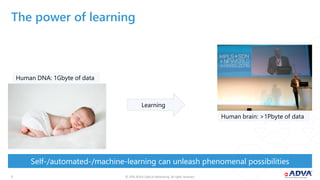
Self-/automated-/machine-learning can unleash phenomenal possibilities
The power of learning
Human DNA: 1Gbyte of data
Learning
Human brain: >1Pbyte of data
© 2018 ADVA Optical Networking. All rights reserved.33
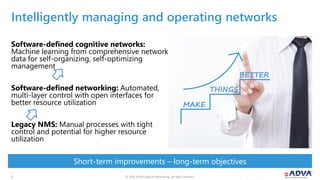
Software-defined cognitive networks:
Machine learning from comprehensive network
data for self-organizing, self-optimizing
management
Software-defined networking: Automated,
multi-layer control with open interfaces for
better resource utilization
Legacy NMS: Manual processes with tight
control and potential for higher resource
utilization
Short-term improvements – long-term objectives
Intelligently managing and operating networks
© 2018 ADVA Optical Networking. All rights reserved.44
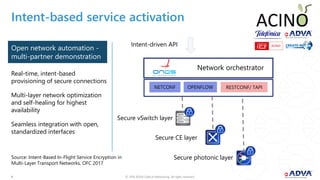
Intent-based service activation
Real-time, intent-based
provisioning of secure connections
Multi-layer network optimization
and self-healing for highest
availability
Seamless integration with open,
standardized interfaces
Open network automation -
multi-partner demonstration
NETCONF RESTCONF/ TAPIOPENFLOW
Secure photonic layer
Secure CE layer
Secure vSwitch layer
Intent-driven API
Network orchestrator
Source: Intent-Based In-Flight Service Encryption in
Multi-Layer Transport Networks, OFC 2017
© 2018 ADVA Optical Networking. All rights reserved.55
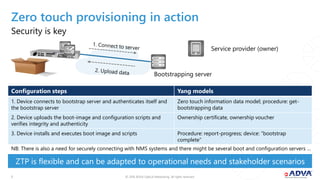
Security is key
ZTP is flexible and can be adapted to operational needs and stakeholder scenarios
Zero touch provisioning in action
Configuration steps Yang models
1. Device connects to bootstrap server and authenticates itself and
the bootstrap server
Zero touch information data model; procedure: get-
bootstrapping data
2. Device uploads the boot-image and configuration scripts and
verifies integrity and authenticity
Ownership certificate, ownership voucher
3. Device installs and executes boot image and scripts Procedure: report-progress; device: “bootstrap
complete”
NB: There is also a need for securely connecting with NMS systems and there might be several boot and configuration servers …
Service provider (owner)
Bootstrapping server
© 2018 ADVA Optical Networking. All rights reserved.66
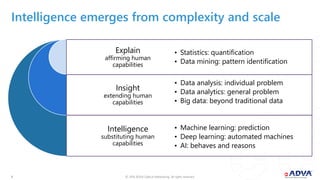
Intelligence emerges from complexity and scale
Intelligence
substituting human
capabilities
Insight
extending human
capabilities
Explain
affirming human
capabilities
• Machine learning: prediction
• Deep learning: automated machines
• AI: behaves and reasons
• Data analysis: individual problem
• Data analytics: general problem
• Big data: beyond traditional data
• Statistics: quantification
• Data mining: pattern identification
© 2018 ADVA Optical Networking. All rights reserved.77
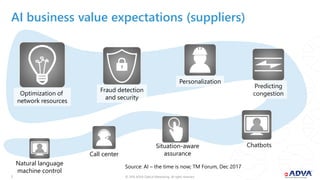
AI business value expectations (suppliers)
Optimization of
network resources
Fraud detection
and security
Personalization
Predicting
congestion
ChatbotsSituation-aware
assuranceCall center
Natural language
machine control
Source: AI – the time is now; TM Forum, Dec 2017
© 2018 ADVA Optical Networking. All rights reserved.88
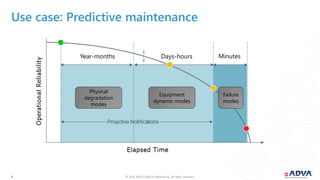
Use case: Predictive maintenance
Year-months Days-hours Minutes
Physical
degradation
modes
Equipment
dynamic modes
Failure
modes
© 2018 ADVA Optical Networking. All rights reserved.99
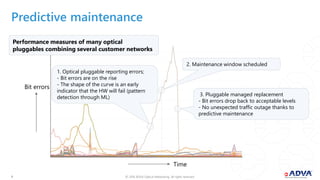
Predictive maintenance
Time
Bit errors
Performance measures of many optical
pluggables combining several customer networks
2. Maintenance window scheduled
3. Pluggable managed replacement
- Bit errors drop back to acceptable levels
- No unexpected traffic outage thanks to
predictive maintenance
1. Optical pluggable reporting errors;
- Bit errors are on the rise
- The shape of the curve is an early
indicator that the HW will fail (pattern
detection through ML)
© 2018 ADVA Optical Networking. All rights reserved.1010
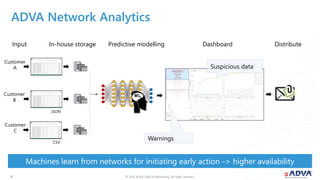
Machines learn from networks for initiating early action -> higher availability
ADVA Network Analytics
Input In-house storage Predictive modelling Dashboard Distribute
JSON
CSV
Warnings
Suspicious data
Customer
A
Customer
B
Customer
C
© 2018 ADVA Optical Networking. All rights reserved.1111
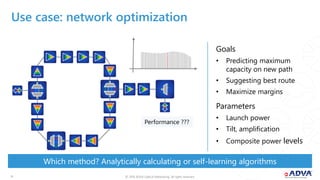
Goals
• Predicting maximum
capacity on new path
• Suggesting best route
• Maximize margins
Parameters
• Launch power
• Tilt, amplification
• Composite power levels
Which method? Analytically calculating or self-learning algorithms
Use case: network optimization
Performance ???
© 2018 ADVA Optical Networking. All rights reserved.1212
Network optimization – problem statement
Calculation is extremely complex and time consuming
0
11 2
2
2
22
2









z
zzz
Eq
E
rr
E
rr
E

0
11 2
2
2
22
2









z
zzz
Hq
H
rr
H
rr
H

It somehow has to start with Maxwell,
leading to wave propagation in fibers …
)(
),( ztj
erEE 
 
 

PSP
Next, consider dispersion, polarization
and nonlinear effects …
… and you get a nonlinear
propagation equation …
),(),(),(
2
),(
62 3
3
3
2
2
2
1 tzEtzPjtzEtzE
tt
j
tz




















 … which cannot be solved analytically anymore and
requires time-consuming numerical calculations.
Simplified considerations,
like OSNR only …
Npf log10dBm58OSNR inges0,1nm 
… or calculating bit
errors directly …
            















 







 

2
erfc
2
erfc
2
1
0110
2
1
010101
0
0th
1
th1

iiii
PPPPPPPB
… do not consider span-length variations, amplifier types, different modulation formats and FEC types, etc. in a simple way and need severe approximations, again
leading to the necessity to calculate each channel and path individually …
Fiber Length
Power[dB]
Gon/off
With B-FRA
Without B-FRA
Separate network into OTDAs
with any-to-any optical connectivity
Pre-analysis
Power and
Dispersion
Engineering
Performance
Analysis
Topology
Link parameters
(traffic demand and routing)
Determine the ReferencePath as the
longestpath with N spans an OTDAhas to
supportwithout electrical regeneration
Define the targetspan launchpower from
N and accumulated launch-power limit
Design CD to hit per-spantarget range
based on reference-pathresidual-CD criteria
Design power by placing amplifiers per link
to attain the node ingress and egress
power targets
Any-to-any path-performanceanalysis
based on signal-integrity parameters
Iteration:
- Optimize span launch power
- Alter amplifiertypes
- Add regeneration
- Add amplificationsites
- Alter designtarget
1E-8
1E-7
1E-6
1E-5
1E-4
1E-3
1E-2
1E-1
1E+0
1 4 7 10 13 16 19 22
BER
Es/N0 [dB]
BPSK
QPSK
9QPR
8QAM
16QAM
Even the NLT concept …
OSNR Requirement incl.
Penalties
10 20 300
16
Number of Spans
24
20
28
32
OSNR[dB]
12
OSNR Degradation
System
Limit
… requires a workflow that is
pretty complex – despite the
many approximations …
Span Count
4 8 16120 20
LaunchPower[dBm]
-1
3
7
11
10 Gb/s, 100 GHz, G.652
10 Gb/s, 50 GHz, G.652
10/40 Gb/s, 50 GHz, G.655
4 dBm
1 dBm
5 10
13
© 2018 ADVA Optical Networking. All rights reserved.1313
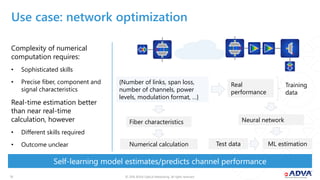
Complexity of numerical
computation requires:
• Sophisticated skills
• Precise fiber, component and
signal characteristics
Real-time estimation better
than near real-time
calculation, however
• Different skills required
• Outcome unclear
Self-learning model estimates/predicts channel performance
Use case: network optimization
{Number of links, span loss,
number of channels, power
levels, modulation format, …}
Real
performance
Training
data
Fiber characteristics
Numerical calculation
Neural network
Test data ML estimation
© 2018 ADVA Optical Networking. All rights reserved.1414
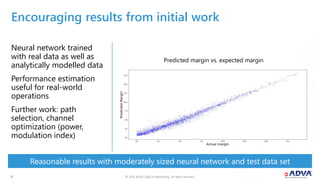
Neural network trained
with real data as well as
analytically modelled data
Performance estimation
useful for real-world
operations
Further work: path
selection, channel
optimization (power,
modulation index)
Reasonable results with moderately sized neural network and test data set
Encouraging results from initial work
Predicted margin vs. expected margin
© 2018 ADVA Optical Networking. All rights reserved.1515
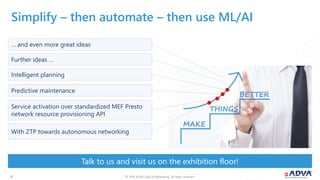
Service activation over standardized MEF Presto
network resource provisioning API
Talk to us and visit us on the exhibition floor!
Simplify – then automate – then use ML/AI
With ZTP towards autonomous networking
Predictive maintenance
Intelligent planning
Further ideas …
… and even more great ideas
© 2018 ADVA Optical Networking. All rights reserved.1616
Further reading
• D. Rafique, et al., “TSDN-enabled network assurance: A cognitive fault
detection architecture,” in 43rd European Conference on Optical
Communication (ECOC), 2017.
• D. Rafique, et al., “Cognitive assurance architecture for optical network fault
management,” IEEE Journal of Lightwave Technology, vol. 36, no. 7, pp.
1443–1450, Apr 2018.
• D. Rafique, et al., “Analytics-driven fault discovery and diagnosis for
cognitive root cause analysis,” in Optical Fiber Communication Conference.
Optical Society of America, 2018.
• etc.
A few publications:
https://blog.advaoptical.com/en/
Thank you
IMPORTANT NOTICE
The content of this presentation is strictly confidential. ADVA Optical Networking is the exclusive owner or licensee of the content, material, and information in this presentation. Any
reproduction, publication or reprint, in whole or in part, is strictly prohibited.
The information in this presentation may not be accurate, complete or up to date, and is provided without warranties or representations of any kind, either express or implied. ADVA
Optical Networking shall not be responsible for and disclaims any liability for any loss or damages, including without limitation, direct, indirect, incidental, consequential and special
damages, alleged to have been caused by or in connection with using and/or relying on the information contained in this presentation.
Copyright © for the entire content of this presentation: ADVA Optical Networking.
srettenberger@advaoptical.com

Transforming optical networking with AI

  • 1.
    Transforming optical networkingwith AI Stephan Rettenberger (with many thanks to Ulrich Kohn) June 2018 From automated control to artificial intelligence
  • 2.
    © 2018 ADVAOptical Networking. All rights reserved.22 Self-/automated-/machine-learning can unleash phenomenal possibilities The power of learning Human DNA: 1Gbyte of data Learning Human brain: >1Pbyte of data
  • 3.
    © 2018 ADVAOptical Networking. All rights reserved.33 Software-defined cognitive networks: Machine learning from comprehensive network data for self-organizing, self-optimizing management Software-defined networking: Automated, multi-layer control with open interfaces for better resource utilization Legacy NMS: Manual processes with tight control and potential for higher resource utilization Short-term improvements – long-term objectives Intelligently managing and operating networks
  • 4.
    © 2018 ADVAOptical Networking. All rights reserved.44 Intent-based service activation Real-time, intent-based provisioning of secure connections Multi-layer network optimization and self-healing for highest availability Seamless integration with open, standardized interfaces Open network automation - multi-partner demonstration NETCONF RESTCONF/ TAPIOPENFLOW Secure photonic layer Secure CE layer Secure vSwitch layer Intent-driven API Network orchestrator Source: Intent-Based In-Flight Service Encryption in Multi-Layer Transport Networks, OFC 2017
  • 5.
    © 2018 ADVAOptical Networking. All rights reserved.55 Security is key ZTP is flexible and can be adapted to operational needs and stakeholder scenarios Zero touch provisioning in action Configuration steps Yang models 1. Device connects to bootstrap server and authenticates itself and the bootstrap server Zero touch information data model; procedure: get- bootstrapping data 2. Device uploads the boot-image and configuration scripts and verifies integrity and authenticity Ownership certificate, ownership voucher 3. Device installs and executes boot image and scripts Procedure: report-progress; device: “bootstrap complete” NB: There is also a need for securely connecting with NMS systems and there might be several boot and configuration servers … Service provider (owner) Bootstrapping server
  • 6.
    © 2018 ADVAOptical Networking. All rights reserved.66 Intelligence emerges from complexity and scale Intelligence substituting human capabilities Insight extending human capabilities Explain affirming human capabilities • Machine learning: prediction • Deep learning: automated machines • AI: behaves and reasons • Data analysis: individual problem • Data analytics: general problem • Big data: beyond traditional data • Statistics: quantification • Data mining: pattern identification
  • 7.
    © 2018 ADVAOptical Networking. All rights reserved.77 AI business value expectations (suppliers) Optimization of network resources Fraud detection and security Personalization Predicting congestion ChatbotsSituation-aware assuranceCall center Natural language machine control Source: AI – the time is now; TM Forum, Dec 2017
  • 8.
    © 2018 ADVAOptical Networking. All rights reserved.88 Use case: Predictive maintenance Year-months Days-hours Minutes Physical degradation modes Equipment dynamic modes Failure modes
  • 9.
    © 2018 ADVAOptical Networking. All rights reserved.99 Predictive maintenance Time Bit errors Performance measures of many optical pluggables combining several customer networks 2. Maintenance window scheduled 3. Pluggable managed replacement - Bit errors drop back to acceptable levels - No unexpected traffic outage thanks to predictive maintenance 1. Optical pluggable reporting errors; - Bit errors are on the rise - The shape of the curve is an early indicator that the HW will fail (pattern detection through ML)
  • 10.
    © 2018 ADVAOptical Networking. All rights reserved.1010 Machines learn from networks for initiating early action -> higher availability ADVA Network Analytics Input In-house storage Predictive modelling Dashboard Distribute JSON CSV Warnings Suspicious data Customer A Customer B Customer C
  • 11.
    © 2018 ADVAOptical Networking. All rights reserved.1111 Goals • Predicting maximum capacity on new path • Suggesting best route • Maximize margins Parameters • Launch power • Tilt, amplification • Composite power levels Which method? Analytically calculating or self-learning algorithms Use case: network optimization Performance ???
  • 12.
    © 2018 ADVAOptical Networking. All rights reserved.1212 Network optimization – problem statement Calculation is extremely complex and time consuming 0 11 2 2 2 22 2          z zzz Eq E rr E rr E  0 11 2 2 2 22 2          z zzz Hq H rr H rr H  It somehow has to start with Maxwell, leading to wave propagation in fibers … )( ),( ztj erEE       PSP Next, consider dispersion, polarization and nonlinear effects … … and you get a nonlinear propagation equation … ),(),(),( 2 ),( 62 3 3 3 2 2 2 1 tzEtzPjtzEtzE tt j tz                      … which cannot be solved analytically anymore and requires time-consuming numerical calculations. Simplified considerations, like OSNR only … Npf log10dBm58OSNR inges0,1nm  … or calculating bit errors directly …                                         2 erfc 2 erfc 2 1 0110 2 1 010101 0 0th 1 th1  iiii PPPPPPPB … do not consider span-length variations, amplifier types, different modulation formats and FEC types, etc. in a simple way and need severe approximations, again leading to the necessity to calculate each channel and path individually … Fiber Length Power[dB] Gon/off With B-FRA Without B-FRA Separate network into OTDAs with any-to-any optical connectivity Pre-analysis Power and Dispersion Engineering Performance Analysis Topology Link parameters (traffic demand and routing) Determine the ReferencePath as the longestpath with N spans an OTDAhas to supportwithout electrical regeneration Define the targetspan launchpower from N and accumulated launch-power limit Design CD to hit per-spantarget range based on reference-pathresidual-CD criteria Design power by placing amplifiers per link to attain the node ingress and egress power targets Any-to-any path-performanceanalysis based on signal-integrity parameters Iteration: - Optimize span launch power - Alter amplifiertypes - Add regeneration - Add amplificationsites - Alter designtarget 1E-8 1E-7 1E-6 1E-5 1E-4 1E-3 1E-2 1E-1 1E+0 1 4 7 10 13 16 19 22 BER Es/N0 [dB] BPSK QPSK 9QPR 8QAM 16QAM Even the NLT concept … OSNR Requirement incl. Penalties 10 20 300 16 Number of Spans 24 20 28 32 OSNR[dB] 12 OSNR Degradation System Limit … requires a workflow that is pretty complex – despite the many approximations … Span Count 4 8 16120 20 LaunchPower[dBm] -1 3 7 11 10 Gb/s, 100 GHz, G.652 10 Gb/s, 50 GHz, G.652 10/40 Gb/s, 50 GHz, G.655 4 dBm 1 dBm 5 10 13
  • 13.
    © 2018 ADVAOptical Networking. All rights reserved.1313 Complexity of numerical computation requires: • Sophisticated skills • Precise fiber, component and signal characteristics Real-time estimation better than near real-time calculation, however • Different skills required • Outcome unclear Self-learning model estimates/predicts channel performance Use case: network optimization {Number of links, span loss, number of channels, power levels, modulation format, …} Real performance Training data Fiber characteristics Numerical calculation Neural network Test data ML estimation
  • 14.
    © 2018 ADVAOptical Networking. All rights reserved.1414 Neural network trained with real data as well as analytically modelled data Performance estimation useful for real-world operations Further work: path selection, channel optimization (power, modulation index) Reasonable results with moderately sized neural network and test data set Encouraging results from initial work Predicted margin vs. expected margin
  • 15.
    © 2018 ADVAOptical Networking. All rights reserved.1515 Service activation over standardized MEF Presto network resource provisioning API Talk to us and visit us on the exhibition floor! Simplify – then automate – then use ML/AI With ZTP towards autonomous networking Predictive maintenance Intelligent planning Further ideas … … and even more great ideas
  • 16.
    © 2018 ADVAOptical Networking. All rights reserved.1616 Further reading • D. Rafique, et al., “TSDN-enabled network assurance: A cognitive fault detection architecture,” in 43rd European Conference on Optical Communication (ECOC), 2017. • D. Rafique, et al., “Cognitive assurance architecture for optical network fault management,” IEEE Journal of Lightwave Technology, vol. 36, no. 7, pp. 1443–1450, Apr 2018. • D. Rafique, et al., “Analytics-driven fault discovery and diagnosis for cognitive root cause analysis,” in Optical Fiber Communication Conference. Optical Society of America, 2018. • etc. A few publications: https://blog.advaoptical.com/en/
  • 17.
    Thank you IMPORTANT NOTICE Thecontent of this presentation is strictly confidential. ADVA Optical Networking is the exclusive owner or licensee of the content, material, and information in this presentation. Any reproduction, publication or reprint, in whole or in part, is strictly prohibited. The information in this presentation may not be accurate, complete or up to date, and is provided without warranties or representations of any kind, either express or implied. ADVA Optical Networking shall not be responsible for and disclaims any liability for any loss or damages, including without limitation, direct, indirect, incidental, consequential and special damages, alleged to have been caused by or in connection with using and/or relying on the information contained in this presentation. Copyright © for the entire content of this presentation: ADVA Optical Networking. srettenberger@advaoptical.com