Introduction to Linguistics


                 nia F lo r e s
        By   Ida
What is a Language?


Language = df. A system that uses some
  physical sign (sound, gesture, mark) to express
  meaning.
We are Uniquely Language-Users

Other Animals Communicate
• Cats arch their back to scare the neighbor cat
• Bees tell each other when they have found
  food
• Chimpanzees can be taught to use primitive
  sign language to communicate desires.
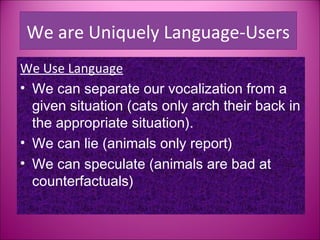
We are Uniquely Language-Users
We Use Language
• We can separate our vocalization from a
  given situation (cats only arch their back in
  the appropriate situation).
• We can lie (animals only report)
• We can speculate (animals are bad at
  counterfactuals)
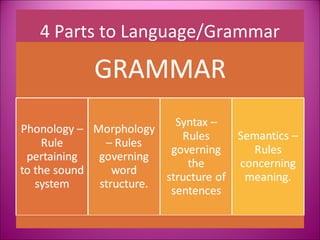
4 Parts to Language/Grammar
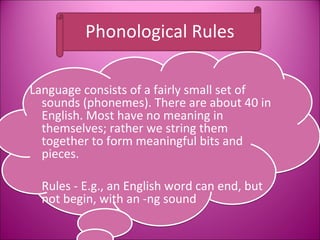
Phonological Rules

Language consists of a fairly small set of
  sounds (phonemes). There are about 40 in
  English. Most have no meaning in
  themselves; rather we string them
  together to form meaningful bits and
  pieces.

  Rules - E.g., an English word can end, but
  not begin, with an -ng sound
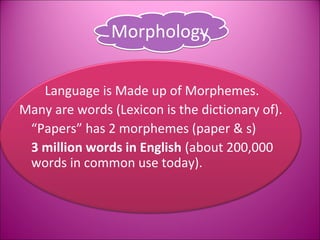
Morphology

   Language is Made up of Morphemes.
Many are words (Lexicon is the dictionary of).
 “Papers” has 2 morphemes (paper & s)
 3 million words in English (about 200,000
 words in common use today).
Syntactic Rules


Rules that enable us to combine morphemes into sentences
  (bridge between sound and meaning).

When children put words together they are followingsyntactic
 rules about how morphemes are put together.
Semantic


Arbitrariness of the Sign - Sounds of
words bear no relationship to meaning
(except for onomatopoeia).

In Philosophy we often distinguish
between denotation and connotation.
Semantics Follows Syntax

  A single sentence can correspond to two
  propositions, each of which has a distinctive
  syntactic (and logical) structure, hence, a
  different cognitive representation.

• Evidence that meaning is assigned to syntactic
  structure, rather than to words and sentences.
Grammar
How do we know that one sentence is
grammatical and the other is not?

– Amy likes Stan
– Think likes I Stan that Amy

Cannot be that we have learned each
instance individually. Sentences are infinite;
brain is not.
Questions About Rules
– How do we come to have such
  knowledge?
– In what form is such knowledge
  represented in the mind?
– How can children learn grammar?
Interesting Facts About Language

• The number of sentences is infinite.
• We are able to distinguish grammatical from
  ungrammatical sentences.
• We are able to recognize truncated sentences
  (“Stop it”) that are missing nouns.
• We are able to recognize ambiguous
  sentences (“Andrew saw the girl with
  binoculars”)
• We can create sentences that paraphrase each
  other.
Noam Chomsky
Focused on the vast and unconscious set
of rules he hypothesized must exist in the
minds of speakers and hearers in order for
them to produce and understand their
native language.  

1957 – Syntactic Structures
1965 – Aspects of the Theory of Syntax
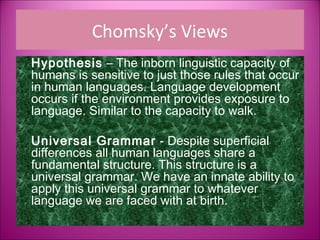
Chomsky’s Views
• He abandons the idea that children produce
  languages only by imitation (abandon behaviorism)

• He rejects the idea that direct teaching and
  correcting of grammar could account for children’s
  utterances because the rules children were
  unconsciously acquiring are buried in the
  unconscious of the adults.

• He claims that there are generative rules (explicit
  algorithms that characterize the structures of a
  particular language).
Chomsky’s Views
    Hypothesis – The inborn linguistic capacity of
    humans is sensitive to just those rules that occur
    in human languages. Language development
    occurs if the environment provides exposure to
    language. Similar to the capacity to walk.
 
    Universal Grammar - Despite superficial
    differences all human languages share a
    fundamental structure. This structure is a
    universal grammar. We have an innate ability to
    apply this universal grammar to whatever
    language we are faced with at birth.
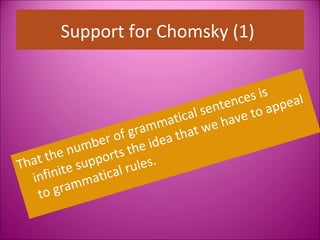
Support for Chomsky (1)


                                            es is eal
                                   se ntenc      app
                              ical         e to
                           mat t we hav
                    gram a tha
             er of e ide
          umb ts th
    the n ppor
 hat te su
T                     les.
      ni
  infi mmatic   al r u
   to gra
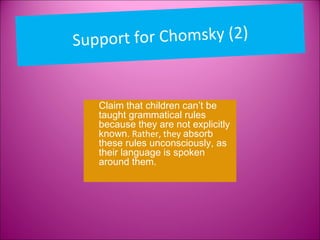
Supp ort for Chomsky (2)


   Claim that children can’t be
   taught grammatical rules
   because they are not explicitly
   known. Rather, they absorb
   these rules unconsciously, as
   their language is spoken
   around them.
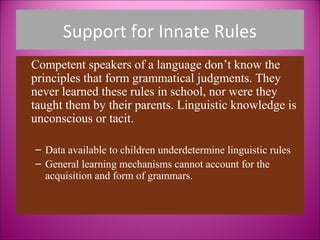
Support for Innate Rules
Competent speakers of a language don’t know the
principles that form grammatical judgments. They
never learned these rules in school, nor were they
taught them by their parents. Linguistic knowledge is
unconscious or tacit.

– Data available to children underdetermine linguistic rules
– General learning mechanisms cannot account for the
  acquisition and form of grammars.
Lingustic

Lingustic

  • 1.
    Introduction to Linguistics nia F lo r e s By Ida
  • 2.
    What is aLanguage? Language = df. A system that uses some physical sign (sound, gesture, mark) to express meaning.
  • 3.
    We are UniquelyLanguage-Users Other Animals Communicate • Cats arch their back to scare the neighbor cat • Bees tell each other when they have found food • Chimpanzees can be taught to use primitive sign language to communicate desires.
  • 4.
    We are UniquelyLanguage-Users We Use Language • We can separate our vocalization from a given situation (cats only arch their back in the appropriate situation). • We can lie (animals only report) • We can speculate (animals are bad at counterfactuals)
  • 5.
    4 Parts toLanguage/Grammar
  • 6.
    Phonological Rules Language consistsof a fairly small set of sounds (phonemes). There are about 40 in English. Most have no meaning in themselves; rather we string them together to form meaningful bits and pieces. Rules - E.g., an English word can end, but not begin, with an -ng sound
  • 7.
    Morphology Language is Made up of Morphemes. Many are words (Lexicon is the dictionary of). “Papers” has 2 morphemes (paper & s) 3 million words in English (about 200,000 words in common use today).
  • 8.
    Syntactic Rules Rules thatenable us to combine morphemes into sentences (bridge between sound and meaning). When children put words together they are followingsyntactic rules about how morphemes are put together.
  • 9.
    Semantic Arbitrariness of theSign - Sounds of words bear no relationship to meaning (except for onomatopoeia). In Philosophy we often distinguish between denotation and connotation.
  • 10.
    Semantics Follows Syntax A single sentence can correspond to two propositions, each of which has a distinctive syntactic (and logical) structure, hence, a different cognitive representation. • Evidence that meaning is assigned to syntactic structure, rather than to words and sentences.
  • 11.
    Grammar How do weknow that one sentence is grammatical and the other is not? – Amy likes Stan – Think likes I Stan that Amy Cannot be that we have learned each instance individually. Sentences are infinite; brain is not.
  • 12.
    Questions About Rules –How do we come to have such knowledge? – In what form is such knowledge represented in the mind? – How can children learn grammar?
  • 13.
    Interesting Facts AboutLanguage • The number of sentences is infinite. • We are able to distinguish grammatical from ungrammatical sentences. • We are able to recognize truncated sentences (“Stop it”) that are missing nouns. • We are able to recognize ambiguous sentences (“Andrew saw the girl with binoculars”) • We can create sentences that paraphrase each other.
  • 14.
    Noam Chomsky Focused onthe vast and unconscious set of rules he hypothesized must exist in the minds of speakers and hearers in order for them to produce and understand their native language.   1957 – Syntactic Structures 1965 – Aspects of the Theory of Syntax
  • 15.
    Chomsky’s Views • Heabandons the idea that children produce languages only by imitation (abandon behaviorism) • He rejects the idea that direct teaching and correcting of grammar could account for children’s utterances because the rules children were unconsciously acquiring are buried in the unconscious of the adults. • He claims that there are generative rules (explicit algorithms that characterize the structures of a particular language).
  • 16.
    Chomsky’s Views Hypothesis – The inborn linguistic capacity of humans is sensitive to just those rules that occur in human languages. Language development occurs if the environment provides exposure to language. Similar to the capacity to walk.   Universal Grammar - Despite superficial differences all human languages share a fundamental structure. This structure is a universal grammar. We have an innate ability to apply this universal grammar to whatever language we are faced with at birth.
  • 17.
    Support for Chomsky(1) es is eal se ntenc app ical e to mat t we hav gram a tha er of e ide umb ts th the n ppor hat te su T les. ni infi mmatic al r u to gra
  • 18.
    Supp ort forChomsky (2) Claim that children can’t be taught grammatical rules because they are not explicitly known. Rather, they absorb these rules unconsciously, as their language is spoken around them.
  • 19.
    Support for InnateRules Competent speakers of a language don’t know the principles that form grammatical judgments. They never learned these rules in school, nor were they taught them by their parents. Linguistic knowledge is unconscious or tacit. – Data available to children underdetermine linguistic rules – General learning mechanisms cannot account for the acquisition and form of grammars.