From Structuralism to
Transformational
Generative Grammar
OBJECTIVES
• Familiarize the proponents of structuralism
and transformational generative grammar;
• Compare the ideas of Europian structuralism
and American structuralism; and
• Appraise the concept of Chomsky about
innateness and grammar.
WHAT IS STRUCTURALISM
• An approach in academic in general that
explores the relationships between
fundamental principal elements in language,
literature, and other fields upon which some
higher mental, linguistic, social, or cultural
“structures” and “structural networks’’ are
built.
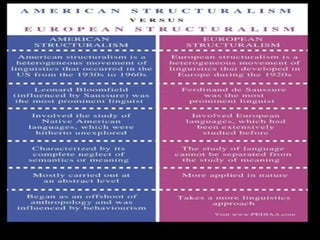
• STRUCTURALISM: heterogeneous school of
linguistics which was developed in Europe and
America in the first half of the 20th Century. Two
of the most prominent structuralism linguists are:
• Ferdinand de Saussure, in European
structuralism.
• Leonard Bloomfield, in American structuralism.
European Structuralism
• Date of its birth From the publication of
Saussure’s “A Course in General
Linguistics”(1916)
5 dichotomies of Saussure’s theory
• 1. Synchronic vs. Diachronic
• 2. prescriptive vs. descriptive
5 Dichotomies of Saussure’s Theory
• 3. Langue vs. Parole
• 4. Signifier vs. Signified
• 5.Syntagmatic vs. Paradigmatic
1.Synchronic vs. Diachronic
• Synchronic - differs from diachronic , or
historical , explanation in being structural,
rather than casual.
• Synchronic description demonstrates how all
the forms and meanings are interrelated at a
particular point in time in a particular
language system.
Synchronic vs. Diachronic
• Diachronic
- The study of a language through its history.it is
the study of language change and
reconstruction of earlier stages of language,
genetic relationship between languages.
2.Prescriptive vs. Descriptive
• Prescriptive linguistics are a normative
approach concerned with what is right and
wrong. On the other hand, Descriptive
linguistics are only concerned with describing
what is (rather than what should be).
3.Langue vs. Parole
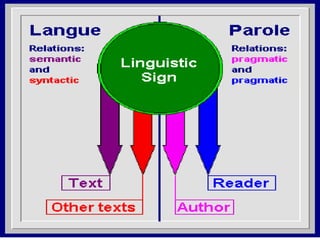
• Langue- The system of a language, its entire
grammar and vocabulary
• Parole-The language as it is spoken by a
particular person in a particular place,
compete with errors, hesitations,etc.
4.Signifier vs. Signified
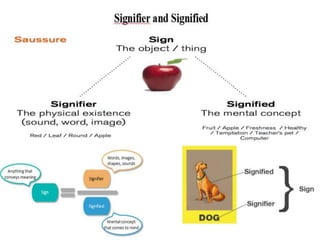
• Signifier is a sensory representation while
signified is a concept(meaning)
• Both components of the linguistic sign are
inseparable.
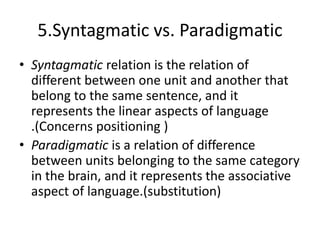
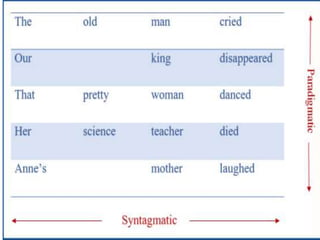
5.Syntagmatic vs. Paradigmatic
• Syntagmatic relation is the relation of
different between one unit and another that
belong to the same sentence, and it
represents the linear aspects of language
.(Concerns positioning )
• Paradigmatic is a relation of difference
between units belonging to the same category
in the brain, and it represents the associative
aspect of language.(substitution)
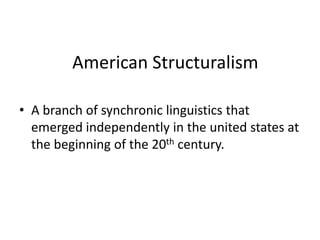
American Structuralism
• A branch of synchronic linguistics that
emerged independently in the united states at
the beginning of the 20th century.
American Structuralism
• Most important figure in American
structuralism; Leonard Bloomfield
(1930’s_1960’s)
• Behaviorism and Science:
• Behaviorism was a school of psychology. According to
this school science can only deal with physical facts.
Statements must be based on these physical
characteristics. Thus, science must observe, describe
physical facts and induce descriptive generalization.
Continuance
• Language: Stimulus and Response;
• Stimulus: Any action that makes an organism to react.
• Response: how the organism reacts to an stimulus and change the
behavior.
• Human behavior is studied in terms of stimulus and response,
consequently linguistic behavior becomes also a pattern of stimulus
and response, where language plays an immediate role. For
example:
S r………………s R
S: the girl feels hungry
r: the girl asks the boy to pick an apple
s: the boy hears the girl’s request
R: the boy picks an apple and gives it to the girl.
Generativism
( Transformational-Generative Grammar)
Chomsky’s Generativism Late 1950’s
Generativism is usually presented as having developed out of,
and in reaction to , the previously dominant school of post-
Bloomfieldian American Structuralism.
Dichotomy of Chomsky:
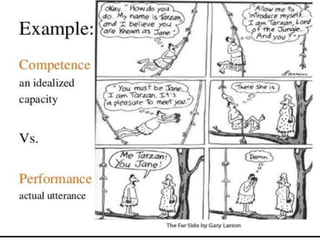
Competency vs. Performance
Chomsky separates competence and performance; he describes
‘competence’ as an idealized capacity that is located as a
psychological or mental property or function and ’performance’
as the production of actual utterances. In short, competence
involves “knowing” the language and performance involves
‘doing’ something with the language. The difficulty with this
construct is that it is very difficult to assess competence without
assessing performance.
Generativism
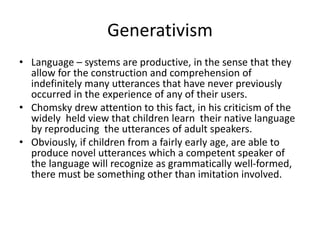
• Language – systems are productive, in the sense that they
allow for the construction and comprehension of
indefinitely many utterances that have never previously
occurred in the experience of any of their users.
• Chomsky drew attention to this fact, in his criticism of the
widely held view that children learn their native language
by reproducing the utterances of adult speakers.
• Obviously, if children from a fairly early age, are able to
produce novel utterances which a competent speaker of
the language will recognize as grammatically well-formed,
there must be something other than imitation involved.
Generativism
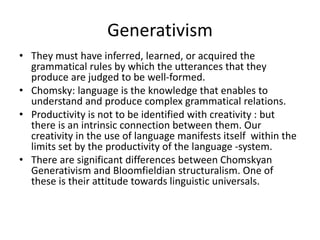
• They must have inferred, learned, or acquired the
grammatical rules by which the utterances that they
produce are judged to be well-formed.
• Chomsky: language is the knowledge that enables to
understand and produce complex grammatical relations.
• Productivity is not to be identified with creativity : but
there is an intrinsic connection between them. Our
creativity in the use of language manifests itself within the
limits set by the productivity of the language -system.
• There are significant differences between Chomskyan
Generativism and Bloomfieldian structuralism. One of
these is their attitude towards linguistic universals.
Generativism
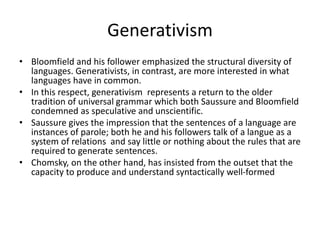
• Bloomfield and his follower emphasized the structural diversity of
languages. Generativists, in contrast, are more interested in what
languages have in common.
• In this respect, generativism represents a return to the older
tradition of universal grammar which both Saussure and Bloomfield
condemned as speculative and unscientific.
• Saussure gives the impression that the sentences of a language are
instances of parole; both he and his followers talk of a langue as a
system of relations and say little or nothing about the rules that are
required to generate sentences.
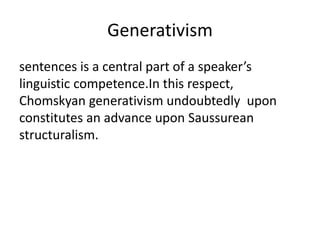
• Chomsky, on the other hand, has insisted from the outset that the
capacity to produce and understand syntactically well-formed
Generativism
sentences is a central part of a speaker’s
linguistic competence.In this respect,
Chomskyan generativism undoubtedly upon
constitutes an advance upon Saussurean
structuralism.
symposium-ppt-.maricel (1).pptx

symposium-ppt-.maricel (1).pptx

  • 1.
  • 2.
    OBJECTIVES • Familiarize theproponents of structuralism and transformational generative grammar; • Compare the ideas of Europian structuralism and American structuralism; and • Appraise the concept of Chomsky about innateness and grammar.
  • 3.
    WHAT IS STRUCTURALISM •An approach in academic in general that explores the relationships between fundamental principal elements in language, literature, and other fields upon which some higher mental, linguistic, social, or cultural “structures” and “structural networks’’ are built.
  • 4.
    • STRUCTURALISM: heterogeneousschool of linguistics which was developed in Europe and America in the first half of the 20th Century. Two of the most prominent structuralism linguists are: • Ferdinand de Saussure, in European structuralism. • Leonard Bloomfield, in American structuralism.
  • 5.
    European Structuralism • Dateof its birth From the publication of Saussure’s “A Course in General Linguistics”(1916) 5 dichotomies of Saussure’s theory • 1. Synchronic vs. Diachronic • 2. prescriptive vs. descriptive
  • 6.
    5 Dichotomies ofSaussure’s Theory • 3. Langue vs. Parole • 4. Signifier vs. Signified • 5.Syntagmatic vs. Paradigmatic
  • 7.
    1.Synchronic vs. Diachronic •Synchronic - differs from diachronic , or historical , explanation in being structural, rather than casual. • Synchronic description demonstrates how all the forms and meanings are interrelated at a particular point in time in a particular language system.
  • 8.
    Synchronic vs. Diachronic •Diachronic - The study of a language through its history.it is the study of language change and reconstruction of earlier stages of language, genetic relationship between languages.
  • 9.
    2.Prescriptive vs. Descriptive •Prescriptive linguistics are a normative approach concerned with what is right and wrong. On the other hand, Descriptive linguistics are only concerned with describing what is (rather than what should be).
  • 10.
    3.Langue vs. Parole •Langue- The system of a language, its entire grammar and vocabulary • Parole-The language as it is spoken by a particular person in a particular place, compete with errors, hesitations,etc.
  • 12.
    4.Signifier vs. Signified •Signifier is a sensory representation while signified is a concept(meaning) • Both components of the linguistic sign are inseparable.
  • 14.
    5.Syntagmatic vs. Paradigmatic •Syntagmatic relation is the relation of different between one unit and another that belong to the same sentence, and it represents the linear aspects of language .(Concerns positioning ) • Paradigmatic is a relation of difference between units belonging to the same category in the brain, and it represents the associative aspect of language.(substitution)
  • 17.
    American Structuralism • Abranch of synchronic linguistics that emerged independently in the united states at the beginning of the 20th century.
  • 18.
    American Structuralism • Mostimportant figure in American structuralism; Leonard Bloomfield (1930’s_1960’s) • Behaviorism and Science: • Behaviorism was a school of psychology. According to this school science can only deal with physical facts. Statements must be based on these physical characteristics. Thus, science must observe, describe physical facts and induce descriptive generalization.
  • 19.
    Continuance • Language: Stimulusand Response; • Stimulus: Any action that makes an organism to react. • Response: how the organism reacts to an stimulus and change the behavior. • Human behavior is studied in terms of stimulus and response, consequently linguistic behavior becomes also a pattern of stimulus and response, where language plays an immediate role. For example: S r………………s R S: the girl feels hungry r: the girl asks the boy to pick an apple s: the boy hears the girl’s request R: the boy picks an apple and gives it to the girl.
  • 20.
    Generativism ( Transformational-Generative Grammar) Chomsky’sGenerativism Late 1950’s Generativism is usually presented as having developed out of, and in reaction to , the previously dominant school of post- Bloomfieldian American Structuralism. Dichotomy of Chomsky: Competency vs. Performance Chomsky separates competence and performance; he describes ‘competence’ as an idealized capacity that is located as a psychological or mental property or function and ’performance’ as the production of actual utterances. In short, competence involves “knowing” the language and performance involves ‘doing’ something with the language. The difficulty with this construct is that it is very difficult to assess competence without assessing performance.
  • 22.
    Generativism • Language –systems are productive, in the sense that they allow for the construction and comprehension of indefinitely many utterances that have never previously occurred in the experience of any of their users. • Chomsky drew attention to this fact, in his criticism of the widely held view that children learn their native language by reproducing the utterances of adult speakers. • Obviously, if children from a fairly early age, are able to produce novel utterances which a competent speaker of the language will recognize as grammatically well-formed, there must be something other than imitation involved.
  • 23.
    Generativism • They musthave inferred, learned, or acquired the grammatical rules by which the utterances that they produce are judged to be well-formed. • Chomsky: language is the knowledge that enables to understand and produce complex grammatical relations. • Productivity is not to be identified with creativity : but there is an intrinsic connection between them. Our creativity in the use of language manifests itself within the limits set by the productivity of the language -system. • There are significant differences between Chomskyan Generativism and Bloomfieldian structuralism. One of these is their attitude towards linguistic universals.
  • 24.
    Generativism • Bloomfield andhis follower emphasized the structural diversity of languages. Generativists, in contrast, are more interested in what languages have in common. • In this respect, generativism represents a return to the older tradition of universal grammar which both Saussure and Bloomfield condemned as speculative and unscientific. • Saussure gives the impression that the sentences of a language are instances of parole; both he and his followers talk of a langue as a system of relations and say little or nothing about the rules that are required to generate sentences. • Chomsky, on the other hand, has insisted from the outset that the capacity to produce and understand syntactically well-formed
  • 25.
    Generativism sentences is acentral part of a speaker’s linguistic competence.In this respect, Chomskyan generativism undoubtedly upon constitutes an advance upon Saussurean structuralism.