Transfer Defect Learning
Jaechang Nam
The Hong Kong University of Science and Technology, China
Sinno Jialian Pan
Institute for Infocomm Research, Singapore
Sunghun Kim
The Hong Kong University of Science and Technology, China
Defect Prediction
• Hassan et al.@ICSE`09, Predicting Faults Using the Complexity of Code
Changes
• D’Ambros et al.@MSR`10, An Extensive Comparison of Bug Prediction
Approaches
• Rahman et al.@ICSE`12, Recalling the Impression of Cross-Project Defect
Prediction
• Hata et al.@ICSE`12, Bug Prediction based on Fine-grained Module
histories
• …
2
Program Prediction Model
(Machine learning)
Future defects
Training prediction model
3
Test set
Training set
Training prediction model
3
Test set
Training set
M1 M2 … M19 M20 Class
11 5 … 53 78 Buggy
… … … … … …
1 1 … 3 9 Clean
M1 M2 … M19 M20 Class
2 1 … 2 8 ?
… … … … … …
13 6 … 45 69 ?
Cross prediction model
4
Target project (Test set)
Source project (Training set)
Cross-project Defect Prediction
5
“Training data is often not available, either
because a company is too small or it is the first
release of a product”
Zimmerman et al.@FSE`09, Cross-project Defect Prediction
Cross-project Defect Prediction
5
“Training data is often not available, either
because a company is too small or it is the first
release of a product”
Zimmerman et al.@FSE`09, Cross-project Defect Prediction
“For many new projects we may not have enough
historical data to train prediction models.”
Rahman, Posnett, and Devanbu @ICSE`12, Recalling the
“Imprecision” of Cross-project Defect Prediction
Cross-project defect prediction
• Zimmerman et al.@FSE`09
– “We ran 622 cross-project predictions and found
only 3.4% actually worked.”
6
Worked,
3.4%
Not
worked,
96.6%
Cross-company defect prediction
• Turhan and Menzies et al.@ESEJ`09
– “Within-company data models are still the best”
7
0
0.05
0.1
0.15
0.2
0.25
0.3
0.35
0.4
Cross Cross with a NN
filter
Within
Avg. F-measure
Cross-project defect prediction
• Rahman, Posnett, and Devanbu@FSE`12
8
0
0.1
0.2
0.3
0.4
0.5
0.6
Cross Within
Avg. F-measure
Cross prediction results
9
0
0.1
0.2
0.3
0.4
0.5
0.6
0.7
F-measure
Cross Within Cross Within Cross Within
Equinox JDT Lucene
Approaches of Transfer Defect Learning
10
Normalization TCA
TCA+
11
• Data preprocessing for training and test dataNormalization
• A state-of-the art transfer learning algorithm
• Transfer Component AnalysisTCA
• Adapted TCA for cross-project defect prediction
• Decision rules to select a suitable data normalization optionTCA+
Approaches of Transfer Defect Learning
Data Normalization
• Adjust all feature values in the same scale
– E.g., Make Mean = 0 and Std = 1
• Known to be helpful for classification
algorithms to improve prediction
performance [Han et al. 2012].
12
Normalization Options
• N1: Min-max Normalization (max=1, min=0)
[Han et al., 2012]
• N2: Z-score Normalization (mean=0, std=1)
[Han et al., 2012]
• N3: Z-score Normalization only using source
mean and standard deviation
• N4: Z-score Normalization only using target
mean and standard deviation
13
14
• Data preprocessing for training and test dataNormalization
• A state-of-the art transfer learning algorithm
• Transfer Component Analysis
TCA
• Adapted TCA for cross-project defect prediction
• Decision rules to select a suitable data normalization optionTCA+
Approaches of Transfer Defect Learning
Transfer Learning
15
Transfer Learning
15
Traditional Machine Learning (ML)
Learning
System
Learning
System
Transfer Learning
15
Traditional Machine Learning (ML)
Learning
System
Learning
System
Transfer Learning
Learning
System
Learning
System
Knowledge
Transfer
Transfer Learning
15
Traditional Machine Learning (ML)
Learning
System
Learning
System
Transfer Learning
Learning
System
Learning
System
Knowledge
Transfer
A Common Assumption in
Traditional ML
16
Pan andYang@TKDE`10, Survey onTransfer Learning
• Same distribution
A Common Assumption in
Traditional ML
16
Pan andYang@TKDE`10, Survey onTransfer Learning
• Same distribution
Cross Prediction
A Common Assumption in
Traditional ML
16
Pan andYang@TKDE`10, Survey onTransfer Learning
• Same distribution
Transfer Learning
Transfer Component Analysis
• Unsupervised Transfer learning
– Target project labels are not known.
• Must have the same feature space
• Make distribution difference between
training and test datasets similar
17
Pan et al.@TNN`10, Domain Adaptation viaTransfer ComponentAnalysis
Transfer Component Analysis (cont.)
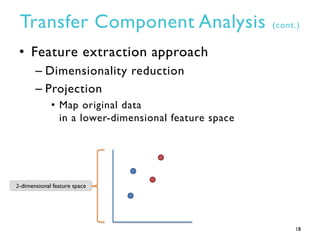
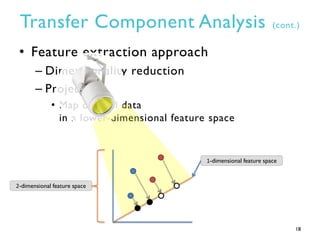
• Feature extraction approach
– Dimensionality reduction
– Projection
• Map original data
in a lower-dimensional feature space
18
Transfer Component Analysis (cont.)
• Feature extraction approach
– Dimensionality reduction
– Projection
• Map original data
in a lower-dimensional feature space
18
2-dimensional feature space
Transfer Component Analysis (cont.)
• Feature extraction approach
– Dimensionality reduction
– Projection
• Map original data
in a lower-dimensional feature space
18
1-dimensional feature space
Transfer Component Analysis (cont.)
• Feature extraction approach
– Dimensionality reduction
– Projection
• Map original data
in a lower-dimensional feature space
18
1-dimensional feature space
Transfer Component Analysis (cont.)
• Feature extraction approach
– Dimensionality reduction
– Projection
• Map original data
in a lower-dimensional feature space
18
1-dimensional feature space
2-dimensional feature space
Transfer Component Analysis (cont.)
• Feature extraction approach
– Dimensionality reduction
– Projection
• Map original data
in a lower-dimensional feature space
– C.f. Principal Component Analysis (PCA)
18
1-dimensional feature space
Transfer Component Analysis (cont.)
19
Pan et al.@TNN`10, Domain Adaptation viaTransfer ComponentAnalysis
Target domain data
Source domain data
Transfer Component Analysis (cont.)
20
PCA TCA
Pan et al.@TNN`10, Domain Adaptation viaTransfer ComponentAnalysis
Preliminary Results using TCA
0
0.1
0.2
0.3
0.4
0.5
0.6
0.7
0.8
F-measure
21*Baseline: Cross-project defect prediction without TCA and normalization
Baseline NoN N1 N2 N3 N4 Baseline NoN N1 N2 N3 N4
Safe  Apache Apache  Safe
Preliminary Results using TCA
0
0.1
0.2
0.3
0.4
0.5
0.6
0.7
0.8
F-measure
21*Baseline: Cross-project defect prediction without TCA and normalization
Prediction performance of TCA
varies according to different
normalization options!
Baseline NoN N1 N2 N3 N4 Baseline NoN N1 N2 N3 N4
Safe  Apache Apache  Safe
22
• Data preprocessing for training and test dataNormalization
• A state-of-the art transfer learning algorithm
• Transfer Component Analysis
TCA
• Adapted TCA for cross-project defect prediction
• Decision rules to select a suitable data
normalization option
TCA+
Approaches of Transfer Defect Learning
TCA+: Decision rules
• Find a suitable normalization for TCA
• Steps
– #1: Characterize a dataset
– #2: Measure similarity
between source and target datasets
– #3: Decision rules
23
#1: Characterize a dataset
24
3
1
…
Dataset A Dataset B
2
4
5
8
9
6
11
d1,2
d1,5
d1,3
d3,11
3
1
…
2
4
5
8
9
6
11
d2,6
d1,2
d1,3
d3,11
DIST={dij : i,j, 1 ≤ i < n, 1 < j ≤ n, i < j}
A
#2: Measure Similarity between
source and target
• Minimum (min) and maximum (max) values of
DIST
• Mean and standard deviation (std) of DIST
• The number of instances
25
#3: Decision Rules
• Rule #1
– Mean and Std are same  NoN
• Rule #2
– Max and Min are different  N1 (max=1, min=0)
• Rule #3,#4
– Std and # of instances are different
 N3 or N4 (src/tgt mean=0, std=1)
• Rule #5
– Default  N2 (mean=0, std=1)
26
EVALUATION
27
Experimental Setup
• 8 software subjects
• Machine learning algorithm
– Logistic regression
28
ReLink (Wu et al.@FSE`11)
Projects
# of metrics
(features)
Apache
26
(Source code)
Safe
ZXing
AEEEM (D’Ambros et al.@MSR`10)
Projects
# of metrics
(features)
Apache Lucene (LC)
61
(Source code,
Churn,
Entropy,…)
Equinox (EQ)
Eclipse JDT
Eclipse PDE UI
Mylyn (ML)
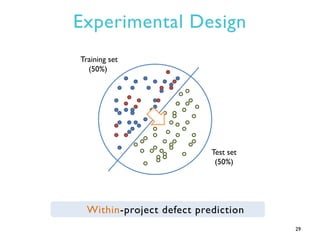
Experimental Design
29
Test set
(50%)
Training set
(50%)
Within-project defect prediction
Experimental Design
30
Target project (Test set)
Source project (Training set)
Cross-project defect prediction
Experimental Design
31
Target project (Test set)
Source project (Training set)
Cross-project defect prediction with TCA/TCA+
TCA/TCA+
RESULTS
32
ReLink Result
33*Baseline: Cross-project defect prediction without TCA/TCA+
0
0.1
0.2
0.3
0.4
0.5
0.6
0.7
0.8
F-measure
Baseline TCA TCA+ Within
Safe  Apache Apache  Safe Safe  ZXing
Baseline TCA TCA+ Within Baseline TCA TCA+ Within
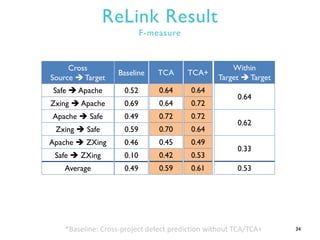
ReLink Result
F-measure
34
Cross
Source  Target
Safe  Apache
Zxing  Apache
Apache  Safe
Zxing  Safe
Apache  ZXing
Safe  ZXing
Average
Baseline
0.52
0.69
0.49
0.59
0.46
0.10
0.49
TCA
0.64
0.64
0.72
0.70
0.45
0.42
0.59
TCA+
0.64
0.72
0.72
0.64
0.49
0.53
0.61
Within
Target  Target
0.64
0.62
0.33
0.53
*Baseline: Cross-project defect prediction without TCA/TCA+
AEEEM Result
35*Baseline: Cross-project defect prediction without TCA/TCA+
0
0.1
0.2
0.3
0.4
0.5
0.6
0.7
F-measure
Baseline TCA TCA+ Within
JDT  EQ PDE  LC PDE  ML
Baseline TCA TCA+ Within Baseline TCA TCA+ Within
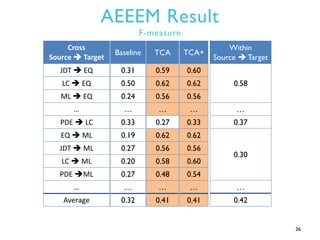
AEEEM Result
F-measure
36
Cross
Source  Target
JDT  EQ
LC  EQ
ML  EQ
…
PDE  LC
EQ  ML
JDT  ML
LC  ML
PDE ML
…
Average
Baseline
0.31
0.50
0.24
…
0.33
0.19
0.27
0.20
0.27
…
0.32
TCA
0.59
0.62
0.56
…
0.27
0.62
0.56
0.58
0.48
…
0.41
TCA+
0.60
0.62
0.56
…
0.33
0.62
0.56
0.60
0.54
…
0.41
Within
Source  Target
0.58
…
0.37
0.30
…
0.42
Threats to Validity
• Systems are open-source projects.
• Experimental results may not be
generalizable.
• Decision rules in TCA+ may not be
generalizable.
37
Future Work
• Transfer defect learning on different
feature space
– e.g., ReLink  AEEEM
AEEEM  ReLink
• Local models using Transfer Learning
• Adapt Transfer learning in other Software
Engineering (SE) problems
– e.g., Knowledge from mailing lists
 Bug triage problem
38
Conclusion
• TCA+
– TCA
• Make distributions of source and target similar
– Decision rules to improve TCA
– Significantly improved cross-project defect
prediction performance
• Transfer Learning in SE
– Transfer learning may benefit other
prediction and recommendation systems in
SE domains.
39

Transfer defect learning

  • 1.
    Transfer Defect Learning JaechangNam The Hong Kong University of Science and Technology, China Sinno Jialian Pan Institute for Infocomm Research, Singapore Sunghun Kim The Hong Kong University of Science and Technology, China
  • 2.
    Defect Prediction • Hassanet al.@ICSE`09, Predicting Faults Using the Complexity of Code Changes • D’Ambros et al.@MSR`10, An Extensive Comparison of Bug Prediction Approaches • Rahman et al.@ICSE`12, Recalling the Impression of Cross-Project Defect Prediction • Hata et al.@ICSE`12, Bug Prediction based on Fine-grained Module histories • … 2 Program Prediction Model (Machine learning) Future defects
  • 3.
  • 4.
    Training prediction model 3 Testset Training set M1 M2 … M19 M20 Class 11 5 … 53 78 Buggy … … … … … … 1 1 … 3 9 Clean M1 M2 … M19 M20 Class 2 1 … 2 8 ? … … … … … … 13 6 … 45 69 ?
  • 5.
    Cross prediction model 4 Targetproject (Test set) Source project (Training set)
  • 6.
    Cross-project Defect Prediction 5 “Trainingdata is often not available, either because a company is too small or it is the first release of a product” Zimmerman et al.@FSE`09, Cross-project Defect Prediction
  • 7.
    Cross-project Defect Prediction 5 “Trainingdata is often not available, either because a company is too small or it is the first release of a product” Zimmerman et al.@FSE`09, Cross-project Defect Prediction “For many new projects we may not have enough historical data to train prediction models.” Rahman, Posnett, and Devanbu @ICSE`12, Recalling the “Imprecision” of Cross-project Defect Prediction
  • 8.
    Cross-project defect prediction •Zimmerman et al.@FSE`09 – “We ran 622 cross-project predictions and found only 3.4% actually worked.” 6 Worked, 3.4% Not worked, 96.6%
  • 9.
    Cross-company defect prediction •Turhan and Menzies et al.@ESEJ`09 – “Within-company data models are still the best” 7 0 0.05 0.1 0.15 0.2 0.25 0.3 0.35 0.4 Cross Cross with a NN filter Within Avg. F-measure
  • 10.
    Cross-project defect prediction •Rahman, Posnett, and Devanbu@FSE`12 8 0 0.1 0.2 0.3 0.4 0.5 0.6 Cross Within Avg. F-measure
  • 11.
    Cross prediction results 9 0 0.1 0.2 0.3 0.4 0.5 0.6 0.7 F-measure CrossWithin Cross Within Cross Within Equinox JDT Lucene
  • 12.
    Approaches of TransferDefect Learning 10 Normalization TCA TCA+
  • 13.
    11 • Data preprocessingfor training and test dataNormalization • A state-of-the art transfer learning algorithm • Transfer Component AnalysisTCA • Adapted TCA for cross-project defect prediction • Decision rules to select a suitable data normalization optionTCA+ Approaches of Transfer Defect Learning
  • 14.
    Data Normalization • Adjustall feature values in the same scale – E.g., Make Mean = 0 and Std = 1 • Known to be helpful for classification algorithms to improve prediction performance [Han et al. 2012]. 12
  • 15.
    Normalization Options • N1:Min-max Normalization (max=1, min=0) [Han et al., 2012] • N2: Z-score Normalization (mean=0, std=1) [Han et al., 2012] • N3: Z-score Normalization only using source mean and standard deviation • N4: Z-score Normalization only using target mean and standard deviation 13
  • 16.
    14 • Data preprocessingfor training and test dataNormalization • A state-of-the art transfer learning algorithm • Transfer Component Analysis TCA • Adapted TCA for cross-project defect prediction • Decision rules to select a suitable data normalization optionTCA+ Approaches of Transfer Defect Learning
  • 17.
  • 18.
    Transfer Learning 15 Traditional MachineLearning (ML) Learning System Learning System
  • 19.
    Transfer Learning 15 Traditional MachineLearning (ML) Learning System Learning System Transfer Learning Learning System Learning System Knowledge Transfer
  • 20.
    Transfer Learning 15 Traditional MachineLearning (ML) Learning System Learning System Transfer Learning Learning System Learning System Knowledge Transfer
  • 21.
    A Common Assumptionin Traditional ML 16 Pan andYang@TKDE`10, Survey onTransfer Learning • Same distribution
  • 22.
    A Common Assumptionin Traditional ML 16 Pan andYang@TKDE`10, Survey onTransfer Learning • Same distribution Cross Prediction
  • 23.
    A Common Assumptionin Traditional ML 16 Pan andYang@TKDE`10, Survey onTransfer Learning • Same distribution Transfer Learning
  • 24.
    Transfer Component Analysis •Unsupervised Transfer learning – Target project labels are not known. • Must have the same feature space • Make distribution difference between training and test datasets similar 17 Pan et al.@TNN`10, Domain Adaptation viaTransfer ComponentAnalysis
  • 25.
    Transfer Component Analysis(cont.) • Feature extraction approach – Dimensionality reduction – Projection • Map original data in a lower-dimensional feature space 18
  • 26.
    Transfer Component Analysis(cont.) • Feature extraction approach – Dimensionality reduction – Projection • Map original data in a lower-dimensional feature space 18 2-dimensional feature space
  • 27.
    Transfer Component Analysis(cont.) • Feature extraction approach – Dimensionality reduction – Projection • Map original data in a lower-dimensional feature space 18 1-dimensional feature space
  • 28.
    Transfer Component Analysis(cont.) • Feature extraction approach – Dimensionality reduction – Projection • Map original data in a lower-dimensional feature space 18 1-dimensional feature space
  • 29.
    Transfer Component Analysis(cont.) • Feature extraction approach – Dimensionality reduction – Projection • Map original data in a lower-dimensional feature space 18 1-dimensional feature space 2-dimensional feature space
  • 30.
    Transfer Component Analysis(cont.) • Feature extraction approach – Dimensionality reduction – Projection • Map original data in a lower-dimensional feature space – C.f. Principal Component Analysis (PCA) 18 1-dimensional feature space
  • 31.
    Transfer Component Analysis(cont.) 19 Pan et al.@TNN`10, Domain Adaptation viaTransfer ComponentAnalysis Target domain data Source domain data
  • 32.
    Transfer Component Analysis(cont.) 20 PCA TCA Pan et al.@TNN`10, Domain Adaptation viaTransfer ComponentAnalysis
  • 33.
    Preliminary Results usingTCA 0 0.1 0.2 0.3 0.4 0.5 0.6 0.7 0.8 F-measure 21*Baseline: Cross-project defect prediction without TCA and normalization Baseline NoN N1 N2 N3 N4 Baseline NoN N1 N2 N3 N4 Safe  Apache Apache  Safe
  • 34.
    Preliminary Results usingTCA 0 0.1 0.2 0.3 0.4 0.5 0.6 0.7 0.8 F-measure 21*Baseline: Cross-project defect prediction without TCA and normalization Prediction performance of TCA varies according to different normalization options! Baseline NoN N1 N2 N3 N4 Baseline NoN N1 N2 N3 N4 Safe  Apache Apache  Safe
  • 35.
    22 • Data preprocessingfor training and test dataNormalization • A state-of-the art transfer learning algorithm • Transfer Component Analysis TCA • Adapted TCA for cross-project defect prediction • Decision rules to select a suitable data normalization option TCA+ Approaches of Transfer Defect Learning
  • 36.
    TCA+: Decision rules •Find a suitable normalization for TCA • Steps – #1: Characterize a dataset – #2: Measure similarity between source and target datasets – #3: Decision rules 23
  • 37.
    #1: Characterize adataset 24 3 1 … Dataset A Dataset B 2 4 5 8 9 6 11 d1,2 d1,5 d1,3 d3,11 3 1 … 2 4 5 8 9 6 11 d2,6 d1,2 d1,3 d3,11 DIST={dij : i,j, 1 ≤ i < n, 1 < j ≤ n, i < j} A
  • 38.
    #2: Measure Similaritybetween source and target • Minimum (min) and maximum (max) values of DIST • Mean and standard deviation (std) of DIST • The number of instances 25
  • 39.
    #3: Decision Rules •Rule #1 – Mean and Std are same  NoN • Rule #2 – Max and Min are different  N1 (max=1, min=0) • Rule #3,#4 – Std and # of instances are different  N3 or N4 (src/tgt mean=0, std=1) • Rule #5 – Default  N2 (mean=0, std=1) 26
  • 40.
  • 41.
    Experimental Setup • 8software subjects • Machine learning algorithm – Logistic regression 28 ReLink (Wu et al.@FSE`11) Projects # of metrics (features) Apache 26 (Source code) Safe ZXing AEEEM (D’Ambros et al.@MSR`10) Projects # of metrics (features) Apache Lucene (LC) 61 (Source code, Churn, Entropy,…) Equinox (EQ) Eclipse JDT Eclipse PDE UI Mylyn (ML)
  • 42.
    Experimental Design 29 Test set (50%) Trainingset (50%) Within-project defect prediction
  • 43.
    Experimental Design 30 Target project(Test set) Source project (Training set) Cross-project defect prediction
  • 44.
    Experimental Design 31 Target project(Test set) Source project (Training set) Cross-project defect prediction with TCA/TCA+ TCA/TCA+
  • 45.
  • 46.
    ReLink Result 33*Baseline: Cross-projectdefect prediction without TCA/TCA+ 0 0.1 0.2 0.3 0.4 0.5 0.6 0.7 0.8 F-measure Baseline TCA TCA+ Within Safe  Apache Apache  Safe Safe  ZXing Baseline TCA TCA+ Within Baseline TCA TCA+ Within
  • 47.
    ReLink Result F-measure 34 Cross Source Target Safe  Apache Zxing  Apache Apache  Safe Zxing  Safe Apache  ZXing Safe  ZXing Average Baseline 0.52 0.69 0.49 0.59 0.46 0.10 0.49 TCA 0.64 0.64 0.72 0.70 0.45 0.42 0.59 TCA+ 0.64 0.72 0.72 0.64 0.49 0.53 0.61 Within Target  Target 0.64 0.62 0.33 0.53 *Baseline: Cross-project defect prediction without TCA/TCA+
  • 48.
    AEEEM Result 35*Baseline: Cross-projectdefect prediction without TCA/TCA+ 0 0.1 0.2 0.3 0.4 0.5 0.6 0.7 F-measure Baseline TCA TCA+ Within JDT  EQ PDE  LC PDE  ML Baseline TCA TCA+ Within Baseline TCA TCA+ Within
  • 49.
    AEEEM Result F-measure 36 Cross Source Target JDT  EQ LC  EQ ML  EQ … PDE  LC EQ  ML JDT  ML LC  ML PDE ML … Average Baseline 0.31 0.50 0.24 … 0.33 0.19 0.27 0.20 0.27 … 0.32 TCA 0.59 0.62 0.56 … 0.27 0.62 0.56 0.58 0.48 … 0.41 TCA+ 0.60 0.62 0.56 … 0.33 0.62 0.56 0.60 0.54 … 0.41 Within Source  Target 0.58 … 0.37 0.30 … 0.42
  • 50.
    Threats to Validity •Systems are open-source projects. • Experimental results may not be generalizable. • Decision rules in TCA+ may not be generalizable. 37
  • 51.
    Future Work • Transferdefect learning on different feature space – e.g., ReLink  AEEEM AEEEM  ReLink • Local models using Transfer Learning • Adapt Transfer learning in other Software Engineering (SE) problems – e.g., Knowledge from mailing lists  Bug triage problem 38
  • 52.
    Conclusion • TCA+ – TCA •Make distributions of source and target similar – Decision rules to improve TCA – Significantly improved cross-project defect prediction performance • Transfer Learning in SE – Transfer learning may benefit other prediction and recommendation systems in SE domains. 39