
Deep API Learning
Xiaodong GU Sunghun Kim
The Hong Kong University of
Science and Technology
Hongyu Zhang Dongmei Zhang
Microsoft Research
Programming is hard
• Unfamiliar problems
• Unfamiliar APIs [Robillard,2009]
DocumentBuilderFactory.newInstance
↓
DocumentBuilderFactory.newDocumentBuilder
↓
DocumentBuilder.parse
“how to parse XML files?”
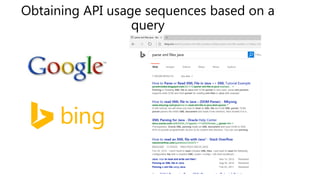
Obtaining API usage sequences based on a
query
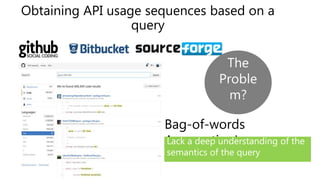
Obtaining API usage sequences based on a
query
The
Proble
m?
Bag-of-words
Assumption!Lack a deep understanding of the
semantics of the query
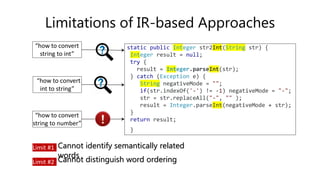
Limitations of IR-based Approaches
“how to convert
int to string”
“how to convert
string to int”
“how to convert
string to number”
static public Integer str2Int(String str) {
Integer result = null;
try {
result = Integer.parseInt(str);
} catch (Exception e) {
String negativeMode = "";
if(str.indexOf('-') != -1) negativeMode = "-";
str = str.replaceAll("-", "" );
result = Integer.parseInt(negativeMode + str);
}
return result;
}
Limit #1 Cannot identify semantically related
words
Limit #2 Cannot distinguish word ordering
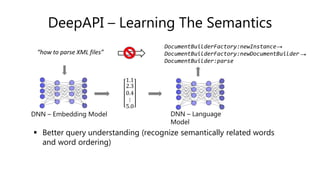
DeepAPI – Learning The Semantics
“how to parse XML files”
DocumentBuilderFactory:newInstance
DocumentBuilderFactory:newDocumentBuilder
DocumentBuilder:parse
DNN – Embedding Model DNN – Language
Model
1.1
2.3
0.4
⋮
5.0
 Better query understanding (recognize semantically related words
and word ordering)
Background – RNN
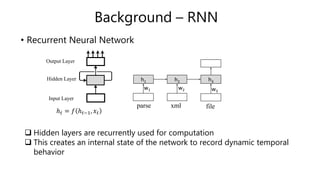
• Recurrent Neural Network
Hidden Layer
Output Layer
Input Layer
h1 h2 h3
parse xml file
w1 w2 w3
 Hidden layers are recurrently used for computation
 This creates an internal state of the network to record dynamic temporal
behavior
ℎ 𝑡 = 𝑓 ℎ 𝑡−1, 𝑥𝑡
Background – RNN Encoder-Decoder
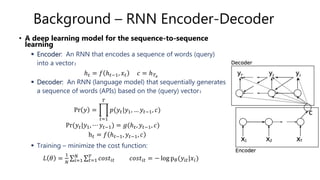
• A deep learning model for the sequence-to-sequence
learning
 Encoder: An RNN that encodes a sequence of words (query)
into a vector:
ℎ 𝑡 = 𝑓 ℎ 𝑡−1, 𝑥𝑡 𝑐 = ℎ 𝑇𝑥
 Decoder: An RNN (language model) that sequentially generates
a sequence of words (APIs) based on the (query) vector:
Pr 𝑦 =
𝑡=1
𝑇
𝑝(𝑦𝑡|𝑦1, … 𝑦𝑡−1, 𝑐)
Pr(𝑦𝑡|𝑦1, ⋯ 𝑦𝑡−1) = 𝑔(ℎ 𝑡, 𝑦𝑡−1, 𝑐)
h 𝑡 = 𝑓 ℎ 𝑡−1, 𝑦𝑡−1, 𝑐
 Training – minimize the cost function:
𝐿 𝜃 =
1
𝑁 𝑖=1
𝑁
𝑡=1
𝑇
𝑐𝑜𝑠𝑡𝑖𝑡 𝑐𝑜𝑠𝑡𝑖𝑡 = − log p 𝜃(𝑦𝑖𝑡|𝑥𝑖)
RNN Encoder-Decoder Model for API
Sequence Generation
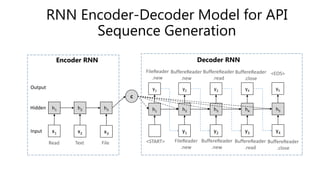
<START>
h1 h2 h3 h4
y1 y2 y3 y4
y1 y2 y3
h1 h2 h3
x1 x2 x3
Read Text File
c
Encoder RNN Decoder RNN
BuffereReader
.new
FileReader
.new
BuffereReader
.read
BuffereReader
.close
<EOS>
BuffereReader
.new
FileReader
.new
BuffereReader
.read
BuffereReader
.close
h5
y5
y4Input
Output
Hidden
Enhancing RNN Encoder-Decoder Model
with API importance
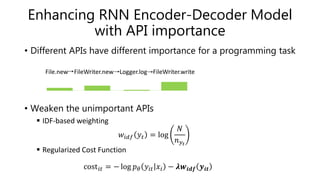
• Different APIs have different importance for a programming task
File.new FileWriter.new Logger.log FileWriter.write
• Weaken the unimportant APIs
 IDF-based weighting
𝑤𝑖𝑑𝑓 𝑦𝑡 = log
𝑁
𝑛 𝑦𝑡
 Regularized Cost Function
cost 𝑖𝑡 = − log 𝑝 𝜃 𝑦𝑖𝑡 𝑥𝑖 − 𝝀𝒘𝒊𝒅𝒇 𝒚𝒊𝒕
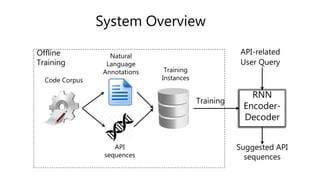
System Overview
Code Corpus
RNN
Encoder-
Decoder
API-related
User Query
Suggested API
sequences
Natural
Language
Annotations Training
Instances
API
sequences
Training
Offline
Training
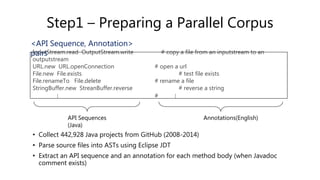
Step1 – Preparing a Parallel Corpus
InputStream.read OutputStream.write # copy a file from an inputstream to an
outputstream
URL.new URL.openConnection # open a url
File.new File.exists # test file exists
File.renameTo File.delete # rename a file
StringBuffer.new StreanBuffer.reverse # reverse a string
⋮ # ⋮
API Sequences
(Java)
Annotations(English)
<API Sequence, Annotation>
pairs
• Collect 442,928 Java projects from GitHub (2008-2014)
• Parse source files into ASTs using Eclipse JDT
• Extract an API sequence and an annotation for each method body (when Javadoc
comment exists)
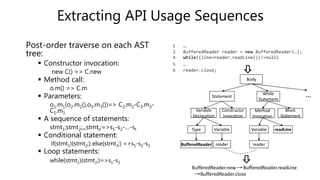
Extracting API Usage Sequences
Post-order traverse on each AST
tree:
 Constructor invocation:
new C() => C.new
 Method call:
o.m() => C.m
 Parameters:
o1.m1(o2.m2(),o3.m3())=> C2.m2-C3.m3-
C1.m1
 A sequence of statements:
stmt1;stmt2;,,,stmtt;=>s1-s2-…-st
 Conditional statement:
if(stmt1){stmt2;} else{stmt3;} =>s1-s2-s3
 Loop statements:
while(stmt1){stmt2;}=>s1-s2
1 …
2 BufferedReader reader = new BufferedReader(…);
4 while((line=reader.readLine())!=null)
5 …
6 reader.close;
Body
Statement
While
Statement
Variable
Declaration
Constructor
Invocation
Method
Invocation
Block
Statement
Type Variable
BufferedReader reader
readLineVariable
reader
BufferedReader.new BufferedReader.readLine
BufferedReader.close
…
Extracting Natural Language Annotations
/***
* Copies bytes from a large (over 2GB) InputStream to an OutputStream.
* This method uses the provided buffer, so there is no need to use a
* BufferedInputStream.
* @param input the InputStream to read from
* . . .
* @since 2.2
*/
public static long copyLarge(final InputStream input,
final OutputStream output, final byte[] buffer) throws IOException {
long count = 0;
int n;
while (EOF != (n = input.read(buffer))) {
output.write(buffer, 0, n);
count += n;
}
return count;
}
API sequence: InputStream.read OutputStream.write
Annotation: copies bytes from a large inputstream
to an outputstream.
MethodDefinition
Javadoc
Comment
Body
… …
The first sentence of a documentation comment
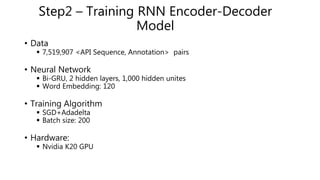
Step2 – Training RNN Encoder-Decoder
Model
• Data
 7,519,907 <API Sequence, Annotation> pairs
• Neural Network
 Bi-GRU, 2 hidden layers, 1,000 hidden unites
 Word Embedding: 120
• Training Algorithm
 SGD+Adadelta
 Batch size: 200
• Hardware:
 Nvidia K20 GPU
Evaluation
• RQ1: How accurate is DeepAPI for generating API usage
sequences?
• RQ2: How accurate is DeepAPI under different parameter
settings?
• RQ3: Do the enhanced RNN Encoder-Decoder models improve
the accuracy of DeepAPI?
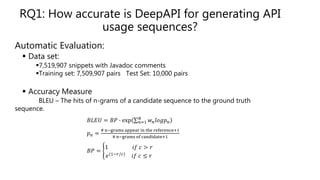
Automatic Evaluation:
 Data set:
7,519,907 snippets with Javadoc comments
Training set: 7,509,907 pairs Test Set: 10,000 pairs
 Accuracy Measure
BLEU – The hits of n-grams of a candidate sequence to the ground truth
sequence.
𝐵𝐿𝐸𝑈 = 𝐵𝑃 ∙ exp 𝑛=1
𝑁
𝑤 𝑛 𝑙𝑜𝑔𝑝 𝑛
𝑝 𝑛 =
# n−grams appear in the reference+1
# n−grams of candidate+1
𝐵𝑃 =
1 𝑖𝑓 𝑐 > 𝑟
𝑒(1−𝑟/𝑐)
𝑖𝑓 𝑐 ≤ 𝑟
RQ1: How accurate is DeepAPI for generating API
usage sequences?
 Comparison Methods
• Code Search with Pattern Mining
Code Search – Lucene
Summarizing API patterns – UP-Miner [Wang, MSR’13]
• SWIM [Raghothaman, ICSE’16]
Query-to-API Mapping – Statistical Word Alignment
Search API sequence using the bag of APIs – Information retrieval
RQ1: How accurate is DeepAPI for generating API
usage sequences?
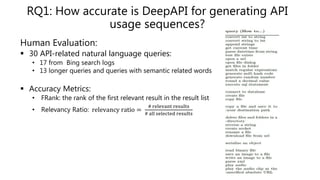
Human Evaluation:
 30 API-related natural language queries:
• 17 from Bing search logs
• 13 longer queries and queries with semantic related words
 Accuracy Metrics:
• FRank: the rank of the first relevant result in the result list
• Relevancy Ratio: relevancy ratio =
# relevant results
# all selected results
RQ1: How accurate is DeepAPI for generating API
usage sequences?
RQ1: How accurate is DeepAPI for generating API
usage sequences?
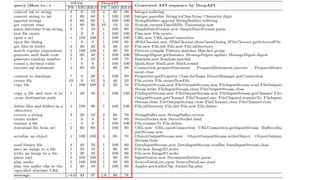
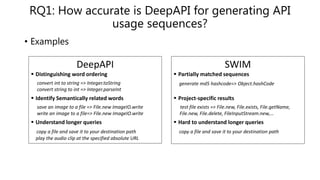
• Examples
DeepAPI
 Distinguishing word ordering
convert int to string => Integer.toString
convert string to int => Integer.parseInt
 Identify Semantically related words
save an image to a file => File.new ImageIO.write
write an image to a file=> File.new ImageIO.write
 Understand longer queries
copy a file and save it to your destination path
play the audio clip at the specified absolute URL
SWIM
 Partially matched sequences
generate md5 hashcode=> Object.hashCode
 Project-specific results
test file exists => File.new, File.exists, File.getName,
File.new, File.delete, FileInputStream.new,…
 Hard to understand longer queries
copy a file and save it to your destination path
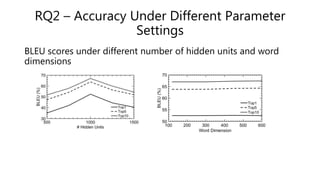
RQ2 – Accuracy Under Different Parameter
Settings
BLEU scores under different number of hidden units and word
dimensions
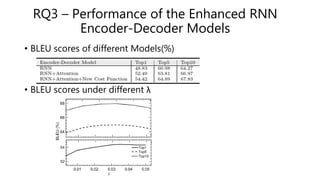
RQ3 – Performance of the Enhanced RNN
Encoder-Decoder Models
• BLEU scores of different Models(%)
• BLEU scores under different λ
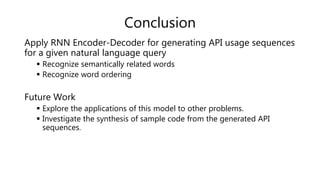
Conclusion
Apply RNN Encoder-Decoder for generating API usage sequences
for a given natural language query
 Recognize semantically related words
 Recognize word ordering
Future Work
 Explore the applications of this model to other problems.
 Investigate the synthesis of sample code from the generated API
sequences.
Thanks!

Deep API Learning (FSE 2016)

  • 1.
    Deep API Learning XiaodongGU Sunghun Kim The Hong Kong University of Science and Technology Hongyu Zhang Dongmei Zhang Microsoft Research
  • 2.
    Programming is hard •Unfamiliar problems • Unfamiliar APIs [Robillard,2009] DocumentBuilderFactory.newInstance ↓ DocumentBuilderFactory.newDocumentBuilder ↓ DocumentBuilder.parse “how to parse XML files?”
  • 3.
    Obtaining API usagesequences based on a query
  • 4.
    Obtaining API usagesequences based on a query The Proble m? Bag-of-words Assumption!Lack a deep understanding of the semantics of the query
  • 5.
    Limitations of IR-basedApproaches “how to convert int to string” “how to convert string to int” “how to convert string to number” static public Integer str2Int(String str) { Integer result = null; try { result = Integer.parseInt(str); } catch (Exception e) { String negativeMode = ""; if(str.indexOf('-') != -1) negativeMode = "-"; str = str.replaceAll("-", "" ); result = Integer.parseInt(negativeMode + str); } return result; } Limit #1 Cannot identify semantically related words Limit #2 Cannot distinguish word ordering
  • 6.
    DeepAPI – LearningThe Semantics “how to parse XML files” DocumentBuilderFactory:newInstance DocumentBuilderFactory:newDocumentBuilder DocumentBuilder:parse DNN – Embedding Model DNN – Language Model 1.1 2.3 0.4 ⋮ 5.0  Better query understanding (recognize semantically related words and word ordering)
  • 7.
    Background – RNN •Recurrent Neural Network Hidden Layer Output Layer Input Layer h1 h2 h3 parse xml file w1 w2 w3  Hidden layers are recurrently used for computation  This creates an internal state of the network to record dynamic temporal behavior ℎ 𝑡 = 𝑓 ℎ 𝑡−1, 𝑥𝑡
  • 8.
    Background – RNNEncoder-Decoder • A deep learning model for the sequence-to-sequence learning  Encoder: An RNN that encodes a sequence of words (query) into a vector: ℎ 𝑡 = 𝑓 ℎ 𝑡−1, 𝑥𝑡 𝑐 = ℎ 𝑇𝑥  Decoder: An RNN (language model) that sequentially generates a sequence of words (APIs) based on the (query) vector: Pr 𝑦 = 𝑡=1 𝑇 𝑝(𝑦𝑡|𝑦1, … 𝑦𝑡−1, 𝑐) Pr(𝑦𝑡|𝑦1, ⋯ 𝑦𝑡−1) = 𝑔(ℎ 𝑡, 𝑦𝑡−1, 𝑐) h 𝑡 = 𝑓 ℎ 𝑡−1, 𝑦𝑡−1, 𝑐  Training – minimize the cost function: 𝐿 𝜃 = 1 𝑁 𝑖=1 𝑁 𝑡=1 𝑇 𝑐𝑜𝑠𝑡𝑖𝑡 𝑐𝑜𝑠𝑡𝑖𝑡 = − log p 𝜃(𝑦𝑖𝑡|𝑥𝑖)
  • 9.
    RNN Encoder-Decoder Modelfor API Sequence Generation <START> h1 h2 h3 h4 y1 y2 y3 y4 y1 y2 y3 h1 h2 h3 x1 x2 x3 Read Text File c Encoder RNN Decoder RNN BuffereReader .new FileReader .new BuffereReader .read BuffereReader .close <EOS> BuffereReader .new FileReader .new BuffereReader .read BuffereReader .close h5 y5 y4Input Output Hidden
  • 10.
    Enhancing RNN Encoder-DecoderModel with API importance • Different APIs have different importance for a programming task File.new FileWriter.new Logger.log FileWriter.write • Weaken the unimportant APIs  IDF-based weighting 𝑤𝑖𝑑𝑓 𝑦𝑡 = log 𝑁 𝑛 𝑦𝑡  Regularized Cost Function cost 𝑖𝑡 = − log 𝑝 𝜃 𝑦𝑖𝑡 𝑥𝑖 − 𝝀𝒘𝒊𝒅𝒇 𝒚𝒊𝒕
  • 11.
    System Overview Code Corpus RNN Encoder- Decoder API-related UserQuery Suggested API sequences Natural Language Annotations Training Instances API sequences Training Offline Training
  • 12.
    Step1 – Preparinga Parallel Corpus InputStream.read OutputStream.write # copy a file from an inputstream to an outputstream URL.new URL.openConnection # open a url File.new File.exists # test file exists File.renameTo File.delete # rename a file StringBuffer.new StreanBuffer.reverse # reverse a string ⋮ # ⋮ API Sequences (Java) Annotations(English) <API Sequence, Annotation> pairs • Collect 442,928 Java projects from GitHub (2008-2014) • Parse source files into ASTs using Eclipse JDT • Extract an API sequence and an annotation for each method body (when Javadoc comment exists)
  • 13.
    Extracting API UsageSequences Post-order traverse on each AST tree:  Constructor invocation: new C() => C.new  Method call: o.m() => C.m  Parameters: o1.m1(o2.m2(),o3.m3())=> C2.m2-C3.m3- C1.m1  A sequence of statements: stmt1;stmt2;,,,stmtt;=>s1-s2-…-st  Conditional statement: if(stmt1){stmt2;} else{stmt3;} =>s1-s2-s3  Loop statements: while(stmt1){stmt2;}=>s1-s2 1 … 2 BufferedReader reader = new BufferedReader(…); 4 while((line=reader.readLine())!=null) 5 … 6 reader.close; Body Statement While Statement Variable Declaration Constructor Invocation Method Invocation Block Statement Type Variable BufferedReader reader readLineVariable reader BufferedReader.new BufferedReader.readLine BufferedReader.close …
  • 14.
    Extracting Natural LanguageAnnotations /*** * Copies bytes from a large (over 2GB) InputStream to an OutputStream. * This method uses the provided buffer, so there is no need to use a * BufferedInputStream. * @param input the InputStream to read from * . . . * @since 2.2 */ public static long copyLarge(final InputStream input, final OutputStream output, final byte[] buffer) throws IOException { long count = 0; int n; while (EOF != (n = input.read(buffer))) { output.write(buffer, 0, n); count += n; } return count; } API sequence: InputStream.read OutputStream.write Annotation: copies bytes from a large inputstream to an outputstream. MethodDefinition Javadoc Comment Body … … The first sentence of a documentation comment
  • 15.
    Step2 – TrainingRNN Encoder-Decoder Model • Data  7,519,907 <API Sequence, Annotation> pairs • Neural Network  Bi-GRU, 2 hidden layers, 1,000 hidden unites  Word Embedding: 120 • Training Algorithm  SGD+Adadelta  Batch size: 200 • Hardware:  Nvidia K20 GPU
  • 16.
    Evaluation • RQ1: Howaccurate is DeepAPI for generating API usage sequences? • RQ2: How accurate is DeepAPI under different parameter settings? • RQ3: Do the enhanced RNN Encoder-Decoder models improve the accuracy of DeepAPI?
  • 17.
    Automatic Evaluation:  Dataset: 7,519,907 snippets with Javadoc comments Training set: 7,509,907 pairs Test Set: 10,000 pairs  Accuracy Measure BLEU – The hits of n-grams of a candidate sequence to the ground truth sequence. 𝐵𝐿𝐸𝑈 = 𝐵𝑃 ∙ exp 𝑛=1 𝑁 𝑤 𝑛 𝑙𝑜𝑔𝑝 𝑛 𝑝 𝑛 = # n−grams appear in the reference+1 # n−grams of candidate+1 𝐵𝑃 = 1 𝑖𝑓 𝑐 > 𝑟 𝑒(1−𝑟/𝑐) 𝑖𝑓 𝑐 ≤ 𝑟 RQ1: How accurate is DeepAPI for generating API usage sequences?
  • 18.
     Comparison Methods •Code Search with Pattern Mining Code Search – Lucene Summarizing API patterns – UP-Miner [Wang, MSR’13] • SWIM [Raghothaman, ICSE’16] Query-to-API Mapping – Statistical Word Alignment Search API sequence using the bag of APIs – Information retrieval RQ1: How accurate is DeepAPI for generating API usage sequences?
  • 19.
    Human Evaluation:  30API-related natural language queries: • 17 from Bing search logs • 13 longer queries and queries with semantic related words  Accuracy Metrics: • FRank: the rank of the first relevant result in the result list • Relevancy Ratio: relevancy ratio = # relevant results # all selected results RQ1: How accurate is DeepAPI for generating API usage sequences?
  • 21.
    RQ1: How accurateis DeepAPI for generating API usage sequences? • Examples DeepAPI  Distinguishing word ordering convert int to string => Integer.toString convert string to int => Integer.parseInt  Identify Semantically related words save an image to a file => File.new ImageIO.write write an image to a file=> File.new ImageIO.write  Understand longer queries copy a file and save it to your destination path play the audio clip at the specified absolute URL SWIM  Partially matched sequences generate md5 hashcode=> Object.hashCode  Project-specific results test file exists => File.new, File.exists, File.getName, File.new, File.delete, FileInputStream.new,…  Hard to understand longer queries copy a file and save it to your destination path
  • 22.
    RQ2 – AccuracyUnder Different Parameter Settings BLEU scores under different number of hidden units and word dimensions
  • 23.
    RQ3 – Performanceof the Enhanced RNN Encoder-Decoder Models • BLEU scores of different Models(%) • BLEU scores under different λ
  • 24.
    Conclusion Apply RNN Encoder-Decoderfor generating API usage sequences for a given natural language query  Recognize semantically related words  Recognize word ordering Future Work  Explore the applications of this model to other problems.  Investigate the synthesis of sample code from the generated API sequences.
  • 25.

Editor's Notes

  • #2 Quality of API sequences such as API bugs. -> language model learn the probability from large-scale data, so they are just noises. DeepAPI only produce commonly used API sequences. Second, this is a threat to validity. Our future work will explore better training data The augment of the loss function will affect the original conditional probabilities? => It is just a regularization. The motivation example “convert int to string” is not convincing as google can distinguish? How the model distinguish words with different forms? For example, “write an image”->”writing an image”? An word embedding mechanism to identify similar words.. In real world, developers want API graph, instead of a sequence. =>No need for graph, sequences indicates difference usages, developers can synthesize their own graphical structure of APIs.
  • #4 General search engines are not designed for source code and could have many unrelated results such as discussions and programming experience. Besides, developers need to brows many web pages to check the results.
  • #16 Q: Bi-GRU will affect API sequence? Why reverse API sequences? => we just use Bi-GRU for the query. For API sequence, we use traditional GRU.