

American history survey


           4th class
  slavery in the new world,
    15th – 18th centuries
announcements
• Please turn in paper # 1. You are not eligible to
  take the midterm exam unless you have turned in
  paper # 1. Deadline: Tuesday 11/8.

• Please see me after class for conflicts for Mon
  11/14 midterm, 10:10 – 11:45 am.

• If you saw Amistad, you may write a 3 – 5
  paragraph review as one of your 3 papers this
  semester. Reviews are both objective (summary)
  and subjective (analysis & evaluation).
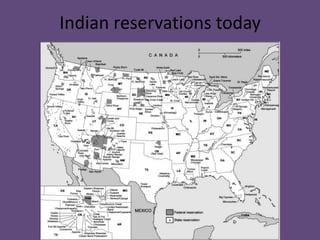
Indian reservations today
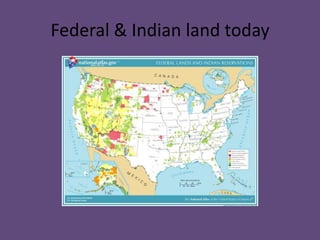
Federal & Indian land today
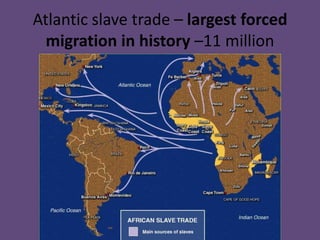
Atlantic slave trade – largest forced
  migration in history –11 million
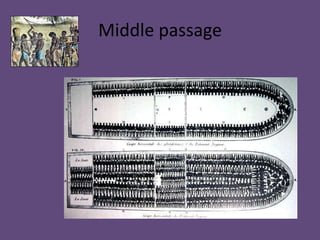
Middle passage
Triangular trade
• Africa to New World: human cargo.
• Colonies in N America to W Europe:
  agricultural & other raw materials desired in
  Europe: tobacco, sugar
  (molasses, rum), rice, wheat, lumber.
• W Europe to Africa: manufactured
  goods, textiles, iron implements, ship wares.
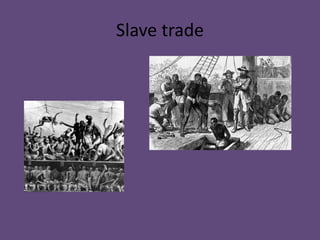
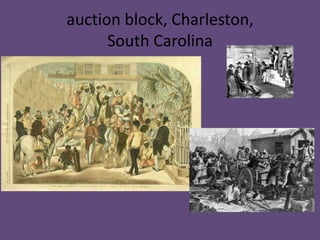
Slave trade
auction block, Charleston,
      South Carolina
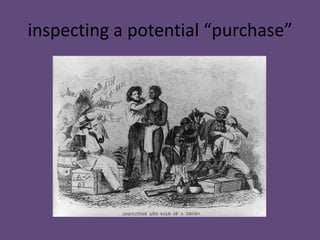
inspecting a potential “purchase”
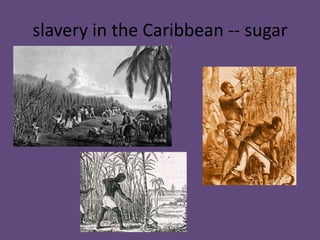
slavery in the Caribbean -- sugar
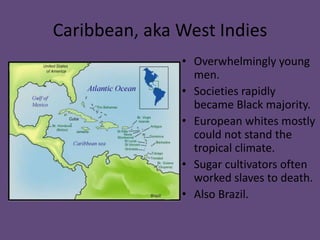
Caribbean, aka West Indies
               • Overwhelmingly young
                 men.
               • Societies rapidly
                 became Black majority.
               • European whites mostly
                 could not stand the
                 tropical climate.
               • Sugar cultivators often
                 worked slaves to death.
               • Also Brazil.
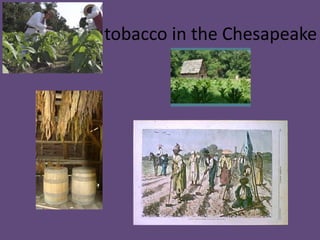
tobacco in the Chesapeake
tobacco
• The major colonial export in 18th c.
• Required year-round attention & many steps in
  process.
• W Africans had been agriculturalists.
• 17th c – societies with slaves; owners, servants, slaves
  worked together. 1st generation slaves had previous
  experience elsewhere & participated in & utilized
  British culture (church, legal system, etc.)
• 18th c – slave societies – elite owned large plantations
  w hundreds of slaves. Increasingly African-born,
  saltwater slaves, direct from African interior.
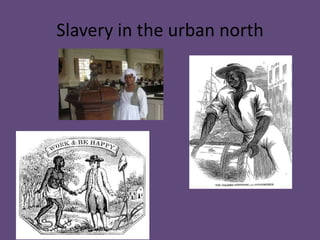
Slavery in the urban north
Northern cities
• New York had largest proportion of slaves.
• NY, Boston, Philadelphia, Newport – port
  cities, men’s work in shipping, transportation,
  & ship-building; women’s work as domestics,
  weavers, etc.
• 10 – 20% of population in 17th & 18th c.
• Northern merchants began to replace British
  as slave traders.
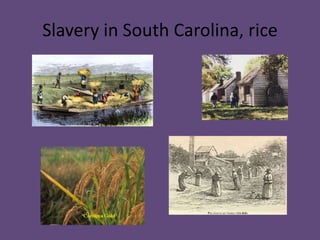
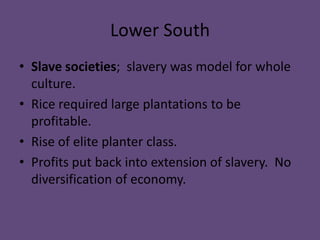
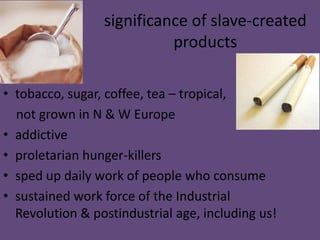
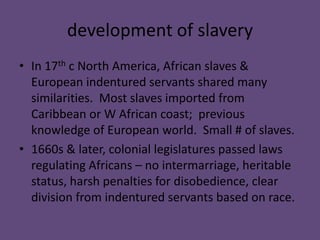
Slavery in South Carolina, rice
Lower South
• Slave societies; slavery was model for whole
  culture.
• Rice required large plantations to be
  profitable.
• Rise of elite planter class.
• Profits put back into extension of slavery. No
  diversification of economy.
significance of slave-created
                           products

• tobacco, sugar, coffee, tea – tropical,
  not grown in N & W Europe
• addictive
• proletarian hunger-killers
• sped up daily work of people who consume
• sustained work force of the Industrial
  Revolution & postindustrial age, including us!
development of slavery
• In 17th c North America, African slaves &
  European indentured servants shared many
  similarities. Most slaves imported from
  Caribbean or W African coast; previous
  knowledge of European world. Small # of slaves.
• 1660s & later, colonial legislatures passed laws
  regulating Africans – no intermarriage, heritable
  status, harsh penalties for disobedience, clear
  division from indentured servants based on race.
development of slavery
• 18th c. Africans, direct from interior, became
  majority of slaves.
• Southern plantation elite dominated their
  colonies. Less affluent whites moved west.
• Slavery differed substantially across time, across
  geography, across economies, and from urban to
  rural areas.
• Freedom for whites based on slavery of Blacks is
  most important contradiction in US history.
assignment for next week

• Primary sources about slavery, from Zinn &
  Arnove, Voices of a People’s History of the US,
  51 – 61.

Us history # 4

  • 1.
    American history survey 4th class slavery in the new world, 15th – 18th centuries
  • 2.
    announcements • Please turnin paper # 1. You are not eligible to take the midterm exam unless you have turned in paper # 1. Deadline: Tuesday 11/8. • Please see me after class for conflicts for Mon 11/14 midterm, 10:10 – 11:45 am. • If you saw Amistad, you may write a 3 – 5 paragraph review as one of your 3 papers this semester. Reviews are both objective (summary) and subjective (analysis & evaluation).
  • 3.
  • 4.
    Federal & Indianland today
  • 5.
    Atlantic slave trade– largest forced migration in history –11 million
  • 6.
  • 7.
    Triangular trade • Africato New World: human cargo. • Colonies in N America to W Europe: agricultural & other raw materials desired in Europe: tobacco, sugar (molasses, rum), rice, wheat, lumber. • W Europe to Africa: manufactured goods, textiles, iron implements, ship wares.
  • 8.
  • 9.
  • 10.
    inspecting a potential“purchase”
  • 11.
    slavery in theCaribbean -- sugar
  • 12.
    Caribbean, aka WestIndies • Overwhelmingly young men. • Societies rapidly became Black majority. • European whites mostly could not stand the tropical climate. • Sugar cultivators often worked slaves to death. • Also Brazil.
  • 14.
    tobacco in theChesapeake
  • 15.
    tobacco • The majorcolonial export in 18th c. • Required year-round attention & many steps in process. • W Africans had been agriculturalists. • 17th c – societies with slaves; owners, servants, slaves worked together. 1st generation slaves had previous experience elsewhere & participated in & utilized British culture (church, legal system, etc.) • 18th c – slave societies – elite owned large plantations w hundreds of slaves. Increasingly African-born, saltwater slaves, direct from African interior.
  • 16.
    Slavery in theurban north
  • 17.
    Northern cities • NewYork had largest proportion of slaves. • NY, Boston, Philadelphia, Newport – port cities, men’s work in shipping, transportation, & ship-building; women’s work as domestics, weavers, etc. • 10 – 20% of population in 17th & 18th c. • Northern merchants began to replace British as slave traders.
  • 18.
    Slavery in SouthCarolina, rice
  • 19.
    Lower South • Slavesocieties; slavery was model for whole culture. • Rice required large plantations to be profitable. • Rise of elite planter class. • Profits put back into extension of slavery. No diversification of economy.
  • 20.
    significance of slave-created products • tobacco, sugar, coffee, tea – tropical, not grown in N & W Europe • addictive • proletarian hunger-killers • sped up daily work of people who consume • sustained work force of the Industrial Revolution & postindustrial age, including us!
  • 21.
    development of slavery •In 17th c North America, African slaves & European indentured servants shared many similarities. Most slaves imported from Caribbean or W African coast; previous knowledge of European world. Small # of slaves. • 1660s & later, colonial legislatures passed laws regulating Africans – no intermarriage, heritable status, harsh penalties for disobedience, clear division from indentured servants based on race.
  • 22.
    development of slavery •18th c. Africans, direct from interior, became majority of slaves. • Southern plantation elite dominated their colonies. Less affluent whites moved west. • Slavery differed substantially across time, across geography, across economies, and from urban to rural areas. • Freedom for whites based on slavery of Blacks is most important contradiction in US history.
  • 23.
    assignment for nextweek • Primary sources about slavery, from Zinn & Arnove, Voices of a People’s History of the US, 51 – 61.

Editor's Notes

  • #4 http://www.infoplease.com/images/indian9.gif
  • #5 http://nationalatlas.gov/printable/images/preview/fedlands/fedlands3.gif
  • #6 https://colonialdiseasedigitaltextbook.wikispaces.com/file/view/map_slave_trade.jpg/112133481/map_slave_trade.jpg
  • #7 http://0.tqn.com/d/africanhistory/1/0/p/I/SlaveShipBrookes.jpghttp://newsimg.bbc.co.uk/media/images/39723000/jpg/_39723847_slaves_203_ap.jpg
  • #9 http://www.finalcall.com/artman/uploads/1/slavery08-12-2008.jpghttp://www.discover-liverpool.com/UserFiles/ATH~Slave%20Ship%20Hold.jpg
  • #10 http://www.oocities.org/eyre_crowe/slave_sale_charleston_coloured.jpghttp://t2.gstatic.com/images?q=tbn:ANd9GcTTMsf24RBB6vqocksRmAR6JI5UP0fKDwuNnikLdVabkUO9p7FBlVsppItFhttp://humanexperience.stanford.edu/system/files/image/slave%20sale%20crop.jpg
  • #11 http://wigwags.files.wordpress.com/2007/12/inspection-and-sale-of-a-slave.jpg
  • #12 http://theorisingexile.files.wordpress.com/2010/11/slavery.jpghttp://www.aworldtowin.net/images/images281/slaverycanecutters.jpghttp://www.cosmeo.com/images/pictures/player/ef6bdad4-9c42-02fe-590c1816b8a32afc.jpg
  • #13 http://www.abdn.ac.uk/slavery/img/map3.jpg
  • #14 http://ayearinbali.files.wordpress.com/2010/10/img_8039.jpg
  • #15 http://4.bp.blogspot.com/-Pm3GAKnt9Dk/Ta7_gzysOeI/AAAAAAAAFa0/2oA5vfKj8c0/s400/tobacco11.JPGhttp://t2.gstatic.com/images?q=tbn:ANd9GcS8NNcIdW8aeXq4-kumxs3gthNUAwrbumTzSSYfWtxhCYnqrNjawKh_6NDfhttp://www.history.org/history/teaching/enewsletter/volume2/images/fieldwork.jpghttp://historymyths.files.wordpress.com/2010/10/207bh1.jpg
  • #16 http://www.independentleaf.com/images/tobacco_leaf.jpg
  • #17 http://www.christchurchphila.org/SiteData/images/SlaveryinPhilaweb2-resize/8c42999c699cff25dd36ccd51370b0a5/SlaveryinPhilaweb2-resize.jpghttp://3.bp.blogspot.com/-3gD0x25QMJI/TW3EAEH7cmI/AAAAAAAAED8/b40UyhGnAoE/s400/NY%2BSLAVE.jpghttp://2.bp.blogspot.com/-owmQj8akJmc/TW3Dfc51elI/AAAAAAAAEDs/3Sbq75ayzqs/s400/NY%2BSLAVE3.gif
  • #19 http://4.bp.blogspot.com/-4TW-AyihD_g/TdaYfA4Xr9I/AAAAAAAAoGs/uUEMMiQP_2I/s400/2.jpghttp://www.google.com.tr/imgres?q=slavery+in+rice,+South+Carolina&hl=tr&gbv=2&biw=1366&bih=527&tbm=isch&tbnid=4dec1Xj40AfU_M:&imgrefurl=http://www.history.ac.uk/1807commemorated/exhibitions/museums/step.html&docid=6wc3wQ2GOL3o_M&imgurl=http://www.history.ac.uk/1807commemorated/images/step1b.jpg&w=461&h=350&ei=-U-lTtuzCK704QSI17TlBA&zoom=1http://www.voyagesphotosmanu.com/Complet/images/Rice_planters_of_South_Carolina.jpghttp://archive.irri.org/publications/today/images/Pioneer_Interviews/Carolina_Gold.png