AGE OF EXPLORATION
Spain Claims an Empire
A Route to Asia
• Prince Henry of Portugal
– Supported exploration
– Caravel – ship with triangular and square sails
• Bartolomeu Dias
– Reach the southern coast of Africa (Cape of
Good Hope
• Vasco Da Gama
– Sailed around Africa to India
– Didn’t have to deal with Muslims or Italians
– Take control of the spice trade
Myth Buster!
• Columbus did not try to prove the world
was round!
• Sail west to reach Asia
• Miscalculated the distance around the
globe
• Miscalculated the size of Asia
Christopher Columbus
• Sea captain from Spain who set voyage in
1492 proclaiming he could reach Asia by
sailing West.
• Takes boats Nina, Pinta, Santa Maria
• Lands on an island in the Caribbean
(Hispaniola or San Salvador).
• He names the native Americans- Indians
Columbus Continued!
• Columbus set on a 2nd journey which was
used to transform the Caribbean into
colonies.
Columbus’ Downfall
• Made 4 total voyages
• Never brought back treasures
• Didn’t spread Christianity to natives
• Mistreated and enslaved natives
• Mistreated Spanish colonists
• Received no fame or fortune
Spain vs. Portugal
• Both want control of the new lands
• Pope Alexander VI
– Line of Demarcation – imaginary line dividing
the new world
– Favored Spain
• Treaty of Tordesillas
– Moved the line west
– Gave Portugal the colony of Brazil
Goals of Exploration
Gold
God
Glory
Amerigo Vespucci
• From Portugal
• Founded present day America
• America is named after Vespucci
Vasco de Balboa
• Expedition through jungles of Panama
• Reached the Pacific Ocean
• Claimed ocean and surrounding lands for
Spain
Ferdinand Magellan
• From Portugal
• First to sail around the world
• 1 out of 5 ships made it back
Hernando Cortes
• From Spain
• Considered a Conquistador ( or
conqueror)
• Responsible for conquering the Aztecs
and Montezuma
• Took their gold and gave them diseases
Francisco Pizarro
• From Spain
• Conquistador
• Conquered the Inca Empire
• Used brutality and cruelty when capturing
the Inca
Other Explorers
• Coronado - explored present-day Arizona
and New Mexico
• De Soto – explored Florida all the way to
Arkansas
• Cabrillo – explored California coast
• All 3 failed to find cities of gold
AGE OF EXPLORATION
European Competition in North
America
Henry Hudson
• Englishman who sailed under the Dutch
flag
• Searching for a route to China
• Sailed up the Hudson River
• Discovered the Hudson bay
• Crew rebelled and put him, his son, and
those loyal on a boat to sea
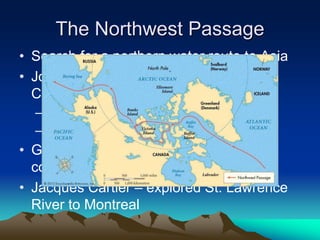
The Northwest Passage
• Search for a northern water route to Asia
• John Cabot – landed in Newfoundland,
Canada
– Claimed for England
– Basis for future English colonies
• Giovanni da Verrazzano – explored the
coast of North America
• Jacques Cartier – explored St. Lawrence
River to Montreal
Spain vs. France
• French claims violated Treaty of Tordesilla
• French protestant colony at Ft. Caroline
attacked by Spanish
• Spanish create St. Augustine
• Spanish defeat the French and colonize
Florida
Spain vs. England
• Religious differences
• Sea Dogs
– Used speedy ships and skilled sailors
– Attacked Spanish galleons
• Sir Francis Drake
– Most famous; raided Spanish ports and ships
• Spanish Armada
– Fleet of ships sent to defeat England
– England won
English Expansion
• Challenged Spanish claims in California
and Newfoundland
• Government refused to provide money to
start colonies
• Private citizens had to fund their own
colonies
• No English colonies until 1600
French and Dutch Colonies
• Samuel de Champlain
– Fur trading post at Quebec
– First permanent French settlement
– Colony became New France
• New Netherland – Dutch
– Present-day New York State
– Bought Manhattan from Native Americans
– Founded New Amsterdam (NYC)
AGE OF EXPLORATION
Life in Spanish America
Life in Spanish Colonies
• Encomienda – grant of Native American labor
• Hacienda – large estates to provide food
– Coffee and cotton
• Spanish born held power
• Creoles – people of Spanish descent, but born
in colonies
• Mestizos – mixed Spanish and Native American
ancestry
• Native Americans and Africans have least
amount of power
Role of the Church
• The good
– helped natives create a better supply of food
– protection from enemies
– learned how to read and write
– developed new skills (carpentry and metalworking)
• The bad
– Worked as slaves
– Replaced traditions and religions
• The ugly
– Native Americans ran away
– Rebellion – killing missionaries and destroying
churches
Opposition to Spanish Rule
• Priests begin to push for better treatment
of the Native Americans.
• Natives disliked the Encomienda system
• The Spanish begin to use Africans as
slaves instead of Native Americans.
Native Resistance
• In the Caribbean, they used poisonous
arrows and warfare to go against the
Spanish.
• In the Southwest, due to the Spanish
burning of Native American religious
objects, they staged an attacked and
drove the Spanish into New Spain.
Bartolome’ de las Casas
• How can a person serve God and enslave
Native Americans at the same time?
• Gave up claim to his encomienda
• Fought against abuse of Native Americans
– “Protector of the Indians”
• New Laws in 1542
– Gradual freeing of all enslaved Native
Americans
– Encomienda’s taken from those who abuse
natives
Sugar Plantations
• Large farms that raised cash crops
• Sugar – most important crop
• Little land to grow sugar in Europe
• Columbus brings sugar to Hispaniola
• Turned to Africans as slaves
THE ATLANTIC SLAVE TRADE
• It was the buying and selling of Africans to
work in the Americas between 1500-1600.
• Over 9.5 million were traded to the
Americas
Slavery in Africa
• Slavery first existed in Africa primarily due
to the spread of Islam.
• Slaves in Africa, though, had legal rights
and social mobility.
• Some slaves were even in positions of
high rank.
• Often they could escape slavery by
marriage and was not hereditary.
The NEED
• The need for slaves changed when they
began to colonize the Americas.
• At first, Native Americans were used. They
turned to Africa.
– Immune to Diseases
– Farming Experience
SPAIN AND SLAVERY
• 1st to use them in copper mines in the
Caribbean.
• When they colonized mainland America,
they used them for farming and mining.
Portugal and Slavery
• Used slaves primarily in Brazil to harvest
sugar cane
• About 40% of slaves headed toward the
Americas ended up in Brazil by the
Portuguese.
What happens in the Americas?
• The demand for cheap labor grew as the
demand for tobacco and coffee went up.
• The British are considered the first to
actually import slaves to the Americas.
Cooperation or Resistance?
Cooperation: African leaders at first met the
demand of the Europeans by selling them
to merchants.
Resistance: Eventually, these African rulers
began to oppose selling Africans to
Europeans because of what the practice
had done to African societies.
TRIANGULAR TRADE
• There were three parts:
1. Europeans transported goods to Africa.
2. In exchange for the goods, the
Europeans were given slaves and sold to
the Americas and West Indies.
3. Then, the Europeans would buy goods
( ex. Sugar, tobacco, etc.) to take back.
Triangular Trade
THE MIDDLE PASSAGE
• The voyage used to transport Africans to
the Americas and Indies.
• There were large ships that packed
Africans into them.
• Disease grew, slaves were beaten, and
they were fed very little.
• Those who did not survive the voyage
were simply tossed overboard.
Middle Passage cont.
• Estimated 20 million made the voyage and
about half of them died along
the way.
The Middle Passage
Slavery in the Americas
1. What was it like?
- The men had to work the fields and women
usually worked in the home.
- They lived on very little food, poor shelter, long
work days, and often were beaten.
2. What happened if you resisted?
- Some would make themselves less productive
by breaking equipment, refusing to work.
- Some ran away
- Some helped to stage uprisings.
Consequences of the Slave Trade
• In Africa, numerous cultures lost generations.
• Africa was devastated by the introduction the
gun and other new advancements in weapons.
• In the Americas, helped the economy with their
labor
• Africans brought their culture ( ex. Music, art,
etc) to the Americas.
• Increase population in the Americas.
THE COLUMBIAN EXCHANGE
- It was the global exchange of food, plants,
and animals during the colonization of the
Americas.
- It brought corn and potatoes to the diets of
many Europeans.
- The downfall to the Columbian Exchange
was the disease factor.
What was the Commercial
Revolution?
• Rise of Capitalism: Economic system
based on private ownership and
investment for profit.
- Merchants would invest their money into
trade and overseas exploration to make a
profit.
- The profit allowed for more businesses
to be built in Europe.
Commercial Revolution Cont.
• Joint Stock Companies: Merchants would
pool their money together to establish
overseas colonies.
- The profits were great, but the risks
were even greater if the colony failed.
- Any profits, the investors shared.
What were the changes in
European society?
1. Growth in towns and rise of merchant
class
2. Merchants get more power
3. Rulers in European countries have an
decrease in power.
Commercial Revolution Cont.
• Growth of Mercantilism: States that a
country’s power depends on wealth. The
more wealth the more goods can be
purchased and armies increased.
- Nations obtain as much gold and silver as
possible and maintain a balance of trade.

ExplorationoftheAmericasPowerPoint-1.pptx

  • 1.
    AGE OF EXPLORATION SpainClaims an Empire
  • 2.
    A Route toAsia • Prince Henry of Portugal – Supported exploration – Caravel – ship with triangular and square sails • Bartolomeu Dias – Reach the southern coast of Africa (Cape of Good Hope • Vasco Da Gama – Sailed around Africa to India – Didn’t have to deal with Muslims or Italians – Take control of the spice trade
  • 3.
    Myth Buster! • Columbusdid not try to prove the world was round! • Sail west to reach Asia • Miscalculated the distance around the globe • Miscalculated the size of Asia
  • 4.
    Christopher Columbus • Seacaptain from Spain who set voyage in 1492 proclaiming he could reach Asia by sailing West. • Takes boats Nina, Pinta, Santa Maria • Lands on an island in the Caribbean (Hispaniola or San Salvador). • He names the native Americans- Indians
  • 5.
    Columbus Continued! • Columbusset on a 2nd journey which was used to transform the Caribbean into colonies.
  • 6.
    Columbus’ Downfall • Made4 total voyages • Never brought back treasures • Didn’t spread Christianity to natives • Mistreated and enslaved natives • Mistreated Spanish colonists • Received no fame or fortune
  • 7.
    Spain vs. Portugal •Both want control of the new lands • Pope Alexander VI – Line of Demarcation – imaginary line dividing the new world – Favored Spain • Treaty of Tordesillas – Moved the line west – Gave Portugal the colony of Brazil
  • 8.
  • 9.
    Amerigo Vespucci • FromPortugal • Founded present day America • America is named after Vespucci
  • 10.
    Vasco de Balboa •Expedition through jungles of Panama • Reached the Pacific Ocean • Claimed ocean and surrounding lands for Spain
  • 11.
    Ferdinand Magellan • FromPortugal • First to sail around the world • 1 out of 5 ships made it back
  • 12.
    Hernando Cortes • FromSpain • Considered a Conquistador ( or conqueror) • Responsible for conquering the Aztecs and Montezuma • Took their gold and gave them diseases
  • 13.
    Francisco Pizarro • FromSpain • Conquistador • Conquered the Inca Empire • Used brutality and cruelty when capturing the Inca
  • 14.
    Other Explorers • Coronado- explored present-day Arizona and New Mexico • De Soto – explored Florida all the way to Arkansas • Cabrillo – explored California coast • All 3 failed to find cities of gold
  • 15.
    AGE OF EXPLORATION EuropeanCompetition in North America
  • 16.
    Henry Hudson • Englishmanwho sailed under the Dutch flag • Searching for a route to China • Sailed up the Hudson River • Discovered the Hudson bay • Crew rebelled and put him, his son, and those loyal on a boat to sea
  • 17.
    The Northwest Passage •Search for a northern water route to Asia • John Cabot – landed in Newfoundland, Canada – Claimed for England – Basis for future English colonies • Giovanni da Verrazzano – explored the coast of North America • Jacques Cartier – explored St. Lawrence River to Montreal
  • 18.
    Spain vs. France •French claims violated Treaty of Tordesilla • French protestant colony at Ft. Caroline attacked by Spanish • Spanish create St. Augustine • Spanish defeat the French and colonize Florida
  • 19.
    Spain vs. England •Religious differences • Sea Dogs – Used speedy ships and skilled sailors – Attacked Spanish galleons • Sir Francis Drake – Most famous; raided Spanish ports and ships • Spanish Armada – Fleet of ships sent to defeat England – England won
  • 20.
    English Expansion • ChallengedSpanish claims in California and Newfoundland • Government refused to provide money to start colonies • Private citizens had to fund their own colonies • No English colonies until 1600
  • 21.
    French and DutchColonies • Samuel de Champlain – Fur trading post at Quebec – First permanent French settlement – Colony became New France • New Netherland – Dutch – Present-day New York State – Bought Manhattan from Native Americans – Founded New Amsterdam (NYC)
  • 22.
    AGE OF EXPLORATION Lifein Spanish America
  • 23.
    Life in SpanishColonies • Encomienda – grant of Native American labor • Hacienda – large estates to provide food – Coffee and cotton • Spanish born held power • Creoles – people of Spanish descent, but born in colonies • Mestizos – mixed Spanish and Native American ancestry • Native Americans and Africans have least amount of power
  • 24.
    Role of theChurch • The good – helped natives create a better supply of food – protection from enemies – learned how to read and write – developed new skills (carpentry and metalworking) • The bad – Worked as slaves – Replaced traditions and religions • The ugly – Native Americans ran away – Rebellion – killing missionaries and destroying churches
  • 27.
    Opposition to SpanishRule • Priests begin to push for better treatment of the Native Americans. • Natives disliked the Encomienda system • The Spanish begin to use Africans as slaves instead of Native Americans.
  • 28.
    Native Resistance • Inthe Caribbean, they used poisonous arrows and warfare to go against the Spanish. • In the Southwest, due to the Spanish burning of Native American religious objects, they staged an attacked and drove the Spanish into New Spain.
  • 29.
    Bartolome’ de lasCasas • How can a person serve God and enslave Native Americans at the same time? • Gave up claim to his encomienda • Fought against abuse of Native Americans – “Protector of the Indians” • New Laws in 1542 – Gradual freeing of all enslaved Native Americans – Encomienda’s taken from those who abuse natives
  • 30.
    Sugar Plantations • Largefarms that raised cash crops • Sugar – most important crop • Little land to grow sugar in Europe • Columbus brings sugar to Hispaniola • Turned to Africans as slaves
  • 31.
    THE ATLANTIC SLAVETRADE • It was the buying and selling of Africans to work in the Americas between 1500-1600. • Over 9.5 million were traded to the Americas
  • 32.
    Slavery in Africa •Slavery first existed in Africa primarily due to the spread of Islam. • Slaves in Africa, though, had legal rights and social mobility. • Some slaves were even in positions of high rank. • Often they could escape slavery by marriage and was not hereditary.
  • 33.
    The NEED • Theneed for slaves changed when they began to colonize the Americas. • At first, Native Americans were used. They turned to Africa. – Immune to Diseases – Farming Experience
  • 34.
    SPAIN AND SLAVERY •1st to use them in copper mines in the Caribbean. • When they colonized mainland America, they used them for farming and mining.
  • 35.
    Portugal and Slavery •Used slaves primarily in Brazil to harvest sugar cane • About 40% of slaves headed toward the Americas ended up in Brazil by the Portuguese.
  • 36.
    What happens inthe Americas? • The demand for cheap labor grew as the demand for tobacco and coffee went up. • The British are considered the first to actually import slaves to the Americas.
  • 37.
    Cooperation or Resistance? Cooperation:African leaders at first met the demand of the Europeans by selling them to merchants. Resistance: Eventually, these African rulers began to oppose selling Africans to Europeans because of what the practice had done to African societies.
  • 38.
    TRIANGULAR TRADE • Therewere three parts: 1. Europeans transported goods to Africa. 2. In exchange for the goods, the Europeans were given slaves and sold to the Americas and West Indies. 3. Then, the Europeans would buy goods ( ex. Sugar, tobacco, etc.) to take back.
  • 39.
  • 40.
    THE MIDDLE PASSAGE •The voyage used to transport Africans to the Americas and Indies. • There were large ships that packed Africans into them. • Disease grew, slaves were beaten, and they were fed very little. • Those who did not survive the voyage were simply tossed overboard.
  • 41.
    Middle Passage cont. •Estimated 20 million made the voyage and about half of them died along the way.
  • 42.
  • 43.
    Slavery in theAmericas 1. What was it like? - The men had to work the fields and women usually worked in the home. - They lived on very little food, poor shelter, long work days, and often were beaten. 2. What happened if you resisted? - Some would make themselves less productive by breaking equipment, refusing to work. - Some ran away - Some helped to stage uprisings.
  • 44.
    Consequences of theSlave Trade • In Africa, numerous cultures lost generations. • Africa was devastated by the introduction the gun and other new advancements in weapons. • In the Americas, helped the economy with their labor • Africans brought their culture ( ex. Music, art, etc) to the Americas. • Increase population in the Americas.
  • 45.
    THE COLUMBIAN EXCHANGE -It was the global exchange of food, plants, and animals during the colonization of the Americas. - It brought corn and potatoes to the diets of many Europeans. - The downfall to the Columbian Exchange was the disease factor.
  • 47.
    What was theCommercial Revolution? • Rise of Capitalism: Economic system based on private ownership and investment for profit. - Merchants would invest their money into trade and overseas exploration to make a profit. - The profit allowed for more businesses to be built in Europe.
  • 48.
    Commercial Revolution Cont. •Joint Stock Companies: Merchants would pool their money together to establish overseas colonies. - The profits were great, but the risks were even greater if the colony failed. - Any profits, the investors shared.
  • 49.
    What were thechanges in European society? 1. Growth in towns and rise of merchant class 2. Merchants get more power 3. Rulers in European countries have an decrease in power.
  • 50.
    Commercial Revolution Cont. •Growth of Mercantilism: States that a country’s power depends on wealth. The more wealth the more goods can be purchased and armies increased. - Nations obtain as much gold and silver as possible and maintain a balance of trade.