C. GOPINATH
TRAINING OFFICER
POT INTRODUCTION
 The success of training depends on recruitment of competent personnel as
trainers.
 First course for pedagogical training was conducted for 21 days under the
supervision of British experts.
The serious inadequancy of this short training necessity to urgently modify
the scheme and to have regular instructor training programme.
* Four more institutes for craft instructors training
programme were also established at Chennai, Hyderabad,
Kanpur & Ludhiana.
* Fifth at New delhi exclusively for women craft instructor
training programme was also established. Later named this
one as national vocational training institute for women
(NVTI)
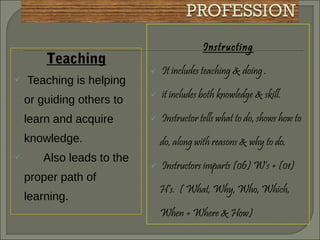
Choice of profession is a very vital step in one’s career.
PROFESSION
It is a way of life choosen for earning our livelihood.
Eg: Doctor, Engineer, Lawyer, Teacher, etc.
Teaching Profession is divided into two ways,
(a) Teaching
(b) Instructing
Teaching
 Teaching is helping
or guiding others to
learn and acquire
knowledge.
 Also leads to the
proper path of
learning.
Instructing
 It includes teaching & doing .
 it includes both knowledge & skill.
 Instructor tells what to do, shows how to
do, along with reasons & why to do.
 Instructors imparts (06) W’s + (01)
H’s. ( What, Why, Who, Which,
When + Where & How)
• This is where the instructor goes one step
beyond or ahead of the teacher.
• Learning to be a good teacher takes years of
training & experience and there is no substitute
for this experience.
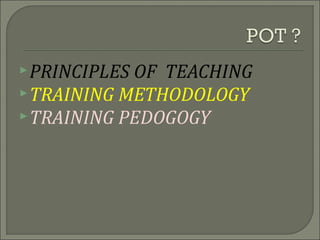
PRINCIPLES OF TEACHING
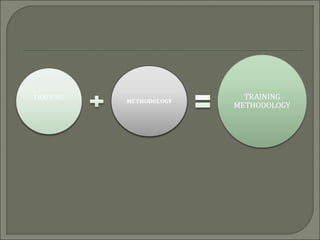
TRAINING METHODOLOGY
TRAINING PEDOGOGY
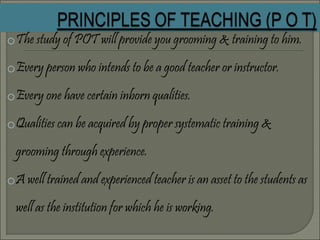
oThe study of POT will provide you grooming & training to him.
oEvery person who intends to be a good teacher or instructor.
oEvery one have certain inborn qualities.
oQualities can be acquired by proper systematic training &
grooming through experience.
oA well trained and experienced teacher is an asset to the students as
well as the institution for which he is working.
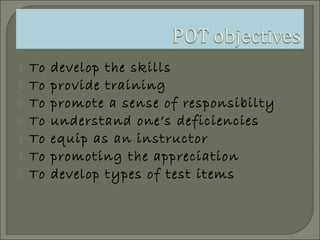
 To develop the skills
 To provide training
 To promote a sense of responsibilty
 To understand one’s deficiencies
 To equip as an instructor
 To promoting the appreciation
 To develop types of test items
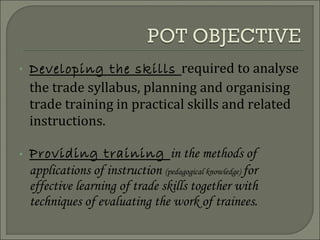
• Developing the skills required to analyse
the trade syllabus, planning and organising
trade training in practical skills and related
instructions.
• Providing training in the methods of
applications of instruction (pedagogical knowledge) for
effective learning of trade skills together with
techniques of evaluating the work of trainees.
 Promoting a sense of responsibility for the
proper upkeep of the equipment, tools,
machineries and other materials entrusted
to the care of the instructor and the ability
to maintain and operate the system of
record keeping in practice.
 Understanding one’s deficiencies in the
trade area (both practical & theoretical) and
over coming their shortcomings so that full
technological competance is achieved.
 Equipping the instructor with advanced
knowledge and skills of modern workshop
administration and management.
 Promoting the appreciation for the need to
keep abreast with current developments both
technical and pedogogical knowledge and skills.
 Developing types of test items and question
banking.
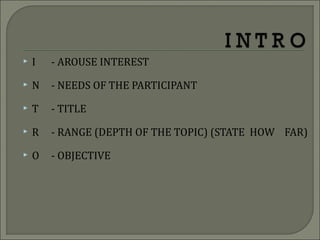
 I - AROUSE INTEREST
 N - NEEDS OF THE PARTICIPANT
 T - TITLE
 R - RANGE (DEPTH OF THE TOPIC) (STATE HOW FAR)
 O - OBJECTIVE
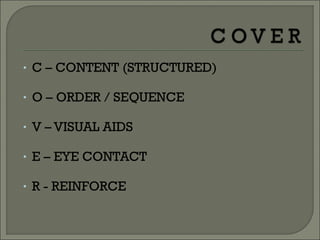
• C – CONTENT (STRUCTURED)
• O – ORDER / SEQUENCE
• V – VISUAL AIDS
• E – EYE CONTACT
• R - REINFORCE
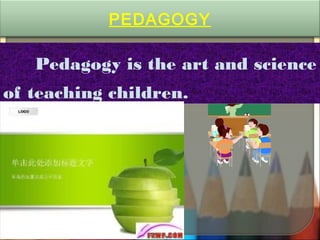
Pedagogy is the art and science
of teaching children.
PEDAGOGY
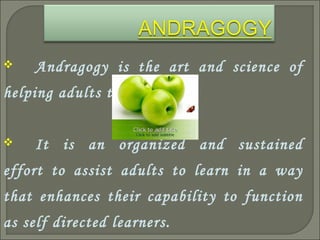
 Andragogy is the art and science of
helping adults to learn.
 It is an organized and sustained
effort to assist adults to learn in a way
that enhances their capability to function
as self directed learners.
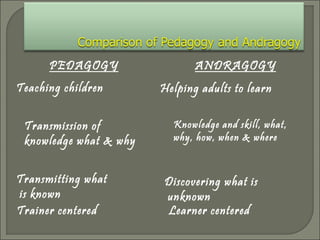
PEDAGOGY ANDRAGOGY
Teaching children Helping adults to learn
Transmission of
knowledge what & why
Knowledge and skill, what,
why, how, when & where
Transmitting what
is known
Discovering what is
unknown
Trainer centered Learner centered
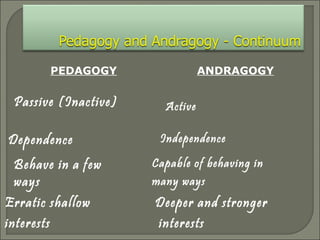
PEDAGOGY ANDRAGOGY
Passive (Inactive) Active
IndependenceDependence
Behave in a few
ways
Capable of behaving in
many ways
Erratic shallow
interests
Deeper and stronger
interests
Training Methodology handouts

Training Methodology handouts

  • 1.
  • 2.
     The successof training depends on recruitment of competent personnel as trainers.  First course for pedagogical training was conducted for 21 days under the supervision of British experts. The serious inadequancy of this short training necessity to urgently modify the scheme and to have regular instructor training programme.
  • 4.
    * Four moreinstitutes for craft instructors training programme were also established at Chennai, Hyderabad, Kanpur & Ludhiana. * Fifth at New delhi exclusively for women craft instructor training programme was also established. Later named this one as national vocational training institute for women (NVTI)
  • 5.
    Choice of professionis a very vital step in one’s career. PROFESSION It is a way of life choosen for earning our livelihood. Eg: Doctor, Engineer, Lawyer, Teacher, etc. Teaching Profession is divided into two ways, (a) Teaching (b) Instructing
  • 6.
    Teaching  Teaching ishelping or guiding others to learn and acquire knowledge.  Also leads to the proper path of learning. Instructing  It includes teaching & doing .  it includes both knowledge & skill.  Instructor tells what to do, shows how to do, along with reasons & why to do.  Instructors imparts (06) W’s + (01) H’s. ( What, Why, Who, Which, When + Where & How)
  • 7.
    • This iswhere the instructor goes one step beyond or ahead of the teacher. • Learning to be a good teacher takes years of training & experience and there is no substitute for this experience.
  • 9.
    PRINCIPLES OF TEACHING TRAININGMETHODOLOGY TRAINING PEDOGOGY
  • 12.
    oThe study ofPOT will provide you grooming & training to him. oEvery person who intends to be a good teacher or instructor. oEvery one have certain inborn qualities. oQualities can be acquired by proper systematic training & grooming through experience. oA well trained and experienced teacher is an asset to the students as well as the institution for which he is working.
  • 13.
     To developthe skills  To provide training  To promote a sense of responsibilty  To understand one’s deficiencies  To equip as an instructor  To promoting the appreciation  To develop types of test items
  • 14.
    • Developing theskills required to analyse the trade syllabus, planning and organising trade training in practical skills and related instructions. • Providing training in the methods of applications of instruction (pedagogical knowledge) for effective learning of trade skills together with techniques of evaluating the work of trainees.
  • 15.
     Promoting asense of responsibility for the proper upkeep of the equipment, tools, machineries and other materials entrusted to the care of the instructor and the ability to maintain and operate the system of record keeping in practice.  Understanding one’s deficiencies in the trade area (both practical & theoretical) and over coming their shortcomings so that full technological competance is achieved.
  • 16.
     Equipping theinstructor with advanced knowledge and skills of modern workshop administration and management.  Promoting the appreciation for the need to keep abreast with current developments both technical and pedogogical knowledge and skills.  Developing types of test items and question banking.
  • 17.
     I -AROUSE INTEREST  N - NEEDS OF THE PARTICIPANT  T - TITLE  R - RANGE (DEPTH OF THE TOPIC) (STATE HOW FAR)  O - OBJECTIVE
  • 18.
    • C –CONTENT (STRUCTURED) • O – ORDER / SEQUENCE • V – VISUAL AIDS • E – EYE CONTACT • R - REINFORCE
  • 21.
    Pedagogy is theart and science of teaching children. PEDAGOGY
  • 22.
     Andragogy isthe art and science of helping adults to learn.  It is an organized and sustained effort to assist adults to learn in a way that enhances their capability to function as self directed learners.
  • 24.
    PEDAGOGY ANDRAGOGY Teaching childrenHelping adults to learn Transmission of knowledge what & why Knowledge and skill, what, why, how, when & where Transmitting what is known Discovering what is unknown Trainer centered Learner centered
  • 25.
    PEDAGOGY ANDRAGOGY Passive (Inactive)Active IndependenceDependence Behave in a few ways Capable of behaving in many ways Erratic shallow interests Deeper and stronger interests

Editor's Notes

  • #22 Greek word Paidagogos: a slave who accompanied child to school (as per Oxford Dictionary)