INTRODUCTION
 Training And Development
include;
 Changing what employees know.
 How they work?
 Attitudes toward their work.
 Interaction with their co-workers or
supervisors.
 TRAINING:
• It’s a short term process.
• Refers to instruction in mechanical problems.
• Targeted in most cases for non-managerial
personnel.
• Specific related purpose.
 DEVELOPMENT:
• It’s a long term process.
• Directed towards future needs.
• Concerned with career growth than immediate
performance.
TRAINING EVALUATION
WHAT IS TRAINING EVALUATION?
The process of examining a training program is called training evaluation. Training
evaluation checks whether training has had the desired effect. Training evaluation ensures
that whether candidates are able to implement their learning in their respective
workplaces, or to the regular work routines.
WHY IS IT IMPORTANT?
Evaluating training effectiveness is important because it sheds light on four aspects. They
include:
• How well the training program met the learner’s needs and objectives?
• What knowledge and skills it has imparted to learners?
• What desirable change it has brought in the learners’ performance?
• What organizational benefits it has yielded?
Step 1:
Identify
Purpose of
Evaluation.
Step 2:
Select Evaluation
Method
Step 3:
Design
Evaluation
Tools
Step 4:
Collect Data
Step 5:
Analyze and
report Results.
FIVE STEPS OF
TRAINING EVALUATION
 STEP 1:
IDENTIFY THE PURPOSES OF EVALUATION:
• Before developing evaluation systems, the purposes of evaluation must be
determined.
• Why do we want to evaluate training programs?
 STEP 2:
SELECT EVALUATION METHOD:
• Kirkpatrick’s four levels of evaluating training programs
• Reaction, learning, behavior, and result
 STEP 3:
DESIGN EVALUATION TOOLS:
• Questionnaire
• Pre/Post Test
• Impact Survey
 STEP 4:
COLLECT DATA:
• Who, when, how to collect data?
 STEP 5:
 ANALYZE AND REPORT RESULTS:
• Evaluation data analysis
• Reporting
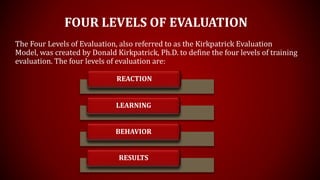
FOUR LEVELS OF EVALUATION
The Four Levels of Evaluation, also referred to as the Kirkpatrick Evaluation
Model, was created by Donald Kirkpatrick, Ph.D. to define the four levels of training
evaluation. The four levels of evaluation are:
REACTION
LEARNING
BEHAVIOR
RESULTS
LEVEL 1
REACTION
 Typical questions concern the degree to which the experience was valuable
(satisfaction), whether they felt engaged, and whether they felt the training was relevant.
 Training organizations use that feedback to evaluate the effectiveness of the training,
students’ perceptions, potential future improvements, and justification for the training
expense.
LEVEL 2
LEARNING
 This level measures the degree to which participants acquired the
intended knowledge, skills and attitudes as a result of the training.
 Only by determining what trainees are learning, and what they are
not, can organizations make necessary improvements.
LEVEL 3
BEHAVIOR
 Level 3 measures the degree to which participants’ behaviors
change as a result of the training.
 Basically whether the knowledge and skills from the training
are then applied on the job.
LEVEL 4
RESULTS
Level 4 seeks to determine the tangible results of the training such as:
 Reduced cost
 Improved quality and efficiency
 Increased productivity
 Employee retention
 Increased sales and
 Higher morale
CONCLUSION
• All the training and development programs of
company are highly effective & beneficial to
the employees in giving their best
contribution to their personal growth &
development as well to meet the
organizational objective.
• Well trained staff are an asset to the business
and help to retain customers and company’s
growth.
THANK YOU

Training And Development Evaluation

  • 2.
    INTRODUCTION  Training AndDevelopment include;  Changing what employees know.  How they work?  Attitudes toward their work.  Interaction with their co-workers or supervisors.
  • 3.
     TRAINING: • It’sa short term process. • Refers to instruction in mechanical problems. • Targeted in most cases for non-managerial personnel. • Specific related purpose.  DEVELOPMENT: • It’s a long term process. • Directed towards future needs. • Concerned with career growth than immediate performance.
  • 4.
  • 5.
    WHAT IS TRAININGEVALUATION? The process of examining a training program is called training evaluation. Training evaluation checks whether training has had the desired effect. Training evaluation ensures that whether candidates are able to implement their learning in their respective workplaces, or to the regular work routines. WHY IS IT IMPORTANT? Evaluating training effectiveness is important because it sheds light on four aspects. They include: • How well the training program met the learner’s needs and objectives? • What knowledge and skills it has imparted to learners? • What desirable change it has brought in the learners’ performance? • What organizational benefits it has yielded?
  • 6.
    Step 1: Identify Purpose of Evaluation. Step2: Select Evaluation Method Step 3: Design Evaluation Tools Step 4: Collect Data Step 5: Analyze and report Results. FIVE STEPS OF TRAINING EVALUATION
  • 7.
     STEP 1: IDENTIFYTHE PURPOSES OF EVALUATION: • Before developing evaluation systems, the purposes of evaluation must be determined. • Why do we want to evaluate training programs?  STEP 2: SELECT EVALUATION METHOD: • Kirkpatrick’s four levels of evaluating training programs • Reaction, learning, behavior, and result
  • 8.
     STEP 3: DESIGNEVALUATION TOOLS: • Questionnaire • Pre/Post Test • Impact Survey  STEP 4: COLLECT DATA: • Who, when, how to collect data?  STEP 5:  ANALYZE AND REPORT RESULTS: • Evaluation data analysis • Reporting
  • 9.
    FOUR LEVELS OFEVALUATION The Four Levels of Evaluation, also referred to as the Kirkpatrick Evaluation Model, was created by Donald Kirkpatrick, Ph.D. to define the four levels of training evaluation. The four levels of evaluation are: REACTION LEARNING BEHAVIOR RESULTS
  • 10.
    LEVEL 1 REACTION  Typicalquestions concern the degree to which the experience was valuable (satisfaction), whether they felt engaged, and whether they felt the training was relevant.  Training organizations use that feedback to evaluate the effectiveness of the training, students’ perceptions, potential future improvements, and justification for the training expense.
  • 11.
    LEVEL 2 LEARNING  Thislevel measures the degree to which participants acquired the intended knowledge, skills and attitudes as a result of the training.  Only by determining what trainees are learning, and what they are not, can organizations make necessary improvements.
  • 12.
    LEVEL 3 BEHAVIOR  Level3 measures the degree to which participants’ behaviors change as a result of the training.  Basically whether the knowledge and skills from the training are then applied on the job.
  • 13.
    LEVEL 4 RESULTS Level 4seeks to determine the tangible results of the training such as:  Reduced cost  Improved quality and efficiency  Increased productivity  Employee retention  Increased sales and  Higher morale
  • 14.
    CONCLUSION • All thetraining and development programs of company are highly effective & beneficial to the employees in giving their best contribution to their personal growth & development as well to meet the organizational objective. • Well trained staff are an asset to the business and help to retain customers and company’s growth.
  • 15.