Arriffin Mansor


                  1
   Why ROI
   Identify a feasible ROI Process
   Use ROI to measure the effectiveness of
    training


                                              2
   Training budgets are increasing
   ROI is the ultimate level of evaluation
   Competitive pressures on costs and
    productivity
   Top executives are requiring ROI information


                                                   3
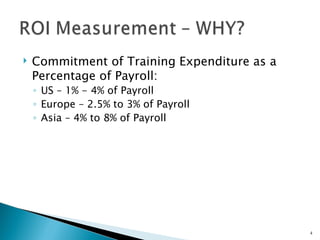
   Commitment of Training Expenditure as a
    Percentage of Payroll:
    ◦ US – 1% - 4% of Payroll
    ◦ Europe – 2.5% to 3% of Payroll
    ◦ Asia – 4% to 8% of Payroll


                                              4
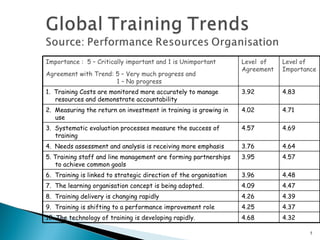
Importance : 5 – Critically important and 1 is Unimportant         Level of    Level of
                                                                   Agreement   Importance
Agreement with Trend: 5 – Very much progress and
                      1 – No progress
1. Training Costs are monitored more accurately to manage          3.92        4.83
   resources and demonstrate accountability
2. Measuring the return on investment in training is growing in    4.02        4.71
   use
3. Systematic evaluation processes measure the success of          4.57        4.69
   training
4. Needs assessment and analysis is receiving more emphasis        3.76        4.64
5. Training staff and line management are forming partnerships     3.95        4.57
    to achieve common goals
6. Training is linked to strategic direction of the organisation   3.96        4.48
7. The learning organisation concept is being adopted.             4.09        4.47
8. Training delivery is changing rapidly                           4.26        4.39
9. Training is shifting to a performance improvement role          4.25        4.37
10. The technology of training is developing rapidly.              4.68        4.32

                                                                                       5
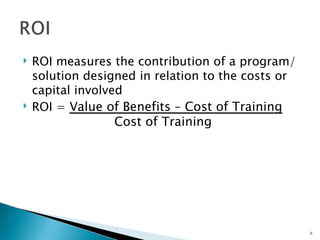
   ROI measures the contribution of a program/
    solution designed in relation to the costs or
    capital involved
   ROI = Value of Benefits – Cost of Training
                   Cost of Training


                                                    6
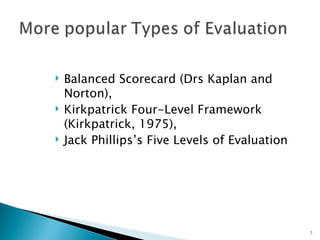
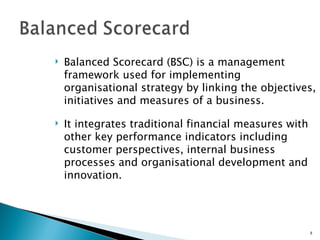
   Balanced Scorecard (Drs Kaplan and
    Norton),
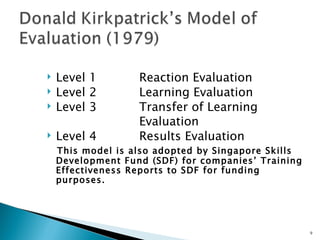
   Kirkpatrick Four-Level Framework
    (Kirkpatrick, 1975),
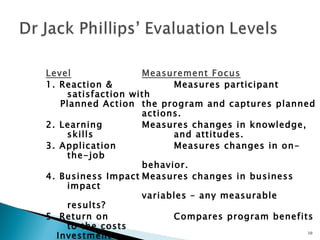
   Jack Phillips’s Five Levels of Evaluation


                                                7
   Balanced Scorecard (BSC) is a management
    framework used for implementing
    organisational strategy by linking the objectives,
    initiatives and measures of a business.

   It integrates traditional financial measures with
    other key performance indicators including
    customer perspectives, internal business
    processes and organisational development and
    innovation.


                                                        8
   Level 1        Reaction Evaluation
   Level 2        Learning Evaluation
   Level 3        Transfer of Learning
                   Evaluation
   Level 4        Results Evaluation
    This model is also adopted by Singapore Skills
    Development Fund (SDF) for companies’ Training
    Effectiveness Reports to SDF for funding
    purposes.


                                                     9
Level              Measurement Focus
1. Reaction &            Measures participant
    satisfaction with
   Planned Action the program and captures planned
                   actions.
2. Learning        Measures changes in knowledge,
    skills               and attitudes.
3. Application           Measures changes in on-
    the-job
                   behavior.
4. Business Impact Measures changes in business
    impact
                   variables – any measurable
    results?
5. Return on             Compares program benefits
    to the costs
  Investment                                      10
   Singapore Airlines
   Singapore Technology
   Motorola
   Compaq
   Companies who submit to SDF for funding


                                              11
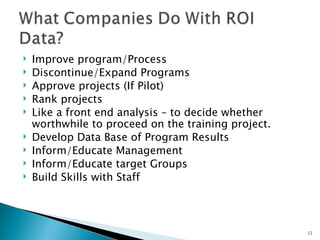
   Improve program/Process
   Discontinue/Expand Programs
   Approve projects (If Pilot)
   Rank projects
   Like a front end analysis – to decide whether
    worthwhile to proceed on the training project.
   Develop Data Base of Program Results
   Inform/Educate Management
   Inform/Educate target Groups
   Build Skills with Staff


                                                     12
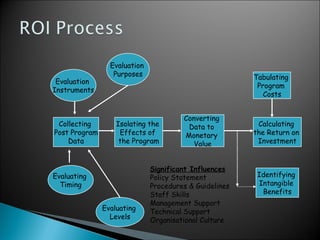
Evaluation
                  Purposes                              Tabulating
 Evaluation
                                                         Program
Instruments
                                                           Costs


                                       Converting
 Collecting        Isolating the        Data to          Calculating
Post Program        Effects of         Monetary         the Return on
    Data            the Program           Value          Investment


                              Significant Influences
Evaluating                    Policy Statement           Identifying
  Timing                      Procedures & Guidelines    Intangible
                              Staff Skills                Benefits
                              Management Support
               Evaluating     Technical Support
                 Levels       Organisational Culture
                                                                        13
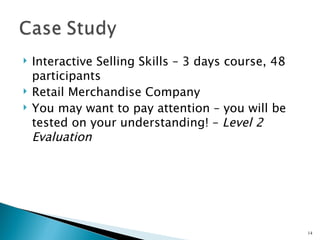
   Interactive Selling Skills – 3 days course, 48
    participants
   Retail Merchandise Company
   You may want to pay attention – you will be
    tested on your understanding! – Level 2
    Evaluation


                                                     14
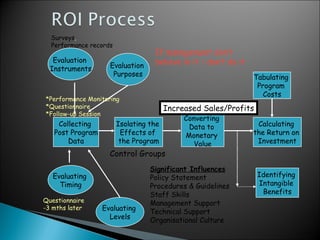
Surveys,
  Performance records
                                   If management don’t
   Evaluation                      believe in it – don’t do it
  Instruments       Evaluation
                     Purposes                                    Tabulating
                                                                  Program
                                                                    Costs
*Performance Monitoring
*Questionnaire                          Increased Sales/Profits
*Follow-up Session
                                             Converting
    Collecting          Isolating the         Data to             Calculating
   Post Program          Effects of          Monetary            the Return on
       Data              the Program            Value             Investment
                    Control Groups
                                  Significant Influences
   Evaluating                     Policy Statement                Identifying
     Timing                       Procedures & Guidelines         Intangible
                                  Staff Skills                     Benefits
Questionnaire                     Management Support
-3 mths later     Evaluating      Technical Support
                    Levels        Organisational Culture
                                                                                 15
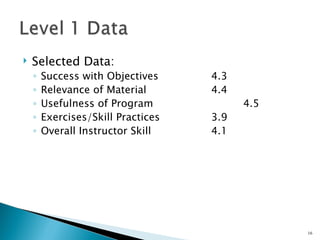
   Selected Data:
    ◦   Success with Objectives     4.3
    ◦   Relevance of Material       4.4
    ◦   Usefulness of Program             4.5
    ◦   Exercises/Skill Practices   3.9
    ◦   Overall Instructor Skill    4.1


                                                16
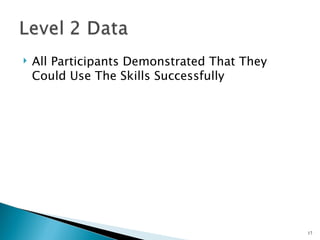
   All Participants Demonstrated That They
    Could Use The Skills Successfully


                                              17
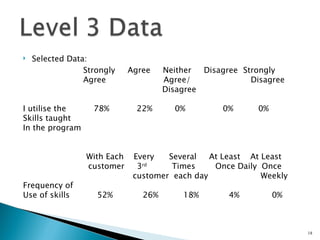
   Selected Data:
                 Strongly    Agree    Neither  Disagree Strongly
                 Agree                Agree/              Disagree
                                      Disagree

I utilise the      78%         22%      0%         0%      0%
Skills taught
In the program


                 With Each    Every   Several   At Least At Least
                 customer      3rd     Times     Once Daily Once
                              customer each day             Weekly
Frequency of
Use of skills       52%         26%       18%        4%         0%


                                                                     18
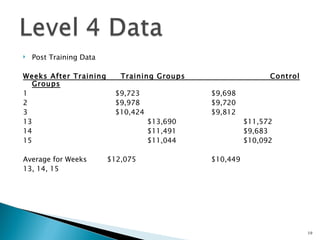
   Post Training Data

Weeks After Training        Training Groups                   Control
  Groups
1                         $9,723              $9,698
2                         $9,978              $9,720
3                         $10,424             $9,812
13                                  $13,690             $11,572
14                                  $11,491             $9,683
15                                  $11,044             $10,092

Average for Weeks        $12,075              $10,449
13, 14, 15


                                                                        19
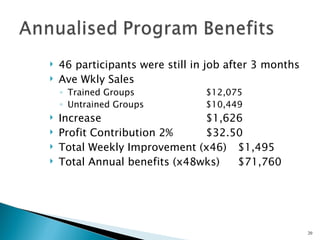
   46 participants were still in job after 3 months
   Ave Wkly Sales
    ◦ Trained Groups             $12,075
    ◦ Untrained Groups           $10,449
   Increase                   $1,626
   Profit Contribution 2%     $32.50
   Total Weekly Improvement (x46) $1,495
   Total Annual benefits (x48wks)  $71,760


                                                       20
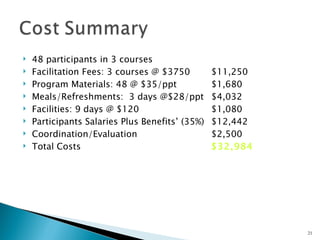
   48 participants in 3 courses
   Facilitation Fees: 3 courses @ $3750         $11,250
   Program Materials: 48 @ $35/ppt              $1,680
   Meals/Refreshments: 3 days @$28/ppt          $4,032
   Facilities: 9 days @ $120                    $1,080
   Participants Salaries Plus Benefits’ (35%)   $12,442
   Coordination/Evaluation                      $2,500
   Total Costs                                  $32,984


                                                           21
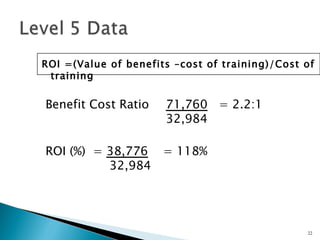
ROI =(Value of benefits –cost of training)/Cost of
 training

Benefit Cost Ratio    71,760 = 2.2:1
                      32,984

ROI (%) = 38,776      = 118%
          32,984


                                                22
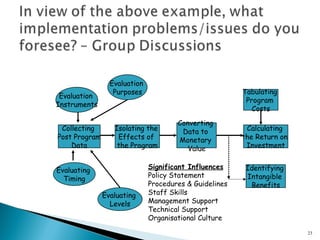
Evaluation
                  Purposes                              Tabulating
 Evaluation
                                                         Program
Instruments
                                                           Costs

                                      Converting
 Collecting       Isolating the        Data to           Calculating
Post Program       Effects of         Monetary          the Return on
    Data           the Program           Value           Investment


Evaluating                    Significant Influences     Identifying
  Timing                      Policy Statement           Intangible
                              Procedures & Guidelines     Benefits
               Evaluating     Staff Skills
                 Levels       Management Support
                              Technical Support
                              Organisational Culture

                                                                        23
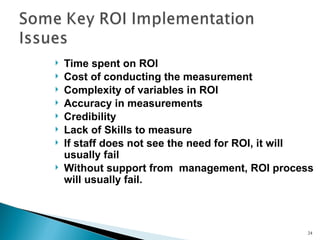
   Time spent on ROI
   Cost of conducting the measurement
   Complexity of variables in ROI
   Accuracy in measurements
   Credibility
   Lack of Skills to measure
   If staff does not see the need for ROI, it will
    usually fail
   Without support from management, ROI process
    will usually fail.


                                                 24
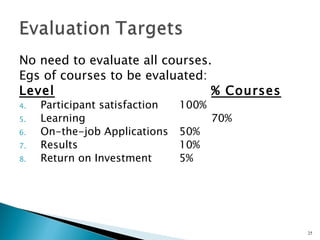
No need to evaluate all courses.
Egs of courses to be evaluated:
Level                           % Courses
4.   Participant satisfaction   100%
5.   Learning                          70%
6.   On-the-job Applications    50%
7.   Results                    10%
8.   Return on Investment       5%


                                             25
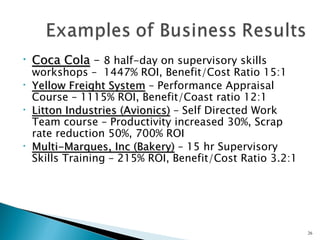
•   Coca Cola – 8 half-day on supervisory skills
    workshops – 1447% ROI, Benefit/Cost Ratio 15:1
•   Yellow Freight System – Performance Appraisal
    Course – 1115% ROI, Benefit/Coast ratio 12:1
•   Litton Industries (Avionics) – Self Directed Work
    Team course – Productivity increased 30%, Scrap
    rate reduction 50%, 700% ROI
•   Multi-Marques, Inc (Bakery) – 15 hr Supervisory
    Skills Training – 215% ROI, Benefit/Cost Ratio 3.2:1


                                                           26
   Let’s discuss


                    27
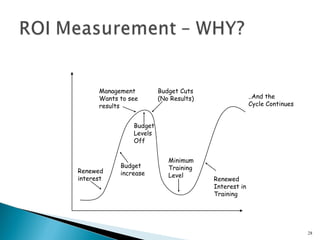
Management         Budget Cuts
      Wants to see       (No Results)                 ..And the
      results                                         Cycle Continues


                Budget
                Levels
                Off


                            Minimum
            Budget          Training
Renewed     increase        Level
interest                                Renewed
                                        Interest in
                                        Training


                                                                        28
   A Training Executive met up with an Instructional Designer to
    discuss about the design of an e-learning programme for
    5000 participants worldwide. This is the first time that the
    company would be using e-learning. The initial investment in
    the training is huge. The CEO is very excited about the
    programme and has high expectations of this training. The
    Training Executive suggested to forecast/measure the ROI.
   As an instructional designer, would you consider the
    suggestion by the Training Executive? Why?
   As the Training Executive, what would you like to achieve
    from measuring ROI?


                                                                    29
   Cost of Technology - Initial cost of
    implementing e-learning
   Newness of e-learning (is it effective &
    efficient as F2F learning?)
   E-learning is not a proven process in many
    organisation – need to show value now than
    later


                                                 30
   In many e-learning projects, the client wants to
    know the projected payback from the project.
   To venture into the expensive development
    process without having some sense of the
    payback is undesired by many clients.
   Consequently, there is tremendous pressure to
    forecast ROI even if it is not very accurate.


                                                       31
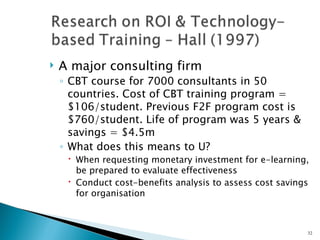
   A major consulting firm
    ◦ CBT course for 7000 consultants in 50
      countries. Cost of CBT training program =
      $106/student. Previous F2F program cost is
      $760/student. Life of program was 5 years &
      savings = $4.5m
    ◦ What does this means to U?
      When requesting monetary investment for e-learning,
       be prepared to evaluate effectiveness
      Conduct cost-benefits analysis to assess cost savings
       for organisation


                                                           32
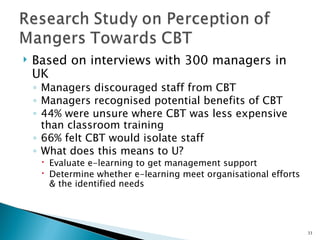
   Based on interviews with 300 managers in
    UK
    ◦ Managers discouraged staff from CBT
    ◦ Managers recognised potential benefits of CBT
    ◦ 44% were unsure where CBT was less expensive
      than classroom training
    ◦ 66% felt CBT would isolate staff
    ◦ What does this means to U?
      Evaluate e-learning to get management support
      Determine whether e-learning meet organisational efforts
       & the identified needs


                                                                  33
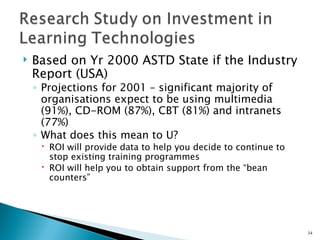
   Based on Yr 2000 ASTD State if the Industry
    Report (USA)
    ◦ Projections for 2001 – significant majority of
      organisations expect to be using multimedia
      (91%), CD-ROM (87%), CBT (81%) and intranets
      (77%)
    ◦ What does this mean to U?
      ROI will provide data to help you decide to continue to
       stop existing training programmes
      ROI will help you to obtain support from the “bean
       counters”


                                                                 34
   Isolate the effects by getting before and after
    training performance data.
   Performance data of with and without training
    groups


                                                      35
   Identify key output for the job to be analyzed
   Identify the input variable for the output with
    cause effect relationship
   Compute the KPI by dividing output with the
    input. It is a ratio.
   Obtain before and targeted KPIs and insert
    the actual KPIs in the diagram.
   Separate the value of the output based on
    volume and efficiency.


                                                      36
Example of input output
         dimension for Sales
• Output is net profits in a week RM20,000
• Input is weekly sales figure RM100,000
• The KPI is 0.20 profit per ringgit sales or return
  on sales
• Insert the previous performance KPI which
  may be 0.15 profit per ringgit sales
• The performance gap between the old and the
  new position.
                                                   37
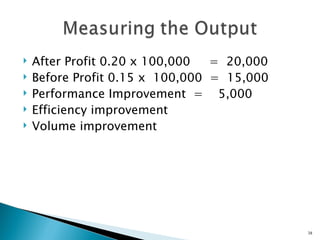
   After Profit 0.20 x 100,000  = 20,000
   Before Profit 0.15 x 100,000 = 15,000
   Performance Improvement = 5,000
   Efficiency improvement
   Volume improvement


                                            38
39
   Increase production units
   Increase value of sales
   Cost savings
    ◦   Less   wastage
    ◦   Less   time
    ◦   Less   labour
    ◦   Less   materials
    ◦   Less   overheads


                                40
   Costs of Trainers
   Opportunity costs of trainees
   Designing and Planning costs of training
    program
   Administration cost of training
   softwares


                                               41
   Calculate the total cost of training or
    intervention
   Identify the input and output variable that
    determine performance.
   The relationship must be meaningful which
    has high cause effect relationship
   Isolate the impact of training with the
    following test, with and without, before and
    after.


                                                   42

ROI training 98

  • 1.
  • 2.
    Why ROI  Identify a feasible ROI Process  Use ROI to measure the effectiveness of training 2
  • 3.
    Training budgets are increasing  ROI is the ultimate level of evaluation  Competitive pressures on costs and productivity  Top executives are requiring ROI information 3
  • 4.
    Commitment of Training Expenditure as a Percentage of Payroll: ◦ US – 1% - 4% of Payroll ◦ Europe – 2.5% to 3% of Payroll ◦ Asia – 4% to 8% of Payroll 4
  • 5.
    Importance : 5– Critically important and 1 is Unimportant Level of Level of Agreement Importance Agreement with Trend: 5 – Very much progress and 1 – No progress 1. Training Costs are monitored more accurately to manage 3.92 4.83 resources and demonstrate accountability 2. Measuring the return on investment in training is growing in 4.02 4.71 use 3. Systematic evaluation processes measure the success of 4.57 4.69 training 4. Needs assessment and analysis is receiving more emphasis 3.76 4.64 5. Training staff and line management are forming partnerships 3.95 4.57 to achieve common goals 6. Training is linked to strategic direction of the organisation 3.96 4.48 7. The learning organisation concept is being adopted. 4.09 4.47 8. Training delivery is changing rapidly 4.26 4.39 9. Training is shifting to a performance improvement role 4.25 4.37 10. The technology of training is developing rapidly. 4.68 4.32 5
  • 6.
    ROI measures the contribution of a program/ solution designed in relation to the costs or capital involved  ROI = Value of Benefits – Cost of Training Cost of Training 6
  • 7.
    Balanced Scorecard (Drs Kaplan and Norton),  Kirkpatrick Four-Level Framework (Kirkpatrick, 1975),  Jack Phillips’s Five Levels of Evaluation 7
  • 8.
    Balanced Scorecard (BSC) is a management framework used for implementing organisational strategy by linking the objectives, initiatives and measures of a business.  It integrates traditional financial measures with other key performance indicators including customer perspectives, internal business processes and organisational development and innovation. 8
  • 9.
    Level 1 Reaction Evaluation  Level 2 Learning Evaluation  Level 3 Transfer of Learning Evaluation  Level 4 Results Evaluation This model is also adopted by Singapore Skills Development Fund (SDF) for companies’ Training Effectiveness Reports to SDF for funding purposes. 9
  • 10.
    Level Measurement Focus 1. Reaction & Measures participant satisfaction with Planned Action the program and captures planned actions. 2. Learning Measures changes in knowledge, skills and attitudes. 3. Application Measures changes in on- the-job behavior. 4. Business Impact Measures changes in business impact variables – any measurable results? 5. Return on Compares program benefits to the costs Investment 10
  • 11.
    Singapore Airlines  Singapore Technology  Motorola  Compaq  Companies who submit to SDF for funding 11
  • 12.
    Improve program/Process  Discontinue/Expand Programs  Approve projects (If Pilot)  Rank projects  Like a front end analysis – to decide whether worthwhile to proceed on the training project.  Develop Data Base of Program Results  Inform/Educate Management  Inform/Educate target Groups  Build Skills with Staff 12
  • 13.
    Evaluation Purposes Tabulating Evaluation Program Instruments Costs Converting Collecting Isolating the Data to Calculating Post Program Effects of Monetary the Return on Data the Program Value Investment Significant Influences Evaluating Policy Statement Identifying Timing Procedures & Guidelines Intangible Staff Skills Benefits Management Support Evaluating Technical Support Levels Organisational Culture 13
  • 14.
    Interactive Selling Skills – 3 days course, 48 participants  Retail Merchandise Company  You may want to pay attention – you will be tested on your understanding! – Level 2 Evaluation 14
  • 15.
    Surveys, Performancerecords If management don’t Evaluation believe in it – don’t do it Instruments Evaluation Purposes Tabulating Program Costs *Performance Monitoring *Questionnaire Increased Sales/Profits *Follow-up Session Converting Collecting Isolating the Data to Calculating Post Program Effects of Monetary the Return on Data the Program Value Investment Control Groups Significant Influences Evaluating Policy Statement Identifying Timing Procedures & Guidelines Intangible Staff Skills Benefits Questionnaire Management Support -3 mths later Evaluating Technical Support Levels Organisational Culture 15
  • 16.
    Selected Data: ◦ Success with Objectives 4.3 ◦ Relevance of Material 4.4 ◦ Usefulness of Program 4.5 ◦ Exercises/Skill Practices 3.9 ◦ Overall Instructor Skill 4.1 16
  • 17.
    All Participants Demonstrated That They Could Use The Skills Successfully 17
  • 18.
    Selected Data: Strongly Agree Neither Disagree Strongly Agree Agree/ Disagree Disagree I utilise the 78% 22% 0% 0% 0% Skills taught In the program With Each Every Several At Least At Least customer 3rd Times Once Daily Once customer each day Weekly Frequency of Use of skills 52% 26% 18% 4% 0% 18
  • 19.
    Post Training Data Weeks After Training Training Groups Control Groups 1 $9,723 $9,698 2 $9,978 $9,720 3 $10,424 $9,812 13 $13,690 $11,572 14 $11,491 $9,683 15 $11,044 $10,092 Average for Weeks $12,075 $10,449 13, 14, 15 19
  • 20.
    46 participants were still in job after 3 months  Ave Wkly Sales ◦ Trained Groups $12,075 ◦ Untrained Groups $10,449  Increase $1,626  Profit Contribution 2% $32.50  Total Weekly Improvement (x46) $1,495  Total Annual benefits (x48wks) $71,760 20
  • 21.
    48 participants in 3 courses  Facilitation Fees: 3 courses @ $3750 $11,250  Program Materials: 48 @ $35/ppt $1,680  Meals/Refreshments: 3 days @$28/ppt $4,032  Facilities: 9 days @ $120 $1,080  Participants Salaries Plus Benefits’ (35%) $12,442  Coordination/Evaluation $2,500  Total Costs $32,984 21
  • 22.
    ROI =(Value ofbenefits –cost of training)/Cost of training Benefit Cost Ratio 71,760 = 2.2:1 32,984 ROI (%) = 38,776 = 118% 32,984 22
  • 23.
    Evaluation Purposes Tabulating Evaluation Program Instruments Costs Converting Collecting Isolating the Data to Calculating Post Program Effects of Monetary the Return on Data the Program Value Investment Evaluating Significant Influences Identifying Timing Policy Statement Intangible Procedures & Guidelines Benefits Evaluating Staff Skills Levels Management Support Technical Support Organisational Culture 23
  • 24.
    Time spent on ROI  Cost of conducting the measurement  Complexity of variables in ROI  Accuracy in measurements  Credibility  Lack of Skills to measure  If staff does not see the need for ROI, it will usually fail  Without support from management, ROI process will usually fail. 24
  • 25.
    No need toevaluate all courses. Egs of courses to be evaluated: Level % Courses 4. Participant satisfaction 100% 5. Learning 70% 6. On-the-job Applications 50% 7. Results 10% 8. Return on Investment 5% 25
  • 26.
    Coca Cola – 8 half-day on supervisory skills workshops – 1447% ROI, Benefit/Cost Ratio 15:1 • Yellow Freight System – Performance Appraisal Course – 1115% ROI, Benefit/Coast ratio 12:1 • Litton Industries (Avionics) – Self Directed Work Team course – Productivity increased 30%, Scrap rate reduction 50%, 700% ROI • Multi-Marques, Inc (Bakery) – 15 hr Supervisory Skills Training – 215% ROI, Benefit/Cost Ratio 3.2:1 26
  • 27.
    Let’s discuss 27
  • 28.
    Management Budget Cuts Wants to see (No Results) ..And the results Cycle Continues Budget Levels Off Minimum Budget Training Renewed increase Level interest Renewed Interest in Training 28
  • 29.
    A Training Executive met up with an Instructional Designer to discuss about the design of an e-learning programme for 5000 participants worldwide. This is the first time that the company would be using e-learning. The initial investment in the training is huge. The CEO is very excited about the programme and has high expectations of this training. The Training Executive suggested to forecast/measure the ROI.  As an instructional designer, would you consider the suggestion by the Training Executive? Why?  As the Training Executive, what would you like to achieve from measuring ROI? 29
  • 30.
    Cost of Technology - Initial cost of implementing e-learning  Newness of e-learning (is it effective & efficient as F2F learning?)  E-learning is not a proven process in many organisation – need to show value now than later 30
  • 31.
    In many e-learning projects, the client wants to know the projected payback from the project.  To venture into the expensive development process without having some sense of the payback is undesired by many clients.  Consequently, there is tremendous pressure to forecast ROI even if it is not very accurate. 31
  • 32.
    A major consulting firm ◦ CBT course for 7000 consultants in 50 countries. Cost of CBT training program = $106/student. Previous F2F program cost is $760/student. Life of program was 5 years & savings = $4.5m ◦ What does this means to U?  When requesting monetary investment for e-learning, be prepared to evaluate effectiveness  Conduct cost-benefits analysis to assess cost savings for organisation 32
  • 33.
    Based on interviews with 300 managers in UK ◦ Managers discouraged staff from CBT ◦ Managers recognised potential benefits of CBT ◦ 44% were unsure where CBT was less expensive than classroom training ◦ 66% felt CBT would isolate staff ◦ What does this means to U?  Evaluate e-learning to get management support  Determine whether e-learning meet organisational efforts & the identified needs 33
  • 34.
    Based on Yr 2000 ASTD State if the Industry Report (USA) ◦ Projections for 2001 – significant majority of organisations expect to be using multimedia (91%), CD-ROM (87%), CBT (81%) and intranets (77%) ◦ What does this mean to U?  ROI will provide data to help you decide to continue to stop existing training programmes  ROI will help you to obtain support from the “bean counters” 34
  • 35.
    Isolate the effects by getting before and after training performance data.  Performance data of with and without training groups 35
  • 36.
    Identify key output for the job to be analyzed  Identify the input variable for the output with cause effect relationship  Compute the KPI by dividing output with the input. It is a ratio.  Obtain before and targeted KPIs and insert the actual KPIs in the diagram.  Separate the value of the output based on volume and efficiency. 36
  • 37.
    Example of inputoutput dimension for Sales • Output is net profits in a week RM20,000 • Input is weekly sales figure RM100,000 • The KPI is 0.20 profit per ringgit sales or return on sales • Insert the previous performance KPI which may be 0.15 profit per ringgit sales • The performance gap between the old and the new position. 37
  • 38.
    After Profit 0.20 x 100,000 = 20,000  Before Profit 0.15 x 100,000 = 15,000  Performance Improvement = 5,000  Efficiency improvement  Volume improvement 38
  • 39.
  • 40.
    Increase production units  Increase value of sales  Cost savings ◦ Less wastage ◦ Less time ◦ Less labour ◦ Less materials ◦ Less overheads 40
  • 41.
    Costs of Trainers  Opportunity costs of trainees  Designing and Planning costs of training program  Administration cost of training  softwares 41
  • 42.
    Calculate the total cost of training or intervention  Identify the input and output variable that determine performance.  The relationship must be meaningful which has high cause effect relationship  Isolate the impact of training with the following test, with and without, before and after. 42