Resource use efficiency in forestry: Utilisation of tree
genetic resources Judy Loo and Ramni Jamnadass
Bioversity International & World Agroforestry Centre
15 February, 2016
Photo:KrishnasisGhosh
Presentation overview:
• Background: CG & tree genetic
resources; what’s different about
trees?
• Values of trees
• Biotech approaches for trees –
remembering the smallholder
• African Orphan Crops Consortium
• Allanblackia example
• Using genes to improve
management practices
• The right tree for the right place
Kyrgyzstan. Photo by Judy Loo
Trees are different!
• Large, long-lived, late maturing, highly diverse,
mostly undomesticated
• Long-distance pollination, produce millions of
seed throughout lifetime – particular challenges
and opportunities
• ~ 80,000 species; thousands important for
livelihoods
• Often trees are managed on some form of the
commons – public land, community forests, etc.
Table 1. Some advantages and drawbacks of the tree growth form
Advantage Drawback
Great potential of biomass gain High maintenance costs
High competition after successful establishment Extremely high recruit mortality
Endurance to short-term resource depletion Increased probability of suffering catastrophic events
Great lifetime fecundity Delayed maturity
Little dependence on particular reproductive events Trade-off between present reproductive output and
future growth, survival, and reproduction
Large pollen and seed production and release
height facilitate gene dispersal
Low plant density complicates mating and increases
pollen limitation
Relatively little seed limitation of recruitment Strong limitation of suitable sites and time windows
for recruitment
Local adaptation favored by strong selection during
early life stages
Local adaptation hindered by high gene flow
Reduced accumulation of mutations per unit of time Increased mutation rate per generation
Strong inbreeding depression increases outcrossing
rate and maintains genetic diversity
Lifelong accumulation of somatic mutations results
in susceptibility to inbreeding depression
From: Rémy Petit and Arndt Hampe, 2006 , Some evolutionary consequences of being a tree
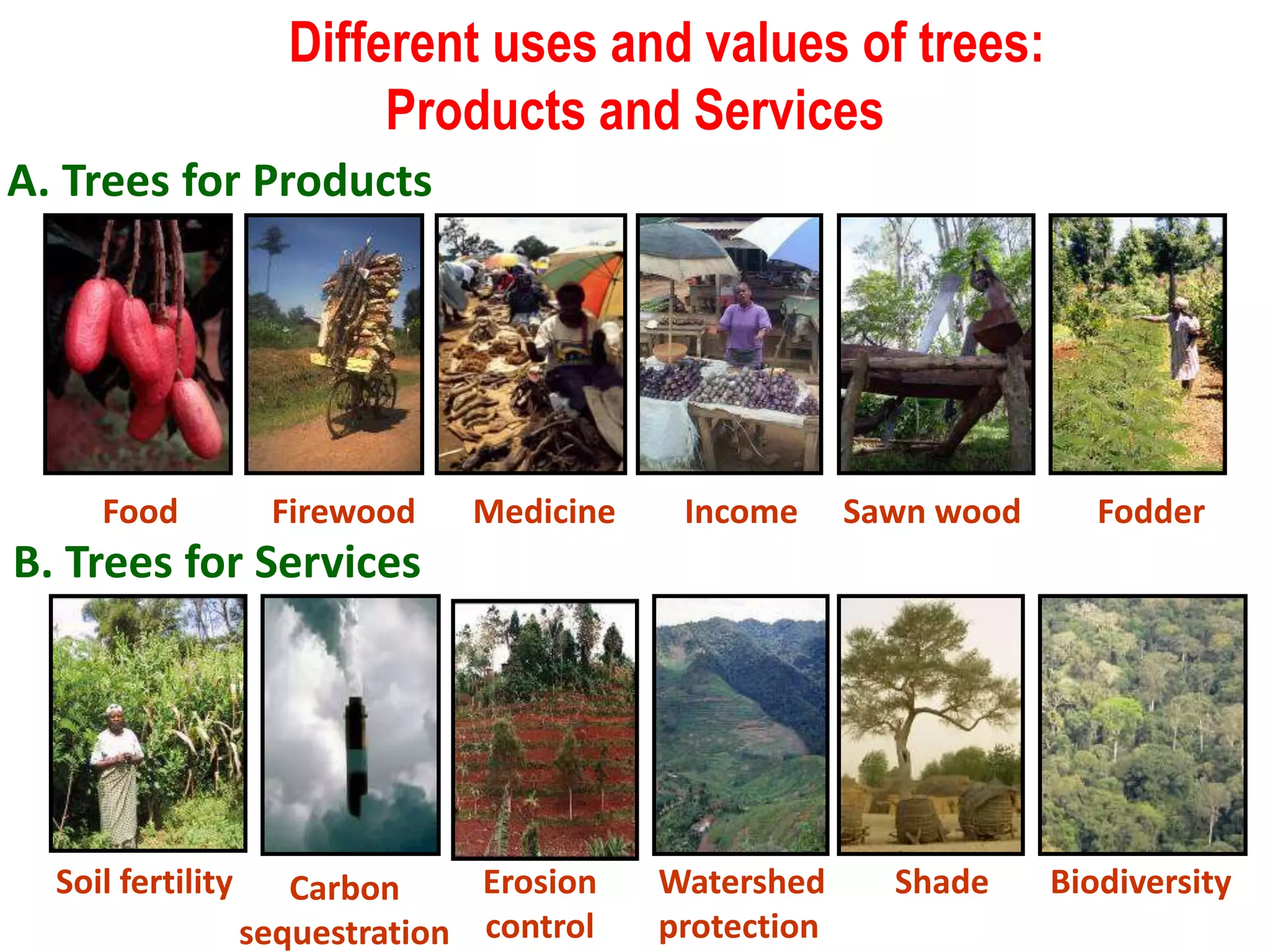
Different uses and values of trees:
Products and Services
B. Trees for Services
A. Trees for Products
Food Firewood Medicine Income Sawn wood Fodder
Soil fertility Carbon
sequestration
Erosion
control
Watershed
protection
Shade Biodiversity
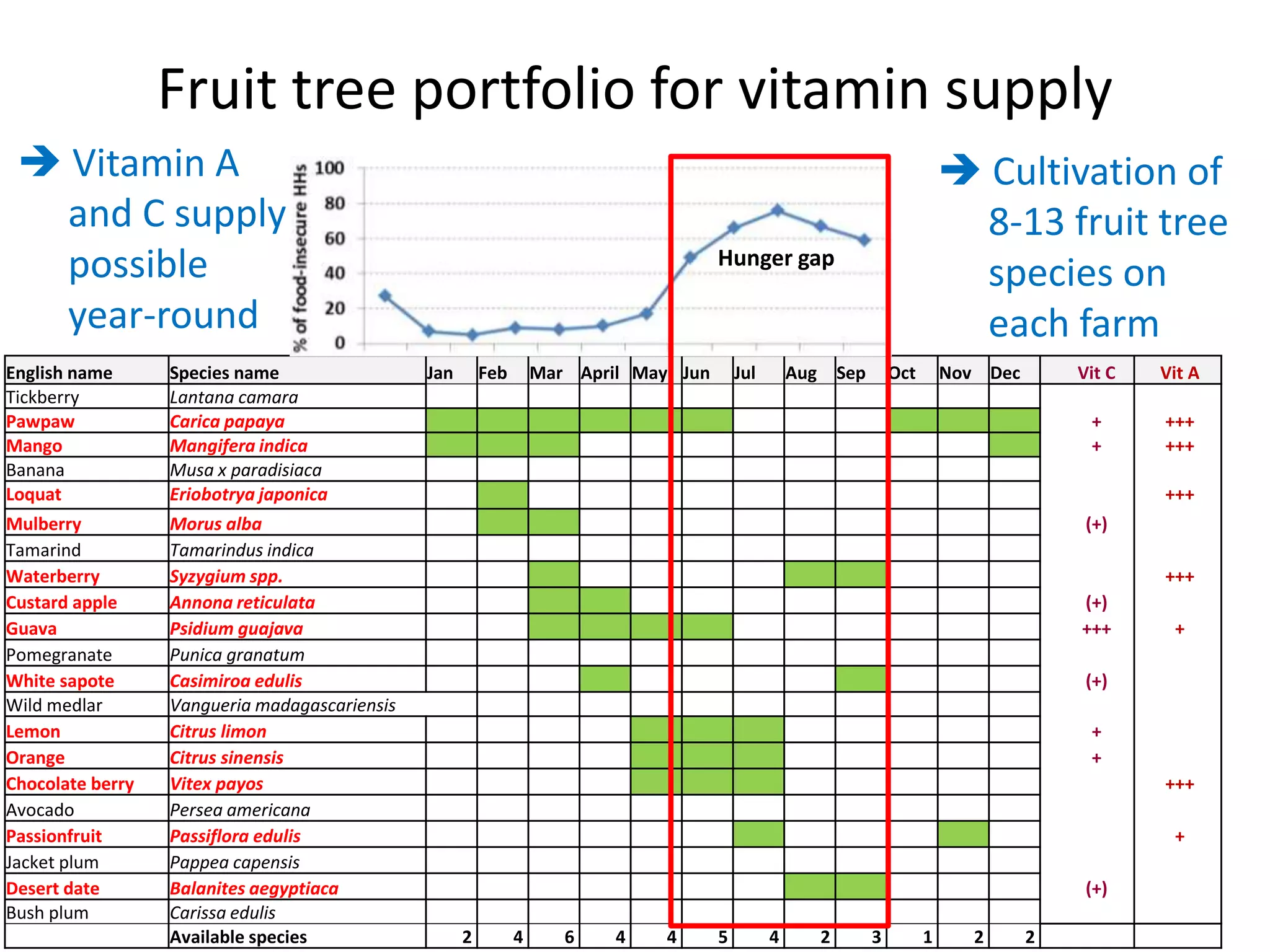
English name Species name Jan Feb Mar April May Jun Jul Aug Sep Oct Nov Dec Vit C Vit A
Tickberry Lantana camara
Pawpaw Carica papaya + +++
Mango Mangifera indica + +++
Banana Musa x paradisiaca
Loquat Eriobotrya japonica +++
Mulberry Morus alba (+)
Tamarind Tamarindus indica
Waterberry Syzygium spp. +++
Custard apple Annona reticulata (+)
Guava Psidium guajava +++ +
Pomegranate Punica granatum
White sapote Casimiroa edulis (+)
Wild medlar Vangueria madagascariensis
Lemon Citrus limon +
Orange Citrus sinensis +
Chocolate berry Vitex payos +++
Avocado Persea americana
Passionfruit Passiflora edulis +
Jacket plum Pappea capensis
Desert date Balanites aegyptiaca (+)
Bush plum Carissa edulis
Available species 2 4 6 4 4 5 4 2 3 1 2 2
Hunger gap
Fruit tree portfolio for vitamin supply
 Vitamin A
and C supply
possible
year-round
 Cultivation of
8-13 fruit tree
species on
each farm
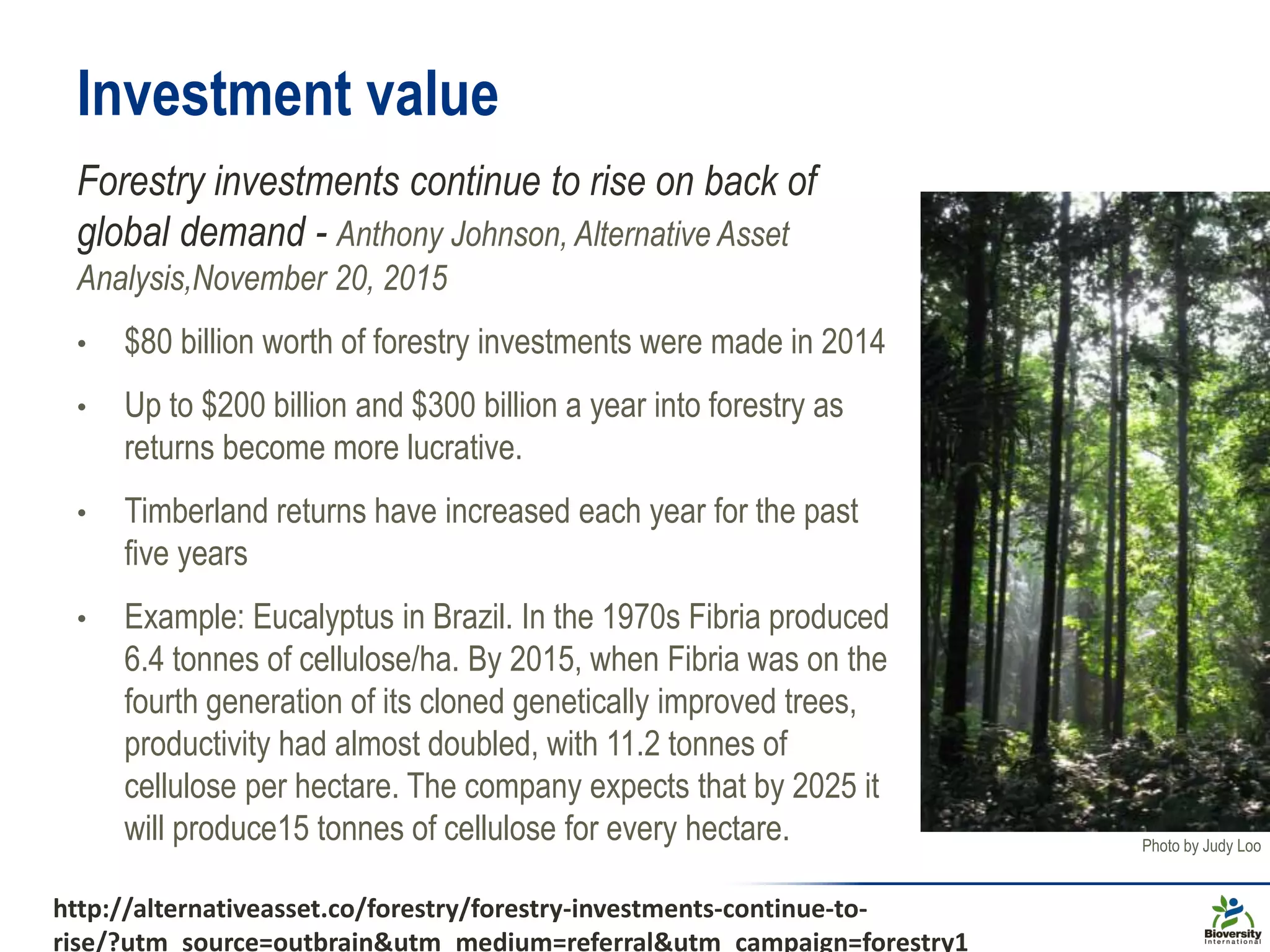
Investment value
Forestry investments continue to rise on back of
global demand - Anthony Johnson, Alternative Asset
Analysis,November 20, 2015
• $80 billion worth of forestry investments were made in 2014
• Up to $200 billion and $300 billion a year into forestry as
returns become more lucrative.
• Timberland returns have increased each year for the past
five years
• Example: Eucalyptus in Brazil. In the 1970s Fibria produced
6.4 tonnes of cellulose/ha. By 2015, when Fibria was on the
fourth generation of its cloned genetically improved trees,
productivity had almost doubled, with 11.2 tonnes of
cellulose per hectare. The company expects that by 2025 it
will produce15 tonnes of cellulose for every hectare. Photo by Judy Loo
http://alternativeasset.co/forestry/forestry-investments-continue-to-
rise/?utm_source=outbrain&utm_medium=referral&utm_campaign=forestry1
Biotech applied to trees
GMO trees
Genomic selection
Sequencing and resequencing
Cloning
Breeding (QTLs)
Molecular tools for management
Timber tracking
Improving returns on planting - restoration
AFRICAN ORPHAN CROPS CONSORTIUM
GENE JOURNEY
VISION
To improve the nutritional content, productivity and climatic adaptability of
some of Africa’s most important food crops (including 47 tree species);
providing a fundamental step in helping to eradicate chronic hunger,
malnutrition and stunting in the children of Africa
2010-11 Conceptualization of AOCC - an uncommon public-private
partnership under leadership of Mars, ICRAF, University of
California, Davis (UCD) and the New Partnership for Africa’s
Development (NEPAD)
Dr. Ibrahim Mayaki CEO NEPAD presented AOCC to African heads of state at an
African Union Assembly and they voted to endorse the initiative
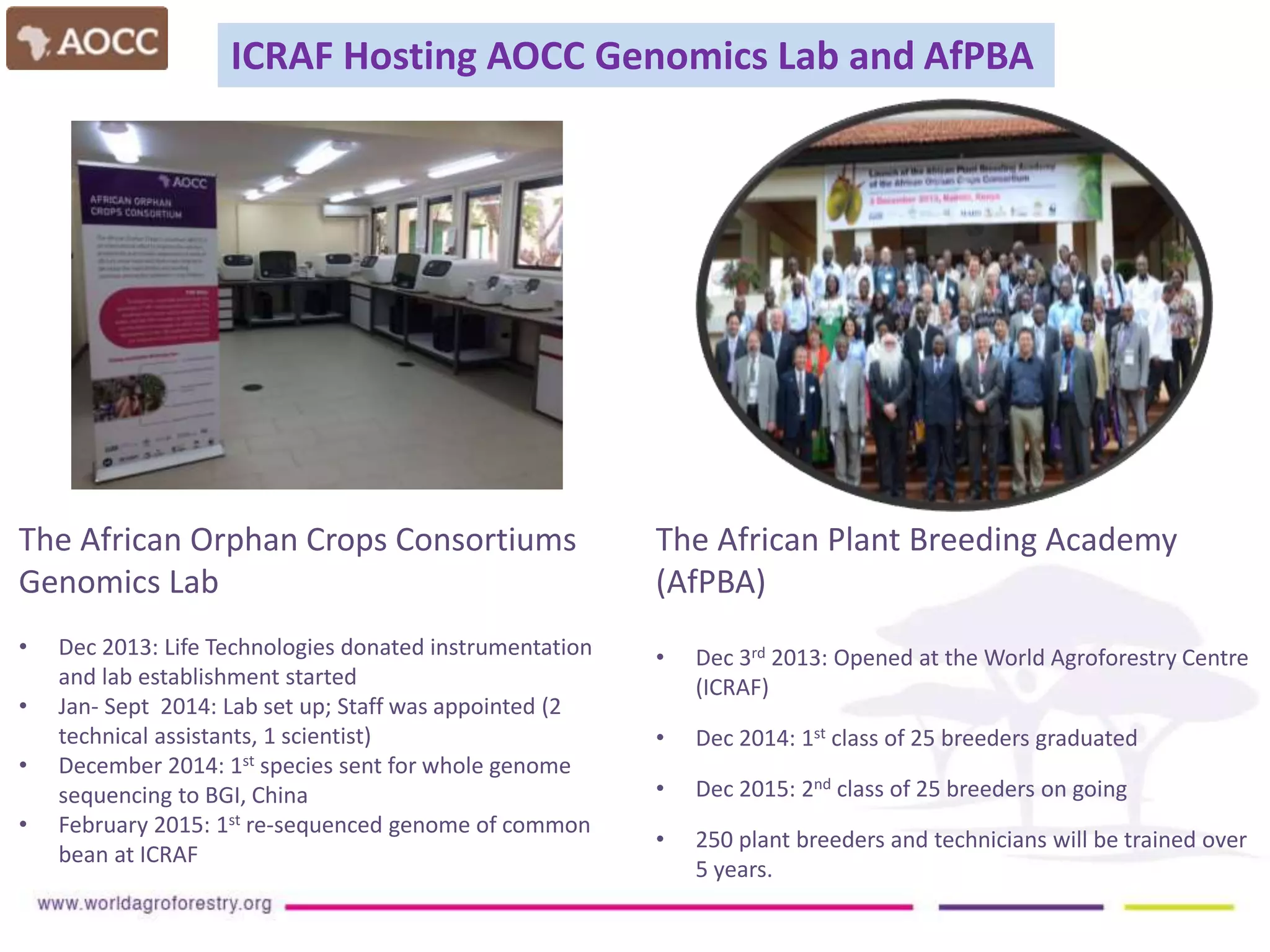
The African Plant Breeding Academy
(AfPBA)
• Dec 3rd 2013: Opened at the World Agroforestry Centre
(ICRAF)
• Dec 2014: 1st class of 25 breeders graduated
• Dec 2015: 2nd class of 25 breeders on going
• 250 plant breeders and technicians will be trained over
5 years.
ICRAF Hosting AOCC Genomics Lab and AfPBA
The African Orphan Crops Consortiums
Genomics Lab
• Dec 2013: Life Technologies donated instrumentation
and lab establishment started
• Jan- Sept 2014: Lab set up; Staff was appointed (2
technical assistants, 1 scientist)
• December 2014: 1st species sent for whole genome
sequencing to BGI, China
• February 2015: 1st re-sequenced genome of common
bean at ICRAF
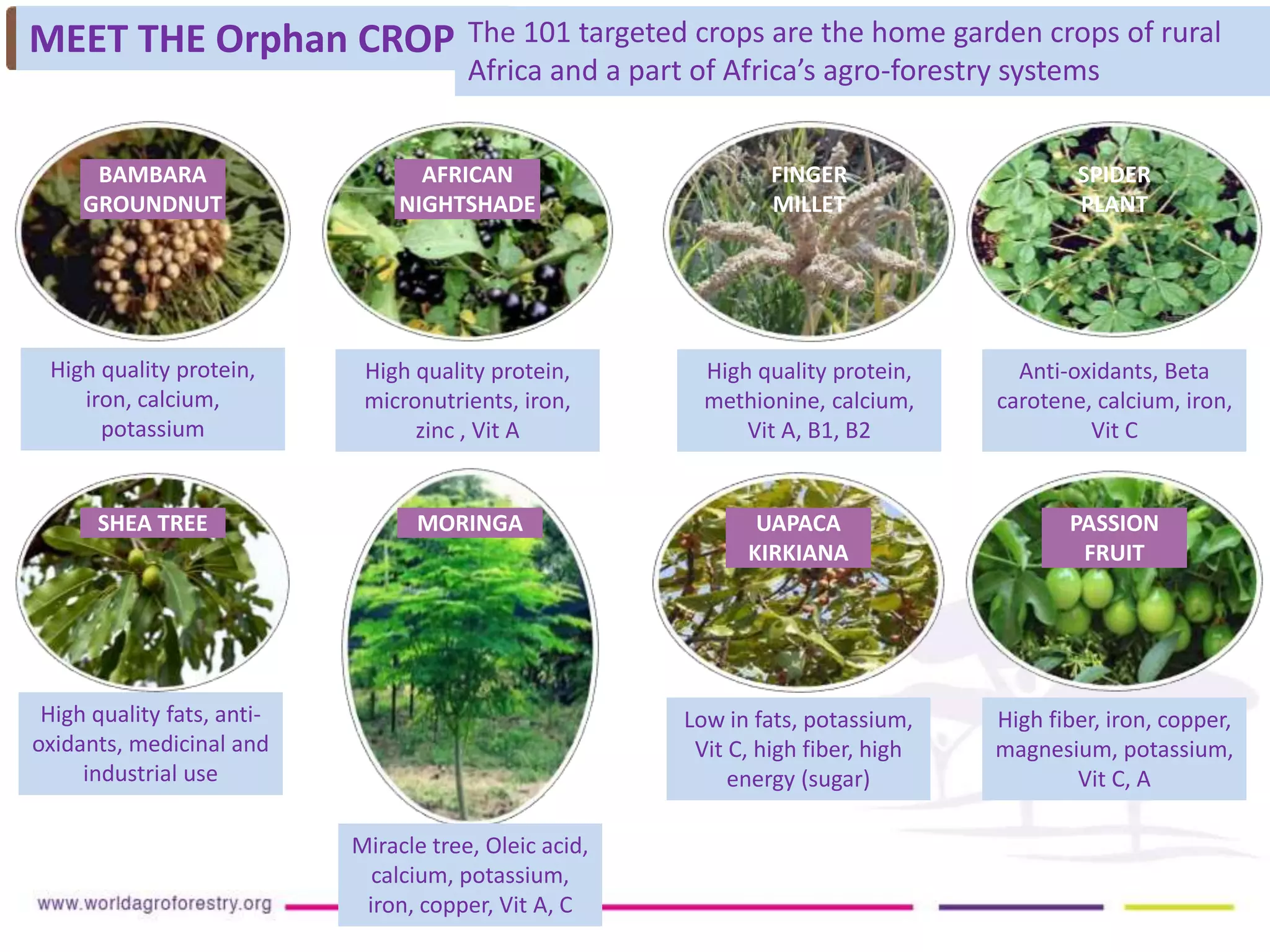
MEET THE Orphan CROPsSThe 101 targeted crops are the home garden crops of rural
Africa and a part of Africa’s agro-forestry systems
BAMBARA
GROUNDNUT
High quality protein,
iron, calcium,
potassium
High quality protein,
micronutrients, iron,
zinc , Vit A
AFRICAN
NIGHTSHADE
FINGER
MILLET
High quality protein,
methionine, calcium,
Vit A, B1, B2
SPIDER
PLANT
Anti-oxidants, Beta
carotene, calcium, iron,
Vit C
High quality fats, anti-
oxidants, medicinal and
industrial use
SHEA TREE MORINGA
Miracle tree, Oleic acid,
calcium, potassium,
iron, copper, Vit A, C
UAPACA
KIRKIANA
Low in fats, potassium,
Vit C, high fiber, high
energy (sugar)
PASSION
FRUIT
High fiber, iron, copper,
magnesium, potassium,
Vit C, A
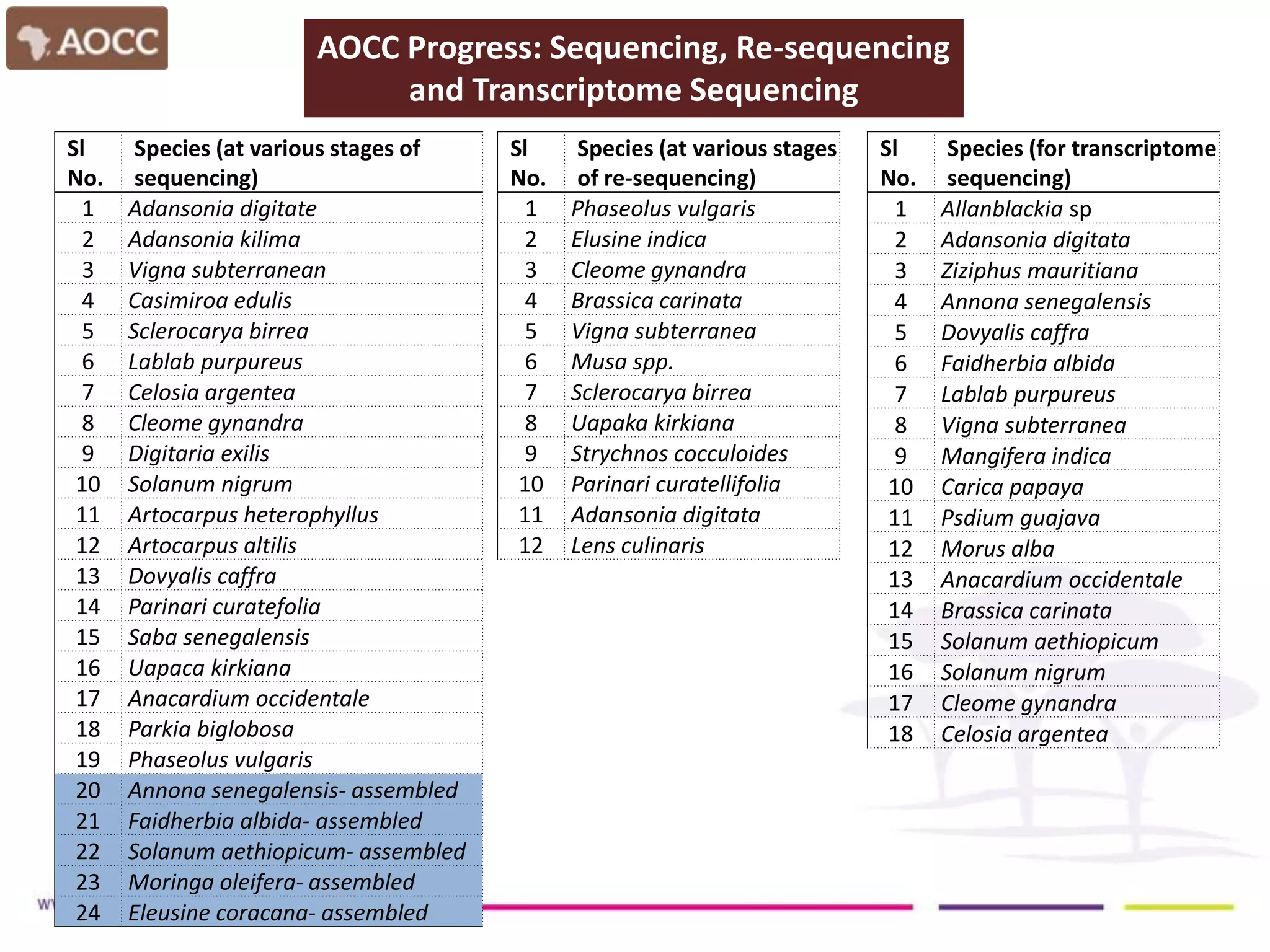
Sl
No.
Species (at various stages of
sequencing)
1 Adansonia digitate
2 Adansonia kilima
3 Vigna subterranean
4 Casimiroa edulis
5 Sclerocarya birrea
6 Lablab purpureus
7 Celosia argentea
8 Cleome gynandra
9 Digitaria exilis
10 Solanum nigrum
11 Artocarpus heterophyllus
12 Artocarpus altilis
13 Dovyalis caffra
14 Parinari curatefolia
15 Saba senegalensis
16 Uapaca kirkiana
17 Anacardium occidentale
18 Parkia biglobosa
19 Phaseolus vulgaris
20 Annona senegalensis- assembled
21 Faidherbia albida- assembled
22 Solanum aethiopicum- assembled
23 Moringa oleifera- assembled
24 Eleusine coracana- assembled
AOCC Progress: Sequencing, Re-sequencing
and Transcriptome Sequencing
Sl
No.
Species (at various stages
of re-sequencing)
1 Phaseolus vulgaris
2 Elusine indica
3 Cleome gynandra
4 Brassica carinata
5 Vigna subterranea
6 Musa spp.
7 Sclerocarya birrea
8 Uapaka kirkiana
9 Strychnos cocculoides
10 Parinari curatellifolia
11 Adansonia digitata
12 Lens culinaris
Sl
No.
Species (for transcriptome
sequencing)
1 Allanblackia sp
2 Adansonia digitata
3 Ziziphus mauritiana
4 Annona senegalensis
5 Dovyalis caffra
6 Faidherbia albida
7 Lablab purpureus
8 Vigna subterranea
9 Mangifera indica
10 Carica papaya
11 Psdium guajava
12 Morus alba
13 Anacardium occidentale
14 Brassica carinata
15 Solanum aethiopicum
16 Solanum nigrum
17 Cleome gynandra
18 Celosia argentea
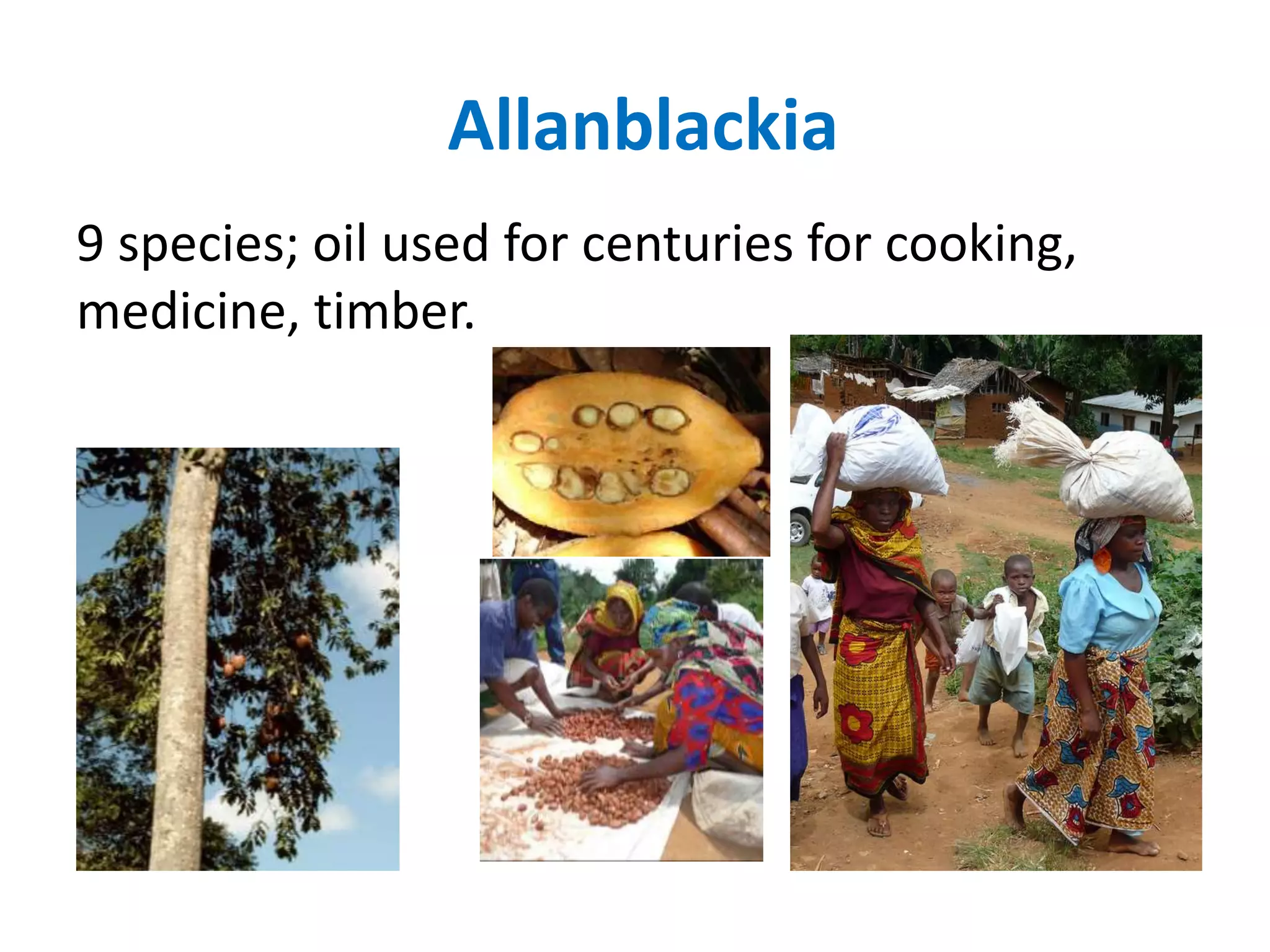
Allanblackia
9 species; oil used for centuries for cooking,
medicine, timber.
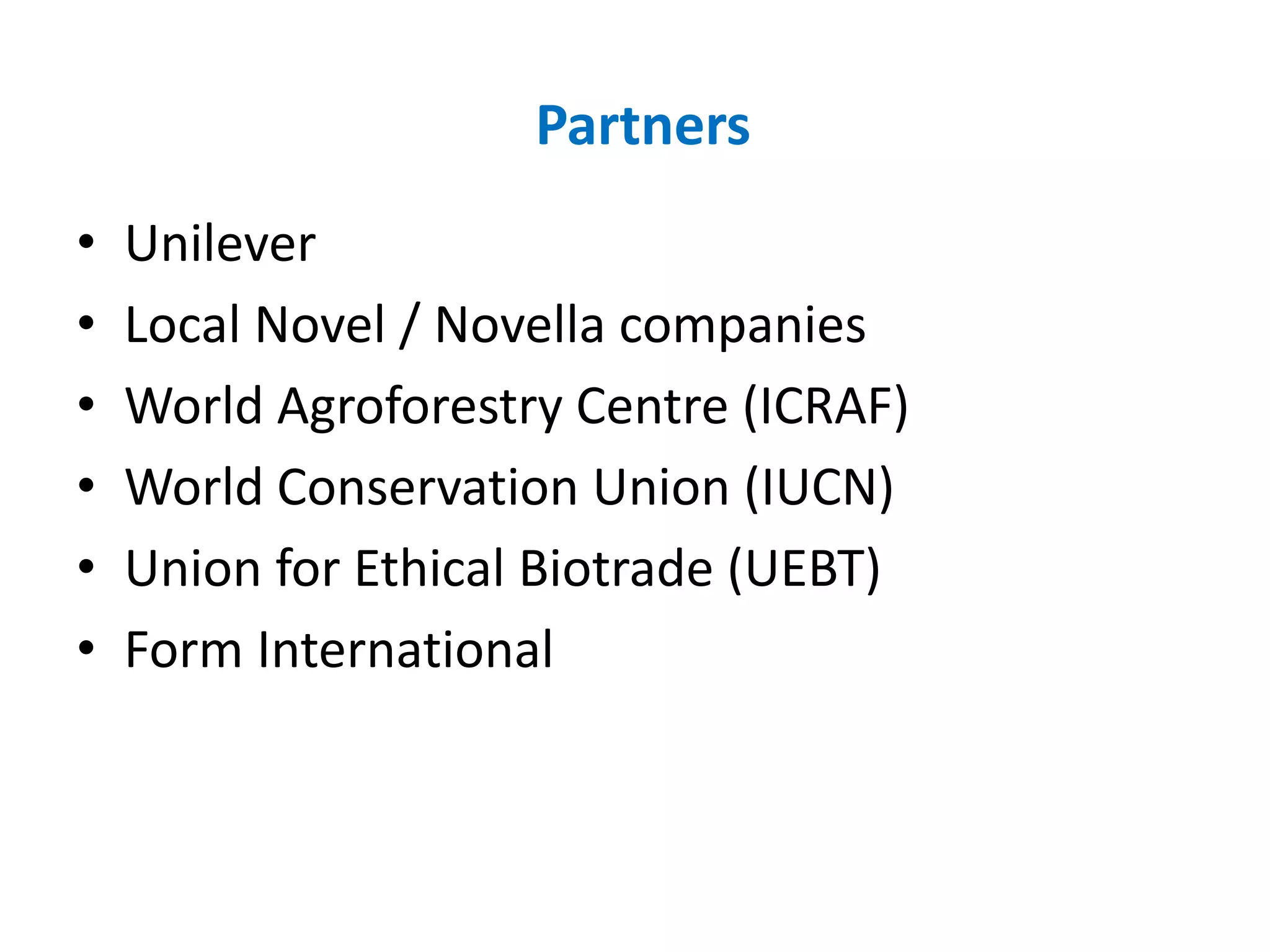
Partners
• Unilever
• Local Novel / Novella companies
• World Agroforestry Centre (ICRAF)
• World Conservation Union (IUCN)
• Union for Ethical Biotrade (UEBT)
• Form International
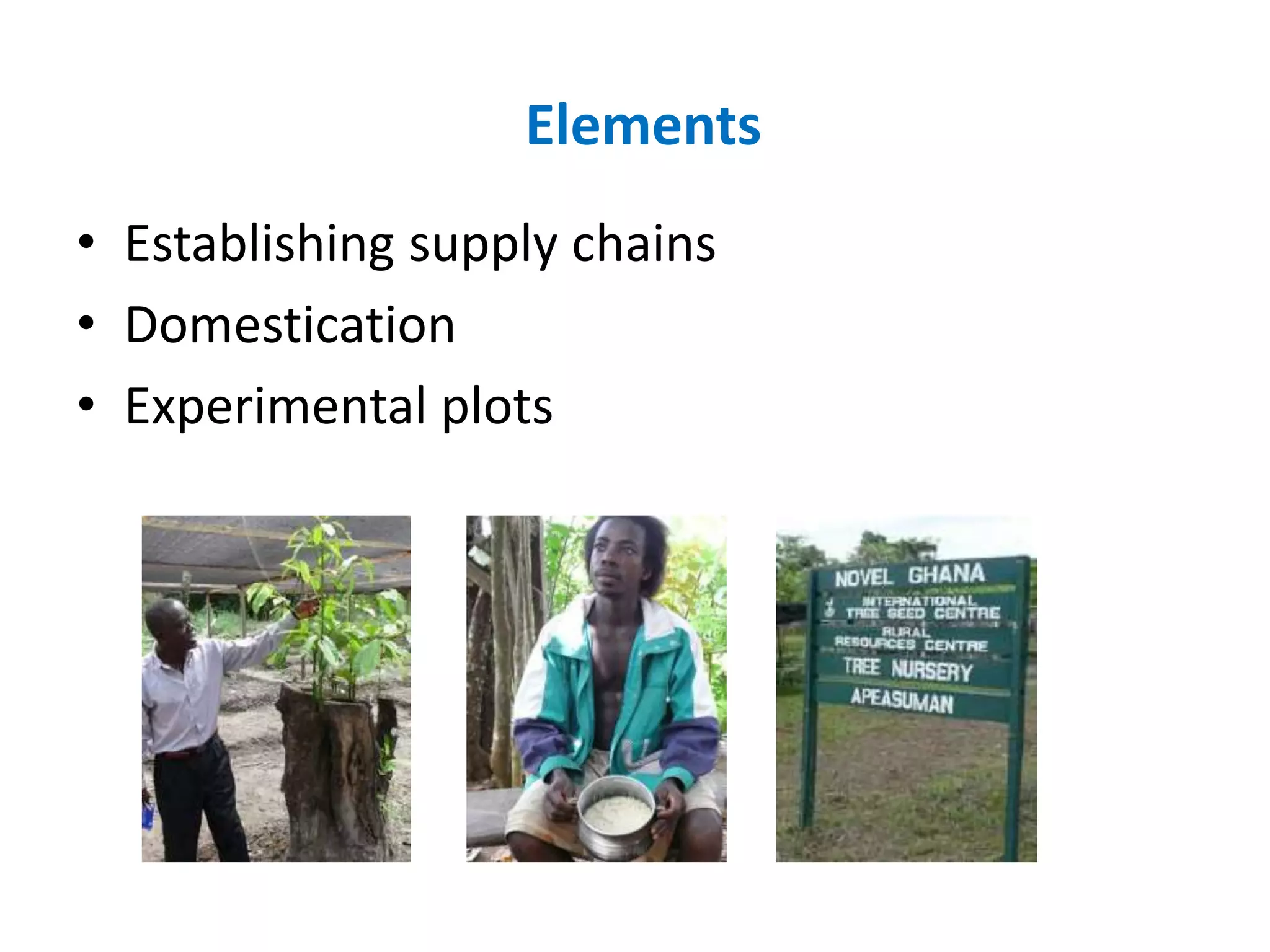
Elements
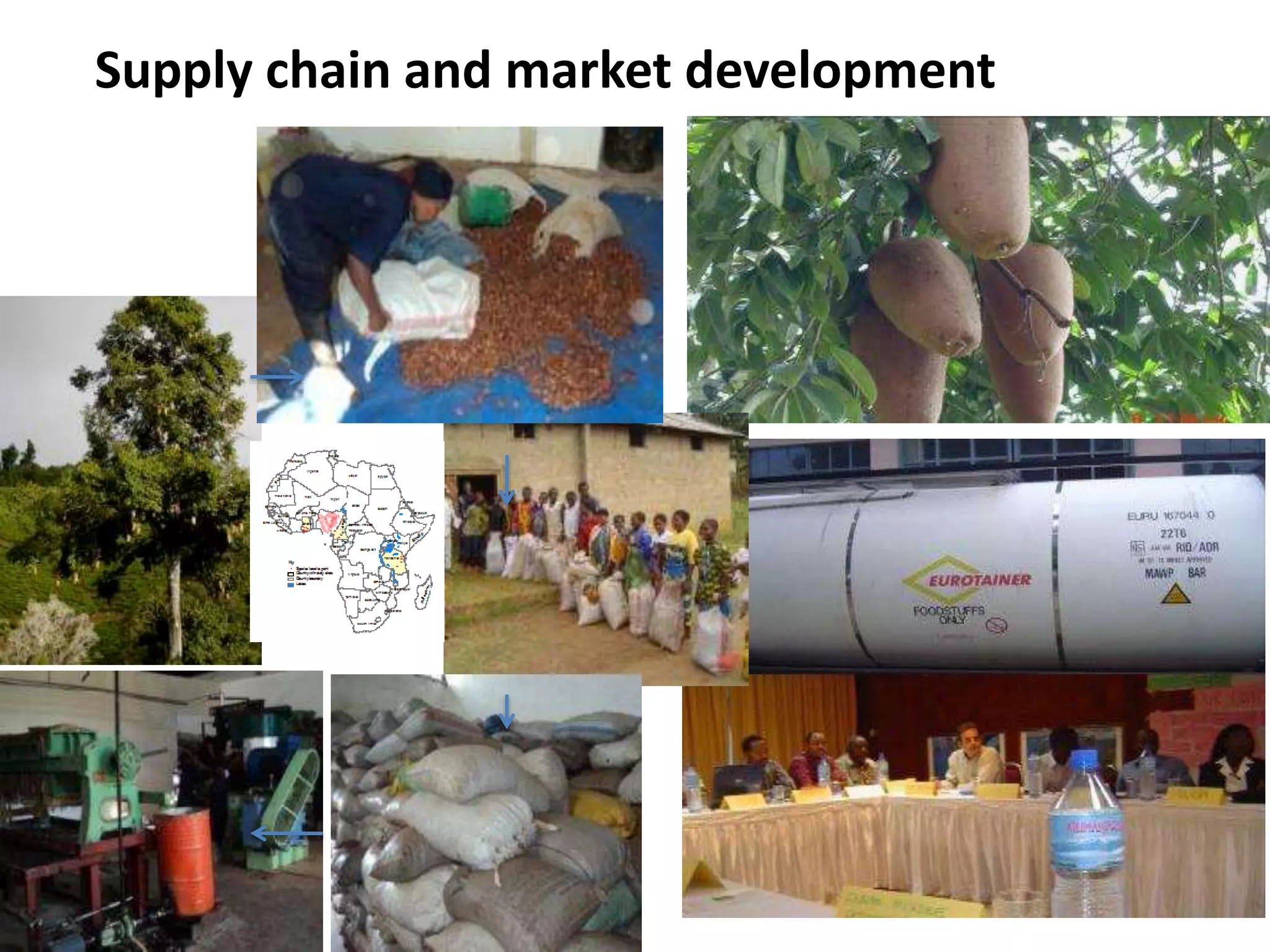
• Establishing supply chains
• Domestication
• Experimental plots
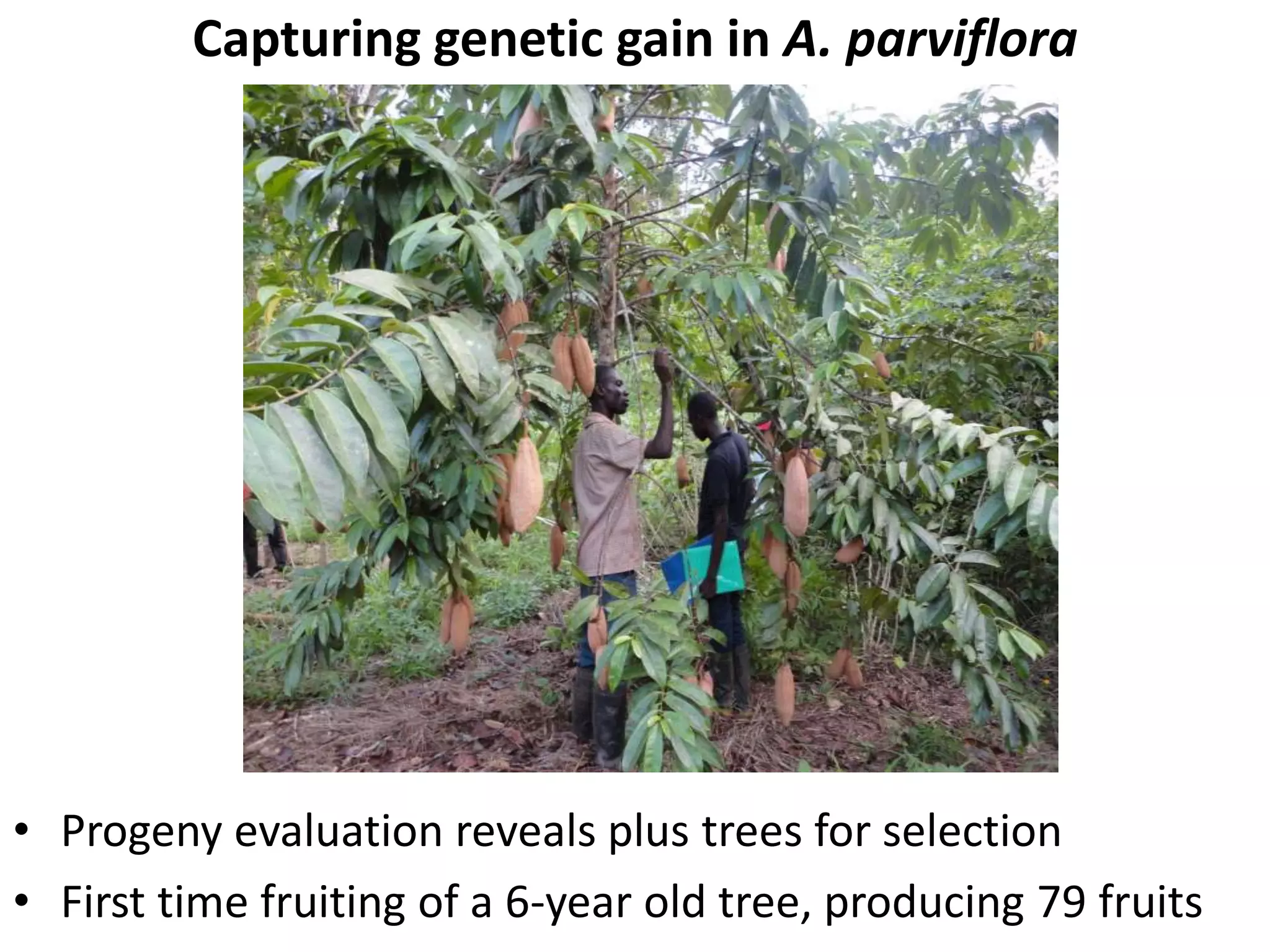
Capturing genetic gain in A. parviflora
• Progeny evaluation reveals plus trees for selection
• First time fruiting of a 6-year old tree, producing 79 fruits
Supply chain and market development
Achievements
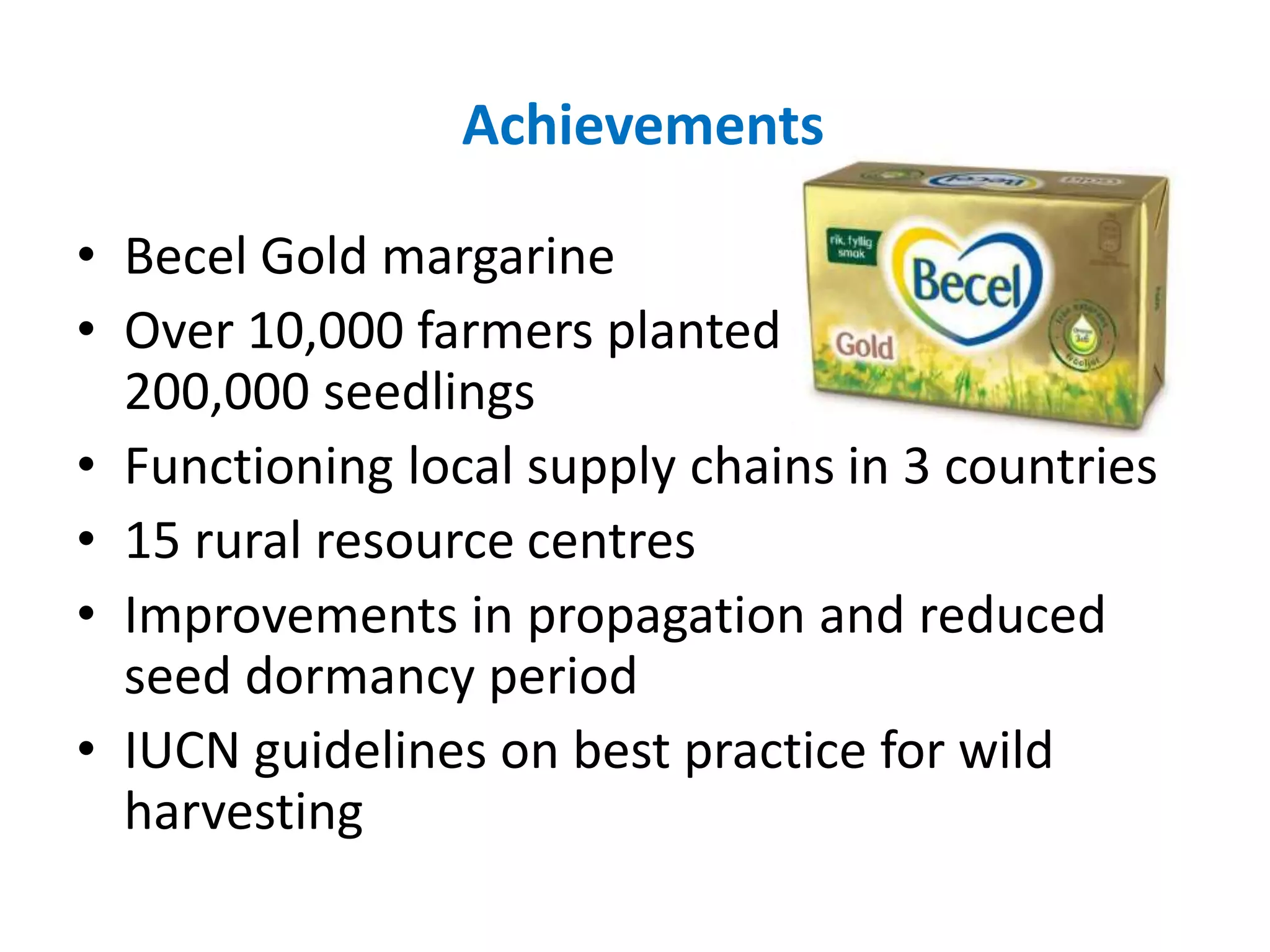
• Becel Gold margarine
• Over 10,000 farmers planted
200,000 seedlings
• Functioning local supply chains in 3 countries
• 15 rural resource centres
• Improvements in propagation and reduced
seed dormancy period
• IUCN guidelines on best practice for wild
harvesting
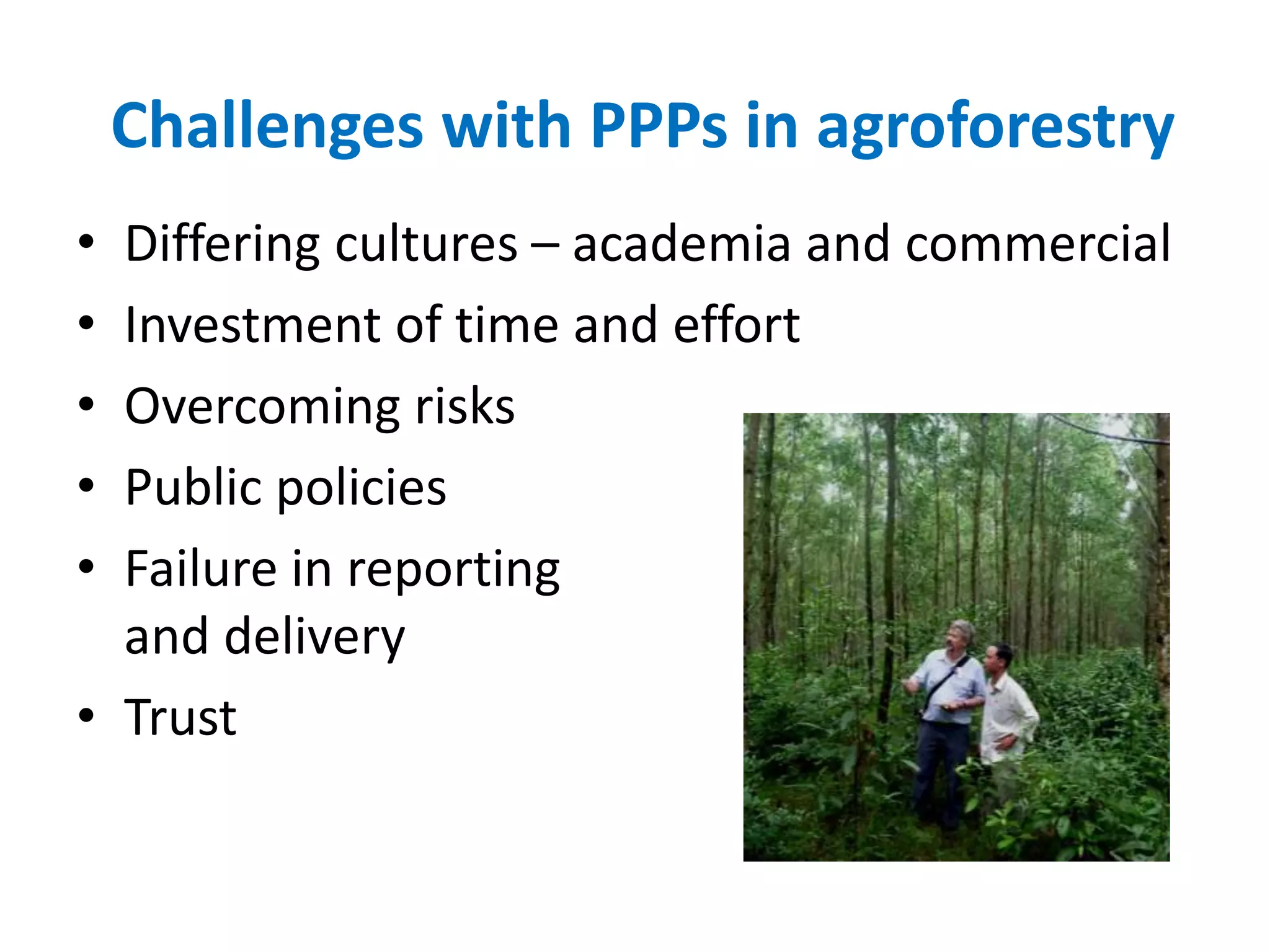
Challenges with PPPs in agroforestry
• Differing cultures – academia and commercial
• Investment of time and effort
• Overcoming risks
• Public policies
• Failure in reporting
and delivery
• Trust
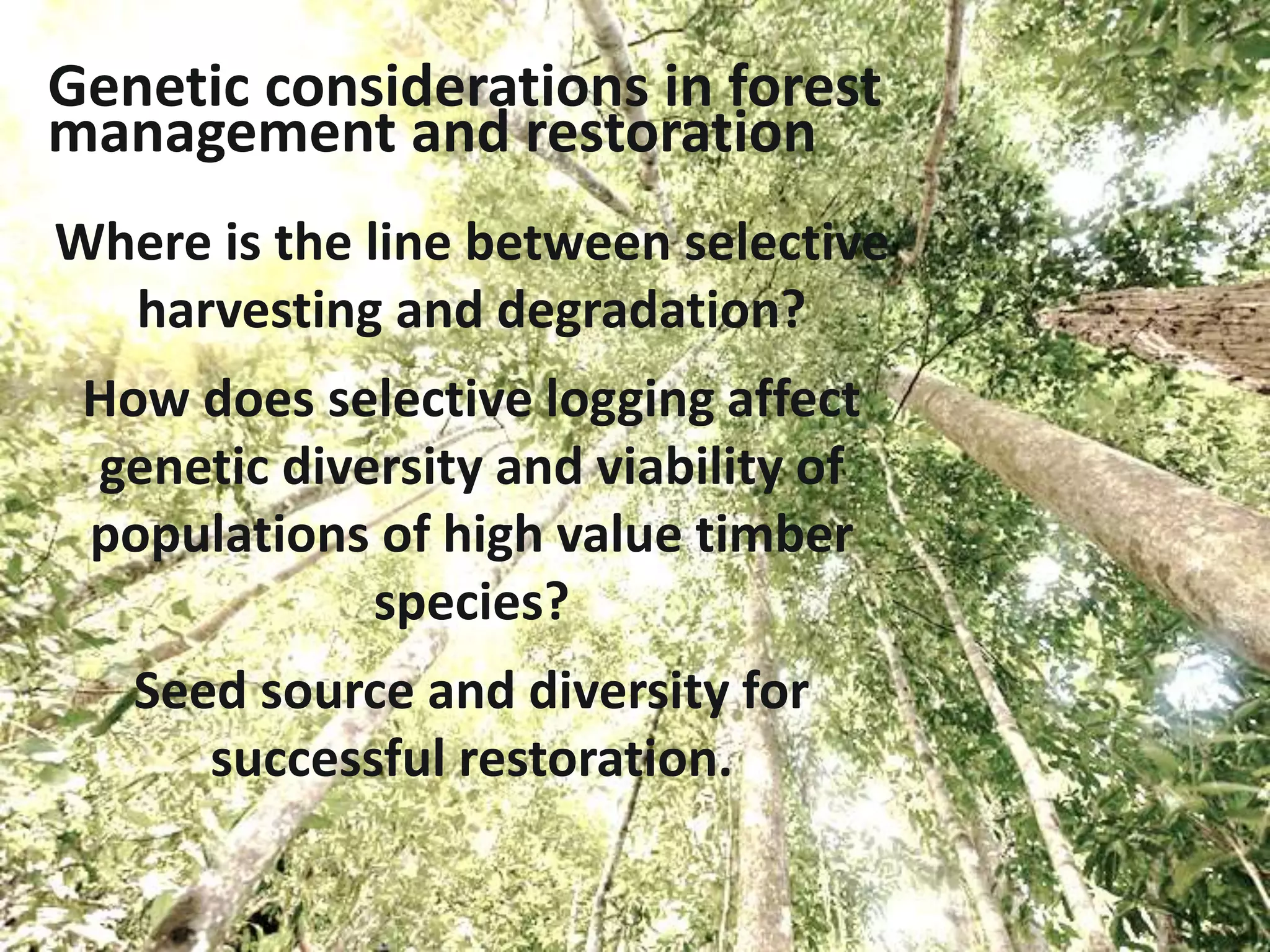
Genetic considerations in forest
management and restoration
Where is the line between selective
harvesting and degradation?
How does selective logging affect
genetic diversity and viability of
populations of high value timber
species?
Seed source and diversity for
successful restoration.
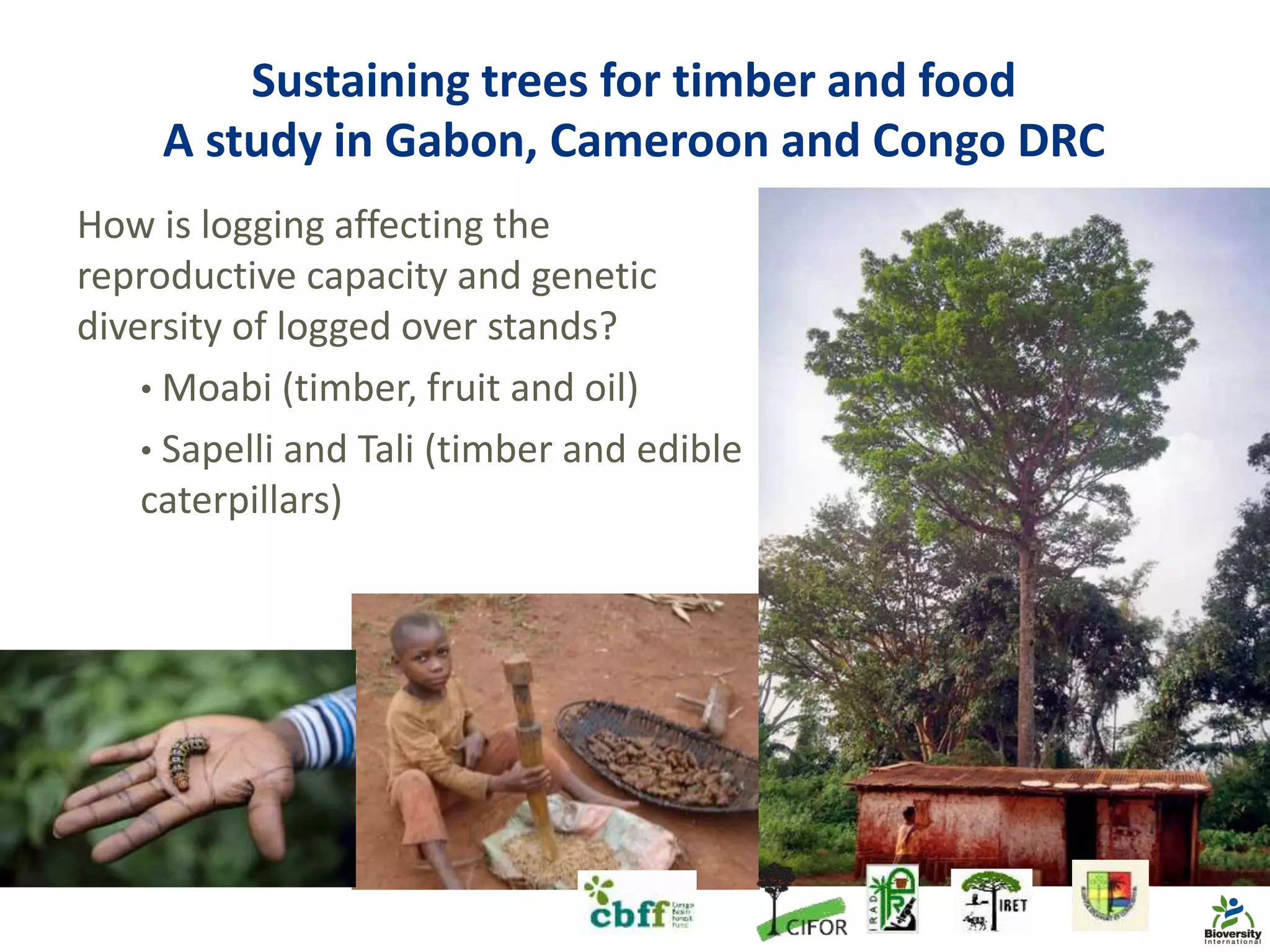
Sustaining trees for timber and food
A study in Gabon, Cameroon and Congo DRC
How is logging affecting the
reproductive capacity and genetic
diversity of logged over stands?
• Moabi (timber, fruit and oil)
• Sapelli and Tali (timber and edible
caterpillars)
• J.Tieguhong; Bioversity photo
• L.Snook Bioversity photo
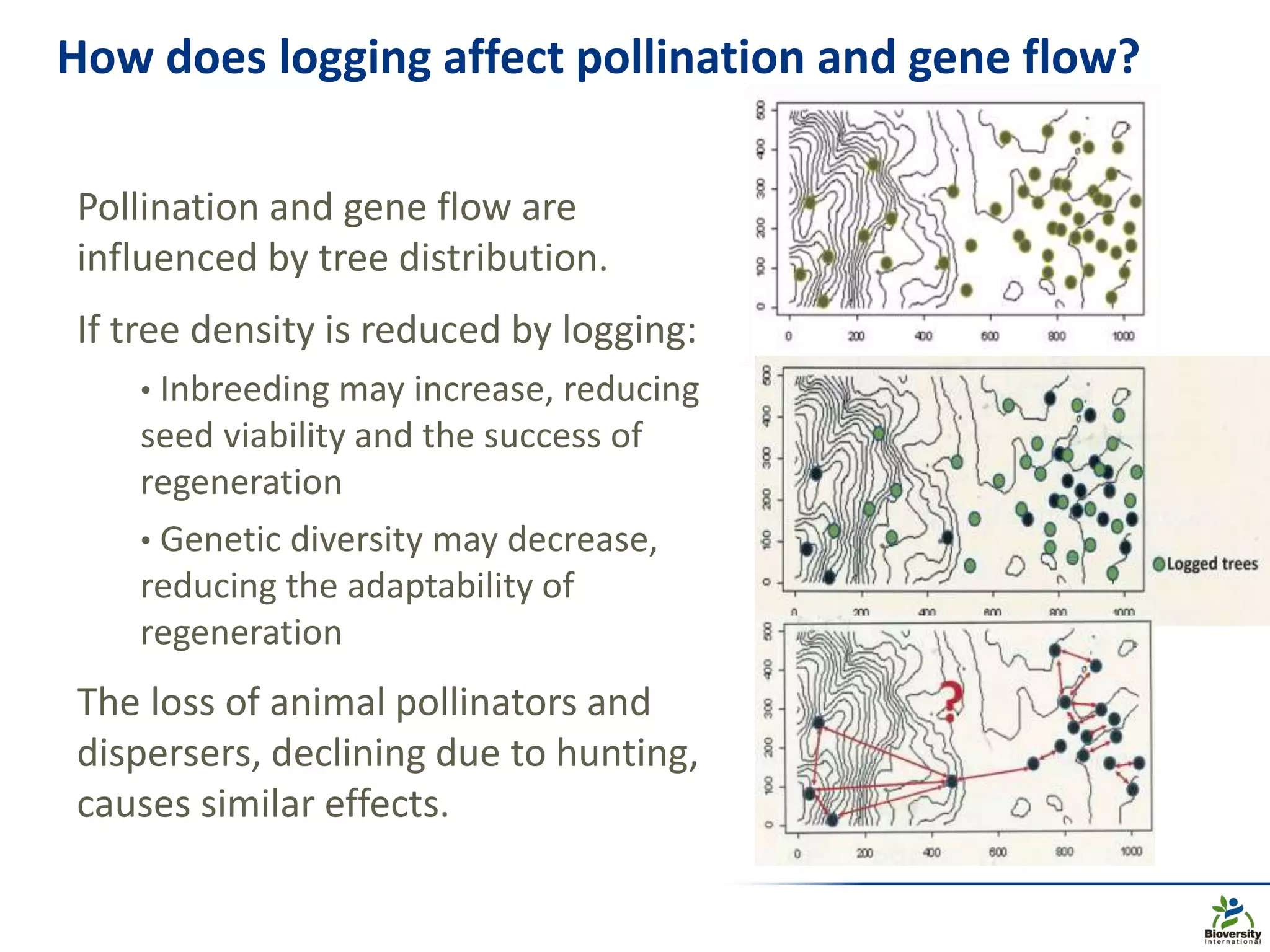
How does logging affect pollination and gene flow?
Pollination and gene flow are
influenced by tree distribution.
If tree density is reduced by logging:
• Inbreeding may increase, reducing
seed viability and the success of
regeneration
• Genetic diversity may decrease,
reducing the adaptability of
regeneration
The loss of animal pollinators and
dispersers, declining due to hunting,
causes similar effects.
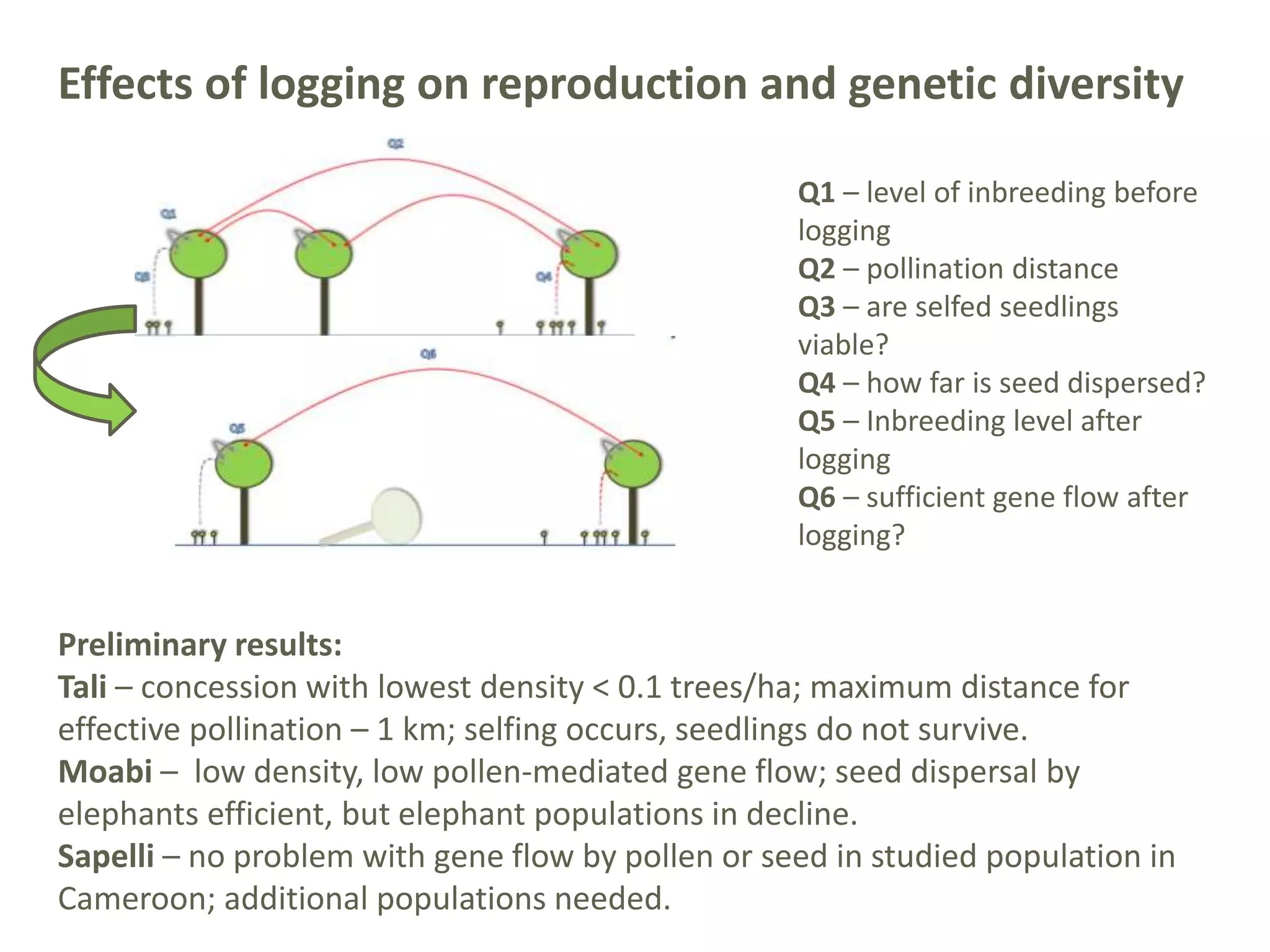
Effects of logging on reproduction and genetic diversity
Q1 – level of inbreeding before
logging
Q2 – pollination distance
Q3 – are selfed seedlings
viable?
Q4 – how far is seed dispersed?
Q5 – Inbreeding level after
logging
Q6 – sufficient gene flow after
logging?
Preliminary results:
Tali – concession with lowest density < 0.1 trees/ha; maximum distance for
effective pollination – 1 km; selfing occurs, seedlings do not survive.
Moabi – low density, low pollen-mediated gene flow; seed dispersal by
elephants efficient, but elephant populations in decline.
Sapelli – no problem with gene flow by pollen or seed in studied population in
Cameroon; additional populations needed.
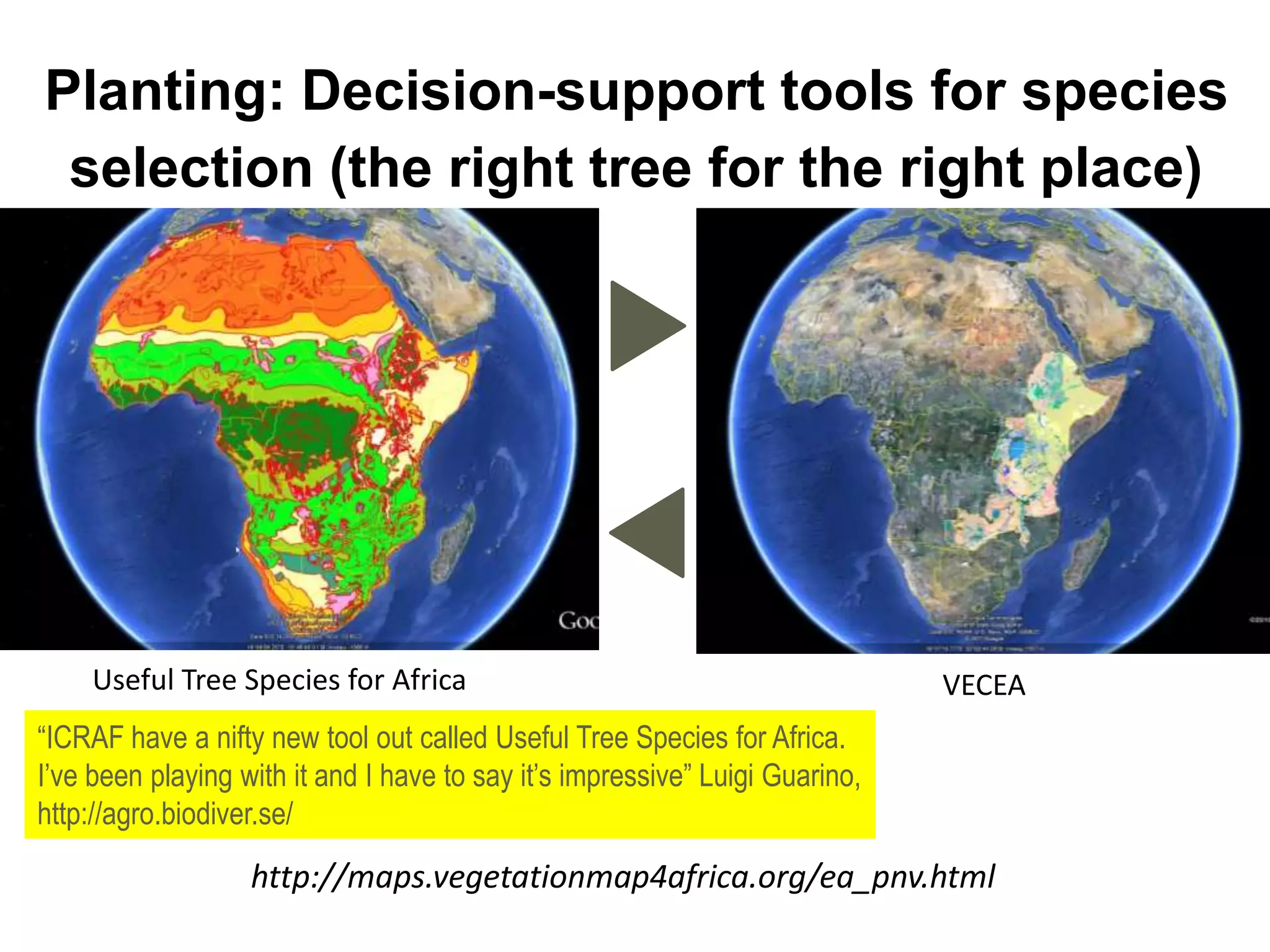
Planting: Decision-support tools for species
selection (the right tree for the right place)
Useful Tree Species for Africa VECEA
“ICRAF have a nifty new tool out called Useful Tree Species for Africa.
I’ve been playing with it and I have to say it’s impressive” Luigi Guarino,
http://agro.biodiver.se/
http://maps.vegetationmap4africa.org/ea_pnv.html
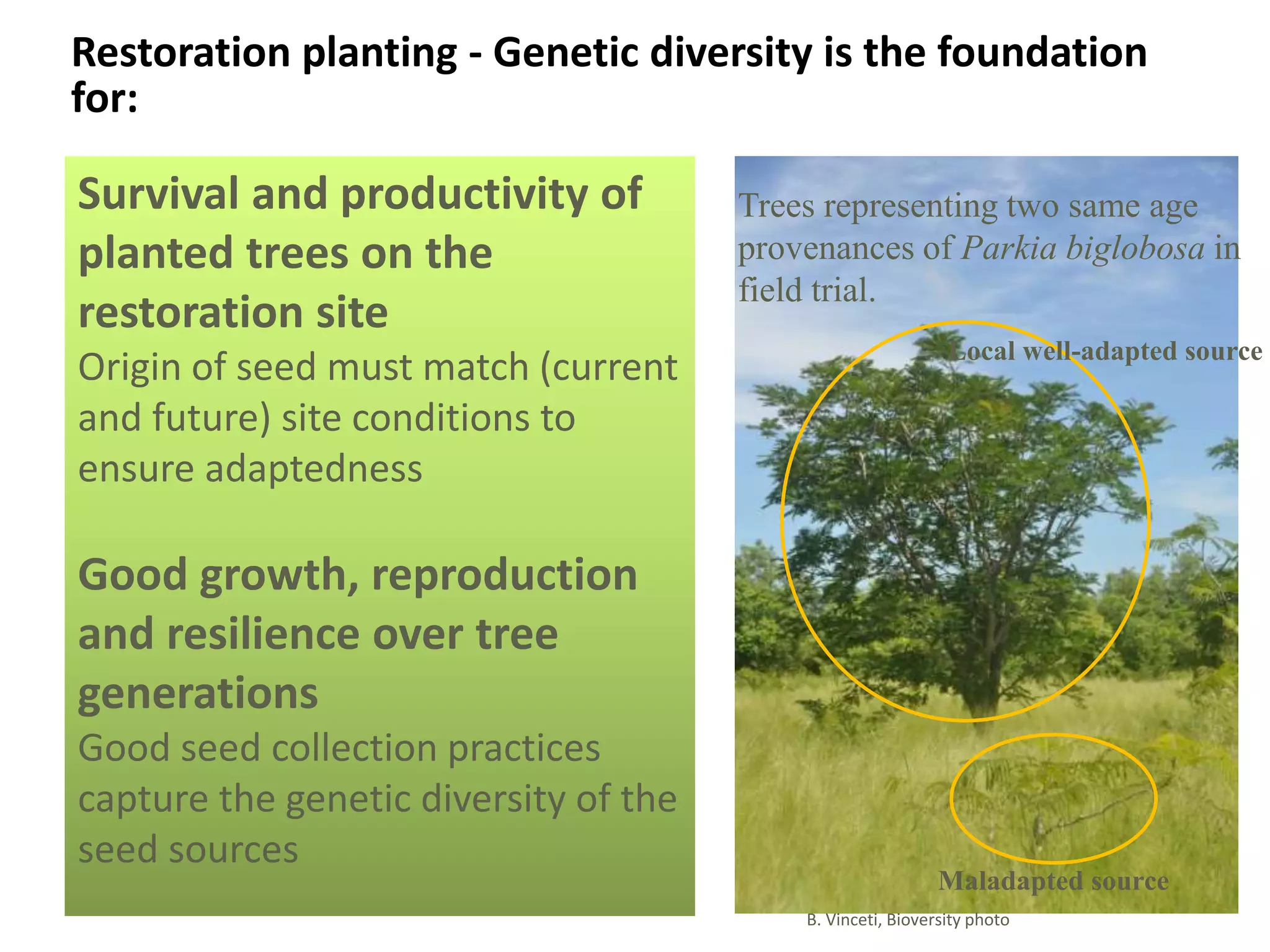
Survival and productivity of
planted trees on the
restoration site
Origin of seed must match (current
and future) site conditions to
ensure adaptedness
Good growth, reproduction
and resilience over tree
generations
Good seed collection practices
capture the genetic diversity of the
seed sources
Restoration planting - Genetic diversity is the foundation
for:
Trees representing two same age
provenances of Parkia biglobosa in
field trial.
Maladapted source
Local well-adapted source
B. Vinceti, Bioversity photo
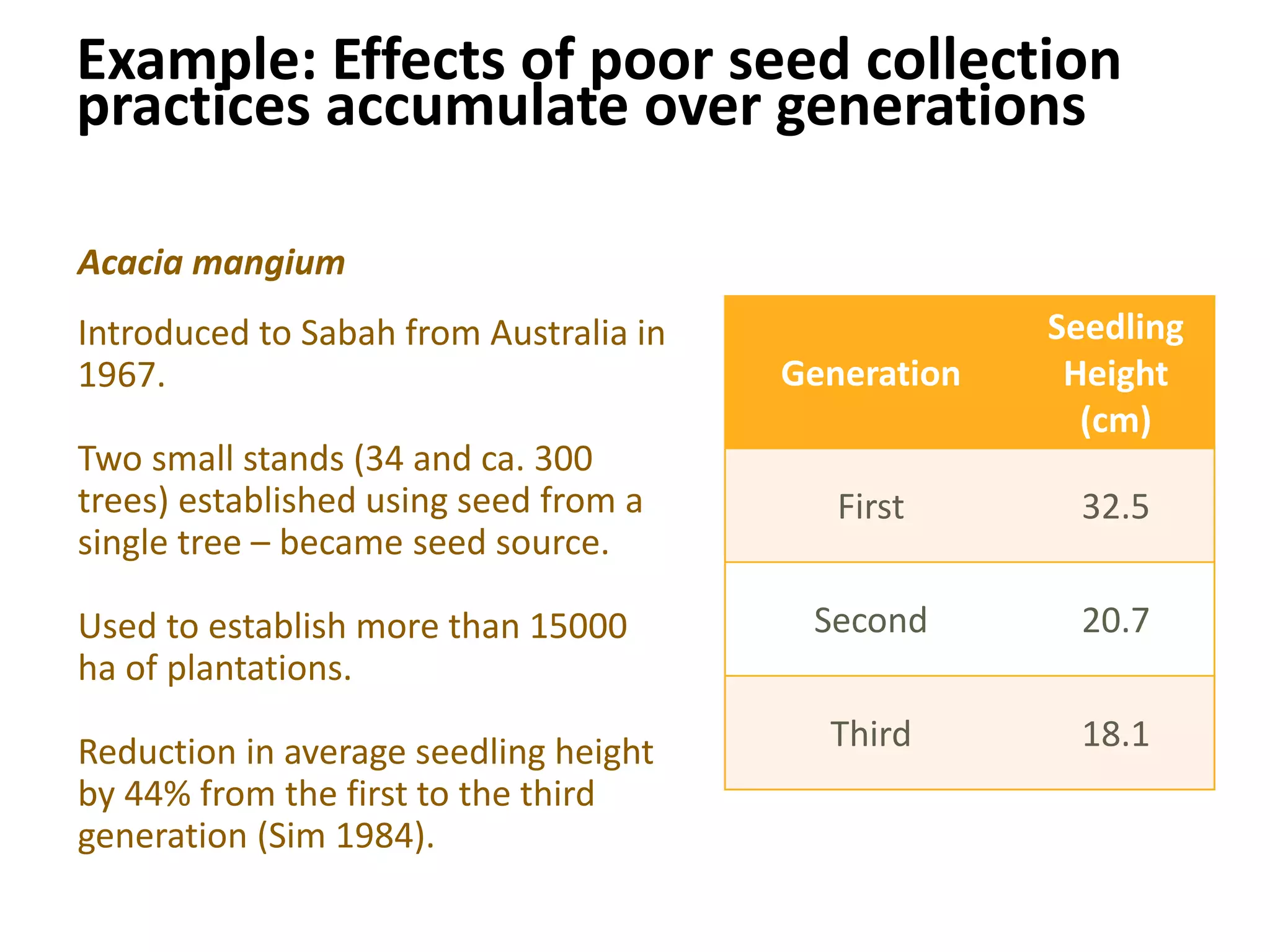
Acacia mangium
Introduced to Sabah from Australia in
1967.
Two small stands (34 and ca. 300
trees) established using seed from a
single tree – became seed source.
Used to establish more than 15000
ha of plantations.
Reduction in average seedling height
by 44% from the first to the third
generation (Sim 1984).
Example: Effects of poor seed collection
practices accumulate over generations
Generation
Seedling
Height
(cm)
First 32.5
Second 20.7
Third 18.1
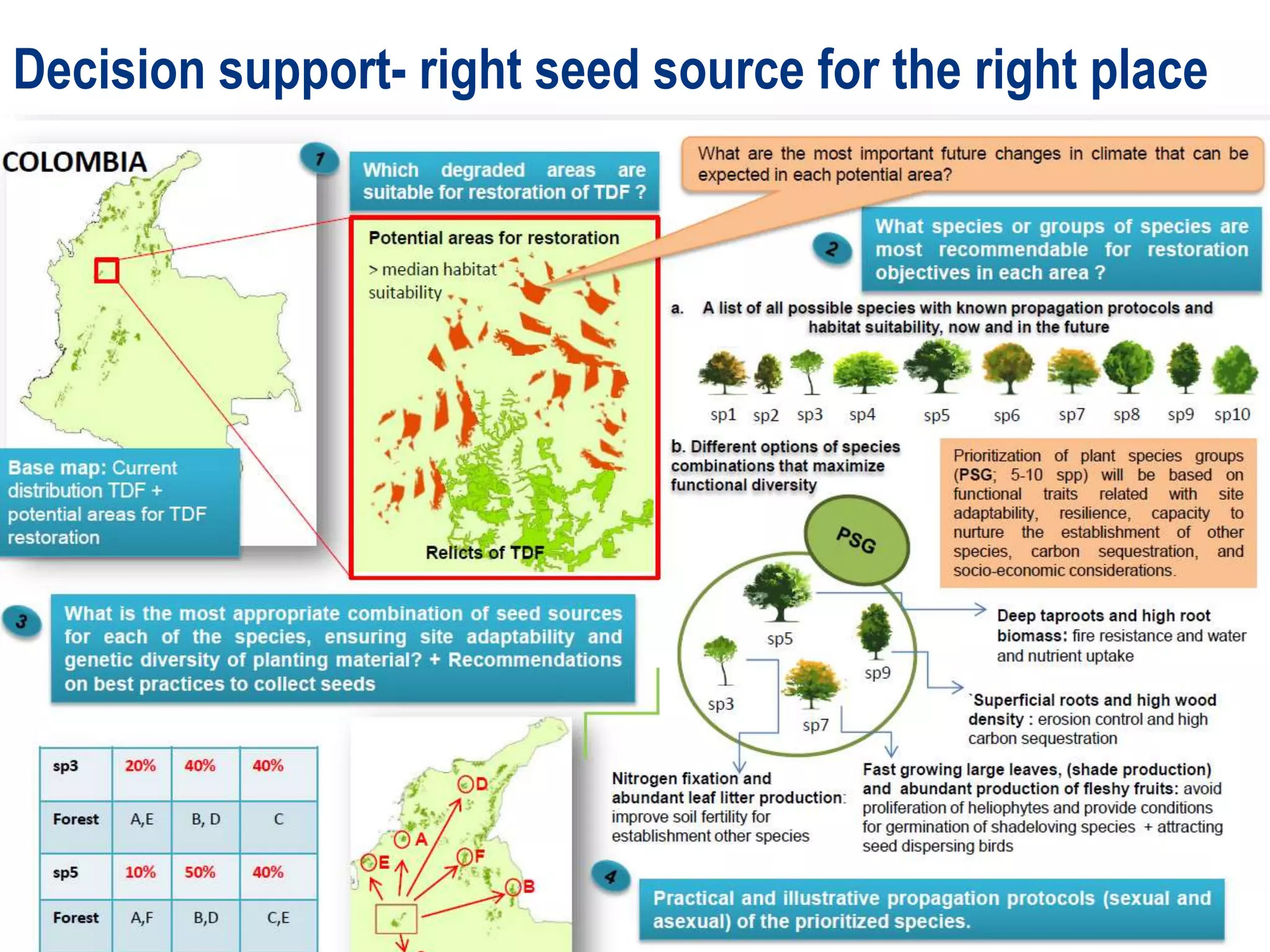
Decision support- right seed source for the right place
• Adaptive traits
– Provenance trials
– Marker assisted or genomic selection
• Levels and patterns of genetic diversity
– Molecular markers
• For most species genetic analyses have not yet been
carried out
• Much work remains to ensure effective planting for
restoration and agroforestry benefits
Matching source to site
www.bioversityinternational.org
Thank you
@BioversityInt
Judy Loo and Ramni Jamnadass
j.loo@cgiar.org, r.jamnadass@cgiar.org

Resource use efficiency in forestry: Utilisation of tree genetic resources

  • 1.
    Resource use efficiencyin forestry: Utilisation of tree genetic resources Judy Loo and Ramni Jamnadass Bioversity International & World Agroforestry Centre 15 February, 2016 Photo:KrishnasisGhosh
  • 2.
    Presentation overview: • Background:CG & tree genetic resources; what’s different about trees? • Values of trees • Biotech approaches for trees – remembering the smallholder • African Orphan Crops Consortium • Allanblackia example • Using genes to improve management practices • The right tree for the right place Kyrgyzstan. Photo by Judy Loo
  • 3.
    Trees are different! •Large, long-lived, late maturing, highly diverse, mostly undomesticated • Long-distance pollination, produce millions of seed throughout lifetime – particular challenges and opportunities • ~ 80,000 species; thousands important for livelihoods • Often trees are managed on some form of the commons – public land, community forests, etc.
  • 4.
    Table 1. Someadvantages and drawbacks of the tree growth form Advantage Drawback Great potential of biomass gain High maintenance costs High competition after successful establishment Extremely high recruit mortality Endurance to short-term resource depletion Increased probability of suffering catastrophic events Great lifetime fecundity Delayed maturity Little dependence on particular reproductive events Trade-off between present reproductive output and future growth, survival, and reproduction Large pollen and seed production and release height facilitate gene dispersal Low plant density complicates mating and increases pollen limitation Relatively little seed limitation of recruitment Strong limitation of suitable sites and time windows for recruitment Local adaptation favored by strong selection during early life stages Local adaptation hindered by high gene flow Reduced accumulation of mutations per unit of time Increased mutation rate per generation Strong inbreeding depression increases outcrossing rate and maintains genetic diversity Lifelong accumulation of somatic mutations results in susceptibility to inbreeding depression From: Rémy Petit and Arndt Hampe, 2006 , Some evolutionary consequences of being a tree
  • 5.
    Different uses andvalues of trees: Products and Services B. Trees for Services A. Trees for Products Food Firewood Medicine Income Sawn wood Fodder Soil fertility Carbon sequestration Erosion control Watershed protection Shade Biodiversity
  • 6.
    English name Speciesname Jan Feb Mar April May Jun Jul Aug Sep Oct Nov Dec Vit C Vit A Tickberry Lantana camara Pawpaw Carica papaya + +++ Mango Mangifera indica + +++ Banana Musa x paradisiaca Loquat Eriobotrya japonica +++ Mulberry Morus alba (+) Tamarind Tamarindus indica Waterberry Syzygium spp. +++ Custard apple Annona reticulata (+) Guava Psidium guajava +++ + Pomegranate Punica granatum White sapote Casimiroa edulis (+) Wild medlar Vangueria madagascariensis Lemon Citrus limon + Orange Citrus sinensis + Chocolate berry Vitex payos +++ Avocado Persea americana Passionfruit Passiflora edulis + Jacket plum Pappea capensis Desert date Balanites aegyptiaca (+) Bush plum Carissa edulis Available species 2 4 6 4 4 5 4 2 3 1 2 2 Hunger gap Fruit tree portfolio for vitamin supply  Vitamin A and C supply possible year-round  Cultivation of 8-13 fruit tree species on each farm
  • 8.
    Investment value Forestry investmentscontinue to rise on back of global demand - Anthony Johnson, Alternative Asset Analysis,November 20, 2015 • $80 billion worth of forestry investments were made in 2014 • Up to $200 billion and $300 billion a year into forestry as returns become more lucrative. • Timberland returns have increased each year for the past five years • Example: Eucalyptus in Brazil. In the 1970s Fibria produced 6.4 tonnes of cellulose/ha. By 2015, when Fibria was on the fourth generation of its cloned genetically improved trees, productivity had almost doubled, with 11.2 tonnes of cellulose per hectare. The company expects that by 2025 it will produce15 tonnes of cellulose for every hectare. Photo by Judy Loo http://alternativeasset.co/forestry/forestry-investments-continue-to- rise/?utm_source=outbrain&utm_medium=referral&utm_campaign=forestry1
  • 9.
    Biotech applied totrees GMO trees Genomic selection Sequencing and resequencing Cloning Breeding (QTLs) Molecular tools for management Timber tracking Improving returns on planting - restoration
  • 10.
    AFRICAN ORPHAN CROPSCONSORTIUM GENE JOURNEY VISION To improve the nutritional content, productivity and climatic adaptability of some of Africa’s most important food crops (including 47 tree species); providing a fundamental step in helping to eradicate chronic hunger, malnutrition and stunting in the children of Africa 2010-11 Conceptualization of AOCC - an uncommon public-private partnership under leadership of Mars, ICRAF, University of California, Davis (UCD) and the New Partnership for Africa’s Development (NEPAD) Dr. Ibrahim Mayaki CEO NEPAD presented AOCC to African heads of state at an African Union Assembly and they voted to endorse the initiative
  • 11.
    The African PlantBreeding Academy (AfPBA) • Dec 3rd 2013: Opened at the World Agroforestry Centre (ICRAF) • Dec 2014: 1st class of 25 breeders graduated • Dec 2015: 2nd class of 25 breeders on going • 250 plant breeders and technicians will be trained over 5 years. ICRAF Hosting AOCC Genomics Lab and AfPBA The African Orphan Crops Consortiums Genomics Lab • Dec 2013: Life Technologies donated instrumentation and lab establishment started • Jan- Sept 2014: Lab set up; Staff was appointed (2 technical assistants, 1 scientist) • December 2014: 1st species sent for whole genome sequencing to BGI, China • February 2015: 1st re-sequenced genome of common bean at ICRAF
  • 12.
    MEET THE OrphanCROPsSThe 101 targeted crops are the home garden crops of rural Africa and a part of Africa’s agro-forestry systems BAMBARA GROUNDNUT High quality protein, iron, calcium, potassium High quality protein, micronutrients, iron, zinc , Vit A AFRICAN NIGHTSHADE FINGER MILLET High quality protein, methionine, calcium, Vit A, B1, B2 SPIDER PLANT Anti-oxidants, Beta carotene, calcium, iron, Vit C High quality fats, anti- oxidants, medicinal and industrial use SHEA TREE MORINGA Miracle tree, Oleic acid, calcium, potassium, iron, copper, Vit A, C UAPACA KIRKIANA Low in fats, potassium, Vit C, high fiber, high energy (sugar) PASSION FRUIT High fiber, iron, copper, magnesium, potassium, Vit C, A
  • 13.
    Sl No. Species (at variousstages of sequencing) 1 Adansonia digitate 2 Adansonia kilima 3 Vigna subterranean 4 Casimiroa edulis 5 Sclerocarya birrea 6 Lablab purpureus 7 Celosia argentea 8 Cleome gynandra 9 Digitaria exilis 10 Solanum nigrum 11 Artocarpus heterophyllus 12 Artocarpus altilis 13 Dovyalis caffra 14 Parinari curatefolia 15 Saba senegalensis 16 Uapaca kirkiana 17 Anacardium occidentale 18 Parkia biglobosa 19 Phaseolus vulgaris 20 Annona senegalensis- assembled 21 Faidherbia albida- assembled 22 Solanum aethiopicum- assembled 23 Moringa oleifera- assembled 24 Eleusine coracana- assembled AOCC Progress: Sequencing, Re-sequencing and Transcriptome Sequencing Sl No. Species (at various stages of re-sequencing) 1 Phaseolus vulgaris 2 Elusine indica 3 Cleome gynandra 4 Brassica carinata 5 Vigna subterranea 6 Musa spp. 7 Sclerocarya birrea 8 Uapaka kirkiana 9 Strychnos cocculoides 10 Parinari curatellifolia 11 Adansonia digitata 12 Lens culinaris Sl No. Species (for transcriptome sequencing) 1 Allanblackia sp 2 Adansonia digitata 3 Ziziphus mauritiana 4 Annona senegalensis 5 Dovyalis caffra 6 Faidherbia albida 7 Lablab purpureus 8 Vigna subterranea 9 Mangifera indica 10 Carica papaya 11 Psdium guajava 12 Morus alba 13 Anacardium occidentale 14 Brassica carinata 15 Solanum aethiopicum 16 Solanum nigrum 17 Cleome gynandra 18 Celosia argentea
  • 14.
    Allanblackia 9 species; oilused for centuries for cooking, medicine, timber.
  • 15.
    Partners • Unilever • LocalNovel / Novella companies • World Agroforestry Centre (ICRAF) • World Conservation Union (IUCN) • Union for Ethical Biotrade (UEBT) • Form International
  • 16.
    Elements • Establishing supplychains • Domestication • Experimental plots
  • 17.
    Capturing genetic gainin A. parviflora • Progeny evaluation reveals plus trees for selection • First time fruiting of a 6-year old tree, producing 79 fruits
  • 18.
    Supply chain andmarket development
  • 19.
    Achievements • Becel Goldmargarine • Over 10,000 farmers planted 200,000 seedlings • Functioning local supply chains in 3 countries • 15 rural resource centres • Improvements in propagation and reduced seed dormancy period • IUCN guidelines on best practice for wild harvesting
  • 20.
    Challenges with PPPsin agroforestry • Differing cultures – academia and commercial • Investment of time and effort • Overcoming risks • Public policies • Failure in reporting and delivery • Trust
  • 21.
    Genetic considerations inforest management and restoration Where is the line between selective harvesting and degradation? How does selective logging affect genetic diversity and viability of populations of high value timber species? Seed source and diversity for successful restoration.
  • 22.
    Sustaining trees fortimber and food A study in Gabon, Cameroon and Congo DRC How is logging affecting the reproductive capacity and genetic diversity of logged over stands? • Moabi (timber, fruit and oil) • Sapelli and Tali (timber and edible caterpillars) • J.Tieguhong; Bioversity photo • L.Snook Bioversity photo
  • 23.
    How does loggingaffect pollination and gene flow? Pollination and gene flow are influenced by tree distribution. If tree density is reduced by logging: • Inbreeding may increase, reducing seed viability and the success of regeneration • Genetic diversity may decrease, reducing the adaptability of regeneration The loss of animal pollinators and dispersers, declining due to hunting, causes similar effects.
  • 24.
    Effects of loggingon reproduction and genetic diversity Q1 – level of inbreeding before logging Q2 – pollination distance Q3 – are selfed seedlings viable? Q4 – how far is seed dispersed? Q5 – Inbreeding level after logging Q6 – sufficient gene flow after logging? Preliminary results: Tali – concession with lowest density < 0.1 trees/ha; maximum distance for effective pollination – 1 km; selfing occurs, seedlings do not survive. Moabi – low density, low pollen-mediated gene flow; seed dispersal by elephants efficient, but elephant populations in decline. Sapelli – no problem with gene flow by pollen or seed in studied population in Cameroon; additional populations needed.
  • 25.
    Planting: Decision-support toolsfor species selection (the right tree for the right place) Useful Tree Species for Africa VECEA “ICRAF have a nifty new tool out called Useful Tree Species for Africa. I’ve been playing with it and I have to say it’s impressive” Luigi Guarino, http://agro.biodiver.se/ http://maps.vegetationmap4africa.org/ea_pnv.html
  • 26.
    Survival and productivityof planted trees on the restoration site Origin of seed must match (current and future) site conditions to ensure adaptedness Good growth, reproduction and resilience over tree generations Good seed collection practices capture the genetic diversity of the seed sources Restoration planting - Genetic diversity is the foundation for: Trees representing two same age provenances of Parkia biglobosa in field trial. Maladapted source Local well-adapted source B. Vinceti, Bioversity photo
  • 27.
    Acacia mangium Introduced toSabah from Australia in 1967. Two small stands (34 and ca. 300 trees) established using seed from a single tree – became seed source. Used to establish more than 15000 ha of plantations. Reduction in average seedling height by 44% from the first to the third generation (Sim 1984). Example: Effects of poor seed collection practices accumulate over generations Generation Seedling Height (cm) First 32.5 Second 20.7 Third 18.1
  • 28.
    Decision support- rightseed source for the right place
  • 29.
    • Adaptive traits –Provenance trials – Marker assisted or genomic selection • Levels and patterns of genetic diversity – Molecular markers • For most species genetic analyses have not yet been carried out • Much work remains to ensure effective planting for restoration and agroforestry benefits Matching source to site
  • 30.
    www.bioversityinternational.org Thank you @BioversityInt Judy Looand Ramni Jamnadass j.loo@cgiar.org, r.jamnadass@cgiar.org