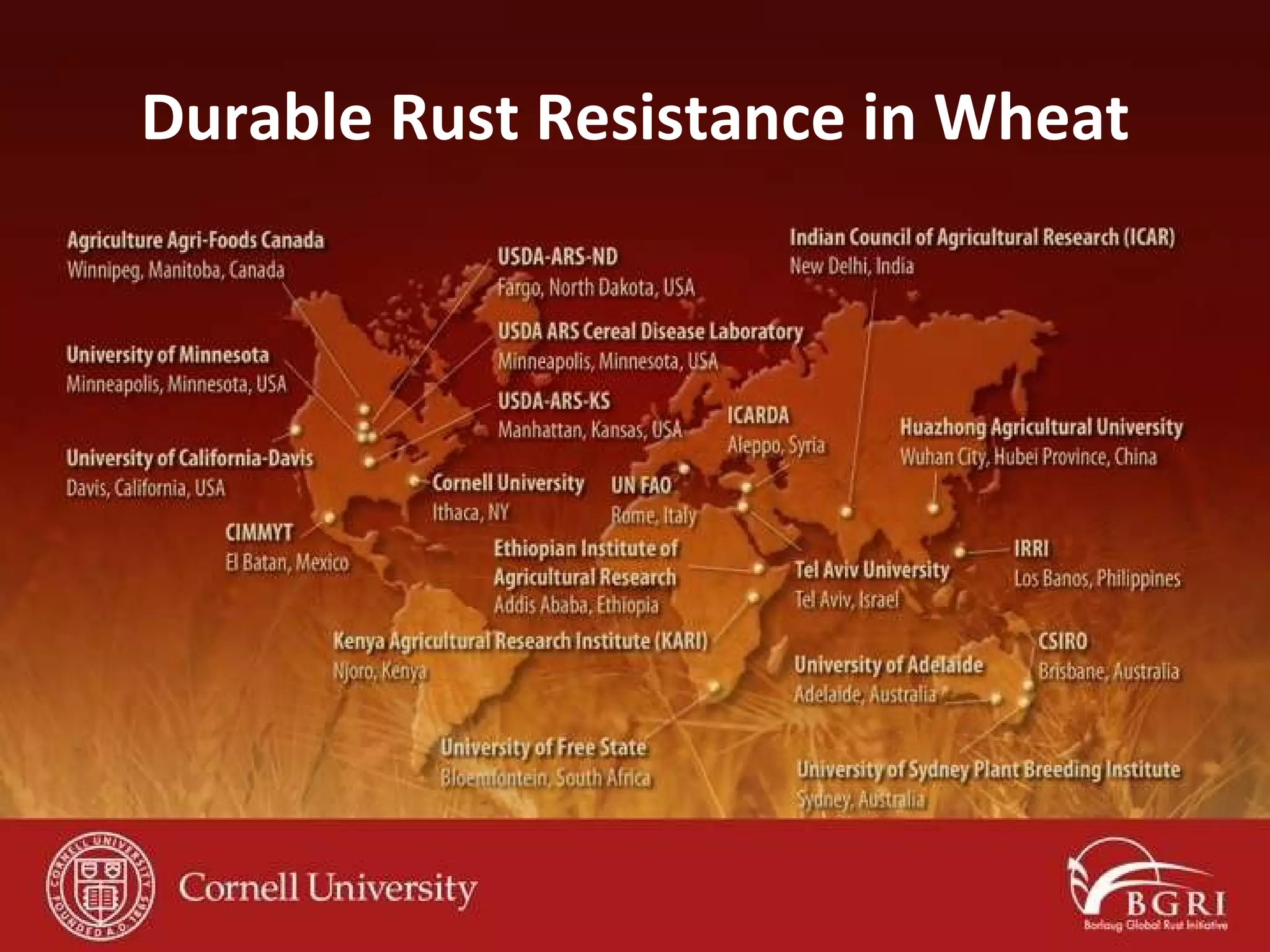
Durable Rust Resistance in Wheat Phase I Progress / Phase II Prospects Ronnie Coffman, Vice Chair, BGRI Director, DRRW Cornell University 18 April 2011 ICARDA Aleppo, Syria
http://wheatrust.cornell.edu  http://www.globalrust.org  Acknowledgements Sathguru Management Consultants, India ICAR Leadership and Scientists Robert Park, University of Sydney Kumarse Nazari, ICARDA Sridhar Bhavani, CIMMYT Nairobi Hans Braun, CIMMYT HQ Ravi Singh, CIMMYT HQ Mike Pumphrey, WSU Hei Leung, IRRI Bedada Girma, EIAR Peter Njau, KARI- Njoro Dave Hodson, FAO (formerly CIMMYT) Gordon Cisar, DRRW Sarah Davidson, DRRW Bill & Melinda Gates Foundation Katherine Kahn
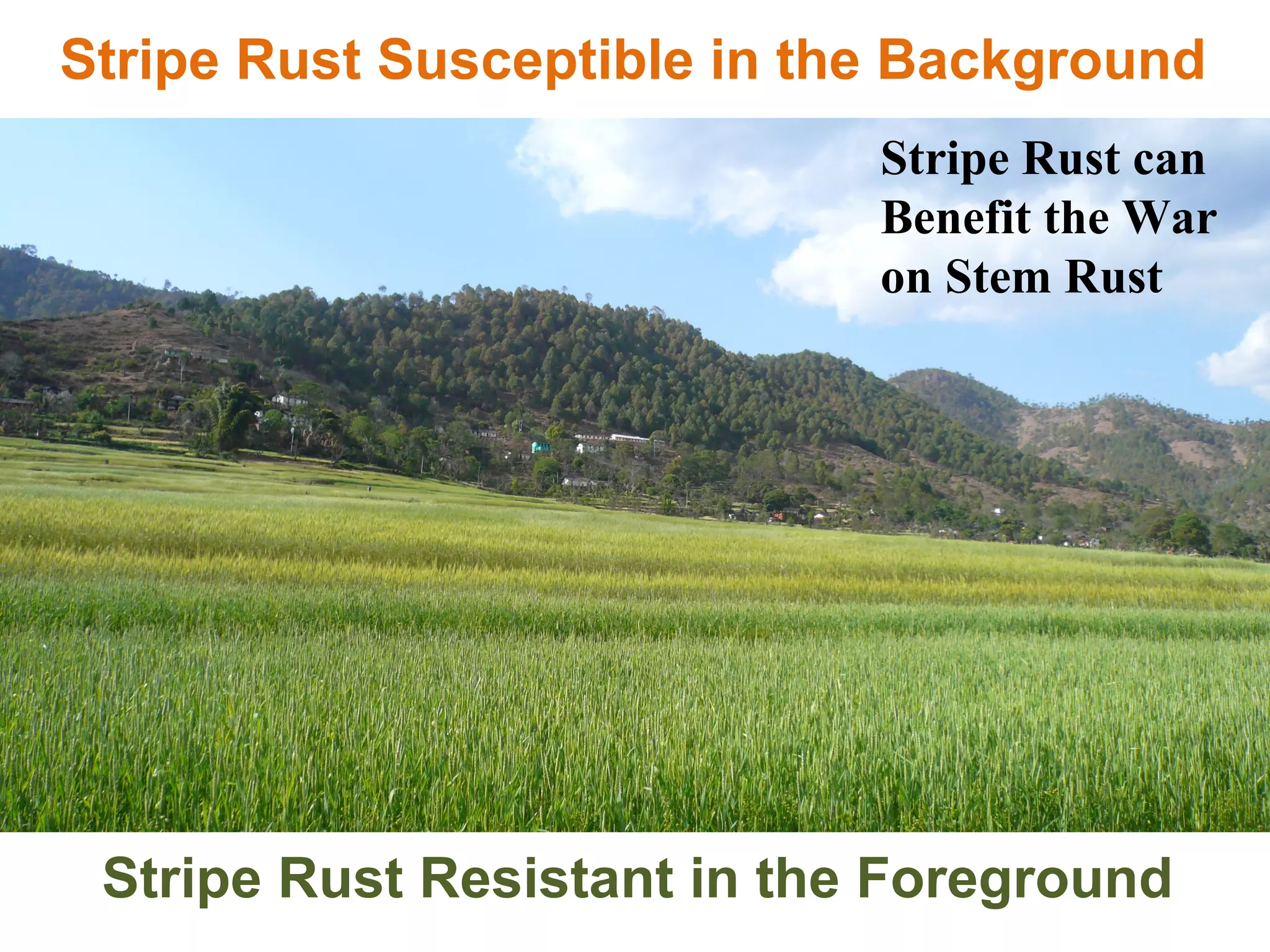
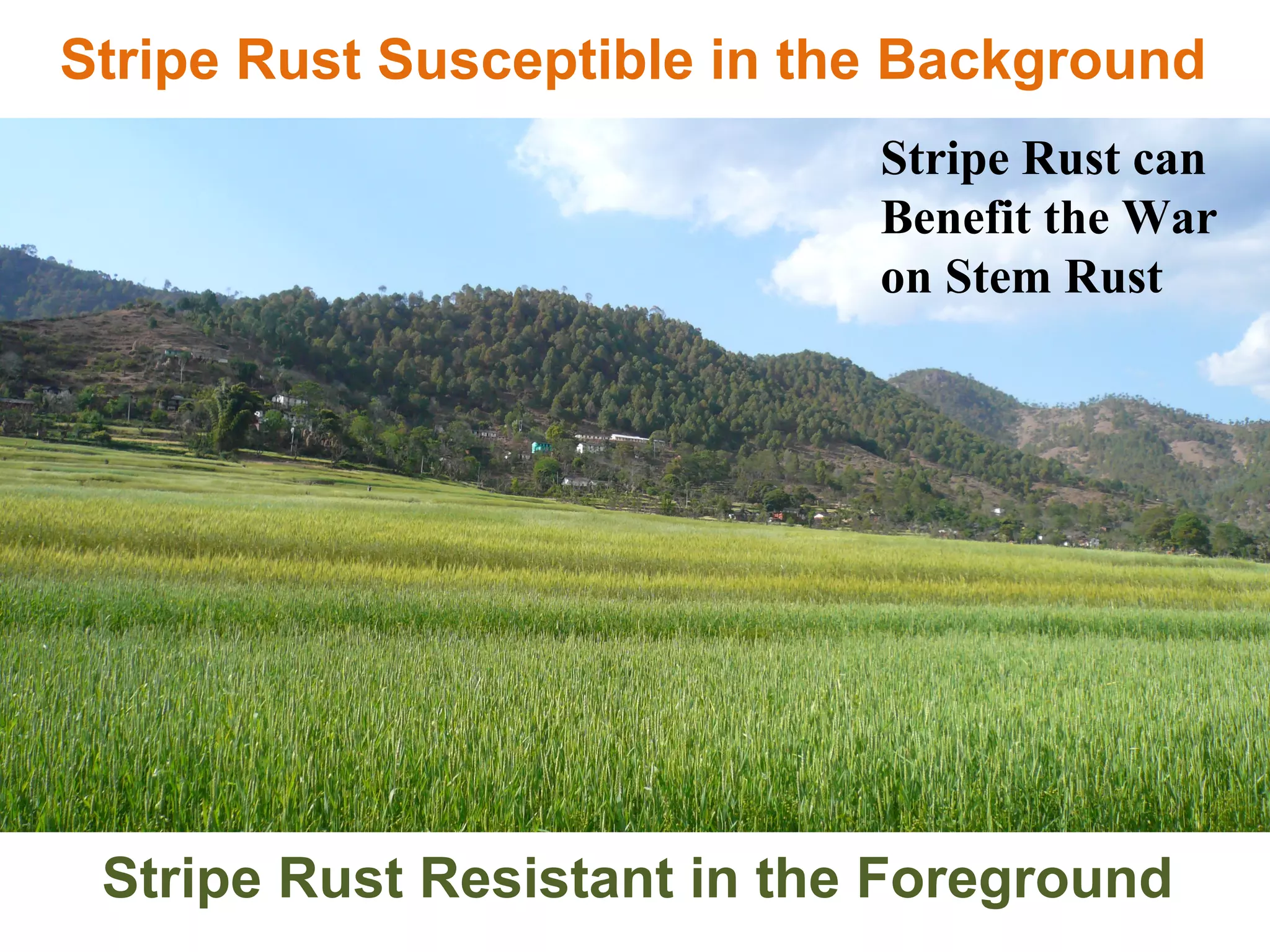
Stripe Rust Susceptible in the Background Stripe Rust Resistant in the Foreground Stripe Rust can Benefit the War on Stem Rust
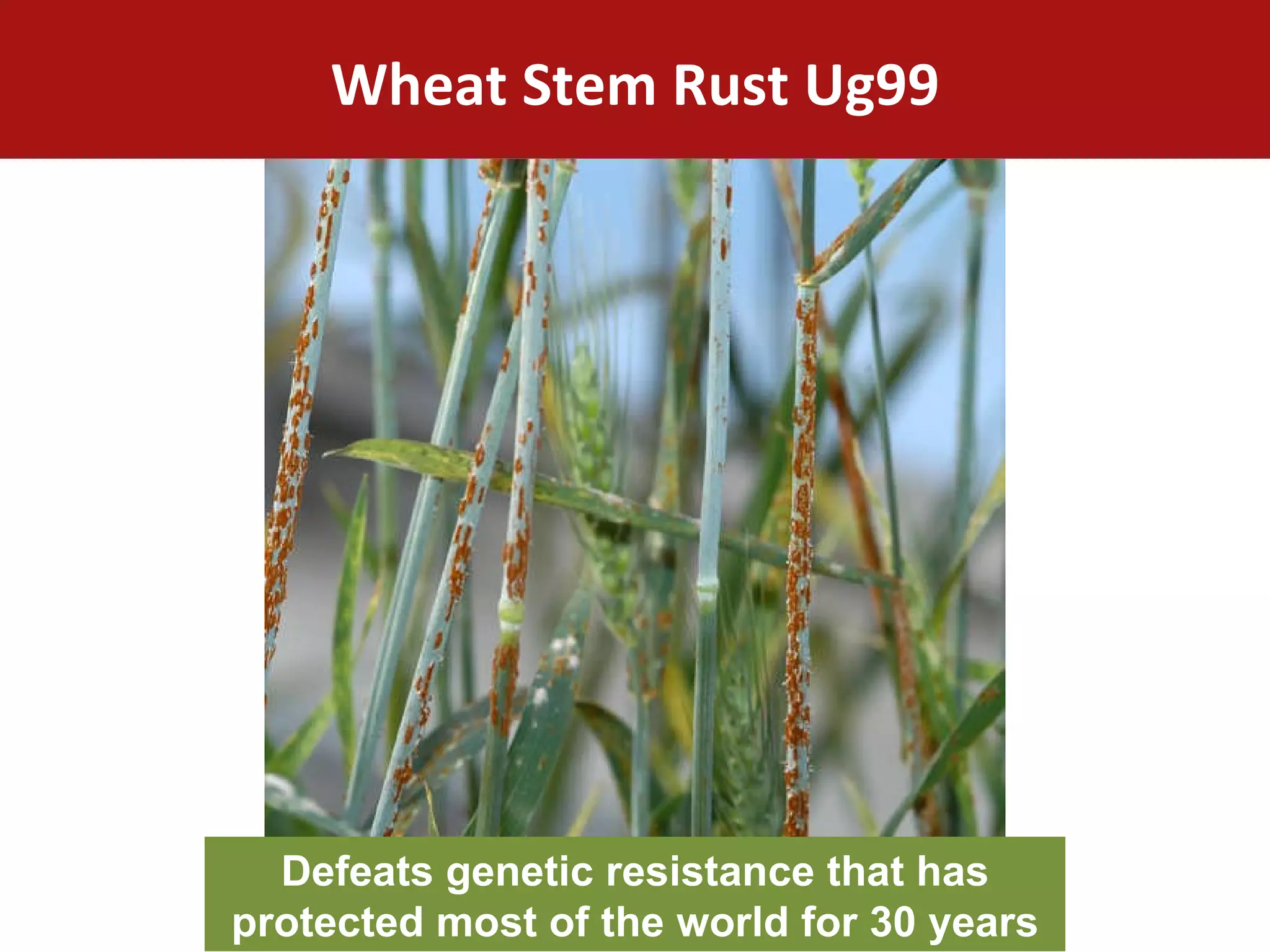
Wheat Stem Rust Ug99 Defeats genetic resistance that has protected most of the world for 30 years
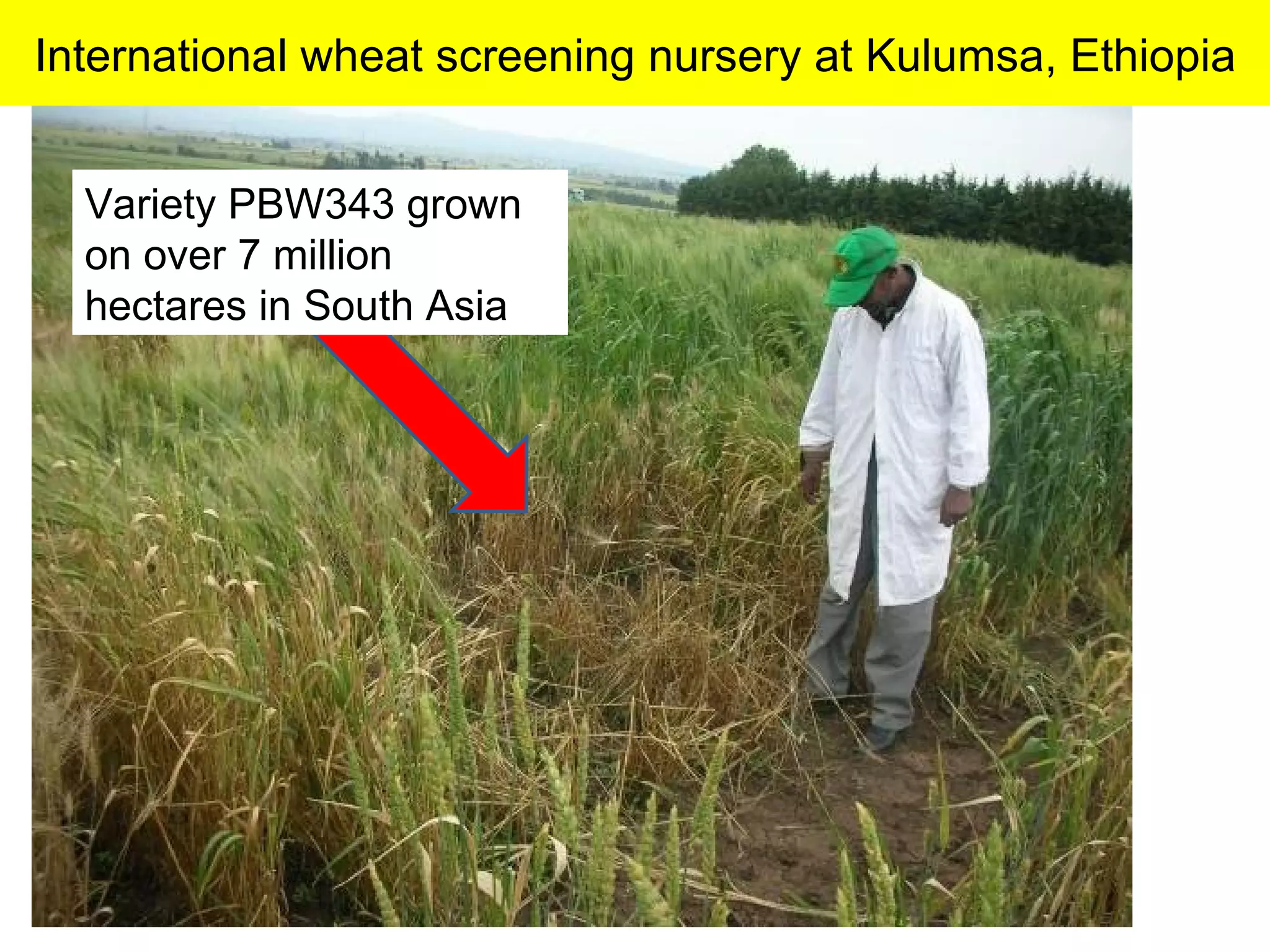
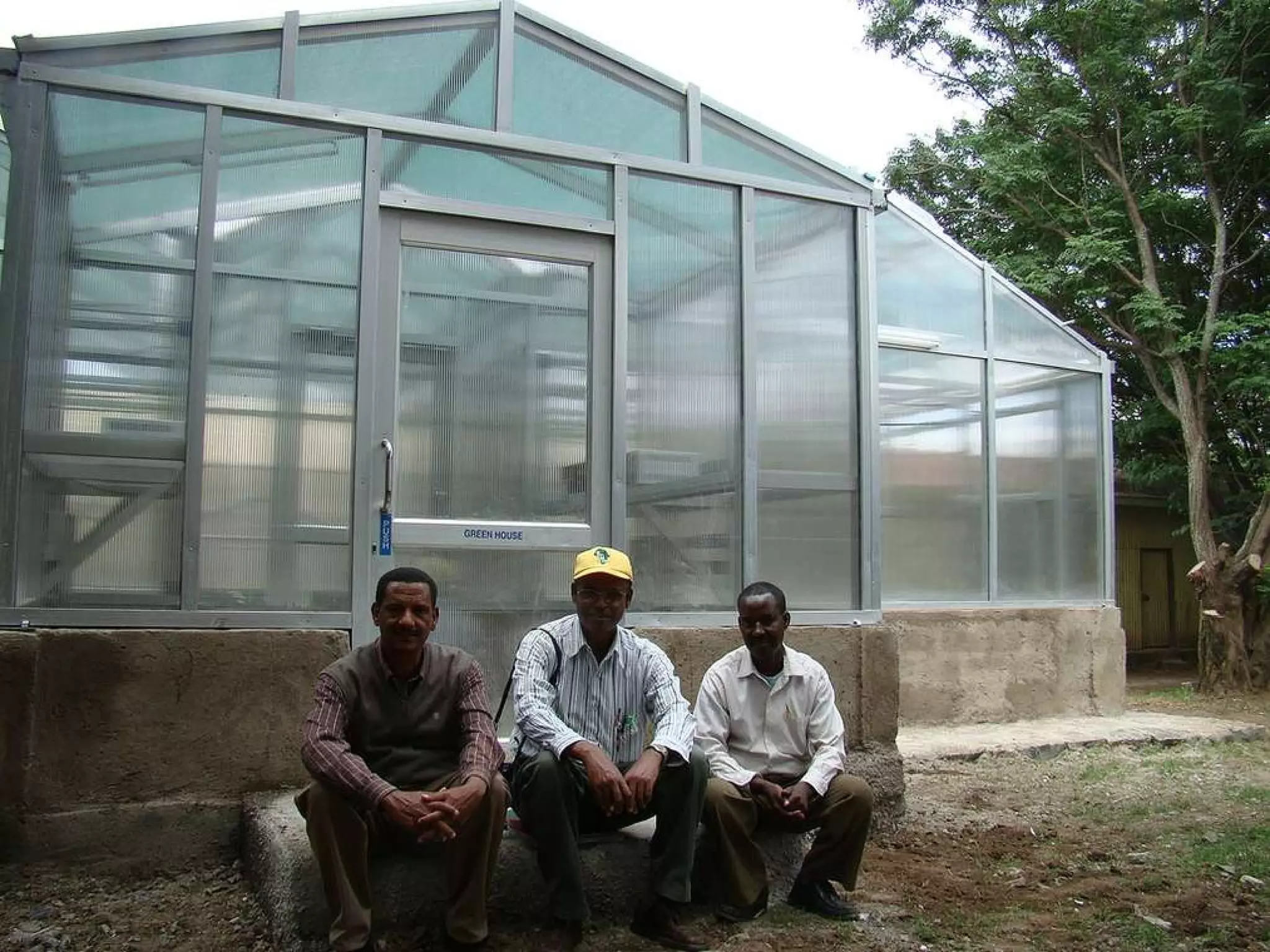
Variety PBW343 grown on over 7 million hectares in South Asia International wheat screening nursery at Kulumsa, Ethiopia
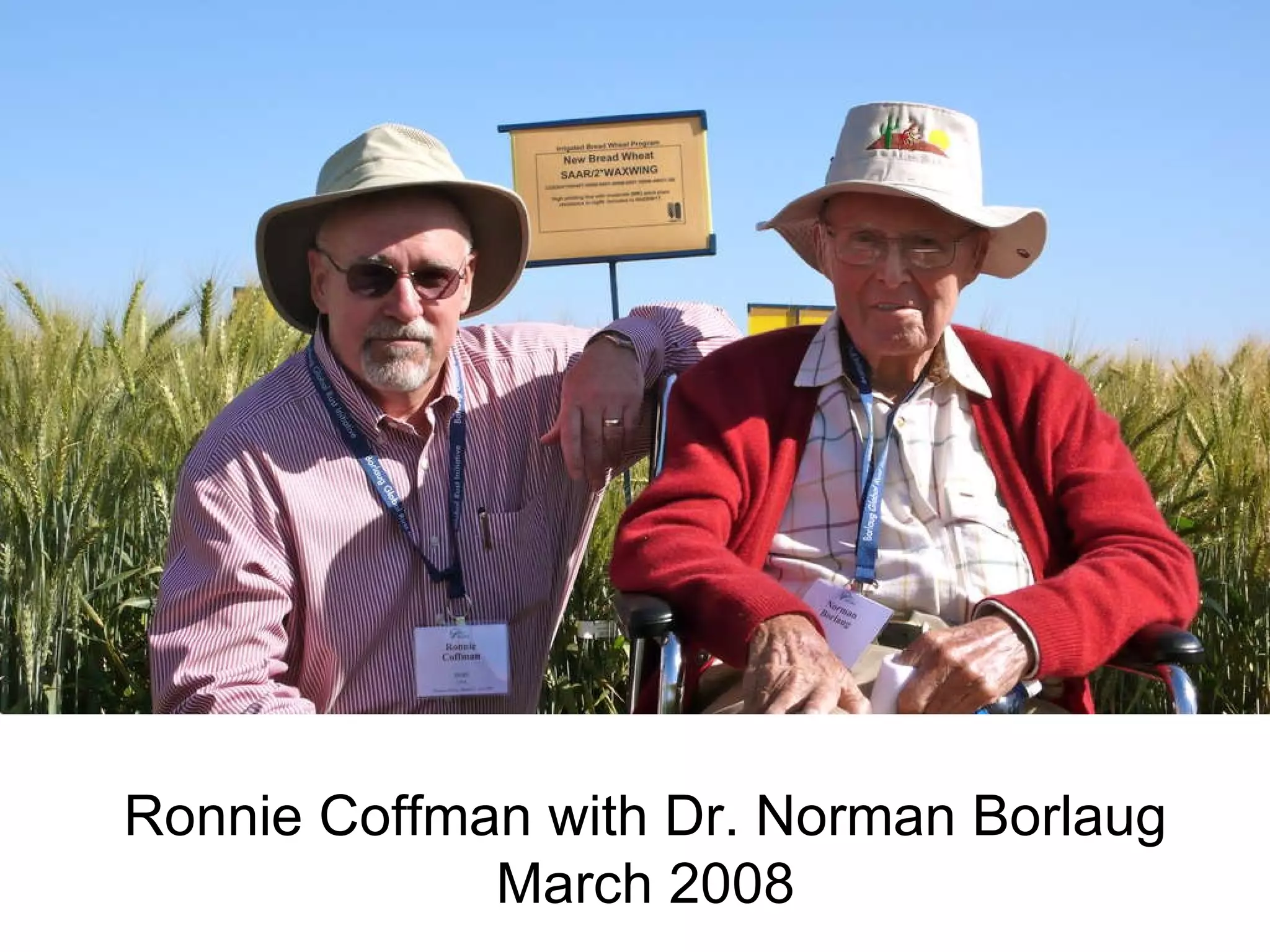
Ronnie Coffman with Dr. Norman Borlaug March 2008
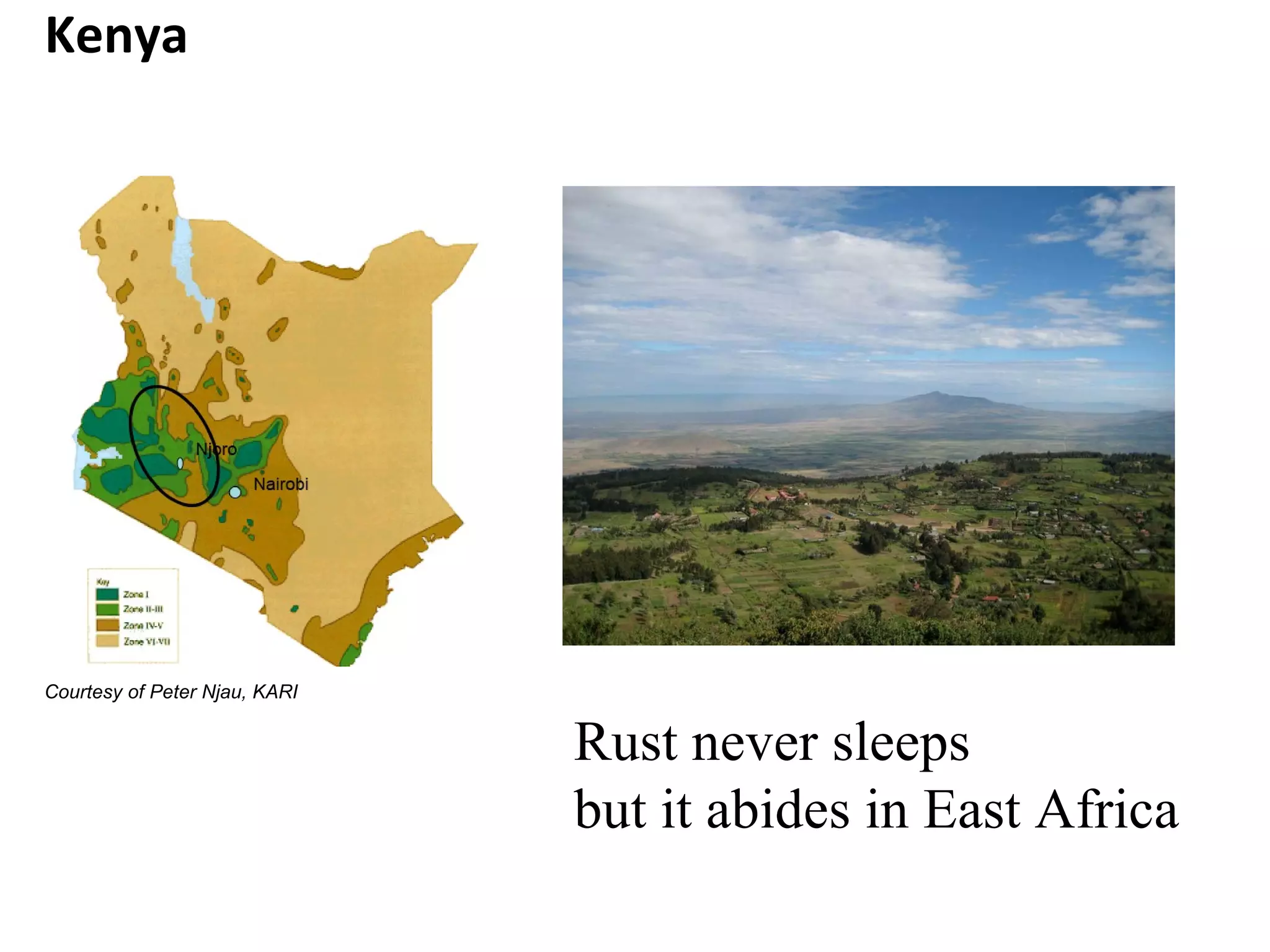
Courtesy of Peter Njau, KARI Kenya Rust never sleeps but it abides in East Africa
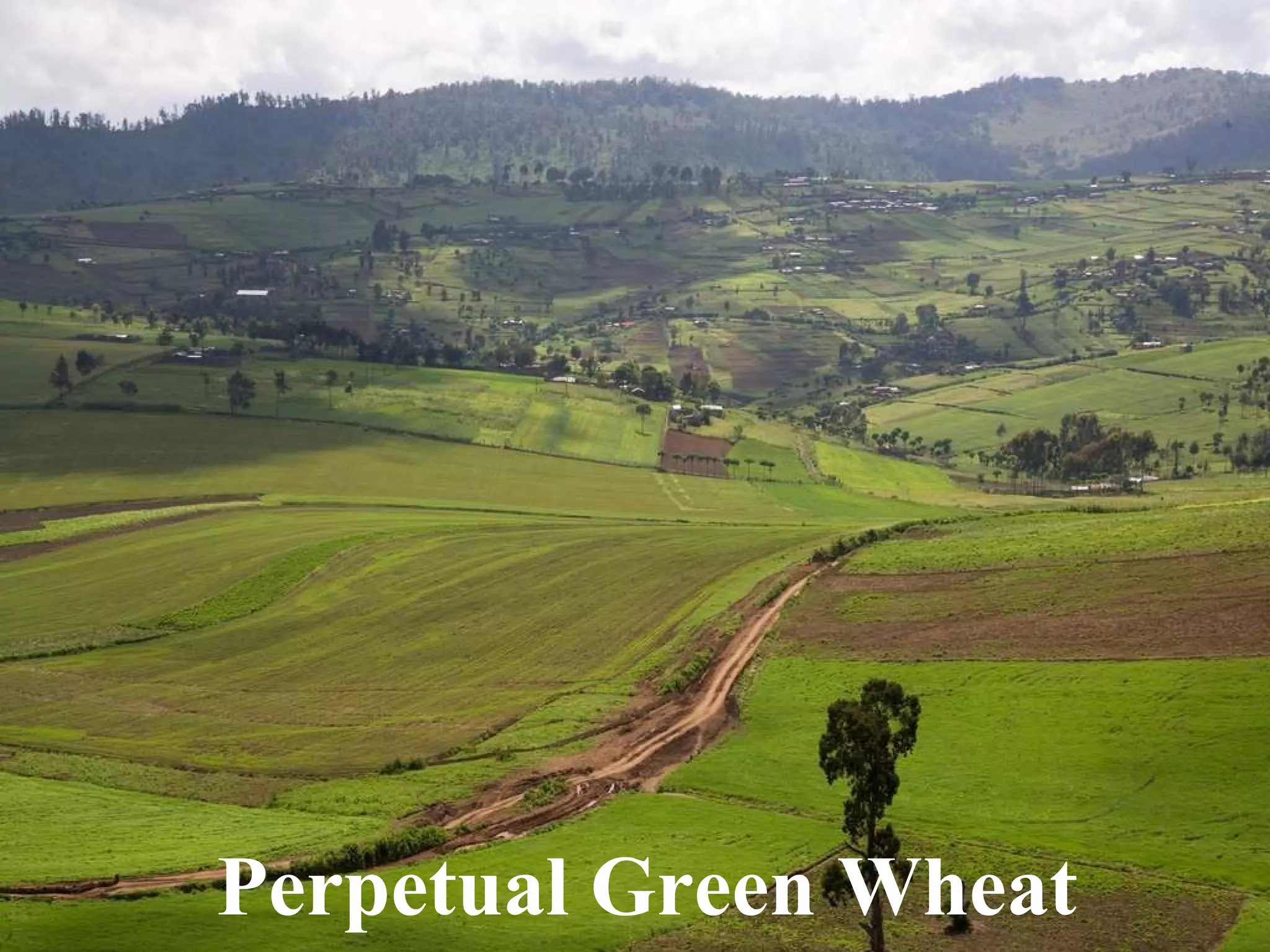
Perpetual Green Wheat
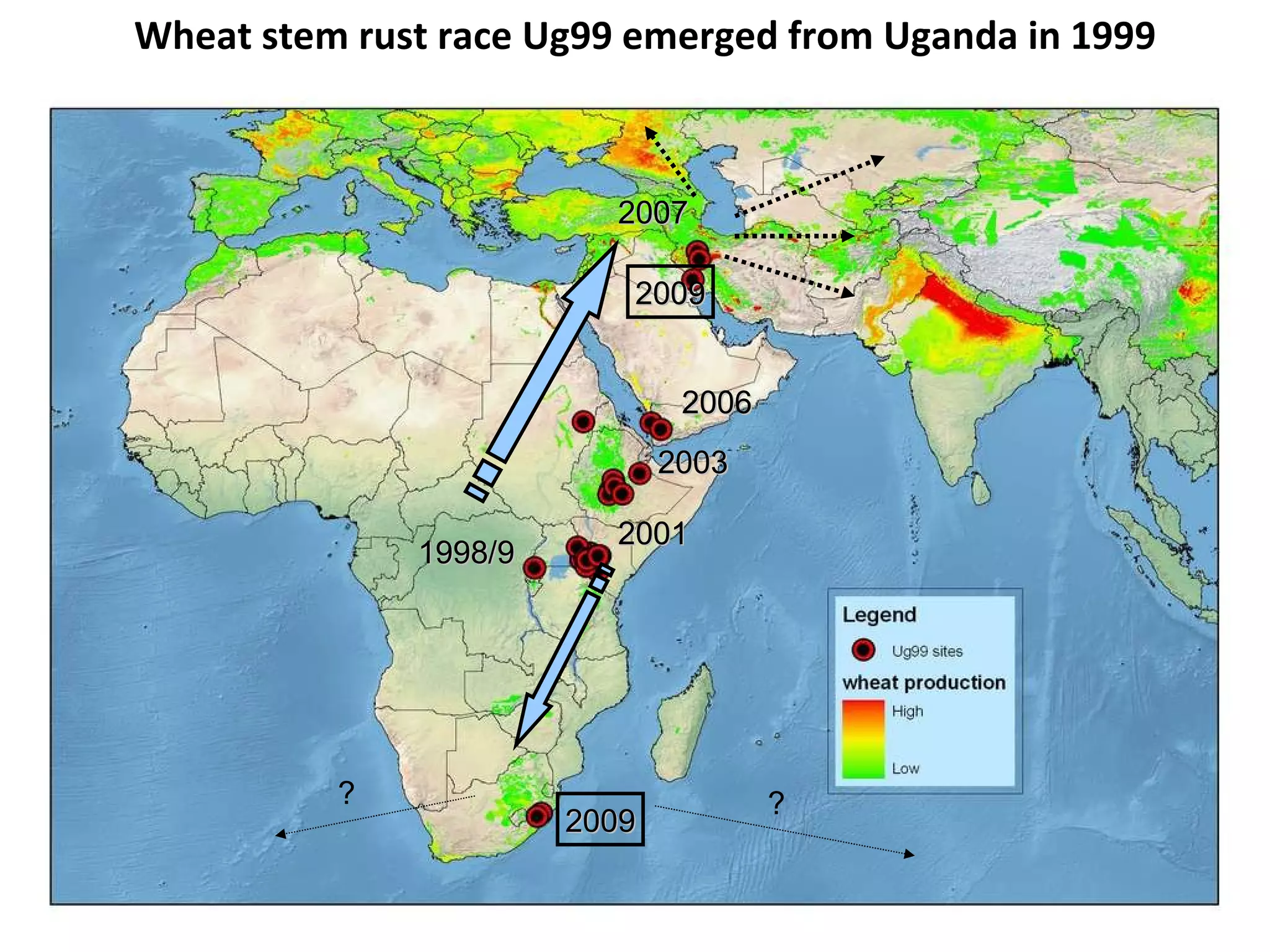
2009 2009 1998/9 2001 2003 2006 2007 ? ? Wheat stem rust race Ug99 emerged from Uganda in 1999
 
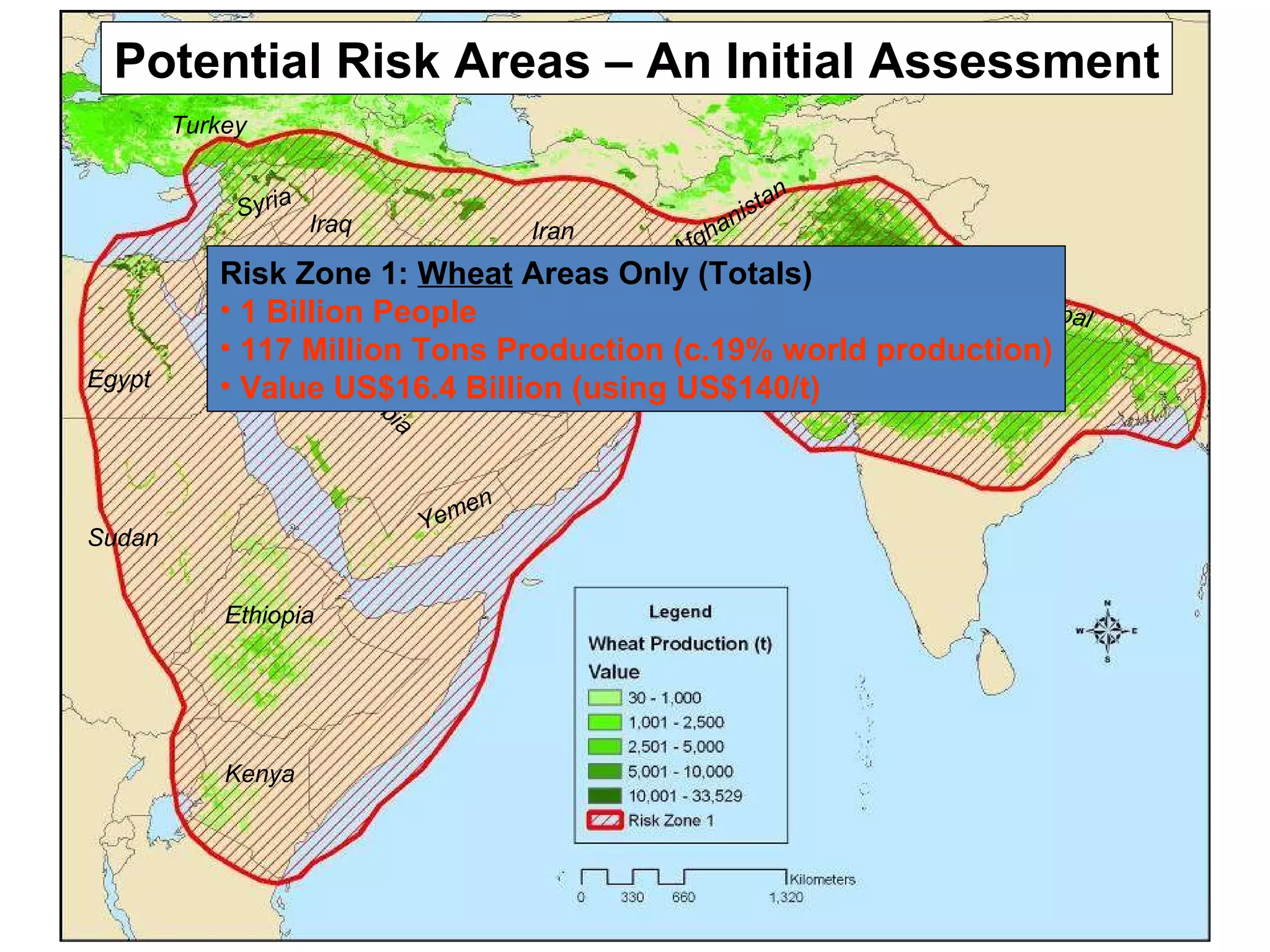
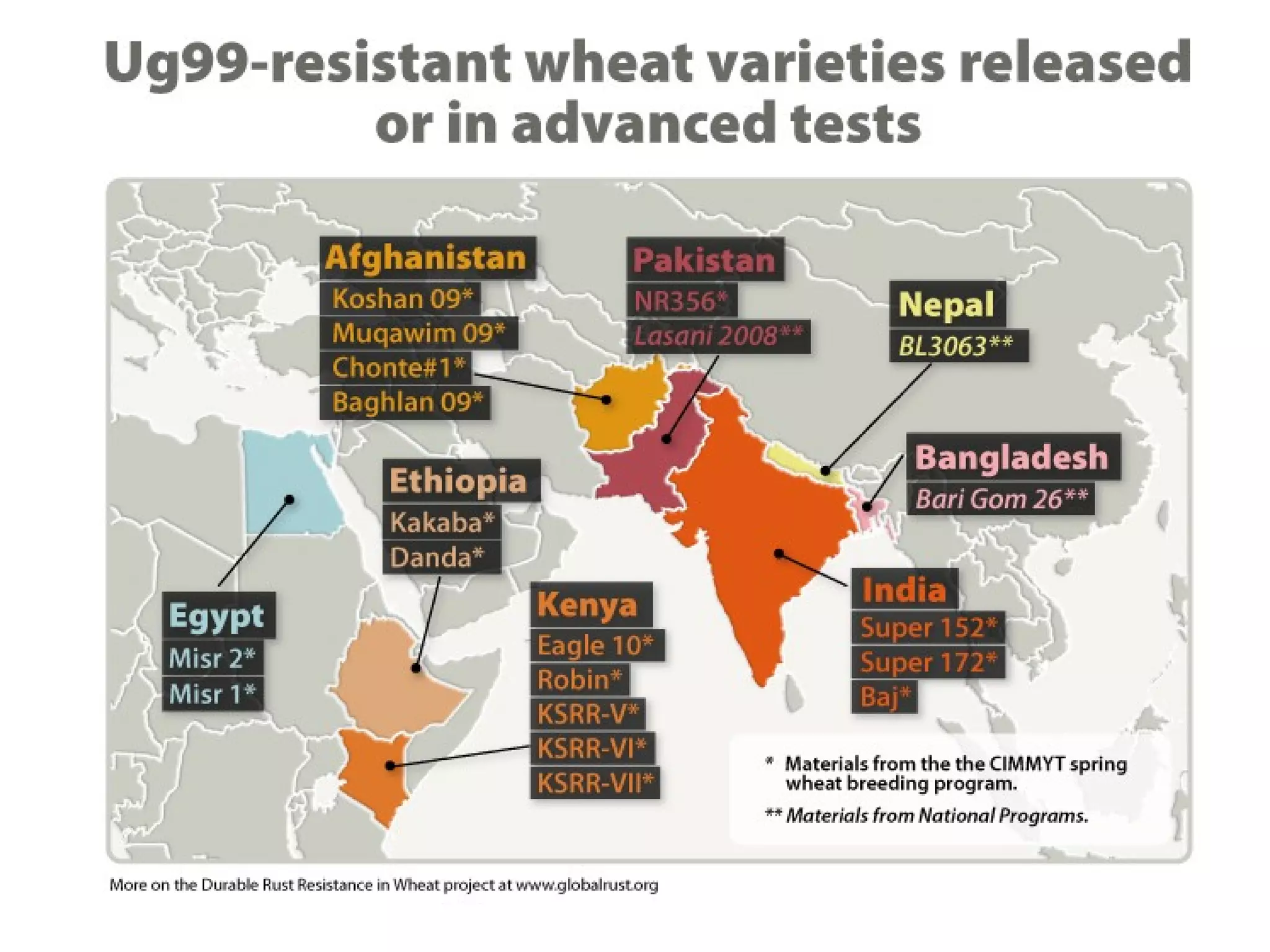
Risk Zone 1:  Wheat  Areas Only (Totals) 1 Billion People 117 Million Tons Production (c.19% world production) Value US$16.4 Billion (using US$140/t) Potential Risk Areas – An Initial Assessment Turkey Iran Saudi Arabia Afghanistan Pakistan India Egypt Sudan Ethiopia Kenya Iraq Syria Nepal Yemen
AGP-FAO Wheat Rust Disease Global Program  Cereal System Initiative for South Asia (CSISA) Projects And many more… Durable Rust Resistance in Wheat Project (DRRW)
Durable Rust Resistance in Wheat
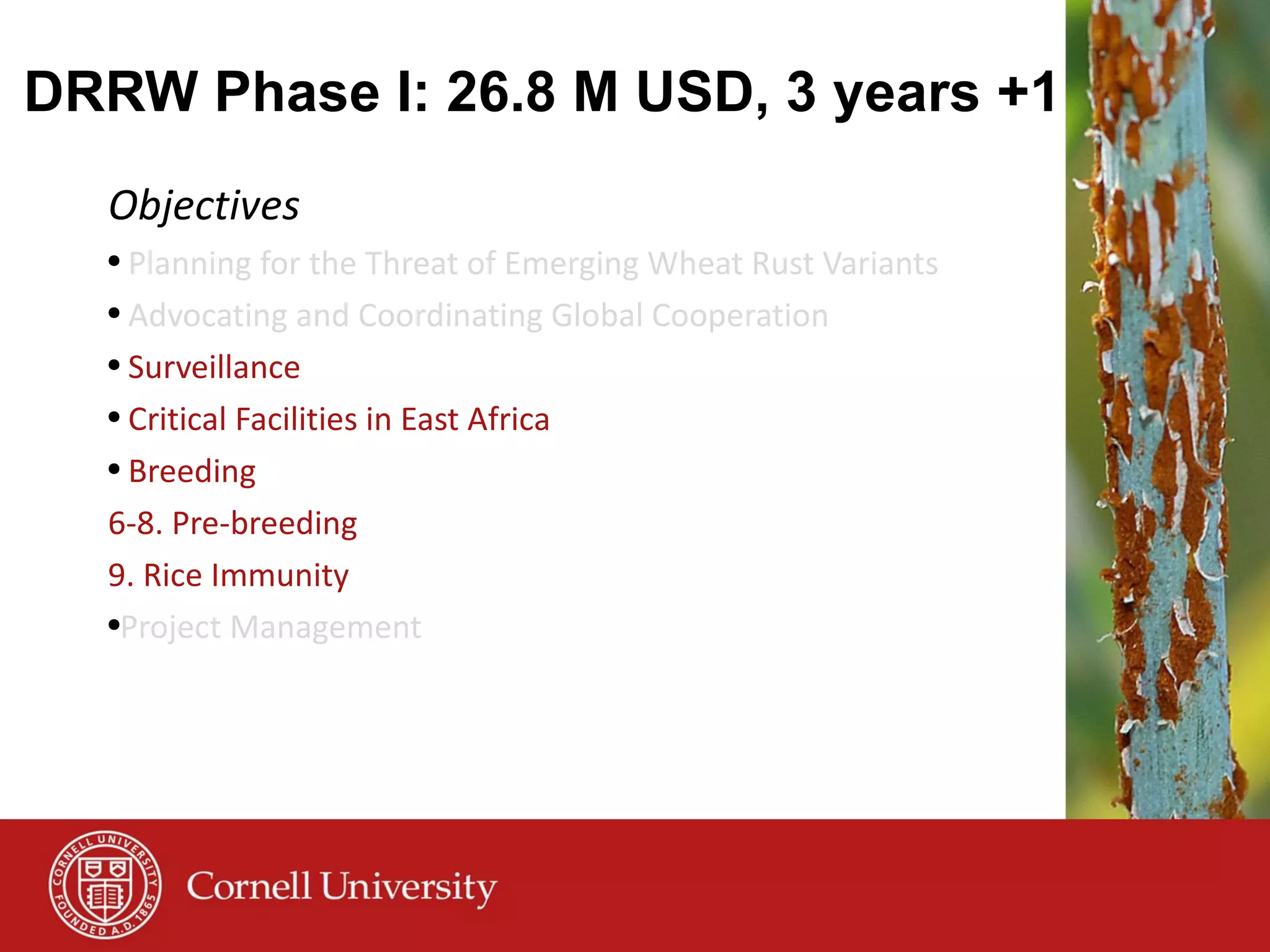
Objectives Planning for the Threat of Emerging Wheat Rust Variants Advocating and Coordinating Global Cooperation Surveillance Critical Facilities in East Africa Breeding 6-8. Pre-breeding 9. Rice Immunity Project Management DRRW Phase I: 26.8 M USD, 3 years +1
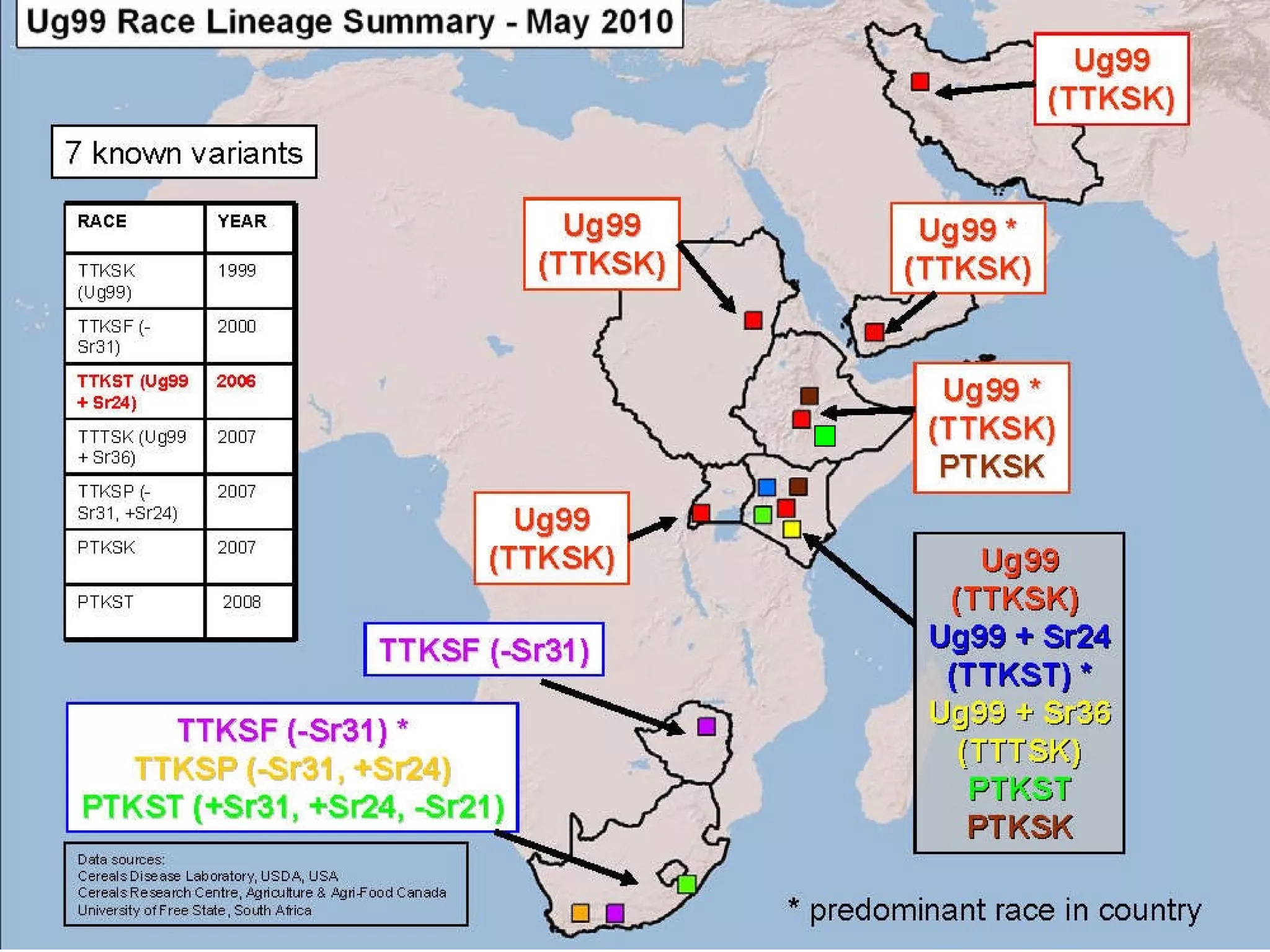
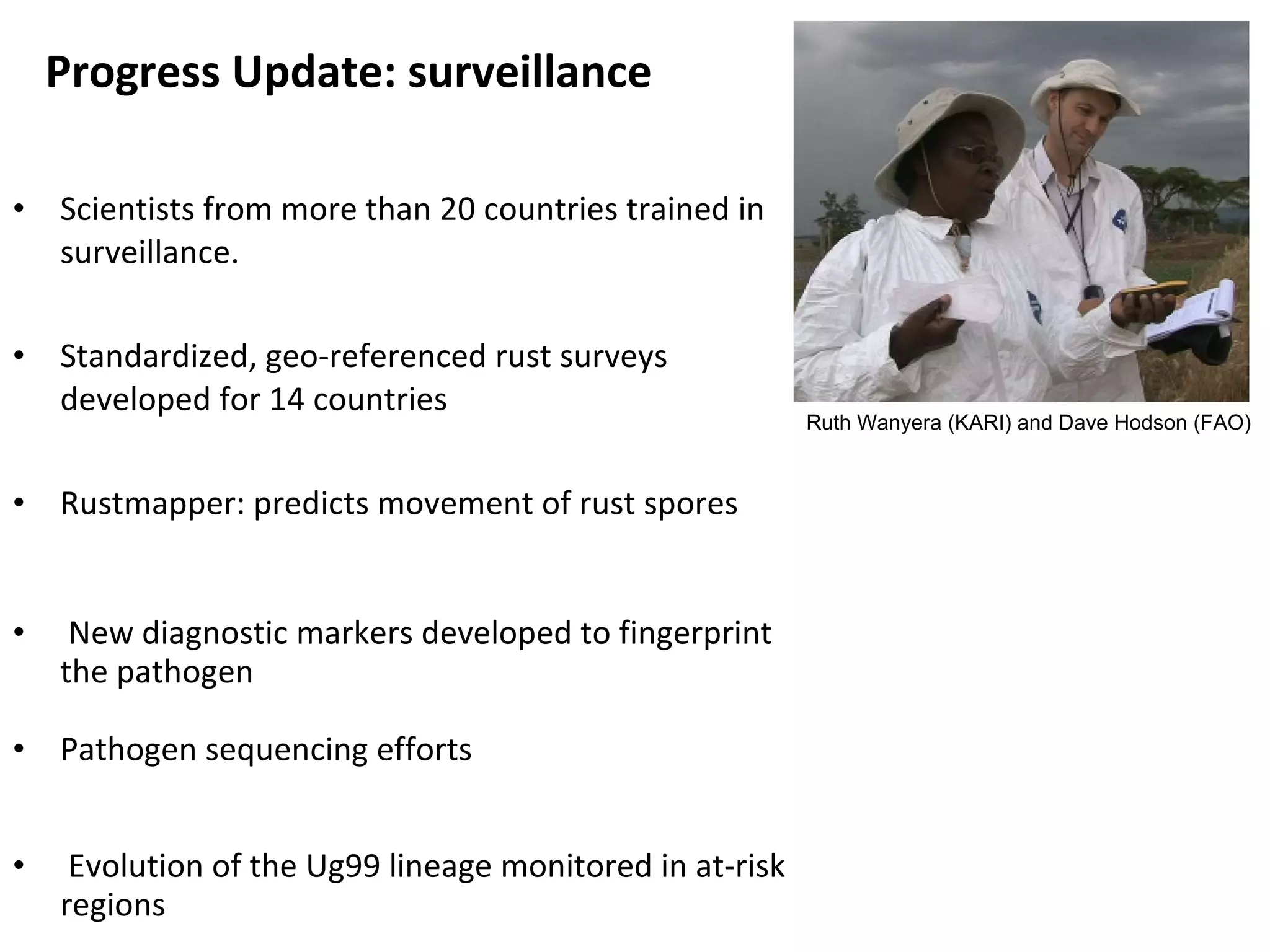
Scientists from more than 20 countries trained in surveillance. Standardized, geo-referenced rust surveys developed for 14 countries Rustmapper: predicts movement of rust spores New diagnostic markers developed to fingerprint the pathogen Pathogen sequencing efforts Evolution of the Ug99 lineage monitored in at-risk regions Progress Update: surveillance  Ruth Wanyera (KARI) and Dave Hodson (FAO)
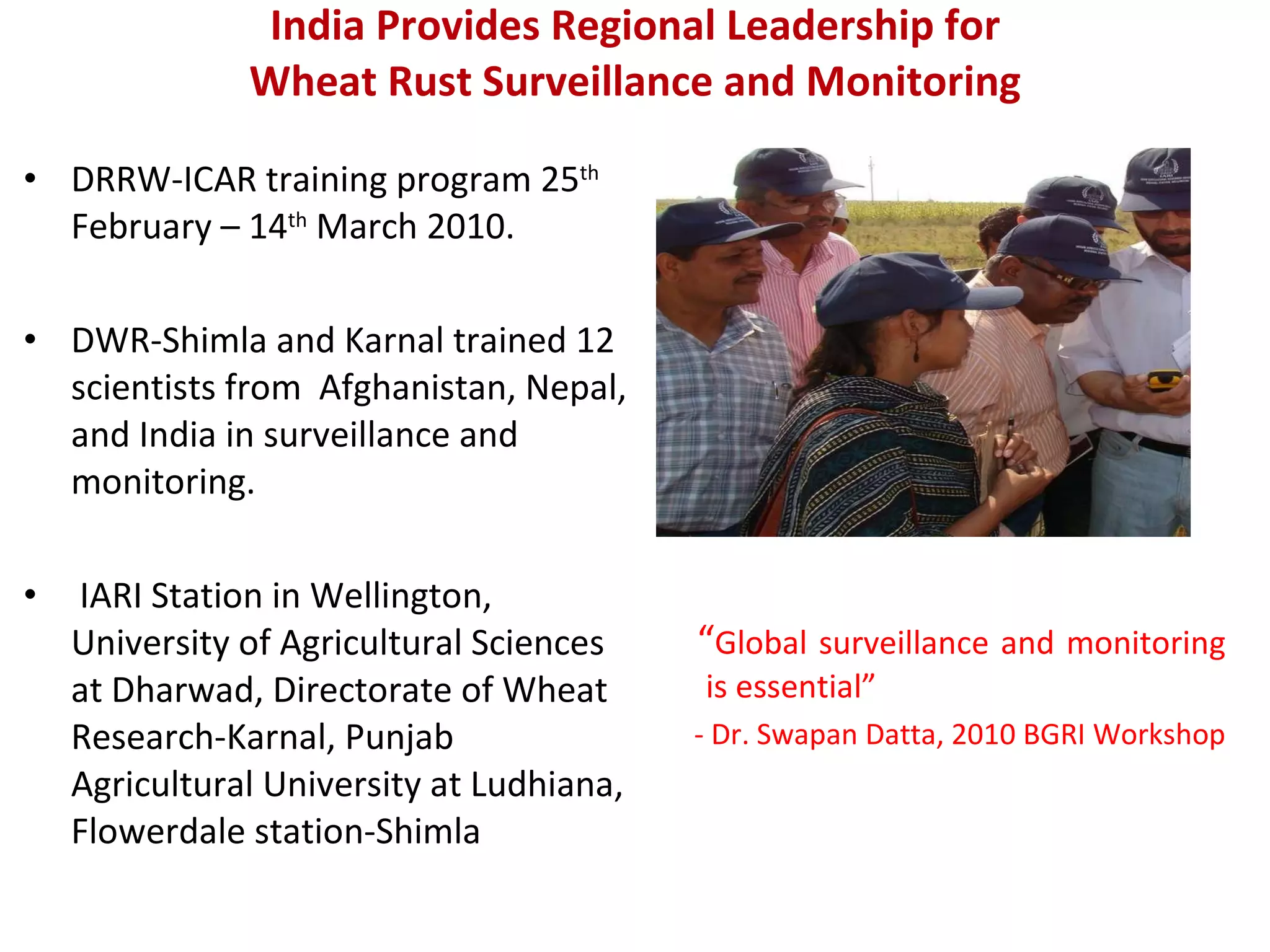
India Provides Regional Leadership for  Wheat Rust Surveillance and Monitoring   DRRW-ICAR training program  25 th  February – 14 th  March 2010. DWR-Shimla and Karnal trained 12 scientists from  Afghanistan, Nepal, and India in surveillance and monitoring. IARI Station in Wellington, University of Agricultural Sciences at Dharwad, Directorate of Wheat Research-Karnal, Punjab Agricultural University at Ludhiana, Flowerdale station-Shimla  “ Global surveillance and monitoring is essential” - Dr. Swapan Datta, 2010 BGRI Workshop
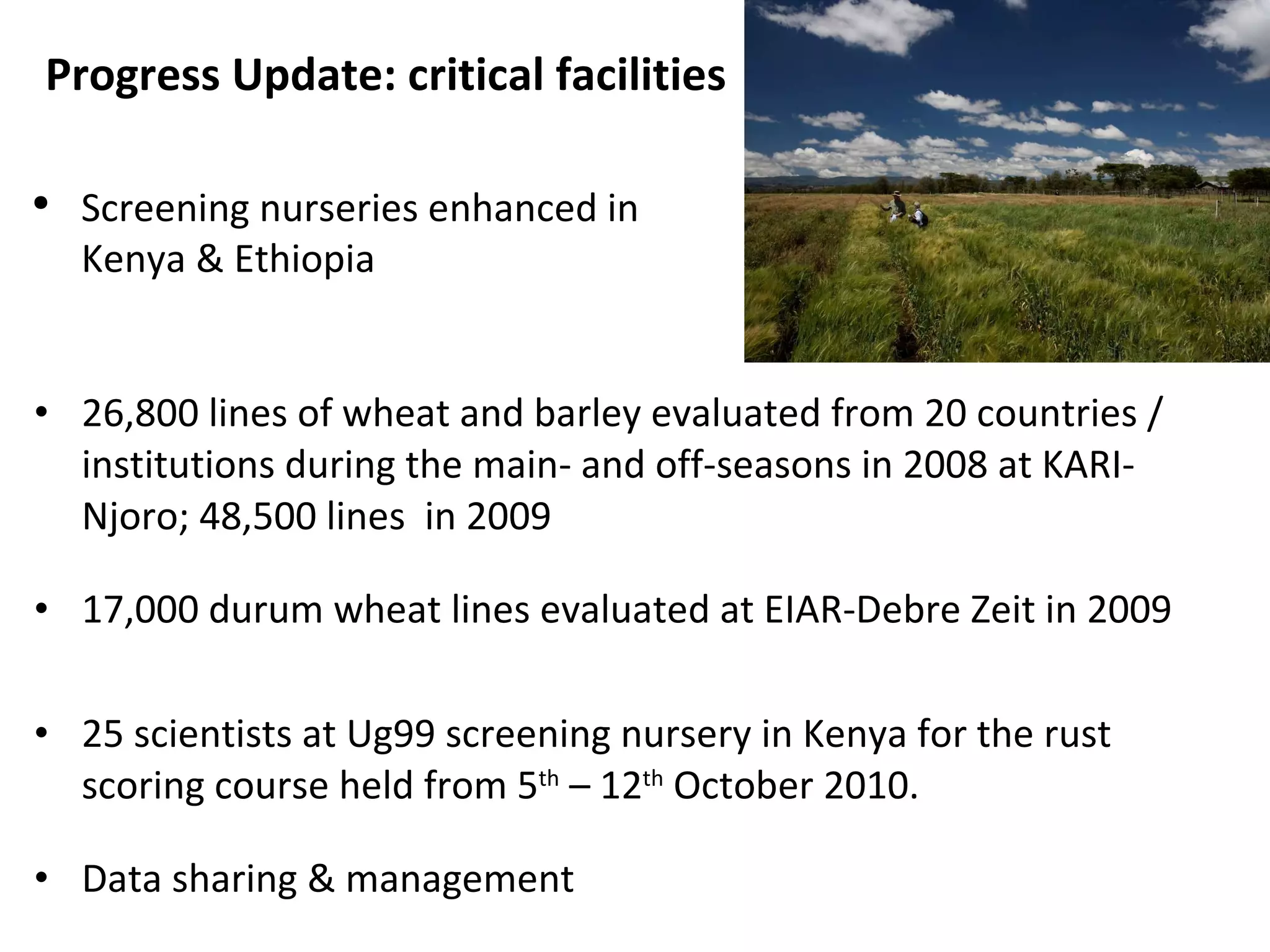
26,800 lines of wheat and barley evaluated from 20 countries / institutions during the main- and off-seasons in 2008 at KARI-Njoro; 48,500 lines  in 2009 17,000 durum wheat lines evaluated at EIAR-Debre Zeit in 2009 25 scientists at Ug99 screening nursery in Kenya for the rust scoring course held from 5 th  – 12 th  October 2010.  Data sharing & management Progress Update: critical facilities  Screening nurseries enhanced in Kenya & Ethiopia
 
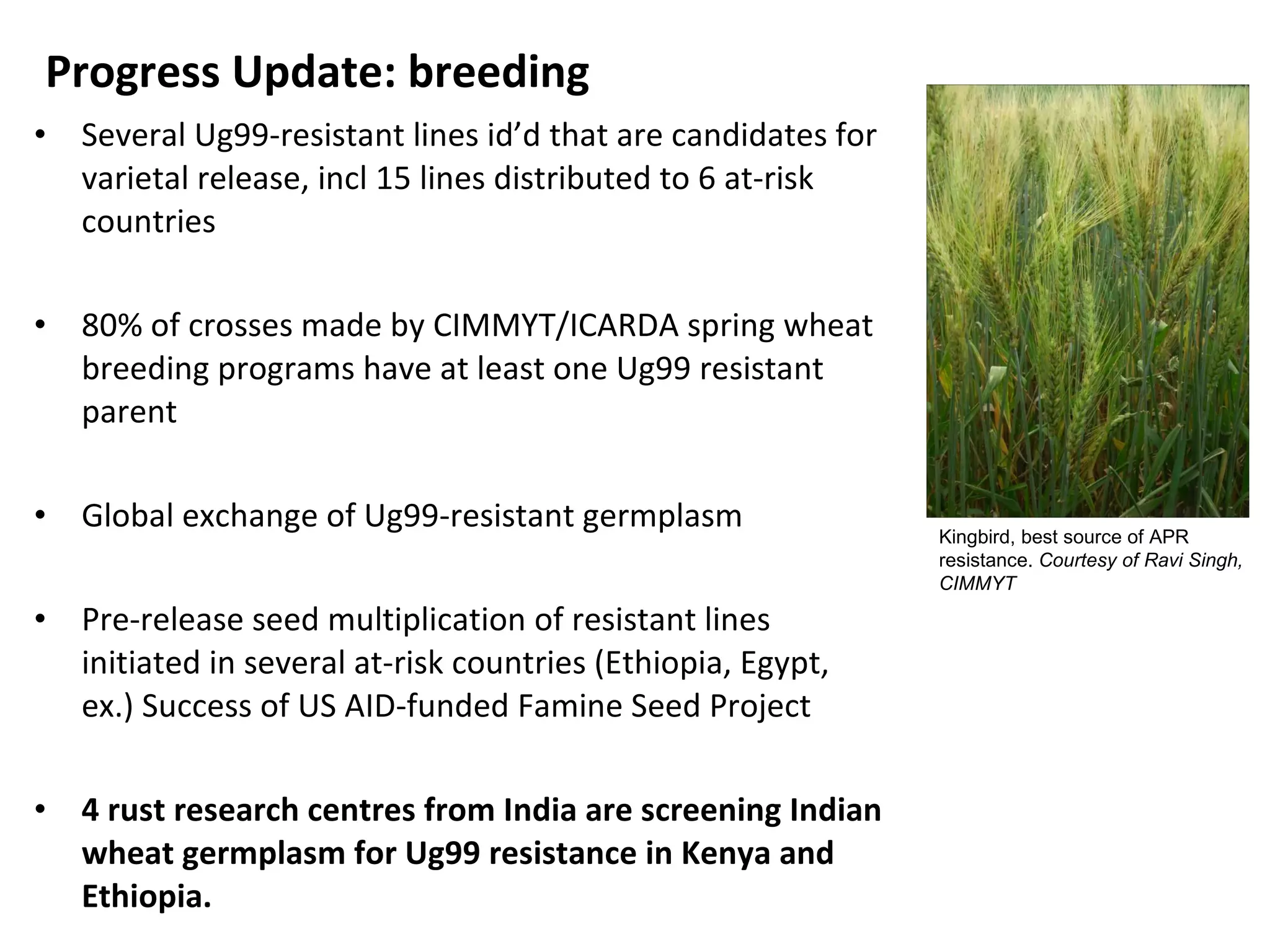
Several Ug99-resistant lines id ’d that are candidates for varietal release, incl 15 lines distributed to 6 at-risk countries 80% of crosses made by CIMMYT/ICARDA spring wheat breeding programs have at least one Ug99 resistant parent Global exchange of Ug99-resistant germplasm Pre-release seed multiplication of resistant lines initiated in several at-risk countries (Ethiopia, Egypt, ex.) Success of US AID-funded Famine Seed Project 4 rust research centres from India are screening Indian wheat germplasm for Ug99 resistance in Kenya and Ethiopia. Progress Update: breeding Kingbird, best source of APR resistance.  Courtesy of Ravi Singh, CIMMYT
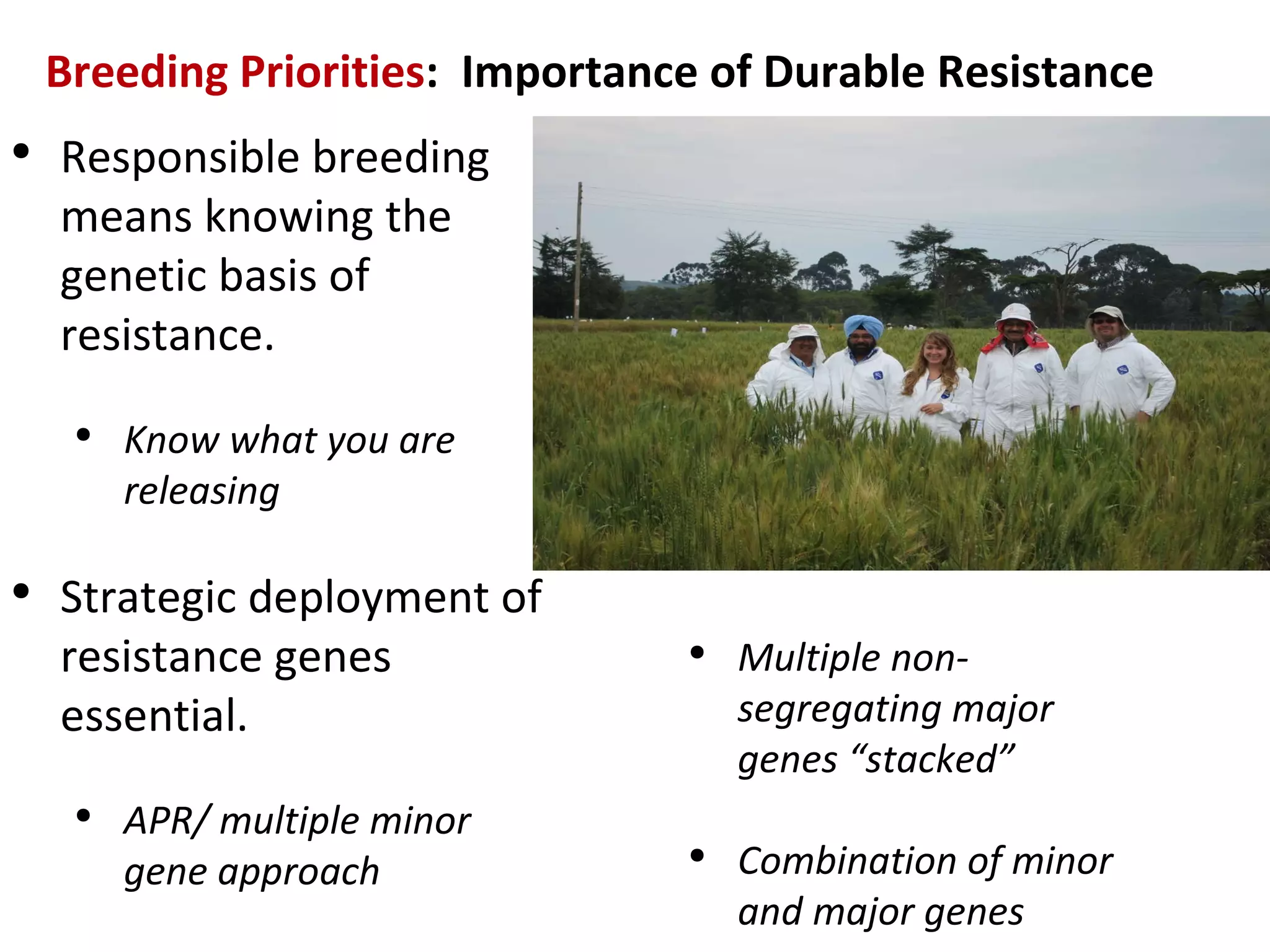
Breeding Priorities :  Importance of Durable Resistance Responsible breeding means knowing the genetic basis of resistance. Know what you are releasing Strategic deployment of resistance genes essential. APR/ multiple minor gene approach Multiple non-segregating major genes  “stacked” Combination of minor and major genes
 
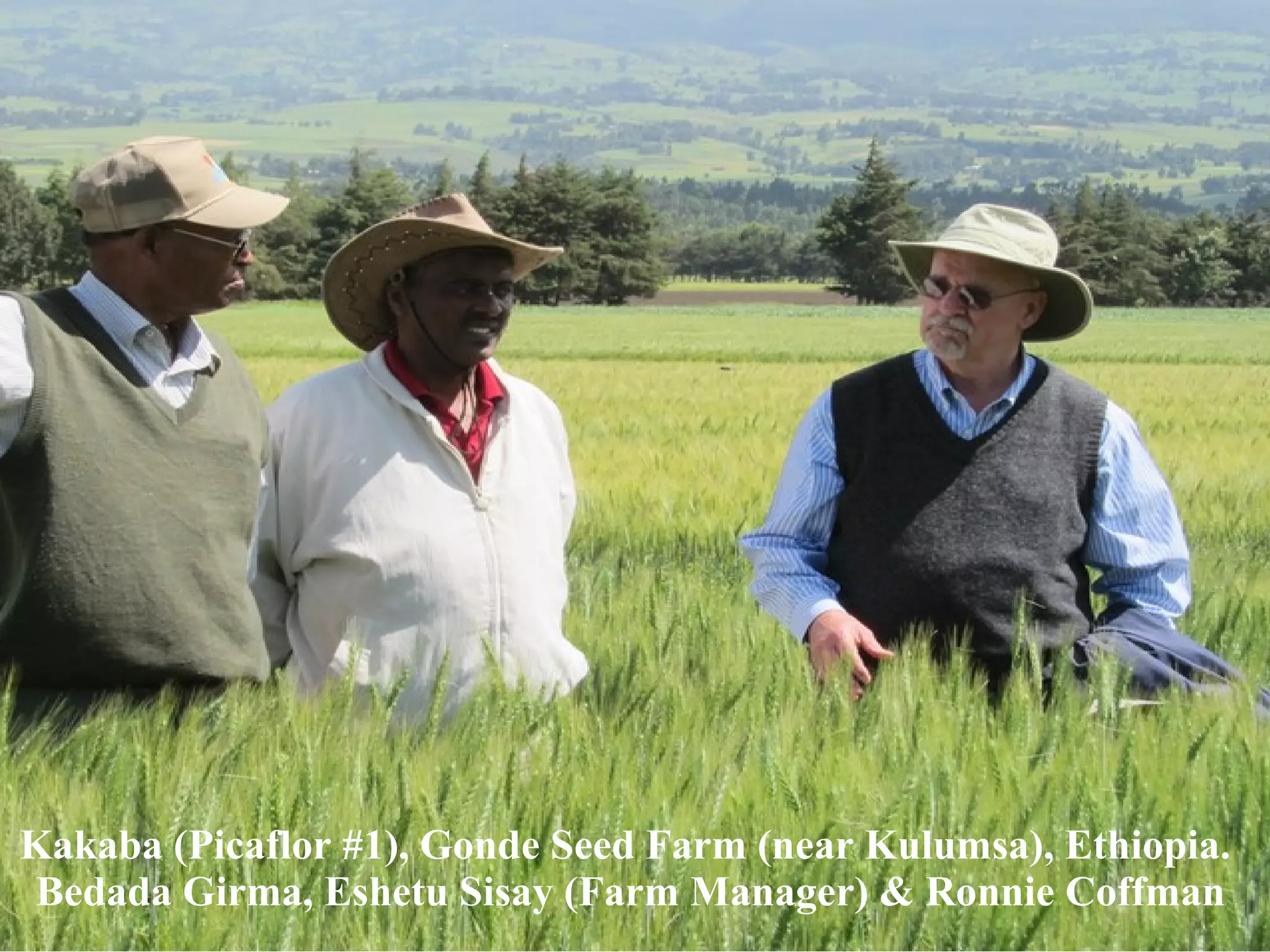
Kakaba (Picaflor #1), Gonde Seed Farm (near Kulumsa), Ethiopia.  Bedada Girma, Eshetu Sisay (Farm Manager) & Ronnie Coffman
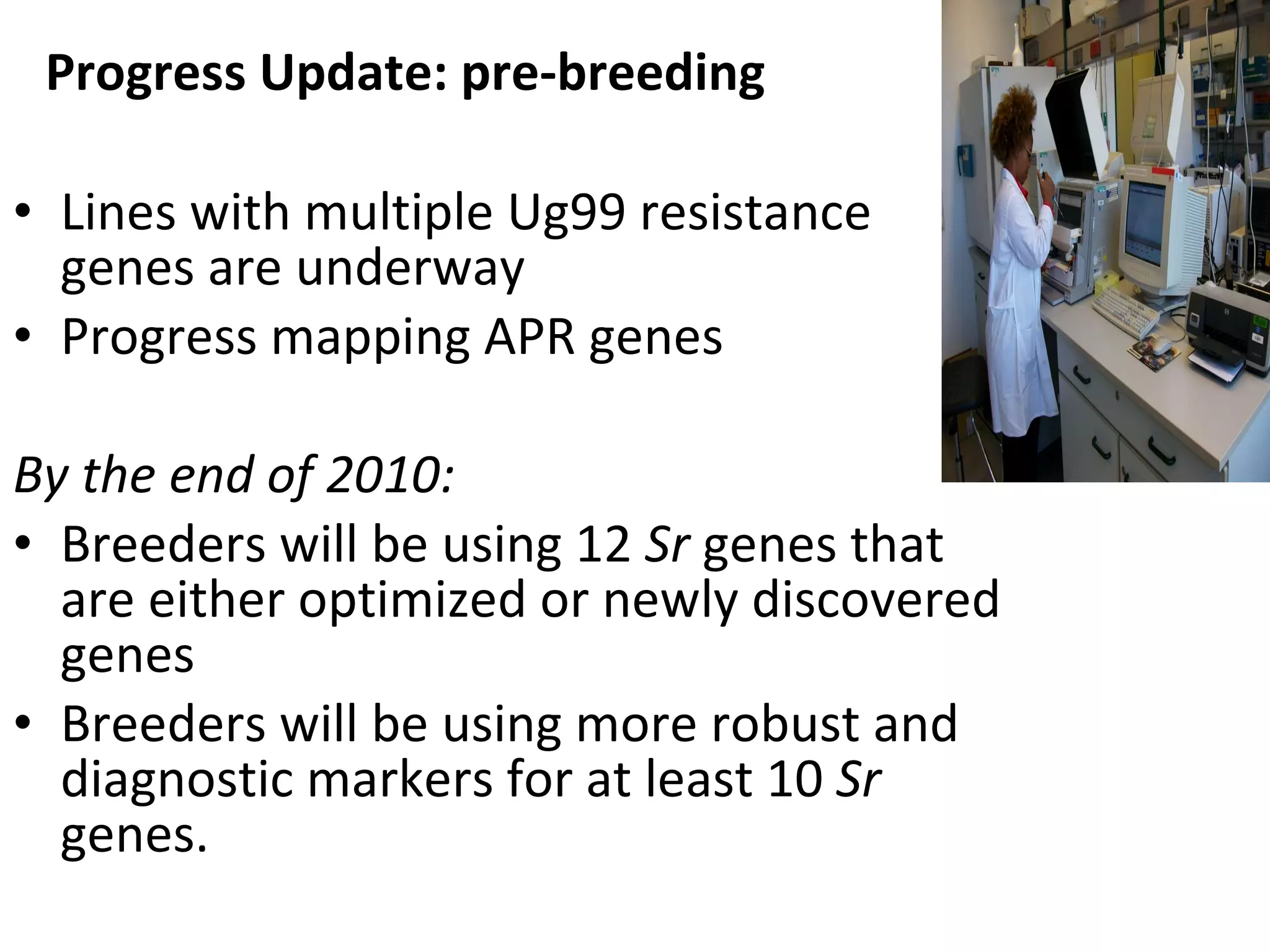
Lines with multiple Ug99 resistance genes are underway Progress mapping APR genes  By the end of 2010: Breeders will be using 12  Sr  genes that are either optimized or newly discovered genes Breeders will be using more robust and diagnostic markers for at least 10  Sr  genes. Progress Update: pre-breeding
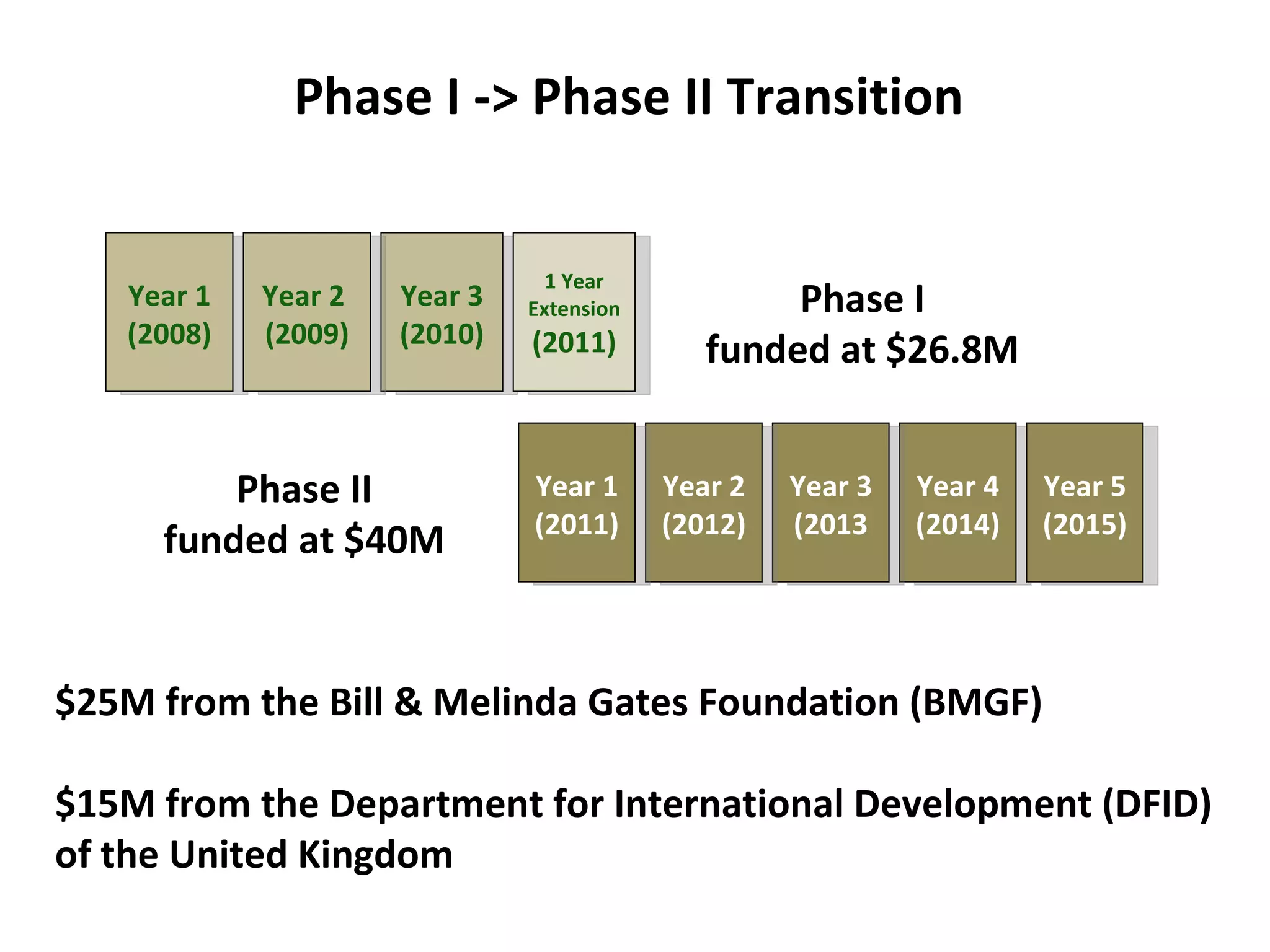
Phase I -> Phase II Transition  Year 1 (2008) Year 3 (2010) Year 2  (2009) 1 Year Extension (2011) Year 4 (2014) Year 3 (2013 Year 2 (2012) Year 1 (2011) Year 5 (2015) Phase I funded at $26.8M Phase II funded at $40M $25M from the Bill & Melinda Gates Foundation (BMGF) $15M from the Department for International Development (DFID) of the United Kingdom
DRRW Phase II. Obj. 21:  Seed systems interventions Obj. 22:  Advocacy for additional investments Obj. 23:  Surveillance of the pathogen Obj. 24:  East Africa screening nursery facilities Obj. 25:  Breeding durably resistant varieties Obj. 26:  Pre-breeding (gene discovery, markers) Obj. 27:  Ethiopian wheat breeding program Obj. 28:  Project management and coordination
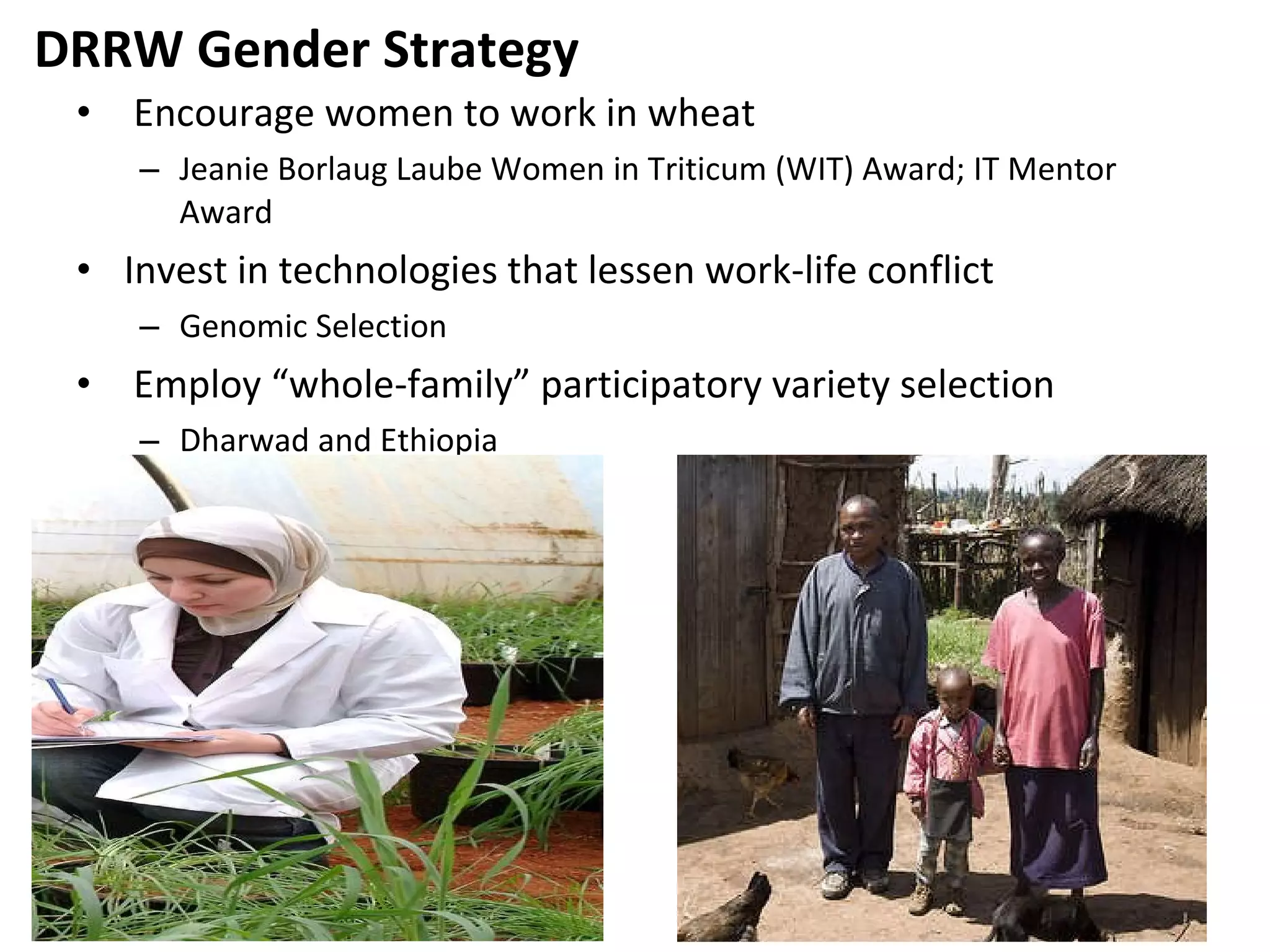
DRRW Gender Strategy Encourage women to work in wheat Jeanie Borlaug Laube Women in Triticum (WIT) Award; IT Mentor Award Invest in technologies that lessen work-life conflict Genomic Selection Employ  “whole-family” participatory variety selection Dharwad and Ethiopia
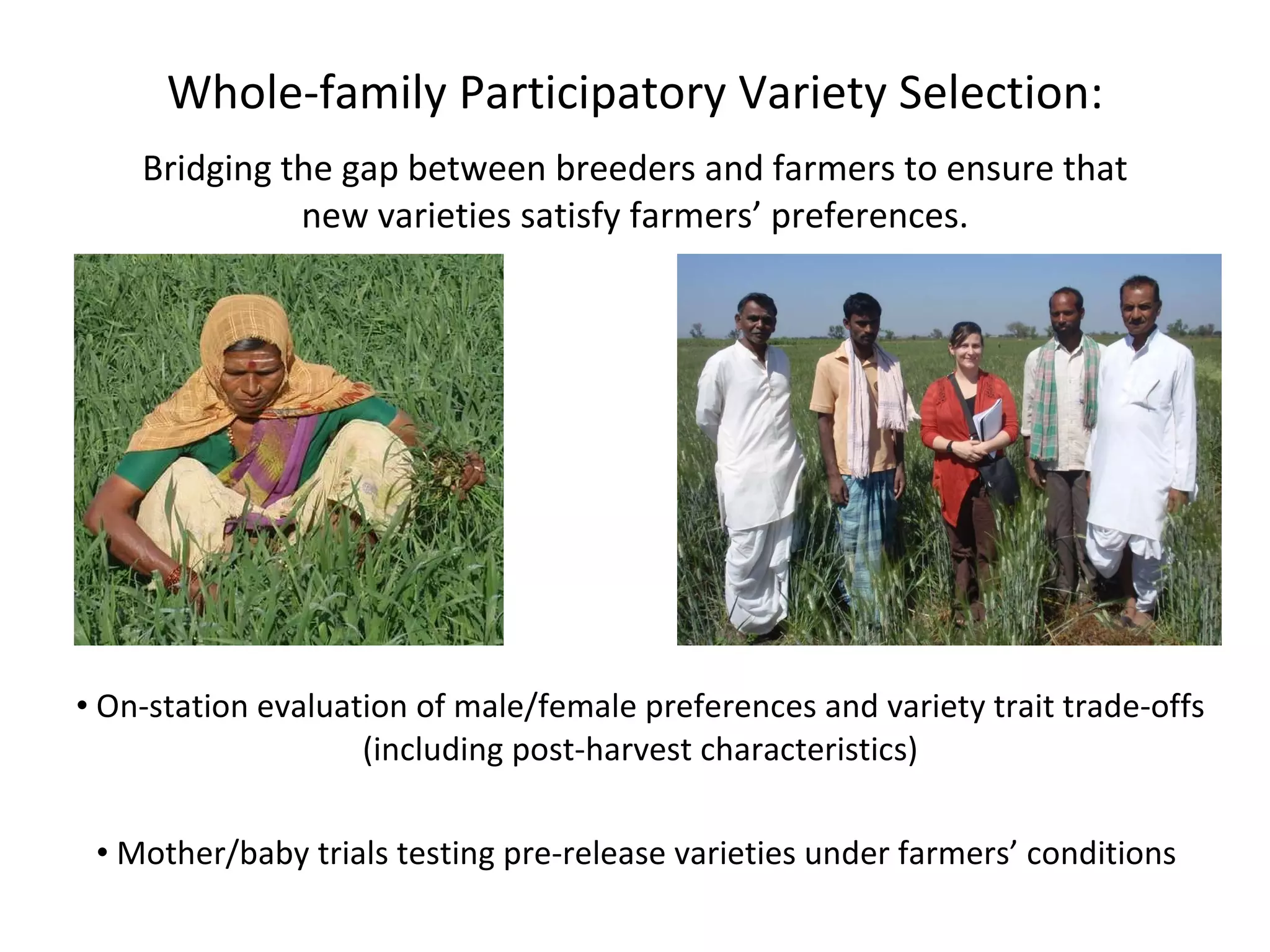
Whole-family Participatory Variety Selection: Bridging the gap between breeders and farmers to ensure that new varieties satisfy farmers’ preferences. On-station evaluation of male/female preferences and variety trait trade-offs (including post-harvest characteristics) Mother/baby trials testing pre-release varieties under farmers’ conditions
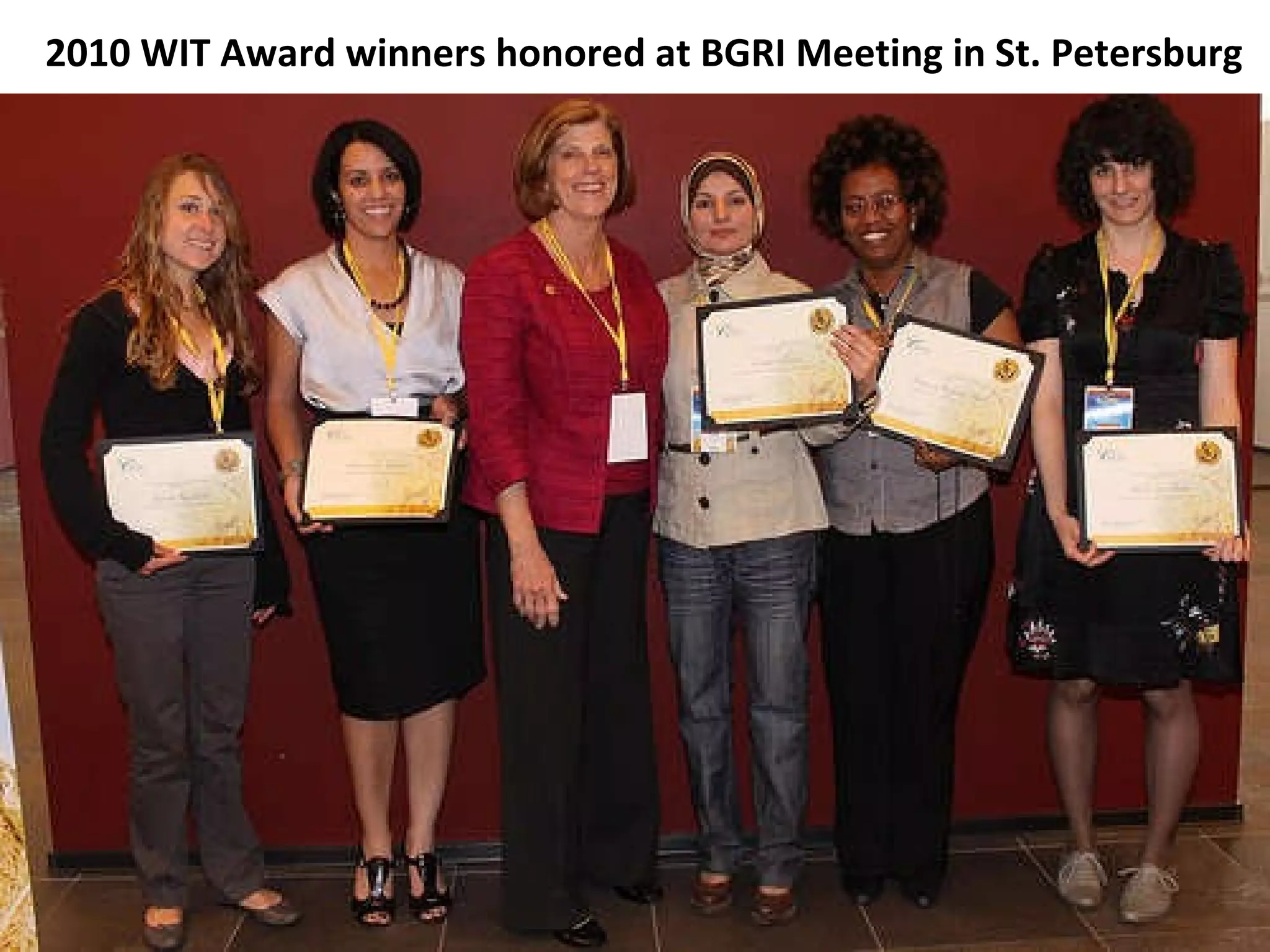
2010 WIT Award winners honored at BGRI Meeting in St. Petersburg
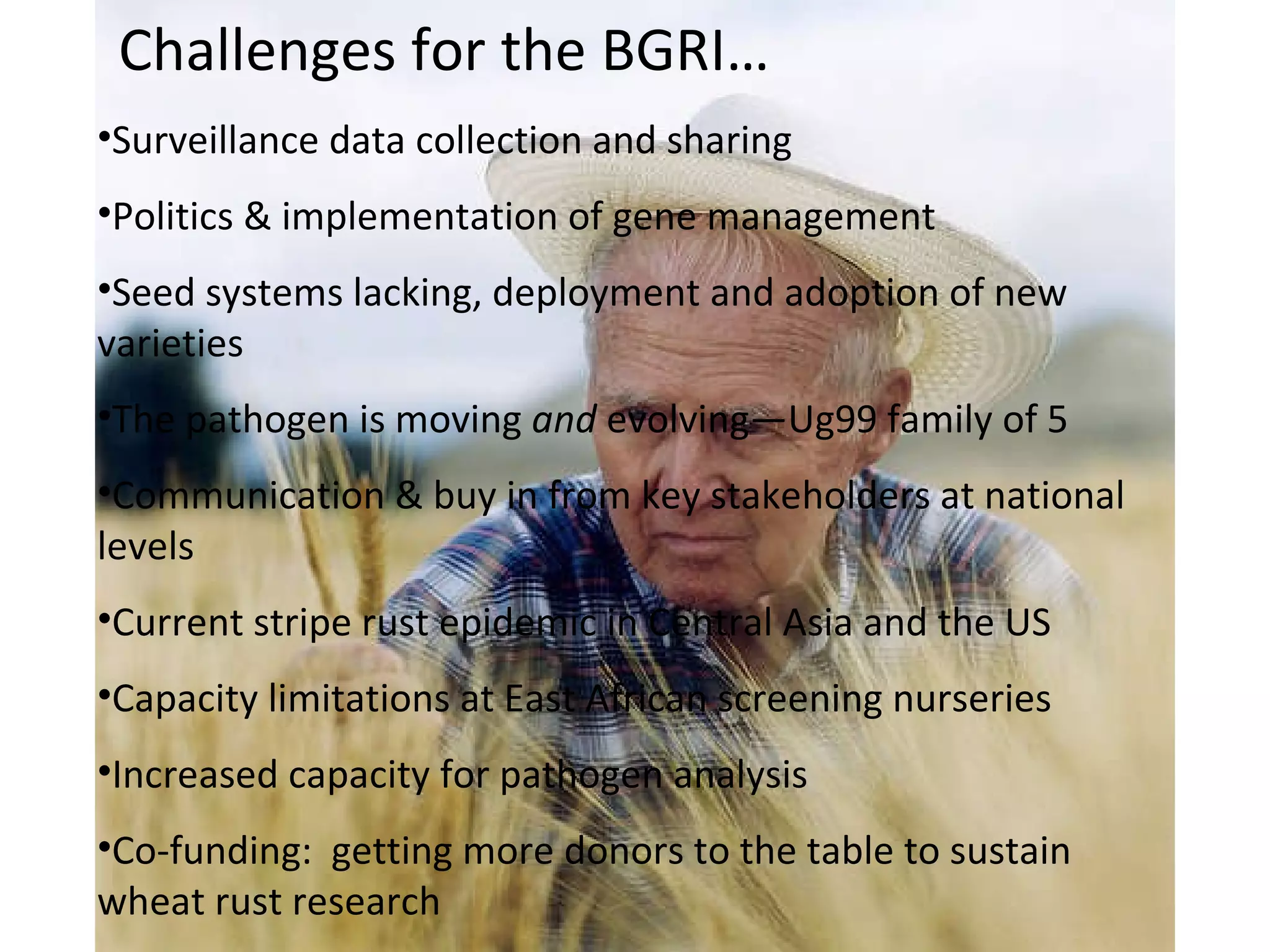
Surveillance data collection and sharing Politics & implementation of gene management Seed systems lacking, deployment and adoption of new varieties The pathogen is moving  and  evolving—Ug99 family of 5 Communication & buy in from key stakeholders at national levels Current stripe rust epidemic in Central Asia and the US Capacity limitations at East African screening nurseries Increased capacity for pathogen analysis Co-funding:  getting more donors to the table to sustain wheat rust research Challenges for the BGRI…
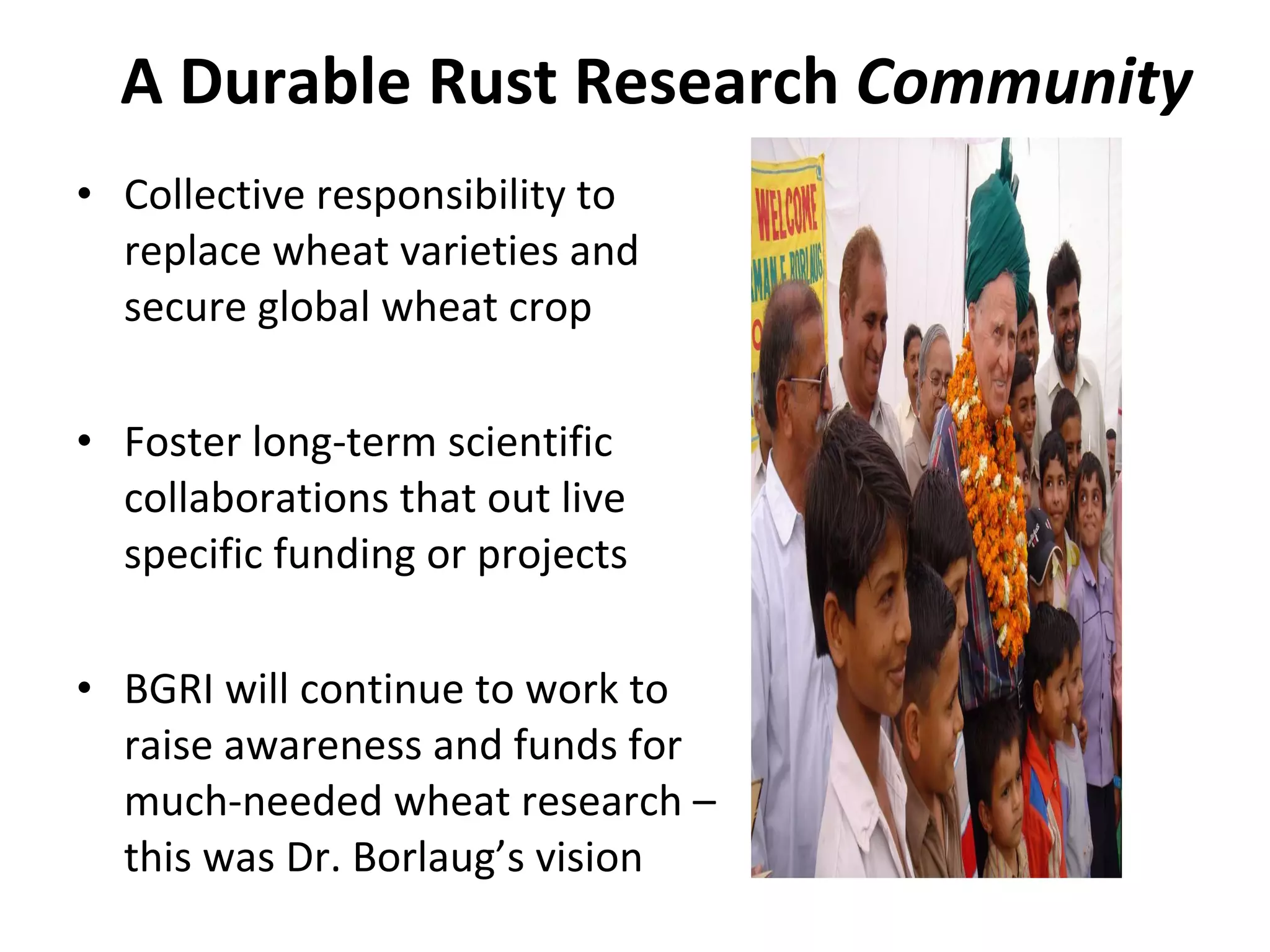
A Durable Rust Research  Community Collective responsibility to replace wheat varieties and secure global wheat crop Foster long-term scientific collaborations that out live specific funding or projects BGRI will continue to work to raise awareness and funds for much-needed wheat research – this was Dr. Borlaug ’s vision
Stripe Rust Susceptible in the Background Stripe Rust Resistant in the Foreground Stripe Rust can Benefit the War on Stem Rust
http://www.globalrust.org

Durable Rust Resistance in Wheat Phase I Progress / Phase II Prospects

  • 1.
    Durable Rust Resistancein Wheat Phase I Progress / Phase II Prospects Ronnie Coffman, Vice Chair, BGRI Director, DRRW Cornell University 18 April 2011 ICARDA Aleppo, Syria
  • 2.
    http://wheatrust.cornell.edu http://www.globalrust.org Acknowledgements Sathguru Management Consultants, India ICAR Leadership and Scientists Robert Park, University of Sydney Kumarse Nazari, ICARDA Sridhar Bhavani, CIMMYT Nairobi Hans Braun, CIMMYT HQ Ravi Singh, CIMMYT HQ Mike Pumphrey, WSU Hei Leung, IRRI Bedada Girma, EIAR Peter Njau, KARI- Njoro Dave Hodson, FAO (formerly CIMMYT) Gordon Cisar, DRRW Sarah Davidson, DRRW Bill & Melinda Gates Foundation Katherine Kahn
  • 3.
    Stripe Rust Susceptiblein the Background Stripe Rust Resistant in the Foreground Stripe Rust can Benefit the War on Stem Rust
  • 4.
    Wheat Stem RustUg99 Defeats genetic resistance that has protected most of the world for 30 years
  • 5.
    Variety PBW343 grownon over 7 million hectares in South Asia International wheat screening nursery at Kulumsa, Ethiopia
  • 6.
    Ronnie Coffman withDr. Norman Borlaug March 2008
  • 7.
    Courtesy of PeterNjau, KARI Kenya Rust never sleeps but it abides in East Africa
  • 8.
  • 9.
    2009 2009 1998/92001 2003 2006 2007 ? ? Wheat stem rust race Ug99 emerged from Uganda in 1999
  • 10.
  • 11.
    Risk Zone 1: Wheat Areas Only (Totals) 1 Billion People 117 Million Tons Production (c.19% world production) Value US$16.4 Billion (using US$140/t) Potential Risk Areas – An Initial Assessment Turkey Iran Saudi Arabia Afghanistan Pakistan India Egypt Sudan Ethiopia Kenya Iraq Syria Nepal Yemen
  • 12.
    AGP-FAO Wheat RustDisease Global Program Cereal System Initiative for South Asia (CSISA) Projects And many more… Durable Rust Resistance in Wheat Project (DRRW)
  • 13.
  • 14.
    Objectives Planning forthe Threat of Emerging Wheat Rust Variants Advocating and Coordinating Global Cooperation Surveillance Critical Facilities in East Africa Breeding 6-8. Pre-breeding 9. Rice Immunity Project Management DRRW Phase I: 26.8 M USD, 3 years +1
  • 15.
    Scientists from morethan 20 countries trained in surveillance. Standardized, geo-referenced rust surveys developed for 14 countries Rustmapper: predicts movement of rust spores New diagnostic markers developed to fingerprint the pathogen Pathogen sequencing efforts Evolution of the Ug99 lineage monitored in at-risk regions Progress Update: surveillance Ruth Wanyera (KARI) and Dave Hodson (FAO)
  • 16.
    India Provides RegionalLeadership for Wheat Rust Surveillance and Monitoring   DRRW-ICAR training program 25 th February – 14 th March 2010. DWR-Shimla and Karnal trained 12 scientists from Afghanistan, Nepal, and India in surveillance and monitoring. IARI Station in Wellington, University of Agricultural Sciences at Dharwad, Directorate of Wheat Research-Karnal, Punjab Agricultural University at Ludhiana, Flowerdale station-Shimla “ Global surveillance and monitoring is essential” - Dr. Swapan Datta, 2010 BGRI Workshop
  • 17.
    26,800 lines ofwheat and barley evaluated from 20 countries / institutions during the main- and off-seasons in 2008 at KARI-Njoro; 48,500 lines in 2009 17,000 durum wheat lines evaluated at EIAR-Debre Zeit in 2009 25 scientists at Ug99 screening nursery in Kenya for the rust scoring course held from 5 th – 12 th October 2010. Data sharing & management Progress Update: critical facilities Screening nurseries enhanced in Kenya & Ethiopia
  • 18.
  • 19.
    Several Ug99-resistant linesid ’d that are candidates for varietal release, incl 15 lines distributed to 6 at-risk countries 80% of crosses made by CIMMYT/ICARDA spring wheat breeding programs have at least one Ug99 resistant parent Global exchange of Ug99-resistant germplasm Pre-release seed multiplication of resistant lines initiated in several at-risk countries (Ethiopia, Egypt, ex.) Success of US AID-funded Famine Seed Project 4 rust research centres from India are screening Indian wheat germplasm for Ug99 resistance in Kenya and Ethiopia. Progress Update: breeding Kingbird, best source of APR resistance. Courtesy of Ravi Singh, CIMMYT
  • 20.
    Breeding Priorities : Importance of Durable Resistance Responsible breeding means knowing the genetic basis of resistance. Know what you are releasing Strategic deployment of resistance genes essential. APR/ multiple minor gene approach Multiple non-segregating major genes “stacked” Combination of minor and major genes
  • 21.
  • 22.
    Kakaba (Picaflor #1),Gonde Seed Farm (near Kulumsa), Ethiopia. Bedada Girma, Eshetu Sisay (Farm Manager) & Ronnie Coffman
  • 23.
    Lines with multipleUg99 resistance genes are underway Progress mapping APR genes By the end of 2010: Breeders will be using 12 Sr genes that are either optimized or newly discovered genes Breeders will be using more robust and diagnostic markers for at least 10 Sr genes. Progress Update: pre-breeding
  • 24.
    Phase I ->Phase II Transition Year 1 (2008) Year 3 (2010) Year 2 (2009) 1 Year Extension (2011) Year 4 (2014) Year 3 (2013 Year 2 (2012) Year 1 (2011) Year 5 (2015) Phase I funded at $26.8M Phase II funded at $40M $25M from the Bill & Melinda Gates Foundation (BMGF) $15M from the Department for International Development (DFID) of the United Kingdom
  • 25.
    DRRW Phase II.Obj. 21: Seed systems interventions Obj. 22: Advocacy for additional investments Obj. 23: Surveillance of the pathogen Obj. 24: East Africa screening nursery facilities Obj. 25: Breeding durably resistant varieties Obj. 26: Pre-breeding (gene discovery, markers) Obj. 27: Ethiopian wheat breeding program Obj. 28: Project management and coordination
  • 26.
    DRRW Gender StrategyEncourage women to work in wheat Jeanie Borlaug Laube Women in Triticum (WIT) Award; IT Mentor Award Invest in technologies that lessen work-life conflict Genomic Selection Employ “whole-family” participatory variety selection Dharwad and Ethiopia
  • 27.
    Whole-family Participatory VarietySelection: Bridging the gap between breeders and farmers to ensure that new varieties satisfy farmers’ preferences. On-station evaluation of male/female preferences and variety trait trade-offs (including post-harvest characteristics) Mother/baby trials testing pre-release varieties under farmers’ conditions
  • 28.
    2010 WIT Awardwinners honored at BGRI Meeting in St. Petersburg
  • 29.
    Surveillance data collectionand sharing Politics & implementation of gene management Seed systems lacking, deployment and adoption of new varieties The pathogen is moving and evolving—Ug99 family of 5 Communication & buy in from key stakeholders at national levels Current stripe rust epidemic in Central Asia and the US Capacity limitations at East African screening nurseries Increased capacity for pathogen analysis Co-funding: getting more donors to the table to sustain wheat rust research Challenges for the BGRI…
  • 30.
    A Durable RustResearch Community Collective responsibility to replace wheat varieties and secure global wheat crop Foster long-term scientific collaborations that out live specific funding or projects BGRI will continue to work to raise awareness and funds for much-needed wheat research – this was Dr. Borlaug ’s vision
  • 31.
    Stripe Rust Susceptiblein the Background Stripe Rust Resistant in the Foreground Stripe Rust can Benefit the War on Stem Rust
  • 32.

Editor's Notes

  • #9 One problem: Green bridge
  • #12 Potential risk areas Based on a combination of previous factors More northern areas were excluded in initial assessment due to sub-optimal temperatures and unfavorable airflows – HOWEVER, they should not be regarded as zero-risk Slide b Even excluding those areas, the potential risk zone if UG99 spreads and epidemics occur is of major global importance