TRAINING AND
COMPETENCY PROGRAM
TISCH HEMATOLOGY
OBJECTIVES
TRAINING and COMPETENCY PROGRAM
 Provides the necessary background information and processes to develop training and
competence assessment programs that meet regulatory and accreditation requirements and help ensure
knowledgeable and competent personnel in all laboratory disciplines
• Demonstrate understanding of processes and procedures employees perform in their respective jobs
• Demonstrate understanding of processes and procedures that verify personnel are competent after initial
training and periodically through employment
• Demonstrate understanding of planned and systematic training and competence assessment through the
quality system's (QSE) 12 essentials and the service's path of workflow
• Identify key elements of qualified trained and competent personnel
2
Tisch Hematology
Total Quality Management in a nutshell.
The 12 Quality Management Essentials
Based on ISO 15189 and CLSI GP26-A3
Organization
Personnel
Equipment
Inventory
Process Control
Information Management
Documents and Records
Non-Conformance and Occurrence Management
Assessment
Process Improvement
Customer Service
Facilities and Safety
3
Tisch Hematology
PATH OF WORKFLOW
Organization Personnel Equipment Inventory
Process
Control
Information
Management
Document
and Records
Non-
Conformance
and
Occurrence
Management
Assessment
Process
Improvement
Customer
Service
Facilities and
Safety
4
PRE-ANALYTICAL > ANALYTICAL > POST-ANALYTICAL
Tisch Hematology
KEY ELEMENTS OF QSE:
Personnel
5
Division/Department
Tisch Hematology
DIFFERENCES BETWEEN EDUCATION AND TRAINING
6
Education in an Academic Setting Training
Focus is on future job for the learner Focus is on present job of the learner
Awareness of a skill Demonstration of a skill
Assessment through tests of
knowledge
Assessment through evaluation of
performance or outcome
Education Training
Gaining knowledge
Gaining skills to apply
knowledge to assigned
work
Tisch Hematology
TRAINING GUIDE COMPONENTS
Training Guide Component Function
Objectives
States the expectations for the outcomes of
the training event
Methods Describes the various means used to conduct the training
Materials
Lists the materials and resources provided for
the training event
Criteria to assess the effectiveness
of training
Describes the tools used to assess the effectiveness
of training
7
Tisch Hematology
TRAINING PROGRAM
8
Tisch Hematology
LEARNING
OBJECTIVES
Learning objectives are
expectations
for training outcomes that
can be observed or
assessed; therefore, they
use action verbs and
describe measurable
behaviors. Learning
objectives for training are
of three types:
9
Tisch Hematology
SAMPLE LEARNING OBJECTIVE
Learning Objective
At the conclusion of training, you will be able to:
• perform the process and supporting procedures without supervision and
within acceptable limits, including:
– performing linearity checks (psychomotor),
– calibrating the instrument (psychomotor),
– loading the sample trays (psychomotor);
• choose the appropriate action to take when there are any problems in the
above activities (affective); and
• achieve a passing score on the written quiz (cognitive). 10
Tisch Hematology
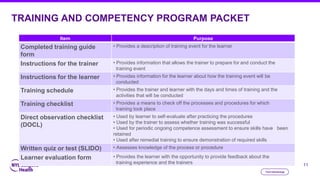
TRAINING AND COMPETENCY PROGRAM PACKET
11
Item Purpose
Completed training guide
form
• Provides a description of training event for the learner
Instructions for the trainer • Provides information that allows the trainer to prepare for and conduct the
training event
Instructions for the learner • Provides information for the learner about how the training event will be
conducted
Training schedule • Provides the trainer and learner with the days and times of training and the
activities that will be conducted
Training checklist • Provides a means to check off the processes and procedures for which
training took place
Direct observation checklist
(DOCL)
• Used by learner to self-evaluate after practicing the procedures
• Used by the trainer to assess whether training was successful
• Used for periodic ongoing competence assessment to ensure skills have been
retained
• Used after remedial training to ensure demonstration of required skills
Written quiz or test (SLIDO) • Assesses knowledge of the process or procedure
Learner evaluation form • Provides the learner with the opportunity to provide feedback about the
training experience and the trainers
Tisch Hematology
HOW TRAINING IS CONDUCTED
NOTE:
Learners should be trained in the actual work area whenever possible.
12
Training Environment
A training environment conducive to learning should be provided. The learner
should have the opportunity to practice in a “safe” environment where:
► he or she is not punished for mistakes;
► there is time for reflection on the information obtained and activity learned;
► the learner can make conclusions from information presented or activities
experienced; and
► the learner can adapt to the new learning.
Whenever possible, training should take place in the area where the work is
performed so the learner can observe the work process and procedures.
LEARNING STYLES
Individuals have different learning styles. Some people learn by visual demonstration, others by listening, and
others by doing. For greatest effectivity, training should be tailored to the learner’s style. A training tool to train
on actionable functions follows the acronym EDIC:
► E – Explain – The trainer explains why each activity is performed, the theory behind
what is done, and how the process fits into the entire picture. This is auditory learning.
► D – Demonstrate – The trainer performs the process activities or steps of the
procedure, explaining what he/she is doing. This is visual and auditory learning.
► I – Imitate – The learner imitates the trainer’s actions, explaining what he/she is
doing and why. This is tactile and auditory learning.
► C – Correct – The trainer corrects errors in a nonpunitive manner.
The EDIC process is repeated as many times as needed over an appropriate period of time until the learner is
competent in the task.
13
Tisch Hematology
PERFORMANCE STANDARDS
Performance standards are statements of expected
results or behaviors that specify the quantity and
quality of work necessary to meet objectives.
Performance standards should be communicated to
new employees when training is initiated so they are
clear about their supervisor’s expectations.
Trainors/perceptors must provide new hires and refresher trainees with
performance standards for their jobs and told when they will be held accountable for
that level of performance. During initial training, employees are then aware of the
performance standards and can use them as a goal for their training outcomes.
However, employees should not be immediately expected to perform at that level.
TISCH HEMATOLOGY
Example of a performance standard
stated as an expected result:
“Within three months of commencing
testing as a full-time clinical laboratory
technologist, you will have fewer than
two corrected reports on manually
transcribed results in LIS per month
and be able to perform automated
testing with 0.04% error rate”
Example of a performance standard
stated as an expected behavior:
“You will answer the telephone within
three rings, identifying yourself by
name and department.”
Training Objective(s)
At the conclusion of training, the employee will be able to:
1. Perform testing and report results without supervision following approved procedures.
2. Perform QC without supervision and follow appropriate corrective action when QC fails.
3. Perform all function checks and maintenance procedures without supervision and follow appropriate corrective action when needed.
4. Create compliant records.
5. Choose the appropriate action to take when there are problems encountered in the test system or process.
6. Achieve a passing score on the written assessment, if applicable.
Training Guide for Trainer
• Organize the training event for success.
• Be patient.
• Communicate clearly.
• Provide accurate and complete information.
• Train by the approved policy, process, or procedure.
• Ensure all safety precautions are communicated and followed.
• Immediately correct performance problems in a respectful manner.
• Provide opportunities for feedback.
• Report any training related problems to management.
• Review the procedure(s) before the training event, and then:
– Show employee how to locate the required procedures in the document management system.
– Explain required PPE and other safety procedures related to the test system or process before training.
– Show employee where reagents and supplies are stored.
– Demonstrate any reagent preparation procedures.
– Show employee how to perform and record any lot-to-lot or other checks associated with new reagents.
– Discuss a high-level overview of test system and process flow.
– Review specimen acceptance and rejection criteria, if applicable.
15
Tisch Hematology
Training Guide for Trainer (Continued)
– Demonstrate any sample processing procedures.
– Demonstrate any analyzer start-up and shut-down procedures and observe employee
performance.
– Demonstrate QC checks and documentation, if applicable, and observe employee
performance.
– Discuss how to resolve and document a QC failure within the test system.
– Demonstrate patient sample testing, if applicable, and observe employee performance.
– Demonstrate how to report patient test results in the LIS. Explain MI or other reporting
conditions.
– Demonstrate how to use any ancillary software programs associated with test system, if
applicable.
– Discuss how to manage aberrant or unusual patient results within the test system.
– Discuss how to manage critical results, if applicable, including documentation.
– Demonstrate function checks and maintenance procedures, if applicable, and observe
employee performance.
– Discuss contingency planning.
– Discuss problems commonly encountered within test system or processes and their usual
resolution.
– Evaluate any blind testing, unknowns, or trial runs.
– Review documentation and circle “Satisfactory” or “Unsatisfactory” as appropriate. Submit
all documentation for management review. Employee may not perform independent testing until
management has reviewed and verified completion of training and certified the employee’s initial
competence. 16
Tisch Hematology
1. TRAINING PLAN ELEMENTS
Training Event Information Function
Learning objectives States the outcome expectations for the learner
Training methods Describes the various training methods to be used
Training materials Lists the training event materials and resources needed
Trainer instructions Provides trainer preparation and presentation information
Learner instructions Provides learner with training event information
Training checklists Describes the function of a training checklist
Learner’s assessment
methods
Describes and provides the competence assessment
methods and tools
Means for the learner to
evaluate the training event
Identifies tools for learners to evaluate the training
experience
17
Tisch Hematology
2. LEARNING DOMAINS AND LEARNING OBJECTIVES
18
Domain Assesses
Examples:
At the conclusion of the training, the learner
will be able to:
Cognitive Knowledge List all the computer codes used in process ABC.
Affective Attitude Defend the specimen labeling policy.
Psychomotor Physical
skills
Calibrate XYZ instrument accurately and according
to the instructions in the procedure.
Tisch Hematology
COMPONENTS OF A COMPLETE CLINICAL SERVICE
TRAINING PROGRAM
19
Division/Department
Type of Employment
Training
Contents
Quality • Laboratory’s QMS, quality policy, and quality manual
• Quality goals, objectives, and related measurements
• QMS responsibilities
• Purchasing and inventory responsibilities
• Laboratory’s path of workflow
• QC program, as relevant to work areas
• PT
• Accreditation program(s) participation
• Non-conformance events and complaint management programs
• Customer service program
COMPONENTS OF A COMPLETE CLINICAL SERVICE
TRAINING PROGRAM
20
Safety • Laboratory floor plan and locations of safety equipment
• PPE (issue of uniforms and/or laboratory coats, procedure for handling and cleaning of uniforms or
laboratory coats, eye and hearing protection)
• Use of engineering controls (eg, safety hoods)
• Environmental health and safety (emergency and disaster response plan and emergency contact list)
• Fire safety (locations of emergency exits, evacuation routes, fire alarm pull stations, and fire extinguishers;
location outside the facility where personnel should report in the event of an emergency evacuation;
procedure for calling in a fire event to appropriate authorities)
• Accident reporting
• Infection control processes and procedures
• Chemical hygiene program (eg, safety data sheets, chemical storage, safety cabinets, handling and storage
of gas cylinders, use of chemical fume hoods)
• Hazardous waste disposal
• Physical hazards (eg, radiation, ergonomic hazards, noise)
• Radiation safety, as applicable
• Decontamination procedures (location of materials for decontamination, decontamination and spill cleanup
procedure, who to notify in event of a spill)
Tisch Hematology
COMPONENTS OF A COMPLETE CLINICAL SERVICE
TRAINING PROGRAM
21
Compliance • Organization and laboratory’s code of ethics
• Professional and scientific rules of conduct
• Regulatory, organizational, and laboratory requirements
for confidentiality of protected health information
Work processes
and procedures
• Processes in the path of workflow in which the employee
works (including preexamination, examination,
postexamination), and quality management
• Procedures performed and records created and
maintained
• Equipment used and maintained
Tisch Hematology
22
Computer systems • Organization-wide system (eg, electronic health record)
• Laboratory’s computer system
• Information services system (eg, e-mail, scheduling, word processing, spreadsheets,
databases)
• Intranet and Internet use and restrictions of use
• Online documents
• Other computer applications used in the job (eg, documentation of training, CE,
competence assessment)
• Use of external memory devices such as flash drives and CDs/DVDs
• Security and confidentiality of information (eg, removal of data from the laboratory,
regulatory and/or laboratory policies on protecting patient confidentiality and
information)
COMPONENTS OF A COMPLETE CLINICAL SERVICE
TRAINING PROGRAM
Tisch Hematology
TRAINING GUIDE COMPONENTS
Training Guide Component Function
Objectives
States the expectations for the outcomes of
the training event
Methods Describes the various means used to conduct the training
Materials
Lists the materials and resources provided for
the training event
Criteria to assess the effectiveness
of training
Describes the tools used to assess the effectiveness
of training
23
Tisch Hematology
24
Cognitive (Knowledge) Levels Affective (Attitudes) Levels Psychomotor (Skill) Levels
Remembering
Example verbs:
Define, label, list, memorize,
match, name, recognize, state
Receiving
Example verbs:
Acknowledge, attend, focus,
follow, listen, take part
Imitation
Example verbs:
Adhere, copy, duplicate, follow,
organize, replicate, repeat,
sketch
Understanding
Example verbs:
Describe, discuss, explain,
reword, illustrate, report,
summarize
Responding
Example verbs:
Clarify, comply, contribute,
react, respond, obey, perform,
select
Manipulation
Example verbs:
Acquire, build, conduct,
implement, operate, perform,
re-create
Applying
Example verbs:
Use, conduct, demonstrate,
interpret, operate, prepare, solve
Valuing
Example verbs:
Accept, challenge, debate,
defend, refute, justify, persuade
Precision
Example verbs:
Accomplish, achieve, calibrate,
complete, control, master,
perfect
Tisch Hematology
25
Analyzing
Example verbs:
Analyze, compare, contrast,
detect, diagram, experiment,
quantify
Organizing or
Conceptualizing Values
Example verbs:
Arrange, codify, discriminate,
formulate, modify, organize,
relate
Articulation
Example verbs:
Coordinate, develop, integrate,
formulate, revise, solve
Evaluating
Example verbs:
Assess, defend, evaluate,
investigate, justify, score
Internalizing Values
Example verbs:
Act, display, influence,
internalize,
practice, solve
Naturalization
Example verbs:
Construct, compose, create,
design, invent, project-manage,
originate
Creating
Example verbs:
Build, design, develop,
formulate, organize, plan,
propose, revise
Tisch Hematology
Training Tips
When preparing to deliver a training event, the following considerations are important:
• Take the time to read through the trainer notes before you begin to deliver the training. Be sure that you
understand the flow and pace of the training.
• Review the related laboratory documents for facts or processes that you may need to brush up on to
ensure smooth delivery.
• Review the learner materials and become familiar with the content in order to answer questions that
may arise.
• Review the training objectives and any post-test to understand the core content and concepts on which
the participants are tested.
Some additional tips for training delivery include:
• Two-way communication is best: listen actively to whoever is speaking to show you understand.
26
Tisch Hematology
Training Tips
Pick up on the emotion as well as the spoken words.
• Respect opinions with which you may disagree.
• Respond politely to all questions.
• Ask open-ended questions to encourage participation; ask probing questions, ask clarifying questions.
• Use as much hands-on training as possible. The most effective training uses all the senses to affect
learning. Demonstrate and apply teaching points to create greater understanding and knowledge of the
subject.
• Test frequently. Tests are most effective when learners know they will be quizzed, because they’ll pay
close attention to the material. Testing is an objective way to determine whether training achieved its
goals.
27
Tisch Hematology
Training Tips
Individuals have different learning styles. Some people learn by visual demonstration, others by listening,
and others by doing. For greatest efficacy, training should be tailored to the learner’s style.
• Link new information to existing knowledge.
– Ask the learner to recall concepts and principles that represent this process or procedure.
– Ask the learner questions to link what he or she already knows that is related to this process or
procedure.
• Demonstrate the process or procedure.
– Organize the new knowledge so it matches the organization of the existing knowledge.
28
Tisch Hematology
Training Tips
Specify both the knowledge and behavior to be learned.
– Show the procedure or a worked-out example in a logical way that is easiest to understand.
– Name the steps in the procedure, highlight any branches, and explain briefly what is being done.
– Show different examples of the procedure, if applicable.
– During the demonstration ask the learner questions about how the procedure was done to strengthen the
new knowledge in memory.
– Summarize the new material by presenting or highlighting important steps.
• Do something with the new knowledge.
– Have the learner practice the process, procedure, or skill in different scenarios and situations so the learner
has to select only the relevant information.
– Provide feedback to let the learner know how he or she has done using the new knowledge.
• Evaluate learning progress.
– Test the learner on the new information to prove to the trainer and the learner that he or she can perform the
process or procedure correctly.
29
Tisch Hematology
30
• TRAINING PLAN
• Collect sufficient patient sample and correctly process the specimen used for the testing
(minimum 10 normals and 10 abnormals )- ORDER TEST DUMMY SAMPLES
• Complete the test report correctly, using the appropriate test units of measurement
• Perform the test correctly by adding the proper order and amount of patient specimen and
reagent
• Add the testing solutions in the proper amount and order- as needed
• Collect sufficient patient sample and add it to the testing system correctly
• Use test solutions and reagents from the same test kit and lot number
• Maintain records of the patient testing results
• Treat PT samples in the same manner as patient specimens and maintain records indicating
such
• Adhere to the laboratory’s Quality Control (QC) policies and document QC activities
• Adhere to the laboratory’s policies for instrument calibrations and maintenance activities
• Follow the laboratory’s corrective action policies and procedures when a test system fails to
meet the laboratory’s acceptable level of performance
• Identify problems that may affect test performance or reporting test results and either correct
the problem or
notify the TC or director
• Document all corrective action taken when there is a test system failure
Techs must not report patient testing unless completely signed off for competency
assessment
Tisch Hematology
SAMPLE ANALYZER TESTING PROCESS
31
What Happens Who’s Responsible Procedures
Sample acceptability
evaluated
• technician; or
• technologist
• “Evaluating Sample Acceptability”
Analyzer test-ready
procedures performed
• technician; or
• technologist
• “Starting Up the ABC Analyzer”
• “Performing Daily Maintenance on the ABC Analyzer”
• “Performing and Evaluating Daily Calibration on the
ABC Analyzer”
• “Performing and Evaluating Controls on the ABC Analyzer”
Patient samples loaded and
tested
• technician; or
• technologist
• “Generating an LIS Pending Log for the ABC Analyzer”
• “Programming Patient Samples on the ABC Analyzer”
• “Loading Routine and Stat Racks on the ABC Analyzer”
Troubleshooting procedures
performed
• technician;
• technologist; or
• supervisor
• Troubleshooting procedures from the manufacturer’s
manual
Results evaluated • technologist; or
• supervisor
• “Evaluating Patient Results”
• “Calling Alert Values”
• “Following Up on Delta Checks”
• “Following Up on Technical Flag Limits”
Results verified in LIS • technologist • “Verifying Results in the LIS”
Samples unloaded and stored • technician; or
• technologist
• “Stori
Tisch Hematology
COMPETENCY
ASSESSMENT
32
Tisch Hematology
COMPETENCY GUIDE FOR EACH TESTING
SYSTEM/METHOD:
33
Competence can be assessed by using any combination or all of the following methods, as required by
regulatory and accreditation organizations:
► Direct observation of routine work processes and procedures,
including applicable pre-examination and post-examination processes
and applicable safety practices
► Direct observation of equipment maintenance and function checks
► Monitoring examination result recording and reporting, including
any critical results
► Review of work records such as work cards, log sheets,
and computer data entry
► Examination of specially provided samples, such as
previously examined samples, interlaboratory comparison (ie,
proficiency testing [PT]) materials or split samples, and in
some cases QC material
► Observed compliance with Safety Protocols
► Assessment of problem-solving skills
Tisch Hematology
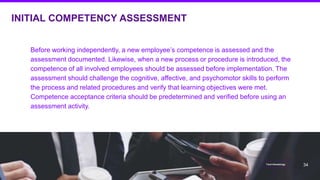
INITIAL COMPETENCY ASSESSMENT
34
Before working independently, a new employee’s competence is assessed and the
assessment documented. Likewise, when a new process or procedure is introduced, the
competence of all involved employees should be assessed before implementation. The
assessment should challenge the cognitive, affective, and psychomotor skills to perform
the process and related procedures and verify that learning objectives were met.
Competence acceptance criteria should be predetermined and verified before using an
assessment activity.
Tisch Hematology
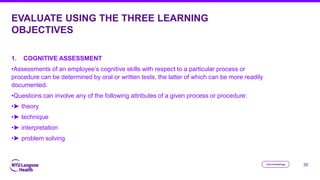
EVALUATE USING THE THREE LEARNING
OBJECTIVES
1. COGNITIVE ASSESSMENT
•Assessments of an employee’s cognitive skills with respect to a particular process or
procedure can be determined by oral or written tests, the latter of which can be more readily
documented.
•Questions can involve any of the following attributes of a given process or procedure:
•► theory
•► technique
•► interpretation
•► problem solving
35
Tisch Hematology
COGNITIVE ASSESSMENT QUESTIONS
36
A Theory Question -A theory question assesses the employee’s knowledge of the background information for a given procedure.
Example:
“Describe the principle of the test method for the hand-held XYZ blood glucose instrument.”
A Technique Question -A technique question assesses the employee’s knowledge of an important step or action in a given procedure.
Example:
“Explain why you add reagent A before adding reagent B.”
An Interpretation Question - An interpretation question assesses the employee’s ability to arrive at the correct conclusion for a given set of results or
information.
Example:
“Interpret the meaning of the following blood gas results on a patient diagnosed with pneumonia.”
A Problem-Solving Question - A problem-solving question assesses the employee’s ability to think critically. Examples include actions for assessing
instrument issues and the subsequent troubleshooting; prioritization of samples in a critical and outpatient environment; or recommendation of an
appropriate procedure-relevant course of action that is consistent with the service’s policy.
Example:
“The high abnormal control results plotted on a Levey-Jennings chart show eight data points in a row in an increasing trend from left to right on the
chart. What does this mean and what will you do?”
“You receive samples and test requests for a stat complete blood count (CBC) from surgery or a troponin from the emergency department and a
prothrombin time (PT) from the outpatient sample collection site. How would you prioritize this work?”
“After identifying a patient for phlebotomy, you discover the sample label is wrong. Describe how you would follow up this situation.”
Tisch Hematology
EVALUATE USING THE THREE LEARNING
OBJECTIVES
2. AFFECTIVE AND PSYCHOMOTOR ASSESSMENT
The need for patient safety and the judicious use of scarce resources in today’s health care environment
do not allow for incompetent practice; therefore, employees need to perform work correctly the first time,
following approved processes and procedures, taking any needed follow-up action and choosing the
appropriate action to take. The best assurance that employees understand and can perform their
assigned work tasks and follow the documented instructions is to have them demonstrate performance
under observation.
Utilize the “Direct Observation Checklists” (DOCL) that cover the work process and procedures for
which training was delivered.
DOCL : As a training tool, employees can use the DOCL for self-assessment. Once training is complete,
the observer uses the DOCL to follow along and document the employee’s performance. If performance
is not satisfactory, the employee should be given more time to practice before reassessment. Observers
should be cognizant that performers may be overly conscientious or demonstrate nervousness when
watched. At the conclusion of the observation, the observer records whether the employee met the
requirements, whether review or additional training is needed, and/or any applicable comments.
DOCLs provide an objective means for assessing performance.
37
Tisch Hematology
ONGOING PERIODIC COMPETENCY ASSESSMENTS
38
Upon completion of initial training and competency, the succeeding the frequency
of assessments are performed every six months and annually thereafter or as
needed.
Tisch Hematology
HOW WAS THE TRANSFER OF SKILLS ASSESSED
The effectiveness of training and competence directly affects the laboratory’s ability to meet its quality goals
and objectives. Successful laboratory quality performance can be inferred through any of the following means:
39
laboratory
performance on
quality indicators
laboratory
performance on
quality audits
laboratory
proficiency testing
performance
trends and patterns
of
occurrences/nonconf
ormances
customer feedback.
When information from any of the measurement types listed above indicates a need for
improvement, a competence assessment can be designed to determine whether any staff
member’s performance needs remediation. Most often, the process will need to be redesigned or
the procedure revised to clarify key points. Then, a training module can be developed following the
suggestions provided in this guideline. Tracking these performance indicators will demonstrate
improvement in a continuous cycle.
Tisch Hematology
40
1.DIRECT OBSERVATION FOR WORK PROCESSES AND EQUIPMENT MAINTENANCE AND FUNCTION CHECKS:
•DOCL form (used in training or competency assessment)
2.MONITOR EXAMINATION RESULT RECORDING AND REPORTING, INCLUDING ANY CRITICAL RESULTS AND
REVIEW OF INTERMEDIATE RESULTS OR WORKSHEETS, QUALITY CONTROL RECORDS, AND PREVENTIVE
MAINTENANCE RECORDS
•Final patient reports from LIS that contains normal and critical results. Include worksheets if necessary.
•QC records
•Maintenance worksheet/Reagent Validation Records/Calibration Records
3.BLIND SAMPLES OR PROFICIENCY TEST SAMPLES
•Blind sample form (MUST PASS 100% AGREEMENT for QUAL or WITHIN +/- 10% DIFFERENCE) and 90% PASSING
SCORE FOR WBC DIFFERENTIALS
•
4.SAFETY PROTOCOLS
•Decontamination log (all stations)
•
5.PROBLEM-SOLVING
•Slido Quizzes
•Supervisor/Lead verbal questions
•Corrective Action Log/Form
COMPETENCY GUIDE FOR EACH TESTING
SYSTEM/METHOD:
Tisch Hematology
41
The supervisor’s review should at least include:
Intermediate results or worksheets
QC records
Calibration records
Preventive maintenance records
Troubleshooting records
PT results
Corrected or amended reports
Note: A supervisor’s routine review of results, reports, and work records can reveal mistakes and issues that could be related to lack of
competence.
Any such NCEs should be investigated to determine their causes. Actions appropriate to removing the cause should be taken and
documented.
Tisch Hematology
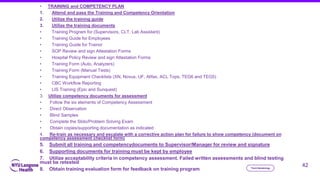
42
• TRAINING and COMPETENCY PLAN
1. Attend and pass the Training and Competency Orientation
2. Utilize the training guide
3. Utilize the training documents
• Training Program for (Supervisors, CLT, Lab Assistant)
• Training Guide for Employees
• Training Guide for Trainor
• SOP Review and sign Attestation Forms
• Hospital Policy Review and sign Attestation Forms
• Training Form (Auto, Analyzers)
• Training Form (Manual Tests)
• Training Equipment Checklists (XN, Novus, UF, Alifax, ACL Tops, TEG6 and TEG5)
• CBC Workflow Reporting
• LIS Training (Epic and Sunquest)
3. Utilize competency documents for assessment
• Follow the six elements of Competency Assessment
• Direct Observation
• Blind Samples
• Complete the Slido/Problem Solving Exam
• Obtain copies/supporting documentation as indicated
4. Re-train as necessary and escalate with a corrective action plan for failure to show competency (document on
competency assessment checklist form)
5. Submit all training and competencydocuments to Supervisor/Manager for review and signature
6. Supporting documents for training must be kept by employee
7. Utilize acceptability criteria in competency assessment. Failed written assessments and blind testing
must be retested
8. Obtain training evaluation form for feedback on training program Tisch Hematology
Must include all six required procedures.
• Collect sufficient patient sample and correctly process the specimen used for the
testing
• Complete the test report correctly, using the appropriate test units of measurement
• Perform the test correctly by adding the proper order and amount of patient specimen
and reagent(s)
• Add the testing solutions in the proper amount and order
• Collect sufficient patient sample and add it to the testing system correctly
• Use test solutions and reagents from the same test kit and lot number
• Maintain records of the patient testing results
43
TRAINING AND COMPETENCY
Tisch Hematology
Treat PT samples in the same manner as patient specimens and maintain records
indicating such?
• Adhere to the laboratory’s Quality Control (QC) policies and document QC activities
• Adhere to the laboratory’s policies for instrument calibrations and maintenance
activities
• Follow the laboratory’s corrective action policies and procedures when a test system
fails to meet the laboratory’s acceptable level of performance
• Identify problems that may affect test performance or reporting test results and either
correct the problem or notify the TC or director
• Document all corrective action taken when there is a test system failure
44
TRAINING AND COMPETENCY
Tisch Hematology
45
Before retraining personnel, trainors and preceptors should answer the
following questions:
► Have all work processes and procedures been clearly documented?
► Are there documented instructions for all activities in the work process?
► Are the documented procedures clear and easy to understand?
► Does the laboratory have a documented training program for all work
processes and procedures?
► How was the effectiveness of the training determined?
► Is this the only person with this performance problem?
► Was work performance feedback given in a timely and clear manner?
TRAINING AND COMPETENCY
Tisch Hematology
46
When there is clear evidence an individual is not competent, needs to
take and document follow-up actions. Reassessment criteria should be
established, documented, and communicated to the person before the
reassessment activity(ies).
Criteria include, but are not limited to:
► How many chances an individual gets to pass assessment
► Administering the same or different challenges
Considerations when performance in visual and practical assessment is
acceptable, but written assessment is unacceptable
Tisch Hematology
47
SAMPLE FORMS USED FOR
TRAINING AND COMPETENCY
ASSESSMENT
Tisch Hematology
48
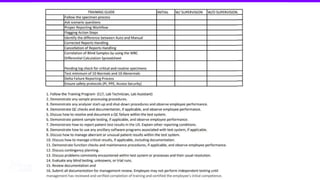
CHECKLIST
Check if completed TRAINING COMPETENCY
1 Follow the specimen process
2 Ask scenario questions
3 Proper Reporting Workflow
4 Flagging Action Steps
5
Identify the difference between Auto and
Manual
6 Corrected Reports Handling
7 Cancellation of Reports Handling
8
Correlation of Blind Samples by using the
WBC Differential Calculation Spreadsheet
9
Test minimum of 10 Normals and 10
Abnormals
10
Pendling Log check for Critical Tests and
Routine
10 Delta Failure Reporting Process
11
Ensure safety protocols (PPE, PI protection,
Access security ie logging out system)
Tisch Hematology
49
Division/Department
Training Guide
for Employee
Sample Copy
50
Division/Department
Training
Evaluation
51
Division/Department
52
Division/Department
TISCH HEMATOLOGY EMPLOYEE NAME: EVALUATOR: DATE:
DIRECT OBSERVATION CHECKLIST XN-9000
Differential (Ma
nual &
Cellavision)
CSF & Body
Fluid, Crystal ID,
Synovial Fld
ESR Alifax
Microhct, Retic,
APT, Fetal HGB
Stain, Sickle Testing
ACL TOP 500 TEG 5S TEG 6S
Clinitek Novus,
UF-1000,
Urinalysis
Manual
YES NO YES NO YES NO YES NO YES NO YES NO YES NO YES NO YES NO
1. Assess the readiness of the analyzer for examinations?
2. Perform the required daily maintenance?
3. Correctly perform and evaluate daily calibration?
4. Correctly perform and evaluate the QC?
5. Correctly troubleshoot any QC problems and record the troubleshooting
(as needed)?
6. Generate an LIS Pending Log for the analyzer?
7. Program patient samples into the analyzer?
8. Load routine and STAT racks onto the analyzer?
9. Correctly troubleshoot any analyzer function problems and record the
troubleshooting (as needed)?
10. Review and evaluate results for any technical flags or comments?
11. Identify and properly report any critical values?
12. Correctly release patient results not already “autoverified”?
13. Correctly archive patient samples?
14. Properly perform shutdown, as needed?
15. Follow all required safety precautions?
Remedial Action Taken (For Supervisor's use only): Remedial Action Completed (For Supervisor's use only):
Evaluator signature/Date:
Employee signature/Date:
53
BLIND STUDY COMPETENCY
EMPLOYEE NAME:
____________________
________
DATE:
____________________
________
TESTING PLATFORM BLIND STUDY
CAP
NAME
SOP REVIEW* PASS FAIL REPEAT
Mark √
CBCD XN-9000
Differential (Manual & Cellavision) use the excel worksheet acceptable criteria = >90%
CSF & Body Fluid
Crystal ID Synovial Fld
ESR Alifax
Microhct
Fetal Hgb Stain
Sickle Cell Testing
Acceptable criteria:
+/- 10% difference for quantitative
values
100% agreement or +/- 1 increment for
qualitative values
Overall Grade: (PASS or FAIL)
________________________
__________
*Note: Due to limitations on obtaining
samples, an SOP review is conducted to
ensure knowledge retention
Q&A
CONTACT:
sasha.palocabase@nyulangone.org
Reference:
1. QMS03. Training and
Competence Assessment.
Clinical and Laboratory
Standards Institute. Fourth
Edition. Wayne, PA.
Accessed March 1, 2023.
56
Tisch Hematology
Thank you
Contact: Sasha D. Palo-Cabase, MLS(ASCP)CM, CPMP
sasha.palocabase@nyulangone.org
Tisch Hematology

TRAINING AND COMPETENCY PROGRAM PRESENTATION.pptx

  • 1.
  • 2.
    OBJECTIVES TRAINING and COMPETENCYPROGRAM  Provides the necessary background information and processes to develop training and competence assessment programs that meet regulatory and accreditation requirements and help ensure knowledgeable and competent personnel in all laboratory disciplines • Demonstrate understanding of processes and procedures employees perform in their respective jobs • Demonstrate understanding of processes and procedures that verify personnel are competent after initial training and periodically through employment • Demonstrate understanding of planned and systematic training and competence assessment through the quality system's (QSE) 12 essentials and the service's path of workflow • Identify key elements of qualified trained and competent personnel 2 Tisch Hematology
  • 3.
    Total Quality Managementin a nutshell. The 12 Quality Management Essentials Based on ISO 15189 and CLSI GP26-A3 Organization Personnel Equipment Inventory Process Control Information Management Documents and Records Non-Conformance and Occurrence Management Assessment Process Improvement Customer Service Facilities and Safety 3 Tisch Hematology
  • 4.
    PATH OF WORKFLOW OrganizationPersonnel Equipment Inventory Process Control Information Management Document and Records Non- Conformance and Occurrence Management Assessment Process Improvement Customer Service Facilities and Safety 4 PRE-ANALYTICAL > ANALYTICAL > POST-ANALYTICAL Tisch Hematology
  • 5.
    KEY ELEMENTS OFQSE: Personnel 5 Division/Department Tisch Hematology
  • 6.
    DIFFERENCES BETWEEN EDUCATIONAND TRAINING 6 Education in an Academic Setting Training Focus is on future job for the learner Focus is on present job of the learner Awareness of a skill Demonstration of a skill Assessment through tests of knowledge Assessment through evaluation of performance or outcome Education Training Gaining knowledge Gaining skills to apply knowledge to assigned work Tisch Hematology
  • 7.
    TRAINING GUIDE COMPONENTS TrainingGuide Component Function Objectives States the expectations for the outcomes of the training event Methods Describes the various means used to conduct the training Materials Lists the materials and resources provided for the training event Criteria to assess the effectiveness of training Describes the tools used to assess the effectiveness of training 7 Tisch Hematology
  • 8.
  • 9.
    LEARNING OBJECTIVES Learning objectives are expectations fortraining outcomes that can be observed or assessed; therefore, they use action verbs and describe measurable behaviors. Learning objectives for training are of three types: 9 Tisch Hematology
  • 10.
    SAMPLE LEARNING OBJECTIVE LearningObjective At the conclusion of training, you will be able to: • perform the process and supporting procedures without supervision and within acceptable limits, including: – performing linearity checks (psychomotor), – calibrating the instrument (psychomotor), – loading the sample trays (psychomotor); • choose the appropriate action to take when there are any problems in the above activities (affective); and • achieve a passing score on the written quiz (cognitive). 10 Tisch Hematology
  • 11.
    TRAINING AND COMPETENCYPROGRAM PACKET 11 Item Purpose Completed training guide form • Provides a description of training event for the learner Instructions for the trainer • Provides information that allows the trainer to prepare for and conduct the training event Instructions for the learner • Provides information for the learner about how the training event will be conducted Training schedule • Provides the trainer and learner with the days and times of training and the activities that will be conducted Training checklist • Provides a means to check off the processes and procedures for which training took place Direct observation checklist (DOCL) • Used by learner to self-evaluate after practicing the procedures • Used by the trainer to assess whether training was successful • Used for periodic ongoing competence assessment to ensure skills have been retained • Used after remedial training to ensure demonstration of required skills Written quiz or test (SLIDO) • Assesses knowledge of the process or procedure Learner evaluation form • Provides the learner with the opportunity to provide feedback about the training experience and the trainers Tisch Hematology
  • 12.
    HOW TRAINING ISCONDUCTED NOTE: Learners should be trained in the actual work area whenever possible. 12 Training Environment A training environment conducive to learning should be provided. The learner should have the opportunity to practice in a “safe” environment where: ► he or she is not punished for mistakes; ► there is time for reflection on the information obtained and activity learned; ► the learner can make conclusions from information presented or activities experienced; and ► the learner can adapt to the new learning. Whenever possible, training should take place in the area where the work is performed so the learner can observe the work process and procedures.
  • 13.
    LEARNING STYLES Individuals havedifferent learning styles. Some people learn by visual demonstration, others by listening, and others by doing. For greatest effectivity, training should be tailored to the learner’s style. A training tool to train on actionable functions follows the acronym EDIC: ► E – Explain – The trainer explains why each activity is performed, the theory behind what is done, and how the process fits into the entire picture. This is auditory learning. ► D – Demonstrate – The trainer performs the process activities or steps of the procedure, explaining what he/she is doing. This is visual and auditory learning. ► I – Imitate – The learner imitates the trainer’s actions, explaining what he/she is doing and why. This is tactile and auditory learning. ► C – Correct – The trainer corrects errors in a nonpunitive manner. The EDIC process is repeated as many times as needed over an appropriate period of time until the learner is competent in the task. 13 Tisch Hematology
  • 14.
    PERFORMANCE STANDARDS Performance standardsare statements of expected results or behaviors that specify the quantity and quality of work necessary to meet objectives. Performance standards should be communicated to new employees when training is initiated so they are clear about their supervisor’s expectations. Trainors/perceptors must provide new hires and refresher trainees with performance standards for their jobs and told when they will be held accountable for that level of performance. During initial training, employees are then aware of the performance standards and can use them as a goal for their training outcomes. However, employees should not be immediately expected to perform at that level. TISCH HEMATOLOGY Example of a performance standard stated as an expected result: “Within three months of commencing testing as a full-time clinical laboratory technologist, you will have fewer than two corrected reports on manually transcribed results in LIS per month and be able to perform automated testing with 0.04% error rate” Example of a performance standard stated as an expected behavior: “You will answer the telephone within three rings, identifying yourself by name and department.”
  • 15.
    Training Objective(s) At theconclusion of training, the employee will be able to: 1. Perform testing and report results without supervision following approved procedures. 2. Perform QC without supervision and follow appropriate corrective action when QC fails. 3. Perform all function checks and maintenance procedures without supervision and follow appropriate corrective action when needed. 4. Create compliant records. 5. Choose the appropriate action to take when there are problems encountered in the test system or process. 6. Achieve a passing score on the written assessment, if applicable. Training Guide for Trainer • Organize the training event for success. • Be patient. • Communicate clearly. • Provide accurate and complete information. • Train by the approved policy, process, or procedure. • Ensure all safety precautions are communicated and followed. • Immediately correct performance problems in a respectful manner. • Provide opportunities for feedback. • Report any training related problems to management. • Review the procedure(s) before the training event, and then: – Show employee how to locate the required procedures in the document management system. – Explain required PPE and other safety procedures related to the test system or process before training. – Show employee where reagents and supplies are stored. – Demonstrate any reagent preparation procedures. – Show employee how to perform and record any lot-to-lot or other checks associated with new reagents. – Discuss a high-level overview of test system and process flow. – Review specimen acceptance and rejection criteria, if applicable. 15 Tisch Hematology
  • 16.
    Training Guide forTrainer (Continued) – Demonstrate any sample processing procedures. – Demonstrate any analyzer start-up and shut-down procedures and observe employee performance. – Demonstrate QC checks and documentation, if applicable, and observe employee performance. – Discuss how to resolve and document a QC failure within the test system. – Demonstrate patient sample testing, if applicable, and observe employee performance. – Demonstrate how to report patient test results in the LIS. Explain MI or other reporting conditions. – Demonstrate how to use any ancillary software programs associated with test system, if applicable. – Discuss how to manage aberrant or unusual patient results within the test system. – Discuss how to manage critical results, if applicable, including documentation. – Demonstrate function checks and maintenance procedures, if applicable, and observe employee performance. – Discuss contingency planning. – Discuss problems commonly encountered within test system or processes and their usual resolution. – Evaluate any blind testing, unknowns, or trial runs. – Review documentation and circle “Satisfactory” or “Unsatisfactory” as appropriate. Submit all documentation for management review. Employee may not perform independent testing until management has reviewed and verified completion of training and certified the employee’s initial competence. 16 Tisch Hematology
  • 17.
    1. TRAINING PLANELEMENTS Training Event Information Function Learning objectives States the outcome expectations for the learner Training methods Describes the various training methods to be used Training materials Lists the training event materials and resources needed Trainer instructions Provides trainer preparation and presentation information Learner instructions Provides learner with training event information Training checklists Describes the function of a training checklist Learner’s assessment methods Describes and provides the competence assessment methods and tools Means for the learner to evaluate the training event Identifies tools for learners to evaluate the training experience 17 Tisch Hematology
  • 18.
    2. LEARNING DOMAINSAND LEARNING OBJECTIVES 18 Domain Assesses Examples: At the conclusion of the training, the learner will be able to: Cognitive Knowledge List all the computer codes used in process ABC. Affective Attitude Defend the specimen labeling policy. Psychomotor Physical skills Calibrate XYZ instrument accurately and according to the instructions in the procedure. Tisch Hematology
  • 19.
    COMPONENTS OF ACOMPLETE CLINICAL SERVICE TRAINING PROGRAM 19 Division/Department Type of Employment Training Contents Quality • Laboratory’s QMS, quality policy, and quality manual • Quality goals, objectives, and related measurements • QMS responsibilities • Purchasing and inventory responsibilities • Laboratory’s path of workflow • QC program, as relevant to work areas • PT • Accreditation program(s) participation • Non-conformance events and complaint management programs • Customer service program
  • 20.
    COMPONENTS OF ACOMPLETE CLINICAL SERVICE TRAINING PROGRAM 20 Safety • Laboratory floor plan and locations of safety equipment • PPE (issue of uniforms and/or laboratory coats, procedure for handling and cleaning of uniforms or laboratory coats, eye and hearing protection) • Use of engineering controls (eg, safety hoods) • Environmental health and safety (emergency and disaster response plan and emergency contact list) • Fire safety (locations of emergency exits, evacuation routes, fire alarm pull stations, and fire extinguishers; location outside the facility where personnel should report in the event of an emergency evacuation; procedure for calling in a fire event to appropriate authorities) • Accident reporting • Infection control processes and procedures • Chemical hygiene program (eg, safety data sheets, chemical storage, safety cabinets, handling and storage of gas cylinders, use of chemical fume hoods) • Hazardous waste disposal • Physical hazards (eg, radiation, ergonomic hazards, noise) • Radiation safety, as applicable • Decontamination procedures (location of materials for decontamination, decontamination and spill cleanup procedure, who to notify in event of a spill) Tisch Hematology
  • 21.
    COMPONENTS OF ACOMPLETE CLINICAL SERVICE TRAINING PROGRAM 21 Compliance • Organization and laboratory’s code of ethics • Professional and scientific rules of conduct • Regulatory, organizational, and laboratory requirements for confidentiality of protected health information Work processes and procedures • Processes in the path of workflow in which the employee works (including preexamination, examination, postexamination), and quality management • Procedures performed and records created and maintained • Equipment used and maintained Tisch Hematology
  • 22.
    22 Computer systems •Organization-wide system (eg, electronic health record) • Laboratory’s computer system • Information services system (eg, e-mail, scheduling, word processing, spreadsheets, databases) • Intranet and Internet use and restrictions of use • Online documents • Other computer applications used in the job (eg, documentation of training, CE, competence assessment) • Use of external memory devices such as flash drives and CDs/DVDs • Security and confidentiality of information (eg, removal of data from the laboratory, regulatory and/or laboratory policies on protecting patient confidentiality and information) COMPONENTS OF A COMPLETE CLINICAL SERVICE TRAINING PROGRAM Tisch Hematology
  • 23.
    TRAINING GUIDE COMPONENTS TrainingGuide Component Function Objectives States the expectations for the outcomes of the training event Methods Describes the various means used to conduct the training Materials Lists the materials and resources provided for the training event Criteria to assess the effectiveness of training Describes the tools used to assess the effectiveness of training 23 Tisch Hematology
  • 24.
    24 Cognitive (Knowledge) LevelsAffective (Attitudes) Levels Psychomotor (Skill) Levels Remembering Example verbs: Define, label, list, memorize, match, name, recognize, state Receiving Example verbs: Acknowledge, attend, focus, follow, listen, take part Imitation Example verbs: Adhere, copy, duplicate, follow, organize, replicate, repeat, sketch Understanding Example verbs: Describe, discuss, explain, reword, illustrate, report, summarize Responding Example verbs: Clarify, comply, contribute, react, respond, obey, perform, select Manipulation Example verbs: Acquire, build, conduct, implement, operate, perform, re-create Applying Example verbs: Use, conduct, demonstrate, interpret, operate, prepare, solve Valuing Example verbs: Accept, challenge, debate, defend, refute, justify, persuade Precision Example verbs: Accomplish, achieve, calibrate, complete, control, master, perfect Tisch Hematology
  • 25.
    25 Analyzing Example verbs: Analyze, compare,contrast, detect, diagram, experiment, quantify Organizing or Conceptualizing Values Example verbs: Arrange, codify, discriminate, formulate, modify, organize, relate Articulation Example verbs: Coordinate, develop, integrate, formulate, revise, solve Evaluating Example verbs: Assess, defend, evaluate, investigate, justify, score Internalizing Values Example verbs: Act, display, influence, internalize, practice, solve Naturalization Example verbs: Construct, compose, create, design, invent, project-manage, originate Creating Example verbs: Build, design, develop, formulate, organize, plan, propose, revise Tisch Hematology
  • 26.
    Training Tips When preparingto deliver a training event, the following considerations are important: • Take the time to read through the trainer notes before you begin to deliver the training. Be sure that you understand the flow and pace of the training. • Review the related laboratory documents for facts or processes that you may need to brush up on to ensure smooth delivery. • Review the learner materials and become familiar with the content in order to answer questions that may arise. • Review the training objectives and any post-test to understand the core content and concepts on which the participants are tested. Some additional tips for training delivery include: • Two-way communication is best: listen actively to whoever is speaking to show you understand. 26 Tisch Hematology
  • 27.
    Training Tips Pick upon the emotion as well as the spoken words. • Respect opinions with which you may disagree. • Respond politely to all questions. • Ask open-ended questions to encourage participation; ask probing questions, ask clarifying questions. • Use as much hands-on training as possible. The most effective training uses all the senses to affect learning. Demonstrate and apply teaching points to create greater understanding and knowledge of the subject. • Test frequently. Tests are most effective when learners know they will be quizzed, because they’ll pay close attention to the material. Testing is an objective way to determine whether training achieved its goals. 27 Tisch Hematology
  • 28.
    Training Tips Individuals havedifferent learning styles. Some people learn by visual demonstration, others by listening, and others by doing. For greatest efficacy, training should be tailored to the learner’s style. • Link new information to existing knowledge. – Ask the learner to recall concepts and principles that represent this process or procedure. – Ask the learner questions to link what he or she already knows that is related to this process or procedure. • Demonstrate the process or procedure. – Organize the new knowledge so it matches the organization of the existing knowledge. 28 Tisch Hematology
  • 29.
    Training Tips Specify boththe knowledge and behavior to be learned. – Show the procedure or a worked-out example in a logical way that is easiest to understand. – Name the steps in the procedure, highlight any branches, and explain briefly what is being done. – Show different examples of the procedure, if applicable. – During the demonstration ask the learner questions about how the procedure was done to strengthen the new knowledge in memory. – Summarize the new material by presenting or highlighting important steps. • Do something with the new knowledge. – Have the learner practice the process, procedure, or skill in different scenarios and situations so the learner has to select only the relevant information. – Provide feedback to let the learner know how he or she has done using the new knowledge. • Evaluate learning progress. – Test the learner on the new information to prove to the trainer and the learner that he or she can perform the process or procedure correctly. 29 Tisch Hematology
  • 30.
    30 • TRAINING PLAN •Collect sufficient patient sample and correctly process the specimen used for the testing (minimum 10 normals and 10 abnormals )- ORDER TEST DUMMY SAMPLES • Complete the test report correctly, using the appropriate test units of measurement • Perform the test correctly by adding the proper order and amount of patient specimen and reagent • Add the testing solutions in the proper amount and order- as needed • Collect sufficient patient sample and add it to the testing system correctly • Use test solutions and reagents from the same test kit and lot number • Maintain records of the patient testing results • Treat PT samples in the same manner as patient specimens and maintain records indicating such • Adhere to the laboratory’s Quality Control (QC) policies and document QC activities • Adhere to the laboratory’s policies for instrument calibrations and maintenance activities • Follow the laboratory’s corrective action policies and procedures when a test system fails to meet the laboratory’s acceptable level of performance • Identify problems that may affect test performance or reporting test results and either correct the problem or notify the TC or director • Document all corrective action taken when there is a test system failure Techs must not report patient testing unless completely signed off for competency assessment Tisch Hematology
  • 31.
    SAMPLE ANALYZER TESTINGPROCESS 31 What Happens Who’s Responsible Procedures Sample acceptability evaluated • technician; or • technologist • “Evaluating Sample Acceptability” Analyzer test-ready procedures performed • technician; or • technologist • “Starting Up the ABC Analyzer” • “Performing Daily Maintenance on the ABC Analyzer” • “Performing and Evaluating Daily Calibration on the ABC Analyzer” • “Performing and Evaluating Controls on the ABC Analyzer” Patient samples loaded and tested • technician; or • technologist • “Generating an LIS Pending Log for the ABC Analyzer” • “Programming Patient Samples on the ABC Analyzer” • “Loading Routine and Stat Racks on the ABC Analyzer” Troubleshooting procedures performed • technician; • technologist; or • supervisor • Troubleshooting procedures from the manufacturer’s manual Results evaluated • technologist; or • supervisor • “Evaluating Patient Results” • “Calling Alert Values” • “Following Up on Delta Checks” • “Following Up on Technical Flag Limits” Results verified in LIS • technologist • “Verifying Results in the LIS” Samples unloaded and stored • technician; or • technologist • “Stori Tisch Hematology
  • 32.
  • 33.
    COMPETENCY GUIDE FOREACH TESTING SYSTEM/METHOD: 33 Competence can be assessed by using any combination or all of the following methods, as required by regulatory and accreditation organizations: ► Direct observation of routine work processes and procedures, including applicable pre-examination and post-examination processes and applicable safety practices ► Direct observation of equipment maintenance and function checks ► Monitoring examination result recording and reporting, including any critical results ► Review of work records such as work cards, log sheets, and computer data entry ► Examination of specially provided samples, such as previously examined samples, interlaboratory comparison (ie, proficiency testing [PT]) materials or split samples, and in some cases QC material ► Observed compliance with Safety Protocols ► Assessment of problem-solving skills Tisch Hematology
  • 34.
    INITIAL COMPETENCY ASSESSMENT 34 Beforeworking independently, a new employee’s competence is assessed and the assessment documented. Likewise, when a new process or procedure is introduced, the competence of all involved employees should be assessed before implementation. The assessment should challenge the cognitive, affective, and psychomotor skills to perform the process and related procedures and verify that learning objectives were met. Competence acceptance criteria should be predetermined and verified before using an assessment activity. Tisch Hematology
  • 35.
    EVALUATE USING THETHREE LEARNING OBJECTIVES 1. COGNITIVE ASSESSMENT •Assessments of an employee’s cognitive skills with respect to a particular process or procedure can be determined by oral or written tests, the latter of which can be more readily documented. •Questions can involve any of the following attributes of a given process or procedure: •► theory •► technique •► interpretation •► problem solving 35 Tisch Hematology
  • 36.
    COGNITIVE ASSESSMENT QUESTIONS 36 ATheory Question -A theory question assesses the employee’s knowledge of the background information for a given procedure. Example: “Describe the principle of the test method for the hand-held XYZ blood glucose instrument.” A Technique Question -A technique question assesses the employee’s knowledge of an important step or action in a given procedure. Example: “Explain why you add reagent A before adding reagent B.” An Interpretation Question - An interpretation question assesses the employee’s ability to arrive at the correct conclusion for a given set of results or information. Example: “Interpret the meaning of the following blood gas results on a patient diagnosed with pneumonia.” A Problem-Solving Question - A problem-solving question assesses the employee’s ability to think critically. Examples include actions for assessing instrument issues and the subsequent troubleshooting; prioritization of samples in a critical and outpatient environment; or recommendation of an appropriate procedure-relevant course of action that is consistent with the service’s policy. Example: “The high abnormal control results plotted on a Levey-Jennings chart show eight data points in a row in an increasing trend from left to right on the chart. What does this mean and what will you do?” “You receive samples and test requests for a stat complete blood count (CBC) from surgery or a troponin from the emergency department and a prothrombin time (PT) from the outpatient sample collection site. How would you prioritize this work?” “After identifying a patient for phlebotomy, you discover the sample label is wrong. Describe how you would follow up this situation.” Tisch Hematology
  • 37.
    EVALUATE USING THETHREE LEARNING OBJECTIVES 2. AFFECTIVE AND PSYCHOMOTOR ASSESSMENT The need for patient safety and the judicious use of scarce resources in today’s health care environment do not allow for incompetent practice; therefore, employees need to perform work correctly the first time, following approved processes and procedures, taking any needed follow-up action and choosing the appropriate action to take. The best assurance that employees understand and can perform their assigned work tasks and follow the documented instructions is to have them demonstrate performance under observation. Utilize the “Direct Observation Checklists” (DOCL) that cover the work process and procedures for which training was delivered. DOCL : As a training tool, employees can use the DOCL for self-assessment. Once training is complete, the observer uses the DOCL to follow along and document the employee’s performance. If performance is not satisfactory, the employee should be given more time to practice before reassessment. Observers should be cognizant that performers may be overly conscientious or demonstrate nervousness when watched. At the conclusion of the observation, the observer records whether the employee met the requirements, whether review or additional training is needed, and/or any applicable comments. DOCLs provide an objective means for assessing performance. 37 Tisch Hematology
  • 38.
    ONGOING PERIODIC COMPETENCYASSESSMENTS 38 Upon completion of initial training and competency, the succeeding the frequency of assessments are performed every six months and annually thereafter or as needed. Tisch Hematology
  • 39.
    HOW WAS THETRANSFER OF SKILLS ASSESSED The effectiveness of training and competence directly affects the laboratory’s ability to meet its quality goals and objectives. Successful laboratory quality performance can be inferred through any of the following means: 39 laboratory performance on quality indicators laboratory performance on quality audits laboratory proficiency testing performance trends and patterns of occurrences/nonconf ormances customer feedback. When information from any of the measurement types listed above indicates a need for improvement, a competence assessment can be designed to determine whether any staff member’s performance needs remediation. Most often, the process will need to be redesigned or the procedure revised to clarify key points. Then, a training module can be developed following the suggestions provided in this guideline. Tracking these performance indicators will demonstrate improvement in a continuous cycle. Tisch Hematology
  • 40.
    40 1.DIRECT OBSERVATION FORWORK PROCESSES AND EQUIPMENT MAINTENANCE AND FUNCTION CHECKS: •DOCL form (used in training or competency assessment) 2.MONITOR EXAMINATION RESULT RECORDING AND REPORTING, INCLUDING ANY CRITICAL RESULTS AND REVIEW OF INTERMEDIATE RESULTS OR WORKSHEETS, QUALITY CONTROL RECORDS, AND PREVENTIVE MAINTENANCE RECORDS •Final patient reports from LIS that contains normal and critical results. Include worksheets if necessary. •QC records •Maintenance worksheet/Reagent Validation Records/Calibration Records 3.BLIND SAMPLES OR PROFICIENCY TEST SAMPLES •Blind sample form (MUST PASS 100% AGREEMENT for QUAL or WITHIN +/- 10% DIFFERENCE) and 90% PASSING SCORE FOR WBC DIFFERENTIALS • 4.SAFETY PROTOCOLS •Decontamination log (all stations) • 5.PROBLEM-SOLVING •Slido Quizzes •Supervisor/Lead verbal questions •Corrective Action Log/Form COMPETENCY GUIDE FOR EACH TESTING SYSTEM/METHOD: Tisch Hematology
  • 41.
    41 The supervisor’s reviewshould at least include: Intermediate results or worksheets QC records Calibration records Preventive maintenance records Troubleshooting records PT results Corrected or amended reports Note: A supervisor’s routine review of results, reports, and work records can reveal mistakes and issues that could be related to lack of competence. Any such NCEs should be investigated to determine their causes. Actions appropriate to removing the cause should be taken and documented. Tisch Hematology
  • 42.
    42 • TRAINING andCOMPETENCY PLAN 1. Attend and pass the Training and Competency Orientation 2. Utilize the training guide 3. Utilize the training documents • Training Program for (Supervisors, CLT, Lab Assistant) • Training Guide for Employees • Training Guide for Trainor • SOP Review and sign Attestation Forms • Hospital Policy Review and sign Attestation Forms • Training Form (Auto, Analyzers) • Training Form (Manual Tests) • Training Equipment Checklists (XN, Novus, UF, Alifax, ACL Tops, TEG6 and TEG5) • CBC Workflow Reporting • LIS Training (Epic and Sunquest) 3. Utilize competency documents for assessment • Follow the six elements of Competency Assessment • Direct Observation • Blind Samples • Complete the Slido/Problem Solving Exam • Obtain copies/supporting documentation as indicated 4. Re-train as necessary and escalate with a corrective action plan for failure to show competency (document on competency assessment checklist form) 5. Submit all training and competencydocuments to Supervisor/Manager for review and signature 6. Supporting documents for training must be kept by employee 7. Utilize acceptability criteria in competency assessment. Failed written assessments and blind testing must be retested 8. Obtain training evaluation form for feedback on training program Tisch Hematology
  • 43.
    Must include allsix required procedures. • Collect sufficient patient sample and correctly process the specimen used for the testing • Complete the test report correctly, using the appropriate test units of measurement • Perform the test correctly by adding the proper order and amount of patient specimen and reagent(s) • Add the testing solutions in the proper amount and order • Collect sufficient patient sample and add it to the testing system correctly • Use test solutions and reagents from the same test kit and lot number • Maintain records of the patient testing results 43 TRAINING AND COMPETENCY Tisch Hematology
  • 44.
    Treat PT samplesin the same manner as patient specimens and maintain records indicating such? • Adhere to the laboratory’s Quality Control (QC) policies and document QC activities • Adhere to the laboratory’s policies for instrument calibrations and maintenance activities • Follow the laboratory’s corrective action policies and procedures when a test system fails to meet the laboratory’s acceptable level of performance • Identify problems that may affect test performance or reporting test results and either correct the problem or notify the TC or director • Document all corrective action taken when there is a test system failure 44 TRAINING AND COMPETENCY Tisch Hematology
  • 45.
    45 Before retraining personnel,trainors and preceptors should answer the following questions: ► Have all work processes and procedures been clearly documented? ► Are there documented instructions for all activities in the work process? ► Are the documented procedures clear and easy to understand? ► Does the laboratory have a documented training program for all work processes and procedures? ► How was the effectiveness of the training determined? ► Is this the only person with this performance problem? ► Was work performance feedback given in a timely and clear manner? TRAINING AND COMPETENCY Tisch Hematology
  • 46.
    46 When there isclear evidence an individual is not competent, needs to take and document follow-up actions. Reassessment criteria should be established, documented, and communicated to the person before the reassessment activity(ies). Criteria include, but are not limited to: ► How many chances an individual gets to pass assessment ► Administering the same or different challenges Considerations when performance in visual and practical assessment is acceptable, but written assessment is unacceptable Tisch Hematology
  • 47.
    47 SAMPLE FORMS USEDFOR TRAINING AND COMPETENCY ASSESSMENT Tisch Hematology
  • 48.
    48 CHECKLIST Check if completedTRAINING COMPETENCY 1 Follow the specimen process 2 Ask scenario questions 3 Proper Reporting Workflow 4 Flagging Action Steps 5 Identify the difference between Auto and Manual 6 Corrected Reports Handling 7 Cancellation of Reports Handling 8 Correlation of Blind Samples by using the WBC Differential Calculation Spreadsheet 9 Test minimum of 10 Normals and 10 Abnormals 10 Pendling Log check for Critical Tests and Routine 10 Delta Failure Reporting Process 11 Ensure safety protocols (PPE, PI protection, Access security ie logging out system) Tisch Hematology
  • 49.
  • 50.
    Training Guide for Employee SampleCopy 50 Division/Department
  • 51.
  • 52.
    52 Division/Department TISCH HEMATOLOGY EMPLOYEENAME: EVALUATOR: DATE: DIRECT OBSERVATION CHECKLIST XN-9000 Differential (Ma nual & Cellavision) CSF & Body Fluid, Crystal ID, Synovial Fld ESR Alifax Microhct, Retic, APT, Fetal HGB Stain, Sickle Testing ACL TOP 500 TEG 5S TEG 6S Clinitek Novus, UF-1000, Urinalysis Manual YES NO YES NO YES NO YES NO YES NO YES NO YES NO YES NO YES NO 1. Assess the readiness of the analyzer for examinations? 2. Perform the required daily maintenance? 3. Correctly perform and evaluate daily calibration? 4. Correctly perform and evaluate the QC? 5. Correctly troubleshoot any QC problems and record the troubleshooting (as needed)? 6. Generate an LIS Pending Log for the analyzer? 7. Program patient samples into the analyzer? 8. Load routine and STAT racks onto the analyzer? 9. Correctly troubleshoot any analyzer function problems and record the troubleshooting (as needed)? 10. Review and evaluate results for any technical flags or comments? 11. Identify and properly report any critical values? 12. Correctly release patient results not already “autoverified”? 13. Correctly archive patient samples? 14. Properly perform shutdown, as needed? 15. Follow all required safety precautions? Remedial Action Taken (For Supervisor's use only): Remedial Action Completed (For Supervisor's use only): Evaluator signature/Date: Employee signature/Date:
  • 53.
    53 BLIND STUDY COMPETENCY EMPLOYEENAME: ____________________ ________ DATE: ____________________ ________ TESTING PLATFORM BLIND STUDY CAP NAME SOP REVIEW* PASS FAIL REPEAT Mark √ CBCD XN-9000 Differential (Manual & Cellavision) use the excel worksheet acceptable criteria = >90% CSF & Body Fluid Crystal ID Synovial Fld ESR Alifax Microhct Fetal Hgb Stain Sickle Cell Testing Acceptable criteria: +/- 10% difference for quantitative values 100% agreement or +/- 1 increment for qualitative values Overall Grade: (PASS or FAIL) ________________________ __________ *Note: Due to limitations on obtaining samples, an SOP review is conducted to ensure knowledge retention
  • 56.
    Q&A CONTACT: sasha.palocabase@nyulangone.org Reference: 1. QMS03. Trainingand Competence Assessment. Clinical and Laboratory Standards Institute. Fourth Edition. Wayne, PA. Accessed March 1, 2023. 56 Tisch Hematology
  • 57.
    Thank you Contact: SashaD. Palo-Cabase, MLS(ASCP)CM, CPMP sasha.palocabase@nyulangone.org Tisch Hematology